The implementation of
online information and
communication
technology (ICT) on
remote construction
projects
A. Weippert
S.L. Kajewski and
P.A. Tilley
The authors
A. Weippertis a Researcher andS.L. Kajewskiis Course Coordinator (Project Management), both at the School of Construction Management and Property, Queensland University of Technology (QUT), Brisbane, Australia. P.A. Tilleyis a Research Scientist at the Commonwealth Scientific Industrial Research Organisation (CSIRO), Building, Construction and Engineering, Construction Research Alliance (CRA), Brisbane, Australia.
Keywords
Information, Communication, Internet, Construction industry
Abstract
In an attempt to bring the unique talents of various construction industry project participants together in a more productive and integrated manner, the Online Remote Construction Management (ORCM) project commenced in July 1999 proposing to test, field trial and/ or evaluate the implementation of various Internet-based construction project management (ICPM) systems and information and communication technologies (ICT) on four case study projects over a two-year period, aiming, in general, to demonstrate leadership in facilitating the use of online technologies for the design, management and construction of building and civil construction projects. This paper provides the final results and a list of “best practice guidelines” that are critical in helping ensure successful implementation of ICT tools and/or ICPM systems on geographically dispersed (remote) civil and building construction projects..
Electronic access
The Emerald Research Register for this journal is available at
http://www.emeraldinsight.com/researchregister
The current issue and full text archive of this journal is available at
http://www.emeraldinsight.com/0957-6053.htm
Construction industry
The unique and highly fragmented nature of the industry requires numerous design firms, consultants, contractors, subcontractors and suppliers be involved in almost any project. Debatably, a significant challenge currently facing the construction industry is that of inaccurate and untimely communications amongst project team members, inevitably resulting in costly delays to the progress of any construction project. Currently, information is often “lost” in the sense that vital
information is not retained for easy re-use and must be re-entered, or bulky manuals and drawing folios must be carried, to ensure the employees working out of the office have rapid access to the information needed to perform some of their tasks.
The industry is faced with the ongoing challenge of changing and improving current work practices in order to become more client-orientated; more competitive as well as productive. These (and many other)
challenges are attributable to numerous factors, including: globalisation of the economy; greater performance expectations from the clients; increased competition between local contractors; continued restructuring of work practices; industrial relations (Love and MacSporran, 1996); and industry’s increased need (due to client demand and expectations) to implement innovative information and communication technologies (ICT) and recognise its potential benefits on projects.
Australia, in particular, is a large country with dispersed projects and team members usually headquartered in major cities and regional centres. Extensive travel is therefore necessary, with inefficiencies in time and
Logistics Information Management Volume 16 · Number 5 · 2003 · pp. 327-340
qMCB UP Limited · ISSN 0957-6053
DOI 10.1108/09576050310499327
The ORCM project was a major research project undertaken by the Queensland University of Technology (QUT) Commonwealth Scientific Industrial Research Organisation (CSIRO) Construction Research Alliance, based at the Queensland University of Technology, Brisbane, Queensland, Australia. This research project was jointly funded (July 1999 to December 2001) by: the Queensland Government Information Industries Bureau (IIB) Department of Communication and Information, Local
delays in decision making. Nationally, the construction industry is valued at
approximately AUS$30 billion per annum. The New South Wales Government
comments that a AUS$10 million project with monthly cash flows of AUS$500,000 might have as many as 50 contracts, five different consultants, 200 tenders, 600 final drawings, 3,000 amended drawings, 150 contract variations, 600 site instructions, and six meetings per week. The use of appropriate IT would be invaluable in improving the
efficiency and productivity of such projects. Further, the New South Wales Government indicates that even a 1 per cent improvement in productivity on their annual expenditure of approximately AUS$6 billion could fund the equivalent of one major hospital or 20 primary schools per annum. Furthermore, although a 1 per cent improvement in productivity may be seen as “conservative”, the potential and overall benefit for the construction industry is believed to be considerable (Fujitsu Centre, 1998).
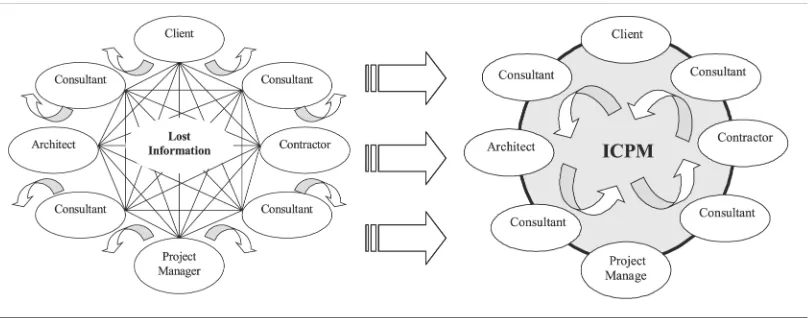
If current levels of international research activities are any guide, improved information sharing and increased use of innovative ICT tools and Internet-based construction project management (ICPM) systems are seen by many industry members as a potential solution to ensure large improvements in the communication efficiency, productivity and overall industry quality (Howell, 1996). By electronically linking and transferring the vast volumes of project related data (created; transmitted; and archived), to and from dispersedly located project participants (clients, architects, contractors, consultants, etc.), will potentially: allow seamless collaboration between project consortiums; promote rapid resolution of ongoing project issues; and reduce the need for unnecessary travel time and cost overruns. Additionally, project communication and information “leaks”, losses or misplacements would be kept to an absolute minimum and all
members of the project consortia would be in possession of the most up-to-date and accurate project information (Figure 1).
Online Remote Construction
Management (ORCM) research project In an attempt to bring the unique talents of various construction industry project participants together in a more productive and integrated manner, the ORCM project
commenced in July 1999 – proposing to test, field trial and evaluate the implementation of two ICPM systems on four case study projects (CS 1-4) over a two-year period –
demonstrating leadership in facilitating the use of online technologies for the design, management and construction of
geographically dispersed building and civil construction projects. Unfortunately, regardless of ICTs (via the Web) being perceived by many as being convenient, inexpensive, and fast, it cannot be
conclusively determined whether the Web influenced the nature of communications between the project participants or not.
ICT tools and ICPM systems investigated The “projectCentre” ICPM system had been used on three of the four CS projects (CS1-3) – i.e. for all project related communications, from design through to end of construction phase – whereas on the fourth CS project (CS4) the “eProject” ICPM system was used. Research activities concentrated on
“projectCentre” and “eProject” communications originating from and directed to the various CS1-4 participants involved on each project. To follow, a brief description of these two ICPM systems: (1) “projectCentre” (projectCentre, 2001) is
a “project Web portal” for construction industry projects. A Web browser is all that is required by the CS project teams to gain access to, or transmit project documents from any location where Internet services are provided. There is no need for the purchase or installation of software nor the download of plug-ins, applets, “Java runtime environments”, or anything else to use projectCentre. There is, however, a set-up cost and weekly usage charge to be covered by the project team. Within projectCentre, there is a public area where the general public can review “project newsletters”, “sales information”, and any other information the project team wish to make public. A password is required for members of the CS project teams to access most of the features of projectCentre. CS project team members send, receive and manage correspondence, requests for
document management system and bureau printing services on-line. Printed project documents can be ordered on-line and delivered to one or more project team offices or on-site through a network of printing services.
(2) “eProject” (eProject, 2001) is an ICPM information and communication system developed by Project Services (a commercialised business unit of the QDPW) and made up of six electronically linked components:
. Client briefing. Once the project team is
established and given the appropriate access to the eProject system, the client brief is created on a computer and emailed to Project Services to be stored electronically. Any members of the project team or other interested parties with approved security access can view the brief. The latest and most up-to-date brief is the only one available on the system.
. Design and documentation. As
communication is electronic (no paper documents), documents can only advance through edit, review, issue and tender stage with the appropriate authorisation of the board. Members of the same discipline team (such as architects) can only view a document in the edit stage. Once the document has left the edit stage, all members of the project team as well as other authorised people can view it.
. Document viewing and publication.
Clients wishing to access and/or view documentation can do so using only one of the following software plug-ins – i.e. Structure Format or Computer Graphics Metafile – freely available from the Web. In the paper-based
system, sections and details of a building are shown on two separate drawings. eProject eliminates this duplication and uses layering to include the same drawing for both. To view details, the relevant part of the document is magnified and the appropriate notes are displayed. Efficient and environmentally
responsible, eProject has the potential to substantially reduce the number of drawings for a project. Specifications, graphics and construction
photographs are stored and viewed in the same way.
. Tender box.Once the documents are
created, a pre-selected list of contractors has the necessary access and information to begin pricing work so that the tender period is virtually eliminated. Questions and queries are addressed throughout the
documentation period. The tender and even prices are securely lodged electronically. The system complies with the appropriate Australian standard code of tendering and even addresses the possibility of bids arriving late due to systems failure.
. Contract administration. All
correspondence is handled via e-mail with the master file kept on project services” server and is accessible through the project Web site – no need for excessive paper files. Document transmission takes just minutes and there is no loss of quality, no matter where it is sent.
. Electronic plan room. Once the project is
[image:3.595.98.503.83.242.2]completed, all documentation of plans must be securely kept for future reference. eProject archives the entire
file in the plan room. It is immediately accessible 24 hours a day, seven days a week to any one with approved access. There is no loss of quality or integrity with additions and alterations
automatically updated.
Research tools used
Quantifiable research was required to identify certain statistical data pertaining to the implementation (drivers, barriers, etc.) and use (user-friendliness, etc.) of the
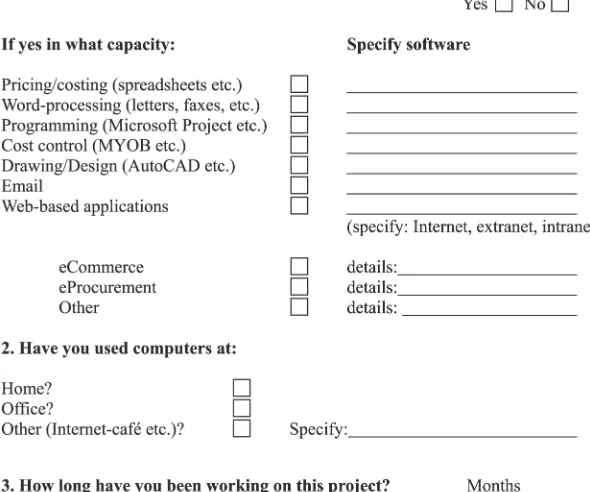
projectCentre and eProject ICPM systems on the four CS projects. To achieve this, the ORCM information technology (IT) analysis survey (Appendix 1) was administered on all four ORCM CS projects. In addition to this quantitative survey, research and analysis was required of a more qualitative nature. As a result the ORCM second questionnaire (Appendix 2) was introduced to determine “descriptive” levels of “impact” CS1-4 project participants perceived the implementation of an ICT tool or ICPM communication system (projectCentre and eProject) had on their project. The design, construction and scoring of both these research tools are examined in the following sections.
ORCM research methods
Selection of ORCM case study (CS) projects
ORCM CS projects went through a “simple” selection process. The Queensland
Department of Main Roads (QDMR), Queensland Department of Public Works (QDPW) and two private industry partners helped ORCM researchers identify four truly remote CS (CS1, 2, 3 and 4) building and/or civil construction projects, and authorised access to their organisations; project team members; project data; etc. These
geographically dispersed projects were valued between AUS$1.5 and AUS$8 million; and their contract periods (from inception to completion) ranged between 26 and 48 weeks.
Collection of data
CS1-4 project participants, who made use of the ProjectCentre and eProject systems, completed the ORCM IT analysis survey and the ORCM 2nd questionnaire. Both research
instruments were sent to project participants via e-mail, fax, or hand delivered, and once completed (filled in), they were returned (using the same medium) to the ORCM research team for analysis.
ORCM IT analysis survey
Survey design
The Acton Peninsula Development,
comprising of the National Museum and the Australian Institute of Aboriginal and Torres Strait Islander Studies, was the first major building development project in Australia that was awarded on the basis of a joint alliance contract. As part of a major research project surrounding the Acton Peninsula
Development, researchers developed a framework for reporting on lessons learned about the application of IT on the project. ORCM researcher received permission from theInformation Technology Analysis Framework for Acton Peninsular Projectpublication authors (Tuckeret al., 2000) to adapt and use it on CS1-4 to evaluate the implementation of the two ICPM systems (projectCentre and eProject), as well as identify any benefits, advantages and barriers to their
implementation.
Survey construction
The ORCM IT analysis survey (Appendix 1) consisted of two main sections. In the first section, ORCM researchers asked CS1-4 project participants to provide a general background to their role in the CS project as well as provide a record, if any, of past and/or existing levels of IT “exposure” and/or experience on projects. The second section of the survey specifically examined the
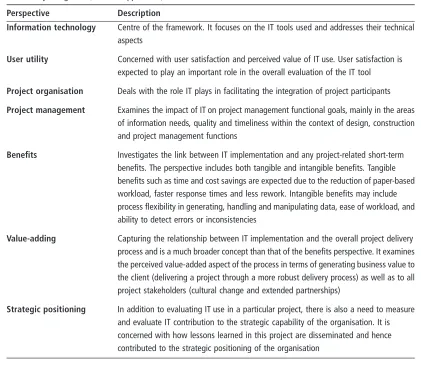
implementation of projectCentre (CS1-3) and eProject (CS4) from seven different but inter-connected perspectives (Figure 2 and Table I).
Survey scoring
CS1-4 project participants were asked to score each of the above seven perspectives, by choosing a number between 1 and 5 for each pre-weighted criteria. A score of 1 was regarded as being the lowest and 5 the highest score obtainable for any criteria within each perspective. All the scores were then
project participant’s overall level of
satisfaction for each perspective in relation to the ICPM information and communication system (projectCentre and eProject). Finally, CS1-4 results were “ranked” and assessed (see Tables II-VI).
[image:5.595.103.505.87.308.2]All responses, ratings, comments and suggestions made by the CS1-4 project participants were collected, analysed and assessed in accordance with the framework proposed in the ORCM (Kajewskiet al., 2000).
Table IKey to Figure 2 (see also Appendix 1)
Perspective Description
Information technology Centre of the framework. It focuses on the IT tools used and addresses their technical aspects
User utility Concerned with user satisfaction and perceived value of IT use. User satisfaction is expected to play an important role in the overall evaluation of the IT tool
Project organisation Deals with the role IT plays in facilitating the integration of project participants
Project management Examines the impact of IT on project management functional goals, mainly in the areas of information needs, quality and timeliness within the context of design, construction and project management functions
Benefits Investigates the link between IT implementation and any project-related short-term benefits. The perspective includes both tangible and intangible benefits. Tangible benefits such as time and cost savings are expected due to the reduction of paper-based workload, faster response times and less rework. Intangible benefits may include process flexibility in generating, handling and manipulating data, ease of workload, and ability to detect errors or inconsistencies
Value-adding Capturing the relationship between IT implementation and the overall project delivery process and is a much broader concept than that of the benefits perspective. It examines the perceived value-added aspect of the process in terms of generating business value to the client (delivering a project through a more robust delivery process) as well as to all project stakeholders (cultural change and extended partnerships)
[image:5.595.87.508.342.708.2]Strategic positioning In addition to evaluating IT use in a particular project, there is also a need to measure and evaluate IT contribution to the strategic capability of the organisation. It is concerned with how lessons learned in this project are disseminated and hence contributed to the strategic positioning of the organisation
ORCM 2nd questionnaire
Questionnaire design
ORCM researchers and committee members received permission to modify the original 15 questions developed by QDMR and then ask CS1-4 project participants and or users of projectCentre and eProject to respond to the adapted 15 “qualitative” questions of the ORCM 2nd questionnaire (Appendix 2).
Questionnaire construction
The 15 questions were open ended so that the researcher could fully understand, validate, clarify, and illustrate the meaning (“who”, “how” and “why”) and step-by-step development of specific ICT adoption phenomena, trends, events, barriers, beliefs, and occurrences. Interviews were conducted on a one-on-one basis to help build a level of “trust” and overcome any initial “barriers” or “scepticism” that may have existed between the interviewer (ORCM researcher) and interviewee (project team member).
Questionnaire scoring
From CS1-4 project participant responses, ORCM researchers were able to identify various “qualitative” perceptions (from an end-user perspective) pertaining to the implementation and use of the projectCentre and eProject ICPM communication systems. These helped develop the “ORCM best practice guidelines”, which can be viewed in the “Discussion” section of this paper.
ORCM research analysis results
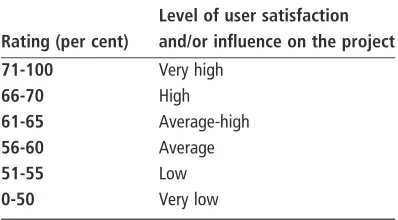
[image:6.595.307.565.87.237.2] [image:6.595.93.292.88.198.2]In the following sections, the “Levels of user satisfaction and/or influence on the project” for each of the seven perspectives (Tables III-VI) is governed by Table II.
Table IILevels of user satisfaction
Rating (per cent)
Level of user satisfaction and/or influence on the project
71-100 Very high
66-70 High
61-65 Average-high
56-60 Average
51-55 Low
[image:6.595.30.296.251.399.2]0-50 Very low
Table IIICS1 (projectCentre): ranking of seven perspectives
Ranking Perspective
Rating (per cent)
Level of user satisfaction and/or influence on the project
1st Information technology 68 High (highest) 2nd Project management 62 Average-high
3rd User utility 58 Average
4th Strategic positioning 56 Average
5th Value-adding 55 Low
6th Project organisation 53 Low
7th Benefits 52 Low (lowest)
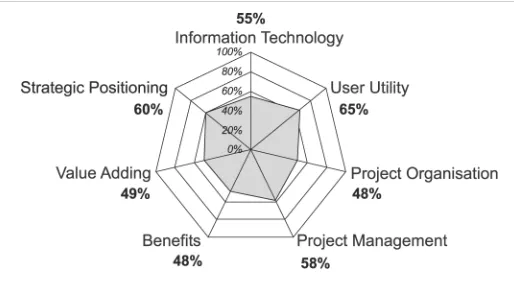
Table IVCS2 (projectCentre): ranking of seven perspectives
Ranking Perspective
Rating (per cent)
Level of user satisfaction and/or influence on the project
1st User utility 65 Average-high (highest) 2nd Strategic positioning 60 Average
3rd Project management 58 Average 4th Information technology 55 Low
5th Value-adding 49 Very low
6th Benefits and project
[image:6.595.31.292.447.597.2]organisation 48 Very low (lowest)
Table VCS3 (projectCentre): ranking of seven perspectives
Ranking Perspective
Rating (per cent)
Level of user satisfaction and/or influence on the project
1st Information technology 67 High (highest) 2nd Project management 65 Average-high 3rd Strategic positioning 64 Average-high
4th User utility 59 Average
5th Value-adding and;
benefits 55 Low
[image:6.595.31.297.651.799.2]6th Project organisation 52 Low (lowest)
Table VICS4 (projectCentre): ranking of seven perspectives
Ranking Perspective
Rating (per cent)
Level of user satisfaction and/or influence on the project
1st Strategic positioning 80 Very high (highest) 2nd Project organisation 78 Very high 3rd Project management 77 Very high
4th Value-adding 73 Very high
5th Information technology 68 High
6th Benefits 67 High
Unfortunately, due to the unavailability of certain CS1-4 project participants, and research time constraints, not all of the project participants were able to complete the ORCM IT analysis survey and the 2nd ORCM questionnaire. Furthermore, the lack of CS1-4 project participants” commitment in using the ICPM systems (projectCentre and eProject) resulted in an incomplete set of data for analysis. Therefore the following results, recommendations; and actual performances of projects are inconclusive, and additional (outstanding) data may well yield significantly different outcomes, yet CS project
participants experienced positive results using the two ICPM solutions across all four CS projects.
ORCM IT analysis survey results
CS1 results
Referring to Figure 3 and Table III, CS1 project participants rated projectCentre’s “information technology” perspectives the highest (68 per cent), i.e. projectCentre’s reliability, secureness (authorised use), user-friendliness, appropriateness for the application, and suitability for site conditions. Conversely, the link between projectCentre’s implementation and any project-related short-term benefits (tangible and intangible) was rated the lowest (52 per cent), indicating project participants were not entirely
convinced with projectCentre’s ability to:
. save time (processing, responding, etc.); . save cost (rework, travelling, overheads,
etc.);
. improve documentation quality; . and decrease design errors and requests
for information (RFIs).
CS2 results
Figure 4 and Table IV show that CS2 project participants rated the “user utility”
perspective of projectCentre the highest (65 per cent), based on level and frequency of: IT tool used most; training provided; technical support provided; as well as accuracy and quality of the tool/system output. Yet, the link between projectCentre’s implementation and any project-related short-term benefits (tangible and intangible) and the role projectCentre played in facilitating the integration of CS2 project participants (“project organisation” perspective) was given the lowest rating (48 per cent), therefore indicating that CS2 project participants were not entirely convinced with projectCentre’s ability to:
. save time; save cost;
. improve documentation quality; . decrease number of design errors and
RFIs;
. enhance coordination between project
participants;
. reduce response time to answer queries; . establish and support the project team; or . empower participants to make
decisions.
CS3 results
Similar to CS1, CS3 project participants rated projectCentre’s “information
technology” perspectives the highest (67 per cent), yet rated the role projectCentre played in facilitating the integration of project participants the lowest (52 per cent), i.e. believing the use and implementation of projectCentre on the project did not significantly:
. enhance coordination between project
participants;
. reduce response time to answer queries; . establish and support the project team; . or empower participants to make
[image:7.595.305.562.84.226.2]decisions (Figure 5 and Table V).
Figure 3CS1 (projectCentre): seven perspectives compared
[image:7.595.34.292.660.796.2]CS4 results
Based on ratings presented in Figure 6 and Table VI, the use of eProject on the CS4 project, in relation to its contribution to the “strategic capability” and project activities of the organisation, received the highest rating (80 per cent) from its participants, i.e. in terms of eProject’s ability to:
. enhance the organisation’s image in the
industry;
. attract more sophisticated clients; and . increase the capability for global
co-operation.
On the other hand, the level of user
satisfaction and perceived “value” of eProject was given the lowest rating (65 per cent), i.e. the extent to which eProject helped its user do his or her job more efficiently and
effectively.
ORCM 2nd questionnaire results As previously stated, responses from CS1-4 project participant made it possible for ORCM researchers to identify certain “qualitative” issues, limitation or process gaps experienced (not expanded upon in this paper) during the implementation and use of projectCentre and eProject on the four CS projects, which helped “flesh out” the following “ORCM best practice guidelines”.
Discussion – ORCM best practice
guidelines
Through the implementation and analyses of: a qualitative questionnaire (ORCM 2nd questionnaire); a quantitative survey (ORCM IT analysis survey); and by way of additional and extensive benchmarking activities carried out in accordance with theORCM Benchmark Methodology Report(Weippertet al., 2000) (not discussed in this paper), the ORCM research team were able to identify the following “ORCM best practice guidelines” (Figure 7), deemed critical in helping ensure successful implementation of ICT tools and/ or ICPM communication systems (similar to projectCentre and eProject) on current and future geographically dispersed (remote) civil and building construction projects:
The key to Figure 7 is as follows:
(1) One system.Project participants want to learn to use only one ICT tool or ICPM system for ease of understanding its capabilities, etc. (one project – one team – one system):
. System compatibility. The capabilities
and functionality have to be compatible with most other ICT products and ICPM systems used in the industry, potentially saving overall implementation time, cost, labour, errors, etc. Application of an ICPM system must not be a “black box” of information processing.
. Ease of data entry.Commonality of an
ICPM system’s access features and
Figure 6CS4 (eProject): seven perspectives compared
Figure 7ORCM best practice recommendations for ICT and ICPM system implementation (see text for key)
ease of data entry is most important. Free access to downloadable and compatible readers and “plug-ins” for common access to data must be provided by ICT tool and ICPM communication system developers. Either there is one industry/client wide system or there is a common user interface.
. Fully-resourced implementation.
Trialling an ICPM system (that has not had much exposure to industry participants) should be treated as a “special case” with proper backing, support and experience from developers, implementers and researchers, i.e. a new ICT system should be fully resourced to ensure that all aspects are covered during the early stages of its implementation (e.g. reliability, capability, etc. of essential project communications).
(2) End-user – prime focus.The end-user is a key factor in gaining advantage from an ICPM system. Taking only the type or potential advantages, capabilities, etc. of a newly developed ICT tool or ICPM communication system into
consideration is not enough during implementation. End-user needs, expectations, requirements,
recommendations, comments, etc. must be a prime focus:
. User v. quality and accuracy.The
quality and accuracy of any project related communication or information (electronic or paper based) is directly dependant on the user or creator of that piece of information or
correspondence (with or without an ICT tool) – technology alone is not enough to guarantee improved quality and accuracy of project related communications.
. Trust.Implementing a new ICT
product or ICPM communication system must create a feeling of trust (reliability, relevance, need, etc.) for potential users.
. Designed for the construction industry by
the construction industry.Whilst developing a new ICT product or ICPM system, the end-users must be involved from the beginning to ensure a greater chance of successful
ICT uptake.
(3) Training.Training in the use of a new ICPM system is essential. This includes continuous access to a telephonic or online “Help desk”, regular onsite demonstrations and “refresher” training sessions to ensure continuous learning and understanding of what the system is capable of, as well as recognising and accepting its limitations.
(4) Commitment.All project participants and stakeholders need to be fully committed to using the new ICT tool or ICPM communication system, with “buy in” and collaboration at the highest level within participating companies, thereby reassuring and guaranteeing potential users of a “corporate commitment”:
. IT driver.Every project should have a
“driver” of ICT uptake
(superintendent or equivalent), encouraging, supporting and
monitoring its application and its use throughout all phases of a project.
. Legal issues.ORCM “best practice
recommendations” are susceptible to the current legal status regarding electronic transmissions, the use of electronic signatures, etc.
Commitment by both government and industry sectors is required to help develop more innovative strategies to build a stronger and more competitive construction industry. ORCM
committee members and their
organisations have sought legal advice regarding the use of electronic communications on both public and private sector projects. These legal investigations are aimed at
strengthening organisational and individual legal status when utilising electronic transactions or
communications on building and civil projects. With the introduction of an
Electronic Transactions Act(Office of Legislative Drafting, 2001), current legal issues are likely to be
strengthened when making use of electronic communications on projects and provide better management of risks such as:
– Integrity.Whether or not the communication received is the same as that sent – has it been altered either in transmission or in storage? – Confidentiality.Controlling the
disclosure of and access to the information contained in the communication.
– Matters of evidence.This concerns e-communications meeting current evidentiary requirements in a court of law, for example, a handwritten signature.
– Matters of jurisdiction.The electronic environment has no physical boundaries, unlike the physical or geographical boundaries of an individual state or country. This means that it may be uncertain which State’s or country’s laws will govern legal disputes about
information placed on the Internet, or about commercial transactions made over the Internet.
Conclusion
This paper attempts to demonstrate the need to facilitate the use of ICPM and ICT for the design, management and construction of geographically dispersed (remote) building and civil construction projects. In general, the outcomes of the ORCM research project were unfortunately not able to be determined quantifiably. Whilst the use of innovative ICPM solutions (projectCentre and eProject) were perceived by many as being convenient, inexpensive, and fast, no matter the distance between team members, it cannot be conclusively determined (from the data collected) whether these Web-based IT solutions positively influenced the nature of communications between the project participants or not.
Nevertheless, project participants experienced positive results using the two ICPM solutions across all four CS projects. These were then recorded, analysed and documented by ORCM researchers in the form of four individual ORCM case study reports and an ORCM consolidated report
discussing case study results, findings and recommendations in much greater depth.
For the purpose of this paper, the ORCM “best practice guidelines” help reinforce the need for further research and development (R&D) of: innovative ICT tools and ICPM communication systems; identifying ways to overcome industry cultural “barriers” and “modifying” traditional work “habits”; and identifying improved implementation procedures and application opportunities within the construction industry.
Future research activities, similar to the ORCM project, will help enrich current levels of ICT and ICPM system knowledge, awareness and skills of all industry
stakeholders, inevitably resulting in a major social impact that will integrate the world of construction in a way that we have never experienced before.
References
Office of Legislative Drafting (2001), Act No. 162 of 1999, prepared on 22 August 2001, Attorney General’s Department, Canberra, available at: http://scaletext. law.gov.au/
eProject (2001), available at: http://eproject. projectservices.qld.gov.au/
Fujitsu Centre (1998),Information Technology in the Building and Construction Industry: Current Status and Future Directions, A Report for the National Building and Construction Committee Department of Industry, Science and Resources, Australian Graduate School of Management and Building Research Centre, August, Faculty of the Built Environment, University of New South Wales. Howell, I. (1996), “The need for interoperability in the
construction industry”,Proceedings of the InCIT 96 International Construction Information Technology Conference, Sydney, April.
Kajewski, S., Weippert, A. and Tilley, P. (2000),Online Remote Construction Management (ORCM), QUT, Brisbane.
Love, E.D. and MacSporran, C. (1996), “The use of information technology by Australian construction contractors”,The Chartered Building Professional, June.
projectCentre (2001), available at: www.projectcentre.net/ Tucker, S.N., Mohamed, S. and Ambrose, M.D. (2000),
Information Technology Analysis Framework for Acton Peninsular Project, Report for Department of Industry, Science and Resources, CSIRO and QUT. Weippert, A., Kajewski, S. and Tilley, P.A. (2000),Online