
Numerical modelling of deformation and fluid flow in hydrothermal systems
23
0
0
Full text
(2) .. Numerical Modelling of Deformation and Fluid Flow in Hydrothermal Systems. Thesis submitted by John George McLellan B.Sc. (Hons.1st class, JCU) October 2004. for the degree of Doctor of Philosophy in the Department of Earth Sciences James Cook University, North Queensland.
(3) John G McLellan. PhD Thesis 2004. STATEMENT OF ACCESS. I, the undersigned, author of this work, understand that James Cook University will make this thesis available for use within the University Library and, via the Australian Digital Theses network, for use elsewhere.. All users consulting this thesis will have to sign the following statement: “In consulting this thesis I agree not to copy or closely paraphrase it in whole Or in part without the written consent of the author; and to make proper public written acknowledgment for any assistance that I have obtained from it.”. I understand that, as an unpublished work, a thesis has significant protection under the Copyright Act and;. I wish this work to be embargoed until: 1st October 2005. _________________________. ______________. Signature. Date. i.
(4) John G McLellan. PhD Thesis 2004. STATEMENT OF SOURCES. DECLARATION. I declare that this thesis is my own work and has not been submitted in any form for another degree or diploma at any university or other institution of tertiary education. Information derived from the published or unpublished work of others has been acknowledged in the text and a list of references is given.. _________________________. ______________. Signature. Date. ii.
(5) John G McLellan. PhD Thesis 2004. STATEMENT OF CONTRIBUTIONS. General contributions towards this study have included: •. Australian Post Graduate Award (APA) scholarship. •. pmd*CRC top-up scholarship. •. pmd*CRC educational and training fund. •. ARC large grant to Oliver & Dickens, financial support towards Chapter 3. Contributions from others towards this thesis have been clearly stated at the forefront of each chapter where applicable, and these people and their contributions to this study include the following:. Chapter 3:. P.M. Schaubs – assistance with computer codes relating to the FISH functions for FLAC. Chapter 4:. L.Feltrin – 3D Modelling of the Century Deposit and text including the following contribution: 20% (p. 88-103), 50% (p. 67-77, 103106), and 80% (p. 88-103). Chapter 6:. N.H.S. Oliver – Conceptual ideas for this chapter, background research and text including the following: 90% (p. 147-153), and 10% (p. 153-163). And normal supervisory conditions throughout the course of this study by N.H.S. Oliver. iii.
(6) John G McLellan. PhD Thesis 2004. AKNOWLEDGEMENTS. I would like to thank my principal supervisor, Nick Oliver for his enthusiasm, dedication and patience in this project. I thank him for his assistance and his willingness to discuss many aspects of this work, and also many suggestions that helped improve this thesis. I also thank my external supervisor Alison Ord (CSIRO) for discussions and problem solving in relation to the modelling work carried out. I would also like to thank Bruce Hobbs and the team at CSIRO Exploration and Mining (Computational Geoscience) for giving me feedback on many problems I encountered along the way, and a special note of thanks to Mike Coulthard for prompt assistance from ITASCA.. Many thanks go out to all who participated in discussions during the course of this study and some of these people include (in alphabetical order): Tom Blenkinsop, Matt Brown, James Cleverley, Leonardo Feltrin, Damien Foster, Jeff Loughran, Geordie Mark, Lucas Marshall, Roger Mustard, Peter Schaubs, Adam Webb and Yanhua Zhang. A special note of thanks goes out to all of the members of the pmd*CRC for encouragement and discussion at conferences and annual reviews.. Finally I would most like to thank my family and friends, for being who they are, and for helping me become the person I am. I am eternally grateful.. iv.
(7) John G McLellan. PhD Thesis 2004. Abstract Geomechanical processes involved in mineralisation of several Australian deposits were tested using both continuous and discontinuous modelling techniques. Numerical modelling using both the finite difference method and discrete element method, were carried out by firstly devising conceptual models. This also allowed rigorous sensitivity testing of many input parameters throughout the modelling procedure. Fully coupled deformation and fluid flow modelling was applied to investigate and establish the influence of topography, structure and extension on porous media fluid flow. Iron ore genesis in the Hamersley Province, W.A., has been a contentious genetic issue for many years, with several ore genesis models proposed. Modelling results from this study confirm the mechanical feasibility of focusing both surface and basinal derived fluids towards sites of iron ore genesis during Proterozoic orogenic collapse, providing upward and downward migration of (reduced and oxidised) fluids during deformation, and allowing infiltration of banded iron formations and consequent silica loss during permeability increase, resulting in favourable conditions for ore genesis. Extension and contractional models of potential scenarios of ore emplacement at the Century Zn-Pb-Ag deposit in northwest Queensland were tested by a combination of 3-D structural modelling and fully coupled fluid flow models. Three conceptual models were devised, and two of these were fully tested by numerical simulations (diagenetic and epigenetic), the other (syngenetic) by Geological Computer Aided Design (GoCad). Reconstruction of the 3-D structural model displayed thickness and grade relationships to NE trending growth faults, providing evidence that supports a syngenetic model of. v.
(8) John G McLellan. PhD Thesis 2004. emplacement. Numerical models provide clear evidence that stratiform Zn-Pb mineralisation is difficult to achieve in subsurface conditions, due to the low permeability of shale units. During contractional deformation, modelling results suggest that it would most probably result in fault or vein style mineralisation at the Century deposit, due to the proximal nature of fluid focussing relative to the faults. The Eastern Succession of the Mt Isa Inlier is a mineral rich region, with many large deposits such as Cannington Pb-Zn-Ag, Osborne Cu-Au, and Slewyn CuAu. This area has been the focus of mineral exploration for some years, and evaluating the prospectivity of this region is one of the current goals of the pmd*CRC. Stress partitioning in this region, during the Isan Orogeny, may have played a vital role in determining the locations of mineral deposits as a result of failure and fluid flow. Discrete element modelling of the Eastern Succession provides strong correlations with known ore deposits and prospects, particularly in the Selwyn region, and also provides several testable targets. Comparisons of these results correspond well with other current prospectivity analysis of the region. The results indicate that mineralising fluids were preferentially focussed into zones of anomalous stress in and around fault zone bends and intersections, and intrusive metasediment contacts. Furthermore the optimum far-field stress that provides the best correlation with known deposit distribution was orientated E/SE rather that E/W, suggesting a component of regional transpression late in the 1600 – 1500 Ma Isan Orogeny. Extension related mineralisation is commonly linked to near surface fluids penetrating into deeper parts of the crust and possible fluid mixing occuring. The general mechanics of extensional faulting are fairly well understood at a. vi.
(9) John G McLellan. PhD Thesis 2004. range of scales, and many models have been proposed. Hydrodynamic models, however, are considerably fewer. This study applied fully coupled deformation and fluid flow numerical models to test the role of extensional deformation and its effects on fluid flow, particularly at basement-cover interfaces. Large contrasts in the permeability of the basement and cover restrict fluid exchange between these two units, unless permeable faults or shear zones are present. Downward migration of fluids is a natural consequence of the extension of dilatant materials where strain rates are high. Rapid decreases in pore pressure, as a result of dilation and failure, may provide mechanisms for mass transfer across basement cover interfaces.. vii.
(10) John G McLellan. PhD Thesis 2004. TABLE OF CONTENTS •. Title page. •. Statement of Access. •. Statement of Sources. •. Statement of Contributions. •. Acknowledgements. •. Abstract. •. Table of Contents. •. List of Figures. •. List of Tables. •. List of Symbols. SECTION A Chapter 1: Introduction 1.1 1.2 1.3 1.4. General Introduction Numerical Modelling Applications Aims & Objectives Thesis Outline 1.4.1 Section A 1.4.2 Section B. Chapter 2: Numerical Modelling 2.1 Introduction 2.2 Theoretical Background 2.2.1 General mechanical Relationships 2.2.2 Elastic-Plastic Behaviour 2.2.2.1 Elasticity 2.2.2.2 Plasticity 2.2.3 Constitutive Models 2.2.4 Porous Media & Fluid Flow 2.2.5 Fluid Behaviour & Discrete Fractures 2.3 Modelling Process 2.3.1 Numerical Procedure 2.4 Modelling Approaches & Software 2.4.1 Continuum & Discontinuum Methods 2.4.2 FLAC 2.4.3 UDEC. …………. p.. 1. ………… ………… ………… ………… ………… …………. p.. 2. p. p.. 3 3. p. p.. 4 4. p.. 6. …………. p.. 7. ………… ………… ………… ………… ………… ………… ………… ………… ………… ………… ………… ………… ………… ………… …………. p.. 8. p. p.. 9 9. p. p.. 14 16. p. p.. 18 25. p. p.. 26 37. p. p.. 40 41. p. p.. 44 44. p. p.. 45 48. viii.
(11) John G McLellan. Chapter 3: Hamersley Province. 3.1 3.2. 3.3. 3.4. 3.5. 3.5. Abstract Introduction Hamersley Province 3.2.1 Structural History 3.2.2 Ore Genesis Models & Fluid Flow History Theoretical Background / Mechanical Modelling 3.3.1 Finite Difference Code 3.3.2 Mechanical Relationships 3.3.3 Fluid Flow Theory 3.3.4 Deformation & Fluid Flow Coupling Boundary Conditions & Model Parameters 3.4.1 General Conditions 3.4.2 Hamersley Specific Models Model Results 3.5.1 Model 1 3.5.2 Model 2 3.5.3 Model 3 3.5.4 Model 4 3.5.5 Model 5 3.5.6 Model 6 Discussion & Conclusions. Chapter 4: Century Deposit. 4.1 4.2. 4.3. 4.4. 4.5 4.6 4.7. Acknowledgements Abstract Introduction Tectonic Evolution & Stratigraphic Subdivisions 4.2.1 The Mount Isa Inlier 4.2.2 The Western Fold Belt 4.2.3 Stratigraphy of the Lawn Hill Formation Century Deposit 4.3.1 Sulphide Textures 4.3.2 Ore Zone Stratigraphy Introduction to 3D Structural Modelling 4.4.1 GoCad 4.4.2 Initial Steps to Construct a 3D Model 4.4.3 Data Acquired to Construct a 3D Model 4.4.4 3D Model Components 4.4.5 3D Modelling Results Century Ore Genesis Deformation & Fluid Flow Numerical Modelling 4.7.1 FLAC. PhD Thesis 2004. …………. p.. 51. ………… ………… ………… ………… ………… ………… ………… ………… ………… ………… ………… ………… ………… ………… ………… ………… ………… ………… ………… ………… …………. p.. 52. p. p.. 53 57. p. p.. 58 60. p. p.. 62 62. p. p.. 63 64. p. p.. 65 66. p. p.. 66 69. p. p.. 72 72. p. p.. 73 74. p. p.. 75 77. p. p.. 79 81. …………. p.. 85. ………… ………… ………… ………… ………… ………… ………… ………… ………… ………… ………… ………… ………… ………… ………… ………… ………… ………… ………… …………. p. p.. 86 87. p. p.. 88 93. p. p.. 93 96. p. p.. 99 104. p. p.. 104 105. p. p.. 108 109. p. p.. 111 112. p. p.. 112 113. p. p.. 120 126. p. p.. 128 129. ix.
(12) John G McLellan. 4.7.2 Sensitivity of Strain Rates 4.7.3 Conceptual Models 4.7.4 Conceptual Model 1 4.7.5 Conceptual Model 2 4.8 Results 4.8.1 Model 1a 4.8.2 Model 1b 4.8.3 Model 2a 4.8.4 Model 2b 4.8.5 Model 2c 4.8.6 Model 2d 4.9 Discussion & Conclusions. Chapter 5: Eastern Succession Abstract 5.1 General Introduction 5.2 Background Geology 5.2.1 Mount Isa Block 5.2.2 Eastern Fold Belt 5.2.3 Intrusive History 5.2.4 Tectonic History & Metallogenesis 5.2.5 Prospectivity 5.3 Conceptual Models 5.3.1 Methodology & Conceptual Models 5.4 Numerical Modelling 5.4.1 Modelling Approach 5.4.2 UDEC 5.4.3 Sensitivity Analysis 5.4.4 Boundary Conditions & Model Parameters 5.5 Results Model 1 5.5.1 Model 1a 5.5.2 Model 1b 5.5.3 Model 1c 5.5.4 Model 1d 5.6 Results Model 2 5.6.1 Model 2a 5.6.2 Model 2b 5.6.3 Model 2c 5.6.4 Model 2d 5.6.5 Aperture & Fluid Flow Behaviour 5.6.6 Prospectivity & Mineralisation 5.7 Discussions & Conclusions. PhD Thesis 2004. ………… ………… ………… ………… ………… ………… ………… ………… ………… ………… ………… …………. p. p.. 129 131. p. p.. 133 135. p. p.. 136 136. p. p.. 139 141. p. p.. 143 145. p. p.. 151 155. …………. p.. 160. ………… ………… ………… ………… ………… ………… ………… ………… ………… ………… ………… ………… ………… ………… ………… ………… ………… ………… ………… ………… ………… ………… ………… ………… ………… ………… ………… …………. p. p.. 161 162. p. p.. 163 163. p. p.. 166 168. p. p.. 169 173. p. p.. 173 174. p. p.. 179 179. p. p.. 180 181. p. p.. 186 189. p. p.. 190 195. p. p.. 200 205. p. p.. 210 210. p. p.. 216 220. p. p.. 226 231. p. p.. 236 243. x.
(13) John G McLellan. Chapter 6: Extension. 6.1 6.2 6.3 6.4 6.5 6.6. 6.7. Acknowledgements Abstract Introduction Geological Context Numerical Modelling Extension and Basin Formation Conceptual Models Results 6.6.1 Model 1a 6.6.2 Model 1b 6.6.3 Model 2a 6.6.4 Model 2b 6.6.5 Model 2c 6.6.6 Model 2d 6.6.7 Strain Rate Variations Discussion & Conclusions. References. PhD Thesis 2004. …………. p.. 247. ………… ………… ………… ………… ………… ………… ………… ………… ………… ………… ………… ………… ………… ………… ………… …………. p.. 248. p. p.. 249 251. p. p.. 252 256. p. p.. 258 258. p. p.. 260 260. p. p.. 262 265. p. p.. 268 271. p. p.. 274 278. p.. 280. …………. p.. 284. SECTION B Appendix 1 – FLAC numerical code …………………………. Appendix 2 – UDEC numerical code …………………………. A1 – A86 A87 – A131. xi.
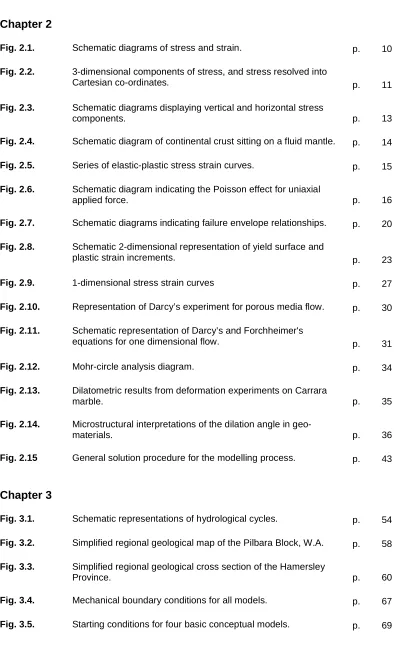
(14) John G McLellan. PhD Thesis 2004. LIST OF FIGURES Chapter 2 Fig. 2.1.. Schematic diagrams of stress and strain.. p.. 10. Fig. 2.2.. 3-dimensional components of stress, and stress resolved into Cartesian co-ordinates.. p.. 11. Fig. 2.3.. Schematic diagrams displaying vertical and horizontal stress components.. p.. 13. Fig. 2.4.. Schematic diagram of continental crust sitting on a fluid mantle.. p.. 14. Fig. 2.5.. Series of elastic-plastic stress strain curves.. p.. 15. Fig. 2.6.. Schematic diagram indicating the Poisson effect for uniaxial applied force.. p.. 16. Fig. 2.7.. Schematic diagrams indicating failure envelope relationships.. p.. 20. Fig. 2.8.. Schematic 2-dimensional representation of yield surface and plastic strain increments.. p.. 23. Fig. 2.9.. 1-dimensional stress strain curves. p.. 27. Fig. 2.10.. Representation of Darcy’s experiment for porous media flow.. p.. 30. Fig. 2.11.. Schematic representation of Darcy’s and Forchheimer' s equations for one dimensional flow.. p.. 31. Fig. 2.12.. Mohr-circle analysis diagram.. p.. 34. Fig. 2.13.. Dilatometric results from deformation experiments on Carrara marble.. p.. 35. Fig. 2.14.. Microstructural interpretations of the dilation angle in geomaterials.. p.. 36. Fig. 2.15. General solution procedure for the modelling process.. p.. 43. Fig. 3.1.. Schematic representations of hydrological cycles.. p.. 54. Fig. 3.2.. Simplified regional geological map of the Pilbara Block, W.A.. p.. 58. Fig. 3.3.. Simplified regional geological cross section of the Hamersley Province.. p.. 60. Fig. 3.4.. Mechanical boundary conditions for all models.. p.. 67. Fig. 3.5.. Starting conditions for four basic conceptual models.. p.. 69. Chapter 3. xii.
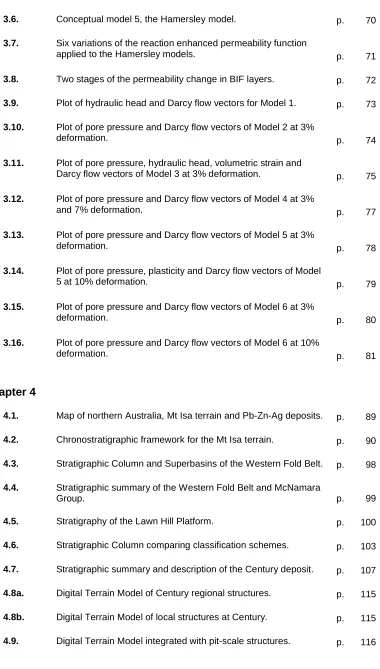
(15) John G McLellan. PhD Thesis 2004. Fig. 3.6.. Conceptual model 5, the Hamersley model.. p.. 70. Fig. 3.7.. Six variations of the reaction enhanced permeability function applied to the Hamersley models.. p.. 71. Fig. 3.8.. Two stages of the permeability change in BIF layers.. p.. 72. Fig. 3.9.. Plot of hydraulic head and Darcy flow vectors for Model 1.. p.. 73. Fig. 3.10.. Plot of pore pressure and Darcy flow vectors of Model 2 at 3% deformation.. p.. 74. Plot of pore pressure, hydraulic head, volumetric strain and Darcy flow vectors of Model 3 at 3% deformation.. p.. 75. Plot of pore pressure and Darcy flow vectors of Model 4 at 3% and 7% deformation.. p.. 77. Plot of pore pressure and Darcy flow vectors of Model 5 at 3% deformation.. p.. 78. Plot of pore pressure, plasticity and Darcy flow vectors of Model 5 at 10% deformation.. p.. 79. Plot of pore pressure and Darcy flow vectors of Model 6 at 3% deformation.. p.. 80. Plot of pore pressure and Darcy flow vectors of Model 6 at 10% deformation.. p.. 81. Fig. 4.1.. Map of northern Australia, Mt Isa terrain and Pb-Zn-Ag deposits.. p.. 89. Fig. 4.2.. Chronostratigraphic framework for the Mt Isa terrain.. p.. 90. Fig. 4.3.. Stratigraphic Column and Superbasins of the Western Fold Belt.. p.. 98. Fig. 4.4.. Stratigraphic summary of the Western Fold Belt and McNamara Group.. p.. 99. Fig. 4.5.. Stratigraphy of the Lawn Hill Platform.. p.. 100. Fig. 4.6.. Stratigraphic Column comparing classification schemes.. p.. 103. Fig. 4.7.. Stratigraphic summary and description of the Century deposit.. p.. 107. Fig. 4.8a.. Digital Terrain Model of Century regional structures.. p.. 115. Fig. 4.8b.. Digital Terrain Model of local structures at Century.. p.. 115. Fig. 4.9.. Digital Terrain Model integrated with pit-scale structures.. p.. 116. Fig. 3.11.. Fig. 3.12.. Fig. 3.13.. Fig. 3.14.. Fig. 3.15.. Fig. 3.16.. Chapter 4. xiii.
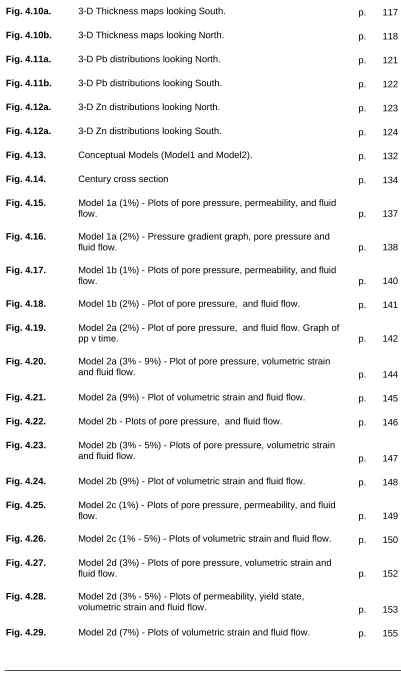
(16) John G McLellan. PhD Thesis 2004. Fig. 4.10a.. 3-D Thickness maps looking South.. p.. 117. Fig. 4.10b.. 3-D Thickness maps looking North.. p.. 118. Fig. 4.11a.. 3-D Pb distributions looking North.. p.. 121. Fig. 4.11b.. 3-D Pb distributions looking South.. p.. 122. Fig. 4.12a.. 3-D Zn distributions looking North.. p.. 123. Fig. 4.12a.. 3-D Zn distributions looking South.. p.. 124. Fig. 4.13.. Conceptual Models (Model1 and Model2).. p.. 132. Fig. 4.14.. Century cross section. p.. 134. Fig. 4.15.. Model 1a (1%) - Plots of pore pressure, permeability, and fluid flow.. p.. 137. Fig. 4.16.. Model 1a (2%) - Pressure gradient graph, pore pressure and fluid flow.. p.. 138. Fig. 4.17.. Model 1b (1%) - Plots of pore pressure, permeability, and fluid flow.. p.. 140. Fig. 4.18.. Model 1b (2%) - Plot of pore pressure, and fluid flow.. p.. 141. Fig. 4.19.. Model 2a (2%) - Plot of pore pressure, and fluid flow. Graph of pp v time.. p.. 142. Fig. 4.20.. Model 2a (3% - 9%) - Plot of pore pressure, volumetric strain and fluid flow.. p.. 144. Fig. 4.21.. Model 2a (9%) - Plot of volumetric strain and fluid flow.. p.. 145. Fig. 4.22.. Model 2b - Plots of pore pressure, and fluid flow.. p.. 146. Fig. 4.23.. Model 2b (3% - 5%) - Plots of pore pressure, volumetric strain and fluid flow.. p.. 147. Fig. 4.24.. Model 2b (9%) - Plot of volumetric strain and fluid flow.. p.. 148. Fig. 4.25.. Model 2c (1%) - Plots of pore pressure, permeability, and fluid flow.. p.. 149. Fig. 4.26.. Model 2c (1% - 5%) - Plots of volumetric strain and fluid flow.. p.. 150. Fig. 4.27.. Model 2d (3%) - Plots of pore pressure, volumetric strain and fluid flow.. p.. 152. Fig. 4.28.. Model 2d (3% - 5%) - Plots of permeability, yield state, volumetric strain and fluid flow.. p.. 153. Model 2d (7%) - Plots of volumetric strain and fluid flow.. p.. 155. Fig. 4.29.. xiv.
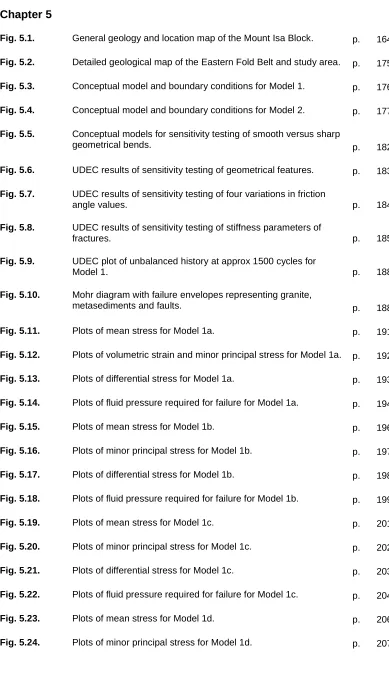
(17) John G McLellan. PhD Thesis 2004. Chapter 5 Fig. 5.1.. General geology and location map of the Mount Isa Block.. p.. 164. Fig. 5.2.. Detailed geological map of the Eastern Fold Belt and study area.. p.. 175. Fig. 5.3.. Conceptual model and boundary conditions for Model 1.. p.. 176. Fig. 5.4.. Conceptual model and boundary conditions for Model 2.. p.. 177. Fig. 5.5.. Conceptual models for sensitivity testing of smooth versus sharp geometrical bends.. p.. 182. Fig. 5.6.. UDEC results of sensitivity testing of geometrical features.. p.. 183. Fig. 5.7.. UDEC results of sensitivity testing of four variations in friction angle values.. p.. 184. Fig. 5.8.. UDEC results of sensitivity testing of stiffness parameters of fractures.. p.. 185. Fig. 5.9.. UDEC plot of unbalanced history at approx 1500 cycles for Model 1.. p.. 188. Fig. 5.10.. Mohr diagram with failure envelopes representing granite, metasediments and faults.. p.. 188. Fig. 5.11.. Plots of mean stress for Model 1a.. p.. 191. Fig. 5.12.. Plots of volumetric strain and minor principal stress for Model 1a.. p.. 192. Fig. 5.13.. Plots of differential stress for Model 1a.. p.. 193. Fig. 5.14.. Plots of fluid pressure required for failure for Model 1a.. p.. 194. Fig. 5.15.. Plots of mean stress for Model 1b.. p.. 196. Fig. 5.16.. Plots of minor principal stress for Model 1b.. p.. 197. Fig. 5.17.. Plots of differential stress for Model 1b.. p.. 198. Fig. 5.18.. Plots of fluid pressure required for failure for Model 1b.. p.. 199. Fig. 5.19.. Plots of mean stress for Model 1c.. p.. 201. Fig. 5.20.. Plots of minor principal stress for Model 1c.. p.. 202. Fig. 5.21.. Plots of differential stress for Model 1c.. p.. 203. Fig. 5.22.. Plots of fluid pressure required for failure for Model 1c.. p.. 204. Fig. 5.23.. Plots of mean stress for Model 1d.. p.. 206. Fig. 5.24.. Plots of minor principal stress for Model 1d.. p.. 207. xv.
(18) John G McLellan. PhD Thesis 2004. Fig. 5.25.. Plots of differential stress for Model 1d.. p.. 208. Fig. 5.26.. Plots of fluid pressure required for failure for Model 1d.. p.. 209. Fig. 5.27.. Plots of mean stress for Model 2a.. p.. 211. Fig. 5.28.. Plots of volumetric strain and minor principal stress for Model 2a.. p.. 212. Fig. 5.29.. Plots of differential stress for Model 2a.. p.. 214. Fig. 5.30.. Plots of fluid pressure required for failure for Model 2a.. p.. 215. Fig. 5.31.. Plot of mean stress for Model 2b.. p.. 216. Fig. 5.32.. Plots of minor principal stress for Model 2b.. p.. 217. Fig. 5.33.. Plots of differential stress for Model 2b.. p.. 218. Fig. 5.34.. Plots of fluid pressure required for failure for Model 2b.. p.. 219. Fig. 5.35.. Plot of mean stress for Model 2c.. p.. 222. Fig. 5.36.. Plots of minor principal stress for Model 2c.. p.. 223. Fig. 5.37.. Plots of differential stress for Model 2c.. p.. 224. Fig. 5.38.. Plots of fluid pressure required for failure for Model 2c.. p.. 225. Fig. 5.39.. Plot of mean stress for Model 2d.. p.. 227. Fig. 5.40.. Plots of minor principal stress for Model 2d.. p.. 228. Fig. 5.41.. Plots of differential stress for Model 2d.. p.. 229. Fig. 5.42.. Plots of fluid pressure required for failure for Model 2d.. p.. 230. Fig. 5.43.. Plots of joint hydraulic aperture, flow rates and velocities.. p.. 232. Fig. 5.44.. Volumetric flow rates.. p.. 234. Fig. 5.45.. Plots of aperture widths and mean stress.. p.. 235. Fig. 5.46.. Plasticity state comparison of regional Model 2a and Model 2b.. p.. 238. Fig. 5.47.. Plasticity state comparison of regional Model 2c and Model 2d.. p.. 239. Fig. 5.48.. Plasticity state comparison of Selwyn region Model 2c and Model 2d.. p.. 240. Fig. 5.49.. Regional comparison with prospectivity analysis by Mustard et al., 2004.. p.. 241. Fig. 5.50.. Selwyn region comparison with prospectivity analysis by Mustard et al., 2004.. p.. 242. xvi.
(19) John G McLellan. PhD Thesis 2004. Chapter 6 Fig. 6.1.. Conceptual models of four basic geometries.. p.. 259. Fig. 6.2.. Model 1a - Plots of unbalanced force and shear strain rate (2%) for Model 1a.. p.. 261. Fig. 6.3.. Model 1a (6%) - Plots of shear strain rates, pore pressure, and fluid flow.. p.. 262. Fig. 6.4.. Model 1b (2%) - Plots of pore pressure, shear strain rates, and fluid flow.. p.. 263. Fig. 6.5.. Model 1b (6%) - Plots of pore pressure, and fluid flow.. p.. 264. Fig. 6.6.. Model 2a (2%) - Plots of shear strain rates, pore pressure, and fluid flow.. p.. 265. Fig. 6.7.. Model 2a (2%) - Plot of pore pressure, and fluid flow.. p.. 266. Fig. 6.8.. Model 2a (2%) - Plots of pore pressure, and fluid flow.. p.. 267. Fig. 6.9.. Model 2a (6%) - Plots of pore pressure, plastcity state and fluid flow.. p.. 268. Fig. 6.10.. Model 2b (2%) - Plots of shear strain rates, pore pressure, and fluid flow.. p.. 269. Fig. 6.11.. Model 2b (6%) - Plots of pore pressure, permeability and fluid flow.. p.. 270. Fig. 6.12.. Model 2c (2%) - Plots of shear strain rates, pore pressure, and fluid flow.. p.. 271. Fig. 6.13.. Model 2c (2%) - Plots of pore pressure, shear strain rate and fluid flow.. p.. 272. Fig. 6.14.. Model 2c (6% - 8%) - Plots of pore pressure, and fluid flow.. p.. 273. Fig. 6.14c. Model 2c (10%) - Plot of pore pressure, and fluid flow.. p.. 274. Fig. 6.15.. Model 2d (2%) - Plots of shear strain rates and fluid flow.. p.. 275. Fig. 6.16.. Model 2d (2%) - Plots of pore pressure, volumetric strain and fluid flow.. p.. 276. Fig. 6.17.. Model 2d (2%) - Plots of pore pressure and fluid flow.. p.. 277. xvii.
(20) John G McLellan. PhD Thesis 2004. LIST OF TABLES. Chapter 3 Table 3.1. Material properties for numerical models.. p.. 68. Table 4.1. Correlation of Deformational Events and Geochronology.. p.. 95. Table 4.2. Physical properties for materials for Models 1 and 2.. p.. 133. Physical properties of rocks, contacts and faults.. p.. 189. Material properties for FLAC coupled deformation and fluid flow models.. p.. 259. Chapter 4. Chapter 5 Table 5.1. Chapter 6 Table 6.1. xviii.
(21) John G McLellan. PhD Thesis 2004. LIST OF SYMBOLS. A. cross sectional area (m). b. aperture (m). c. cohesion (Pa). e. void ratio. E. youngs modulus (Pa). F. yield function for plasticity models. Fc. horizontal force in the crust (N m ). g. gravitational acceleration (9.81m s-2). G. shear modulus (Pa). h. height (m). H. hydraulic head (m). k. permeability (m ). kij. permeability tensor (m2). kn. normal stiffness of joints (Pa). K. hydraulic conductivity (m s ). K. elastic bulk modulus (Pa). Kf. Bulk modulus of fluid. Ks. Bulk modulus of solid. L. length (m). M. slope of critical state line. Mf. Biot modulus for fluid. Ms. Biot modulus for solid. n. porosity. N. number of joints per unit distance. pc. yield surface intercept (strain hardening/softening). pf. pore fluid pressure (Pa). Pf. fluid pressure (Pa). P. pressure (Pa). PFf. fluid pressure required for failure (Pa). q. specific discharge. Q. flow potential function for plasticity models. Q. volumetric fluid flow rate (m3 s-1). Re. Reynolds number for porous media. Rk. Stiffness ratio. -1. 2. -1. xix.
(22) John G McLellan. PhD Thesis 2004. T. tensile strength (Pa). ν. poissons ratio. ν. specific volume (m3 kg-1). ν. kinematic viscosity (m2 s-1). Vi. Darcy fluid velocity (m s-1). Vv. void volume (m ). Vt. total volume (m3). Vs. volume of the solid (m3). w. fracture width (m). z. elevation (m). α. angle of shear (°). β. yield surface parameter for modified Cam-Clay plasticity. εa. axial strain. εn. normal strain. ε pl. plastic strain. ε vp. plastic volumetric strain. εr. radial strain. εs. shear strain. εxx. normal strain in the x plane. εyy. normal strain in the y plane. εxy. shear strain on x plane in y direction. εyx. shear strain on y plane in x direction. φ. friction angle (°). γ. shear strain. γf. specific weight (kg m-2 s-2). γp. rate of plastic shear strain. µ. viscosity (kg m s ), (Pa s). µ. friction coefficient. ρ. density (kg m-3). ρc. density of the crust (kg m-3). ρm. density of the mantle (kg m-3). ρw. density of fluid (kg m ). η. dynamic viscosity (Pa s). ηf. viscosity (kg m-1 s-1), (Pa s). σc. critical stress (Pa). σeff. effective stress (Pa). σm. mean stress (Pa). σn. normal stress (Pa). 3. -1. -1. -3. xx.
(23) John G McLellan σo. yield stress (Pa). σs. shear stress (Pa). σx,y,z. normal stress components (Pa). σxx. normal stress in the x plane (Pa). σyy. normal stress in the y plane (Pa). σxy. shear on the x plane in the y direction (Pa). σyx. shear on the y plane in the x direction (Pa). σ1. maximum principal stress (Pa). σ2. intermediate principal stress (Pa). σ3. minimum principal stress (Pa). *. σ. mean stress (Pa). σ. stress tensor. σ. effective stress (Pa). τ. shear stress (Pa). τs. shear stress (Pa). *. τ. maximum shear stress (Pa). t. deviatoric stress measure (Pa). ∆σ. differential stress (Pa). ∆σn. effective normal stress increment (Pa). ∆µn. normal displacement increment (Pa). π. pi. ψ. dilation angle (°). Ψ. hardening parameter. PhD Thesis 2004. xxi.
(24)
Figure
+3
Related documents
