University of Southern Queensland
Faculty of Engineering and Surveying
Surveying and the Law
A dissertation submitted by
Anthony Patrick SMITH
in fulfilment of the requirements of
Courses ENG4111 and ENG4112 Research Project
towards the degree of
Bachelor of Spatial Science (Surveying Major)
Abstract
There is a general perception that we are living in a more litigious society than ever before. This dissertation investigates this statement in relation to the surveying profession. There are many aspects of law and legislation that confront the surveyor in daily practice. The threat of legal action is one consideration, but there is also the potential of facing disciplinary action from the Board of Surveyors, or the possibility of having to lodge an insurance claim if a mistake is made. After an extensive literature review, it was discovered that little had been written to document litigation taken against surveyors within Australia. Details of disciplinary hearings are scarce. Nor is there a readily accessible review of insurance claims lodged by surveyors. This dissertation attempts to fill that void. After considering what it means to be a professional surveyor, and compiling law and legislation relevant to surveying, this dissertation investigates specific cases where surveyors have come into conflict with the law. Examples are provided where surveyors have faced disciplinary action from their governing body and where professional indemnity insurance claims have been lodged.
A detailed questionnaire and set of interview questions was provided to a sample of professional surveyors. These questions related to qualifications, experience, knowledge of the law and moral and ethical attitudes. The results are both quantitatively and qualitatively analysed, and their impact is discussed. Further to this, consideration of the issues facing the modern surveyor is explored, and recommendations for avoiding litigation, and Board of Surveyors investigations or for lodging insurance claims is provided.
The general perception within the surveying profession appears to be that we are living in a more litigious society, and this dissertation goes a long way to supporting this statement in terms of the surveying profession.
Certification
I certify that the ideas, designs and experimental work, results,
analyses and conclusions set out in this dissertation are entirely my
own effort, except where otherwise indicated and acknowledged.
I further certify that the work is original and has not been previously
submitted for assessment in any other course or institution, except
where specifically stated.
Anthony Patrick SMITH
Student No: 001972161
_______________________________
Signature
5
thSeptember 2009
_______________________________
Acknowledgements
This dissertation is the culmination of several years of external study.
Whilst this has been an onerous task at times, it has also been very
satisfying and rewarding.
There are several people I would like to thank for their assistance with
the completion of this project.
Mr. Shane Simmons, senior lecturer from the Faculty of Engineering
and Surveying at the University of Southern Queensland for his
assistance during the supervision of this project.
Mrs. Susanne Schultz, law librarian from the Division of Academic
Information Services at the University of Southern Queensland for her
assistance with the research part of the project.
My fellow work colleagues at RailCorp New South Wales, for their
continued interest and support.
My sincere appreciation to all of my fellow surveyors who answered
my questionnaire and short answer surveys.
I would sincerely like to thank my friends and their families for their
continued friendship and belief in me.
Sincere gratitude to my extended family for their love, prayers and
encouragement.
Lastly, and most importantly to my wonderful wife Sharlene and to my
two children Nicole and Matthew for their love, support, patience and
understanding throughout this journey.
I could not have achieved this without you all. Thank you.
Table of Contents
Page
Chapter 1 – Introduction
1.1 Introduction 1 1.2 Background 2 1.3 Research Problem 2 1.4 Project Aim 2-3 1.5 Project Objectives 3 1.6 Structure of the Dissertation 4 1.7 Conclusion 4
Chapter 2 – Literature Review
Page 2.65 Trade Practices Act 24-25 2.66 Fair Trading Amendment Bill 25-26 2.67 Confidentiality 26 2.7 Public Liability 26-27
2.71 The 2002 Senate Economics References Committee 27-29 2.72 Strategies 29-30
2.73 Disclaimers 30 2.8 The Russell Island (Morgan) Inquiry 31-32 2.9 The Future of Surveying 32-35
Chapter 3 – Methods
3.1 Introduction 36 3.2 Hypothesis 1 36 3.21 Aim 36 3.22 Method 36-37
3.23 Conclusion 37-38 3.3 Hypothesis 2 38 3.31 Aim 38-39 3.32 Method 39 3.33 Survey Questionnaire 40 3.34 Interview Questions 40
Page
3.5 Ethical Issues 41
3.6 Conclusion 41
Chapter 4 – Complaints & Disciplinary Action
4.1 Introduction - Complaints 424.11 Results & Discussion 44
4.2 Introduction – Disciplinary Action 44
4.3 Case No.1 – Introduction 45
4.31 Summary of the Board’s Decision 45
4.32 Findings 45
4.33 Determination 45-46 4.4 Case No.2 - Introduction 46
4.41 Summary of the Board’s Decision 46
4.42 Findings 47
4.43 Determination 47
4.5 Case No.3 - Introduction 47
4.51 Summary of the Board’s Decision 48
4.52 Findings 48
4.53 Determination 48
4.6 Introduction – Tribunal Hearings 48
4.7 Case No.4 49
Page 4.73 An Admission 51 4.74 Statutory Provisions 52-53 4.75 Reasoning 54-55 4.76 Rulings 55-56 4.77 Orders 56 4.8 Case No.5 56 4.81 Summary of the Tribunal’s Decision 56-58 4.82 Allegations 58-59 4.83 Statutory Provisions 60 4.84 Rulings 61 4.85 Orders 61 4.9 Case No.6 61-62 4.91 Summary of the Tribunal’s Decision 62 4.92 Statutory Provisions 62-65 4.93 Orders 66 4.94 Summary 66 4.95 Conclusion 67
Chapter 5 – Insurance
Page
5.22 Results 70
5.23 Discussion 70
5.3 Public Liability Insurance 70
5.31 Results 71
5.32 Results 72
5.33 Discussion 72
5.4 Workers Compensation Insurance 73
5.41 Results 73
5.42 Results 74
5.43 Discussion 74-75 5.5 Conclusion 75
Chapter 6 – Presentation & Findings
6.1 Introduction 766.2 Research Sample 76
6.3 Age Group of the Surveyors Interviewed 77
6.31 Results & Discussion 77
6.4 Surveying Experience 78
6.41 Results & Discussion 78
6.42 Experience as a Registered Surveyor 79
6.43 Results & Discussion 79
6.44 Surveying Experience – Government vs. Private Practice 80
Page
6.46 Surveying Experience – Disciplines 81
6.5 Surveying Qualifications 82
6.51 Results & Discussion 82
6.52 Professional Membership 83
6.53 Results & Discussion 83
6.6 Questionnaire 83
6.61 Level of Knowledge of the Law 84
6.62 Legal Action 84
6.63 Professional Indemnity or Public Liability Claim 85
6.64 Out of Court Settlement 85
6.65 WorkCover or OH&S Infringement 86
6.66 Litigious Society 86
6.67 Ethics & Professionalism 86
6.68 Work Practices 87
6.7 Ethics & Professional Scenario’s 87
6.71 Scenario 1 88
6.72 Results & Discussion 88
6.73 Scenario 2 88
6.74 Results & Discussion 89
6.75 Scenario 3 89
6.76 Results & Discussion 89
Page 6.8.1 Question 1 90 6.8.2 Question 2 91 6.8.3 Question 3 91-92 6.8.4 Question 4 92-93 6.8.5 Question 5 93-94 6.8.6 Question 6 95-96
6.8.7 Question 7 96-97 6.8.8 Question 8 97-98 6.8.9 Question 9 98-99 6.8.10 Question 10 100-101 6.8.11 Question 11 101-102 6.8.12 Question 12 102-103 6.8.13 Question 13 103-104 6.8.14 Question 14 104-105
Chapter 7 – Conclusion
7.1 Introduction 106 7.2 Complaints, Disciplinary Action & Tribunal Hearings 105-106 7.3 Insurance 107-108
7.4 Questionnaire & Interview Question Survey 109
Chapter 8 – Recommendations & Future Research
Page 8.3 Risk Management 111-112 8.4 Future Directions 112 List of References 113-116 Appendix A Project Specification 1 Appendix B Questionnaire 2-6 Appendix C Interview Questions 7-8
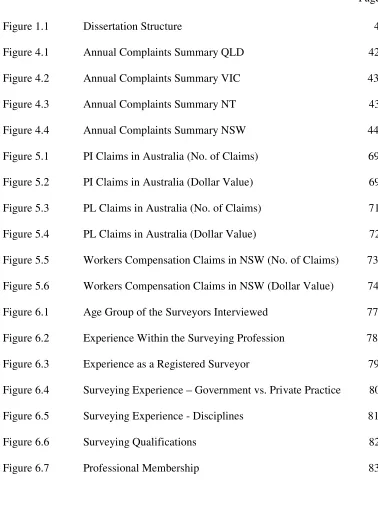
List of Figures
[image:15.612.145.523.128.642.2]Page
Figure 1.1 Dissertation Structure 4
Figure 4.1 Annual Complaints Summary QLD 42
Figure 4.2 Annual Complaints Summary VIC 43
Figure 4.3 Annual Complaints Summary NT 43
Figure 4.4 Annual Complaints Summary NSW 44
Figure 5.1 PI Claims in Australia (No. of Claims) 69
Figure 5.2 PI Claims in Australia (Dollar Value) 69
Figure 5.3 PL Claims in Australia (No. of Claims) 71
Figure 5.4 PL Claims in Australia (Dollar Value) 72
Figure 5.5 Workers Compensation Claims in NSW (No. of Claims) 73
Figure 5.6 Workers Compensation Claims in NSW (Dollar Value) 74
Figure 6.1 Age Group of the Surveyors Interviewed 77
Figure 6.2 Experience Within the Surveying Profession 78
Figure 6.3 Experience as a Registered Surveyor 79
Figure 6.4 Surveying Experience – Government vs. Private Practice 80
Figure 6.5 Surveying Experience - Disciplines 81
Figure 6.6 Surveying Qualifications 82
Glossary
ACSIS – Australian Consulting Surveyors Insurance Society APAS – Association of Public Authority Surveyors
APRA – Australian Prudential Regulation Authority
BOSSI NSW – Board of Surveying and Spatial Information – New South Wales BLF – Builders Labourers’ Federation
CPD – Continued Professional Development DLI – Department of Land Information (WA) FSC – Final Survey Certificate (WA)
HIH – Health International Holdings
ISNSW – Institution of Surveyors - New South Wales ISNZ – Institution of Surveyors – New Zealand ISA – Institution of Surveyors Australia
LS – Licensed Surveyor (VIC) & (WA) LS Act – Licensed Surveyor Act (WA) NSW – New South Wales
NT – Northern Territory NZ – New Zealand
OH&S – Occupational Health and Safety QA – Quality Assurance
QLD – Queensland
RTA – Roads and Traffic Authority SA – South Australia
SSA – Special Survey Area (WA)
SYDNET - A network of continuously operating reference stations (CORS) located in the Sydney metropolitan area
SSSI – Surveying and Spatial Sciences Institute SSI – Spatial Sciences Institute
TAS – Tasmania
TLA – Transfer of Land Act (WA) VIC – Victoria
Chapter 1 – Introduction
1.1
Introduction
Surveyors are constantly under pressure to perform work to a very high standard. They must comply with Government legislation and regulations; comply with standards set by professional institutions encompassing their code of ethics; and they must deal with the demands of clients and consumers. Surveyors are faced with consumers that have an increasing awareness of their rights. New technology and equipment is constantly changing the way survey tasks are performed, and the surveyor must keep pace with these new developments to remain competitive. Whilst meeting these demands and attempting to run a successful business, the survey practice is required by law to have professional indemnity and public liability insurance to help protect the business; the employees; personal assets; professional credibility and the general public.
The surveying profession by its very nature is associated with the legal profession and the insurance society. On a daily basis, regulations, legislation and law have a profound influence on many decisions a surveyor makes. For the most part, these rules and regulations set out clear guidelines for the surveyor to follow and assist in the various tasks performed. Occasionally however the surveyor may fall outside these guidelines for various reasons, and it is some of these situations that will be covered in this dissertation.
1.2
Background
The background to this topic is borne out of a conversation amongst fellow surveyors based around the general perception that we are living in a more litigious society than in years gone by. This topic provided a robust and thought provoking discussion, with several interesting examples of litigation taken against surveyors being raised. One intention of this dissertation is to investigate if there is any truth in the comment ‘we are living in a more litigious society than in years gone by’ and to uncover and examine examples of such litigation and its effect on the professional surveyor.
1.3
Research Problem
The project will investigate whether a void exists in information relating to litigation, insurance claims and disciplinary hearings relevant to surveyors in Australia. It is possible that there may be reluctance within some sections of the surveying profession to provide negative information relating to surveying misconduct. This dissertation will consider whether a lack of transparency exists, and whether data is not being made readily available, or whether it is simply a case that this data is not being documented.
1.4 Project Aim
After considering the impacts of this litigation, disciplinary action and insurance claims, recommendations will be suggested to help safeguard surveyors in the future.
1.5 Project Objectives
• To consider what are the hallmarks of a professional surveyor. What are the professional, legal and moral requirements needed to practice as a professional surveyor.
• To research, summarise and document various legal proceedings, disciplinary hearings and professional indemnity insurance claims that have been pursued through the courts and insurance society that relate to surveying.
• To research and investigate the relationship between the role and expectations placed on the modern surveyor and to explore the effect of these expectations on the individual, the business and the profession overall.
• To analyse how decisions made as a professional surveyor can impact upon you and your client.
• To numerically and graphically illustrate the amount of litigation, disciplinary action and insurance claims faced by the surveying profession over the last decade.
1.6 Structure of the Dissertation
Chapter 1 - Introduction
↓
Chapter 2 - Literature Review
↓
Chapter 3 - Methods
↓
Chapter 4 – Complaints and Disciplinary Action
↓
Chapter 5 - Insurance
↓
Chapter 6 – Presentation and Findings
↓
Chapter 7 - Conclusion
↓
[image:21.612.167.508.85.318.2]Chapter 8 - Recommendations and Future Research
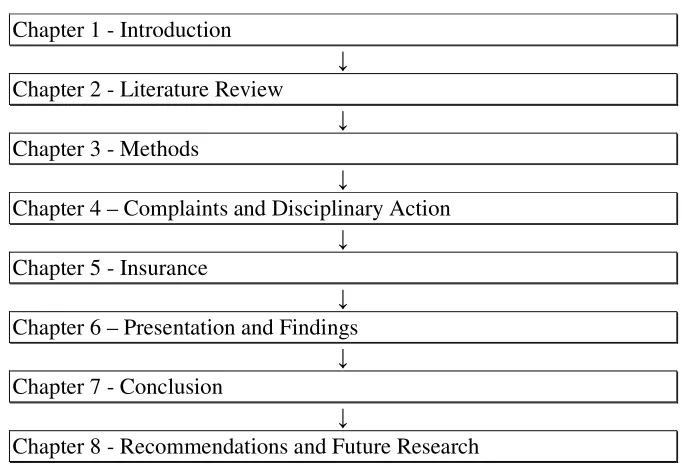
Figure 1.1 Dissertation Structure
The overall flow of the dissertation is demonstrated in Figure 1.1 above.
1.7 Conclusion
Chapter 2 - Literature Review
2.1 Introduction
This chapter will review literature relevant to the surveying profession. It will provide definitions of the key elements involved in being a professional, and will examine the effect of litigation on the professional surveyor and the associated risks involved in working as a practitioner. It will discuss how this risk effects the profession as a whole, and will consider strategies that can be put in place to reduce these risks.
2.2 The Surveying Profession
The Oxford English dictionary online (2009) describes a profession as ‘an occupation in which a professed knowledge of some subject, field, or science is applied; a vocation or career, especially one that involves prolonged training and a formal qualification.’
It is generally accepted that an occupational group counts as a profession when it exhibits the following features: the work of its members is to the better good of the community; the members of the group hold a high academic level of education in the provision of this good; they possess a high degree of autonomy in the exercise of their expertise; they are grouped together as a self-conscious community; and, they have a certain institutional status which has a legal holding on its members and equally a protective status to those members.
Enemark and Higgins (2006) broadly define a surveyor as ‘a professional person, with academic qualifications, technical expertise, interpretative ability and management skills.’ Surveyors are a diverse group of professionals that are governed by law and provide a service to their client and to the community in the execution of their daily work. Chalkley (1999)states the ‘professional knowledge, and ethical standards are both important characteristics of the competent surveyor.’
hold its position alongside other professions such as engineers, solicitors and medical practitioners.
It is not simply enough for a person to possesses a qualification and then call themselves a professional. McLeod and Hayward (2003) state ‘unless they become members of the recognised controlling body, they are not members of any profession.’ Businesses such as ‘Professional Nails’ or ‘Professional Plumbing’ for example believe they have the right to take on the title of ‘Professional’ simply because they are good at what they do, or have been doing it for a long time. Indeed they use the term as a marketing tool.
Kearsley (2007) asks ‘is it sufficient to earn money at a particular job in order for it to earn the right to be called a ‘Profession”? Certainly not, indeed many who are in the traditional professions earn less than those outside them.’ The fee charged for services rendered is also an important part of being a professional. Beardslee (2002) suggests ‘in the professional service business we are selling a relationship, and the more expensive that relationship, the more likely the client is to feel that the relationship is valuable.’ Conversely it could be said that the cheaper the service, the more likely the service is of little value. Surveyors should be prepared to charge a premium fee for their services, in line with the training they have undertaken to achieve their professional status.
Australia is governed by state, and territory acts and ordinances and is restricted by that legislation to persons registered or licensed under such legislation.’
The surveyor will have exposure to and work alongside many other disciplines on a regular basis. One such association is that between a solicitor and a surveyor. In a manual of loss prevention Blume, Gibbons, & Gill (1986) states ‘The surveyor’s and solicitor’s professions have long been associated in amity and in mutual co-operation and respect. Each complements the other in providing the community the high standards of care and service in real estate transaction which characterise the conveyancing system and distinguish it from others which ride rough-shod over matters of survey and associated title problems.’
A working relationship between the surveying profession and the legal profession can be a difficult one to balance. For example on the one hand, solicitors constantly rely on surveyors for identification surveys or plans of survey during property transactions and yet on the other hand, some solicitors are keen to promote the possibility of taking legal action against surveyors if something goes wrong. There is often a contradiction between working together to provide a high quality service to the client and one looking to actively promote litigation to the detriment of the other.
that a working partnership with a lawyer or the client’s lawyer is an essential part of providing service to their client.’
Whilst a relationship between a surveyor and a solicitor can be fruitful, surveyors can find themselves on the receiving end of solicitors securing future business for themselves. Media and the internet have seen the use of advertising as a way for the legal profession to exploit the surveying profession, and others, to attract business.
Winston Solicitors from the United Kingdom advertise on their Claims Connection (2009) website under the heading Complaints against Surveyors for professional negligence, ‘If you have been the victim of poor or negligent advice received from a Surveyor that has led to financial loss - you may be able to claim compensation. We are a firm of compensation lawyers who specialise in claims against professionals who wrongly advise their clients. If you have suffered loss or damage as a result of the negligent advice provided by a surveyor or similar professional - please make an enquiry with us today.
If you have a problem that has arisen as a result of a poor survey report from a qualified professional - you may be entitled to compensation. Despite excellent standards set by most professional surveying organisations, mistakes do happen and the people on the receiving end will quite rightly should explore the prospect of a compensation claim.
you in detail about how your claim may proceed. If we feel that your case has merit, we will consider dealing with the matter ‘no win no fee’.
With members of the legal profession encouraging the public to take litigation against the surveying profession, it is quite understandable that many surveyors feel that we are living in a more litigious society. This situation raises the question of the ethics and professionalism of the legal profession, however that is beyond the scope of this dissertation. There is a paradox here in that surveyors are expected to maintain a strong code of ethics, and yet these principles are not necessarily followed by other professions. This sort of information being provided to the general public is a growing concern for the surveying profession. As the public becomes more informed and knowledgeable of their rights, there is likely to be an increase in litigation taken out against surveyors in the future.
2.3 Ethics
Central to the ideals of any professional body is a code of ethics. The Oxford English dictionary online (2009) describes ethics as ‘The moral principles or system of a particular leader or school of thought. The rules of conduct recognised in certain associations or departments of human life.’ The four keywords here are morals; principles; rules and conduct. These are all relevant to the surveying profession.
A professional code of ethics extends beyond the normal moral code every member of society should follow. A professional is expected to commit to specific responsiblities that relate to their daily work practice. The willingness to follow such guidelines is the key to the growth of the profession and the level of respect the public shows towards that profession. Hence the saying ‘trust me, I am a Doctor’.
The advice a professional gives to a client is based on skill, knowledge, ability and experience, and is the main reason why a member of the community seeks out and relies on the opinion of that professional. The community expects such advice to be correct, and in their best interests.
recently voted to merge the two institutes to create the new Surveying and Spatial Sciences Institute (SSSI).
The surveying code of ethics encompasses what is expected from the surveyor and from the staff associated with the practice. It requires all involved to maintain a high standard of work practice when dealing with the public, and includes matters such as professional conduct and dignity. The various professional surveying bodies within Australia have established a code of ethics, and members are bound to accept and practice this code as part of their membership requirements. The Institution of Surveyors NSW incorporated (2009) for example is ‘bound by a constitution under the Corporations Act 2001 as a public company limited by guarantee, registered in NSW. Its ethics are described as ‘rules of conduct based on honesty, justice and courtesy and are central to appropriate standards of professional behaviour.’
2.4 The role of the Board of Surveying and Spatial Information
In January 2006, BOSSI formed the Spatial Information Committee for the coordination of spatial information and to develop a vision and strategies to significantly improve access to, and use of spatial information across the whole NSW community. It is the Board that regulates the surveying profession in NSW, and each state or territory of Australia has a similar governing body to oversee surveying activities within their jurisdiction.
The BOSSI website (2009) states that to become a registered surveyor in NSW‘A person who has either completed a four year university degree in NSW or an equivalent degree gained in a reciprocating state can apply to the Board to become a candidate Surveyor. A candidate surveyor will be required to gain a certificate of competency through completing a set amount of practical experience and either sit four examinations or complete a Professional Training Agreement (PTA) for land surveyors or three examinations for mining surveyors. Once they have gained competency, they are able to apply for registration as a surveyor.’
In a manual of loss prevention Blume, Gibbons, & Gill, (1986) state ‘registration is not an automatic procedure. A person seeking registration is required to be of good fame and character and to have attained an accepted standard of education and practical training. The right to be registered as a surveyor is determined by a board set up under the appropriate legislation.’
regular basis to obtain these points. This enables the members of the various institutions to stay informed of changes within the profession, and help maintain a high standard of professionalism. It should be noted that Queensland is in the early stages of trialling an alternative to the CPD system, by introducing random auditing of surveyors.
Traditionally the role of the Board of Surveyors has been implemented by Government legislation, and is used as a Government regulator of the surveying profession. However changing economic conditions, and new technology will require the role of the Boards of Surveying across the country to adjust to these social trends. A report by Professor Ian Williamson from the University of Melbourne, and discussed in a paper by Powers (2002) states that ‘the statutory role set out in the Surveyors Act 1929 should be changed to foster the development of a spatial framework for the creation and maintenance of land management information systems which support the sustainable development of the state.’ Such a change would expand the role of the Board beyond the regulation of cadastral surveyors to include other professionals who have interests in the development of the state as whole.
rather then professional practice. There would be a reduction in examination of survey plans and it would be replaced by risk management.
Self-regulation is not a new concept. Most jurisdictions have moved or are considering a move in this direction. There are several models in different states that are in the developing stages. Powers (2002) discusses ‘a recently published paper in Victoria suggests that surveyors retain licensing on an industrial self-regulating model. The Victorian Land Surveying Bill strengthens the regulatory powers of the Board and introduces the concept of continuing professional development, so that the right to undertake cadastral surveys is no longer a licence for life. South Australia has had a system of regulation since 1993. A co-regulation model has been recommended for Queensland.’ It is suggested that the Surveyor-General should take responsibility for the integrity and quality of spatial data infrastructure in NSW through the formation of a new Spatial Data Infrastructure Act. For this change to occur, it would be necessary for the surveying profession as a whole to be proactive in the development of appropriate legislation, and to ensure its members have the necessary education and training, to maintain the reputation of the surveying profession during such change.
law relating to surveying will go a long way to help protect the surveyor from facing such litigation.
2.5 Law and Legislation
Common law in Australia is still based on English Laws. Over time Common Law has not kept pace with Australia as it has grown and developed. Legislation in the form of statutes has been created to supplement the areas of Common Law that have become deficient. According to the Duhaime Legal Dictionary online (2009), ‘statutes are the written laws approved by legislatures, parliaments or elected or appointed houses of assembly, also known as legislation. States have, generally, two methods of determining the law as regards the conduct of their citizens. One is to support the development of law through local customs, traditionally the common law. But the common law gives tremendous law-moulding powers to the discretion of judges; unelected individuals. The common law has some flexibility built into it where as a statute, once enacted, continues in full force and effect until it is repealed.’
instruments; to make consequential amendments to certain other Acts and instruments; and for other purposes.’
Surveyors in each state of Australia are governed by similar acts including; the Surveyors Act 2003, Section 39 for Queensland; the Surveying Act 2004 for Victoria; the Licensed Surveyors Act 1909 for Western Australia; the Licensed Surveyors Act for the Northern Territory; the Surveyors Act 2002 for Tasmania and the Survey Act 1992 for South Australia. These Acts provide a framework and guidelines under which surveyors operate.
The surveyor must become familiar with whichever Acts or Legislation are relevant to their chosen discipline, and they must apply this knowledge of the law and continually update it to provide a service to the client and to he general public. Failure to do so could leave the surveyor exposed to the potential of facing litigation.
Two specific areas of law relevant to surveyors are the tort of negligence, and the tort of liability.
2.51 Law of Tort
safety is recognised by the tort of assault and tort of negligence; the interest or right of ownership or possession of land and goods is protected by the tort of trespass; the interest or right of a person to protect his or her reputation is recognised by the tort of defamation; and the interest or right of a person to protect the goodwill in a business is recognised by the tort of passing off.
2.52 Liability in Tort
This affects the surveyor in their non-professional capacity, and includes activity not relating to their professional skills. A function of the law of tort is to decide who should bear the loss caused by the actions of others. Any action by a person that causes harm to another should be compensated, even if the harm caused was not intentional. Blume, Gibbons, & Gill (1986) states ‘this duty of care so far as a surveyor is concerned may be seen in the context of a surveyor’s non-professional duty of care and in the context of a surveyor’s duty of care arising out of professional conduct.’ Courts later recognised that if there was not intent, and actions where not the other persons fault, compensation would only be awarded if fault could be proven which is known as ‘fault liability.’
that liability will be the same as if the employer committed the negligence personally.’
The employer is responsible for the employee during the course of the employee’s daily work. It is the registered surveyor’s responsibility to supervise and correct any employee, to maintain the surveying practice standards. The surveyor will be held liable for any breach in that standard.
The employee is not always able to hide behind their employer if there is evidence that proves the employee is at fault. This is known as vicarious liability. However in most instances, the employer will have coverage under their professional negligence insurance for this situation.
A surveyor has a responsibility to execute professional skills at a level that is expected by society, for a person with such qualifications. To not maintain this level of expertise, the surveyor could be in breach of a Tort of Negligence.
personal injury or death. These rules will apply to any claim for personal injuries or death brought in the form of an unconscionable conduct claim, a contravention of the product safety and information provisions, a supply by a manufacturer or importer of unsatisfactory consumer goods or a supply by a manufacturer or importer of defective goods.
The Trade Practices Amendment (Personal Injuries and Death) Bill 2004 was introduced into the Parliament on 9 December 2004. This Bill will prevent individuals, and the Australian Competition and Consumer Commission, in a representative capacity, from bringing actions for damages for personal injuries or death resulting from contraventions of Division 1 of Part V of the Trade Practices Act 1974.
2.6 Professional Negligence
The plaintiff (injured party) must prove, on the balance of probabilities, all of the following: That the defendant owed a duty to the plaintiff to take reasonable care to prevent the plaintiff suffering injury, loss or damage. The defendant breached that duty, by failing to live up to the standard of care expected. The defendant’s breach of duty caused damage to the plaintiff. The plaintiff suffered damage, loss or injury that was of a kind which was reasonably foreseeable i.e. the damage was not too remote.
2.61 Duty of Care
The legal aid website (2009) states ‘the law says we all have a duty of care to take reasonable care not to cause foreseeable harm to other people or their property. This is also known as the law of negligence.’ A surveyor is responsible of a duty of care towards any person they have been contracted by.
A Surveyor can be liable to someone, who they are not under contract to, for a breach of duty of care in tort. This can be on a professional level or a non-professional level.
Non-professional liability occurs when a surveyor is negligent during the course of the time at work but not in direct line of the surveying tasks. When a surveyor is negligent in the execution of their work and the negligence affects a person or their property, however if the person is not their client, the surveyor is responsible under the law of professional liability.
There are some situations where a duty of care is readily recognised, for example:
property). Occupiers of land owe a duty to those entering their property (even trespassers in certain circumstances. Professional persons owe a duty to their clients.
By statute: Parliaments have, on occasion; added circumstances where a duty is owed; clarified the common law duty; restricted access to common law rights; or altered the actual standard of care owed once the duty has been established. For example, consider the various legislative instruments relating to: occupational health and safety; workers’ compensation; occupier’s liability; and product liability.
2.62 The Standard of Care
Once the duty of care is established it is necessary to determine the standard of care, which is the benchmark a professional person is expected to meet in the execution of their work practice. The following case lays down this precedent. Bolam v Friern Hospital Management Committee [1957] 1 WLR 583 Wikipedia (2009) ‘is an English tort law case that lays down the typical rule for assessing the appropriate standard of reasonable care in negligence cases involving skilled professionals (for example, doctors): the "Bolam test". Where the defendant has represented him or herself as having more than average skills and abilities, this test expects standards which must be in accordance with a responsible body of opinion, even if others differ in opinion.’
Gibbons, & Gill (1986) refers to the case of ‘Lanphier –v- Phipo (1838) in which the following principles where laid down. Every person who enters into a learned profession undertakes to bring to the exercise of it a reasonable degree of care and skill. There may be persons who have higher possible education and greater advantage than he has but he undertakes to bring a fair, reasonable and competent degree of skill, which is the standard that has been followed ever since.’
The surveyor’s duty of care extends not only to their client but also to persons directly affected by the surveyor’s actions. The time frame and areas that duty of care may cover is known as the extent of the duty of care. It is important that a surveyor is familiar with these expectations, so as to avoid claims against the surveyor’s practice.
2.63 Negligent Misstatement
The inaccurate reporting of information, either verbal or written, is the most common form of professional liability for the surveyor. Liability lies with the surveyor not reporting the correct information to the client, and is called negligent misstatement. This often occurs unintentionally, however it can lead to claims of damages and economic loss experienced by the claimant or client.
2.64 Contracts
The court is able to decide if the contract is binding, and can add areas as the judge sees fit. The additions must seem to be fair to both parties concerned. Confidentiality is another important matter that may be implied in a contract where it is not specifically mentioned.
It is an important rule of risk management and good business to have all contracts in writing, to avoid future disputes. The following points should be included in every contract: a detailed list of expected services or goods to be provided; the price in full; time frame for delivery of the goods or completion of the service; special needs or terms relating to the job at hand; resolution plan for any unexpected difficulties along the way. Electronic forms of communication such as E-mail are a written form of agreement, and can be used as written proof of a contract between two parties. The surveyor must be aware of the limitations in all contracts and never sign any contract that is unclear. If there are any doubts, legal advice should be sort before signing.
2.65 Trade Practices Act
not, in trade or commerce, engage in conduct that is misleading or deceptive or is likely to mislead or deceive.’ Initially the Act did not cover surveying, as it did not see it as one of the services protected under the Act. Amendments to the fair tradinglegislation however has seen responsibility to deliver a high quality product to be a requirement of the individual, as important as that delivered by a corporation, and this has an impact on professions such as surveying.
2.66 Fair Trading Amendment Bill
Recent false representations in relation to land have seen the need to extend the Trade Practices Act, and legislation has been altered to include the Fair Trading Amendment Bill (1994) which states that ‘the latter Act did not cover transactions in land from a consumer protection perspective. Such provisions remained at that time with the former Act. However, in the intervening period, it has become clear that certain consumer transactions may not be covered by either Act, given the range of matters which the Land (Fair Dealings) Act covers. There are certain transactions relating to representations in connection with subject to finance clauses in land contracts which potentially come within this category. Therefore, in order to remove such loopholes and to streamline and unify consumer protection Legislation generally, it has been determined that land transactions should be subject to the ordinary and uniform requirements contained in the Fair Trading Act. In this way, land transactions will be on the same footing as those pertaining to goods and services generally and, consequently, the Fair Trading Act may be characterised as a code of consumer protection Legislation.’
This area of the Act affects those dealing with transfers of land; however it is an area of the Law a surveyor must be familiar with, as so much of a surveyors practice relates to land and associated transfers. Section 53A of the Fair Trading Act (1974) states, in part, as follows: ‘a corporation shall not, in trade or commerce, in connection with the sale or grant, or the possible sale or grant, of an interest in land or in connection with the promotion by any means of the sale or grant of an interest in land; make a false or misleading representation concerning the nature of the interest in the land, the price payable for the land, the location of the land, the characteristics of the land, the use to which the land is capable of being put or may lawfully be put or the existence or availability of facilities associated with the land.’
2.67 Confidentiality
The surveying profession by its nature is a collector of information, and often a surveyor is exposed to a client’s personal information. The Law relating to confidentiality requires the surveyor to know how to handle and process this information, so as to protect the client and not expose the practice from any breaches of confidentiality.
2.7 Public Liability
Public liability refers to financial damages and legal expenses arising out of the death, bodily injury or damage to property suffered by members of the general public. In recent years, these two issues have had an increased effect on the surveying profession.
2.71 The 2002 Senate Economics References Committee
In 2002, The Senate Economics References Committee commissioned a Review of Public Liability and Professional Indemnity Insurance. The terms of reference were to report on: the impact of public liability insurance for small business and community and sporting organisations; and the impact of professional indemnity insurance, including Directors and Officers Insurance, for small business. Particular reference was made to: the cost of such insurance; reasons for the increase in premiums for such insurance; and schemes, arrangements or reforms that can reduce the cost of such insurance and/or better calculate and pool risk.
The legal aid website of Queensland (2009) noted that ‘the federal government is currently reviewing the law of negligence as a result of the increase in the size of the claims made in recent years and the impact that this has had on insurance premiums. The Inquiry into the impact of public liability and professional indemnity insurance cost increases report commissioned by the federal government has recommended changes to the law to which governments at federal, state and territory levels are now responding. Significant changes are now in progress, including proposed amendments to the Trade Practices Act to make it compatible with existing and proposed professional standards legislation.’
There has been much debate as to the need to revise such legislation and the effect this will have on all professions including surveying. A submission by the Law Council of Australia (2000), to the Commonwealth Minister for Financial Services highlighted the fact that much of the basis of law in Australia was that ‘traditionally, professionals have accepted unlimited liability for their professional default because they have been able to sue against default. Liability insurance has proved an effective and equitable means of spreading legally compensable loss throughout the community through the flow on from insurance premiums built into the professional’s fee. This situation worked effectively whilst the scale of claims was, in general, modest. However, this is no longer the case. Over the past fifteen years or so there has been a substantial and escalating increase in the number and quantum of claims against professionals.’
the effects these increases have had on professionals. The representative for the surveying profession was Mr. I G Marler, and in a report to the Secretary of the Senate Economics Reference Committee (2002) Marler mentioned the need to introduce a regulating system to control increasing insurance costs. Marler (2002) states ‘the concepts and management of the ACSIS scheme are commended to you for consideration in the interests of stabilising Professional Indemnity costs to many professional groups. Furthermore we would suggest encouragement for State Legislation, similar to New South Wales and Western Australia that caps a professional’s liability and additionally amendment of the Federal Trade Practice Legislation so as not to override State Legislation and Schemes in this area. In summary our views in this regard are that from the community’s perspective it is better to have a Professional with their liability capped than to have no professional at all. The latter being the result of spiralling Professional Indemnity costs and unobtainable insurance cover.’
2.72 Strategies
such a simple and yet practical practice in the daily work routine, the surveyor is able to gain protection against potential litigation.
2.73 Disclaimers
There are many publications that provide the surveyor with assistance in trying to avoid litigation. A Disclaimer Manual for Surveyors, is a publication produced by the Association of Consulting Surveyors Australia, and is an invaluable tool in any surveying practice, De Lange (1991) states ‘This manual can assist the surveyor by supporting office procedures and plan preparation, assisting in the use of explanatory contract clauses and warnings’. The Macquarie Dictionary online describes a disclaimer as ‘a clause added to legal documents limiting the application of previous clauses.’
2.8 The Russell Island (Morgan) inquiry
The surveyor faces pressure from the client to produce a survey that gives the best financial results. At times it can be a fine balance in private practice, between producing the result the client wants and at the same time complying with legal regulations and moral requirements of the profession. The importance of maintaining professional standards cannot be underestimated, so as not to work in breach of the law.
An example of a surveyor facing litigation and disciplinary action is the Russell Island (Morgan) Inquiry. The Moreton Bay Combined Island Associations Incorporated newsletter (2009) claims ‘A surveyor who surveyed 7335 Russell Island lots was found by the enquiry to have “conducted himself unprofessionally”. He had “surveyed for the purposes of subdividing lots without the reasonable expectation they would be filled before sale” and “engaged in a survey for the subdivision of land into residential lots and when such land was obviously inundated he failed in many instances to take levels or other precautionary measures to ensure that it would properly be done.’ Survey plans were registered at the Titles Office without the rectification work being done.
This case falls into the categories of unconscionable conduct and professional misconduct. Unconscionable conduct is conduct that it is so extreme that it is appalling to any reasonable person. Such conduct can occur when one party has more power than the other within the transaction, and uses that power to benefit themselves. This could be in a financial way or to gain even more power in the social arena. This type of conduct has been seen many times in the political arena, and often plays out that a politician has used their position to increase their financial stakes in society. Duhaime (2009) states that professional misconduct is ‘conduct on the part of a certified professional that is contrary to the interests of the public served by that professional, or which harms the standing of the profession in the eyes of the public.
2.9 The Future of Surveying
The surveyors of the future will be faced with an ever changing technical environment. This is going to require many changes to the way surveyors are governed, both in relation to legislation and by their governing bodies. Enemark (2006) explores the course the profession is taking by stating that ‘the future imposes all kinds of challenges upon our profession and educational institutions. Furthermore, issues such as curricular development; quality assurance; continuing professional development; and mutual recognition are crucial to any professional organisation at national, regional or international level. The issues become even more acute when looking at the challenges facing the surveying profession.’
spatial science profession, as many would like it to be known faces many challenges. Ristevski and Williamson (2001) remark that the current system ‘has for one hundred years delivered a remarkably successful, efficient, low-cost form of regulation which has maintained the integrity of land records, contributed to certainty of title and the all important credibility of the land registration system. While the system has been a relatively effective one, the tenets that define it remain outdated in the current environment. The outmoded nature has been recognised in Victoria and the current reform process is aimed at delivering a modern regulatory system.’
Reforms to the system will ultimately see a new role for the modern surveyor. Such calls for reform have been discussed in commissioned working groups to recommend the way into the future for surveying. The International Federation of Surveyors (FIG) published a document in 1998 titled “Cadastre 2014, A Vision for a Future Cadastral Systems” by the Swiss surveyors Jurg Kauffman and Daniel Steudler. The main elements of this paper are; the separation between maps and register will be abolished; cadastral mapping will be no longer used; paper and pencil cadastre will have gone completely. Cadastre 2014 will be highly privatised with public and private practice working closely together and will be cost effective. The Cadastre 2014 will show the complete legal situation of land, which will make land administration and management simpler in the future.
future. The growing ability to access and update integrated land-related information raises questions regarding segmentation of the professions. It is appropriate to move away from relatively narrow professional streams and develop a more broadly based multi-skilled profession?’ Clearly this is a very contentious debate. With advances in technology the surveying profession will experience the use of its skill by other industries. The public will look to the surveyor for the more skilled aspects of the profession. This will see a doubling up of information collection. It is debated that the modern surveying practice will consist of multi-disciplinary professionals that that can best deal with the demands of the future.
There is also pressure placed on the relevant Boards, for a reform of surveying administrations. Jones, Rowe and Kentish (1999) state ‘it should be noted that the advent of a legal coordinate-based cadastre would remove a large part of the current rationale for licensing and registration. It would also remove much of the need for survey examination, requiring surveyors to take a much higher level of responsibility for their work. It would not, however, remove the need for practitioners to be competent, nor would it remove the need for discipline specialists.’
Chapter 3 – Methods
3.1 Introduction
This project will involve the use a mixed research methodology combining the use of quantitative and qualitative research methods to investigate the hypotheses set out below. The results will be analysed to determine the effect on the overall project.
3.2 Hypothesis 1
Does the statistical data support the statement that we are living in a more
litigious society in relation to surveying?
3.21 Aim
• To provide the number of litigation cases involving surveyors in Australia. • To provide the number of disciplinary hearings conducted by the relevant
surveying boards in Australia.
• To provide the number of professional indemnity and public liability claims lodged with insurance companies by surveyors in Australia.
3.22 Method
confidentiality. Relevant cases involving surveyors will be summarised and relevant areas of the law highlighted.
• Databases include; LexisNexis AU, Lawbook online, Legal Aid website, AUSTLII online, CCH online, Hein online, Oxford dictionary, Macquarie dictionary online and Duhaime Legal Dictionary online.
• To collect statistical data from phone calls and E-mail relating to the number and severity of complaints taken by relevant surveying Boards in Australia. This included the Surveyors Board of Queensland; Surveyors Registration Board of Victoria; Land Surveyors Licensing Board of Western Australia; The Surveyors Board of The Northern Territory; The Board of Surveying and Spatial Information of New South Wales; The Tasmanian Land Surveyors Accreditation Board and The Institution of Surveyors, Australia Inc. (South Australia). The results will be numerically and graphically illustrated.
• To collect data from the websites of relevant Boards of surveying in each state, regarding disciplinary hearings and to investigate the outcomes of such hearings.
• To collect data from insurance companies relating to Professional Indemnity and Public Liability claims made against surveyors, collected from the Australian Prudential Regulation Authority (APRA). The results will be numerically and graphically illustrated.
3.23 Conclusion
professional surveyor facing litigation or disciplinary action by the Boards of Surveying in each state. However the number of legal cases that had lead to prosecution are relatively few and many breaches in surveying practice are dealt with by insurance companies in the form of professional indemnity or public liability claims.
It became apparent during the course of the research, that there was more to this topic then meets the eye. During conversations with fellow surveyors, there was a general feeling of pressure being placed on the professional surveyor with regards to the risk of litigation. Therefore a second hypothesis was required which would have a qualitative research angle.
3.3 Hypothesis 2
Does the surveying profession perceive that we are living in a more litigious
society in relation to the surveying profession?
3.31 Aim
• To determine the principles defining a profession, and a professional. • To analyse relevant areas of the law relating to the professional surveyor. • To analyse the effect Government legislation has on the surveying
profession.
• To discuss the role of the Board of Surveyors and the processes by which they regulate the surveying profession.
• To analyse the effect the insurance industry has on the surveying profession.
• To discuss and analyse the pressures faced by the modern surveyor.
• To explore the knowledge of law and legislation possessed by experienced surveyors from both public and private practice.
3.32 Method
An extensive literature review was required to discuss the relevant law and related Government legislation relevant to the surveying profession was conducted. The role of the board of surveyors in each state was investigated, and the effect the current economic environment has on the modern surveyor was explored.
The actual numbers of legal cases and insurance claims are relatively few, but due to the transparent society that we live in, the pressure on the surveying professional had to be considered. Therefore the methodology was expanded to include face to face interviews, to determine if the general surveying community was feeling this pressure.
It may be assumed that the methodology was to become qualitative in nature, relying on the surveyors opinions. However the benefits of applying a mixed research methodology using survey questions to gather information was considered more appropriate. This data was then graphed and analysed.
3.33 Survey Questionnaire
The survey questionnaire investigated the knowledge of thirteen professional surveyors. The answers are graphed in groups of yes and no categories. The short questionnaire was used to collect factual data about the surveyor interviewed including their knowledge of law and experience relating to surveying.
3.34 Interview Questions
It was necessary to apply a qualitative research technique in the form of face to face interviews. The information collected was analysed to explain the relevance of the hypothesis that surveyors are experiencing a more litigious work environment then in previous years. Relevant parts of the interviews are included, thus forming a mixed research methodology.
3.3.4 Conclusion
The questionnaire and interview questions provided relevant data on the effects that the current economic climate has on the surveyor and the surveying profession. The data demonstrated the vast knowledge required to be a professional surveyor in Australia, and the responsibilities they face.
3.4 Mixed Methodology research
3.5 Ethical issues
The information collected by both the questionnaire and interview questions is anonymous, and the answers are treated with the same practices of confidentiality as any professional would maintain when dealing with any client or member of the public.
3.6 Conclusion
Chapter 4 – Complaints & Disciplinary Action
4.1 Introduction - Complaints
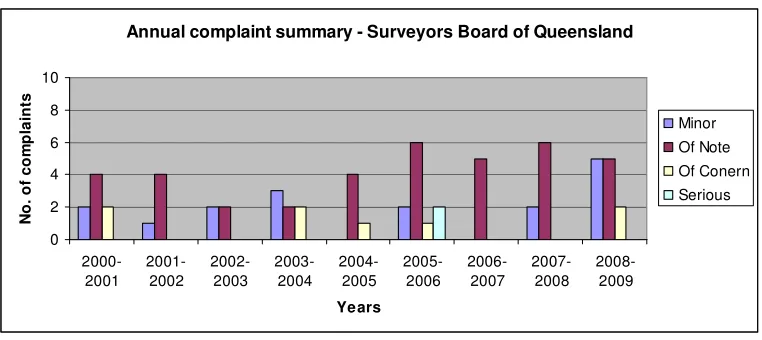
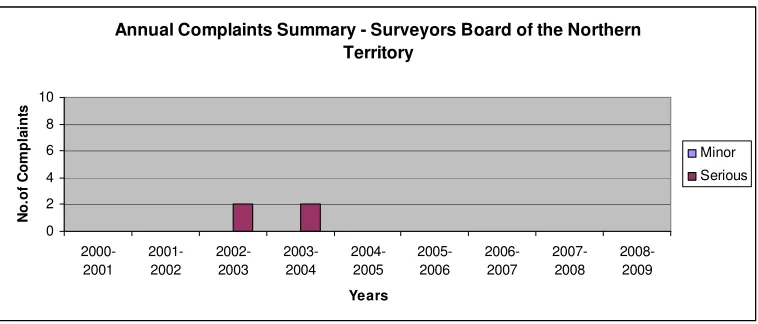
If a surveyor falls in breach of the law often the Board of Surveyors is contacted, and a complaint lodged. An investigation into the number of complaints made against surveyors to the surveying Board’s throughout Australia was undertaken. Information was difficult to obtain in all states. Some states did not provide public access to this data, and some states, such as South Australia did not actually record the data at all. The eastern states of Australia provided the best data source as can be seen in the following graphs.
Annual complaint summary - Surveyors Board of Queensland
[image:59.612.150.531.356.526.2]0 2 4 6 8 10 2000-2001 2001-2002 2002-2003 2003-2004 2004-2005 2005-2006 2006-2007 2007-2008 2008-2009 Years N o . o f c o m p la in ts Minor Of Note Of Conern Serious
Annual complaints summary - Surveyors Board of Victoria 0 2 4 6 8 10 2000-2001 2001-2002 2002-2003 2003-2004 2004-2005 2005-2006 2006-2007 2007-2008 2008-2009 Years N o . o f C o m p la in ts Minor Of Conern Serious
Figure 4.2 Annual Complaints Summary – Source: Surveyors Board of Victoria
Annual Complaints Summary - Surveyors Board of the Northern Territory 0 2 4 6 8 10 2000-2001 2001-2002 2002-2003 2003-2004 2004-2005 2005-2006 2006-2007 2007-2008 2008-2009 Years N o .o f C o m p la in ts Minor Serious
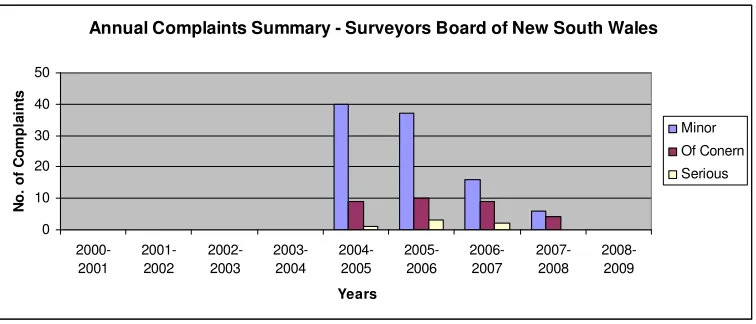
[image:60.612.151.530.309.471.2]Annual Complaints Summary - Surveyors Board of New South Wales 0 10 20 30 40 50 2000-2001 2001-2002 2002-2003 2003-2004 2004-2005 2005-2006 2006-2007 2007-2008 2008-2009 Years N o . o f C o m p la in ts Minor Of Conern Serious
Figure 4.4 Annual Complaints Summary – Source: Surveyors Board of New South Wales
4.11 Results and Discussion
The Surveyors Board of the Northern Territory is an interesting case, with only four complaints lodged in the last nine years.
The complaints are broken up into various categories, ranging from ‘minor’ to ‘serious’, and there is a general trend of a decrease in complaints lodged with the Board’s over recent times.
4.2 Introduction - Disciplinary Action
4.3 Case No.1
This case details a Formal Hearing into the Professional Conduct of Mr. Graham Shaw Licensed Surveyor (Registration. No. 1063) Reference: S.23/04. Surveyors Registration Board of Victoria website (2009).
4.31 Summary of the Board’s Decision
On 20 June 2008, the Surveyors Registration Board of Victoria received advice of Mr. Shaw's audit history from the Office of Surveyor-General Victoria.
The Board noted from that advice, the history of Mr. Shaw's audits from 1 August 1997 to 11 February 2008, and that the results of his last two audits, PS 544665K and PS 517687C, were unsatisfactory.
Following consideration of this advice, the Board determined to conduct a formal hearing, in accordance with Section 23 of the Surveying Act 2004 to determine whether Mr. Shaw, in his business as a licensed surveyor, had engaged in unprofessional conduct.
The hearing was conducted on 15 September 2008 and the Panel made the following decision:
4.32 Findings
That the Licensed Surveyor had engaged in unprofessional conduct which was of a serious nature.
4.33 Determination
‘That all Abstracts of Field Notes certified by the Licensed Surveyor between September 15, 2008 and March 31, 2009 be countersigned by another Licensed Surveyor who certifies that the Abstract of Field Notes correctly represents the adopted boundaries and the related features as at the date of the survey.’
4.4 Case No.2
This case details a Formal Hearing into the Professional Conduct of Mr John Muldowney LS (Registration. No. 1790). Reference: S23/05. Surveyors Registration Board of Victoria website (2009).
4.41 Summary of the Board’s Decision
4.42 Findings
The Motion of the Surveyors Registration Board of Victoria was made out in that the Licensed Surveyor had engaged in unprofessional conduct which was not of a serious nature.
4.43 Determination
The Licensed Surveyor be reprimanded.
That the Licensed Surveyor be required to undertake further training in the form of an office audit of his procedures and checking systems by a Licensed Surveyor appointed by the Board (“the supervising Licensed Surveyor”).
The supervising Licensed Surveyor shall not be a professional competitor of the Licensed Surveyor.
The duration of the audit shall be approximately one half a day to a day.
The audit shall be conducted within three months of the date of this Decision and the Licensed Surveyor shall be given at least 28 days prior notice of the date of the audit.
The cost of the audit shall be fully reimbursed by the Licensed Surveyor to the Board within 30 days of receipt of the Board’s invoice or such further extension of time the Board deems fit.
4.5 Case No.3
4.51 Summary of the Board’s Decision
In accordance with Section 21 (7) of the Licensed Surveyors Act 1909 the following orders of the Board are notified for general information.
4.52 Findings
Having found 1 charge laid under Section 21 (1) (f) of the Licensed Surveyors Act against Robert Tudor Owen proven, the Board ordered that Mr Tudor Owen be reprimanded, pay a fine of $1000 and pay part of the cost of the enquiry of an amount of $500.
4.53 Determination
The Board ordered that the following conditions be placed on Mr. Tudor Owen's Practising Certificate.
1. Mr. Tudor Owen is to complete the subdivision expeditiously and submit progress reports to the Board after 2 weeks and thereafter every 4 weeks until completion.
2. Provide the Board, by 31st January 2005, with a Business Plan showing how he will improve his record keeping, document control and communications with his client.
4.6 Introduction - Tribunal Hearings
4.7 Case No.4
This is a case between the Land Surveyors Licensing Board of Western Australia (WA) and Licensed Surveyor Mr Peter Neale. WASAT 176 (5 July 2007). File No. VR 128 of 2006. The relevant legislation to this case is the Licensed Surveyors (Transfer of Land Act 1893) Regulations 1961(WA); the Licensed Surveyo