1
Biennial Conference of the Australian Society for Engineering in Agriculture (SEAg), published by SEAg, Editors: T.M. Banhazi and C. Saunders - 13-16 of September 2009, Brisbane, QLD
RESPONSE OF CROP YIELD AND YIELD COMPONENTS OF TOMATO TO DIFFERENT TILLAGE METHODS IN THE ARID LANDS OF VARAMIN, IRAN
M. Rashidi1* and B.G. Khabbaz2
1
Department of Agricultural Machinery, Faculty of Agriculture, Islamic Azad University, Takestan Branch, Iran
2
Faculty of Engineering and Surveying, University of Southern Queensland, Australia
*
Corresponding author’s e-mails: [email protected]; [email protected]
ABSTRACT
A field experiment was conducted at the Research Site of Varamin Agricultural Research Center, Varamin, Iran on sandy loam soils to study the response of tomato (Lycopersicon esculentum) to different tillage methods during 2007 and 2008. Tillage treatments in the study included were conventional tillage (CT; moldboard plowing + two passes of disk harrowing), minimum tillage (MT; one pass of disk harrowing) and no-tillage (NT). Crop yield, yield components (plant population density, PPD; number of fruits per plant, NFPP; fruit weight, FW; fruit length, FL; fruit diameter, FD) and a fruit quality parameter (total soluble solids, TSS) were determined for all treatments. Results indicated that tillage methods significantly (P ≤ 0.05) influenced crop yield, yield components and TSS. Results also showed that PPD and NFPP are the most important yield components explaining crop yield difference under different tillage methods. The maximum PPD (10025 plants ha-1), NFPP (19.1) and as a result crop yield (12.2 t ha-1) were observed with CT, while maximum values of FW (71.2 g), FL (70.0 mm), FD (59.2 mm) and TSS (7.27%) were noted NT plots. On the other hand, minimum PPD (5117 plants ha-1), NFPP (10.2) and hence crop yield (3.70 t ha-1) were obtained with NT, while the minimum values of FW (63.6 g), FL (61.0 mm), FD (53.6 mm) and TSS (5.81%) were noted in case of CT treatment. Therefore, one pass of moldboard plow followed by two passes of disk harrow was found to be more appropriate and profitable tillage method in improving crop yield of tomato in the arid lands of Iran.
Key words: Conventional tillage; Conservation tillage; Minimum tillage; No-tillage; Tomato
(Lycopersicon esculentum); Crop yield; Arid lands; Varamin; Iran
Running title: RESPONSE OF TOMATO TO TILLAGE METHODS
INTRODUCTION
Tomato (Lycopersicon esculentum) is one of the most important vegetable crops of Iran and is well adapted to its soil and climatic conditions. Tomato ranks first in cultivated area and production among all other vegetables in Iran. According to Agricultural Ministry of Iran the average national production of tomato for the last two years was 4.4 million tones. Although the use of improved varieties and fertilizers has increased tomato production to much extent, the full potential of crop production has not yet been achieved when compared to progressive countries (Iranian Ministry of Agriculture, Statistical Yearbook, 2006).
2
Biennial Conference of the Australian Society for Engineering in Agriculture (SEAg), published by SEAg, Editors: T.M. Banhazi and C. Saunders - 13-16 of September 2009, Brisbane, QLD
Therefore, currently there is a significant interest and emphasis on the shift to the conservation tillage and no-tillage methods for the purpose of controlling soil erosion (Iqbal et al., 2005).
Most of the tomato area in Iran is under conventional tillage (Iranian Ministry of Agriculture, Statistical Yearbook, 2006). Conventional tillage practices modify soil structure by changing its physical properties such as soil bulk density, soil penetration resistance and soil moisture content (Keshavarzpour & Rashidi, 2008; Rashidi & Keshavarzpour, 2008). Annual disturbance and pulverizing caused by conventional tillage produce a finer and loose soil structure as compared to conservation and no-tillage methods which leave soil intact (Rashidi & Keshavarzpour, 2007; Rashidi et al., 2008). This difference results change in number, shape, continuity and size distribution of the pores network, which controls the ability of soil to store and transmit air, water and agricultural chemicals. This also improves porosity and water holding capacity of the soil. This all leads to a favorable environment for crop growth and nutrient use (Khan et al., 2001; Khurshid et al., 2006).
On the other hand, conservation tillage methods often result in decreased pore space (Hill, 1990), increased soil strength (Bauder et al., 1981) and stable aggregates (Horne et al., 1992). The pore network in conservationally tilled soil is usually more continues because of earthworms, root channels and vertical cracks (Cannel, 1985). Therefore, conservation tillage may reduce disruption of continues pores. Reddy et al. (2007) quantified the amount of carbon dioxide (CO2) released from soil as a result of different tillage methods. They observed 37% higher CO2 efflux from conventionally tilled soils compared to no-till soils which represents higher carbon sequestration in no-till soils. However, the results of conservation tillage and no-tillage methods are contradictory (Iqbal et al., 2005). Conservation tillage and no-tillage methods in arid lands of Iran had an adverse effect on yields of some crops (Hemmat & Taki, 2001). Conversely, while comparing conventional tillage method to conservation tillage and no-tillage methods Chaudhary et al. (1992) concluded that higher moisture preservation and 13% more income were obtained in case of no-tillage.
Though considerable amount of research has been done on many crops, information on response of tomato to conservation tillage and no-tillage methods is meager. At this time, a wide range of tillage methods is being used in Iran without evaluating their effects on crop yield and yield components of tomato. Therefore, the present investigation was planned to determine the response of crop yield and yield components of tomato to different tillage methods in the arid lands of Iran.
MATERIALS AND METHODS
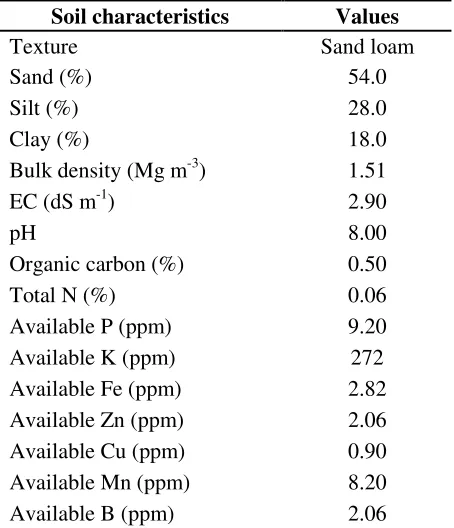
Experimental site: The experiment was carried out for two consecutive growing seasons (2007 and 2008) at the Research Site of Varamin Agricultural Research Center, Varamin, Iran. The site is located at latitude of 35° 19' N and longitude of 51° 39' E and is 1000 m above mean sea level, in arid climate in the center of Iran, where the summers are dry and hot while the winters are cool. The soil of the experimental site was a fine, mixed, thermic, Typic Haplocambids sand loam soil. Details of soil physical and chemical properties of the experimental site are given in Table 1.
Weather parameters: The mean monthly rainfall and temperature data of the experimental site for 2007 and 2008 are given in Fig. 1.
3
[image:3.595.192.419.108.372.2]Biennial Conference of the Australian Society for Engineering in Agriculture (SEAg), published by SEAg, Editors: T.M. Banhazi and C. Saunders - 13-16 of September 2009, Brisbane, QLD
Table 1. Soil physical and chemical properties of the experimental site (0-30 cm depth).
Soil characteristics Values
Texture Sand loam
Sand (%) 54.0
Silt (%) 28.0
Clay (%) 18.0
Bulk density (Mg m-3) 1.51
EC (dS m-1) 2.90
pH 8.00
Organic carbon (%) 0.50
Total N (%) 0.06
Available P (ppm) 9.20
Available K (ppm) 272
Available Fe (ppm) 2.82
Available Zn (ppm) 2.06
Available Cu (ppm) 0.90
Available Mn (ppm) 8.20
Available B (ppm) 2.06
[image:3.595.183.428.403.583.2]0.0 10.0 20.0 30.0 40.0 50.0 60.0 70.0 80.0 J a n . F e b . M a r. A p r. M a y J u n e J u ly A u g . S e p t. O c t. N o v . D e c . R a in fa ll ( m m ) 0.0 5.0 10.0 15.0 20.0 25.0 30.0 35.0 T e m p e ra tu re ( °C ) Rainfall Temperature
Fig. 1: Mean monthly rainfall and temperature during crop growth, 2007 and 2008
4
Biennial Conference of the Australian Society for Engineering in Agriculture (SEAg), published by SEAg, Editors: T.M. Banhazi and C. Saunders - 13-16 of September 2009, Brisbane, QLD
(totally there were four rows per plot). Before transplanting, recommended levels of N (350 kg ha -1
), P (100 kg ha-1) and K (50 kg ha-1) were used as Urea, TSP (triple super phosphate) and SOP (sulphate of potassium), respectively. They were incorporated in CT and MT, and surface applied in NT. Trifluralin (0.75 L ha-1) was also applied for weed control before tomato transplanting. Tomato was transplanted on 5th May when the soil was well irrigated in all treatments. During the growing season, the insecticides and fungicides were applied according to general local practices and recommendations. All other necessary operations except those under study were kept normal and uniform for all the treatments.
Observation and data collection: Tomatoes were harvested three times (23 July, 12 August and 31 August) and standard procedures were adopted for recording the data on crop yield and yield components. Crop yield, plant population density (PPD) and number of fruits per plant (NFPP) were determined by counting plants and harvesting fruits of the two middle rows of each plot (Srivastava et al., 1994). Other parameters, i.e. fruit weight (FW), fruit length (FL), fruit diameter (FD) and total soluble solids (TSS) were determined from the 20 samples taken randomly from harvested fruits of the two middle rows of each plot (Doss et al., 1980; Jain et al., 2000). The TSS of tomatoes was measured using an ATC-1E hand-held refractometer (2005, ATAGO, Japan) at temperature of 20°C.
Data analysis: The Data were subjected to ANOVA using statistical software, SPSS 12.0 for Windows (SPSS Inc., 233 S Wacker Drive, Chicago, IL, USA). Means were separated by Duncan’s multiple range test (DMRT) at P ≤ 0.05 (Steel & Torrie, 1984).
RESULTS
Crop yield and yield components of tomato were significantly influenced by tillage methods. Among three different tillage methods CT method recorded significantly higher crop yield (12.2 t ha-1) compared to NT (3.7 t ha-1) and MT (6.2 t ha-1) methods. Between two conservation tillage methods MT method recorded significantly higher crop yield (67%) than NT method. Similar trend was also observed in case of PPD and NFPP. Significantly higher PPD and NFPP were observed in CT plots (10025 plants ha-1 and 19.1, respectively) compared to MT (6908 plants ha-1 and 13.2, respectively) and NT (5117 plants ha-1 and 10.2, respectively) plots (Table 2).
[image:4.595.47.561.588.681.2]In contradiction to above trend, NT and MT methods recorded significantly higher FW, FL, FD and TSS compared to CT method. Between conservation tillage methods, NT method recorded higher values for the above parameters. Values of FW, FL and FD were 12, 15 and 10%, respectively higher in NT plots compared to that of CT plots. The quality parameter of tomato fruits, TSS was significantly higher in NT plots (7.27%) compared to that of CT (5.81%) and MT (6.31%) plots (Table 2).
Table 2. Effect of different tillage treatments on crop yield and yield components of tomato (mean 2007 and 2008).
Treatments Crop yield
(t ha-1)
PPD (plant ha
-1
)
NFPP FW (g) FL
(mm)
FD
(mm) TSS (%) Conventional tillage
(CT)
12.2 a 10025 a 19.1 a 63.6 c 61.0 c 53.6 c 5.81 c
Minimum tillage (MT) 6.19 b 6908 b 13.2 b 67.6 b 64.8 b 57.6 b 6.31 b
No-tillage (NT) 3.70 c 5117 c 10.2 c 71.2 a 70.0 a 59.2 a 7.27 a
LSD5% 0.160 244.9 0.373 0.742 1.260 0.991 0.453
Means in the same column with different letters differ significantly at 0.05 probability level according to DMRT
5
Biennial Conference of the Australian Society for Engineering in Agriculture (SEAg), published by SEAg, Editors: T.M. Banhazi and C. Saunders - 13-16 of September 2009, Brisbane, QLD
DISCUSSION
In this study, the salient components of crop yield such as PPD, NFPP, FW, FL, FD and a fruit quality parameter, i.e. TSS were studied to analyze the effect of different tillage methods on growth and crop yield of tomato. The statistical results of the study indicated that tillage method significantly affected crop yield, PPD, NFPP, FW, FL, FD and TSS during the study years. Results also showed that tillage practices were beneficial in improving the growth and crop yield of tomato (Table 2).
The maximum value of PPD (10025 plants ha-1) and NFPP (19.1) was observed in case of CT treatment, while maximum value of FW (71.2 g), FL (70.0 mm), FD (59.2 mm) and TSS (7.27%) was noted in case of NT treatment. As PPD and NFPP were the most important yield components explaining crop yield of tomato under different tillage methods, the maximum value of crop yield (12.2 t ha-1) was observed in case of CT treatment (Table 2). These results are in agreement with those of Khan et al. (1999), Khan et al. (2001), Iqbal et al. (2005), Khurshid et al. (2006), Rashidi & Keshavarzpour (2007), Keshavarzpour & Rashidi (2008), Rashidi & Keshavarzpour (2008) and Rashidi et al. (2008) who concluded that conventional tillage can be associated with reduced soil penetration resistance, reduced soil bulk density, increased soil moisture preservation, improved soil structure, enhanced root-soil contact and better suppressing weed growth which favorably affect root development, plant growth, plant population density and as a result crop yield.
On the other hand, the minimum value of PPD (5117 plants ha-1) and NFPP (10.2) was obtained in case of NT treatment, while the minimum value of FW (63.6 g), FL (61.0 mm), FD (53.6 mm) and TSS (5.81%) was noted in case of CT treatment. In view of the fact that PPD and NFPP were the most important yield components explaining crop yield of tomato under different tillage methods, the minimum value of crop yield (3.70 t ha-1) was obtained in case of NT treatment (Table 2). These results are in agreement with those of Bauder et al. (1981), Hill (1990), Horne et al. (1992), who concluded that no-tillage and conservation tillage methods can be associated with decreased pore space, increased soil penetration resistance, increased soil bulk density, decreased soil moisture conservation which adversely affect root development, plant growth, plant population density and consequently crop yield. These results are also in line with the results reported by Iqbal
et al. (2005) that no-tillage method can not compensate the adverse effect of fine texture, very low
organic matter and an overall initial weak structure of the soil. These results are also in agreement with those of Hemmat & Taki (2001), Keshavarzpour & Rashidi (2008) and Rashidi & Keshavarzpour (2008), who concluded that no-tillage method in arid regions had an adverse effect on crop yield. Furthermore, Reddy and Reddy (2008) opinioned that no-tillage needs extra nutrients in the form of crop residue to give similar yields to conventional tillage. They observed 18% higher yields in conventional tillage compared to no-tillage with similar quantity of nutrients. Conversely, they observed 21% higher yields in no-tillage plots compared to conventional tillage when extra crop residue was included in the form of winter cover crop. Hence, future studies are needed to find the response of tomato to no-tillage along with higher nutrient dosage and residue cover.
CONCLUSION
6
Biennial Conference of the Australian Society for Engineering in Agriculture (SEAg), published by SEAg, Editors: T.M. Banhazi and C. Saunders - 13-16 of September 2009, Brisbane, QLD
find the beneficial effects of no-tillage on soil quality and crop yields when it was supplemented with extra nutrients or crop residue.
ACKNOWLEDGEMENT
Thanks to Eng. Mohammad-Reza Imani for statistical expertise on several occasions. Also, the financial support provided by the Agricultural Extension, Education and Research Organization of Iran under research award number 2-109-220000-14-0000-86008 is gratefully acknowledged.
REFERENCES
Bauder, J.W., G.W. Randall and J.B. Swan, 1981. Effects of four continue tillage systems on mechanical impedance of a clay-loam soil. Soil Sci. Soc. Amer. J., 45: 802-806.
Bremner, J.M., 1982. Total nitrogen. In: Page, A.L., R.H. Miller and D.R. Keeny (Eds.), Methods of Soil Analysis. Part 2, 2nd ed., Agronomy Monograph No. 9. ASA and SSSA, Madison, WI, pp. 915-928.
Blake, G.R. and K.H. Hartge, 1986. Bulk density. In: Klute, A. (Ed.), Methods of Soil Analysis. Part 1, 2nd ed., Agronomy Monograph No. 9. ASA and SSSA, Madison, WI, pp. 365-375. Cannel, R.Q., 1985. Reduced tillage in north-west Europe - a review. Soil and Tillage Res., 5:
129-177.
Chaudhary, A.D., M. Javed, M.A. Rana, A. Sarwar and Q. Zaman, 1992. Comparative performance of direct drilling and conventional tillage practices under rice-wheat rotation system. Pakistan J. Agric. Sci., 29: 5-8.
Doss, B.D., J.L. Turner and L.E. Evans, 1980. Irrigation methods and in row chiseling for tomato production. J. Am. Soc. Hortic. Sci., 105: 611-614.
Gee, G.W. and J.W. Bauder, 1986. Particle size analysis. In: Klute, A. (Ed.), Methods of Soil Analysis. Part 1, 2nd ed. Agronomy Monograph No. 9. ASA and SSSA, Madison, WI, pp. 383-411.
Hemmat, A. and D. Taki, 2001. Grain yield of irrigated wheat as affected by stubble tillage management and seeding rates in central Iran. Soil and Tillage Res., 63: 57-64.
Hill, R.L., 1990. Long-term conventional and no-tillage effects on selected soil physical properties. Soil Sci. Soc. Amer. J., 54: 161-166.
Horne, D.J., C.W. Ross and K.A. Hughes, 1992. Ten years of maize/oats rotation under three tillage systems on a silt-loam soil in New Zealand. 1. A comparison of some soil properties. Soil and Tillage Res., 22: 131-143.
Iqbal, M., A.U. Hassan, A. Ali and M. Rizwanullah, 2005. Residual effect of tillage and farm manure on some soil physical properties and growth of wheat (Triticum aestivum L.). Int. J. Agri. Biol., 7: 54-57.
Jain, N., H.S. Chauhan, P.K. Singh and K.N. Shukla, 2000. Response of tomato under drip irrigation and plastic mulching. In: Proceeding of 6th International Micro-irrigation
Congress, Micro-irrigation Technology for developing Agriculture. 22-27 October 2000,
South Africa.
Keshavarzpour, F. and M. Rashidi, 2008. Effect of different tillage methods on soil physical properties and crop yield of watermelon (Citrullus vulgaris). World Appl. Sci. J., 3: 359-364.
Khan, F.U.H., A.R. Tahir and I.J. Yule, 1999. Impact of different tillage practices and temporal factor on soil moisture content and soil bulk density. Int. J. Agri. Biol., 1: 163-166.
Khan, F.U.H., A.R. Tahir and I.J. Yule, 2001. Intrinsic implication of different tillage practices on soil penetration resistance and crop growth. Int. J. Agri. Biol., 3: 23-26.
Khurshid, K., M. Iqbal, M.S. Arif and A. Nawaz, 2006. Effect of tillage and mulch on soil physical properties and growth of maize. Int. J. Agri. Biol., 8: 593-596.
Lal, R., 1993. Tillage effects on soil degradation, soil resilience, soil quality and sustainability. Soil
7
Biennial Conference of the Australian Society for Engineering in Agriculture (SEAg), published by SEAg, Editors: T.M. Banhazi and C. Saunders - 13-16 of September 2009, Brisbane, QLD
Nelson, D.W. and L.E. Sommers, 1982. Total carbon, organic carbon and organic matter. In: Page, A.L., R.H. Miller and D.R. Keeny (Eds.), Methods of Soil Analysis. Part 2, 2nd ed., Agronomy Monograph No. 9. ASA and SSSA, Madison, WI, pp. 539-579.
Olsen, S.R., 1982. Phosphorus. In: Page, A.L., R.H. Miller and D.R. Keeny (Eds.), Methods of Soil Analysis. Part 2, 2nd ed., Agronomy Monograph No. 9. ASA and SSSA, Madison, WI, pp. 403-430.
Rashidi, M. and F. Keshavarzpour, 2007. Effect of different tillage methods on grain yield and yield components of maize (Zea mays L.). Int. J. Agri. Biol., 9: 274-277.
Rashidi, M. and F. Keshavarzpour, 2008. Effect of different tillage methods on soil physical properties and crop yield of melon (Cucumis melo). American-Eurasian J. Agric. & Environ. Sci., 3: 31-36.
Rashidi, M., F. Keshavarzpour and M. Gholami, 2008. Effect of different tillage methods on yield and yield components of forage corn. American-Eurasian J. Agric. & Environ. Sci., 3: 347-351.
Reddy, S.S., K.C. Reddy and R. Tiffany, 2007. Influence of tillage and poultry litter application on carbon dioxide efflux and carbon storage in soil under cotton production system. Proceedings of ASA-CSSA-SSSA 2007 International meetings, New Orleans, LA, Nov
4-8, 2007. Available online at
http://a-c-s.confex.com/a-c-s/2007am/techprogram/P34934.HTM.
Reddy, S. S. and K.C. Reddy, 2008. Cotton lint yield and soil quality as influenced by continuous poultry litter application for 5-yr. Proceedings of ASA-CSSA-SSSA 2008 International meetings, Houston, TX, Oct. 5-9, 2008. Available online at
http://a-c-s.confex.com/crops/2008am/techprogram/P43784.HTM.
Srivastava, P.K., M.M. Parikh, N.G. Sawani and S. Raman, 1994. Effect of drip irrigation and mulching on tomato yield. Water management, 25: 179-184.
Steel, R.G.D. and J.H. Torrie, 1984. Principles and Procedures of Statistics: A Biometrical
Approach. McGraw Hill Book Co., Inc., New York, USA.