wasps?
.
White Rose Research Online URL for this paper:
http://eprints.whiterose.ac.uk/85569/
Version: Accepted Version
Article:
Ghana, S, Suleman, N and Compton, SG (2015) Ability to gall: The ultimate basis of host
specificity in fig wasps? Ecological Entomology, 40 (3). 280 - 291. ISSN 0307-6946
https://doi.org/10.1111/een.12183
Reuse
Unless indicated otherwise, fulltext items are protected by copyright with all rights reserved. The copyright exception in section 29 of the Copyright, Designs and Patents Act 1988 allows the making of a single copy solely for the purpose of non-commercial research or private study within the limits of fair dealing. The publisher or other rights-holder may allow further reproduction and re-use of this version - refer to the White Rose Research Online record for this item. Where records identify the publisher as the copyright holder, users can verify any specific terms of use on the publisher’s website.
Takedown
If you consider content in White Rose Research Online to be in breach of UK law, please notify us by
Salah Ghana1,2, Nazia Suleman1,3and Stephen G. Compton1,4 2
3 1
School of Biology, Faculty of Biological Sciences, University of Leeds, Leeds, LS2 9JT, 4
UK. 5
2
Present Address:Zoology Department, Faculty of Sciences, Tripoli University, Libya. 6
3
Present Address: Plant Protection Division, Nuclear Institute for Agriculture and Biology 7
(NIAB), Faisalabad,Pakistan. 8
4
Department of Zoology and Entomology, Rhodes University, Grahamstown6140, South 9
Africa. 10
11
12
13
Correspondence: Dr.NaziaSuleman, Principal Scientist, Plant Protection Division, Nuclear 14
Institute forAgriculture and Biology (NIAB), Faisalabad, Pakistan. 15
E-mail: [email protected] 16
17
18
19
20 21
22
23
24
Abstract 26
1. Fig trees (Ficus spp.) and their host specific pollinator fig wasps (Agaonidae) are 27
partners in an obligate mutualism. Receptive phase figs release specific volatiles to 28
attract their pollinators and this is generally effective in preventing pollinator species 29
from entering figs of the wrong hosts. 30
2. If entry is attempted into atypical host figs then ostiole size and shape and style length 31
may also prevent reproduction. Despite these barriers, there is increasing evidence 32
that fig wasps enter atypical hosts, and that this can result in hybrid seed and fig wasp 33
offspring. 34
3. This study examines the basis of pollinator specificity in two dioecious fig species 35
from different geographical areas. Kradibiatentacularispollinates Ficusmontana in 36
Asia.F. asperifolia from East Africa is closely related, but is pollinated by a different 37
species of Kradibia. 38
4. In glasshouses,K. tentacularis was attracted to its normal host, F1s and backcrosses, 39
but only rarely entered figs of F. asperifolia. Foundresses were able to lay eggs in 40
hybrids, backcrosses and F. asperifolia, although flower occupancy was lowest in F. 41
asperifoliafigs and intermediate in hybrids. 42
5. The fig wasp failed to reproduce in female F. montana, male F. asperifolia and male 43
F1s, and most but not all backcrosses to F. montana. This was a result of the failure to 44
initiate gall production. 45
6. Host specificity in this fig waspis strongly influenced by host volatiles, but ability to 46
gall may be the ultimate determinant of whether it can reproduce. 47
Key words: Agaonidae,dioecy,Ficus, hybrids, Kradibia, volatiles 48
Running title: Pollinator specificity in dioecious figs 49
Introduction 51
Ficus is one of the most diverse genera of plants (Harrison, 2005) with approximately 800 52
described species (Berg and Corner, 2005).Fig trees and fig wasps have an obligatory 53
mutualistic relationship that had persisted for over 75 million years(Compton et al., 54
2010;Cruadet al., 2012).Fig wasps transport pollen from their natal figs to receptive figs(figs 55
that are ready to be pollinated) while wasps only lay their eggs in fig flowers, where the 56
larvae develop in and feed on galled ovaries(Cook and Segar, 2010).There are two types of 57
pollination in fig trees, passive and active. Passive pollination is where the pollinators 58
haphazardly pollinate receptive flowers by carrying the pollen on their bodies (Cook and 59
Rasplus, 2003) and do not display any behaviour to collect the pollen (Jousselin et al., 2001). 60
Fig wasps with this inefficient type of pollination lack coxal combs and their host figs have 61
high anther to ovary ratios (Kjellberg et al., 2001). Active pollination, where female insects 62
collect, store and then release the pollen, has been recorded in at least three pollinator-plant 63
mutualisms: yuccas and yucca moths (Pellmyr and Huth, 2002),senita cacti and senitamoths 64
(Fleming and Holland, 1998) and figs and fig wasps (Janzen, 1979).Fig wasps display 65
morphological and behavioural adaptations for collecting and depositing pollen with pollen 66
pockets and coxal combs that help in collecting and depositing the pollen (Jousselin et al., 67
2003). Active pollination may be a way to provide their larvae with an additional food 68
source, and can reduce larval mortality rates(Jousselin and Kjellberg, 2001; Tarachai et al., 69
2008). The ratio of male to female flowers is low in figs with active pollination (Kjellberg et 70
al., 2001). 71
It was believed that each fig tree species is pollinated by one specific fig wasp species 72
(Ramirez, 1970; Bronstein, 1987) but there is increasing evidence that manyFicusspecies are 73
pollinated by more than one fig wasp species (Ware and Compton, 1992; Molbo et al., 2003; 74
often important signals from flowering plants to their pollinators and in obligate mutualisms 76
chemicals released by one partner can be crucial for attraction ofthe other (Grison-Pige et al., 77
2002; Raguso, 2008; Soler et al., 2011). Specificity between fig trees and their pollinators is 78
maintained by a combination of chemical barriers(stage and host plant specific attractant 79
volatiles) and physical barriers determined by ostiole diameter and style length (Ware and 80
Compton, 1994; van Noort and Compton, 1986). Figs of each species emit a species-specific 81
blend of volatile chemical compounds during their receptive phase that differs from that 82
released by younger and older figs(van Noort et al., 1989; Grison-Pige et al., 2001). Changes 83
in the floral scent after figs are pollinated result in pollinators avoiding these figs (Proffit et 84
al., 2008) and the figs can become repellent by the time that the next generation of pollinators 85
emerges (Guet al., 2012). Once the female wasps have landed on the surface of the receptive 86
fig there are further physical or chemical cues that can influence whether they attempt entry 87
(Wang et al., 2013). The females then have to gain entrythrough the ostiole, which acts asa 88
physicalbarrier. The ostiolar bracts become looser at the receptive phase to make penetration 89
easier (Verkerke, 1986), but a proportion of pollinator females fail to pass successfully 90
through the ostiole (Liu et al., 2013) despite their morphological adaptations to aid entry 91
(Ramirez, 1974; Verkerke, 1989; van Noort et al., 1989). 92
In monoecious fig trees, seeds and fig wasp offspringare produced in the same figs. 93
Inside the figs there are both male and female flowers. Male flowers produce pollen and 94
female flowers can develop seeds or support wasp offspring. Female flowers vary in their 95
style lengths and pedicels, with flowers with shorter styles having longer pedicels and vice 96
versa (Verkerke, 1989). This allows all the stigmas to be at the same level at the time that 97
pollinators enter, providing a synstigma over which the wasp females can walk and probe the 98
styles. It was initially believed that female wasps only lay their eggs inside female flowers 99
ovipositors that can reach most or all of the female flowers in their host figs, and mean style 101
and ovipositor lengths among species pairs are strongly correlated (Nefdt and Compton, 102
1996). In dioecious fig trees, wasps and seeds are produced on different plants. Figs borne on 103
male trees have male and female flowers, but are functionally male. Male flowers produce 104
pollen and the female flowers all have short styles that are easily accessible to female fig 105
wasps for oviposition and do not produce seeds. Female trees have flowers with longer styles 106
and stigmas adapted for pollen collection.They only develop seeds rather than fig wasp 107
offspring(Corlett et al., 1990), but it is unknown whether they oviposit into those flowers (if 108
any) that are accessible. 109
There are over 13,000 species of insects recorded as being able to induce plants to 110
make galls (Dreger-Jauffret and Shorthouse, 1992;Roskam, 1992). Galls can develop on 111
leaves, stems, buds, petioles, fruits and roots (Weis et al., 1988; Dreger-Jauffret and 112
Shorthouse, 1992; Raman et al., 2007). They provide a food resource and shelter to the 113
inducing insects or their offspring (Sanver and Hawkins, 2000; Raman, 2007; Hardy and 114
Cook, 2010). Gall inducers are more host specific than most other guilds of herbivorous 115
insects (Hardy and Cook, 2010). The galls can be induced during feeding or 116
oviposition(Miles, 1968; Raman, 2007; Matsukura et al., 2009). Galls that are initiated by 117
oviposition are believed to be responding to compounds secreted with the eggs or coming the 118
eggs themselves, but larvae can also continue to stimulate gall development(Miles, 1968; 119
Stone et al., 2002). The nature of these compounds and the mechanisms involvedhowever,are 120
still unclear (Stone and Schonrogge, 2003; Tooker and De Moraes, 2008).Most gall inducers 121
are specific to particular plant organs and specific host plants(Shorthouse et al., 2005) and 122
attraction to the wrong host can lead to failures in gall formation and progeny 123
Female fig wasps are able to induce galls in the ovules where they lay their eggs 125
(Jansen-Gonzálezet al., 2014). After they enter receptive figs they insert their ovipositors into 126
the ovaries through the styles and lay a single egg in each ovary together with a secretion that 127
stimulates the ovaries to enlarge. There are several reported cases when fig wasps pollinators 128
enter atypical hosts (Janzen, 1979; Ware and Compton, 1992). This can lead to viable hybrid 129
seeds (Ramirez ,1970; Ramirez and Montero, 1988; Ware and Compton, 1992) and hybrid 130
plants (Parrish et al., 2003; Moe and Weiblen, 2012).Viable hybrid fig trees represent 131
potential routes for introgression between fig trees species, and a mechanism that facilitates 132
speciation (Kasumi et al., 2012). 133
We investigated whether fig wasps were willing and able to lay eggs in 134
experimentally-generated male hybrid figs. The aims of this studywere (I) to determine 135
iffemales of Kradibia(= Liporrhopalum) tentacularis, the pollinator of the dioecious fig tree 136
F. montana, are attracted to and can enter figs of another closely-related species and their 137
hybrids, (II) to determine ifK. tentacularisthat enter these figs can lay eggs in these atypical 138
hosts and if so whether their offspring develop successfully, and (III) whether they also lay 139
eggs into accessible flowers in female figs of F. montana, but the eggs fail to develop. 140
141
Materials and Methods
142
Study site and species 143
F.montanaBlumeis a dioecious fig treenative to SE Asia(Berg and Corner, 2005). It is a 144
branched understory shrub with figs that develop in the leaf axils or clustered on spurs from 145
the older wood (Suleman, 2007; Rajaet al., 2008a). FicusasperifoliaMiqisdistributed across 146
tropical Africa. It is closely related to F. montana(both belong to subgenus Sycidium) and the 147
asperifolia branches less frequently, tends to grow taller and produces figs that grow slightly 149
larger (Berg andWiebes, 1992). 150
Glasshouse populations of F.montana and its active pollinator, Kradibia (= 151
Liporrhopalum) tentacularis(Grandi) were maintained at the experimental gardens of Leeds 152
Universityfrom 1996 (Raja et al., 2008b; Suleman et al., 2012, Suleman et al., 2013c). They 153
originated from Bogor (Java, Indonesia), and the Krakatau Islands (Indonesia). Only the 154
green-leaved form of F. montana (Tarachaiet al., 2012) was used. TheF. 155
asperifoliaoriginated from seed collected Kibale Forest, Uganda, in August 156
2004.KradibiahilliWiebesis the pollinator of F. asperifolia in East Africa (Berg and Wiebes, 157
1992), but it was not available and all experiments and crosses involved K. tentacularis.Most 158
F. asperifolia figs in the general (mixed-species)glasshouse population remained un-159
pollinated, but small numbers were entered by K. tentacularisfemales.Both species develop 160
rapidly from seed and experimentally-generated offspring started to produce figs from as 161
little as nine months after germination. 162
The glasshouses were provided with heating to maintain temperatures and with artificial 163
lights to maintain a minimum day length to 14 hours during the winter period.Under 164
glasshouse conditions, both sexes of F. montanahad an asynchronous all-year fruiting pattern 165
on individual plants and among the population as a whole, but with fewer figs produced in 166
winter (Sulemanet al., 2011a). F. asperifolia displayed similar fruiting patterns, but with a 167
more extreme seasonal response, and few figs were present on the trees during the winter 168
months (Sulemanet al., 2011a). 169
Foundress females of K.tentacularisroutinely re-emerge from the first F. montanafigs 170
they enter, after losing their wings and part of their antennae, and are capable of utilising up 171
to four additional figs nearby (Suleman, 2007; Sulemanet al., 2013b). Because they lose their 172
174
Crosses 175
The developmental stages of the figs wereclassified according to the terminology of Galil 176
andEiskowitch (1968) as modified for dioecious figs by Valdeyronand Lloyd (1979). 177
Hybrids of F. montana (F1s) were generated in 2005from F. montana males and F. 178
asperifolia females by introducing adult female K. tentacularisfrom D phase male figs into B 179
(receptive) phase female figs of F. asperifolia(Ghana, 2012). Reciprocal crosses were not 180
possible because only K. tentacularis was available.Backcrosses to F. montanawere 181
generated from male F. montana and female F1s by introducing F. montana pollinators into 182
female F1s in 2006. 183
184
Attraction to receptive figs and pollinator entry 185
Sixindividuals (mixed sexes) ofF. montana,F. asperifolia, F1s and backcrosses were chosen 186
haphazardlyfrom the glasshouse populationsand seven pre-receptive figs on each tree were 187
selected. The plants were organised in a row in analternating sequence with approximately 50 188
cm spaces between each other.The figs on each plant were not close to each other and their 189
branches were surrounded by Vaseline petroleum jelly® to prevent any wingless K. 190
tentacularis from re-emerging from figs elsewhere and entering the focal figs (Raja et al., 191
2008b). These were checked regularly and entry by winged pollinators was detected by the 192
presence of detached wings at their ostioles. The figs were removed after seven days and 193
opened under a binocular microscope to score how many K. tentacularishad entered, based 194
on the numbers of wings and antennae left in the ostiolar area. 195
196
Thirty oneimmature A phase figs from three male plants of F. montana were chosen 198
haphazardlyandindividual netting bags (pore diameter 0.19 mm) were placed around them to 199
exclude pollinators. Receptivity was tested each day by introducing wasps to the ostiolar 200
area. Any attempt to enter the figs was taken as indicative that the figs were receptive. These 201
figs were then collected and dissected under a binocular microscope. All the flowers in the 202
figs were picked and positioned horizontally on slides under a compound microscope to 203
measure the lengths of the styles using an ocular scale. The measurements followed 204
thosedescribed by Nefdt and Compton (1996), where style length was taken as the distance 205
between the top of the stigma and the end of style whereit connected with the ovary.The 206
procedure was repeated for male F1s, backcrosses and F. asperifolia (three plants with five 207
figs from each group), but with a modification for F. asperifolia figs, because K. tentacularis 208
females were generally unwilling to enter them. To stimulate them to attempt entry, receptive 209
figs of F. montana were rubbedacross the ostioles of the F. asperifoliafigs and if the females 210
could then enter the figs through the ostiole, they were considered to be receptive. Figs ofF. 211
asperifolia, F1s and backcross are larger than those of F. montana and were dissected 212
longitudinally through the ostioleinto four pieces and flowers from one quarter were 213
measured, rather than all the flowers. 214
Ovipositor lengths were measured by collecting K. tentacularis females from 25 late 215
phase D figs from five male trees of F. montana (five figs from each plant). The figs were 216
kept in plastic containers until the wasps emerged, usually on the next day. About ten wasps 217
from each fig were collected, slide mounted and measured under a compound microscope. 218
219
Ability to lay eggs in atypical hosts and in female figs 220
Five male F. montana, F1s and backcrosses and three F. asperifoliaplants were chosen 221
were bagged to prevent fig wasps from entering. Adult femaleK. tentaculariswere obtained as 223
beforeand introduced into receptivefigs ofF. montana, F1s and backcrosses by putting one 224
ortwo on the ostiole area of each fig. Ifawasp entered, the figs were re-bagged to prevent any 225
more wasps from entering. The wasps were introduced similarly into male figs ofF. 226
Asperifoliausing the technique described previously. The figs were left for 24 hours, then 227
collected and stained to reveal whether eggs had been laid. 228
The staining protocol was modified from Khan and Saxena(1986). Figs were 229
dissected into several pieces and immersed into hot (recently boiling) water for one minute. 230
This step was repeated three times with gaps of less than one minute. The figs were then 231
immersed in 1% aqueous acid fuchsin for 4-6 hours and finally washed in water. Individual 232
flowers were removed using a dissecting microscope and placed on glass slides under a cover 233
slip. The ovary contents could then be examined using a compound microscope. Preliminary 234
experiments had shown that this technique was effective at finding eggs until about 48 hours 235
after oviposition, after which growth of the ovary wall makes subsequent observations more 236
difficult. From each fig, ten styles from flowers containing eggs and a similar number from 237
flowers without eggs were measured to compare style lengths and to determine whether the 238
absence of eggs was related to style length. 239
To study the ability of K. tentacularis to lay its eggs in female flowers from female 240
figs of F. montana, five plants and five figs from each plant were selected and the same 241
methodsas with male figs were applied. 242
243
Ability to gall 244
Relative ovary diameters in phases B and C male figs (representing pre- and post-oviposition 245
periods) were used as indicators of the ability of the wasps to initiate galls. Three F. montana, 246
were covered with mesh bags as before.Half had their ovaries measured once they became 248
receptiveand the remainder had single pollinator females introduced and werethen re-bagged. 249
Theywere then collected seven days later. All the figs were dissected longitudinally into four 250
pieces under a dissected microscope and the diameter of ovaries from all the flowers in one 251
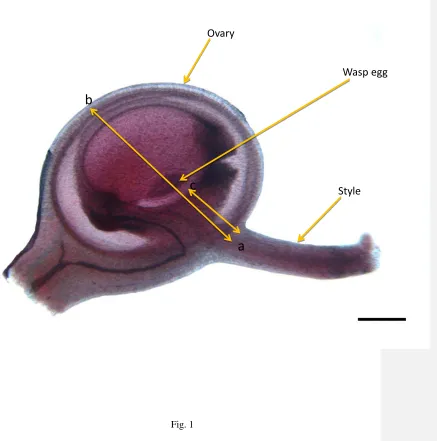
quarter were recorded (Fig. 1). 252
253
Data analysis 254
A generalized linear mixed-effect regression model (Lmer)was used with a Poisson error for 255
count data to determine whether there were significant differences in the numbers of 256
pollinators entering figs of F. asperifolia and F. montana, F1s and backcrosses to F. 257
montana.The fixed effect variables in the model were the different fig groups (F. montana, F. 258
asperifolia, F1s and backcrosses) with fig number and plant number as random effects. 259
GLMs, Wilcoxon rank-sum tests, t tests and nested ANOVA were all performed in R 260
(2.12.2). 261
262
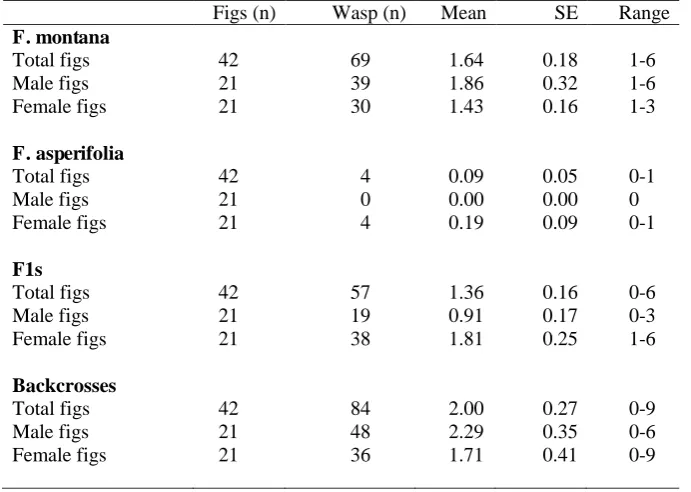
Results
263
Attraction to receptive figs and pollinator entry 264
Fig wasp foundresses are typically attracted to receptive figs of their host plants by volatiles 265
released during B phase, but not by receptive figs belonging to other species. In the 266
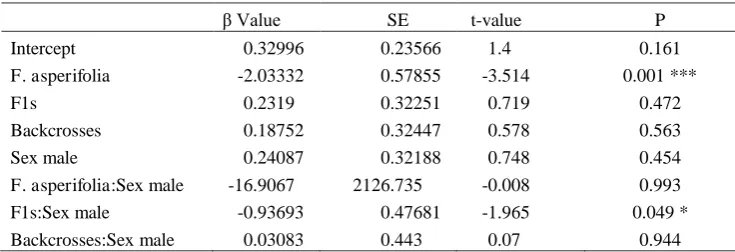
greenhouse environment, where plants with receptive figs were positioned close to each other 267
(Table 1), up to six K. tentacularis females entered male and female figs on F1 plants, in 268
similar numbers as in F. montana figs. Similarly, up to nine females entered backcross figs. 269
These results were in contrast to F. asperifolia figs, which at most were entered by a single 270
pollinator, and often remained un-entered (Table 1). Although the number of foundresses 271
groups (Table 1). Lmerdetected no significant difference in foundress numbers between F1s 273
and backcrosses with F. montana, but fig wasp densities were significantly lower in F. 274
asperifolia figs (Table 2).There was a significant difference after removing the plant sex 275
interaction term from the model and comparing the new model to the previous one, showing 276
that sex influenced the number of fig wasps that entered the figs (Lmer: X2= 9.53, df = 3, P < 277
0.05). 278
All the receptive figs of F. montana were entered by fig wasps, compared with less 279
than 10% of the F. asperifolia figs (X2= 65.79, df = 1, P < 0.001).Around 85 % of the F1 figs 280
were entered (Table 3), which was a significantly lower than for theF. montana figs (X2= 281
4.49, df = 1, P < 0.05). There was no significantdifference between backcrosses andF. 282
montana (X2= 1.38, df = 1, P = 0.24). 283
No female K. tentacularis were found trapped in the ostioles while facing inwards, 284
suggesting that all those pollinators that attempted to enter the figs did so successfully. Often 285
there were more pairs of wings at the entrance to the ostioles than wasps dead inside, because 286
K. tentacularis routinely re-emerge from the figs. 287
288
Ovipositor length constraints 289
After female fig wasps have managed to enter a receptive male fig they start laying eggs in 290
the female flowers by inserting their ovipositor along the length of their styles. Ovipositor 291
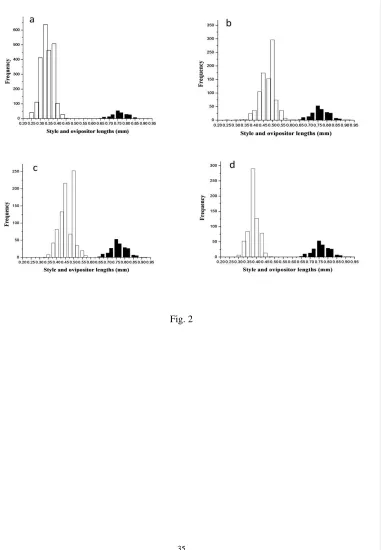
lengths of K. tentacularis ranged from 0.65 to 0.92 mm (Fig. 2). Comparisons of the 292
ovipositor lengths with the style lengths of female flowers in male figs of F. montana(its 293
natural host), F. asperifolia, F1s and backcrosses showed that the ovipositor of K. 294
tentacularis can potentially reach all the flowers in F1s, backcrosses and F. asperifolia, as 295
well as those of F. montana (Fig. 2). 296
Ability to lay eggs in atypical hosts and in female figs 298
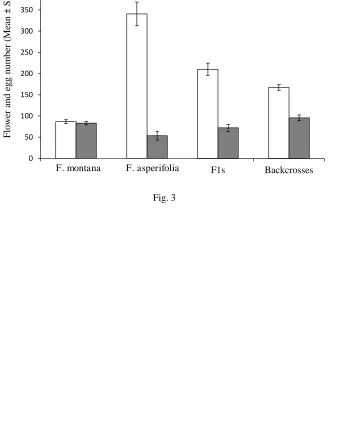
F. asperifolia, F1s and backcrosses had a higher number of female flowers in their male figs 299
than F. montana, with means ± SE of 340.47 ± 27.98, 209.88 ± 14.54 and 167.28 ± 6.61 300
respectively, compared with 86.64 ± 4.63 in F. montana (Fig. 3). There was a significant 301
difference in female flower numbers between the groups (nested ANOVA, F (3,14) = 10.3, P 302
< 0.001). Pairwise t teststhat compared female flowers number between groups showed that 303
differences between all groups were significant (P <0.05 between F1s and backcrosses and P 304
< 0.001 for other combinations). 305
Around 28200 fig flowers were examined for the presence of eggs. No K. 306
tentacularisadult offspring had ever emerged from male F. asperifolia and F1 figs in the 307
greenhouse populations, but the foundresses were found to have laid eggs in F1s, backcrosses 308
and F. asperifolia, as well as F. montana. Although figs of F. asperifolia, F1s and 309
backcrosses contained more female flowers than F. montana figs, the numbers of eggs laid by 310
a single foundress were about the same,with mean s of 53.47 ± 10.21, 72 ± 8.66 and 95.60 ± 311
6.87 respectively, compared with 83.16 ± 4.25 eggs in F. montanafigs. There was no 312
significant difference in the numbers of eggs laid (nested ANOVA, F (3, 14) = 1.99, P = 313
0.16). 314
The egg occupancy rates in F1 male figs entered by a single female ranged between 315
17.32% and 50.59% of the female flowers (Table 4), compared with 36.71% to 86.91% in 316
backcrosses, 7.65% to 20.41% in F. asperifolia and 94.8 to 98.2% in F. montana.When two 317
female fig wasps were introduced into the receptive figs, the lowest occupancy rate was in 318
F1s (41.41 to 66.61%) followed by backcrosses (66.71 to 88.24%) and F. montana (77.2 to 319
96.9%). No two-foundressdata are available for F. asperifolia. 320
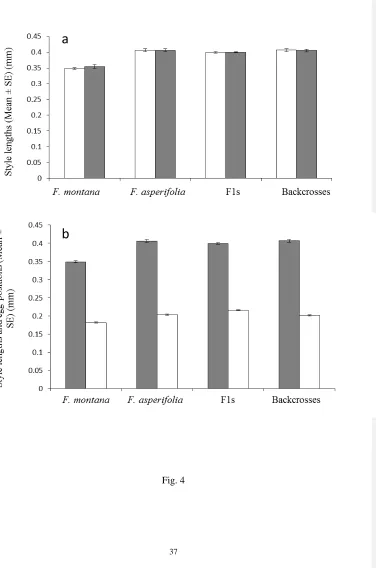
There were no significant differences in the style lengths of flowers that contained 321
asperifolia (Wilcoxon RS, W = 8504.5, P = 0.57), F1s (Wilcoxon RS, W = 29437.5, P = 323
0.64) and backcrosses (Wilcoxon RS, W = 30153.5, P = 0.73, Fig. 4a). Eggs numbers per 324
ovary ranged from 0 to 2, but most ovaries contained only one egg. In F. asperifolia(when 325
one wasp was introduced),most flowers were empty (84%) and no flowers were recorded 326
with double oviposition (Table 4). In F1s, about halfthe flowers contained one egg or were 327
without eggs when either one or two femaleswere introduced,and only three ovaries were 328
recorded with two eggs (Table 4). In backcrosses the proportion of flowers containing eggs 329
was higher than in F1 figs,with around 60%utilized when one wasp was introduced and 80% 330
when two wasps were introduced, but only four flowers were recorded with two eggs (Table 331
4). In F. montana, the normal host for K tentacularis, double oviposition was again rare with 332
only 24 examples among the 4432 female flowers examined (Table 4). The positions of the 333
eggs inside the ovaries were similar in all groups (Fig. 1)with no significant differences in 334
location between the groups. The positions rangedfrom 0.12 to 0.32mm in F. montana, 0.17 335
to 0.25mm in F. asperifolia, 0.15 to 0.27 mm in F1s and 0.15 to 0.25 mm in backcrosses. 336
There was no significant interaction effect between style length, plant group and egg position 337
(Mixed effect modelsall P > 0.05) (Fig. 4b). 338
There were no typical eggs found in the 2723 female flowers from female figs ofF. 339
montana,that were examined, but a single egg of atypical shape and position was found in 340
one ovary. 341
342
Ability to gall 343
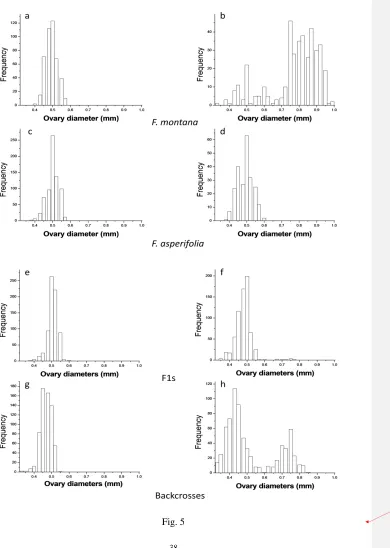
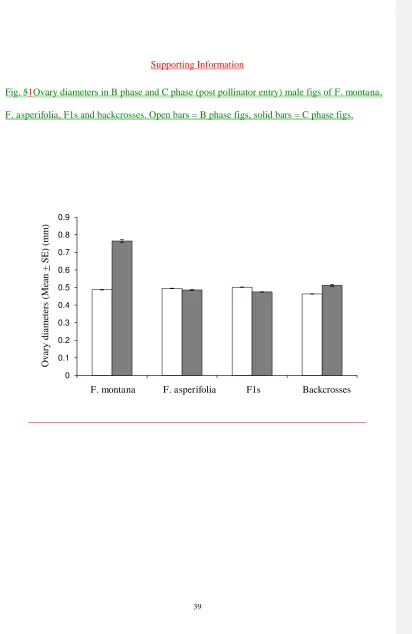
Ovaries in B phase figs of F. montanawere 0.48 mm ± 0.001 in diameter (n = 440), compared 344
with 0.76 mm ± 0.007 in C phase figs (n = 393), after the ovaries had responded to 345
oviposition and galling. In F1 figs, the mean diameter of the ovaries shrank over time (0.50 ± 346
5Supporting Information Figure 1)), but a small number of ovaries had started to expandafter 348
pollinator entry and had reached between 0.6and 0.7mm in diameter (Fig. 56). These 349
enlarged ovaries were only detected in two figs, both collected from the same plant. In 350
backcrosses, the overall measurements of the ovaries in B phase were 0.46 mm ± 0.001 (n = 351
643) and 0.51 mm ± 0.005 in C phase (n = 714). Many ovaries in these figs had started to 352
develop after pollinator entry and were larger than 0.45 mm, the maximum ovary diameter 353
recorded in B phase backcross figs. In contrast, there was no evidence of ovary expansion 354
after oviposition in F. asperifolia figs, where the ovary diameters were 0.50 mm ± 0.001 (n = 355
712) in B phase figs and 0.49 mm ± 0.003 at C phase (n = 746). 356
In F. montana there was a significant increase in the ovary diameters of female 357
flowers between B and C phases (Wilcoxon RS, W = 14976, P< 0.001), whereas there was a 358
significant decline in ovary diameters from B to C phases in F1 figs (W = 355075, P <0.001). 359
In backcrosses and F. asperifolia there was no significant difference between ovary diameters 360
of female flowers in B and c phase figs (W = 240326.5, P = 0.13 and W = 274183, P = 0.27, 361
respectively). 362
363
Discussion
364
The floral scents emitted by receptive figs vary sufficiently between stages and between 365
species for pollinators to be attracted to their specific host species at the particular time when 366
the figs are ready to be pollinated (Raguso, 2008; Soleret al., 2010, but see Zhang et al., 2014 367
for an apparent exception). K. tentacularis routinely pollinates F. montana and flying females 368
of this species are attracted to its receptive figs, but probably not at all to receptive figs of 369
the closely related F. asperifolia. Under greenhouse conditions small numbers of K. 370
tentacularisfemales nonetheless do land on F. asperifolia figs and attempt to enter them. 371
the two Ficus species in the closed environment of the glasshouses. In nature, even if the 373
species were sympatric and showed similar habitat preferences, the differences in volatiles 374
released by the figs would be sufficient to make chance encounters between K. 375
tentacularisand F. asperifolia figs extremely rare. A proportion of these rare encounters may 376
nonetheless result in K. tentacularis entering the figs, as has been documented with other fig 377
wasp species (Ware and Compton 1992; van Noortet al.,2013), and small numbers of K. 378
tentacularis also entered figs of another related fig tree (F. sandanakanaBerg) in the 379
glasshouses (S. Ghana, personal observations). The specific chemical compounds released by 380
the receptive figs of the two species (Proffit et al., 2009; Soler et al., 2011) are therefore 381
highly effective at preventing pollen flow from F. montanato F. asperifolia, but would not 382
represent an absolute barrier in situations where the two plant species were sympatric. Given 383
the evident difference in volatile profiles of the two species, it is likely that pollen flow in the 384
other direction, mediated by the pollinator of F. asperifolia, would be similarly restricted. 385
The willingness of pollinator females to attempt entry into figs can be influenced by 386
cues on the surface of receptive figs that are independent of the volatiles responsible for long-387
distance attraction (Wang et al., 2013). K. tentacularisfemales placed experimentally on the 388
surface of receptive F. asperifoliafigs were generally disinterested in entering them, but some 389
entries did nonetheless take place when receptive figs were available for long periods in the 390
glasshouses. Rubbing receptive F. montanafigs on the surface of the F. asperifolia figs had 391
a strong effect on pollinator entry, by stimulating the females to seek out the ostiole. This 392
involved an increase in speed of walking and antennal drumming on the fig surface while 393
they were apparently seeking out the narrow entrance provided by the ostiole. The stimuli 394
provided by the F. montana figs may have been the same volatiles that are responsible for 395
long distance attraction, less volatile compounds emanating from the fig surface, or a 396
The ostiole of figs is often regarded as a physical filter that can trap female pollinators 398
that are associated with different species of fig trees (van Noortand Compton, 1996), but K. 399
tentacularis females that attempted entry into F. asperifolia figs apparently had no problems 400
passing through the ostiole, because no dead females were found in the ostiole facing 401
inwards. The females routinely re-emerge from figs of F. montana and the same behaviour 402
was observed among females that had entered F. asperifolia figs. 403
Female K. tentacularis that entered male figs of F. asperifoliawere able to lay as 404
many eggs as those that entered F. montana figs. The former contained more flowers, all of 405
which were accessible to the females based on their style lengths, but these additional 406
resources probably could not be utilisedbecauseof the limited egg loads of the single 407
pollinators that were introduced.Any differences between the species in terms of ease of 408
oviposition were apparently unimportant. The ease with which K. tentacularis laid eggs in 409
figs of F. asperifoliacontrasts strongly with its ability to induce growth in the ovaries where 410
the eggs were laid. Whereas galled ovules in F. montana figs rapidly expanded, there was no 411
apparent response from the ovules of F. asperifolia, and no successful development of fig 412
wasp larvae. In contrast to this inability to generate galls, the lack of K. tentacularis offspring 413
in female figs of its routine host species, F. montana results from an almost total inability to 414
deposit eggs in the ovules of female figs, reflecting their flowers’ longer styles and different 415
stigma structure (Shi et al., 2006). 416
Artificial hybrid crosseshave been generated between some fig tree species and an 417
increasing number of examples of putative hybrid fig trees are being recorded from natural 418
environments (Condit, 1950; Parrish et al., 2003; Kusumiet al., 2012). F1 hybrids between 419
F. montana and F. asperifolia, and backcrosses to F. montana, provided indications of how 420
some of the plant characters associated with pollination can be inheritedin hybrid offspring 421
hybridisation. F1s between plant species often have volatile profiles intermediate between 423
those of their parents (Schnitzler et al., 2004; Salzmann et al., 2007; Shuttleworth and 424
Johnson, 2010). Chemical analysis of the volatiles released from receptive F1s and 425
backcrosses suggests that the overall volatile profiles were more similar to those of F. 426
asperifolia thanF. montana (C. Soler, personal communication), but clearly the hybrids 427
inherited the key compounds that made the figs attractive to K. tentacularis.The F1hybrids 428
were also closer to the female parents in terms of mean style lengths, but the number of 429
flowers in thefigs was more intermediate. As expected, the floral characters of backcrosses 430
tended to be closer to F. montana. 431
Hybrid figs were just as attractive as F. montana to K. tentacularis females and just as 432
many eggs were laid in the hybrid figs, but no fig wasp offspring have been seen to develop 433
in any of the F1 figs maintained in the glasshouses, despite small numbers of ovaries on one 434
of the experimental plants showing signs of expansion in response to galling. Premature 435
abortion of any F1 figs that contained the very small numbers of galls appears to have been 436
responsible. In contrast to F1 plants, ovules in figs of backcrosses to F. montana showedgall 437
development, though more rarely and not to the same extent as ovules inside figs of F. 438
montana, and some of the backcross plants were able to support the successful development 439
of pollinator offspring. 440
Species specific volatiles released from receptive figs and the responses of pollinator 441
fig wasps to them are clearly the major source of host specificity in the fig tree: fig wasp 442
mutualism, because they greatly reduce the chances that fig wasp females will land on figs 443
belonging to species other than their routine hosts. Chance encounters result in fig wasps 444
having the opportunity to attempt fig entry. Whether or not they do so may depend on short-445
range stimuli from the surface of the figs, but the list of examples where pollinators are 446
1992).After negotiating the ostiole, so long as the style lengths of the flowers in the male figs 448
are not too long (Nefdt and Compton, 1996), then our results suggest that egg deposition is 449
likely to occur, but for reproduction to be successful the female must also be able to 450
successfully induce gall formation in the ovules where she lays her eggs. Gall-forming insects 451
are often highly host specific, with unpredictable abilities to gall hybrids with their usual 452
hosts (Skuhravy et al., 1997). If the inability the pollinator of F. montana to induce galls in 453
even a closely related species is typical of most fig wasps, then the ability to form galls could 454
be considered as the ultimate factor limiting the host range of these pollinators. However, 455
results from another fig tree suggest that it is not always the case. F. microcarpaL. f. is an 456
Asian fig tree introduced to South Africa, where it has no very close relatives. Despite this, 457
small numbers of two native African pollinator fig wasps, belonging to a different genus from 458
its usual pollinator, have been reared from its figs, showing that they can successfully form 459
galls (van Noortet al.,2013). 460
461
Acknowledgements 462
Dr. Finn Kjellberg (CNRS, Montpellier, France) suggested the technique for stimulating 463
pollinator entry in atypical host figs. This research was funded by the Libyan Higher 464
Education Ministry. The admirable serviceof maintaining fig and fig wasppopulations at the 465
Leeds University Experimetal Gardens was provided by Martin Lappage.We also 466
acknowledge anonymous refrees, Associate Editor and the Editor in Chief of the journal for 467
their valuabe suggestions in improving the manuscript. 468
469
References 470
Berg, C. C. & Corner, E. J. (2005) Flora Malesiana, Vol. 17 Part 2. Moraceae – Ficus. 471
Berg, C. C. & Wiebes, J. T. (1992) African fig trees and fig wasps, Verhandelingen 473
Afdeling Natuurkunde, Tweede Reeks, Deel 89. 474
Bronstein, J. L. (1987) Maintenance of species-specificity in a neotropical fig-pollinator 475
wasp mutualism. Oikos,48, 39-46. 476
Compton, S. G. Ball, A. D. Collinson, M. E. Hayes, P. Rasnitsyn, A. P. & Ross, A. J. (2010) 477
Ancient fig wasps indicate at least 34 Myr of stasis in their mutualism with fig trees. 478
Biology Letters,6, 838-842. 479
Compton, S. G. Grehan, K. & van Noort, S. (2009) A fig crop pollinated by three or more 480
species of agaonid fig wasps. African Entomology,17, 512-222. 481
Cruaud, A. Rønsted, N. Chantarasuwan, B. Chou, L.S. Clement, W.L. Couloux, A. Cousin, S. 482
B. Genson, G. Harrison, R.D. Hanson, P.E. Hossaert-McKey, M. Jabbour-Zahab, R. 483
Jousselin, E. Kerdelhué, C. Kjellberg, F. Lopez-Vaamonde, C. Peebles,J. Peng, Y-Q. 484
Pereira, R.A. Schramm ,T. Ubaidillah,R. van Noort, S. Weiblen, G.D. Yang, D.R. 485
Yodpinyanee,A. Libeskind-Hadas, R. Cook, J.M. Rasplus, J.Y.&Savolainen, V. 486
(2012) An extreme case of plant-insect codiversification: figs and fig-pollinating 487
wasps.Systematic Biology,6, 1029-47. 488
Condit, I.J. (1950). An interspecific hybrid in Ficus. Journal of Heredity,41,165-168. 489
Cook, J. M. & Rasplus, J. (2003) Mutualists with attitude: coevolution fig wasps and figs. 490
Trends in Ecology and Evolution,18, 241-248. 491
Cook, J. M. & Segar, S. T. (2010) Speciation in fig wasps. Ecological Entomology,35, 54-66. 492
Corlett, R. T. Boudville, V. & Seet, K. (1990) Seed and Wasp Production in Five Fig Species 493
(Ficus, Moraceae). Malayan Nature Journal,44, 97-102. 494
Dreger-Jauffret, F. & Shorthouse, J. D.(1992) Diversity of gall-inducing insects and their 495
Galil, J. & Eisikowitch, D. (1968) Further studies on the pollination ecology of Ficus 497
sycomorus. Tijdschrift voor Entomologie, 112, 1-13. 498
Ghana, S. (2012)Experimental studies of hybridization in fig trees (Ficus spp., Moraceae) and 499
their pollinators. PhD thesis. University of Leeds, UK. 500
Ghana, S. Suleman, N.&Compton, S. G. (2012) Factors influencing realized sex ratios in fig 501
wasps: double oviposition and larval mortalities. Journal of Insect Behavior,25, 254-502
263. 503
Grison-Pige, L. Bessier, J. M. & Hossaert- McKey, M. (2002) Specific attraction of fig-504
pollinating wasps: Role of volatile compounds released by tropical figs. Journal of 505
Chemical Ecology,28, 283-295. 506
Grison-Pige, L. Bessier, J. M. Turlings, T. C. Kjellberg, F. Roy, J. & Hossaert- Mckey, M. 507
(2001) Limited intersex mimicry of floral odour in Ficus carica. Functional 508
Ecology,15, 551-558. 509
Gu, D. Compton, S.G. Peng, Y. Q& Yang, D. R. (2012) ‘Push’ and ‘Pull’ responses by fig 510
wasps to volatiles released by their host figs. Chemoecology,22, 217-227. 511
Hardy, N. B. & Cook, L. G. (2010) Gall-induction in insects: evolutionary dead-end or 512
speciation driver. BMC Evolutionary Biology,10, 257-264. 513
Harrison, R. D. (2005) Figs and the diversity of tropical rainforests. Bioscience,55, 1053-514
1064. 515
Harrison, R. D. (2006) Maintenance of specificity in an isolated fig. Biotropica,39, 275-277. 516
Janzen, D. H. (1979) How to be a fig. Annual Review of Ecology and Systematics,10, 13-51. 517
Jansen-González, S.Teixeira, S. de P. Kjellberg, F. Pereira, R.A.S. (2014)Same but different: 518
Larval development and gall-inducing process of a non-pollinating fig wasp compared 519
Jousselin, E. Hossaert- Mckey, M. Herre, E. A. & Kjellberg, F. (2003) Why do fig wasps 521
actively pollinate monoecious figs? Oecologia,134, 381-387. 522
Jousselin, E. & Kjellberg, F. (2001) The functional implications of active and passive 523
pollination in dioecious figs. Ecology Letters,4, 151-158. 524
Jousselin, E. Rasplus, J. & Kjellberg, F. (2001) Shift to mutualism in parasitic lineages of the 525
fig/fig wasp interaction. Oikos,94, 287-294. 526
Kusumi, J. Azuma, H. Tzeng, H-Y. Chou, L-S. Peng, Y-Q. Nakamura, K. & Sua, Z-H 527
(2012) Phylogenetic analyses suggest a hybrid origin of the figs (Moraceae: Ficus) 528
that are endemic to the Ogasawara (Bonin) Islands, Japan. Molecular Phylogenetics 529
and Evolution,63, 168-179. 530
Khan, Z. R. & Saxena, R. C. (1986) Technique for locating planthopper (Homoptera: 531
Delphacidae) and leafhopper (Homoptera: Cicadellidae) eggs in rice plants. Journal 532
of Economic Entomology,79, 271-273. 533
Kjellberg, F. Jousselin, E. Bronstein, J. L. Patel, A. Yokoyama, J. & Rasplus, J. (2001) 534
Pollination mode in fig wasps: the predictive power of correlated traits. Proceedings 535
of the Royal Scoiety of London Series B- Biological Sciences,268, 1113-1121. 536
Kjellberg, F. Tayou, A. Hossaert-McKey, M. Suleman, N. Raja, S.&Compton, S.G. (2014) 537
Some pollinators are more equal than others: Factors influencing pollen loads and 538
seed set capacity of two actively and passively pollinating fig wasps. Acta 539
Oecologica,57, 73-79. 540
Lin, R. Yeung, C. Fong, J. J. Tzeng, H. & Li, S. (2010) The lack of pollinator specificity in a 541
dioecious fig tree: sympatric fig-pollinating wasps of Ficus septica in southern 542
Taiwan. Biotropica,43, 200-207. 543
Liu C, Yang D-R, Compton SG, Peng Y-Q (2013) Larger fig wasps are more careful 544
Marussich, W. A. & Machado, C. A. (2007) Host-specificity and coevolution among 546
pollinating and nonpollinating New World fig wasps. Molecular Ecology,16, 1925-547
1946. 548
Matsukura, K. Matsumura, M. & Tokuda, M. (2009) Host manipulation by the orange 549
leafhopper Cicadulina bipunctata: gall induction on distant leaves by dose-dependent 550
stimulation. Naturewissenschaften,96, 1059-1066. 551
Miles, P. W. (1968) Insect secretions in plants. Annual Review of Phytopathology,6, 137-164. 552
Molbo, D. Machado, C. A. Sevenster, J. G. Keller, L. & Herre, E. A. (2003) Cryptc species of 553
fig-pollinating wasps: Implications for the evolution of the fig-wasp mutualism, sex 554
allocation, and precision of adaptation. Proceedings of the National Academy of 555
Science of the United States of America,100, 5867- 5872. 556
Moe, A.M. & Weiblen G.D. (2012) Pollinator-mediated reproductive isolation among 557
dioecious fig species (Ficus, Moraceae). Evolution,66, 3710-3721. 558
Nefdt, R. C. & Compton, S. G. (1996) Regulation of seed and pollinator production in the 559
fig-fig wasp mutualism. Journal of Animal Ecology,65, 170-182. 560
Parrish, T. L. Koelewijn, H. P. & Dijk, P. J. (2003) Genetic evidence for natural hybridization 561
between species of dioecious Ficus on Island Populations. Biotropica,35, 333-343. 562
Pellmyr, O. & Huth, C. J. (2002) Evolutionary stability of mutualism between yuccas and 563
yucca moths. Nature,372, 257-260. 564
Proffit, M. Chen, C. Soler, C. Bessiere, J. Schatz, B. & Hossaert-Mckey, M. (2009) Can 565
chemical signals, responsible for mutualistic partner encounter, promote the specific 566
exploitation of nursery pollination mutualisms?- The case of figs and fig wasps. 567
Entomologia Experimentalis et Applicata,131, 46-57. 568
Proffit, M. Schatz, B. Bessiere, J. Chen, C. Soler, C. & Hossaert- Mckey, M. 569
figs of Ficus hispida before, during and after the phase of receptivity to pollinators. 571
Symbiosis,45, 15-24. 572
Raguso, R. A. (2008) Wake up and smell the roses: the ecology and evolution of floral scent. 573
Annual Review of Ecology Evolution and Systematics,39, 549-569. 574
Raja, S. Suleman, N. & Compton, S. G. (2008a). Why do fig wasps pollinate female figs? 575
Symbiosis,45, 25-28. 576
Raja, S. Suleman, N. Compton, S. G. & Moore, J. C. (2008b). The mechanism of sex ratio 577
adjustment in a pollinating fig wasp. Proceedings of the Royal Society of London. 578
Series B: Biological Sciences,275, 1603-1610. 579
Raman, A. (2007) Insect-induced plant galls of India: unresolved questions. Current 580
Science,92, 748-757. 581
Raman, A. Cruz, Z. T. Muniappan, R. & Reddy, G. V. P. (2007) Biology and host specificity 582
of gall-inducing Acythopeus burkhartorum (Coleoptera: Curculionidae), a biological-583
control agent for the invasive weed Coccinia grandis (Cucurbitaceae) in Guam and 584
Saipan. Tijdschrift voor Entomologie,150, 181-191. 585
Ramirez, B. W. (1970) Host specificity of fig wasps (Agaonidae). Evolution,24, 680-691. 586
Ramirez, B. W. (1974) Coevolution of Ficus and Agaonidae. Annals of Missouri Botanical 587
Garden,61, 770-780. 588
Ramirez, B. W. & Montero, S. J. (1988) Ficus microcarpa L., F. benjamina L. and other 589
species introduced in the New World, their pollinators (Agaonidae) and other fig 590
wasps. Revista de Biologia Tropical,36, 441-446. 591
Roskam, J. C.(1992) Evolution of the gall-inducing guild. Biology of Insect-Induced Galls. 592
Oxford University Press. 593
Salzmann, C. C. Cozzolino, S. &Schiestl, F. P. (2007) Floral scent in food-deceptive orchids: 594
Sanver, D. & Hawkins, B. A. (2000) Galls as habitats: the inquiline communities of insect 596
galls. Basic and Applied Ecology,1, 3-11. 597
Schnitzler, J. P. Steinbrecher, R. Zimmer, I. Steigner, D. & Fladung, M. (2004) Hybridization 598
of European oaks (Quercus ilex x Q. robur) results in a mixed isoprenoid emitter type. 599
Plant, Cell and Environment,27, 585-593. 600
Shi, Z-H. Yang, D.-R. & Peng, Y.-Q. (2006) The style- length of the female florets and their 601
fate in two dioecious species of Xishuangbanna,China.Trees,20, 410-415. 602
Shorthouse, J. D. Wool, D. & Raman, A. (2005) Gall-inducing insects - nature's most 603
sophisticated herbivores. Basic and Applied Ecology, 6, 407-411. 604
Shuttleworth, A. & Johnson, S. D. (2010) Floral scents of chafer-pollinated asclepiads and a 605
potential hybrid. South African Journal of Botany,76, 770-778. 606
Skuhravy, V. Skuhrava, M. & Brewer, J. W. (1997) Gall midges (Dipt., Cecidomyiidae) 607
associated with Populus tremula, P. tremuloides and their hybrid (Salicaceae). 608
Journal of Applied Entomology,121, 315-320. 609
Soler,C. Proffit, M. Chen,C. & Hossaert-McKey, M. (2010) Private channels in plant-610
pollinator mutualisms. Plant Signaling and Behavior,5, 893-895. 611
Soler, C. Hossaert- Mckey, M. Buatois, B. Bessier, J. Schatz, B. & Proffit, M. (2011) 612
Geographic variation of floral scent in a highly specialized pollination mutualism 613
Phytochemistry72, 74-81. 614
Stone, G. N. & Schonrogge, K. (2003) The adaptive significance of insect gall morphology. 615
Trends in Ecology and Evolution,18, 512-522. 616
Stone, G. N. Schonrogge, K. Atkinson, R. J. Bellido, D. & Pujade-Villar, J. (2002) The 617
population biology of oak gall wasps (Hymenoptera: Cynipidae). Annual Review of 618
Suleman, N. (2007) Population biology of a fig plant-pollinator and parasitoid system under 620
laboratory conditions. Ph.D., University of Leeds, UK. 621
Suleman, N. Raja, S. & Compton, S. G. (2011a) A comparison of growth and reproduction, 622
under laboratory conditions, of males and females of a dioecious fig trss. Plant 623
Systematics and Evolution,296, 245-253. 624
Suleman, N. Raja, S. & Compton, S. G. (2011b) Sexual differences in the attractiveness of 625
figs to pollinators: females stay attractive for longer. Ecological Entomology,36, 417-626
424. 627
Suleman, N. Raja, S.&Compton, S. G. (2012) Only pollinator fig wasps have males that 628
collaborate to release their females from figs of an Asian fig tree. Biology Letters, 8, 629
344-346. 630
Suleman, N.Quinnell, R. J.&Compton, S. G. (2013a) Variation in inflorescence size in a 631
dioecious fig tree and its consequences for the plant and its pollinator fig wasp. Plant 632
Systematics and Evolution,299, 927-934. 633
Suleman, N. Raja, S.Quinnell, R. J.& Compton, S. G. (2013b) Putting your eggs in several 634
baskets: oviposition in a wasp that walks between several figs. 635
EntomologiaExperimentalis et Applicata,149,85-93. 636
Suleman, N. Raja,S. & Compton, S.G. (2013c) Parasitism of a pollinator fig wasp: mortalities 637
are higher in figs with more pollinators, but are not related to local densities of figs. 638
Ecological Entomology, 38, 478-484. 639
Suleman, N. Quinnell, R. J.&Compton,S. G.(2014) Floral ratios in the figs of Ficus montana 640
span the range from actively to passively pollinated fig trees. Acta Oecologica,57, 641
Tarachai, Y. Pornwiwan, P. Wattana, T. & Compton, S.G. (2012) The distribution and 643
ecology of the purple form of Ficus montana in western Thailand. Thai Forest 644
Bulletin (Botany),40, 26-30. 645
Tarachai, Y. Compton, S. G. & Trisonthi, C. (2008) The benefits of pollination for a fig 646
wasp. Symbiosis,45, 29-32. 647
Tooker, J.F. & De Moraes, C.M.(2008) Gall insects and indirect plant defenses: A case of 648
active manipulation? Plant Signaling and Behavior,3, 503-504. 649
Valdeyron, G. & Lloyd, D. G. (1979) Sex differences and flowering phenology in the 650
common fig, Ficus carica L. Evolution,33, 673-685. 651
van Noort, S. & Compton, S. G. (1996) Convergent evolution of agaonine and sycoecine 652
(Agaonidae, Chalcidoidea) head shape in response to the constraints of host fig 653
morphology. Journal of Biogeography,23, 415-424. 654
van Noort, S. Wang, R. & Compton, S.G. (2013) Fig wasps (Hymenoptera: Chalcidoidea: 655
Agaonidae, Pteromalidae) associated with Asian fig trees (Ficus, Moraceae) in 656
southern Africa: Asian followers and African colonists. African Invertebrates,54, 657
381- 400. 658
vanNoort, S. Ware, A.B. & Compton, S.G. (1989) Release of pollinator-specific volatile 659
attractants from the figs of Ficusburtt-davyi. South African Journal of Science,85, 660
323-324 661
Verkerke, W. (1986) Anatomy of Ficus ottoniifolia (Moraceae) syconia and its role in the fig-662
fig wasp symbiosis. Proceedings of the Koninklijke Nederlandse Akademie van 663
Wetenschappen,89, 443-469. 664
Wang, G. Compton, S.G. & Chen, J. (2013) The mechanism of pollinator specificity between 666
two sympatric fig varieties: a combination of olfactory signals and contact cues. 667
Annals of Botany,111, 173-181. 668
Ware, A. B. & Compton, S. G. (1992) Breakdown of pollinator specificity in an African fig 669
tree. Biotropica,24, 544-549. 670
Ware, A. B. and Compton, S. G. (1994) Responses of fig wasps to host plant volatile cues. 671
Journal of Chemical Ecology,20, 785-802. 672
Weis, A. E. Walton, R. &Crego, C. L. (1988) Reactive plant tissue sites and the population 673
biology of gall makers. Annual Review of Entomology,33, 467-486. 674
Wool, D. (2005) Differential colonization of host trees by galling aphids: Selection of hosts 675
or selection by hosts? Basic and Applied Ecology,6, 445-451. 676
Zhang, Y. Peng, Y.Q. Yang, D. R. & Compton, S.G. (2014) Premature attraction of 677
pollinators to inaccessible figs of Ficus altissima: a search for ecological and 678
evolutionary consequences. PLoS ONE 9-(1)e86735. 679
Fig.1A female flower from a male F1hybrid fig, showing the presence of an egg laid by K. 681
tentacularis. Ovary diameter was measured from a to b. Egg position distance was measured 682
from a to c. The scale bar represents 0.1 mm. 683
Fig. 2 The relationship between the ovipositor lengths of F. montana’s pollinator (solid bars) 684
and style lengths in male figs of a) F. montana b) F. asperifolia c) F1s and d) backcrosses to 685
F. montana. 686
Fig. 3Female flower numbers in male figs of F. asperifolia, F. montana and their hybrids, and 687
the numbers of eggs laid by K. tentacularisfoundresses. Open bars = flower numbers, solid 688
bars = egg numbers. 689
Fig.4 (a)Style lengths from flowers with and without eggs. Open bars = flowers that 690
contained eggs, solid bars = flowers that contained no eggs (b) Style lengths and egg 691
positions in F. montana, F. asperifolia and their hybrids. Solid bars = style lengths, open bars 692
= egg positions. 693
Fig. 5Ovary diameters in B phase and C phase (post pollinator entry) male figs of F. 694
montana, F. asperifolia, F1s and backcrosses. Open bars = B phase figs, solid bars = C phase 695
figs. 696
Fig. 56Ovary diameters in female flowers from male figs of F. montana, F. asperifolia, F1s 697
and backcrosses. a) B phase b) C phase (after pollinator entry). 698
699
700
701
702
Table 1. The numbers of K. tentacularis females entering male and female figs in the general 704
glasshouse population. 705
706
Figs (n) Wasp (n) Mean SE Range
F. montana
Total figs 42 69 1.64 0.18 1-6
Male figs 21 39 1.86 0.32 1-6
Female figs 21 30 1.43 0.16 1-3
F. asperifolia
Total figs 42 4 0.09 0.05 0-1
Male figs 21 0 0.00 0.00 0
Female figs 21 4 0.19 0.09 0-1
F1s
Total figs 42 57 1.36 0.16 0-6
Male figs 21 19 0.91 0.17 0-3
Female figs 21 38 1.81 0.25 1-6
Backcrosses
Total figs 42 84 2.00 0.27 0-9
Male figs 21 48 2.29 0.35 0-6
Female figs 21 36 1.71 0.41 0-9
707
708
709
710
711
712
713
[image:31.595.59.405.197.443.2]Table 2. The minimal adequate generalized linear mixed-effects model with Poisson errors 715
for the number of wasps attracted to receptive figs and its interaction with plant sex when 716
compared withF. montana (intercept). 717
718
Value SE t-value P
Intercept 0.32996 0.23566 1.4 0.161
F. asperifolia -2.03332 0.57855 -3.514 0.001 ***
F1s 0.2319 0.32251 0.719 0.472
Backcrosses 0.18752 0.32447 0.578 0.563
Sex male 0.24087 0.32188 0.748 0.454
F. asperifolia:Sex male -16.9067 2126.735 -0.008 0.993 F1s:Sex male -0.93693 0.47681 -1.965 0.049 * Backcrosses:Sex male 0.03083 0.443 0.07 0.944
719
720
721
722
723
724
725
726
727
728
729
[image:32.595.48.416.219.345.2]Table 3. The numbers of figs entered by pollinator females and their densities in figs where 731
they were present. 732
733
Group Total figs Total figs entered Mean SE Range
F. montana 42 42 1.64 0.18 1-6
F. asperifolia 42 4 1.00 0.05 0-1
F1s 42 36 1.58 0.16 0-6
Backcrosses 42 39 2.15 0.27 0-9
734
735
736
737
738
739
740
741
742
743
744
745
746
Table 4. The distribution of K. tentacularis eggs within ovaries of Ficusmontana, F. asperifolia and their hybrids. Five figs with one
ortwo foundresses were examined from each tree. The contents of all the female flowers within these figs were recorded.
Species Tree One foundress Two foundresses
N
ovaries
Occupancy Eggs per flower
N
ovaries
Occupancy Eggs per flower
(%) Mean Variance Range (%) Mean Variance Range
F. montana 1 281 95.73 0.96 0.04 0-1 306 94.77 0.97 0.07 0-2
2 521 96.35 0.97 0.04 0-2 477 77.15 0.78 0.19 0-2
3 498 95.18 0.96 0.05 0-2 467 94.65 0.95 0.06 0-2
4 386 98.19 0.98 0.02 0-2 363 96.69 0.98 0.05 0-2
5 480 94.79 0.95 0.05 0-2 653 96.94 0.97 0.03 0-1
Total 2166 2266
F. asperifolia 1 2347 19.13 0.19 0.15 0-1 - - - - -
2 1112 20.41 0.2 0.16 0-1 - - - - -
3 1648 7.65 0.07 0.07 0-1 - - - - -
Total 5107
F1s 1 579 49.91 0.5 0.25 0-1 602 66.61 0.67 0.22 0-1
2 1020 50.59 0.5 0.25 0-1 884 52.04 0.52 0.25 0-1 3 1149 17.32 0.17 0.14 0-1 1473 41.41 0.41 0.24 0-1 4 1578 27.76 0.28 0.2 0-1 1330 44.89 0.45 0.25 0-1 5 921 38.87 0.39 0.24 0-2 842 44.42 0.44 0.25 0-2
Total 5247 5131
Backcrosses 1 999 58.16 0.58 0.24 0-1 1110 74.41 0.77 0.18 0-1 2 948 36.71 0.37 0.23 0-1 780 79.10 0.79 0.17 0-1 3 868 38.25 0.38 0.24 0-1 790 66.71 0.66 0.22 0-1 4 710 78.59 0.79 0.17 0-1 769 77.50 0.77 0.17 0-1
5 657 86.91 0.87 0.11 0-2 663 88.24 0.88 0.1 0-2
Wasp egg
Style
Ovary
a
b
[image:35.612.69.506.167.608.2]c
Fig. 3
0 50 100 150 200 250 300 350 400
F. montana F. asperifolia F1s Backcrosses
F
low
er
a
nd
eg
g
num
be
r
(Me
an
±
S
E)
Fig. 4
a
Fig. 5
[image:39.612.78.468.155.703.2]Supporting Information
Fig. 51Ovary diameters in B phase and C phase (post pollinator entry) male figs of F. montana,
F. asperifolia, F1s and backcrosses. Open bars = B phase figs, solid bars = C phase figs.
0 0.1 0.2 0.3 0.4 0.5 0.6 0.7 0.8 0.9
F. montana F. asperifolia F1s Backcrosses
Ov
ar
y
diam
eter
s
(Me
an
+
S
E)
(
m
m
)
[image:40.612.54.466.96.730.2]