This is a repository copy of Young Children as Wayfarers: Learning about Place by Moving
Through It.
White Rose Research Online URL for this paper:
http://eprints.whiterose.ac.uk/86870/
Version: Accepted Version
Article:
Hackett, A. (2015) Young Children as Wayfarers: Learning about Place by Moving Through
It. Children & Society. ISSN 0951-0605
https://doi.org/10.1111/chso.12130
This is the peer reviewed version of the following article: Hackett, A. (2015), Young
Children as Wayfarers: Learning about Place by Moving Through It. Children & Society.
doi: 10.1111/chso.12130, which has been published in final form at
http://dx.doi.org/10.1111/chso.12130. This article may be used for non-commercial
purposes in accordance with Wiley Terms and Conditions for Self-Archiving
(http://olabout.wiley.com/WileyCDA/Section/id-820227.html).
[email protected] https://eprints.whiterose.ac.uk/
Reuse
Unless indicated otherwise, fulltext items are protected by copyright with all rights reserved. The copyright exception in section 29 of the Copyright, Designs and Patents Act 1988 allows the making of a single copy solely for the purpose of non-commercial research or private study within the limits of fair dealing. The publisher or other rights-holder may allow further reproduction and re-use of this version - refer to the White Rose Research Online record for this item. Where records identify the publisher as the copyright holder, users can verify any specific terms of use on the publisher’s website.
Takedown
If you consider content in White Rose Research Online to be in breach of UK law, please notify us by
Young children as wayfarers: learning about place by moving through it
Abstract
This article describes the walking and moving of young children around places. It is
based on an ethnographic study of children aged between 24 and 36 months visiting
a museum. Drawing on Ingold’s (2007) concept of wayfaring, the author argues
movement through place creates embodied, tacit ways of knowing and experiencing
the world. This embodied and tacit knowledge is not well accounted for in dominant
models of how young children learn. In this study, wayfaring both enabled the
children to learn about places and routes, and led to the development of traditions, in
which collective meanings and actions were attached to particular locations.
Dr. Abigail Hackett
Post Doctoral Research Associate
Centre for the Study of Childhood and Youth
Interdisciplinary Centre of the Social Sciences (ICOSS)
The University of Sheffield
219 Portobello
Sheffield S1 4DP.
Tel: (+44) (0)114 222 8391
Young children as wayfarers: the importance of movement and time in how places
becoming meaningful to children
Drawing on a one year ethnographic study of children aged between 24 and 36 months
visiting a museum, this paper argues that the everyday practice of moving through a place
led to the development of rich child-led meanings and interpretations of that place. Drawing
on theories of place as being constituted by movement (Ingold, 2007), which itself has a
temporal dimension (Massey, 2005) I focus on the changing and shifting meanings of the children’s movement in place over the course of the one year study. This paper contributes to the literature on children’s embodied and sensory experience of place (Christensen, 2003; Harju, 2013; Rasmussen, 2004) by providing an example of moving and experiencing in a
place over the course of a year. During this time, an initially unfamiliar museum place
gradually became familiar and imbued with specific meanings for the children and families in
the study.
The research is concerned with the meaning making of children in the museum. As Willis
(2000: 3) writes, “meaning making is at theheart of human practices”. From a semiotic
perspective, Kress (1997) relates “meaning” to communication; for Kress, multimodal signs
combine meaning and form to communicate a message. Kress (1997: 3) is interested in “how children themselves seem to tackle the task of making sense of the world around them, and how they make their meanings in the world”. Meaning making is therefore both
something people (including children) transmit (communicating with others) and something
people do with the experiences they encounter (being in a place and making sense of it).
From this perspective, the children in the museum were simultaneously making sense of
their experiences and communicating about their experience, using for example, words,
gestures and their moving bodies (Hackett, 2014). Kress (2010) employs the term ‘affordances’ to discuss what is possible or easy to convey using a particular means. Affordances are shaped by a thing’s materiality, what it has previously been used for and
social norms and conventions attached to it. As the museum changed from an unknown to a
familiar place, I discuss the implications of this change for the affordances of the space for the children’s embodied meaning making.
The study consisted of a series of ten unstructured visits to a museum with two year old
children and their families. During the visits, the children mainly led the way through the
museum, running ahead, down and around the corridors. When something in the museum
caught their attention, the children tended to use movement to explore it, for example,
children’s movement in the museum as they become more familiar with the place, and reflects on the implications of this for research on very young children’s experience of places.
Children, place, embodiment
Tuan (1977), James (2000), Christensen (2003) and others have stressed the importance of
the sensory and situated for how children make sense of the world. Research on children’s
perspectives of place has highlighted the importance of materiality and embodied experience
(Bartos, 2013; Dicks and others, 2006; Rowsell, 2014). Recent work has explored this
relationship between materiality, place and childhood further through the concept of
intra-action between children and material environment (Hultman and Lenz Taguchi, 2010;
Somerville, 2015). Rasmussen and Smidt (2003: 88) argue that “the neighbourhood is in the children” in that local places are perceived by the children’s bodies and become part of their being and knowing.
Research has highlighted children’s own understandings of and meanings attached to place, which can be quite different and distinct from adult understandings and meanings (Harju,
2013; Rasmussen, 2004). For example, hidden and secret places can be important for
developing peer cultures and friendships (Christensen and Mikklesen, 2012; Skånfors and
others, 2009). Rasmussen (2004: 166) writes
Children’s places are created in different contexts, shaped in some instances for decidedly social reasons and in others for more
individually determined purposes. It must also be emphasized that ‘children’s places’ do not last forever; sometimes the relationship ceases, after a short period (as in hopscotch grids or chalk drawings)
and in other situations the relationship can last for years.
Visual research methods (Bartos, 2013; Burke, 2005; Hallden, 2003; Rasmussen and Smidt,
2003) and ethnographic methods of experiencing places with children (Christensen, 2003;
Procter, 2015) have been successfully used in order to understand the material, sensory and
tacit ways in which children experience and attach meaning to places. In addition, the role of
movement for how children get to know places has been highlighted (Christensen, 2003;
Christensen and Mikkelson, 2012). Christensen (2003: 16) argues for the importance of “the
and O’Brien (2003) stress the importance of children’s increasing independence and autonomy in being able to create their own routes through local neighbourhoods.
From an anthropological perspective, walking and movement are essential parts of lived
experience. For Ingold (2007) wayfaring, a coupling of “locomotion and perception” (p. 78), is “the most fundamental mode by which living beings, both human and non-human, inhabit the earth” (p. 81). Ingold’s (2008) work emphasises both the impermanency of boundaries and environments; people and animals move across the world’s surface in a “zone of
entanglement” (Ingold, 2008: 1807), meaning that both the environment and the people are continually changed by the act of moving through. Therefore, Ingold connects walking paths
with both ways of knowing and with continually creating place. Ingold (2007: 101) writes, “wayfaring, in short, is neither placeless nor place-bound but place making”. Therefore, place can be forged by moving through, and that paths taken through locations have a profound
impact on how they come to be known (see also Hall, 2009; Pink, 2007; Pink and others
2010; Vergunst, 2010). Pink (2007: 246) writes
Paths and routes are not simply functional routes that connect one
place to another, but are meaningful sensory and imagined places in
their own right.
Bringing together this anthropological work on movement and paths constituting place
(Ingold, 2007; Pink, 2007), with studies of children’s embodied experience, children’s
walking and running can be understood as an activity which constitutes their experience and
is ‘place making’. Theories of walking as knowing (Christensen and O’Brien, 2003; Ingold,
2007), perceived by the body and also becoming part of the body’s being and knowing
(Ingold, 2008; Rasmussen and Smidt, 2003), informed a consideration of children’s early
explorations of the museum.
Ingold (2007) considers the role of time in relation to these lines of movement from the perspective of ongoingness. The “walking, talking and gesticulating” (Ingold, 2007: 1) lines people make can be seen as one continuous line, beginning at birth and lasting the life
course. In many cultures, oral story and place-based movement lines are taken up from one
generation to the next, so that the ongoingness of lines extends beyond the human life
cycle. This sense of lines as providing a temporality and sense of continuous coming into being resonates with Massey’s (2005) theory of ‘throwntogetherness’. For Massey (2005) space is not fixed; as we move through the world, time moves on as space continually
children was dominated by constant movement; down the corridors, round the galleries, onto the exhibits and over the benches. Massey’s (2005) perspective of ‘throwntogetherness’ emphasises the progression of both time and space as the children and families made
repeated visits to the museum, and repeatedly moved through and around the space. The
next section outlines the study in more detail, and the role of movement in the field.
An ethnographic study of families in museums
This paper draws on an ethnographic study of young children’s visits to museums in
northern England with their families. In particular, the discussion in this paper centres on one
year of making repeated return visits with a group of families to one city museum. Five
families were involved in this part of the study, who made roughly monthly visits to a local
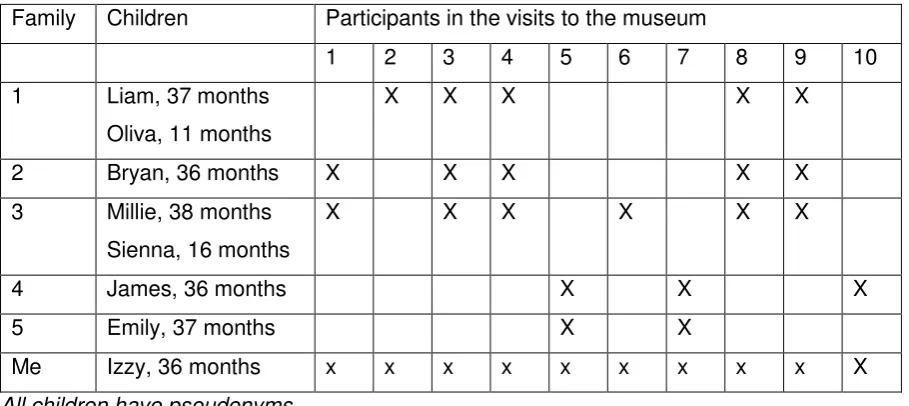
museum. I recruited the families through personal contacts. Table one summarises the
families involved in the study, which families came on which visit, the number of visits and
the ages of each of the children by the end of the study.
INSERT TABLE 1
The museum visits largely involved moving around the corridors and galleries of the
museum, often with the children in the lead, and the parents following. Movement was an
important part of the visit for the children, as was the embodied exploration of the museum,
including some of the exhibits and other aspects of the rooms such as uplighters and floor
grates. The visits tended to end when the children became tired or hungry, or the parents
decided the children would like to run outside in the park. This was an important aspect of
the ethical approach of the project; as well as parental consent, the assent of the young
children to be involved in the study (Cocks, 2006) was judged on a moment by moment
basis. Therefore it was important the fieldwork stopped when the children wanted it to.
During each museum visit, I accompanied the families as a participant observer. I used a
small hand held video camera during the visits, which I also passed to the parents to use at
times. The video camera was used in an unstructured way to record footage of the children
doing anything considered interesting or important during the visits. In addition to the visual
data, fieldnotes were written following each visit, and parental interviews carried out at home
towards the end of the study. Overall the data set consists of: Field visits to the museum: 10
Video recordings in the museum: 92 Parental interviews: 5
Throughout the fieldwork, I was accompanied by my own daughter Izzy, who was also aged
two years at the start of the study. This added an important dimension to the fieldwork,
beyond the rapport and friendship I was able to build up with participants through our shared
experiences of parenting a young child (Wylie, 1987). Having Izzy with me in the field
ensured my full participation in the embodied experience of the fieldwork. Similarly to the
other parents, I needed to follow and chase Izzy, and make sure she did not get lost, while
navigating the museum with pushchair and bags. This particular experience of moving
around the museum was a way of knowing which I shared with the families participating in
my research. When considering the walking, or the wayfaring (Ingold, 2007), of young
children, it becomes quickly apparent that young children rarely just walk. Young children
run, jump, dance, dive and climb. Very young children roll, crawl, cruise and creep. As I
experienced for myself in the field, parents of young children also rarely just walk; they
chase, push buggies, carry children and wear slings. They cajole their children along, they walk at a snail’s pace next to their toddler, they are pulled by the hand around the place by excited small people. Moving around and perceiving the museum in this way was a complex
embodied activity. In addition, the quality and meaning of this movement changed as the
visits progressed, as I will describe in the next section.
First visits to the museum: scoping the joint
On early visits to the museum, the museum was an unfamiliar place to the children, and they
discovered what the museum was like by walking around it. During early visits, the fieldnotes
record a practice I have termed ‘scoping the joint’, in which the young children tended to
move very fast around each room in turn, getting a sense of the place. The following extract
from field notes gives a sense of what this was like.
The children ran the length of the museum to the arctic gallery,
where they played for an extended period of time. After this, we went
to the natural history gallery, which they ran through quite quickly,
stopping only briefly, until they reached the art gallery. In the art
gallery, they stopped and Bryan and Millie spent 30 minutes drawing,
doing jigsaws and dancing (while Izzy continued to explore in the
natural history gallery). The visit ended with all three children in the
Fieldnotes16th June (first main field visit to the museum)
The emphasis in these fieldnotes on lines of movement, rather than bounded places, resonates with Ingold’s perspective of places as locations where many lines of movement come together, rather than disconnected dots on a map (Ingold, 2007: 84). Consequentially,
Ingold (2007: 88) emphasises walking as the primary means through which knowledge of
place is created, writing
Thus the knowledge we have of our surroundings is forged in the
very course of our moving through them, in the passage from place
to place and the changing horizons along the way.
Walking around the museum was an effective way for the children to find out about the
museum. Conceptualising the museum as consisting of lines of movement (Ingold, 2007)
foregrounded the space in between exhibits, rather than individual specific exhibits in which
the museum designers themselves might locate learning or engagement (e.g. Crowley and
others, 2001).
Learning the routes and creating traditions
As the study progressed, the regular visits to the museum resulted in the children becoming
more familiar with and confident in the museum. The children put a lot of effort into learning
routes around the museum, remembering the paths they needed to take to get to places that
were interesting to them. These observations resonate with Christensen’s (2003) description
of children’s focus on learning routes and paths around their local neighbourhood. In the
museum, the children tended to establish specific exhibits that were meaningful to them, which they could use as ‘waymarkers’ to both request to go to a specific location and as a way of remembering where things were. The vignette below describes an incident when
Emily remembered a specific detail from her previous visit to the museum, and worked hard
to recapture the route on her second visit.
Emily walks through the art gallery, looking around, and then
Treasures gallery, and then do not point anything out, I just say ‘is there anything in here, is this what you were looking for?’ She looks around, and points at a white statue in a case, she says ‘oh yes we saw that’ Then she walks to the end of the gallery, turns and walks back towards the statue. Next to the statue is the painting of Nelson
which we spent a long time looking at last time we visited. She says ‘yes we saw this we saw this!’ However, she only looks at the
painting briefly before wandering off.
Vignette drawn from fieldnotes, 3rd Sept
The above vignette gives a glimpse into the work children seemed to put in to trying to
remember the layout, routes and material aspects of the museum based on the previous
visits. Knowing the routes seemed important to the children. In addition, the parents involved
in the study often articulated a sense that their children wanted to know the routes. During the museum visit from which the above vignette is drawn, Emily’s mother commented to me “I know she is enjoying it because she knows where everything is.” The importance of their children’s growing familiarity with the museum was a theme which strongly emerged from the parental interviews (Hackett, 2012).
As the children began to know these routes, it became easier for them to influence how the
museum visits progressed. Increasingly on later visits, the children tended to lead the way,
running to the places they wanted to be with their peers, while the adults followed. This extract from fieldnotes is concerned with one of the ‘waymarkers’ in the museum, a stuffed polar bear. The fieldnotes illustrate how both verbal negotiation and knowledge of the route
played a part in Millie being able to visit the polar bear during this visit.
The mums began suggesting that we go for some lunch soon, but Millie said ’I want to see the polar bear’. I said ‘shall we go see the polar bear quickly then get some lunch? Do you know where it is?’ The children shouted ‘yes!’. And started running in a straight line very fast all the way through the natural history gallery to the arctic gallery,
where the polar bear was.
Fieldnotes 11th August
This example from my fieldnotes is representative of a repeated theme during the study, in
which the children used partly verbal request, but mostly bodily movement, to influence and
Processes of traditionalization in time and space
Through the processes of coming to be familiar with and learning the routes around the
museum described above, the children created and directed their own experience of the
museum. Walking the same routes to the same locations, repeatedly, gave prominence to
some parts of the museum over others. In these favourite locations, the children tended to
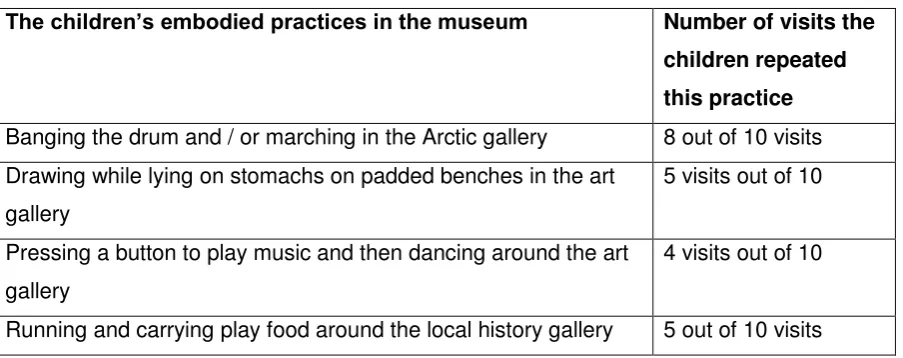
repeat certain kinds of actions over subsequent visits. As illustrated in table two, the
traditions the children established during the museum study were largely embodied and
mostly involved movement such as dancing, marching and running. The movement involved
in these traditions also meant that many of them dominated the space, for example marching
with the drum and dancing in the art gallery both involved considerable noise, and fast and
slow movement along paths which filled the available space.
INSERT TABLE 2
The striking repetition of these embodied practices over subsequent visits demonstrates the
repeated, imagined and collectively remembered nature of these practices. Repeated
embodied practices reference the ones that happened before. So for example, the fourth
time the children danced in the art gallery had a different meaning to the first time they did it.
The fourth time they danced in the art gallery could be understood as an embodied
expression of their familiarity with that place, and their memories of dancing there on the
previous visits. Ingold (2007) writes about the process of remembering through lines of
speaking, reading and walking. Re-walking the same paths or writing down traditional stories create “pathways along which the voices of the past could be retrieved and brought back into the immediacy of the present experience” (p.15). From this perspective, the children’s
repeated embodied movements in the museum were a “means of recovery” (p.15) through
which the children remembered and re-enacted meaningful aspects of past visits to the
museum.
Within folklore studies, traditions are understood as processes, rooted in the social and
enacted over time (Ben-Amos, 1984; Hymes, 1975). Hymes (1975) argues that all groups attempt to ‘traditionalize’ aspects of their culture, and this is achieved by performing the traditions, in order to keep them alive and pass them on to others. Since many traditions are
passed on by doing, the process of transmitting them also becomes a process of
became meaningful to a specific group of young children and their families, in particular
locations of the museum, over time.
In her discussion of the rhythms of lived time, Adam (2006) suggests that human cultural practices may serve to ‘arrest time’ by transcending the natural flow of time, or delineating it in new, human controlled ways. Lemke (2000) discusses the role of material objects or
places in disrupting or defining which timescales are most significant at a given moment. He
argues that objects can play a role in joining ideas across space and time, so that historically
or geographically distant ideas or events become relevant and powerful in the immediate
short term. Lemke gives an example of a Samurai warrior sword, imbued with the traditions
and teachings of generations, being used to behead one who insults the honour of the clan.
In this case, it is not only the material qualities of the sword that are relevant, but also the
long-time-scale meaning it carries and transfers with it across generations. These ideas are
relevant to the development of cultural patterns and processes in a classroom (or indeed, a
museum). Lemke (2000: 278) argues
Are there emergent processes and patterns in classrooms? I think
every teacher and student knows that there are. There are new
routines that emerge, new social groupings and the typical
interactions that sustain them, class in-jokes, informal rituals, typical
sayings and phrasings, favorite word usages with special meanings,
and so forth. These in turn can become the raw material for more
complex new patterns unique to the classroom, and they certainly
constrain the probabilities of actions and utterances that would
invoke these special meanings or contribute positively or negatively
to social relationships.
Lemke’s description of these processes is useful for thinking about the situated and temporal nature of the children’s traditions in the museum. From Lemke’s perspective, the material locations and things in the museum, (such as the Arctic gallery, the drum and drum sticks),
evoked for the children previous practices and patterns of behaviour. These remembered
visits and shared embodied experiences took on a significance or intensity, over and above,
for example, the many activities and experiences they had had outside of the museum in the
intervening month. In this way, the material qualities of the museum place evoked for the
children the embodied sensations and ways of knowing they had collaboratively developed
together on previous visits, allowing them to build on the meaning making which occurred in
In the next section, I focus on one tradition, marching with the drum in the Arctic gallery, and
discuss how it was both reproduced and modified by the children over eight different visits to
the museum. The way in which the children modified marching with the drum on the later
visits gives a further perspective on the significance of ‘traditionalization’ for children’s
emplaced practices in time and place.
The affordances of emplaced knowledge: an example of marching with the drum
In the Arctic gallery at the museum, the small, circular shape of the room seemed to
encourage the children to march in circles around the gallery. This was a way of effectively
seeing everything that was in the gallery, and also created a sense of ownership as the
children filled the space with their movement. Two Inuit skin drums with drumsticks were
also available in this gallery, and frequently the children picked up the drums and banged
them loudly as they marched in circles around the space. This meant the space was filled
not only with the walking routes of the children, but also with the noise they were making on
the drums. The drums could also be a source of conflict, as sometimes either drums or
sticks were missing, or there were more children than drums, meaning the children had to
negotiate or compromise. All the children participating in the study marched with the Arctic
drum at some point, and it was also something that the children requested to do. In total,
marching and drumming happened on eight out of the ten field visits. In the vignette below,
towards the end of the series of visits to the museum, Bryan and Izzy developed a variation
of marching and banging the drum.
In the Arctic gallery, Izzy picks up an Inuit drum. She bangs it loudly.
A few minutes later, Izzy and Bryan are each holding a drum,
banging them loudly. The two children walk around the Arctic gallery
in a circle three times, banging their drums. They closely follow in each other’s footsteps – first Bryan then Izzy following.
After making three circles of footsteps around the gallery, Izzy and
Bryan walk out of the Arctic gallery, still banging their drums as they
head for the benches in the corridor. Bryan sits on the bench,
banging the drum and banging the bench with the drumstick. He
stands up and walks around the bench banging the drum. A few
minutes later, Bryan seems to realise that Izzy is sitting on a different
him intently, and banging her drum. He stands up and walks down
the side of the bench, to sit right next to her. The two children sit
closely together and bang their drums.
After a few minutes, Izzy and Bryan walk away from the benches into
the natural history gallery. They make a loop near to the huge woolly
rhino, then walk into an area arranged like a domestic kitchen.
Placing their drums on the floor, they drum with their drumsticks on
the kitchen work surface, before beginning to play with the kitchen.
Vignette from fieldnotes, 13th October
This vignette is the culmination of a series of repeated episodes of marching with the drum,
and represents a significant modification. Whilst during previous incidents of marching with
the drum, the children had substituted drumsticks for hands or feet, and the drum itself for a
number of other surfaces in the museum, the location of marching with the drum (the Arctic
gallery) had remained a constant during six previous episodes. This was the first time Izzy
and Bryan tentatively left the gallery with the drums, sitting at first directly outside the gallery
to drum, then experimenting further by marching with their banging drums into the next
room, the natural history gallery. The possibility of drumming and marching in different
locations of the museum significantly expanded the children’s possibilities for meaning
making with the drum. For example, the children’s marching was no longer in repeated
circles around the small Arctic gallery, but involved carving a path through the museum,
making choices about direction from a number of different possibilities. The banging drum
had a different affective quality in the thoroughfare of the corridor, and in the larger space
natural history gallery.
Kress (2010) writes that the affordances of modes for making meaning shift in time and
space, depending partly on social norms and conventions. Whilst it is not certain the extent
to which Izzy and Bryan were aware of or testing the boundaries of the unwritten rules of the
museum space (Milligan and Brayfield, 2004), moving the drums from the Arctic gallery was
something that visitors to the museum rarely did. Following the episode in the vignette
above, the children put the drums down, and Bryan’s mother moved in quickly to pick them
up and return them to the Arctic gallery. Clarkin-Phililps and others’ (2013) study
demonstrates how very young children can become aware of certain behavioural
conventions in museums, such as standing behind a yellow line to view art work. Either on a
deliberate or unconscious level, Izzy and Bryan were experimenting with an unwritten social
children’s knowledge of the place, the route around and out of the Arctic gallery and into the next gallery, built up over a number of subsequent visits, was a form of emplaced knowledge
which was essential to their ability to develop and modify the embodied tradition of marching
with the drum in this particular way.
“It just feels like the sort of place you can run around in really.” Tina (Millie’s mother), parental interview, February 2012
In this study, wayfaring, that is moving and perceiving (Ingold, 2007), together was the key
way in which I, the parents and the children had a shared experience of knowing the
museum (Pink, 2009). When the children walked and ran together in the museum, they
created shared embodied ways of being in the space. This coming to know the place was
reflected in how the children moved around the place on later visits, particularly through the
development of and modification of embodied traditions in specific locations around the
museum.
In line with the growing literature of children’s embodied, sensory experience of place (Bartos, 2013; Christensen, 2003; Hultman and Taguchi, 2010), this study has sought to understand children’s embodied experience of the museum, with a particular emphasis on movement (Christensen and Mikkelston, 2012; Ingold, 2007). In particular, this study has
considered movement in a context of both time and space. Meanings of place are continually recreated as people move across the world in a “zone of entanglement” (Ingold, 2008: 1807) and this movement has a sense of history. Drawing on Massey (2005: 140), time moves as space changes, so that the present “here-and-now” draws on “a history and geography of thens and theres”. The implications for the children, moving through a museum during the course of a number of repeated visits, is that their paths of movement take on a different
significance over time. While initially, walking and running through the museum was a way
for children to come to know it, movement in the museum during later visits referenced
previous visits and remembered embodied practices or traditions (Hymes, 1975). Emplaced
practices referencing previous collective experiences and memories had implications for the
affordances (Kress, 2010) of place for the children, as illustrated by the example of banging
the Arctic drum. This study has highlighted the importance of paying attention not only to children’s immediate sensory experience of time and place, but to the shifting, repeated and recreated processes through which sensory experiences take on different meanings over
Acknowledgements
I am grateful to the families who gave up their time to be part of this study, and shared their
ways of knowing with me. I would also like to thank Kate Pahl and Dylan Yamada-Rice for
their helpful comments on earlier drafts of this paper.
References
Adam B. 2006. Time. Theory, Culture and Society 23 (2-3): 119-126.
Bartos AE. 2013. Children sensing place. Emotion, Space and Society 9: 89-98.
Ben-Amos D. 1984. The seven strands of tradition. Varieties in its meaning in American
Folklore Studies. Journal of Folklore Research 21 (2/3): 97-131.
Burke C. 2005. “Play in focus”: Children Researching Their Own Spaces and Places for Play. Children, Youth andEnvironment 15 (1): 27-53.
Christensen P. 2003. Place, space and knowledge: children in the village and the city. In
Children in the City. Home, neighborhood and community. Christensen P, O'Brien M (eds).
London: Routledge; 13-28.
Christensen P, O'Brien M. (eds). 2003. Children in the City. Home, neighborhood and
community. London: Routledge.
Christensen P, Mikkelson MR. 2012. ‘There is Nothing Here for Us…..!’ How Girls Create Meaningful Place of Their Own Through Movement. Children and Society 29 (3): 197-207.
Clarkin-Phillips J, Carr M, Thomas R, Waitai M, Lowe J. 2013. Stay Behind the Yellow Line:
Young Children Constructing Knowledge from an Art Exhibition. Curator: The Museum
Journal 56 (4): 407-420.
Cocks A. 2006. The ethical maze: finding an inclusive path towards gaining children’s
Crowley K, Callanan MA, Jipson JL, Galco J, Topping K, Shrager J. 2001. Shared scientific
thinking in everyday parent-child interaction. Science Education 85 (6): 712-732.
Dicks B, Soyinka B, Coffey A. 2006. Multimodal ethnography. Qualitative Research 6 (1):
77-96.
Hackett A. 2014. Zigging and Zooming all over the place: Young children’s meaning making and moving in the museum. Journal of Early Childhood Literacy 14 (1): 5-27.
Hackett A. 2012. Running and learning in the museum: a study of young children’s behaviour in the museum, and their parents’ discursive positioning of that behaviour. Childhoods Today 6 (1): 1-21.
Hall T. 2009. Footwork: moving and knowing in local space(s). Qualitative Research 9:
571-585.
Hallden G. 2003. Children's views of family, home and house. In Children in the City. Home,
neighborhood and community. Christensen P, O'Brien M. (eds). London: Routledge; 29-45.
Harju A. 2013. Children’s Use of Knowledge of Place in Understanding Social Relations.
Children and Society 27: 150-160.
Hultman K, Lenz Taguchi H. 2010. Challenging anthropocentric analysis of visual data: a
relational materialist methodological approach to educational research. International Journal
of Qualitative Studies in Education 23 (5): 525-542.
Hymes D. 1975. Folklore's Nature and the Sun's Myth. The Journal of American Folklore 88
(350): 345-369.
Ingold T. 2007. Lines. A Brief History. London: Routledge.
Ingold T. 2008. Bindings against boundaries: entanglement of life in an open world.
James A. 2000. Embodied being(s): understanding the self and the body in childhood. In The
body, childhood and society Prout A. (ed.). (Basingstoke: Macmillan). P.19-37.
Kress G. 1997. Before Writing. Rethinking paths to literacy. London: Routledge.
Kress G. 2010. Multimodality. Exploring Contemporary Methods of Communication. London:
Routledge.
Lemke J. 2000. Across the Scales of Time: Artifacts, Activities, and Meanings in Ecosocial
Systems. Mind, Culture, and Activity 7 (4): 273-290.
Massey D. 2005. For Space. London: Sage.
Milligan MJ, Brayfield A. 2004. Museums and Childhood: Negotiating Organizational
Lessons. Childhood 11: 275-301.
Pink, S. 2007. Walking with Video. Visual Studies 22 (3): 240-252.
Pink S. 2009. Doing Sensory Ethnography. London: Sage.
Pink S, Hubbard P, O’Neill M, Radley A. 2010. Walking across disciplines: from ethnography
to arts practice. Visual Studies 25 (1): 1-7.
Procter L. 2015. Children, Nature and Emotion: Exploring how children’s emotional
experiences of ‘green’ spaces shape their understandings of the natural world. InChildren’s
Emotions in Policy and Practice: Mapping and Making Spaces of Childhood. Blazek M, Kraftl
P. (eds.) London: Bloomsbury.
Rasmussen K. 2004. Places for Children - Children's Places. Childhood 11: 155-173.
Rasmussen K, Smidt S. 2003. Children in the neighbourhood: the neighbourhood in the
children. In Children in the City. Home, neighbourhood and community. Christensen P,
Rowsell J. 2014. Towards a phenomenology of contemporary reading. Australian Journal of
Language and Literacy 37 (2): 117-127.
Skånfors L, Löfdahl A, Hägglund S. 2009. Hidden spaces and places in the preschool: withdrawal strategies in preschool children’s peer cultures. Journal of Early Childhood Research, 7 (1): 94–109.
Somerville M. 2015. Emergent literacies in ‘the land of do anything you want’. InChildren,
Place and Sustainability Somerville M, Green M. (eds). London and New York: Palgrave
Macmillan.
Tuan Y. 1977. Space and Place. The Perspective of Experience. Minneapolis: University of
Minnesota Press.
Vergunst J. 2010. Rhythms of Walking: History and Presence in a City Street. Space and
Culture 13: 376-388.
Willis P. 2000. The Ethnographic Imagination. Cambridge: Polity Press.
Wylie J. 1987. “Daddy’s Little Wedges”: On Being a Child in France. In Children in the Field.
Table 1: The participants involved in the study
Family Children Participants in the visits to the museum
1 2 3 4 5 6 7 8 9 10
1 Liam, 37 months
Oliva, 11 months
X X X
X X
2 Bryan, 36 months X X X X X
3 Millie, 38 months
Sienna, 16 months X
X
X X
X
X
4 James, 36 months X X X
5 Emily, 37 months X X
Me Izzy, 36 months x x x x x x x x x X
All children have pseudonyms.
Table 2: The embodied practices which the children repeated during the museum visits
The children’s embodied practices in the museum Number of visits the children repeated
this practice
Banging the drum and / or marching in the Arctic gallery 8 out of 10 visits
Drawing while lying on stomachs on padded benches in the art
gallery
5 visits out of 10
Pressing a button to play music and then dancing around the art
gallery
4 visits out of 10