evaluation.
White Rose Research Online URL for this paper: http://eprints.whiterose.ac.uk/135219/
Version: Accepted Version
Article:
Clegg, J. orcid.org/0000-0001-7366-0243, Black, R., Smith, A. et al. (1 more author) (2018) Examining the impact of a city-wide intensive interaction staff training program for adults with profound and multiple learning disability: a mixed methods evaluation. Disability and Rehabilitation. pp. 1-10. ISSN 0963-8288
https://doi.org/10.1080/09638288.2018.1495769
[email protected] https://eprints.whiterose.ac.uk/
Reuse
Items deposited in White Rose Research Online are protected by copyright, with all rights reserved unless indicated otherwise. They may be downloaded and/or printed for private study, or other acts as permitted by national copyright laws. The publisher or other rights holders may allow further reproduction and re-use of the full text version. This is indicated by the licence information on the White Rose Research Online record for the item.
Takedown
If you consider content in White Rose Research Online to be in breach of UK law, please notify us by
Title: Examining the impact of a city wide Intensive Interaction staff training programme for adults with profound and multiple learning disability: a mixed methods evaluation
As of June 18th 2018 DRAFT
Word Count: 9,223
Abstract
Purpose: Intensive Interaction is used to increase communication in people at a pre-verbal stage of communication development. The aim of the study was to evaluate a city wide implementation of Intensive Interaction training to care staff by investigating how staff use Intensive Interaction with adults with profound and multiple learning disability and their perceived impact of Intensive Interaction on these service users.
Method: In phase 1 a survey investigated the outcomes of Intensive Interaction training on the work practices of staff supporting people with profound and multiple learning disability. In phase 2, individual interviews were conducted with staff to further investigate these experiences and perceptions. Interviews were analysed using thematic analysis.
Results: Ninety six per cent of participants reported using Intensive Interaction at work with 56 % wanting to use Intensive Interaction more regularly. Factors preventing staff from using Intensive Interaction were highlighted. Three over-arching themes were identified from the interviews; the impact of Intensive Interaction; facilitating the implementation of Intensive Interaction and; the organisational support and barriers to the implementation of Intensive Interaction.
Conclusions: Training in Intensive Interaction at a city wide level enables staff to develop their knowledge of the approach and to engage in Intensive Interaction to promote the social inclusion of adults with profound and multiple learning disability. The barriers preventing staff from engaging in Intensive Interaction with adults with profound and multiple learning disability should be addressed.
Key words: Intensive Interaction, staff, training, evaluation, adults, profound multiple learning disability
Introduction
People with profound and multiple learning disability have complex needs due to extremely delayed intellectual and social functioning and associated neurological and sensory conditions (1). The population of adults with profound and multiple learning disability is increasing as more premature infants survive into infancy and these children move through adolescence into adult life (2,3). This increasing population with complex needs combined with a shift to community living places more demand on adult health and social care services. Valuing People Now (4), a cross governmental strategy for people with learning disabilities in England, highlights the need to ensure that people with profound and multiple learning disability are active members of their communities and able to access personalised support to enable them to reach their potential. Central to personalised support is effective communication between staff and the individual (5). In people with profound and multiple learning disability, communication is severely impaired, often at a pre-verbal level where non-pre-verbal communication such as sounds, gestures and facial expression is often relied on with limited effectiveness (1,6).
a supported living setting to use the approach. Staff were very enthusiastic about the approach immediately after receiving the training but over time their enthusiasm waned and the use of the approach reduced (11). Similar findings were reported by Samuel et al., (12) where care staff learnt to use Intensive Interaction but found it very challenging to embed into everyday practice. Zeedyk et al., (13) delivered approximately one hour of training in Intensive Interaction to 12 volunteers at a state care facility for children with special needs in Romania. The volunteers provided written accounts of their experiences of using Intensive Interaction. The study showed that after just a small amount of training, volunteers were able to identify improvements in the children’s communication and also reported feeling closer to the children (13). Rayner & Bradley (14) in their Interpretative Phenomenological Analysis (15) of three carers trained in Intensive Interaction identified that on-going investment in their training through coaching, supervision and support was vital to their commitment to using the approach.
These evaluation studies highlight an important question about the over-arching aim of Intensive Interaction. Firth (16) proposed a dual processing model of Intensive Interaction where a distinction is made between a ‘social inclusion process model’ and a ‘developmental process model’. The latter model aims to identify and intervene to enable the individual with profound and multiple learning disability to achieve specific developmental or educational or communicative goals as evidenced currently by case series research. In contrast, the social inclusion process model aims to facilitate social interaction and communication and therefore social inclusion more generally. Firth (16) discusses the advantages of and benefits that each approach can bring to the lives of people with profound and multiple learning disability and the type of evidence needed to support the implementation of each approach. For example, a social inclusion approach may involve training staff to use Intensive Interaction with the people they support and this would require a less robust level of evidence (because social inclusion is a right for all) to a developmental approach where one to one Intensive Interaction is delivered with the primary aim of enabling an individual to achieve a specific communicative behaviour(s) and requires more intensive one to one resource such as a speech and language therapist or a more highly trained Intensive Interaction practitioner.
The evidence base for supporting Intensive Interaction and communication interventions more generally for people with profound and multiple learning disability is limited (6). Only 18 studies were identified in a recent systematic review of the effectiveness of Intensive Interaction across child and adult populations (17). The majority of these studies aligned with Firth’s developmental approach (16), examining changes in the individual’s communicative behaviours with three studies evaluating staff training in Intensive Interaction. The authors were unable to conclude if Intensive Interaction is an effective intervention. However, they did highlight the importance of further understanding the role of staff training and supporting staff to deliver Intensive Interaction and the challenges and facilitators to the potential effectiveness of this.
Conducting controlled research studies of these interventions in social care settings is challenging due to the heterogeneity of the population as well as a relatively low prevalence, the high intensity and individualised nature of communication interventions, the frequent changing of support or care staff and the medical needs of the population which contribute to low recruitment and/or high attrition rates (17). Perhaps most importantly are ethical issues, particularly the challenges of this population in understanding their potential participation and giving informed consent. Despite these challenges, interventions to facilitate communication are essential and need to be evidence based. Understanding how a communication intervention such as Intensive Interaction can be implemented by social care staff across a city wide service to adults with profound and multiple learning disability offers an opportunity to contribute to the evidence base.
The aim of the current study was to evaluate a city wide implementation of Intensive Interaction training to social care staff by investigating how staff use Intensive Interaction with adults with profound and multiple learning disability and their perception of the impact of Intensive Interaction on facilitating interaction and communication between staff and these service users.
and multiple learning disability in day service provision. In phase 2, staff were interviewed to gain rich descriptive data to further investigate these experiences and perceptions.
The study asked the following research questions:
1. What are the perceptions of staff about the impact of Intensive Interaction on their day to day work practice in supporting people with profound and multiple learning disability in day services?
2. What challenges do staff experience in implementing Intensive Interaction in day services for people with profound and multiple learning disability?
3. What support do staff need to implement Intensive Interaction in their everyday work practice with people with profound and multiple learning disability?
Materials and Methods
The city-wide Intensive Interaction training
Seven staff members were trained by an independent Intensive Interaction consultant to become Intensive Interaction Coordinators. The coordinators then delivered Intensive Interaction awareness training to 120 staff working with adults with profound and multiple learning disability across day service provision. The training was open to all staff who provided support to adults with profound and multiple learning disability in the city council day centres. Within the day centre provision, some adults with profound and multiple learning disability have one to one support from other service providers and the training was also open to these staff. A one day awareness training integrated the theory behind the approach with practical information about its implementation. Monitoring and developing the quality of the sessions were two key elements of the training. Two methods of monitoring quality were highlighted 1) videoing the session and reviewing it back with colleagues, managers, and the person receiving support and their family or 2) completing a written record form. Two different record forms were introduced; a session sheet, to be completed after each session and a new behaviour sheet for recording any new behaviour observed in the people supported as a result of using Intensive Interaction. The training initiative acknowledged that training individuals does not necessarily result in a change of practice (18) so on-going support in services was implemented including mentoring and support from the coordinators, videoing and reviewing the Intensive Interaction sessions, and convening Intensive Interaction meetings to discuss if and how Intensive Interaction was being embedded by staff.
Staff who showed a particular interest in the approach after the one day training were invited to apply for further training and mentoring. These staff were assigned a Coordinator as a mentor whose role was to support them to develop their practice, video their sessions and prepare them to have their work appraised by a panel of assessors, made up of other Coordinators. If the panel considered their understanding of the approach was sufficiently comprehensive and the staff member could demonstrate an aptitude for delivering it, they were signed off as Advanced Practitioners. Advanced Practitioners were expected to practice the approach, support their colleagues to use it and to feedback any difficulties they were having to their managers and to the Coordinators. The day service trained nine staff members to Advanced Practitioner level. Part of the role of the Advanced Practitioner and Coordinator was to implement Intensive Interaction across the day service provision. Due to the turn-over of care staff across the day centres, the Advanced Practitioner and Co-ordinator roles involved cascading the Intensive Interaction training to all staff so that staff who had not attended the one day awareness training were also familiar with the approach.
Phase 1: Staff Survey Participants
Participants were 54 staff working in day service provision supporting adults with profound and multiple learning disability. All participants worked across a number of day centres for adults with profound and multiple learning disability in one large city with a population of approximately half a million people. All 54 participants had completed the same one day Intensive Interaction awareness training led by the city council.
The survey (supplementary material 1) consisted of ten questions aimed to elicit data about participants’ staff role, employer, length of employment with people with profound and multiple learning disability, when they completed the Intensive Interaction training and the level of training, their use of Intensive Interaction in the work place and any barriers perceived in using Intensive Interaction. The survey was short in order to increase participation. One of the authors was instrumental in designing and delivering the Intensive Interaction training with the city council ( Coordinator role) and led the development of the survey to reflect the aims of its implementation. A distractor statement (statement 9) was included in question 10 to determine if the participants were familiar with Intensive Interaction. The survey was piloted on three support workers to determine its readability and ease of completion. The pilot identified that four of the questions needed re-wording to make them clearer and that clearer instructions were needed to aid participants to complete and return the survey.
Procedure
All staff working in day service provision supporting adults with profound and multiple learning disability were invited to complete the survey. Staff were informed of the survey through staff meetings and leaflets and posters displayed in the day centres along with paper copies of the survey freely available. Email was also used to inform staff of the survey with a link to the online survey. The survey could be completed by a paper version or online. Paper copies were returned to the research team via a posting box in each of the day centres.
A total of 98 surveys were returned, of these, 54 respondents reported completion of the one day Intensive Interaction training delivered by the city council. Only the completed surveys of the 54 respondents who had completed the training were then analysed.
Analysis
The survey data was entered into SPSS version 20 and analysed using descriptive and frequency descriptives for each of the ten questions.
Phase 2: Interviews
The findings from phase one, informed phase two, which investigated the experiences and perceptions of staff in more detail following on from the survey findings.
Participants
Potential participants were approached by displaying posters in the day centres about phase 2 of the study and how to participate, attending staff team meetings to discuss the study and distribute information sheets and information sent by email. There were no exclusion criteria so all 28 participants who offered and then consented to be interviewed (n=28) were included in phase 2.
Procedure
The same member of the research team (second author) interviewed all the participants. All the interviews were conducted individually. Most of the interviews took place in a day centre (n=20). Alternative venues were chosen by the participants at their convenience such as the University of Sheffield. Interviews were audio-recorded and transcribed using transcription software (Express Scribe Transcription). Interviews were anonymised at the point of transcription.
Interviews
The purpose of the interviews was to gain a deeper understanding of the experiences and perceptions of the staff in their understanding and use of Intensive Interaction. The findings from the survey in phase 1 were used to inform this. An interview guide was developed (supplementary material 2) to explore the participants’ knowledge and understanding of Intensive Interaction, the perceived benefits of and barriers to using Intensive Interaction and their experiences of implementing the approach in their everyday practice. In order to be sure of the relevance and meaning of the questions in the interview guide, the interviews were pre-tested on three volunteers; an Intensive Interaction coordinator, a member of day service staff and one former manager who had retired. Interviewees suggested having a hand out with the main questions available so a visual aid could be referred to. Some questions were considered repetitive and were therefore removed. The interviews ranged in length from six minutes and five seconds to 32 minutes and 23 seconds. The mean duration was 15 minutes and five seconds.
Analysis
Interviews were analysed using thematic analysis, a method of analysing qualitative data where themes are identified from the data and analysed in relation to each other (19,20). Thematic analysis was chosen as it is a flexible method for analysing qualitative data and is recommended as a more pragmatic approach for analysing large amounts of qualitative data such as the data collected in this study (19).
The interviews were transcribed by the second author. This researcher then completed the data familiarisation by reading each transcript several times to generate the initial codes (19). Once all the data had been coded, the codes were sorted into potential themes using NVIVO by the same researcher. Similar themes were grouped together under umbrella super-ordinate themes. A constant process of theme refinement and modification was adhered to. This set of themes were then reviewed with the other members of the research team against a percentage (20%) of the transcriptions. Several discussions about the themes were undertaken until the final themes were agreed.
Ethical Approval
Ethical approval for phase 1 and 2 was gained from the City Council’s Research Governance Framework and the Department of Human Communication Sciences Ethics Review Panel, University of Sheffield.
Results
Phase 1: Survey results
The responses from each question are presented in detail below. Question 1: Who do you work for? (54/54 responses received)
More participants (74%) were employed by the city council than by another care provider (26%).
Question 2: What is your job title? (54/54 responses received)
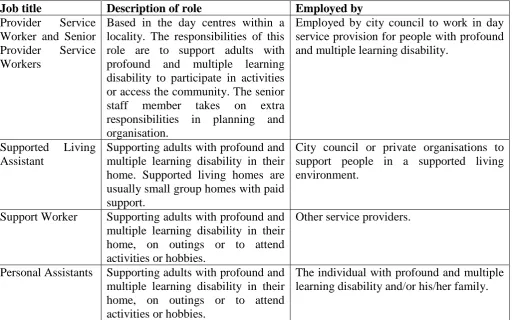
The majority (67%) were Provider Service Workers, 17% were Supported Living Assistants, 6% were support workers and 2% were Personal Assistants. Table 1 gives a description of these job titles.
Insert table 1 about here
disabilities for less than one year, 22% for between one and three years, 18% for between four and six years and 13% between six and nine years.
Question 4: Have you had Intensive Interaction training? (54/54 responses received) All participants (100%) had received the one day Intensive Interaction awareness training.
Question 5: If yes, when did you have Intensive Interaction Training? (54/54 responses received)
Of the 54 participants, 24% had received it less than one year ago and 45% had received it between one and two years ago. Seventeen per cent had received it two to three years ago and 14% had received it three to four years ago.
Question 6: If yes, please say what level of training you have had?
Of the 54 participants, 87% had completed the One Day Awareness training course, 11% were additionally trained as Advanced Practitioners and 2% as a Co-ordinator.
Question 7: Do you use Intensive Interaction at work? (54/54 responses received) The majority (96%) did use Intensive Interaction at work and 4% said that they did not.
Question 8
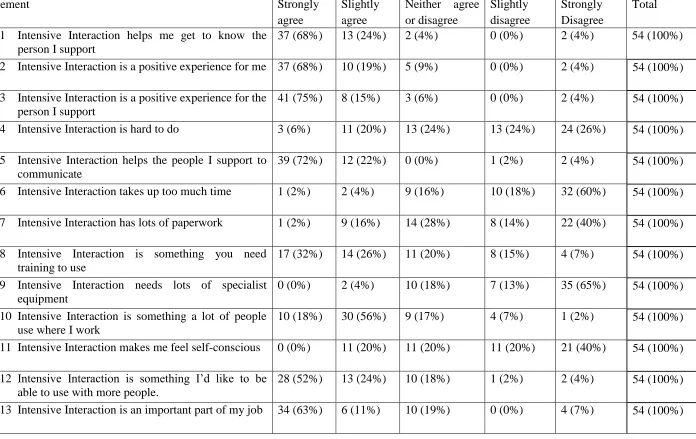
Participants were asked to rate to what extent they agreed with 13 statements relating to Intensive Interaction. The options ranged from strongly agree to strongly disagree and participants were asked to select one option per statement. In describing these results below, strongly and slightly agreed are collapsed together to indicate agreed, and strongly and slightly disagreed are collapsed to indicate disagree. Table 2 shows the exact participants’ responses to the statements in question 8.
Insert table 2 about here
The majority of participants (92%) agreed that Intensive Interaction helps them get to know the person they support. Most participants (87%) agreed that Intensive Interaction is a positive experience for them and for the person they support (91%). Responses were more varied in response to whether Intensive Interaction is hard to do. Half of the participants (50%) disagreed that Intensive Interaction is hard to do. The remaining participants were less decided with 26% agreeing and 24% undecided. Most participants (94%) agreed that Intensive Interaction helps the people they support to communicate.
Two thirds of the participants (78%) disagreed that Intensive Interaction takes up too much time and over half (54%) disagreed that there is too much paperwork although some uncertainty was expressed here where 20% agreed and 20% were uncertain. With respect to training, 56% agreed that training is needed to use Intensive Interaction but interestingly, almost a quarter of participants disagreed (22%) and 20% were undecided.
Responses to the distractor statement ‘Intensive Interaction needs lots of specialist equipment’ showed that the participants were familiar with Intensive Interaction as the majority of participants (78%) disagreed with this. Most participants (74%) agreed that Intensive Interaction is used a lot in their work place although 17% were undecided.
Responses were more varied for the statement ‘Intensive Interaction makes me feel self-conscious’ where 60% of participants disagreed with this and no participants were in strong agreement although 18% were undecided. Most participants (76%) agreed they would like to be able to use Intensive Interaction with more people. For the final statement, most participants (74%) agreed Intensive Interaction is an important part of their job. However, 19% were undecided.
paperwork’, statement 8 ‘Intensive Interaction is something you need training to use’ and statement 11 ‘Intensive Interaction makes me feel self-conscious’.
Question 9: Would you like to be able to use Intensive Interaction more, the same or for less time than you do currently? (54/54 responses received)
Fifty six per cent wanted to use Intensive Interaction more often than they do. Forty two per cent wanted to continue using Intensive Interaction at the same rate and only 2% felt they would like to be able to use Intensive Interaction less often than they do presently.
Question 10: If you are not using Intensive Interaction or would like to use it more what do you feel stops you from using Intensive Interaction at work? (24/54 responses received)
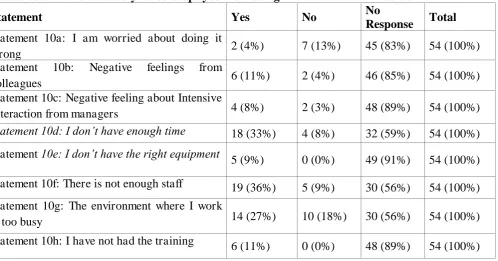
Participants were asked to choose from a list of options provided or to add their own individual response (see table 3).
A total of 30 out of the 54 participants responded to this question. Only 4% reported worrying about doing Intensive Interaction incorrectly thus preventing their use of it. Eleven per cent stated that a negative response from colleagues stopped them from using Intensive Interaction. Eight per cent stated that a negative response from managers meant they were unable to use Intensive Interaction. A higher per cent (33%) of participants said that a lack of time prevented them from using Intensive Interaction. Only 9% of participants stated that a lack of equipment prevented them from using Intensive Interaction. The highest per cent of participants (36%) reported that low staffing levels prevented them using Intensive Interaction. A slightly lower per cent (27%) reported that a busy environment prevented them from using Intensive Interaction. Eleven per cent of participants considered that a lack of training prevented them from using Intensive Interaction. No participants added their own responses.
Insert table32 about here
Further Comments (27/54 responses received)
Phase 2: Findings from the interviews
Three overarching themes were identified as follows: 1) the impact of Intensive Interaction; 2) facilitating the implementation of Intensive Interaction and; 3) organisational support and barriers in the implementation of Intensive Interaction (see table 4).
Insert table 4 about here
Theme 1- The impact of Intensive Interaction
Within the over-arching theme of the impact of Intensive Interaction, five sub-themes emerged; 1) staff knowledge; 2) increased staff awareness; 3) staff perceptions of people with profound and multiple learning disability; 4) the relationships between staff and service users and; 5) the people with profound and multiple learning disability themselves.
Subtheme 1: Staff Knowledge of Intensive Interaction
An understanding of the principles behind Intensive Interaction and its proposed benefits for the people with profound and multiple learning disability was evident, e.g., a form of communication that relies less on verbal exchanges and more on body language such as gestures, sounds and facial expressions. Intensive Interaction is an exchange using the same principles as a conversation (turn taking, communication, sharing experiences) but relies less on the verbal aspects of the exchange and is tailored so the person with profound and multiple learning disability understands and participates.
Because he can’t speak I have to pick up on his gestures and his tones and everything to try, I know now when’s happy or he’s sad or he’s a bit stressed and just on his body language and his vocal tone (One to One Worker, 18 months service, transcript 16).
Mirroring is a starting point for beginning these communicative interactions and an exchange where the person with profound and multiple learning disability takes a lead and controls the interaction.
I'd say personally it's more intensive about that individual and…letting them lead in a way...to get a reaction and it's more individualised and it's more tailored to their abilities really and their understanding (Provider Service Worker, 4 years service, transcript 13).
One to one time with an individual increases the opportunity to develop the interactive experience and facilitate relationships. Positive examples of trained staff sharing the principles of Intensive Interaction with untrained colleagues were evident, including those from other care providers.
Subtheme 2: Increased staff awareness
Participants are more “tuned in” to the communication of their service users. Increased awareness of changes in mood and the techniques service users employ to attract attention and to initiate interaction with staff such as the use of eye contact or vocalising certain sounds were highlighted. This extended to including people considered previously unengaged and not proactive in their interaction. Providing better support to service users was attributed to this increased awareness.
There’s plenty of examples that I can think of where...the initial work that's been done, has led to gaining some sort of information about the person which has led to an improvement in service even if it's only being pleased to see you and shouting your name (Senior Provider Service Worker, 10 years service, transcript 2)
A heightened sense of satisfaction after an Intensive Interaction session was experienced. Emotive language was used to describe these feelings such as “joy” (transcript 3), “thrill” (transcript 2), “uplifting” (transcript 2) and “enjoyment” (transcript 1). Confidence in using Intensive Interaction increased with early self-consciousness decreasing the more the approach was used.
Perceptions of service users changed where service users were described differently with higher expectations of their communicative intent described.
I didn't think that she would have any way of communicating but she does she listens she makes eye contact, she looks up. (Provider Service Worker, 10 years service, transcript 4).
Subtheme 4: The relationship between staff and service users
Intensive Interaction enabled relationship building through spending time with the person and demonstrating to the person they were understood and listened to. A heightened sense of trust was attributed to service users both in and out of Intensive Interaction sessions.
He’ll stand for a while and like just look at me and he wasn't doing that (before). He just didn't want to know because he didn't know me, didn't have that trust (Provider Service Worker, 7 months service, transcript 8).
Subtheme 5: The people with profound and multiple learning disability themselves
Changes in communicative behaviours were attributed to Intensive Interaction. Service users now initiated communication with sounds and eye contact and are described as happier, more confident and more engaged. Their own increased awareness, the person feeling “listened to” and the opportunity for one to one time resulted in positive changes for service users.
There was a person...who used to sit with her head in her arms covering her face up with her head down. Now her head is up, sat upright in a chair looking around. Very alert and ... makes lots of loud happy noises; huge difference.” (Provider Service Worker, 4 years service, transcript 7)
Theme 2: Facilitating the implementation of Intensive Interaction
The second theme identified factors enabling the implementation of Intensive Interaction. The sub themes included 1) staff training in Intensive Interaction; 2) the Advanced Practitioner role; 3) recording related to Intensive Interaction sessions and; 4) External support and collaborative working.
Subtheme 1: Staff Training in Intensive Interaction
The Intensive Interaction one day training course was referred to but was not sufficient to meet their needs and accessing refresher training to maintain and further develop their skills is needed. Those not in receipt of training all expressed an interest in taking part because they wanted to increase not only their own knowledge but also their practical skills and therefore be a more useful member of staff. Staff who had received the training felt it gave them a name for an approach that they were using naturally. Completing the training gave permission to spend one to one time with a service user as opposed to completing tasks to give the impression of being busy.
So whereas before we were sort of doing it and someone from outside would walk in and we'd sort of jump up quickly and start to look busy because you were afraid of being accused of not doing anything (Provider Service worker, 16 years service, transcript 23)
Subtheme 2: The Advanced Practitioner Role
The role of Advanced Practitioner was highly regarded and enabled a sense of pride and also an additional responsibility to share their knowledge with new staff and agency staff, as well as feeding back to managers when Intensive Interaction was not delivered and the potential explanations for this. Advanced Practitioners felt confident and able to carry out their role and liaise with staff members and managers about implementing Intensive Interaction.
Advanced Practitioners appreciated the opportunity to attend specific meetings run by a speech and language therapist where they share their positive experiences of the role and the challenges they experience. Participants who were not an Advanced Practitioner used the Advanced Practitioners to support them and as a source of information. Advanced Practitioners were viewed by managers as not only “vital” (Operational Manager, Transcript 3) in supporting their colleagues but also ‘instrumental’ (Operational Manager, Transcript 3) in feeding back to the management team the barriers staff experienced in using Intensive Interaction.
Subtheme 3: Recording related to Intensive Interaction
Recording of Intensive Interaction sessions was reported to take place and was described as “important” (Front Line manager, Transcript 6) as it was “evidence” (Provider Service Worker, Transcript 1). Completing this paperwork served an important function as it enabled staff to share with their colleagues any progress the service user had made or any new information learnt about the person. The recording is a way for new staff to get to know the service user who they would be supporting as it could serve as a record of their preferences and how they communicated and interacted with others.
It was also important for demonstrating to managers the value and impact of the approach. Some participants used the paperwork to validate this time commitment.
So it's important that you're recording down because…like with N or J or
L you can sit there for an hour and it looks like nothing is happening and then you'll just get a little bit…it’s important that you record that down. (Provider Service Worker, 6 years service, transcript 20).
Using video to record sessions “rarely happened’ (Provide Service Worker, Transcript 18) as it is too time consuming. Completing paperwork was not always accomplished due to time constraints such as the pressure to move on to another task after finishing an Intensive Interaction session.
Changes in the formatting of session sheets from writing to a checklist format was less time consuming. However, this was at the expense of losing information that is useful and important for reviewing individuals’ progress. As well as being time consuming, paperwork can prevent colleagues from engaging in Intensive Interaction for fear of completing the form incorrectly or not understanding how the information on the form is used.
When I’ve been filling it in people have said ‘oh I can’t do that as I don’t get it’ and I think people don’t understand that there’s no right or wrong (Provider Service Worker, 16 years service, transcript 23).
The regular recording of sessions has implications for monitoring the frequency and quality of the implementation of Intensive Interaction across the day service. Although participants had ideas and thoughts about how the information recorded in the paperwork could be used (service reviews, getting to know the individual, monitoring the quality of the interactions) none of the participants could identify a system in use for extracting and storing this information. This was due to a lack of time or a need for someone to take the lead on this.
Subtheme 4: External Support and Collaborative Working
Speech and language therapy presence is very, very valuable… and it's really just keeping the whole aspect of Intensive Interaction going. (Operational Manager, length of service not known Transcript 3)
Theme 3-Implementing Intensive Interaction: organisational support and barriers
Theme 3 was the organisational support needed to implement Intensive Interaction and the barriers that challenged this implementation. Four subthemes were identified 1) staffing; 2) role of management; 3) organisational structure and; 4) organisational change.
Subtheme 1: Staffing – levels, consistency and individual preferences
Staffing is reported as a barrier to using Intensive Interaction with specific reference to low staffing levels, a reliance on agency staff and working with staff unfamiliar with the expected routines. Staff felt unable to work individually with a person due to concerns leaving staff on their own, particularly agency staff who were unfamiliar with the day centre and service users.
You're having to show them [the new staff] around and you're having to guide them because maybe they've not been here before so you're then pulled away from doing the Intensive Interaction with the individual that you might have wanted to (Provider Service Worker, 2 years service, transcript 21).
The reluctance to explain Intensive Interaction was a result of agency staff not necessarily returning to the day centre again. Feelings of guilt were reported when Intensive Interaction was prioritised over other physical tasks leaving other staff to cover thereby increasing their workload.
Completing the training did not encourage all staff to use Intensive Interaction. There are some staff who “just don’t get” (Provider Service Worker, Transcript 4) the overall purpose of Intensive Interaction. This was due to the physical closeness involved in Intensive Interaction, feelings of self-consciousness, embarrassment and not believing in the core values of the approach.
There's believers and non-believers aren't there? (Provider Service Worker, 10 years service, transcript 4).
Not using Intensive Interaction (even if they had received the training) was explained as personal preference. Some staff preferred to work with groups of people with different needs rather than supporting people with profound and multiple learning disability. For example, the mobility of people with profound and multiple learning disability was highlighted where a more active staff member may prefer to support people who are more physically active than others.
If you've got more of an outgoing person who's in to sporty type stuff and things like that then they'll want more of an able bodied person to be able to do those things with. (Provider Service Worker, length of service not known , transcript 22).
Therefore, the implementation of Intensive Interaction relied on staff with an interest and a passion in this approach.
Subtheme 2: The Role of Management
Managers are supportive of Intensive Interaction and approachable and willing to discuss Intensive Interaction with staff. Opinions differed on how managers should support Intensive Interaction and how successfully they achieved this.
I've sat in meetings with (managers) and staff team and it's all "oh yeah, we'll promise this and make sure this happens" and it all sounds good but then it doesn't happen (Provider Service Worker, 4 years service, transcript 13)
The practical support offered by managers is valued including providing the necessary equipment (e.g., files for storing session sheets) and offering advice. Staffing and managing time were identified as barriers and the managers considered their roles to be encouraging and supporting staff to think creatively about how they can implement Intensive Interaction to overcome these barriers. Opportunities to discuss Intensive Interaction in appraisals and team meetings, and sharing experiences and frustrations with managers were valued. However, the discrepancy between the desire and the actual resources need for the implementation was highlighted.
There’s definitely the idealism on the manager’s side and the quite negative realism from the staff team, it feels like, and it's how to kind of marry those two. Keep that ideal spirit but within the reality of how it can work. (Senior Provider Service Worker, length of service not known, transcript 5).
Subtheme 3: Organisational Structure
The prioritisation of Intensive Interaction alongside the other tasks staff are required to complete is a complex issue. Physical tasks such as personal care and moving people out of their wheelchairs to other settings prevent staff from being able to use Intensive Interaction. These physical tasks were prioritised over taking time to engage in Intensive Interaction with service users.
So it's only in the afternoon by the time you've come back and done dinner and you've done the personal care and the drinks and stuff it's whether or not you've got time to do Intensive Interaction (Provider Service Worker, 4 years service, transcript 1)
This focus on physical tasks raised the issue of when and how Intensive Interaction should be used. Some participants felt it should be in fixed sessions (and therefore more at risk of not happening if they were particularly short staffed or busy) and some felt it should be done whenever that person was being supported to maximise their opportunity for meaningful communication.
There's part of me as well that really feels that it should be something that just is a natural part of every communication that you have with that person throughout the day (Senior Provider Service Worker, length of service not known, transcript 5).
However, this is harder to record as it is more spontaneous and shorter than a prolonged Intensive Interaction session.
So when you're interacting with people throughout the day it is a form of Intensive Interaction you know when you're mirroring people and copying people but it's is relating that to the fact that yes it's Intensive Interaction and it needs to be recorded (Provider Service Worker, 4 years service, transcript 13).
Subtheme 4: Organisational Change
The re-structuring of the day services had an impact on the use of Intensive Interaction. It was a positive change, bringing together a new group of staff and enabling them to have a fresh start.
It makes a happier environment … forstaff and people you care for.” Transcription 7, Provider Service Worker, 6 years service, transcript 7
However, the changes had a negative impact with Intensive Interaction being less of a priority.
I feel of late, because of so many things happening in the service… I feel that's probably got lost so there's not that quality of input (Front Line Manager, 2.5 years service, transcript 24).
This study evaluated a city wide implementation of Intensive Interaction training to social care staff by understanding how staff use Intensive Interaction with adults with profound and multiple learning disability and the perceived impact of Intensive Interaction on facilitating interaction and communication between staff and service users.
Intensive Interaction had an impact on staff knowledge of the approach, their work practice and their perceptions of people with profound and multiple learning disability. Using Intensive Interaction enabled staff to build relationships with service users. These increased relationships then enabled staff to more effectively identify changes in their service users such as seeking out interaction, increased eye contact and appearing more content. Staff confidence and job satisfaction also increased. These findings support previous research whereby staff are able to participate in Intensive Interaction training and to implement the approach with the people they support (11,12,13,14). At a city wide level, the increase in staff confidence and job satisfaction extends previous research and is an important implication for services to consider in retaining staff.
As with previous studies (11-14), challenges in the continued implementation of Intensive Interaction were identified. However, this study specifies these challenges in more depth. Staffing structures are complex and the implementation of Intensive Interaction is not only about having adequate and consistent staffing. There needs to be a core team of consistent, enthusiastic staff who are trained in Intensive Interaction with a desire, passion and adequate skill set. Being part of a core team provided staff with more confidence, access to support and building of trust within the core team to enable effective prioritisation of Intensive Interaction over other tasks. Support from managers and dedicated time to discuss Intensive Interaction was valued. However, frustration was experienced when their concerns were not adequately addressed. Intensive Interaction had become a natural way of interacting with the people they support and was used on a regular basis. However, for many they still relied on a structured approach where there were designated Intensive Interaction sessions and spaces. These sessions could be subsumed by other tasks and responsibilities such as personal care. The organisational changes the day service has undergone had a mixed impact on Intensive Interaction. For some, it was a fresh start where a newly formed staff team could work together to embed the approach but for the majority the on-going changes and upheaval meant that Intensive Interaction took second place to what were perceived to be more pressing demands. The prioritisation of Intensive Interaction needs to be addressed so that it has at least equal status to other responsibilities.
Structures supporting the use of Intensive Interaction centred on training and the role of the Advanced Practitioner. The Advanced Practitioner role was viewed as vital but multi-faceted and previous research has not identified the importance of such a role (11-14), albeit on-going coaching, supervision and support has been highlighted (11-14). The Advanced Practitioner role was an important factor in maintaining a focus on Intensive Interaction across the day centres. Completing the administration relating to Intensive Interaction is important and contributes to improving services but this was not happening currently. The external support from speech and language therapy services was highly valued and seen as critical for maintaining the approach. Participants perceived the impact of Intensive Interaction at a local level, e.g., the level of the individual (staff and/or service users) or within a day centre rather than city wide. However, the Advanced Practitioner role along with support from speech and language therapy has potential for increasing the reach of Intensive Interaction across a city.
Methodological Considerations
This study focused on the experiences and perceptions of staff in evaluating a city wide training initiative to enable staff working with adults with profound and multiple learning disability to implement Intensive Interaction with their service users. A mixed methods approach was used where a survey was completed and the findings of the survey followed up with in-depth interviews analysed using thematic analysis to understand the staff experiences and perceptions. Contrary to the limited evidence base evaluating Intensive Interaction, the study did not investigate the pre and post intervention communication behaviours of the individuals with profound and multiple learning disability using more quantitative methodology. Therefore, the findings of the study are centred on how staff experienced and perceived the implementation of the Intensive Interaction training rather than more controlled measures.
There are several important methodological limitations to consider. Firstly, the participants were self-selecting as they volunteered to participate. These participants may have been more likely to use Intensive Interaction and have more positive experiences than participants who chose not to take part. Secondly, the majority of the participants in phase two were day service staff with managers and agency support workers less well represented. Four participants were interviewed in phase two had not participated in the formal Intensive Interaction training and so some staff may have been less familiar with the approach than others. Finally, as this was a retrospective evaluation of staff experiences and perceptions, the impact of Intensive Interaction may be under or over estimated by these participants.
Further research needs to identify how Intensive Interaction within a social inclusion process model can enable more effective social inclusion of adults with profound and multiple learning disability. Recommendations for services include the positive implications of Intensive Interaction for staff retention, enabling staff to prioritise Intensive Interaction for their service users, the role of Advanced Practitioners or an equivalent role in maintaining the continued implementation of Intensive Interaction.
Summary and conclusions
Staff training in Intensive Interaction at a city wide level can enable staff to develop their knowledge of the approach and to engage in Intensive Interaction to promote the social inclusion of adults with profound and multiple learning disability.
References
1. Bellamy, G., Croot, L., Bush, A., Berry, H., & Smith, A. (2010). A study to define profound and multiple learning disability (PMLD). Journal of Intellectual Disabilities, 14(3), 221-235.
2.Parrott, R., Tillet, N., & Wostenholme, J. (2008). Demand for services: changes in demography and demand for services from people with complex needs and profound and multiple learning disabilities. Tizard Learning Disability Review, 13(3), 26-34.
3.Emerson, E., Roberts, J., & Whelton, B.(2009). Commissioning person-centred, cost effective local support for people with learning disability. Tizard Learning Disability Review, 14(2), 49-51.
4.Department of Health (DoH). (2009). Valuing people now: a new three-year strategy for people with learning disabilities. In: HMSO (ed.). London, UK.
5.Mansell, J. (2010). Raising our sights: services for adults with profound intellectual and multiple disabilities. Tizard Learning Disability Review, 15(1), 5-12.
6.Goldbart, J., & Caton, S. (2010). Communication and people with the most complex needs: what works and why this is essential. Mencap, UK.
8.Nind, M. (1996). Efficacy of Intensive Interaction: developing sociability and communication in people with severe and complex learning difficulties using an approach based on care-giver infant interaction. European Journal of Special Needs Education, 11(1), 48-66.
9.Leaning, B., & Watson, T. (2006). From the inside looking out – an Intensive Interaction group for people with profound and multiple learning disabilities. British Journal of Learning Disabilities, 34(2), 103-109.
10.Elgie, S., & Maguire, N. (2001). Intensive Interaction with a woman with multiple and profound disabilities: a case study. Tizard Learning Disability Review, 6(3), 18-24.
11.Firth, G., Elford, H., Leeming, C., & Crabbe, M. (2008). Intensive Interaction as a novel approach in social care: care staff’s views on the practice change process. Journal of Applied Research in Intellectual Disabilities, 21(1), 58-69.
12.Samuel, J., Nind, M., Volans, A. & Scriven, I. (2008). An evaluation of Intensive Interaction in community living settings for adults with profound intellectual disabilities. Journal of Intellectual Disabilities, 12(2), 111-126.
13.Zeedyk, M.S., Daview, C., Parry, S., & Caldwell, P. (2009). Fostering social engagement in Romanian children with communicative impairments: the experiences of newly trained practitioners of Intensive Interaction. British Journal of Learning Disabilities, 37(3), 186-196.
14.Rayner, K., & Bradley, S. (2014). Teaching Intensive Interaction to paid carers: using the ‘communities of practice’ model to inform training. British Journal of Learning Disabilities, 44(1), 63-70.
15.Smith, J.A., Flowers, P. & Larkin, M. (2009). Interpretative Phenomenological Analysis (IPA): Theory, Mind and Research. Sage, London, UK.
16.Firth, G. (2008). A dual aspect process model of Intensive Interaction. British Journal of Learning Disabilities, 37(1), 43-49.
17.Hutchison, N., & Bodicoat, A., (2015). The effectiveness of Intensive Interaction, a systematic review. Journal of Applied Research in Intellectual Disabilities, 28(6), 437-454.
18.Georgiade, N., & Phillimore, L. (1975). The myth of the hero-innovator and alternative strategies for organisational change. In Kiernan, C.C., & Woodford, F.P. (eds). Behaviour modification with the severely retarded. Associated Scientific Publishers Amsterdam, Netherlands.
19.Braun, V., & Clarke, V. (2006). Using thematic analysis in psychology. Qualitative Research in Psychology(3), 77-101.
Tables
Table 1 Definition of job titles in question 2 of the survey
Job title Description of role Employed by
Provider Service Worker and Senior Provider Service Workers
Based in the day centres within a locality. The responsibilities of this role are to support adults with profound and multiple learning disability to participate in activities or access the community. The senior staff member takes on extra responsibilities in planning and organisation.
Employed by city council to work in day service provision for people with profound and multiple learning disability.
Supported Living Assistant
Supporting adults with profound and multiple learning disability in their home. Supported living homes are usually small group homes with paid support.
City council or private organisations to support people in a supported living environment.
Support Worker Supporting adults with profound and multiple learning disability in their home, on outings or to attend activities or hobbies.
Other service providers.
Personal Assistants Supporting adults with profound and multiple learning disability in their home, on outings or to attend activities or hobbies.
Table 2: Question 8: Responses to statements about Intensive Interaction
Statement Strongly
agree
Slightly agree
Neither agree or disagree
Slightly disagree
Strongly Disagree
Total
1 Intensive Interaction helps me get to know the person I support
37 (68%) 13 (24%) 2 (4%) 0 (0%) 2 (4%) 54 (100%)
2 Intensive Interaction is a positive experience for me 37 (68%) 10 (19%) 5 (9%) 0 (0%) 2 (4%) 54 (100%)
3 Intensive Interaction is a positive experience for the person I support
41 (75%) 8 (15%) 3 (6%) 0 (0%) 2 (4%) 54 (100%)
4 Intensive Interaction is hard to do 3 (6%) 11 (20%) 13 (24%) 13 (24%) 24 (26%) 54 (100%)
5 Intensive Interaction helps the people I support to communicate
39 (72%) 12 (22%) 0 (0%) 1 (2%) 2 (4%) 54 (100%)
6 Intensive Interaction takes up too much time 1 (2%) 2 (4%) 9 (16%) 10 (18%) 32 (60%) 54 (100%)
7 Intensive Interaction has lots of paperwork 1 (2%) 9 (16%) 14 (28%) 8 (14%) 22 (40%) 54 (100%)
8 Intensive Interaction is something you need training to use
17 (32%) 14 (26%) 11 (20%) 8 (15%) 4 (7%) 54 (100%)
9 Intensive Interaction needs lots of specialist equipment
0 (0%) 2 (4%) 10 (18%) 7 (13%) 35 (65%) 54 (100%)
10 Intensive Interaction is something a lot of people use where I work
10 (18%) 30 (56%) 9 (17%) 4 (7%) 1 (2%) 54 (100%)
11 Intensive Interaction makes me feel self-conscious 0 (0%) 11 (20%) 11 (20%) 11 (20%) 21 (40%) 54 (100%)
12 Intensive Interaction is something I’d like to be able to use with more people.
28 (52%) 13 (24%) 10 (18%) 1 (2%) 2 (4%) 54 (100%)
Table 3: Participants’ Responses to Question 10: If you are not using Intensive Interaction or would like to use it more what do you feel stops you from using Intensive Interaction at work?
Statement Yes No No
Response Total Statement 10a: I am worried about doing it
wrong 2 (4%) 7 (13%) 45 (83%) 54 (100%)
Statement 10b: Negative feelings from
colleagues 6 (11%) 2 (4%) 46 (85%) 54 (100%)
Statement 10c: Negative feeling about Intensive
Interaction from managers 4 (8%) 2 (3%) 48 (89%) 54 (100%)
Statement 10d: I don’t have enough time 18 (33%) 4 (8%) 32 (59%) 54 (100%)
Statement 10e: I don’t have the right equipment
5 (9%) 0 (0%) 49 (91%) 54 (100%)
Statement 10f: There is not enough staff 19 (36%) 5 (9%) 30 (56%) 54 (100%)
Statement 10g: The environment where I work
is too busy 14 (27%) 10 (18%) 30 (56%) 54 (100%)
Statement 10h: I have not had the training 6 (11%) 0 (0%) 48 (89%) 54 (100%)
Table 4: Themes and sub-themes
Themes Sub-themes
The impact of Intensive Interaction Staff knowledge
Increased staff awareness
Staff perceptions of people with profound and multiple learning disability
The relationships between staff and service users The people with profound and multiple learning disability
Facilitating the implementation of Intensive Interaction
Staff training in Intensive Interaction The Advanced Practitioner Role
Recording related to Intensive Interaction External support and collaborative working Implementing Intensive Interaction: organisational
support and barriers
Staffing – levels, consistency and individual preferences
[image:19.595.59.566.406.646.2]