http://eprints.whiterose.ac.uk/128400/
Version: Published Version
Article:
Karimi, Shahrzad, Ullrich, Carsten A., D'Amico, Irene orcid.org/0000-0002-4794-1348 et al.
(1 more author) (2018) Spin-helix Larmor mode. Scientific Reports. 3470. ISSN 2045-2322
https://doi.org/10.1038/s41598-018-21818-8
[email protected]
https://eprints.whiterose.ac.uk/
Reuse
This article is distributed under the terms of the Creative Commons Attribution (CC BY) licence. This licence
allows you to distribute, remix, tweak, and build upon the work, even commercially, as long as you credit the
authors for the original work. More information and the full terms of the licence here:
https://creativecommons.org/licenses/
Takedown
If you consider content in White Rose Research Online to be in breach of UK law, please notify us by
www nature com scientificreports
Spin-helix Larmor mode
Shahrzad Karimi , Carsten A. Ullrich , Irene D’Amico & Florent Perez
A two dimensional electron gas DEG with equal strength Rashba and Dresselhaus spin orbit coupling sustains persistent helical spin wave states which have remarkably long lifetimes In the presence of an in plane magnetic eld there exist single particle excitations that have the character of propagating helical spin waves For magnon like collective excitations the spin helix texture reemerges as a robust feature giving rise to a decoupling of spin orbit and electronic many body e ects We prove that the resulting spin ip wave dispersion is the same as in a magnetized DEG without spin orbit coupling apart from a shift by the spin helix wave vector The precessional mode about the persistent spin helix state is shown to have an energy given by the bare Zeeman splitting in analogy with Larmor s theorem We also discuss ways to observe the spin helix Larmor mode experimentally
Spin-flip waves are collective excitations of magnetic systems1,2: rather than flipping individual magnetic
moments, which causes a large exchange energy penalty, the periodic reversal of magnetic moments extends as a precessional wave over the entire system, which is energetically favorable. here has been recent interest in spin waves in ferromagnetic thin ilms as an information carrier, which constitutes the basis for magnonics3,4.
Spin waves exist in systems with localized and itinerant magnetic moments. In the latter case, the precession of the interacting spins, the charge motion, and the spin-orbit coupling (SOC) due to inversion asymmetry are all interrelated and lead to novel phenomena. For example, chiral spin waves have been observed in asymmetric monolayers of iron5,6 and on the surface of topological insulators7, helical spin waves have been predicted in a
two-dimensional electron gas (2DEG) subject to Rashba SOC8, and twisted spin waves have been predicted and
observed in magnetized 2DEGs9.
he fundamental and practical aspects of spin waves in the presence of SOC have drawn interest recently in the context of spintronics10–13. SOC provides the conversion of charge based information into the spin wave14,15.
However, the presence of both SOC and Coulomb interaction still poses interesting challenges, especially in the dynamical regime.
In this paper, we will study spin waves in a 2DEG in the presence of in-plane magnetization and SOC. his system exhibits a rich interplay between Coulomb many-body efects, Rashba and Dresselhaus SOC, applied magnetic ield, and electron density, which we have studied earlier9,16–18. What we found is that the spin waves
are modiied by the SOC in a subtle manner: the spin waves get a boost of their group velocity whose magnitude and orientation depends on the crystallographic propagation direction in the quantum well plane. his interest-ing behavior of the spin waves can be understood via a transformation into a spin-orbit twisted reference frame; however, in general this only holds to lowest order in SOC9.
In this paper, we consider a very special case in which exact results can be proved to all orders in SOC, namely, the case of a persistent spin helix19–27. he spin helix arises in a 2DEG in which the strengths of the Rashba and
Dresselhaus ields, α and β, are equal (in this paper we only include contributions to the Dresselhaus efect which are linear in the wavevector, i.e., β=β1; the cubic β3 coupling coeicient23,27 is ignored). We here consider a
2DEG embedded in a zincblende quantum well grown along the [001] direction: SU(2) symmetry is then par-tially restored, and a helical spin texture can be sustained along the [110] direction. his result is robust against spin-independent disorder scattering and Coulomb interactions20. he main experimental signature of this state
is that spin packet excitations are protected from decoherence, leading to extraordinarily long lifetimes22,25.
If a magnetic ield is applied in the plane of a 2DEG with α=β, spin-packet excitations can sustain long-lived precessional motion23. Furthermore, some interesting magnetoelectronic efects can occur in 2DEGs28–30 or
quan-tum wires31,32 which relect the special condition α=β. However, to our knowledge the spin-wave dynamics
under these circumstances, which involves Coulomb interactions between the electrons at inite magnetic ield, has not been explicitly addressed before.
Our treatment of spin waves is based both on time-dependent density-functional theory (TDDFT) in the linear-response regime33 and on an equation-of-motion approach featuring the full many-body Hamiltonian9,34.
Department of Physics and Astronomy University of Missouri Columbia MO USA Department of Physics,
University of York York YO DD United Kingdom Institut des Nanosciences de Paris CNRS Université Paris VI Paris France Correspondence and requests for materials should be addressed to C A U email ullrichc@
missouri edu)
Received: 29 September 2017
Accepted: 1 February 2018
Published: xx xx xxxx
We derive the exact form of the spin-wave dispersion for systems with a spin-helix texture, and ind that it is obtained from the dispersion without SOC by a simple wave vector shit. he spin-wave stifness Ssw remains
unchanged.
he main result of this paper is that we identify an exact dynamical state of the 2DEG with α=β, which can be characterized as a collective precession of the 2DEG about the spin-helix state. he precession occurs at the bare Zeeman frequency, and we therefore refer to it as the spin-helix Larmor mode. his mode will be character-ized by its long lifetime, and we will discuss ways in which it could be experimentally observed.
Results
DEG with spin orbit coupling in a magnetic field the spin helix
We consider the electronic ground state of a 2DEG in an n-doped zincblende quantum well in the presence of an in-plane magnetic ield and Rashba and Dresselhaus SOC. Since the magnetic ield is parallel to the 2DEG, it only acts on the spin and there is no Landau level quantization (as long as the magnetic length lB= /| |eB is not signiicantly smaller than thewell width). We will use the efective-mass approximation and work in units where =e*=m*= 1, where e* and
[image:3.595.155.352.45.152.2]m* are the efective charge and mass, respectively.
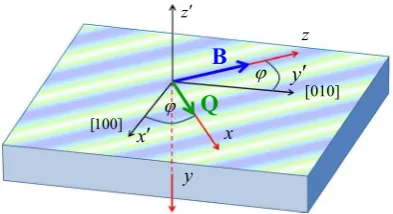
Figure 1 deines two reference frames. he primed frame ′ is ixed with respect to the quantum well: the x′-,
y′- and z′-axes point along the crystallographic [100], [010], and [001] directions, respectively; the 2DEG is in the
x′−y′ plane. he Rashba and Dresselhaus SOC ields will be introduced in ′, but it will be convenient for the discussion of spin waves to work in a coordinate system which is oriented such that its x and z axes lie in the quantum well plane, and the z-axis points along the in-plane magnetic ield B. As shown in Fig. 1, the x-axis is at an angle ϕ with respect to the x′-axis.
Single-particle states.
Without magnetic ield or SOC, the lowest electronic conduction subband in the quantum well is spin-degenerate. For simplicity, we will treat the electronic states as purely two-dimensional; however, the main results in this paper will not change qualitatively if one takes the inite well width into account. he magnetic ield lits the degeneracy and splits the lowest subband into two, which we shall denote by the indexp=±1. In the reference frame ′, the associated single-particle states can be written as Φ′pk(r′) =eik⋅r′Ψ′pk, where r′= (x′, y′), k= (kx′, ky′), and Ψ′pk is a two-component spinor of the form
ψ
ψ
Ψ′ =
′′
.
↑
↓ (1)
p p
p
k k k
Here, “spin-up“ and “spin-down” (↑ and ↓) refer to the spin quantization axis z′. he states Ψ′pk are obtained from the following Kohn-Sham single-particle equation:
σ σ σ Ψ′ Ψ′
+ +
=
′ ′ ′ ′
ˆ ˆ ˆ
k
h h E
2 x x y y pk pk pk, (2)
2 0
where σˆ0, , ,x y z′ ′ ′ are the usual Pauli matrices. he of-diagonal parts in Eq. (2) involve
ϕ α β
= − + + +
′ ′ ′
h Z Z k k
2 sin (3)
x xc y x
ϕ α β
= + − − .
′ ′ ′
h Z Z k k
2 cos (4)
y xc x y
Here, Z=g*µ
BB is the bare Zeeman energy (µB is the Bohr magneton, and g* is the efective g-factor). he
pres-ence of Coulomb many-body efects in the interacting 2DEG gives rise to the Zeeman exchange-correlation (xc) energy Zxc, which we discuss below. α and β are the usual Rashba and Dresselhaus linear coupling parameters;
x
y
z
x
y
] 100 [
] 010 [
B
[image:3.595.155.548.469.699.2]Q
www.nature.com/scientificreports/
we ignore contributions to the Dresselhaus efect that are cubic in the wavevector, since these tend to be much smaller than the linear contributions23,27.
It is convenient to change the reference frame for the spin, and go over to reference system , whose z-axis is along the magnetic ield direction. We introduce two in-plane vectors, q0 and q1, given in ′ by
α ϕ β ϕ α ϕ β ϕ
= + eˆ′+ + eˆ′
q0 ( cos sin )x ( sin cos ) y (5)
β ϕ α ϕ α ϕ β ϕ
= − eˆ′+ − eˆ′.
q1 ( cos sin )x ( cos sin )y (6)
With this, Eq. (2) transforms into
σ σ σ
+
+ − ⋅
+ ⋅
Ψ = Ψ
ˆ ˆ ˆ
k Z Z
E
k q k q
2 2 z x p p p , (7)
c
k k k
2
0 x 0 1
where the scalar products k⋅q0 and k⋅q1 remain invariant under ′→. Ψpk is now a two-component spinor whose spatial coordinates and spin quantization axes are deined with respect to .
Let us now discuss the xc contribution. he in-plane magnetic ield causes the 2DEG to become uniformly magnetized. he xc energy per particle of a homogeneous 2DEG35, e
xc(n, ζ), can be written as a functional of the
density n and the spin polarization ζ, where n=n↑+n↓ and ζ= (n↑−n↓)/n (↑ and ↓ are now deined with respect to eˆz). he Zeeman xc energy is then given by
ζ
= ∂
∂ .
Z 2 e
(8)
c
xc x
he renormalized Zeeman energy36 can now be deined as Z*=Z+Z
xc.
he general solution of Eq. (7) has been considered elsewhere37; instead, we concentrate here on the special
case α=β and ϕ=π/4 or 5π/4. Under these circumstances, q1= 0 and Eq. (7) simpliies considerably:
σ σ
+ − ⋅
Ψ = Ψ
ˆ ˆ
⁎
k Z
E
k Q
2 2 z pk pk pk, (9)
2 0
where
α ϕ π
π
= ± =
.
ˆ
{
e
Q 4 , /4
5 /4 (10)
x
To keep the discussion a bit simpler, we will limit ourselves to the case ϕ=π/4 in the following, so Q=4αeˆx (the ϕ= 5π/4 case is essentially the same, just in the opposite direction).
he solution of Eq. (9) is straightforward. We obtain
Ψ+,k=
( )
10 , Ψ−,k=( )
01 , (11)where
= ± − ⋅ .
±
⁎
E k Z k Q
2 2 (12)
k
, 2
he single-particle energies (12) have the important property
= +
+ + − ⁎
E ,k Q E ,k Z, (13)
which is illustrated in Fig. 2b, using the parameters Z*= 0.0381 and α= 0.05. his large value of α (typical exper-imental values of α are about an order of magnitude smaller) was chosen for clarity of presentation.
B
=
spin helical single particle eigenstates
In the absence of external magnetic ields, i.e., for Z*= 0 (see Fig. 2a), the degeneracy of the two energy branches E+,k+Q and E−,k gives rise to a persistent spin-helix stateof the 2DEG, as illustrated by the stripe-like pattern in Fig. 1. his is easy to see: Due to the degeneracy, linear combinations of the eigenstates Ψ−,k and Ψ+,k+Q are also solutions of Eq. (9). he single-particle wave functions for wave vector k can therefore be written as
Φ± =
( )
+ ⋅ ±( )
⋅a e b e
r
( ) 10 i 10 i , (14)
k (k Q r) k r
where |a|2+ |b|2= 1. From the associated spin-density matrix it is straightforward to determine the magnetization
in the frame. We obtain mz= |a|2− |b|2, and since the macroscopic magnetization must vanish (i.e., mz= 0),
this implies |a| = |b|. Writing = φ
a b, eia b,/ 2 and deining δ
ab=φa−φb, we get
δ δ
= ± ⋅ + = ⋅ + .
Accordingly, the stripes in Fig. 1 indicate a periodic rotation of the electronic spin in and out of the plane, with a wave vector Q=4αeˆx oriented at a 45° angle with respect to the x′-axis (i.e., the [110] direction). his is the spin helix pattern20,27.
he magnetizations mx and my associated with the states Φ +
k and Φ
−
k cancel out; therefore, adding up all
occu-pied spin-helix states below the Fermi energy EF gives zero. his means that the ground state of the N-electron
system has no spin texture. he persistent spin helix pattern can be observed if additional quasiparticles are injected at the Fermi level, as shown in Fig. 2a. Such states will have a very long lifetime20,22,23.
B
≠
spin helical single particle excitations
For a inite magnetic ield (Z*> 0), the degeneracy of the two energy branches E+,k+Q and E−,k is lited, as shown in Fig. 2b. As a consequence, the spin-helix pattern (15) isnot a property of the ground state anymore: instead, the spin helix becomes a nonequilibrium feature.
To see this, consider a single-particle excitation across the Fermi surface, with wave vector transfer Q, as illus-trated by the thick green arrow in Fig. 2b. First-order perturbation theory tells us that the time-dependent wave function has the form
γ
Φ → + = + ⋅ − − + + ⋅ − −
⁎
( )
( )
t e e e e
r
( , ) 1
0 01 , (16)
i i E Z t i iE t
k k Q (k Q r) ( ,k ) k r ,k
where | |γ 1 and we made use of Eq. (13). In the frame, the x and y components of the associated magnetiza-tion are given by
γ φ
= | | ⋅ − ⁎ + γ
m tx( ) 2 cos(Q r Z t ) (17)
[image:5.595.158.553.46.169.2]γ φ
= − | | ⋅ − ⁎ + γ
m ty( ) 2 sin(Q r Z t ) , (18)
where φγ is the phase of γ. his deines a forward propagating spin helix (i.e., a spin-lip wave), with amplitude 2|γ|, wave vector Q, and group velocity Z*Q/Q2. Single-particle excitations of this type, which are long-lived due
to the property (13), were experimentally observed by Walser et al.23,38 using circularly polarized optical pump
pulses and imaging via time-resolved Kerr rotation microscopy. A theoretical study using a drit-difusion model was recently carried out by Ferreira et al.39.
So far, our discussion has been for single-particle excitations, i.e., we did not consider collective excitations. In the following Section, we will present a very special case of a collective mode, which we call the spin-helix Larmor mode, which can be viewed as a coherent superposition of the let- and right-propagating single-particle spin helices considered above. As we will see, this gives rise to a collective, standing precessional wave with wave vector
Q which is undamped. Propagating collective spin-lip waves and their wave vector dispersions will be considered
in Methods.
Spin-helix Larmor mode
We consider a 2DEG in the presence of a uniform magnetic ield B=Beˆz, in the reference frame of Fig. 1. he many-body Hamiltonian without SOC is
∑
σ∑
=
+
+ | − |.
ˆ
ˆ ˆ
H p Z
r r
2 1 2
1 2
1
(19) i
i
z i
ij i j
0
2
,
We consider the spin-wave operator9,34,40,41
Figure 2. Single-particle energies E−,k and E+,k for α= 0.05 and k along the [110] direction, see Eq. (13). (a) No
magnetic ield (Z*= 0). Linear combinations of E
−,k and E+,k+Q states have spin helix texture, but these cancel out if summed over all occupied states below EF. A persistent spin helix appears if a quasiparticle is injected at
www.nature.com/scientificreports/
∑
σ =+
+ ⋅
ˆ ˆ
S 1 e
2 i (20)
i i
q
q r
, i
(σˆ+=σˆx+iσˆy), whose Heisenberg equation of motion, in the absence of SOC, is
ω
= = − − ⋅ .
+ + + +
ˆ ˆ ˆ ˆ
id
dtSq [Sq,H0] LSq q Jq (21)
he second term on the right-hand side of Eq. (21) arises from the commutator of Sˆ+
q with the kinetic part of
ˆ
H0, where
∑
σ= +
+
+ ⋅
ˆ e
J 1 p q
2 i ( /2) (22)
i i
i
q
q r
, i
is the transverse spin-current operator at wave vector q. he Larmor frequency ωL is equal to the bare Zeeman energy, ωL=Z. For small values of q, the equation of motion (21) can be written as
ω
= − .
+ +
ˆ ˆ
id
dtSq sw,0( )q Sq (23)
Here, ωsw,0(q) implicitly contains the coupling between the collective spin waves and the single-particle spin-current dynamics34. he real part, Rω ( )q =ω +S q /2
L
sw,0 sw 2 , is the spin-wave dispersion, where Ssw is the
spin-wave stifness (explicit expressions and discussion of Ssw are provided in the Methods section). he
imagi-nary part of ωsw,0(q) accounts for the damping of the spin wave due to electron-electron interactions42.
Now let us include SOC. he SOC Hamiltonian for the spin-helix case is given by [see Eq. (9)]
∑
σ= − ⋅
ˆ ˆ
H 1 Q p
2 i i z i, (24)
SOC ,
and the total Hamiltonian of the system is Hˆ =Hˆ +Hˆ
0 SOC. he equation of motion for
+
ˆ
Sq in the presence of
SOC is given by
ω
= + = − − − ⋅ .
+ + + +
ˆ ˆ ˆ ˆ ˆ
id
dtSq [Sq,H0 HSOC] LSq (q Q) Jq (25)
We now show that the SOC contribution can be transformed away. We introduce the SU(2) unitary transfor-mation Uˆ =exp[− ∑i iQ r⋅ i z iσˆ,/2], which leads to
= = .
+
−
+ + − +
ˆ ˆ ˆ† ˆ ˆ ˆ ˆ† ˆ
US Uq Sq Q, UJ Uq Jq Q (26)
In other words, Uˆ causes a boost of the wave vector argument of the spinwave and the spin-current operators,
q→q−Q, and transforms the momentum operator of the ith electron into U Uˆpiˆ†=pi+Qσˆz i,/2. On the other hand, Uˆ leaves the Coulomb and the Zeeman parts of Hˆ
0 unchanged. hus, we obtain
σ
= − .
ˆ ˆ ˆ† ˆ ˆ
UHU H Q
8 (27)
0 2
0
Since Q2σˆ0/8 commutes with − +
ˆ
Sq Q, the transformed equation of motion (25) becomes
=
+
− +
ˆ ˆ† ˆ ˆ ˆ
id
dtSq U S[ q Q,H U0] , (28)
where
ω
= − − − ⋅ .
− +
− +
− +
ˆ ˆ ˆ
S H S q Q J
[q Q, 0] L q Q ( ) q Q (29)
For small values of |q−Q|, this becomes − = −ω −
+
− +
ˆ ˆ ˆ
S H q QS
[q Q, 0] sw,0( ) q Q. Substituting this into Eq. (28), we
ind that the spin waves of the system with α=β are those of the system without SOC (governed only by Hˆ
0), but
where the wave vector is shited:
ωsw( )q =ωsw,0(q−Q). (30)
Let us now consider the important special case q=Q. It is known43 that, in the absence of SOC, the
spin-polarized electron system carries out a collective precessional motion with ωsw,0=ωL. he Larmor fre-quency ωL is equal to the bare Zeeman energy, ωL=Z. he Larmor mode has ininite lifetime (zero line width),
because it can be represented as a superposition of two exact eigenstates of the system Hamiltonian Hˆ
0: the
many-body ground state |0〉0 (the subscript 0 indicates absence of SOC), with ground-state energy E0, and the
many-body eigenstate Sˆ+| 〉0
carry any spin current in the plane. his is obvious from the equation of motion (21) in the absence of SOC: for the Larmor’s mode which occurs at q= 0, no current is induced by the homogenous precession.
Coming back to the case with SOC with the full Hamiltonian Hˆ, we can now formulate the spin-helix Larmor
theorem. If the spin wave has wave vector Q, commensurate with the spin-helix texture, all Coulomb many-body
contributions drop out and the frequency is given by the bare Zeeman energy:
ωsw( )Q =ωsw,0(0)=Z, (31)
which follows directly from Eq. (30). In the presence of SOC, the Larmor’s mode occurs at q=Q and is not a homogenous mode anymore; however, one still has the property that no spin-current is driven by the precession, since the total current term in Eqs (25) and (29) disappears when q=Q: this happens because SOC induces spin currents opposite to the spin currents induced by the motion. he spin wave then has vanishing group velocity,
∇qωsw(q)|q=Q = 0, which means that it is a standing wave. All electronic spins precess about their local orienta-tion, given by the spin helix coniguraorienta-tion, with the Larmor frequency ωL=Z. he spin-helix Larmor mode is a superposition of two many-body eigenstates of Hˆ: the ground state |0〉 and the state Sˆ+| 〉0
Q .
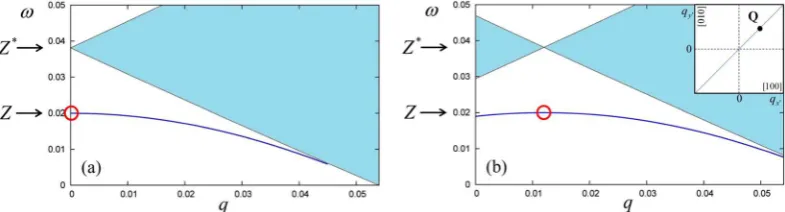
We illustrate the spin-wave dispersions with and without SOC in Fig. 3. he let panel shows ωsw,0(q) (which is independent of the direction of q), and the right panel shows ωsw(q) for q parallel to Q, i.e., along the [110] direc-tion. For this particular case, ωsw(q) is simply obtained by a horizontal shit by Q of ωsw,0(q) (likewise for the particle-hole continua). he spin-wave dispersions plotted in Fig. 3 are obtained from the numerical solution of Eq. (42), see below. he small-wave vector expansion (44) is very close to the exact result.
Experimental Schemes
Experimental observation of the spin-helix Larmor mode should be possible in specially designed doped mag-netic semiconductor quantum well samples where the α=β condition is met. he spin-lip waves under an in-plane magnetic ield can be detected using inelastic light scattering, similar to our earlier work9,16–18. he
Larmor-type precessional mode about the spin-helix state should then be recognizable by a signiicant narrowing of the linewidth.
Time-resolved Kerr rotation spectroscopy is another suitable technique to detect collective spin excitations in a 2DEG44,45. In the experimental setup by Walser et al.23 however, only the spin-helical single-particle excitations
were observed; at the magnetic ield strength of 1 T considered in the experiment, the collective modes were too short-lived to be seen since their separation from the spin-lip continuum was too small and the mode frequency was of the same order as the linewidth.
We also propose a device design which would allow one to excite Larmor’s mode optically and probe it elec-tronically. In the absence of SOC, the Larmor’s mode is usually probed in a paramagnetic resonance setup, by a microwave (mw) magnetic ield bmw =bcos( )ωt eˆy applied in the plane perpendicular to the quantizing ield
=Beˆ
B z. he corresponding coupling Hamiltonian is = − µ ω −
+ −
ˆ ˆ ˆ
H ig bcos( )(t S S )
e B
mw 2 0 0 . he unitary
transfor-mation Uˆ maps the situation with SOC to the situation without SOC; hence, the coupling Hamiltonian becomes
µ ω
= − +− −
ˆ ˆ ˆ† ˆ ˆ
UH U ig bcos( )(t S S )
e B Q Q
mw 2 . his corresponds to a coupling with a standing helical magnetic ield
in the plane (x, y). Such a magnetic ield can be generated by a device like the one sketched in Fig. 4. he idea is to deposit metal stripes on top of the sample, separated by a distance π/Q (for typical values of α, of order ~1 meV Å, this corresponds to a few µm). he stripes are aligned parallel to the quantizing magnetic ield B=Beˆz, perpen-dicular to the [010] direction, and the spacing of the stripes is commensurate with the standing-wave spin-helix Larmor mode. he metal stripes follow the principle of photo-conductive antennas used in time-domain THz experiments46. When an infrared optical pulse hits the sample, the photo-generated carriers in the substrate create
[image:7.595.157.550.47.153.2]a short conductive channel closing the biased circuit of the stripes. A current pulse with frequencies in the THz range will propagate through the stripes in alternating direction. his will, by induction, generate concentric oscillating magnetic ields compatible with the spin-helix pattern as depicted in the right panel of Fig. 4. he magnetic ield exerts torques on the spin-polarized 2DEG underneath. If the current pulse spectrum contains the right frequency, ω=ωL, this will trigger a helical standing spin wave which will persist ater the end of the pulse.
Figure 3. (a) Spin-wave dispersion ωsw,0(q) (line) and single-particle spin-lip continuum (shaded area) without SOC. (b) Spin-wave dispersion ωsw(q) and single-particle spin-lip continuum, plotted along [110], for α=β=
0.003 (Q= 0.012). he 2DEG parameters are rs= 2, ζ=−0.0762, Z= 0.02, and Z*= 0.0381 (all values are in
www.nature.com/scientificreports/
Detection of the spin-helix Larmor mode, and measurement of its lifetime, should then be possible via the cur-rents induced in the metal stripes from the stray magnetic ields associated with the standing spin wave. Such a detection technique is common in ferromagnetic magnonics3,4.
In our semiconductor test-bed system9, we deal with lower spin densities and higher frequencies: we expect
stray ields of the order of nT, and rapidly varying, at a rate of about 50–100 GHz, with a lifetime in the 100 ps to ns range. he measurements will therefore push the limits of present-day electronics, but they should be feasible. Moreover, the physics and concepts presented here are applicable to emerging 2D conducting systems with higher doping and strong spin-orbit efects. he above estimate for the lifetime of the spin-helix Larmor mode is based on spin-wave linewidths of the order of 50 µeV which were measured9 for quantum wells with α≠β; the
corre-sponding dephasing time (165 ps for a linewidth of 50 µeV) can be viewed as a lower threshold to the lifetime of the Larmor mode, since it includes electronic many-body contributions which drop out if α=β. he lifetime of the spin-helix Larmor mode is mainly determined by cubic Dresselhaus contributions and disorder.
Discussion
In this paper, we have considered the spin dynamics in a 2DEG in the presence of SOC, under the very special condition where the Rashba and Dresselhaus coupling strengths are equal (α=β) and where an in-plane mag-netic ield is applied perpendicular to the [110] direction. Without this magmag-netic ield, the system sustains per-sistent spin-helix states which have been widely studied in the literature. he magnetic ield lits the degeneracy that leads to the persistent spin-helix states; it instead leads to single-particle excitations that have the form of propagating spin helices.
he presence of Coulomb interactions causes these single-particle excitations to combine and form collective spin waves, which are robust against any decoherence caused by SOC. We have found that for the 2DEG with α=β the spin-wave dispersion is the same as for the system without SOC, apart for a rigid wave vector shit by Q (the spin-helix wave vector). he case of q=Q thus produces the special scenario which we have termed the spin-helix Larmor mode, where all many-body efects vanish and the precession frequency is given by the bare Zeeman energy (divided by ). his is a new and exact result for electronic many-body systems, which opens up new ways of manipulating and driving electronic spins by optical means.
Methods
We now discuss the spin-wave dispersions in the quantum well system considered above. We have seen that in the case α=β the single-particle states (11) are pure up and down spinors; therefore, the longitudinal and transverse spin response channels are decoupled. he transverse spin-density response equation reads
ω χ ω ω ω ω
→n ( , )q = ( , )[ ( , )q →v q + f ( , )q →n ( , )],q
(32)
T T T Txc T
where → =nT (n↑↓,n↓↑) is the transverse spin-density response, → =vT (v↑↓,v↓↑) is an external perturbation, and the noninteracting transverse spin response function and the transverse xc kernel are diagonal 2 × 2 matrices in the frame 41,47:
χ ω χ ω
χ ω
ω ω
ω =
=
.
↑↓ ↑↓
↓↑ ↓↑ ↑↓ ↑↓
↓↑ ↓↑
f f
f
q q
q
q q
q
( , ) ( , ) 0
0 ( , ) ,
( , ) ( , ) 0
0 ( , ) (33)
T
T c
c
,
,
x xc,
, x
[image:8.595.151.552.47.140.2]he general form of the individual elements of the noninteracting spin-density-matrix response function for a 2DEG is33
d k f E
E E i
d k f E
E E i
q ( , ) (2 ) ( ) (2 ) ( ) , (34) pp p p p
p p p p
pp pk p p p p p p k
k k q
k k q ,
1 2
2
, 1 , 1 , 1 , 1
1 2
2
, 1 , 1
, 1 , 1
∫
∫
∑
∑
χ ω
π ω η
δ δ δ δ δ δ δ δ
δ δ
π ω η
δ δ δ δ
δ δ δ δ δ δ = − − + + × + + × + + − + × + × + σσ ττ
σ σ σ σ
στ σ τ
σ σ
σ σ στ σ τ ′ ′ ′ ± ′ − + ↑ − ↓ ′ + ′↑ ′ − ′↓ ′ ′ ′ ± ′ + ′ + ↑ ′ − ↓ + ′↑ − ′↓ ′ ′
where σ, σ′, τ, τ′ are spin indices (↑ or ↓), and η is a positive ininitesimal (since we will be considering spin waves outside the particle-hole continuum, we can drop η). he Fermi function is given by f(Epk) =θ(EF−Epk), where
EF is the Fermi energy of a paramagnetic 2DEG in the presence of SOC. It can be shown that EF=EF0−α2−β2, where EF0=πn is the Fermi energy of a 2DEG without SOC, and with 2D electronic density n.
We recast Eq. (12) as E±,k= ±Z⁎/2+ 21 kQ/22−2α2. With a change of the integration variable, → ±
k k Q/2, the noninteracting spin-lip response functions become
∫
∫
χ ω π ω π ω = − + − − ⋅ − + | − | + − − − ⋅ − − | − | ↑↓ ↑↓ ⁎ ⁎ ⁎ ⁎(
)
(
)
d k f
Z
d k f
Z
q
k q Q q Q
k q Q q Q
( , )
(2 ) ( ) /2
(2 ) ( ) /2 (35)
k Z
k Z
,
2
2
0 2 2
2
2
2
0 2 2
2 2 2
∫
∫
χ ω π ω π ω = + + − ⋅ + − | + | − − + − ⋅ + + | + | ↓↑ ↓↑ ⁎ ⁎ ⁎ ⁎(
)
(
)
q d k
f
Z
d k f
Z
k q Q q Q
k q Q q Q
( , )
(2 ) ( ) /2
(2 ) ( ) /2 , (36)
k Z
k Z
,
2
2
0 2 2
2
2
2
0 2 2
2
2
2
where the Fermi function f0 indicates that EF has been replaced by EF0.
Looking at Eqs (35) and (36) we immediately see that the spin-lip response functions of the system with SOC can be expressed in terms of the corresponding functions without SOC (denoted by the superscript 0):
χ↑↓ ↑↓, ( , )q ω =χ↑↓ ↑↓0, (q−Q, )ω (37) χ↓↑ ↓↑, ( , )q ω =χ↓↑ ↓↑0, (q+Q, )ω. (38)
his simple result only holds for the special case α=β. In TDDFT, the spin-lip linear-response xc kernel of the 2DEG is given in the adiabatic local-density approximation (ALDA) by33
ζ ζ
= ≡ = ∂
∂ .
↑↓ ↑↓ ↓↑ ↓↑
f f K
n e 2 (39) , xc , xc xc xc
he spin-lip wave dispersion now follows from Eq. (32) by setting →vT to zero and inding the eigenmodes, which leads to
χ↑↓ ↑↓ − ω − χ↓↑ ↓↑ + ω − = .
K q Q K q Q
[ xc 0, ( , sw) 1][ xc 0, ( , sw) 1] 0 (40)
Upon closer inspection of Eqs (35) and (36), we ind
χ↓↑ ↓↑0, (q+Q,ωsw)=χ↑↓ ↑↓0, (q−Q,−ωsw). (41)
We are only interested in positive frequencies, so the spin-lip wave dispersion is obtained from Eq. (40) as the implicit solution ωsw(q) of
χ↑↓ ↑↓0, (q−Q,ωsw)=Kxc−1. (42)
he spin-wave dispersion can be analytically determined for small wave vectors. To second order, we ind
ω π π = + + | − | + . ⁎ ⁎
Z K E
Z K
q q Q
( ) 1
www.nature.com/scientificreports/
his can be rewritten as
ω ( )q =Z+ 1S | − |q Q
2 , (44)
sw sw 2
which corresponds to spin waves propagating with group velocity vg(q) =Ssw(q−Q), where the spin-wave
stif-ness of the 2DEG is
π
=
+
. ⁎
S E
Z K
2 1 2
(45) F
sw 0
xc
Since Kxc=Zxc/( )nζ and ζ=−Z*/(2πn), this can also be written as
= −
− .
⁎ ⁎
S E
Z Z
Z Z
2
(46) F
sw
0
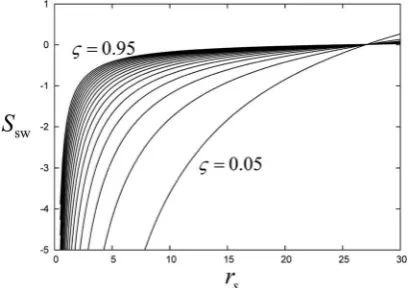
We plot the ALDA spin-wave stifness for various values of the spin polarization ζ and as a function of the 2D Wigner-Seitz radius rs in Fig. 5. he stifness has negative values for all practically relevant values of rs, and crosses
over to Ssw> 0 for very low densities (at rs= 26.96 for ζ= 0.05 and at rs= 24.49 for ζ= 0.95). In practice, one is
interested in studying collective modes in the typical metallic range of rs between about 2 and 6; this is the
inter-mediate coupling regime where the Coulomb energy (which scales as rs−1) is comparable to the kinetic energy (which scales as rs−2), but which can still be regarded as weakly correlated. As an example, in the quantum well system considered in ref.37 the spin-wave stifness was S
sw=−27.6, for rs= 2.2 and ζ= 0.053.
Data availability
All data generated or analysed during this study are included in this article.References
1. Stancil, D. D. & Prabhakar, A. Spin waves: heory and applications. (Springer, Berlin, 2010). 2. Zakeri, K. Elementary spin excitations in ultrathin itinerant magnets. Phys. Rep.545, 47–93 (2014). 3. Kruglyak, V. V., Demokritov, S. O. & Grundler, D. Magnonics. J. Phys. D: Appl. Phys.43, 264001–1–14 (2010). 4. Chumak, A. V., Vasyuchka, V. I., Serga, A. A. & Hillebrands, B. Magnon spintronics. Nature Phys.11, 453–61 (2015).
5. Zakeri, K., Zhang, Y., Chuang, T.-H. & Kirschner, J. Magnon lifetimes on the Fe(110) surface: he role of spin-orbit coupling. Phys. Rev. Lett.108, 197205–1–5 (2012).
6. Di, K. et al. Direct observation of the Dzyaloshinskii-Moriya interaction in a Pt/Co/Ni ilm. Phys. Rev. Lett.114, 047201–1–5 (2015). 7. Kung, H.-H. et al. Chiral spin mode on the surface of a topological insulator. Phys. Rev. Lett.119, 136802–1–6 (2017).
8. Ashrai, A. & Maslov, D. L. Chiral spin waves in fermi liquids with spin-orbit coupling. Phys. Rev. Lett.109, 227201–1–5 (2012). 9. Perez, F. et al. Spin-orbit twisted spin waves: group velocity control. Phys. Rev. Lett.117, 137204–1–5 (2016).
10. Winkler, R. Spin-orbit coupling efects in two-dimensional electron and hole systems, vol. 191 of Springer Tracts in Modern Physics. (Springer, Berlin, 2003).
11. Žutić, I., Fabian, J. & Das Sarma, S. Spintronics: Fundamentals and applications. Rev. Mod. Phys.76, 323–410 (2004). 12. Wu, M. W., Jiang, J. H. & Weng, M. Q. Spin dynamics in semiconductors. Phys. Rep.493, 61–236 (2010).
13. Bercioux, D. & Lucignano, P. Quantum transport in Rashba spin-orbit materials: a review. Rep. Prog. Phys.78, 106001–1–31 (2015). 14. Liu, T. & Vignale, G. Electric control of spin currents and spin-wave logic. Phys. Rev. Lett.106, 247203–1–4 (2011).
15. Kajiwara, Y. et al. Transmission of electrical signals by spin-wave interconversion in a magnetic insulator. Nature464, 262–266 (2010).
16. Baboux, F. et al. Coulomb-driven organization and enhancement of spin-orbit ields in collective spin excitations. Phys. Rev. B87, 121303–1–5 (2013).
17. Baboux, F., Perez, F., Ullrich, C. A., Karczewski, G. & Wojtowicz, T. Electron density magniication of the collective spin-orbit ield in quantum wells. Phys. Rev. B92, 125307–1–6 (2015).
18. Baboux, F., Perez, F., Ullrich, C. A., Karczewski, G. & Wojtowicz, T. Spin-orbit stifness of the spin-polarized electron gas. Phys. Stat. Solidi RLL10, 315–9 (2016).
[image:10.595.155.360.47.191.2]19. Schliemann, J., Egues, J. C. & Loss, D. Nonballistic spin-ield-efect transistor. Phys. Rev. Lett.90, 146801–1–4 (2003).
Figure 5. Spin-wave stifness of the 2DEG, obtained with the ALDA, for various values of the spin polarization
Rev. Lett.97, 236601–1–4 (2006).
21. Liu, M.-H., Chen, K.-W., Chen, S.-H. & Chang, C.-R. Persistent spin helix in Rashba-Dresselhaus two-dimensional electron systems.
Phys. Rev. B74, 235322–1–6 (2006).
22. Koralek, J. D. et al. Emergence of the persistent spin helix in semiconductor quantum wells. Nature458, 610–3 (2009).
23. Walser, M. P., Reichl, C., Wegscheider, W. & Salis, G. Direct mapping of the formation of a persistent spin helix. Nature Phys.8, 757–62 (2012).
24. Schönhuber, C. et al. Inelastic light-scattering from spin-density excitations in the regime of the persistent spin helix in a GaAs-AlGaAs quantum well. Phys. Rev. B89, 085406–1–6 (2014).
25. Sasaki, A. et al. Direct determination of spin-orbit interaction coeicients and realization of the persistent spin helix symmetry.
Nature Nanotech.9, 703–9 (2014).
26. Kammermeier, M., Wenk, P. & Schliemann, J. Control of spin helix symmetry in semiconductor quantum wells by crystal orientation. Phys. Rev. Lett.117, 236801–1–5 (2016).
27. Schliemann, J. Persistent spin textures in semiconductor nanostructures. Rev. Mod. Phys.89, 011001–1–17 (2017).
28. Duckheim, M. & Loss, D. Resonant spin polarization and spin current in a two-dimensional electron gas. Phys. Rev. B75, 201305–1–4 (2007).
29. Nakhmedov, E. P. & Alekperov, O. Interplay of Rashba- and Dresselhaus spin-orbit interactions in a quasi-two-dimensional electron gas of a inite thickness under in-plane magnetic ield. Eur. Phys. J. B85, 298–1–19 (2012).
30. Wilde, M. A. & Grundler, D. Alternative method for the quantitative determination of Rashba- and Dresselhaus spin-orbit interaction using the magnetization. New J. Phys.15, 115013–1–18 (2013).
31. Nazmitdinov, R. G., Pichugin, K. N. & Valín-Rodríguez, M. Spin control in semiconductor quantum wires: Rashba and Dresselhaus interaction. Phys. Rev. B79, 193303–1–4 (2009).
32. Micu, C. & Papp, E. Equal coupling strength approach to spin precession efects concerning Rashba and Dresselhaus spin-orbit interactions in the presence of in-plane magnetic ields. Superlatt. Microstruct.51, 651–662 (2012).
33. Ullrich, C. A. Time-dependent density-functional theory: concepts and applications. (Oxford University Press, Oxford, 2012). 34. Perez, F., Cibert, J., Vladimirova, M. & Scalbert, D. Spin waves in magnetic quantum wells with Coulomb interaction and sd
exchange coupling. Phys. Rev. B83, 075311–1–9 (2011).
35. Attaccalite, C., Moroni, S., Gori-Giorgi, P. & Bachelet, G. B. Correlation energy and spin polarization in the 2D electron gas. Phys. Rev. Lett.88, 256601–1–4 (2002).
36. Perez, F. et al. From spin lip excitations to the spin susceptibility enhancement of a two-dimensional electron gas. Phys. Rev. Lett. 99, 026403–1–4 (2007).
37. Karimi, S. et al. Spin precession and spin waves in a chiral electron gas: beyond Larmor’s theorem. Phys. Rev. B96, 045301–1–14 (2017).
38. Salis, G., Walser, M. P., Altmann, P., Reichl, C. & Wegscheider, W. Dynamics of a localized spin excitation close to the spin-helix regime. Phys. Rev. B89, 045304–1–7 (2014).
39. Ferreira, G. J., Hernandez, F. G. G., Altmann, P. & Salis, G. Spin drit and difusion in one- and two-subband helical systems. Phys. Rev. B95, 125119–1–12 (2017).
40. Holstein, T. & Primakof, H. Field dependence of the intrinsic domain magnetization of a ferromagnet. Phys. Rev.58, 1098–113 (1940).
41. Perez, F. Spin-polarized two-dimensional electron gas embedded in a semimagnetic quantum well: Ground state, spin responses, spin excitations, and Raman spectrum. Phys. Rev. B79, 045306–1–16 (2009).
42. Hankiewicz, E. M., Vignale, G. & Tserkovnyak, Y. Inhomogeneous Gilbert damping from impurities and electron-electron interactions. Phys. Rev. B78, 020404–1–4 (2008).
43. Lipparini, E. Modern many-particle physics. 2nd edn, (World Scientiic, Singapore, 2008).
44. Bao, J. M., Pfeifer, L. N., West, K. W. & Merlin, R. Ultrafast dynamic control of spin and charge density oscillations in a GaAs quantum well. Phys. Rev. Lett.92, 236601–1–4 (2004).
45. Barate, P. et al. Collective nature of two-dimensional electron gas spin excitations revealed by exchange interaction with magnetic ions. Phys. Rev. B82, 075306–1–9 (2010).
46. Dreyhaupt, A., Winnerl, S., Dekorsy, T. & Helm, M. High-intensity terahertz radiation from a microstructured large-area photoconductor. Appl. Phys. Lett.86, 121114–1–3 (2005).
47. Giuliani, G. F. & Vignale, G. Quantum heory of the Electron Liquid. (Cambridge University Press, Cambridge, 2005).
Acknowledgements
S.K. and C.A.U. are supported by DOE Grant DE-FG02-05ER46213. F.P. acknowledges support from the Fondation CFM, C’NANO IDF and ANR.
Author Contributions
C.A.U., I.D’A. and F.P. conceived the study, developed the theory, and wrote the manuscript. S.K. carried out the linear response calculations of the spin-wave dispersions, participated in the discussions and contributed to the review of the manuscript.
Additional Information
Competing Interests: he authors declare no competing interests.
Publisher's note: Springer Nature remains neutral with regard to jurisdictional claims in published maps and institutional ailiations.
Open Access This article is licensed under a Creative Commons Attribution 4.0 International License, which permits use, sharing, adaptation, distribution and reproduction in any medium or format, as long as you give appropriate credit to the original author(s) and the source, provide a link to the Cre-ative Commons license, and indicate if changes were made. he images or other third party material in this article are included in the article’s Creative Commons license, unless indicated otherwise in a credit line to the material. If material is not included in the article’s Creative Commons license and your intended use is not per-mitted by statutory regulation or exceeds the perper-mitted use, you will need to obtain permission directly from the copyright holder. To view a copy of this license, visit http://creativecommons.org/licenses/by/4.0/.
![Figure 2. Single-particle energies magnetic ield (E−,k and E+,k for α = 0.05 and k along the [110] direction, see Eq](https://thumb-us.123doks.com/thumbv2/123dok_us/1985047.160151/5.595.158.553.46.169/figure-single-particle-energies-magnetic-ield-direction-eq.webp)