White Rose Research Online URL for this paper:
http://eprints.whiterose.ac.uk/130456/
Version: Accepted Version
Article:
Jameel, Furqan, Wyne, Shurjeel, Nawaz, Syed et al. (2 more authors) (Accepted: 2018)
On the Secrecy Performance of SWIPT Receiver Architectures with Multiple
Eavesdroppers. Hindawi: Wireless communications and mobile computing. (In Press)
[email protected] https://eprints.whiterose.ac.uk/
Reuse
Items deposited in White Rose Research Online are protected by copyright, with all rights reserved unless indicated otherwise. They may be downloaded and/or printed for private study, or other acts as permitted by national copyright laws. The publisher or other rights holders may allow further reproduction and re-use of the full text version. This is indicated by the licence information on the White Rose Research Online record for the item.
Takedown
If you consider content in White Rose Research Online to be in breach of UK law, please notify us by
On the Secrecy Performance of SWIPT Receiver
Architectures with Multiple Eavesdroppers
Furqan Jameel, Shurjeel Wyne, Syed Junaid Nawaz, Junaid Ahmed, and Kanapathippillai Cumanan
Abstract—Physical layer security (PLS) has been shown to hold promise as a new paradigm for securing wireless links. In contrast with the conventional cryptographic techniques, PLS methods exploit the random fading in wireless channels to provide link security. As the channel dynamics prevent a constant rate of secure communications between the legitimate terminals, the outage probability of the achievable secrecy rate is used as a measure of the secrecy performance. This work investigates the secrecy outage probability of a simultaneous wireless information and power transfer (SWIPT) system, which operates in the presence of multiple eavesdroppers that also have the energy harvesting capability. The loss in secrecy performance due to eavesdropper collusion, i.e., information sharing between the eavesdroppers to decode the secret message, is also analyzed. We derive closed-form expressions for the secrecy outage probability for Nakagami-m fading on the links and imperfect channel
estimation at the receivers. Our analysis considers different combinations of the separated and the integrated SWIPT receiver architectures at the receivers. Numerical results are provided to validate our analysis.
Index Terms—Achievable Secrecy Rate, Outage Probability, Nakagami-mFading
I. INTRODUCTION
Simultaneous wireless information and power transfer (SWIPT) systems have spurred considerable research interest in both academia and industry [1]. The SWIPT technique provides significant convenience to its users by efficiently utilizing the radio frequency (RF) signal for both information and power transfer [2]. However, SWIPT systems require a special receiver design to support the dual capability of energy harvesting (EH) and information decoding (ID). In the liter-ature, two broad categories of SWIPT receiver architectures have been proposed namely the separated and the integrated receiver architectures [1]. The separated receiver architecture has dedicated separate units for ID and EH. However, this increases the complexity and cost of the receiver hardware [3]. In contrast, the integrated receiver architecture has a unified circuitry to perform ID and EH jointly, which reduces the hardware costs [3].
Varshney et al. in [4] were the first to propose the transmis-sion of information and energy simultaneously. They devel-oped a capacity-energy function to characterize the fundamen-tal tradeoff in performance between simultaneous information and power transfer. In [5], the authors extended the work
Furqan Jameel, Shurjeel Wyne, Syed Junaid Nawaz, and Junaid Ahmed are with the Department of Electrical Engineering, COMSATS Institute of Information Technology, Islamabad 45550, Pakistan.
Kanapathippillai Cumanan is with the Department of Electronic Engineer-ing, University of York, Heslington, York, YO10 5DD, UK.
Manuscript received December XX, 2017...
of [4] to frequency-selective channels with additive white Gaussian noise (AWGN). It was shown in [5] that a non-trivial tradeoff exists for information transfer versus energy transfer via power allocation. A SWIPT system under co-channel interference was studied in [6]. The authors derived optimal designs to achieve outage-energy tradeoffs and rate-energy tradeoffs. In [7] the authors considered the performance of a SWIPT system with imperfect channel state information (CSI) at the transmitter. Networks that employ pure wireless power transfer were studied in [8] and [9]. In [8], the authors studied a hybrid network that overlaid an uplink cellular network with randomly deployed power beacons, which charged mobiles wirelessly. The authors then derived the tradeoffs between different network parameters under an outage constraint on the data links.
a potential eavesdropper then any increase in the information signal power to improve the power transfer efficiency may also compromise the message secrecy [6]. Therefore, the inherent tradeoff between power efficiency and information security in a SWIPT system merits detailed examination. The authors in [27] investigated the maximization of secrecy throughput for SWIPT systems. In particular, they considered power allocation between EH and ID to provide an optimal secure SWIPT solution. In the same work an analytical expression for the secrecy outage probability was also derived. In [28], the authors investigated the secrecy performance of a SWIPT system with the separated receiver SWIPT architecture em-ployed at the eavesdropper and κ−µfaded links. In [29] the authors introduced an artificial noise-aided precoding scheme to maximize the secrecy rate. In [30] the authors studied the secrecy capacity of an EH orthogonal-frequency-division-multiplexing network. All the sub-carriers were allocated an identical power and the power-splitting technique was used to coordinate ID and EH. In [31] the authors analyzed secure beamforming for an amplify-and-forward two-way relaying SWIPT network and proposed a zero-forcing based sub-optimal solution to maximize the secrecy of the considered network.
In the SWIPT literature most investigations have considered only the separated receiver architecture [27], [29], [30], [31]. Furthermore, multiple eavesdroppers when considered are of-ten assumed to operate independently, whereas in many practi-cal scenarios these eavesdroppers may collaborate to enhance their secret message decoding capability [32]. Finally, the achievable secrecy rate may degrade significantly under im-perfect channel estimation at the legitimate receiver, whereas imperfect CSI at the eavesdropper can prove beneficial for the system’s secrecy performance. To the best of the authors’ knowledge, a comparative analysis of the secrecy performance of the separated and integrated SWIPT architectures with eavesdropper cooperation and imperfect CSI has not been performed previously. Specifically, the main contributions of the submitted work are listed as follows:
• We derive closed-form expressions for the secrecy outage
probability with imperfect CSI knowledge at the receivers and different combinations of the separated and the integrated SWIPT architectures at the legitimate and the eavesdropping receivers.
• The tradeoff between secrecy performance and harvested
energy is investigated.
• The loss in secrecy performance due to eavesdropper
cooperation is analyzed and compared with the non-cooperative case.
The remainder of this paper is organized as follows. Section II presents the system model. In Section III the closed-form expressions for the outage probability are derived for different receiver architectures. Section IV provides numerical results along with relevant discussion. In Section V, some concluding remarks are given.
II. SYSTEMMODEL
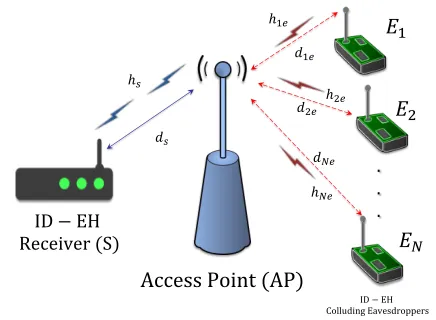
We consider the downlink of a SWIPT system as shown in Fig. 1 in which the Access Point (AP) transmits a secure
message to the legitimate receiver S, which has simultaneous EH and ID capability. This transmission is also received by
N eavesdropping nodes that are admitted into the network for EH-only but exploit their SWIPT receiver architectures in an attempt to intercept the secret communication between AP and S [33]. Since the eavesdroppers, denoted by E =
{Ei|i= 1,2, ...N}, are also part of the network - the AP is assumed to have CSI for the main channel to node S as well as for theN wiretap channels [33]. All nodes are considered to be equipped with single antennas.1 Our analysis considers two types of receiver architectures for both S and E, i.e., the conventional separated receiver and the integrated receiver architecture [3] shown in Fig. 2. In the separated receiver, the RF signal after power-splitting (PS) is fed to separate circuitry for ID and EH, whereas in the integrated receiver PS between EH and ID takes place after the rectifier. The rectifier of the integrated receiver also down-converts the RF signal for ID, i.e., the down-conversion operation is integrated with the energy receiver in this architecture. For both receiver types, the fractional powers received for ID and EH are denoted by
0≤ρ <1 and1−ρ, respectively.
ID EH Colluding Eavesdroppers
Access Point AP
[image:3.612.328.546.319.479.2]ID EH Receiver S
Fig. 1. System Model.
Consider that the AP transmits signalswith powerP. The signal received at S can then be written as
ys=
s
P Ploss
s
ˆ
hss+ns, (1)
whereˆhs represents the channel gain estimated by S andns denotes the zero-mean variance N0 additive white Gaussian
noise (AWGN) due to the receiver electronics at S. Addition-ally, Ploss
s =
(4π)2
dΞ s
GtGrλ2c is the path loss, where ds denotes the distance between AP and S and Ξ is the path loss exponent. Furthermore, λc is the carrier wavelength and GtandGrare the antenna gains at AP and S, respectively.
Since S employs PS architecture, the received signal is further divided into two streams for ID and EH. The signal at the information decoder of S is given as
ys=√ρs
s
P Ploss
s
ˆ
hss+ns
!
+zs, (2)
Separated Receiver Architecture with Power Splitting
Harvesting
Decoding Power
Splitter
Transmitter
Battery
Decoder ADC
Power Splitter LPF
DIODE
Rectifier
[image:4.612.51.293.58.245.2]Integrated Receiver Architecture with Power Splitting
Fig. 2. Separated and integrated receiver architectures of SWIPT [3].
where ρs is the power splitting factor at S and zs is the signal processing noise at S, also distributed normally as
N(0, σ2
s). Since 1−ρs fraction of received power is used for energy harvesting, thus the amount of harvested energy at S, ignoring small amount of energy stored by antenna and signal processing noise, can be written as [3]
EHs=
ζs(1−ρs)P|ˆhs|2 Ploss
s
, (3)
where ζs represents the power conversion efficiency at S. The AP transmission is also picked up by the eavesdroppers, the signal received at the information decoder of the i-th eavesdropper is written as
yie=√ρie
s
P Ploss
ie
ˆ
hies+nie
!
+zie, (4)
where hˆie represents the channel gain estimated by the i-th eavesdropper. Furthermore, nie = ne represents the thermal noise distributed as N(0, N0) and zie = ze is the signal processing noise distributed asN(0, σ2
e), at thei-th eavesdrop-per. Here the noise statistics are assumed identical due to all eavesdroppers using the same type of hardware. For a tractable analysis, we consider Ploss
ie =Peloss and ρie=ρe∀i ∈ N. Similar to (3), the amount of harvested energy at the i-th eavesdropper can be written as [3]
EHie=
ζie(1−ρie)P|hˆie|2 Ploss
ie
, (5)
whereζieis the power conversion efficiency at thei-th eaves-dropper. Moreover, without loss of generality, we consider
ζie = ζe throughout this work. Finally, the receiver nodes make an erroneous channel estimate due to their hardware impairments modeled as [35], [36]
ˆ
hk=
q 1−δ2
khk+δkv, (6)
where k ∈ {s, ie}, hk represents the true channel amplitude gain. The parameter 0 < δk <1 is a measure of estimation
accuracy with δk = 0for a perfect estimate. Additionally, v is a normal random variable distributed as N(0,1). Now by substituting (6) into (2) we can express the signal received at S as
ys=√ρs
s
P(1−δ2
s) Ploss
s
hss+
s
P Ploss
s
δsvs+ns
! +zs,
(7)
and substituting (6) into (4) we can express the signal received ati-th eavesdropper as
yie=√ρie
s
P(1−δ2
ie) Ploss
e
hies+
s
P Ploss
e
δievs+nie
! +zie.
(8)
Using the above equations, the instantaneous signal-to-noise ratio (SNR) of the main channel can be written as
χs=
ρsΩs(1−δs2)
(Ωsρsδ2s+ρsN0+σ2s)|
hs|2, (9)
and the SNR for thei-th wiretap channel can be expressed as
χie=
ρeΩe(1−δ2ie)
(Ωeρsδie2 +ρeN0+σ2e)|
hie|2, (10)
whereΩs=P/(Psloss)andΩe=P/(Peloss). For subsequent analysis,δie=δe,∀i ∈ N is considered.
III. SECRECYOUTAGEANALYSIS
In this section closed form expressions for the secrecy outage probability are derived separately for four different cases that are based on the receiver types used at S and
E. Specifically, PSp−Sp
out denotes outage probability for the case of separated receiver architectures at S and E,PSp−In
out denotes the outage for separated receiver at S and integrated receiver atE,PIn−Sp
out is the outage for integrated receiver at S and separated receiver at E, and PoutIn−In denotes outage probability for the case of integrated receivers at both S and
E. Each of these four cases are discussed first for the non-cooperative eavesdropping scenario and later for cooperation among the eavesdroppers.
A. Non-cooperative Eavesdroppers
In this scenario, the worst-case of the eavesdropper with the maximum SNR is considered to decode the message. The instantaneous SNR of the wiretap link can be re-written as
χe= max i∈N χie=
ρeΩe(1−δe2)
(Ωeρsδ2e+ρeN0+σe2)
max
i∈N |hie|
2. (11)
whereχieis Gamma distributed [37] with probability density function (PDF) fχie(γie) =
hm
ie(Ωieρieδ 2
ie+ρieN0+σ 2 ie)
ρie(1−δ2ie)¯γie
imie
×
exp−mie(Ωieρieδie2+ρieN0+σ 2 ie)γie
ρie(1−δ2ie)¯γie
× (γie)mie− 1
Γ(mie) . Then, the cumulative distribution function (CDF) for the instantaneous SNR of the wiretap link (i.e. random variableχefalling below an arbitrary valueγe), is given as
Now using statistical independence of the wiretap channels and the CDF of a Gamma random variable [38], we obtain
Fχe(γe) = Pr(χ1e< γe, χ2e< γe, . . . , χN e< γe),
=
1−exp
−me(Ωeρeδ
2
e+ρeN0+σ2e)γe ρe(1−δ2e)¯γe
× me−1
X
r=0 1
r!
me(Ωeρeδ2e+ρeN0+σe2)γe ρe(1−δ2e)¯γe
rN
,
(13)
The corresponding PDF can be written as
fχe(γe) =
dFχe(γe)
dγe
= N(γe)
me−1
Γ(me)
m
e(Ωeρeδ2e+ρeN0+σe2) ρe(1−δ2e)¯γe
me
×
1−exp
−me(Ωeρeδ
2
e+ρeN0+σe2)γe ρe(1−δe2)¯γe
× me−1
X
r=0 1
r! m
e(Ωeρeδe2+ρeN0+σe2)γe ρe(1−δe2)¯γe
rN−1
×exp
−me(Ωeρeδ
2
e+ρeN0+σe2)γe ρe(1−δe2)¯γe
, (14)
whereγ¯e= ΩeE{maxi∈N|hie|2}represents the average SNR of the wiretap link andmeis the Nakagami-m fading severity parameter for the wiretap link.
The PDF of the instantaneous SNR of the main link can be obtained as [37]
fχs(γs) =
ms(Ωsρsδs2+ρsN0+σs2) ρs(1−δs2)¯γs
ms
×(γs)
ms−1exp−ms(Ωsρsδ 2
s+ρsN0+σ 2 s)γs
ρs(1−δ2s)¯γs
Γ(ms)
. (15)
The corresponding CDF is given as [37]
Fχs(γs) = 1−exp
−ms(Ωsρsδ
2
s+ρsN0+σ2s)γs ρs(1−δ2s)¯γs
ms−1
X
r=0 1
r!
×
ms(Ωsρsδs2+ρsN0+σs2)γs ρs(1−δs2)¯γs
r
, (16)
whereγ¯s= ΩsE{|hs|2} is the average SNR of the main link andmsrepresents the Nakagami-m fading severity parameter for the main link.
1) Separated Receivers at S and E: The achievable rates
for the main and wiretap links can be written asCs= log2(1+
χs)and Ce= log2(1 +χe), respectively [3]. The achievable secrecy rate Csec is defined as the non-negative difference between the achievable rates of the main channel and wiretap channel, which is expressed asCsec= [Cs−Ce]+. A secrecy outage event occurs when Csec falls below some target rate
Rs > 0 [39], [40]. The secrecy outage probability is then written as
PoutSp−Sp= Pr(Csec< Rs)
= Z ∞
0
Z 2Rs(1+γe)−1
0
fχs(γs)fχe(γe)dγsdγe,
= Z ∞
0
Fχs(2
Rs(1 +γ
e)−1)fχe(γe)dγe. (17)
Now using (14) and (15) in (17) and with the help of [41, (8.352.4)], we obtain
PoutSp−Sp= N
Γ(me)
m
e(Ωeρeδ2e+ρeN0+σ2e) ρe(1−δ2e)¯γe
me
× N−1
X
w=0
N−1
w
(
−1)w
Γ(me)Γ(ms)× M
(Ψ1,Ψ2),
(18)
where
M(a, b) = Z ∞
0
(γe)me−1exp(−mea)Γ(me, mea)w
×Γ(ms, msb)dγe,
Ψ1=
(Ωeρeδe2+ρeN0+σe2)γe ρe(1−δe2)¯γe
,
Ψ2=
(Ωsρsδs2+ρsN0+σs2)(2Rs(1 +γe)−1) ρs(1−δ2s)¯γs
.
Furthermore, Γ(., .)is the upper incomplete Gamma function andΓ(.)is the Gamma function [41]. The function M(a, b)
can be readily evaluated using any computational software.
2) Separated Receiver at S and Integrated Receiver at E:
In this case the achievable rate for the main link is Cs =
log2(1 +χs). On the wiretap link, the integrated receiver’s ID channel can be modeled as a free-space optical intensity channel [3]. The asymptotic high-SNR achievable rate for this channel is expressed asCe= log2(χe) +12log22eπ, assuming that the signal processing noise dominates the antenna noise [3], [42]. Then using the approach of (17), we obtain
PoutSp−In=
Z ∞
0
Fχs(2
Rsγ
eC−1)fχe(γe)dγe, (19)
whereC=p e
2π. Substituting (14) and (15) in (19) and using [41, (8.352.4)], we get
PoutSp−In= N
Γ(me)
me(Ωeρeδe2+ρeN0+σ2e) ρe(1−δe2)¯γe
me
× N−1
X
w=0
N−1
w
(−1)w
Γ(me)Γ(ms)× M
(Ψ1,Ψ3).
(20)
whereΨ3= (Ωsρsδ 2
s+ρsN0+σ 2
s)(2RsγeC−1)
ρs(1−δ2s)¯γs .
3) Integrated Receiver at S and Separated Receiver at E:
In this case, the main link has an asymptotic achievable rate of
similar approach to (17) and after some manipulations, the outage probability is given as
PoutIn−Sp= 1−
Z ∞
2Rs C
Fχe
γ
sC
2Rs −1
fχs(γs)dγs. (21)
Substituting (13) and (15) in (21) and using the binomial theorem, we get
PoutIn−Sp= 1− N X z=0 N z (
−1)z
Γ(ms)Γ(me)
×
ms(Ωsρsδ2s+ρsN0+σ2s) ρs(1−δ2s)¯γs
ms
T(Ψ4,Ψ5),
(22)
whereT(a, b) =R∞
2Rs/CΓ(me, mea)z(γs)ms
−1exp(−m
sb)dγs involves a single integral and can be readily evaluated in any computational software. Furthermore, Ψ4 =
(Ωeρeδ2e+ρeN0+σ
2
e)(γsC2Rs−1)
ρe(1−δe2)¯γe andΨ5=
(Ωsρsδ
2
s+ρsN0+σ 2 s)γs
ρs(1−δ2s)¯γs .
4) Integrated Receivers at S and E: In this case the
main and wiretap links have asymptotic achievable rates of
Cs = log2(χs) +12log22eπ and Ce = log2(χe) + 12log22eπ, respectively [3]. Then using the same approach as that for deriving (17), we obtain
PIn−In
out = 1−
Z ∞
2Rs
Fχe
γs 2Rs
fχs(γs)dγs. (23)
Replacing (13) and (15) in (23) and after some algebraic manipulations, we obtain
PoutIn−In= 1− N X z=0 N z
(−1)z
Γ(ms)Γ(me)
×
m
s(Ωsρsδs2+ρsN0+σ2s) ρs(1−δs2)¯γs
ms
T(Ψ6,Ψ5),
(24)
whereΨ6=
(Ωeρeδ2e+ρeN0+σ
2 e)2Rsγs
ρe(1−δ2e)¯γe .
B. Cooperative Eavesdroppers
For the case of cooperative eavesdropping, the N eaves-droppers share information to form a virtual antenna array for receive beamforming such that a single-input multiple-output (SIMO) channel exists between the AP and the eavesdroppers [19]. The combined message ensures the maximum achievable rate of the wiretap link. In this case the instantaneous SNR of the combined wiretap signal can be written as
χe=
N
X
i=1
χie. (25)
The PDF ofχecan be written as [43]
fχe(γe) =
me(Ωeρeδ2e+ρeN0+σe2) ρe(1−δ2e)¯γe
N me
γN me−1
e
Γ(N me)
×exp(−me(Ωeρeδ
2
e+ρeN0+σ2e)
ρe(1−δe2)¯γe γ¯e). (26)
The CDF of the sum of independent, identically-distributed Gamma random variables is expressed as [38]
Fχe(γe) = 1−exp
−me(Ωeρeδ
2
e+ρeN0+σ2e)γe ρe(1−δe2)¯γe
× N me−1
X
r=0 1
r!
−me(Ωeρeδ
2
e+ρeN0+σe2)γe ρe(1−δ2e)¯γe
r
.
(27)
1) Separated Receivers at S andE: Using (26) and (15) in
(17) and with the help of [41, (8.352.4)], the secrecy outage probability for this case is expressed as
PoutSp−Sp= 1−
me(Ωeρeδ2e+ρeN0+σ2e) ρe(1−δ2e)¯γe
N me
U(Ψ1,Ψ2),
(28)
whereU(a, b) =R∞
0
γN me−1 e
Γ(N me)exp(−mea)
Γ(N me,msb)
Γ(N me) dγe.
2) Separated Receiver at S, Integrated Receiver atE:
Sub-stituting (26) and (15) into (19), the secrecy outage probability for this case is expressed as
PSp−In
out = 1−
Z ∞
0 m
e(Ωeρeδ2e+ρeN0+σ2e) ρe(1−δ2e)¯γe
N me
× γ
N me−1
e
Γ(N me)
exp
−me(Ωeρeδ
2
e+ρeN0+σe2) ρe(1−δe2)¯γe
¯
γe
×exp
−ms(Ωsρsδ
2
s+ρsN0+σs2)(2RsγeC−1) ρs(1−δ2s)¯γs
× ms−1
X
r=0 1
r!
ms(Ωsρsδs2+ρsN0+σs2)(2RsγeC−1) ρs(1−δs2)¯γs
r
dγe.
(29)
After some simplifications and using [41, (8.352.4)], the secrecy outage probability is expressed as
PoutSp−In= 1−
me(Ωeρeδe2+ρeN0+σe2) ρe(1−δe2)¯γe
N me
U(Ψ1,Ψ3).
(30)
3) Integrated Receiver at S and Separated Receiver at
E: Substituting (27) and (15) in (21), the secrecy outage probability for this case is expressed as
PoutIn−Sp= 1−
Γ(ms,ms(Ωsρsδ
2
s+ρsN0+σ 2 s)γs
ρs(1−δ2s)¯γs )
Γ(ms)
− Z ∞ 2Rs C exp
−me(Ωeρeδ
2
e+ρeN0+σe2)γsC ρe(1−δ2e)¯γe2Rs
+me(Ωeρeδ 2
e+ρeN0+σ2e) ρe(1−δ2e)¯γe2Rs
× N me−1
X r=0 1 r! ×
−me(Ωeρeδ
2
e+ρeN0+σe2)γsC ρe(1−δe2)¯γe2Rs
+me(Ωeρeδ 2
e+ρeN0+σ2e) ρe(1−δ2e)¯γe2Rs
r
(γs)ms−1
Γ(ms)
×
m
s(Ωsρsδs2+ρsN0+σs2) ρs(1−δs2)¯γs
ms
×exp
−ms(Ωsρsδ
2
s+ρsN0+σs2)γs ρs(1−δs2)¯γs
After some algebraic manipulations, we obtain
PoutIn−Sp= 1−
Γ(ms,ms(Ωsρsδ
2
s+ρsN0+σ 2 s)γs
ρs(1−δ2s)¯γs )
Γ(ms)
−[
ms(Ωsρsδ 2
s+ρsN0+σ 2 s)
ρs(1−δ2s)¯γs ]
ms
Γ(ms) V
(Ψ4,Ψ5), (32)
whereV(a, b) =R∞
2Rs C
(γs)ms−
1
exp(−msa)Γ(N ms,meb)
Γ(N ms) dγs.
4) Integrated Receivers at S and E: Replacing (27) and
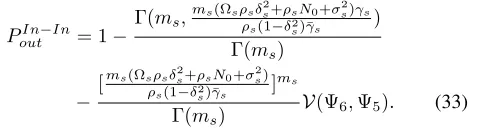
(15) in (23) and using a similar approach as for the derivation of 32, the secrecy outage probability for this case is expressed as
PoutIn−In = 1−
Γ(ms,ms(Ωsρsδ
2
s+ρsN0+σ 2 s)γs
ρs(1−δs2)¯γs )
Γ(ms)
−[
ms(Ωsρsδ 2
s+ρsN0+σ 2 s)
ρs(1−δ2s)¯γs ]
ms
Γ(ms) V
(Ψ6,Ψ5). (33)
IV. NUMERICALRESULTS ANDDISCUSSION
We now provide some numerical results to validate the analytical expressions derived in Section III. The system parameters provided in Table I are used for result generation, unless stated otherwise.
S No. Simulation Parameter Value
1. Channel Realizations 105 2. Antenna Noise VarianceN0 0.1 dB 3. Signal Processing Noise Varianceσ2
s=σ
2
e 0 dB
4. Target Secrecy RateRs 1 bit/sec/Hz
5. Main Link PowerΩs 30 dB
6. Wiretap Link PowerΩe 10 dB
7. Nakagami-mshape factorms=me 2
8. Power splitting factorρs=ρe 0.8
9. Channel estimation accuracyδs=δe 0.2
10. No. of eavesdroppersN 5 TABLE I
SIMULATIONPARAMETERS.
Fig. 3 compares the secrecy performance for different com-binations of receiver architectures at the legitimate receiver and the eavesdroppers. Fig. 3(a) shows that for any given value of¯γs, the smallest secrecy outage probability is achieved when S is equipped with a separated andEwith an integrated receiver architecture. on the other hand, the secrecy outage probability is the largest for the case when S is equipped with an integrated and E with a separated architecture, all other parameters remaining un-changed. The figure also shows that the outage probability increases with cooperation between the eavesdroppers. Fig. 3(a) shows that by increasing γ¯s a steady reduction in the outage probability can be achieved. However, at large values (γ¯s > 28 dB), an outage floor is introduced for both the cooperative and non-cooperative cases, which shows that the outage probability does not decrease despite an increase in the main link SNR. This floor appears because of the channel estimation errors for the main link. By comparing Figs. 3(a) & (b), it can be observed that by increasing the target rate Rs, for a fixed γ¯s, the outage probability increases for all receiver architecture combinations.
[image:7.612.53.300.72.281.2]Finally, comparing the two sub-figures also reveals that the difference between the outage performance with and without eavesdropper cooperation diminishes asRs is increased from 1 to 2 bps/Hz. All graphs shown in the figures exhibit a good match between the simulation and analytical results, which validates the accuracy of our derived analytical expressions.
[image:7.612.66.306.212.276.2]Fig. 4 shows the secrecy outage probability surface plotted against ¯γs and the Nakagami-m parameter, for different re-ceiver architectures at S and E. Figure 4(a), for the case of non-cooperative eavesdroppers, shows that the secrecy outage probability decreases with an increase in ms = me, which corresponds to a decreasing severity of the channel fading. Moreover, the figure shows that progressively larger values of the Nakagami parameter (ms = me =m > 2, result in an increasing difference between the secrecy outage probabilities achieved by the 4 receiver combinations; the combination of S separated andEintegrated receivers has the smallest outage as already observed in Fig. 3. By comparing Fig. 4(b), i.e., co-operative eavesdroppers with Fig. 4(a) for the non-cooperating case, it can be observed that for a given γs and identical system parameters, cooperation between the eavesdroppers significantly increases the secrecy outage probability relative to that for the non-cooperative case.
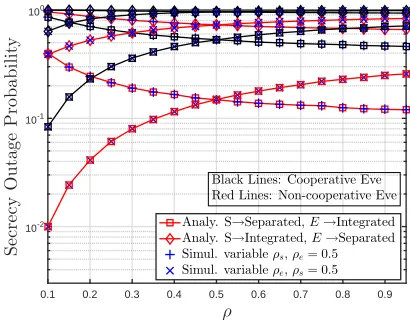
Fig. 5 shows the impact of the PS factorρ on the secrecy outage probability. To separately demonstrate the effect of PS at S only,ρsis varied while the PS factor at the eavesdroppers is fixed at ρe = 0.5. Another set of curves shown in Fig. 5 describe the effect of PS at eavesdroppers only, while
ρs = 0.5 is maintained for those curves. The figure shows that by increasing values ofρsthe secrecy outage probability decreases. This is because a larger fraction of the received power is then used for ID at S. In contrast, the secrecy outage probability increases with increasing values of ρe. This is due to the fact that more power is then allocated by the eavesdroppers to decode the secret message, which diminishes the system’s secrecy performance.
Fig. 6 shows the impact of the channel estimation errors on the secrecy outage probability. Figs. 6(a),(b) show that an in-crease inδs, the legitimate receiver’s estimation error, degrades the secrecy performance. Whereas, Figs. 6(c),(d) show that an increase in δe, the eavesdropping receiver’s estimation error, reduces the secrecy outage probability. This follows from the fact that the secrecy outage event is dependent on the decoding ability of both the legitimate and the eavesdropper nodes. An imperfect channel estimate at the eavesdropper increases its likelihood of incorrect decoding of the secret message, which reduces the information leakage. One may also observe from the figure that an increasing error in CSI estimate of the higher SNR main link has a more dominant effect on the secrecy outage probability than a similar increase in CSI error on the wiretapping receivers. This can be verified by comparing the relative shift in the secrecy outage curves between Fig. 6(a) and (b) with the relative shift in the secrecy outage between Fig. 6(c) and Fig. 6(d). This effect is more pronounced for the cooperating eavesdroppers case.
¯
γs (dB)
0 5 10 15 20 25 30
S
ec
re
cy
O
u
ta
g
e
P
ro
b
a
b
il
it
y
10-3
10-2
10-1 100
Analy. S→Separated,E→Separated Analy. S→Separated,E→Integrated Analy. S→Integrated,E→Separated Analy. S→Integrated,E→Integrated Simul. Non-cooperative
Simul. Cooperative Black Lines: Cooperative Eve Red Lines: Non-cooperative Eve
¯
γs (dB)
0 5 10 15 20 25 30
S
ec
re
cy
O
u
ta
g
e
P
ro
b
a
b
il
it
y
10-1
100
Analy. S→Separated,E→Separated Analy. S→Separated,E→Integrated Analy. S→Integrated,E→Separated Analy. S→Integrated,E→Integrated Simul. Non-cooperative
Simul. Cooperative Black Lines: Cooperative Eve Red Lines: Non-cooperative Eve
[image:8.612.72.527.64.237.2](a) (b)
Fig. 3. Comparison of secrecy performance between different SWIPT receiver architectures. (a)Rs= 1bps/Hz (b)Rs= 2bps/Hz.
0 10
¯ γs(dB)
20 30 4 3
ms=me
2 1
10-1
100
10-3
10-2
10-4
S
ec
re
cy
O
u
tage
P
rob
ab
il
it
y
0.1 0.2 0.3 0.4 0.5 0.6 0.7 0.8 0.9 1
S→Separated E→Integrated
S→Integrated E→Separated
S→Integrated E→Integrated S→Separated
E→Separated
0 10
¯ γs(dB)
20 30 4 3
ms=me
2 1
10-2
10-1
100
S
ec
re
cy
O
u
tage
P
rob
ab
il
it
y
0.1 0.2 0.3 0.4 0.5 0.6 0.7 0.8 0.9 1
S→Separated E→Integrated
S→Integrated E→Separated
S→Separated E→Separated
S→Integrated E→Integrated
(a) (b)
Fig. 4. Effect of Nakagami-mparameter and eavesdropper cooperation on secrecy performance,δs =δe = 0.1. (a) Non-cooperative eavesdroppers (b)
Cooperative eavesdroppers.
ρ
0.1 0.2 0.3 0.4 0.5 0.6 0.7 0.8 0.9
S
ec
re
cy
O
u
ta
g
e
P
ro
b
a
b
il
it
y
10-2
10-1
100
Analy. S→Separated,E→Integrated Analy. S→Integrated,E→Separated Simul. variableρs,ρe= 0.5 Simul. variableρe,ρs= 0.5
Black Lines: Cooperative Eve Red Lines: Non-cooperative Eve
Fig. 5. Effect of power splitting factorρon the secrecy outage probability.
0.99 with fixed ρe = 0.5. However, plotting of each curve in Fig. 7 is restricted to its respective ρs sub-interval that produces a non-negative secrecy capacity. This results in
different energy levels, harvested according to (1−ρs), at zero secrecy capacity as shown in Fig. 7. One may observe from the figure that the enhanced eavesdropper performance due to cooperation diminishes the harvested energy conditional on a non-negative secrecy capacity. The figure also shows that
δs = δe = 0.001 achieves a better energy-secrecy operating point than that of δs = δe = 0.2, which highlights the significance of having an accurate CSI estimate at the main receiver. Moreover, the figure shows that when the number of eavesdroppers N increases from 5 to 10, the area of the energy-secrecy capacity region decreases significantly for both the cooperative as well as the non-cooperative eavesdroppers. Finally, for a fixed number of eavesdroppers, the energy-secrecy capacity region for non-cooperative eavesdroppers is larger than that of the cooperative eavesdroppers. This highlights the fact that cooperation among the eavesdroppers considerably degrades the secrecy performance of the system.
V. CONCLUSION
[image:8.612.74.528.269.450.2] [image:8.612.65.270.504.664.2]δs
0.1 0.2 0.3 0.4 0.5 0.6 0.7 0.8 0.9
S
ec
re
cy
O
u
ta
g
e
P
ro
b
a
b
il
it
y
10-2 10-1 100
Analy. S→Separated,E→Separated
Analy. S→Separated,E→Integrated
Analy. S→Integrated,E→Separated
Analy. S→Integrated,E→Integrated
Simul. Non-cooperative Simul. Cooperative
Black Lines: Cooperative Eve Red Lines: Non-cooperative Eve
(a)
δs
0.1 0.2 0.3 0.4 0.5 0.6 0.7 0.8 0.9
S
ec
re
cy
O
u
ta
g
e
P
ro
b
a
b
il
it
y
10-3
10-2
10-1 100
Analy. S→Separated,E→Separated
Analy. S→Separated,E→Integrated
Analy. S→Integrated,E→Separated
Analy. S→Integrated,E→Integrated
Simul. Non-cooperative Simul. Cooperative
Black Lines: Cooperative Eve Red Lines: Non-cooperative Eve
(b)
δe
0.1 0.2 0.3 0.4 0.5 0.6 0.7 0.8 0.9
S
ec
re
cy
O
u
ta
g
e
P
ro
b
a
b
il
it
y
10-4
10-3
10-2 10-1
100
Analy. S→Separated,E→Separated Analy. S→Separated,E→Integrated Analy. S→Integrated,E→Separated Analy. S→Integrated,E→Integrated Simul. Non-cooperative Simul. Cooperative
Black Lines: Cooperative Eve Red Lines: Non-cooperative Eve
(c)
δe
0.1 0.2 0.3 0.4 0.5 0.6 0.7 0.8 0.9
S
ec
re
cy
O
u
ta
g
e
P
ro
b
a
b
il
it
y
10-2
10-1 100
Analy. S→Separated,E→Separated Analy. S→Separated,E→Integrated Analy. S→Integrated,E→Separated Analy. S→Integrated,E→Integrated Simul. Non-cooperative Simul. Cooperative Black Lines: Cooperative Eve Red Lines: Non-cooperative Eve
[image:9.612.70.533.54.441.2](d)
Fig. 6. Effect of imperfect CSI on the secrecy outage probability. (a) variableδs, fixedδe= 0.001. (b) variableδs, fixedδe= 0.5. (c) variableδe, fixed δs= 0.001. (d) variableδe, fixedδs= 0.5.
Secrecy Capacity (bits/sec/Hz)
0 0.5 1 1.5 2 2.5 3 3.5 4
E
n
er
g
y
(d
B
m
)
0 10 20 30 40 50 60 70 80
N= 5
N= 10
Black Lines: Cooperative Eve Red Lines: Non-cooperative Eve
δs=δe= 0.2 δs=δe= 0.001
Fig. 7. Energy-Secrecy Capacity Region.ρs varied between 0.01 and 0.99, ρe= 0.5andζe=ζs= 0.8.
eavesdroppers and different combinations of the SWIPT re-ceiver architectures considered at the legitimate rere-ceiver and the eavesdroppers. We derived closed-form expressions for the
secrecy outage probability for each of these cases and showed that the smallest secrecy outage probability is achieved when the legitimate receiver has a separated architecture and the eavesdroppers have an integrated SWIPT receiver. The worst-case scenario is when the legitimate receiver has an integrated architecture and the eavesdroppers have separated SWIPT architectures; for a high main link SNR and
[image:9.612.69.271.492.651.2]ACKNOWLEDGMENT
This work is supported by the EU-funded project ATOM-690750, approved under call H2020-MSCA-RISE-2015.
REFERENCES
[1] I. Krikidis, S. Timotheou, S. Nikolaou, G. Zheng, D. W. K. Ng, and R. Schober, “Simultaneous wireless information and power transfer in modern communication systems,”IEEE Communications Magazine, vol. 52, no. 11, pp. 104–110, 2014.
[2] K. Huang and E. Larsson, “Simultaneous information and power transfer for broadband wireless systems,”IEEE Transactions on Signal Process-ing, vol. 61, no. 23, pp. 5972–5986, 2013.
[3] X. Zhou, R. Zhang, and C. K. Ho, “Wireless information and power transfer: Architecture design and rate-energy tradeoff,”IEEE Transac-tions on CommunicaTransac-tions, vol. 61, no. 11, pp. 4754–4767, 2013. [4] L. R. Varshney, “Transporting information and energy simultaneously,”
inproc. IEEE International Symposium on Information Theory, 2008, pp. 1612–1616.
[5] P. Grover and A. Sahai, “Shannon meets Tesla: Wireless information and power transfer,” inproc. IEEE International Symposium on Information Theory, 2010, pp. 2363–2367.
[6] L. Liu, R. Zhang, and K.-C. Chua, “Wireless information transfer with opportunistic energy harvesting,”IEEE Transactions on Wireless Communications, vol. 12, no. 1, pp. 288–300, 2013.
[7] Z. Xiang and M. Tao, “Robust beamforming for wireless information and power transmission,”IEEE Wireless Communications Letters, vol. 1, no. 4, pp. 372–375, 2012.
[8] K. Huang and V. K. Lau, “Enabling wireless power transfer in cellular networks: Architecture, modeling and deployment,”IEEE Transactions on Wireless Communications, vol. 13, no. 2, pp. 902–912, 2014. [9] S. Lee, R. Zhang, and K. Huang, “Opportunistic wireless energy
harvesting in cognitive radio networks,”IEEE Transactions on Wireless Communications, vol. 12, no. 9, pp. 4788–4799, 2013.
[10] G. De Meulenaer, F. Gosset, F.-X. Standaert, and O. Pereira, “On the energy cost of communication and cryptography in wireless sensor networks,” in proc. IEEE International Conference on Wireless and Mobile Computing, Networking and Communications, 2008, pp. 580– 585.
[11] K. Cumanan, H. Xing, P. Xu, G. Zheng, X. Dai, A. Nallanathan, Z. Ding, and G. K. Karagiannidis, “Physical layer security jamming: Theoretical limits and practical designs in wireless networks,”IEEE Access, vol. 5, pp. 3603–3611, 2017.
[12] B. Juan, X. Tao, J. Xu, X. Zhang, and Q. Zhang, “Relay selection for secrecy connectivity in random wireless networks,”Wireless Communi-cations and Mobile Computing, vol. 16, no. 15, pp. 2263–2273, 2016. [13] D. Deng, X. Li, L. Fan, W. Zhou, R. Qingyang Hu, and Z. Zhou,
“Secrecy analysis of multiuser untrusted amplify-and-forward relay networks,”Wireless Communications and Mobile Computing, vol. 2017, 2017, Article ID 9580639.
[14] X. He and A. Yener, “Secure degrees of freedom for Gaussian channels with interference: Structured codes outperform Gaussian signaling,” in
proc. IEEE Global Telecommunications Conference, 2009, pp. 1–6. [15] Y. Zou, X. Wang, and W. Shen, “Physical-layer security with multiuser
scheduling in cognitive radio networks,”IEEE Transactions on Commu-nications, vol. 61, no. 12, pp. 5103–5113, 2013.
[16] Z. Shu, Y. Qian, and S. Ci, “On physical layer security for cognitive radio networks,”IEEE Network, vol. 27, no. 3, pp. 28–33, 2013. [17] H. Sakran, M. Shokair, O. Nasr, S. El-Rabaie, and A. A. El-Azm,
“Proposed relay selection scheme for physical layer security in cognitive radio networks,”IET Communications, vol. 6, no. 16, pp. 2676–2687, 2012.
[18] K. Cumanan, Z. Ding, M. Xu, and H. V. Poor, “Secrecy rate optimization for secure multicast communications,”IEEE Journal of Selected Topics in Signal Processing, vol. 10, no. 8, pp. 1417–1432, Dec 2016. [19] P. C. Pinto, J. Barros, and M. Z. Win, “Secure communication in
stochastic wireless networksPart I: Connectivity,”IEEE Transactions on Information Forensics and Security, vol. 7, no. 1, pp. 125–138, 2012. [20] J. P. Vilela, M. Bloch, J. Barros, and S. W. McLaughlin, “Wireless
se-crecy regions with friendly jamming,”IEEE Transactions on Information Forensics and Security, vol. 6, no. 2, pp. 256–266, 2011.
[21] O. O. Koyluoglu, C. E. Koksal, and H. El Gamal, “On secrecy capacity scaling in wireless networks,”IEEE Transactions on Information Theory, vol. 58, no. 5, pp. 3000–3015, 2012.
[22] N. Romero-Zurita, M. Ghogho, and D. McLernon, “Outage probability based power distribution between data and artificial noise for physical layer security,”IEEE Signal Processing Letters, vol. 19, no. 2, pp. 71– 74, 2012.
[23] G. Zheng, L.-C. Choo, and K.-K. Wong, “Optimal cooperative jamming to enhance physical layer security using relays,”IEEE Transactions on Signal Processing, vol. 59, no. 3, pp. 1317–1322, 2011.
[24] K. Cumanan, G. C. Alexandropoulos, Z. Ding, and G. K. Karagiannidis, “Secure communications with cooperative jamming: Optimal power allocation and secrecy outage analysis,”IEEE Transactions on Vehicular Technology, vol. PP, no. 99, pp. 1–1, 2017.
[25] Y. Liu, J. Li, and A. P. Petropulu, “Destination assisted cooperative jamming for wireless physical-layer security,” IEEE Transactions on Information Forensics and Security, vol. 8, no. 4, pp. 682–694, 2013. [26] Y. Yang, Q. Li, W.-K. Ma, J. Ge, and P. Ching, “Cooperative secure
beamforming for AF relay networks with multiple eavesdroppers,”IEEE Signal Processing Letters, vol. 20, no. 1, pp. 35–38, 2013.
[27] H. Yu, S. Guo, Y. Yang, and B. Xiao, “Optimal target secrecy rate and power allocation policy for a swipt system over a fading wiretap channel,”IEEE Systems Journal, vol. PP, no. 99, pp. 1–12, 2017. [28] F. Jameel and S. Wyne, “Secrecy outage of SWIPT in the presence of
cooperating eavesdroppers,” AEU-International Journal of Electronics and Communications, vol. 77, pp. 23–26, 2017.
[29] B. Fang, Z. Qian, W. Zhong, and W. Shao, “AN-aided secrecy precoding for SWIPT in cognitive MIMO broadcast channels,”IEEE Communica-tions Letters, vol. 19, no. 9, pp. 1632–1635, 2015.
[30] M. Zhang, Y. Liu, and R. Zhang, “Artificial noise aided secrecy information and power transfer in OFDMA systems,”IEEE Transactions on Wireless Communications, vol. 15, no. 4, pp. 3085–3096, 2016. [31] Q. Li, Q. Zhang, and J. Qin, “Secure relay beamforming for
simulta-neous wireless information and power transfer in nonregenerative relay networks,”IEEE Transactions on Vehicular Technology, vol. 63, no. 5, pp. 2462–2467, 2014.
[32] X. Chen, D. W. K. Ng, and H.-H. Chen, “Secrecy wireless informa-tion and power transfer: Challenges and opportunities,”IEEE Wireless Communications, vol. 23, no. 2, pp. 54–61, 2016.
[33] F. Jameel, S. Wyne, and I. Krikidis, “Secrecy Outage for Wireless Sensor Networks,” IEEE Communications Letters, vol. 21, no. 7, pp. 1565– 1568, 2017.
[34] H. Zhang, Y. Huang, C. Li, and L. Yang, “Secure beamforming design for SWIPT in MISO broadcast channel with confidential messages and external eavesdroppers,” IEEE Transactions on Wireless Communica-tions, vol. 15, no. 11, pp. 7807–7819, 2016.
[35] Y. Isukapalli and B. D. Rao, “Packet error probability of a transmit beamforming system with imperfect feedback,”IEEE Transactions on Signal Processing, vol. 58, no. 4, pp. 2298–2314, 2010.
[36] T. Yoo and A. Goldsmith, “Capacity and power allocation for fading MIMO channels with channel estimation error,”IEEE Transactions on Information Theory, vol. 52, no. 5, pp. 2203–2214, 2006.
[37] G. K. Karagiannidis, D. A. Zogas, and S. A. Kotsopoulos, “On the mul-tivariate Nakagami-m distribution with exponential correlation,” IEEE Transactions on Communications, vol. 51, no. 8, pp. 1240–1244, 2003. [38] R. Morsi, D. S. Michalopoulos, and R. Schober, “Multiuser scheduling schemes for simultaneous wireless information and power transfer over fading channels,”IEEE Transactions on Wireless Communications, vol. 14, no. 4, pp. 1967–1982, 2015.
[39] F. Jameel, S. Wyne, and Z. Ding, “Secure communications in three-step two-way energy harvesting DF relaying,”IEEE Communications Letters, vol. pp, no. 99, pp. 1–1, 2017.
[40] M.-N. Nguyen, N.-P. Nguyen, D. B. Da Costa, H.-K. Nguyen, and R. T. De Sousa, “Secure cooperative half-duplex cognitive radio networks with
k-th best relay selection,”IEEE Access, vol. 5, pp. 6678–6687, 2017. [41] I. S. Gradshteyn and I. M. Ryzhik, Table of integrals, series, and
products, 8th ed. Academic press, 2014.
[42] A. Lapidoth, S. M. Moser, and M. A. Wigger, “On the capacity of free-space optical intensity channels,”IEEE Transactions on Information Theory, vol. 55, no. 10, pp. 4449–4461, 2009.
![Fig. 2. Separated and integrated receiver architectures of SWIPT [3].](https://thumb-us.123doks.com/thumbv2/123dok_us/1982016.159740/4.612.51.293.58.245/fig-separated-integrated-receiver-architectures-swipt.webp)