riTgi::" r fi "' 'j"i:i
:
z 21;
ry Yu*
-T\ .jn
,ri +6r
"l)
Wqste Hqzords
ond
lmpoct:
From
Regulotory Clqssificotion to
Environmentol Compotibility
The Assessmenl
of
MeEsures
for
the
Processing
of
Wqste
from
Plonts Subiect
to
licensing
Procedures
EUROPEAN COMMISSION Joint Reseorch Centre
j'l
{a
TSffisECI
EDITED BY THE INSTITUTE FOR PROSPECTIVE TECHNOLOGICAL STUDIES (IPTS}
SPECIAL ISSUE:
WASTE
Stimuloting Greoter Uptoke
of
Woste
Minimizotion
Pockoging
Re-use
-
Building on
the
Opportunities
to
lmprove
Environmenlol
Performonce
ond
Reduce
Costs
Environmentolly Compatible
Trectment
ond
Use
of
Orgonic
Wosle
6
The
IPTS
Report
No.22
March 1998
''
j"
,be tpTS Report Luas launchedin
December 1995,on
tbe requestand
under the auspicesrf
,i:
Commissioner Cresson. IVhat seemed like a daunting cballenge in late 1995, nou appears in retroslEct as a cntcial galuaniser of tbe IPTS' energies and skills.The Reort has publisbed anicles
in
numerous areas, maintaining a rough balance between tbem, andexpbxtit?g interdisciplinanty as
far
as possible. Articles are deemed prospectiuely releuant iJ tbey attempt toeaplore issues not
let
on
tbe poliq,maker's agenda (but projectedto
be there sooneror
later), orunderappreciated aspects
cf
issues already ctn tbe pclicymaker's agenda. The long drafting and redmftingprocess, based on a seNes of interactiue consultations tL,ilh outside experts guarantees quality contrci.
Tbe .firct,
and
possibly most significant indicator of success is that the Report is being read. Issue 00 (December 199) had a pnnt nmd
2000 copies, it1 uthat seemed an optimistic prdection at the time. Since then, circulation bas been boosted to 7000 copies. Requestsfor subscriptions haue come not onlyfrom uariouspafts oJ'Europe but also from the US. Japan, Australia, Latin America, N. A"frica, etc.
The laurels the publication is reapitlg are rendering it attractiuefor authorsfrom outside tbe Commissictrt.
lVe baue already publisbed contributions b.y' autbors from such renowned institutions as the Dtttcb TNO, tbe
German W)1, the Italian ENM and tbe US Ccntncil o.f Strategic and International Studies.
Moreouer, tbe IPTS formall.y collaborates on the production cf tbe IPTS Report witb a group of prestigious
European institutions, with u,hom the IPTS bas Jbrmed tbe European Science and Technolopy Obsen)atory (ESTO), an important pan of the remit ol'the IPTS, The IPTS Report is tbe most uisible manifeslation of tbis
collaboration.
Tbe Report is produced simultaneously in.four languages (English, Frencb, German and Spanisb) by tbe IPTS; kt these one could add tbe ltalian translation uohtnteered b-y- ENEA: -yet anotber sign of tbe Repon's increasing uisibility. The fact tbat it is not ottly auailable in seueral languages, but also largefu prepared and produced on tlre Internet lVorlcl \Vide Web, makes it quite an uncommon undenaking.
lVe shall continue to endeauour to
find
tbe best way offulfilling
the expectations of our quite diuerce readercbip, auoiding ouersimplftcation, as utell as encyclopaedic reuiews and the inaccessibility of academicjournals. The ke1 is to remind ourcelues, as u,ell as the readerc, tb6t we cannot be all tbings to all people, tbat
it
is impoltant to cdrue out our niche and continue optimalu exploring and exploitittg it, boping toilluminate topics under a neut, reuealing ligbt
for
tbe benefit of the readers, in order to prepare themfor
managing tbe cballenges ahead.
JJ'JJ
No.22
March 1998
The
IPTS
Reoort
rr
t1l'(: f il. {'(
it
montb?
iddrc
of
Tbe
IPTS
kport
?eab
witla the
important
iaduc
o/
waile
managemznt
in
Europe
from
tbe dtan?point
of
a
u
tainab
le
?e ve lop mznt.
To
giue
an
Oea
of
the acalc
of
tbe challznge, European
output
of
waile
hat
beenedtimate? at 2.2
billion
tonner,
of
wbicb
720
million
tonnet are
from
in?uttry
an?
26
millbn
tonnca are
bazar?ou,a.
Tarting a preuentive
approacla
an? re?ucing
tbia output
ia
a
prbrity
for
European pohcy,
at b
re?ucing
itd
level
o/
toxitity.
From tbid
uizwpoint
I
woul/ like
to mzntion
one
of
tbe key
actiont
in
tbe
Filtb
Framzwork
Programmz
/or
Rercarch
an?
Developmznt
pbit/a
/ocutet on
the
?evelopmznt
o/
tecbnologi-
inten?e?
to
make
it
potditrlz
to
re?ucererource
utilizatinn
an?
promote
tbe
re-ute an? recycling
of
watet
Tbia
actbn
ia alao
looking
at
clzan procerder an7
pro?uctt
bau7
on
tbe
'Life
Cyclz
Analyd
it'
concept.
Itt
overall
aim
it
tofacilitate
tlee?evelopmznt
of innovative
htgh-quatity
pro?uctd
an?
aerviced
wbicb
redpon?
to
tbe
nze?d
of
citizent an?
tbe
ma.rket, toget/aer
witb
new mctbo?d
of pro?uction
wbic/t economite
on
relourceJ an?
rupect
t/aeenvbonmznt.
_Jttt,J
@ IPTS - JRC - Seville. 1998
No.22 - March 1998
'-J-J-J-J
@ IPTS - JRC - Seville, 1998
The IPTS Report
Tlait
orizntation
it
compatible with
tbegoal of integrate?
pollution
prevention
an? control launcbe?
in
1996 by tbe ?irectiee. Tbe
JRC hat
alreahy ptaye?
a
ignificant
rolz
in tbil,
in parti.cukr
tbanka
to
tbe European Integrate?
Pollatbn
Prevention
an?
Control Bureau
det
up
wilhin
the
IPTS in
Sevilte.
In?ee?,
thit
bureau
it
in
cbarge
of ?rafting
re/erence
)ocununtd on
But
No.22 - March 1998
The
IPTS
Report
SPECIAI ISSUE: WASTE
itAncH1998
EDnFD BY THE lNslifl"fiE FoR
PRosPEcTrve
4
EdltOrlaland spanish.
SUBSCRIPTIOI{S
For a subscrifiion to The IPTS Report,
or to amend an existing subscrlption, ple6e
write with full details to: the IPTS Report secrebriat
IPTS, JRC Sevilla
World Trade Center
lda de la carnda E-41092 Sevilh, $ain
Tel: +34'5-44 88 284 Fax: +34-5-44 S 255 ' E-rnail: ipts_secrqrc.e6
webaddress: wwJrc.es/iptsreporvsubscribe.html provide a useful starting point.
.JTT,JJ
O IPTS - JRC - Seville, 1998
6
Stlmulatlng Greaterufiake
of waste Mlnlmlzatloni'
Despite a number of successful projects many companies are reluctant to adopt wasteminimization. Lack of awareness or adequate information and the investment needed are
amone the obstacles.
1l
Envlronmentally compatible Treatment
and
Useof organlc
waste
;rii'
ri'
Meeting sustainability objectives, and more directly, complyingwith
new European directives, are pufting increasing pressure on landfilling as a disposal option for organic wastes. The alternatives, such as biogas production, composting and incineration, each haveparticular wastes, require the possibility to determine environmental compatibility accurately
32
The Assessm€ntof
Measuresfor
th€
Processlngof
waste
from
ii,
Plants
sublect
to
Llcenslng
Proc€dures'
With a wide variety of waste minimization alternatives being available a need has arisen for a means of assessing options which is better suited to day{o-day licensing purposes than the more complex life-cycle-assessment approach. The gross energy requirement indicator mightTECHNOLOOICAL s'TUDIES {IPIS)
And issued in Cooperation with tf|e European s&T observatory Network
PUTITSH€B BY ITIE EUROPEAN COII|MISSION
Joint Researdl Centre
ISSN:1025-9384
cat logue Number 0K-M-98-002-€N-C
DEPOT LEOAL SE-1957.95
DIRECTOR
Jean-Mafie cadiou
. EXECUTIVE EDI'TOR
Dimlfis Kyriakc[
EDIORIAI BOARD
K,Beese{subject.Editor, Biotechnorosy).0.car.atti.
12
Packaglng
Re-USe-
BUlldlng
Onth€ Opportunltles
tO lmprove
c.Fahrenkros,J.oavisan$rbject"Editor:
:ir:,
Envlronmental
P€rformanc€ and
Reduc€costs
Technology"Emplovment-cornpetitivenessi, rr' M. conzebz, H. Hernrndez {subject-Editor:
Transport). D. Kyriakou {Execiltive
Eo,t"r'*oi"or"a
Packaging waste accounts for an important portion of total waste and arises at all stages in Editor: Information and commurtcationTechnologv),
the supply chain. Re-use may often be preferable to recycling, particularly in the case of bulkI Maghiros (Production Manager). P Ssrup (Subjed'
ejm"en"i.n*"no.A.sori?,(sub;cr-€;;;i;
packaging. However, a support framework needs to be put in place to promote this. Energv), C. TahirPRODUCNON
crNDoc-egc/Cr sERilcros [NoulsTlcos
oraesal
TRANSLATTON
cri{Doc-csrc/cl SERMcros LrNculsltcos
coPl$GHr
the views expressed in this publication do not
neoessarily reflect those of the European commission
o ECsc-EEc-EAEC Brussels'Lr-0cmbourg,'1997 'Reproduction is authorised, except for commerchl
puflcoses, prsvided the source is acknowledged.
,
Ihe EC mav not be held responsible for tie usemade of tie infoffnagon.
their pros and cons.
25
Waste Hazards and lmpact: From Regulatory classlflcatlonto
EnvironmentaltllE lPrs
lrPoRr
+:
COmpatiblllt}is publlshed in the first week of every month,
except
::for the months of January and Atgust. lt s edited in
The
IPTS
Report
EDITORIAL
L.
Bontoux and
F.
Leone
he
first
generationof
European waste legislation(1975 -1995)
is
generallyrecognized
to
have
had
positiveenvironmental consequences. However,
care must be taken to ensure that the continual tightening
of
the
legislation does not end upbringing such achievements into question. Since
1975, waste
recovery techniques
andtechnologies have improved significantly, and past
policy
actionsand
waste management strategies must evolveto
recognize this.A
longterm
perspectiveis
now
needed, whereenvironmental, technological
and
economicconsiderations are all satisfied.
The European strategy for waste management places waste prevention as its top priority, thereby
following the broad European policy aim to move
towards sustainable development. However, so
far,
in
practice, most waste management effortsseem
to
be concentrated on material recyclingand energy recovery on the one hand and waste treatment and disposal on the other. In effect, over
the last ten years, national and European waste management regulations have made considerable
progress towards more stringent environmental
quality requirements.
ln this issue ol The IPTS Repo( the first article
provides some elements
to
explain why wasteprevention has so far not been as successful as it
could have been. lt seems that socio-cultural and
organizational barriers are still high. Additionally, while regulatory requirements for waste handling
and disposal are numerous and pressing, waste prevention cannot be easily legislated into action.
No.22
March 1998
It
requiresa
wide
rangeof
changes, from industrial processes to living habits, from productdesign to new visions of the world.
Re-use is also often talked about, and in some
industrial sectors it seems already to be common practice (e.g. tertiary packaging),
but little
isknown about the true significance of this practice
in
termsof
waste prevention. The Europeanpackaging directive (94l62lEEC) mentions it
explicitly in article 5 but does not propose any
specific measures
to
promoteit.
The secondarticle of this special issue
of
The IPTS Report deals with this point. lt discusses cunent examplesof
re-useof
primary packaging, often the mostconspicuous
form
of
municipal waste, anddescribes a number of issues that limit the scope
of packaging re-use operations.
In the area of waste disposal, the debate about
the choice between landfilling and incineration has been given new force by the recent proposal
for
a
landfill directive. This proposal aims atdrastically reducing the amount of organic waste
going to landfill. Many experts think that this will result in more waste going
to
incinerators. Ourthird
article
shedslight on this
debate by proposing a prospective view of the various waysto
treat and disposeof
organic wastein
anenvironmentally-friendly way. This article also defends the view that the use of organic waste to
produce energy
will
have growing importance,especially in the medium to long term.
Another
area
of
concern
in
wastemanagement, beyond the mere reduction of the volume of waste produced, is reducing the hazard
it
represents. Currently,the main
practical:11
,J',JJ'
No.22
March 1998
consequences of the European waste legislation
on hazardous waste is to limit its movement. The
restrictive conditions and requirements
of
theBasel Convention and
of
Council Regulation259l93lEEC raised
a
numberof
environmental,economic
and
social issues linkedto
wastemanagement,
in
particularfor
recovery andrecycling.
In
Europe, these issues range fromlimitations
on
transoort
to
debates
onincineration, and from potential disruption of
markets to hampered industrial competitiveness.
The large amounts
of
waste from industrial countries dumpedwithout any control
indeveloping countries during the past decade and
poor waste disposal practices
in
Europe haveprompted policy action
to
ban the export ofhazardous
waste
and
severelyrestrict
themovement
of
waste
in
general.This
hasincreased the need
to
precisely know what iswaste and has sparked
off
heated debates on this subject, bothwithin the
European union and world-wide.Our
fourth article dealswith the
issue of 'hazardousness'and how it is legally defined. 5o far, European regulations have sought to identify, name, quantify and classify wastes in terms of thepotential danger they represent for man and the
environment. However,
the
article raises the question of the applicability of these regulations.Another important issue for the decision maker
in waste management is to be able to choose the best
option,
giventhe
local
economic andThe IPTS Reoort
environmental constraints.
This
ouestion is becoming every day more important in the questfor sustainability. There ls therefore now a need
to
develop
better
ways
to
evaluatethe
environmental performanceof
wastemanagement options and
to
communicate theresults of this evaluation. Methodologies such as
LCA,
risk
assessment, multi-decision criteria analysisor
cost/benefit analysisall
have acontribution to make in this area. Our last article deals with the issue
of
indicators, important for comparing various technology options.lt
places the discussion in the context of the IPPC directive.The issue
of
waste management is complexand far reaching. lt touches everyone of us and involves all industrial sectors. In this special issue,
we only deal with a few of its aspects. lt would
seem that the quest for sustainable development
requires
us
to
broaden'waste
managementthinking' to the management of material streams,
the
economyand
all
industrial
activities,abandoning a vision strictly limited to waste. This
idea has been taken
up in
the new IntegratedPollution Prevention and Control (IPPC) concept
now part
of
European environmental andindustrial policies. This opens the door
to
the broader adoption of concepts such as 'lntegratedWaste Management',
which
is
an
attempt tofind
the
most
appropriateeconomic
andenvironmental means
to
deal with unavoidable waste. The final success for European society will be measured on the ground, once we can seewhether
the
oracticehas
remained faithfulto the spirit of the policy.
..
t'
,1'
'ti:i!.i
i!;iil;
,J ,J ,J ,J ,J
filiffii"
;:l::i'riiii o
r:ii;!r.'
;
iii,'S"
The
IPTS
Report
Despite
the
clear andproven benefits
of
waste
minimization
for
companies, relatively
few
have takenit
upEncouraging uptake
of
wasteminimization
Wpically focuses
on
supportrngdemonstration
projects whose success isthen
hopedto
encourageothers
No.22
March 1998
Stimulating
Greater
Uptake
of
Waste
Minimization
Celia Creaves,
CESf
lssue: waste minimizatlon demonstration projects across Europe have hlghllghted the
benefits whlch can be achieved
through
a rigorous approachto
waste management.However, desplte
the
successof
these rypesof
projects, many organlzatlons remainreluctant to embark on similar initiatives. An improved understanding of the obstacles
to
greater uptake wlll help
to
hlghllght the opportunltlesfor
pollcyto
stimulate progress.Relevance: Waste minimization lles at
the
heart of effortsto
achieve sustalnable wastemanagement
in the future.
More wldespread actoption requiresan insight
into
the factors which influence organlzauons' waste management actlvlfles. Through a better appreciationof
the
motlvations ancl barrlerslt
is possibleto
ldentlfy how
policy andother tnltlatlves can encourage progress In thls area.
htroductlon
have failed to take uo waste minimization. Efforts tounderstand
why
this should be the case havehighlighted
a
number of factors which influence motivation and behaviour, and have revealed scope for policy intervention to improve uptake.Factors
influencing
uptake
of
waste
min:mization
A typical approach to encouraging uptake of
waste minimization is based around the provision
of
supportfor
discrete demonskation projects, involvinga
limited
numberof
representativeorganizations, usually
in a
particular location. Those taking part receive consultancy advice andassistance
in
identifying
opportunities forminimization, as well as the regular interaction
with
other participants, allowing exchange ofviews and experience.
As
the
benefits (bothfinancial and otherwise) emerge, it is hoped that other groups will be stimulated to action.
',JJ,J-J
O IPTS - JRC - Seville, 1998 ver recent years/ pressure
on
resourcesacross Europe has lead
to
an
increasedfocus on the effective management and,
where
possible, avoidanceof
waste. Furthermore, research suggesh that the costs of waste can be as high as 10%of
a
company'sturnover (ETBPP, 1996). Both governments and
other organizations have recognized the benefits
that waste minimization can bring. As
well
as making good economic sense, leading to efficient use of resources and considerable cost savings, it helps to reduce pressure on waste disposal facilities. The financial benefits have been highlighted in a series of demonstration proiects. For example, in theUK, a group of eleven companies saved almost 5
million ECU per year and substantially improved their environmental performance through waste
No.22
March 1998
An
analysisof
the perceived incentives forparticipation
in
externally sponsored wasteminimization proiects (CESI 1995) revealed that:
o
opportunities for cost reduction provided the greatest motivation;o
the availability of external funding, resulting inreduced financial risk, was also important
(although 35o/o of those surveyed stated that
they would have got involved without such
funding); and
o
where there wasan
existing and already recognized environmental issue, this helped to encourage involvement.Recent projects have shown that cost savings can be achieved just as easily through numerous, small actions, which can be easily introduced, as through a limited number of major actions, which
might
encounter internal obstaclesto
their implementation (W S Atkins; 1997). However, inall cases there is a need to recognize that it takes
time for the financial benefits to accrue, and the lack of immediately apparent results can act as a brake to progress amongst companies introducing
waste minimization.
Although
environmental
pressures areincreasing, the environmental benefits of waste
minimization have been found to have a relatively
small
role
in
motivation, particularly
bycomparison
with
potential financial savings.Where
environmental
benefits
can
be determined, these are frequently viewed in termsof improving public relations.
Balanced against financial and environmental incentives there can often be obstacles
to
beovercome. First,
until
actively involved, manycompanies have only a limited understanding of
waste minimization, or do not believe that there is scope for improvement in their businesses. For
the individuals involved, there can be concerns
about revealing weaknesses and faults
in
their-Jt-Jtt
@ IPTS - JRC - Seville. 1998
areas of responsibility. These can be overcome
by
ensuring thatexplicit
senior managementsupport is in place.
Participants in demonstration projects almost
always consider their involvement to have been
worthwhile. External consultants and assessors
help to give their efforts focus, drive, an external perspective and a systematic approach. However, there
is
often reluctanceto
work
with
such organizationswithout
the
financial
and managerial support offered by the projects.The long term success of waste minimization initiatives is helped by ensuring the involvement
of staff across the organization from the outset.
This might typically take the form of a series of project teams focusing
on
specific operational areas,with
a
co-ordinatingteam
havingresponsibility for overall cohesion.
Demonstration projects are often based on a
'Club'
approach, which allows participants to come togetheron
a
regular basisand
shareinformation. A survey of those involved in recent
[image:9.539.211.522.45.702.2]projects found that 70o/o found
this
approach useful. Major perceived benefits are summarized in Figure 1. Others included the inspiration from othermembers' progress/ reassurance
on
issues ofconcern, peer group pressure
to
demonstrateprogress and
a
senseof
community. Potentialproblems, such as conflict between competing
companies
who
mightbe
unwillingto
shareinformation, the resources needed for aftendance at meetings and other club activities, and inequality between club members in terms of expertise and value derived, have also been highlighted.
Policy
lssuesNotwithstanding
the
positive response toparticipation
in
demonstration projects, the key challenge for policy makers is to develop skategiesThe
IPTS
Report
A large
number
of
small actions can be
just
aseffective
as a single large action,which
may provemore
difFicultto
implement
Explicit senior management
suppon
mav be necessary in
order
to
overcome internal obstacleswithin
companiesThe sharing
of
information
between participants indemonstration
projectsis generally positive,
but
mayencounter
problems
whencompetitors
aresuspicious
of
eachother
or
members are'. , r'li:!i:l
,"iq, "ga
'\o
The
IPTS
Report
Dissemination
of
the
resultsof
demonstration
projects needsto
concentrate
on cost benefits
andclarifying
the
underlying concept
The
long
paybackperiod
for
wasteminimization
initiativesis a
deterrent
to
companies
Flgure
1.Benefits
of
a'club'approach
for promoting wider uptake of waste minimization
across the business communitv and more widelv. The policy issues cover two main areas:
o
dissemination; and.
encouraging stand-alone initiatives.Dissemination
of
the
resultsof
wasteminimization demonstration projects is essential if
more widespread uptake of successful approaches
is
to
be
achieved.To
have greatest impact, dissemination activities need to focus on the costbenefis to those involved. At a more fundamental level, they also need to address the fact that many organizations do not have a clear understanding of
the concept of waste minimization or, perhaps more worryingly, believe that they are already minimizing their waste when, in fact, they have little idea of
either the quantities or sources of waste arising, let
alone the opportunities for reduction. Those who could take a positive role in dissemination range
from the European Commission, through national
and local government, to trade associations and
local
business groups.As
well
as
publishedNo.22
March 1998
material,
organizationsconsidering
wasteminimization could benefit from direct exposure to those
who
have had successwith
their own initiatives. This could take the form of discussion groups or site visits.For companies considering establishing a waste
minimization initiative, a major deterrent is often the investment required. The key challenge here is
to
highlightthe link
betweena
short{erminvestment
and
long term payback. Analysissuggests that a waste minimization club, using a shared consultant, could operate independently. The key challenge here is to ensure that companies are sufficiently convinced of the long term benefit
to invest in waste minimization the short term.
Small and medium sized enterprises (SMEs) remain a particular challenge for those seeking to
encourage waste minimization. For these types of
companies, readily accessible information on
what can realisticallv be achieved with minimal
investment (both
of
time and money) can bett,Jtt
O IPTS - JRC - Seville, 1998
Eenefits
ideas
inspiiation
reassurance
pressure
methodology
community
10%
15o/o
20%Percer*age of participants mentioning.
No.22
March 1998
useful. Success stories can be particularly helpful in this context. SMEs can benefit particularly from the interaction provided by a Club, providing they
can be persuaded of the benefits to be derived
from the time commitment necessary.
Research in the UK suggests that there is a
relationship between company size
and
theamount
of
savings which can be achieved. In one study, data extrapolated from a sample of 11companies indicated
that
the
meanratio
ofannual first year savings
to
turnover was just over 0.3% (CESI 1995). These types of results could be consolidatedwith
those from otherprojects across Europe
to
developa
more detailed picture of the results which might beexpected at the company level. The data could
then
be
used
by
individual
organizationsembarking on a waste minimization project to
benchmark progress.
The extent
to
which technical solutions arerequired
to
progress waste minimization variesaccording to the gpe of activity undertaken. For those seeking guidance on solutions, there could be value
in
the establishmentof
a database of technological options. Such a database could bedeveloped to be accessible over the Internet, to
allow as broad a coveraSe as possible.
Organizations developing waste minimization solutions need to be aware of the principles of
Integrated Pollution Prevention
and
Control(IPPC). The 1996 IPPC Directive seeks to ensure
that efforts to minimize pollution take account of
potential
impacts
on
the
full
range
ofenvironmental media, and employ Best Available Technology (BAT). Waste m in imization i n itiatives,
including new technologies, should not operate in
such a way that pollution reduction across one area of an organization's activities is replaced by increased pollution in another. A good example of
where this might apply is sewage treatment works.
,J.J,J'J
O IPTS - JRC - Seville, '1998
With
respectto
stand alone initiatives, amechanism
is
neededto
allow companies toobtain
the
benefitswhich
consultants canbring, in terms of focus and structure, without
the need
to
investin
external resources. Thiscould be,
in
part, achievedby
ensuring theinvolvement
of
an
enthusiastic
projectchampion
with
senior management support,and financial and operational resource. The
establishment
of
local 'clubs', which
alloworganizations to share experience, can also be
beneficial. Local
environmental
or
tradegroupings
could
havean
importantrole
infacilitating
the
settingup of
such clubs. Tomaximize
the
interaction
amongst
clubmembers,
it
is, generally, advisableto
avoidincluding
organizationswho are
in
direct competition with one another in a single club.On
the other hand, there can be benefits inbringing together companies operating
in
thesame broad industry sector. By making the club focus as local as possible, concerns regarding
time
commitmentsto
attend
meetings etc. can be minimised.As the role of cost savings as an incentive
to
greater uptakeof
waste minimization arehighlighted,
it is
important
that
theenvironmental benefits
are not
overlooked.There has been
a
tendencyin
some recentdemonstrator projects
to
no
longer measurechanges
in
environmental performance. Thedevelopment
of a
policy framework which isoptimized to encourage greater uptake of waste
minimization needs to recognize the
full
range of improvements that can be achieved, and themechanisms which need
to
be established forthem to be realised.
Stimulation
of
greateruptake
of
waste minimizationis
best achieved through the involvementof
thefull
rangeof
stakeholders.Box
I
illustrates possible roles for key players.The IPTS Reoort
lnformation
onavailable technical
solutions
needsto
bemade as widely
available as possible
A mechanism is needed
to
allow companiesto
obtain
the
benefits
which
consultants canbring,
interms of focus
andstructure,
without
the
needto
invest inexternal resources
Research in
the
UKsuggests
that
there
is arelationship between company size and
the
amount
of
savingswhich can be achieved
ffi
a:.iill
I
',aiii $ tii:ii- t::&
The
IPTS
Report
No.22 - March 1998
, r .' ;.
Sx
tr.Sta*ffi|tr
mtu6 ln
adYeTlng
wctr
Tra& A$ciations:
Resarch conrmuniity:
I
Rsearch into teehnological solutjonslvhich are in accordancr with IPPC.Chamberu of Conrmerce):
!
Derelopmentof LCA and other toolsirr
evaluation of waste minimization options. local Govensrwrt/ocal interestTlicy
srakeru, i
'
o
Promotion of benefits of waste minimization..
Developinent of policies which support waste minimization (e.g. financial incentives such ast
Provision of local focus for shuing of.$reeiiencg and colleqtiveaglio,n,,.
waste based'taxes)..
Dissemination of good practice.*"ahcdi€s:: -l'- I
,i'''
'.
ftovision of favourable investment conditions. t.Recommendatlons
Actions which could help to stimulate greater
uptake
of
waste minimization, based
on experience to date, can be summarized as follows:'
Dissemination - a coherent approach acrossEurope could help
to
ensure that there isconsistency
and
reinforcementin
themessages reaching target groups. The full
range
of
communicationsmedia
shouldbe
utilised,
with
a
focus
on
clearlydemonstrable
benefits
and
practical experience in real organizations. An exampleof
a
national
dissemination programmewhere
wasteminimization has
receivedconsiderable
support
is the
U KEnvironmental Technology Best Practice
Programme (ETBPP). One of the ETBPP's key
aims
is
to
promote
the
use
of
betterenvironmental practices
which
reducebusiness
costs
for
UK
industry
andcommerce.
As well
as
regular events toencourage
waste
minimization,
theProgramme produces
a
series
of
freepublications, including
case
studies,good
practice guides,
informationon
new
technologies
and
techniques (new practice).',J,J-J,J
No.22
March 1998
Frameworks
-
Future developmentsin
areas such as Environmental Management Systems, IPPC and other initiatives aimed at improvingenvironmental performance across industry
should take account
of
the
benefits andpractical challenges
of
waste minimization,and seek to provide an appropriate framework
for stimulating greater uptake.
Local action - Where possible, consideration
should be given
to
mechanisms which will encourage stand alone initiatives, possibly based around a club approach, which needs to be established at the local level. This could include considerationof
the role
of
localsupport networks, such as business clubs and trade associations.
By way
of
illustration,considerable success has been achieved with
demonstration
projects
based
in
river catchment areas in the UK. The Dee (W. S.Atkins, 1997) and
Aire
and Calder (CEST,1994) Waste Minimization Projects achieved
annual cost savings of over 3 million ECU and
around 6.75 million ECU shared amongst 14
and .l 1 companies respectively.
There
would also
be
benefit
in a
pan-European assessment
of
success factors, based on demonstration projects and other activities,which
draws
on
individual
countries'experiences to refine understanding and ensure that future policy is appropriately focused for
maximum impact.
f
Keywords
waste, motivation, minimization/ management, greater uptake
References
.
CESI Final Report on the Aire and Calder Project, CESI 1994..
CESI Waste Minimization and Cleaner Technology: an assessment of motivation, CESI 1995..
ETBPP, CC27, 1996..
W. S. Atkins, Dee Catchment Waste Minimization Project, 199/.contact
Celia Greaves, CEST
Tel.: +44 171 354 9942, fax +44 171 354 4301, e-mail: [email protected]
J'',J"J
@ IPTS - JRC - Seville, '1998
The IPTS Report
About
the
author
Celia
Greaves
is aProject Leader
at
CEST,the
Centrefor
Exploitation
of
Scienceand Technology. She has over
ten
yearsexperience across a
broad range
technology-related
innovations andapplications. Her
interests at CEST include
emerging
technologies,
busi nessand
the environment,
andtransport.
'i#
2'itr:
0
t'
The
IPTS
Reoort
Packaging re-use
offers
benefits
interms
of
cost savings on
account
of
reduced material use, as well as being a responseto
European legislation
No.22
March 1998
Packaging
Re-use:
Building on
the
Opportunities
to
lmplove
Environmental
ver
recent years, pressureon
resourcesacross Europe has lead
to
an
increasedfocus
on
the
effective management of waste. In the case of packaging, this hasbeen manifest
in
European legislation settingspecific recovery and recycling targets which will come into effect in 2001 . One way in which the
response
to
the
obligations arisingfrom
this legislation can be optimized is through increasedpackaging re-use, whether
this
be
in
thecontext
of
industrial transit packaging or primary consumer packaging.Packaging re-use offers
a
numberof
clear benefits (UK Department of the Environment, 1 992):'
a
sustainable approachto
packaging waste- in
line with the
aspirationsof
the waste hierarchv:Peffiormance
and
Reduce Costs
Celia 0reaves,
CESI
lssus: Packaglng waste
forms an lmportant
componentof the
non.hazarclous wastestream,
wpically
accountingfor
up
to
10%of total
arlsings. This wasteis
producedthroughout the supply chaln,
from
raw material manufacture through to the consum€r.European legistatlon almed
at
harmonlzlngnafional
packaglngwaste
managementmeasures
and mlnlmlzlng
the
envlronmental tmpactsof
packagtngwaste
seeksto
achleve thls through hcreaslng levels of recovery recycllng and re-use.
pefevance: The European Parliament and Councll Dlrecfive 94/6UEC
on
packagtng andPackaglng waste sets speclflc targets for the recovery and recycling of packaging waste,
includlng re-use. An efflclent response requlres an understandlng of the lssues arouncl,
ancl scope
for
re-use amongst thosewho
produce and handle packaging, as well as asultable framework of support. stakeholclers Include both pollcymakers and lndustry.
|ntroduction
'
an
effective
responseto
the
European legislation; and'
cost savings-
through reduced useof
rawmaterials
and
reduced quantitiesof
wasterequiring disposal.
In
addition, re-use can,in
many cases, be introduced more easily than recycling, which often requires more complex and costly infrastructure and procedures. For a variety of activities,it
may be possible for organizations to introduce packaging re-use with very few changes to existing ways of working. Furthermore, simple, closed loop re-use schemes can help to avoid some of the problems associated with over-supply in the recycled material sector, as have already been experienced in some countries. By decreasing the amounts of material tobe recycled, whilst at the same time reducing the
amount of waste
to
be disposed of, future over-supply in recyclate markets should be minimized.J,J-J'^J
No.22
March 1998
The
realizationof
these benefitscan
befacilitated by policies which encourage packaging re-use. There is also a need for those involved to
understand
the
scopefor
and
limitations topackaging re-use.
lvpes of
packaglngPackaging can be considered as falling into
three main groups:
'
primary-
that which forms part of the salesunit to the consumer (e.9. a drink can);
o
secondary-
that which
is
usedto
groupindividual sales units, either for the consumer, or
to ease handling by the retailer (e.9. a cardboard sleeve for holding several drink cans); and
'
tertiarv - that which allows sales units to beBox 1. Packaglng
attrlbuts
Deslgnlng
for
re-us€Packaging has traditionally been designed to provide the optimum mix of attributes (see Box 1)
for the lowest cost. In many cases there are trade-offs to be made between particular attributes. For
example,
a
more expensive typeof
packagingcould provide better protection, but the additional cost may not justify the benefits. More recently, there has been
a
growing recognitionof
theenvironmental
implications
of
packaging decisions, and' this has begunto
emerge as a further design consideration.J',JJT
@ IPTS - JRC - Seville, 1998
Proteciion of conients agajnst damage (e.g. during handlingor through'contamination)
Containment (e.g. to prevent
spillage)
:Ease of handling (i.e. size, weight and shape)
Ease of storage (e.g. to allow a number of packages to be safely stacked)
ldentification (both for product management purposes and branding) Customer preferenqe (particularly in the case of primary packaging)
transported in bulk (e.g. transit packaging for securing and handling
a
large number of drink cans).In principal, re-use is feasible for all of these types of packaging. However, in each case there
are specific issues which need to be addressed. For example, primary packaging
is
typicallydistributed across a large number of consumers, and collection and consolidation after use in such circumstances can be challenging.
The materials used
in
packagingwill
varyaccording to the type of packaging (i.e. primary,
secondary,
tertiary)
and
the
circumstancesof
its
use. Attributestypically
required are summarized in Box I.For any organization moving from single trip to reusable packaging, a major concern
will
be to ensure that the packaging is sufficiently durable to be used a number of times. Here therewill
be abalance
to
be achieved between the costs ofpackaging, the number of times it can be re-used, and the scope for and cost of refurbishment. There are also issues around sustainabiliry
with
theadditional material typically required
for
morerobust (re-usable) packaging being at odds with
moves towards waste minimization. However, if
packaging is re-used sufficient times, the average
amount per product is reduced over time.
The
IPTS
Report
Re-use is
often
technically easier than recycling and can
avoid over-supply in
recyclate markets
Packaging falls
into
three
different
groups accordingto
its role and re-use considerations aredifferent
for
eachPackaging design seeks
to
provide anoptimum
mixof
attributes.
Recently,
envrronmental considerations have
begun
to
emerge
as aThe IPTS Report
Packaging designed
for
re-use needs
to
bemore
durable; packagingcomponents
which
may be repairedor
replaced maytherefore
becomecost-effective
Re-use
of
primarypackaging (i.e.
the
packaging in which
the
final customer
receivesthe
goods) requires changes inconsumer
attitudes
and ma\l clashwith
brand imagefactors
In general,
it
is likelyto
be easierfor
organizations
to
introduce
re-useof
tertiary
packaging (i.e.that
usedto
transport
units in
bulk) thanprimary
packagingThere are a growing number of suppliers who
can
provide packagingwhich
is
specifically designedfor
re-use, includingthe ability
to replace particular paftsif
they become broken.For example, Perstorp Plastic Systems (Perstorp Plastic Systems, undated) has developed a range
of plastic containers with hinged sides which can be removed and replaced as appropriate.
Whilst
much
progresscan
be
made inpackaging re-use without
the
needfor
majortechnological intervention, technology can make a
valuable contribution. For example, electronic tags (using bar-codes or magnetic memory chips) attached to containers could help organizations to manage the flow
of
reusable packaging throughthe
supply chain. Advancementsin
materialstechnology
could
be
significant
in
thedevelopment of new packaging materials which
are particularly appropriate for re-use, and in the redeployment of existing materials. An example of
the lafter is the use of inflatable cushion packaging for fragile products (Heesemans, .1995).
lssues relating
to
packaging design areparticularly important in the context of primary packaging, where attributes such as branding and
customer requirements have
a
high
priority.Consumer support
for
re-usable packaging,notwithstanding issues such as container return
after use (see below), is a major challenge in a
'throw-away' culture. The Body Shop (Wheeler,
1994) has offered an in-store refill service since
1976buL despite discounts of more than 20% on
certain products,
only
around 2o/oof
their UKpurchases involve
a
refill. Although levels areslightly higher
in
Sweden and Cermany, at 7%and 5% respectively, there is still considerable scope for improvement.
Branding can form a significant constraint to re-use
of
primary packaging,with
companiesoften
reluctant
to
move
towards
theNo.22
March'1 998
standardization
of
design
which
wouldmake
the
processmore
streamlined andcost-effective.
Areas offering greatest scope for progress in consumer packaging re-use include those with a
mass market characterized bv standard containers.
such as certain types of drink bottle and, on a smaller scale, egg cartons. For bottles, re-use can
be
stimulatedby
the establishmentof
'bring'deposit systems, which have had some success in countries such as Norway and the Netherlands.
Supply
chain
issuesIn
general,it
is
likely
to
be
easier for organizationsto
introduce re-useof
tertiarypackaging than primary packaging. Whilst tertiary
packaging
may
be
passed between severalorganizations,
primary
packagingis
oftendistributed behveen large numbers of consumers. In such situations it can be difficult to ensure that
the packaging is returned to the supplier. 'Bring'
systems, such as those described above, offer the greatest potential here.
Perhaps the simplest way in which re-use of
tertiary and, to some degree, secondary packaging can be introduced is through closed loop schemes
where suppliers and their induskial customers
work together to achieve re-use of
a
particulartype
of
packaging. For such schemesto
be successful, there needsto
be understanding of objectivesand
full
supportfrom
all
partiesinvolved. There may be particular benefit in the various users of the packaging having a role in its
design.
In
this way, problems associated with handling, storage and integration into productionprocesses can be minimised.
In planning packaging re-use, organizations need to be sure that they have sufficient stocks to accommodate
patterns
of
flow
between,Jt,Jt,J
No.22
March 1998
suppliers and customers. For example, a
scheme
could be applied across Europe, whilst ensuringis
unlikely
to
be
successfulif
all empty
a consistent, pragmatic and coherent approachcontainers are with the customer when they
are
to waste management in the widest sense. needed for filling by the supplier. Arrangementsfor the
transferof
such containers backto
As well as economic/fiscal measures, there are suppliers requires particular consideration.Costs
a number of other actions which could help to and environmental impacts associated withsuch
stimulate greater uptakeof
packaging re-use.transfer
can
be
avoidedby
returningempty
Options include:containers as part of the return journey of
the r
Public awareness - There would be benefit in goods delivery vehicle, where appropriate.This
promotionof
the valueof
packaging re-usemay not always be possible but, where
it
is,
amongst consumers. This could be linked towould
help
to
ensureefficient
useof
the
the broader issue of sustainable developmenttransport
infrastructure.
and could be aimed at overcoming the stigmaattached to'second hand' packaging. Industrial promotion
-
Creater uptake ofpackaging re-use across industry
can
beencouraged by highlighting the real benefits
that can be accrued. Where companies can
see practical experience
at
other
similar organizations, they are much more likely torecognize the relevance
to
themselves and,more importantly, to take action, than on the
basis
of
unqualified guidance.A
particularadvantage
of
encouraging organizations totake responsibility
for
re-useof
their
own packaging is that it could help to avoid someof
the trans-border and subsidiarity related issues that might arise. The extent to which thisis possible
will
depend upon the relationshipbetween suppliers and customers throughout
the supply chain.
Standardization
-
The
standardization ofcertain types
of
consumer packaging couldfacilitate the cost-effective operation of 'bring'
deposit systems.
This
would
require co-operation between companies, in the context of both packaging design and the managementof
its
re-use. Standardizationof
tertiary packaging, particularly whereit
is used by alimited
numberof
organizations,can
be achieved more easily.Incentive schemes
-
Traditional approaches, such as 'deposits' on bottles, demonstrate the Pollcyimplicatlons
and necommendationsIn seeking to encourage greater packaging
re-use, there may
well
be lessonsto
be learnedfrom previous experience, particularly in terms
of
primary packaging. Over the past 50 years,the number of refillable/re-usable containers has
declined sharply,
and there has been
acorresponding decrease
in
levelsof
re-use. Reasons for this are likely to include:.
public attitudes - as manifest in consumerism and the throw-away culture ando
the 'value' attached to packaging and itsre-use - as defined by economic signals, such as
the
value
of returns
and the
costs
ofdisposal, etc.
A major success factor is the extent to which frameworks can be established which reflect the true cost
of
production, use and disposal ofpackaging. This helps to highlight the benefits of packaging re-use and stimulate industry and consumers to take a more proactive role.
Countries such
as
Denmark, Belgium andLuxembourg
have provided support
for packaging re-use through a variety of economic instruments. The challenge for the future is todetermine whether and how such mechanisms
,J_Jttr
@ IPTS - JRC - Seville, 1998
The IPTS Report
Re-use
of
tertiary
andsecondary packaging requires
full
involvement
andsupport
of
all parties and planningto
ensuresufficient
stocksAs a result
of
changingattitudes
and economicsignals, packaging
re-use has in
fact
declined sharply over
the
last 50 yearsAwareness raising,
standardization and
economic
incentivesare
among the
actions whichcould
helpto
stimulate
greater uptakeof
packaging"ll
e'
ol'
o
The IPTS Report
About
the
author
Celia
Greaves
is a Project Leaderat
CESIthe
Centrefor
Exploitation
of
Scienceand Technology. She has over
ten
vearsexperience across a broad range
technology
relatedinnovation
andapplication. Her
interests at CEST include emerging
technologies,
businessand
the
environment,
andtransport.
No.22
March 1998
value
of
well
planned, consistent incentive schemes. However, consideration does needto
be
givento
issues such as subsidiarigand free trade.
o
Economic Instruments - Proposals for the newEuropean Waste Strategy
have
includedsuggestions for the introduction of charges for non-reusable products. Consideration could
be given to how similar economic instruments
might help to stimulate greater packaging re-use. New forms of waste taxation (for example, the landfill tax in the UK) could form important
incentives for packaging re-use.
o
Trans-European aspects - The introduction oflarge scale
re-use schemescould
haveimplications
for
trade across EU memberstates. These
would
need
to
be
fullyevaluated prior
to
the
introductionof
anymajor policy initiatives, to ensure that market
distortions do not arise.
As with other aspects of the European policy,
any
measuresto
encourage greater re-use ofpackaging need to take account of the subsidiarity and related issues. Whilst many companies might welcome a standard approach, the benefits of any
l(€ywords
packaging, re-use, environment, supply chain, waste
References
o
Departmentof
the
Environment,Ihe
Producer Responsibility Obligations (Packaging Waste)Regulations, 1997 - User's
6uidg
Department of the Environment, 1997.Wheeler, D., The Body Shop lnternational,
Why
Reailers should take responsibilityfor
Post-consumer waste, Turning Packaging waste recovery targets into opportunities to gain competitive
advantage, Presented at Kensington Hilton Hotel, London, 21 st June 1 994.
Heesemans,
M., Ihe
Developmentof
Environmentally Friendly Packaging for Sony Televisions, unpublished master's thesis, Delft University of Technology, 1995.Perstorp Plastic Systems, Company literature - Magnum Folding Pallet Container, undated.
contact
Celia Creaves, CEST
Tel.: +44 171 354 9942, fax: +44 171 354 4301, e-mail: [email protected]
-J,J-JJ-J
@ IPTS - JRC - Seville. 1998 economies of scale which could be achieved will
need to be weighed against the priority given to local determination and interpretation. The need
to ensure free trade conditions is also relevant.
Support for packaging re-use is likely to be best targeted towards producerlndustry lead schemes where those who are likely to re-use the packaging take a key role. Any other approach is likely to be less able to achieve a comparable impact (in terms
of levels of re-use) for equivalent input.
In
conclusion,as
measuresto
encourageincreased packaging re-use are examined and
developed,
it
is important to recognize that thisapproach
is
not always appropriate, either ineconomic
or
environmental terms. Life cycleanalyses
could play
an
importantrole
indetermining the balance between the benefits
highlighted earlier, and the costs and impacts of
additional material handling,
storage andtransport, and
the
needto
investin
differenttypes of packaging. This is particularly pertinent
No.22
March 1998
Environ
mentally
Com
Patible
Treatment and
use
of
organic waste
Ludwig
Leible,,rAs
lssu€: Envlronmentally compatlble treatment and use of waste ls a great challenge
that
wlll
haveto
bemet
lf
our
productlon and consumptlon conclltlons areto
be brought closerto Sustalnablllw.
Nevertheless,lt
ls
becomlngmore and mor€
dlfflcult
and expenslveto
use wastes ln an environmentally-frlendly way. Inthls
cont€xtthe
useof
organlc waste as a sourceof
energywlll
be an lnterestlng alternatlve ,wnn grourlnglmportance, especlauv In the medlum and long€r term;
Relavance: Organlc wastes make up a large part
of total
iMastesfrom'both
productlonand consump$on. Although landfllllng ls economlcally attractlve today, landflll capaclty
i9 CleArly
flnlte
ancl lts environmental impact ls caushg concern. Regulatory restrlctlonsare therefore belng Introduced, placlng Increased emphasls on
alternatlves-htroductlon
on-fossil organic residues and wastes (for
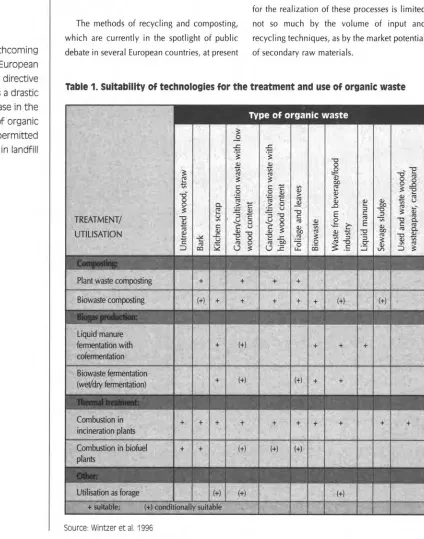
further definitions, see Table 1) make up
a large part of the volume of waste from
production
and
consumption
ofproducts. For example, in Cermany the current
annual volume
of
organic wastes generated isabout
65
-
75 million
tonnesof
dry organicmatter. This corresponds approximately
to
onethird
of
above-ground biomass production.Today the cheapest option for most of this waste is to landfill it, but in the longer term this
will
no longerbe
permittedfor
organic wastes onaccount of their environmental impact and the
limited landfill
capacity.The
forthcomingEuropean
Landfill
Directive
aims
in
thisdirection. Consequently,
the
searchfor
other treatment methods and usesof
organic wastewill
have to be reinforced. Their use for energy,J,J,J'-J
O IPTS - JRC - Seville. 1998
will
be at the centre of the aftention and botheconomic and environmental considerations are likely
to
giveit
even greater priority than thecultivation
of
specific renewable crops for thegeneration of energy.
The Volume and
lmportance
of
Organlcwaste
Vegetable raw materials are the starting point
for
almostall
organic waste. This material isconsumed
either directly
or
following processinginto
food,
animal
fodder
andindustrial raw materials (renewable resources).
Both
in
the
harvestingof vegetable
rawmaterials
(plant
production)
and
in
their processing (animal husbandry,food
industry, processingof
renewable
resources) andfollowing their consumption, organic wastes of
varying volume and composition are left over.
The IPTS Report
The
forthcoming
European Landfill
Directive
will
put
limits onthe
amount
of
waste