GARCIA WORKING PAPERS
Reflexive working groups for
selection committee members:
12 SSH and STEM test institutions
Edited by Marjolein Dennissen, Channah Herschberg,
Yvonne Benschop, Marieke van den Brink
! GARCIA is an EU-Framework 7 funded project under topic SiS.2013.2.1.1-1
“Supporting changes in the organisation of research institutions to promote Gender Equality”
Grant agreement n. 611737 • Project coordinator:University of Trento • Homepage: www.garciaproject.eu
2
Table of contents
General introduction 4
1. BELGIUM, by Grégoire Lits 5
1.1 Introduction 5
1.2 Set up of the task 6
1.2.1 STEM Department 6
1.2.2 SSH Department 8
1.3 Evaluation of the task 12
1.4 Conclusion 14
2. ICELAND, by Finnborg Salome Steinþórsdóttir, Gyða Margrét Pétursdóttir,
Þorgerður Einarsdóttir 16
2.1 Introduction 16
2.2 Set up of the task 17
2.2.1 STEM and SSH department 17
2.3 Evaluation of the task 22
2.3.1 STEM and SSH department 22
2.4 Conclusion 23
3. ITALY, by Rossella Bozzon, Francesca Fiore, Annalisa Murgia, Barbara Poggio 25
3.1 Introduction 25
3.2 Set up of the task 26
3.2.1 STEM department 26
3.2.2 SSH department 33
3.3 Evaluation of the task 37
3.3.1 STEM department 37
3.3.2 SSH department 39
3.4 Conclusion 40
3.5 References 41
4. TheNETHERLANDS, by Laura Berger, Marjolein Dennissen 43
4.1 Introduction 43
4.2 Set up of the task 44
4.3 Evaluation of the task 47
4.4 Conclusion 50
5. SLOVENIA, by Polona Sitar 52
5.1 Introduction 52
5.2 Set up of the task 53
5.3 Evaluation of the task 57
3
6. SWITZERLAND, by Sabine Kradolfer, Nicky Le Feuvre 62
6.1 Introduction 62
6.2 Set up of the task 65
6.2.1 Actions coordinated at university level 66
6.2.2 STEM department 70
6.2.3 SSH department 71
6.3 Evaluation of the task 72
6.3.1 Actions coordinated at university level 72
6.3.2 STEM department 74
6.3.3 SSH department 75
6.4 Conclusion 75
6.5 References 76
6.6 Appendices 76
4
GENERAL INTRODUCTION
This GARCIA Working Paper ‘Reflexive working groups for selection committee members:
12 SSH and STEM test institutions’ presents the collection of the reports on the reflexive working groups for selection committee members that were organized in the six GARCIA beneficiaries: Belgium, Iceland, Italy, the Netherlands, Slovenia, and Switzerland. The reflexive working groups were organized in two disciplines: Science, Technology, Engineering and Mathematics (STEM) and Social Sciences and Humanities (SSH).
The reflexive working groups for selection committee members are part of work package 7 of the GARCIA project. The GARCIA Project – Gendering the Academy and Research: combating Career Instability and Asymmetries – is concerned with the implementation of actions in European universities and research centres to promote gender equality and to prevent gender stereotypes and discriminations. Work package 7 focuses on the revealing of gender practices in the construction of scientific excellence in recruitment and selection procedures. The construction of scientific excellence is especially salient for the early stages of a scientific career, as the label of excellence can make the difference between the inclusion or exclusion of researchers in academia. Building on the D7.2 report on Gender practices in the construction of excellence (Herschberg, Benschop & Van den Brink, 2016), the reflexive working groups are developed for committee members and other key players involved in the recruitment and selection of early career researchers.
A reflexive working group is a type of interactive training that invites the participants to reflect on their own actions and behaviour in organization processes. It is a space to share and exchange experiences. The aims of reflexive working groups were threefold. First, to raise awareness among key players on how gender practices influence the selection process and the selection criteria, including conceptions of excellence. Second, to raise awareness that evaluation criteria are not objectified truths, and that evaluators’ conceptions of criteria differ in highly political selection processes. And third, to raise awareness of the gender practices in evaluation procedures that disadvantage women.
Reflexive working groups are thus designed to discuss the recruitment and selection procedures of early career researchers and how gender practices are key to the inclusion or exclusion of candidates. Each beneficiary reported on the organization, execution and evaluation of these reflexive working groups in their national and organizational context. They reported on the challenges and resistances that they encountered either during the organization of the working groups or during the execution of the working groups. Although the basis of the reflexive working groups was the same for every beneficiary, national and organizational context factors resulted in several differences between the beneficiaries. Yet, these differences resulted in a valuable overview of what the organization of a reflexive working group of this kind entails in different national and organizational contexts. This exemplifies that keeping in mind the context in which the reflexive working groups are to be organized is crucial for its effectiveness and success.
5
1. BELGIUM
1.1 INTRODUCTION
The objective of organizing reflexive working groups with recruitment committee members is twofold. We first wanted to promote, amongst committee members (most of them being full professor) a climate that decreases gender bias in evaluation moments. That was achieved by discussing, during the working groups, the main findings we made in previous working packages of the Garcia project regarding the question of gender bias in UCLouvain organisational culture. We secondly wanted to collect information about the selection criteria that are used in actual recruitment procedures. Discussing, in light of different findings of the Garcia project, evaluation criteria and the perception of what is
“scientific excellence” with committee members permit us: 1/to collect information about
how “scientific excellence” is conceived in recruitment procedures at UCLouvain and 2/ to raise awareness of gender practices and gender bias in recruitment among key players in recruitment procedures.
We performed two working groups with committee members. One in the IACCHOS Institute (SSH Institute of the UCLouvain) and one in the ELI Institute (Institute of earth and life sciences - STEM). As recruitment commissions are composed mainly of full professors, we invited to the working groups most of the full professors of the two institutes. We also particularly targeted professors who occupy or had occupied decisional functions within their institute or even within the central administration of the UCLouvain (among them: Dean, President of Institute, former Vice-rector, and former Rector).
UCL specific context of recruitment
Selection procedures at the postdoctoral level at UCLouvain can take different forms. Tenure-track recruitment procedures are particularly different from non-permanent postdoctoral research or teaching staff member recruitments. Tenure-track recruitments
(at the level of “chargé de cours” (assistant or associate professor) or “chercheur qualifié”
(research associate) are the most formal recruitment procedures. It is the only stage of the career for which an official recruitment committee is constituted to assess the scientific quality of the candidates. Non-permanent post-doctoral position generally does not imply the constitution of a selection commission and are often directly conducted by the primary investigator of a research project himself.
Tenure-track recruitment procedures also depend on the scientific career paths that exist. Two career paths exist in Belgian universities: appointment as permanent professor at a university and appointment as permanent research associate at the FNRS (Belgian Funds for Scientific Research). Selection procedures as university professor or as permanent researcher at the FNRS are different.
6
professors from the Faculty and 2 external members generally coming from abroad. This tailor-made committee examines all the applications received and draws up a short-list with candidates that will be invited to a hearing. After the hearing, the committee produce a ranking of the candidates. This ranking (identifying generally one preferred candidate, in some cases two can be ranked as first) is transmitted to the central authority of the UCLouvain (the rectoral board, composed of the rector and vice-rectors). The rectoral board then invite the first-ranked candidate(s) for a hearing and make the final decision to appoint the candidate selected by the local recruitment committee. Generally the candidate selected by the local commission is appointed, but, in some uncommon cases, the rectoral board can decide that the first-ranked candidate does not demonstrate sufficient scientific achievement and decide to close up the procedure and postpone the appointment to the next year.
1.2 SET UP OF THE TASK
Two different workshops were organised with committee members. The first one with committee members from the STEM department (ELI) took place on March the 25th 2016 (11AM to 1PM), the second with committee members from the SSH department (IACCHOS) also on the 25th of March (2PM to 4PM).
1.2.1 STEM Department
Organization of the workshop
The first task to perform was to identify professors in the ELI that have taken part on a regular basis to recruitment committees. As it is very difficult to obtain the information about past recruitment procedures, we decided to invite to the workshop all the professors having the rank of “full professor”, namely 22 full professors. We send them an e-mail to invite them to what we called a “Workshop on the Garcia Project”. In this invitation we presented the Garcia project and explained that the aim of the workshop was to identified: 1/ the criteria of “academic success” and the evolution of “academic career” and 2/ to think about the impact of these two elements on gender inequality in academic career. 11 out of 22 responded to our call to participation, 11 didn’t give us an answer (despite the different reminders we sent them).
Among the 11 respondents, 6 were not available in the two weeks we intended to plan the meeting. 5 accepted to come on the 25th of March for a 2 hours meeting (11AM to 1PM). Finally one of them cancelled and 4 full professors took part to the meeting.
7
committee (to appoint an associate professor), but had several experiences with the recruitment of postdoc researchers for is research team.
Among the 22 full professors of the ELI, only two are women. None of them took part to the meeting, one didn’t answered to the invitation, and the second one was interested in the project but was on sabbatical leave and could not participate.
Content of the discussions
We divided the meeting in three parts. In a first part, we presented the aim of the working group and some actual facts about the “leaky pipeline” phenomenon and the progressive disappearance of women in academic career in Belgium coming from the Garcia working paper 5. We then asked the participants to react and comment these statements.
In a second part, we presented the results of a first research about the conception of
“academic excellence” realised at UCLouvain. Based on interviews made previously with
recruitment committee members, we distinguished two different conceptions of what is scientific excellence at UCL. A first one we called the “nomination set of criteria” and a
second that we called the “competition set of criteria”. We then asked the participants to
comment and discuss this distinction. We asked them if they agreed with this analytical distinction between these two set of criteria that are used to evaluate the scientific quality of a candidate during recruitment procedures. We also asked them if these sets of criteria could, to a certain extent, serve as an impediment for women to access permanent research positions.
In a last round of discussion we asked the participants if they have any recommendations to make regarding gender inequalities in recruitment procedures at UCLouvain.
In the first round of discussion (discussing the leaky pipeline phenomenon). A first intervention was made saying that:
“I have been in two recruitment commissions recently. In both we recruited women, thus in our institute, gender inequalities, if we make the math, I don’t believe that exist” (Prof. ELI 1)
This first statement was quickly dismissed by others participants. The second participant stated that gender inequalities in recruitment is not a novelty. That 20 years ago the same observation was already done and that the situation has not evolved much ever since. For this professor the explication of that phenomenon is that:
“Private life concern are more important to women candidates that to men”. (Prof. Eli 2).
After this observation the discussion went mostly around the difficulty for women to articulate their “working life” with their “family life”. One interesting observation in this regard was that:
“As well as it is the case for men, women have all to gain from a career
management policy that take into account the family life” (Prof. Eli 3)
8
bigger that before”. Only one participant disagreed with this statement and found that work pressure is now lower than 30 years ago and that gender inequalities in this regard does not exist (Prof. Eli. 1).
It is also worth noting that during this round of discussion about the leaky pipeline phenomenon, men and women were regularly presented as, “biologically” or even
“naturally” different and that those natural differences play a role in how research is done.
Men were described as “dominant male”, more prone to adopt “blunt” or “animal” comportments, and that the presence of more women in the work environment make it more difficult to behave in this masculine manner. Women doctoral student were
described as “more cautious”: - “they take 18 months to go to the lab for the first time” -
than male PhD student that “when they have an idea, they have an idea, they fail and then they start again”. “The get the same result in the same time, but this is a reality” (Prof. Eli 2).
The second round of discussion was devoted to the discussion of how to assess academic excellence in recruitment procedures. We presented our analytical distinction (nomination criteria vs. competition criteria) and asked the participants if this distinction made sense regarding their experience.
The four participants agreed with our distinction. Competition criteria (impact factor, number of publications, postdoctoral abroad research stays…) where seen as more useful to write a first short-list of candidates, and “nomination criteria (the ability to fit in the department, human and social competencies, capacity to be autonomous) where seen as more important for the last round of audition. Our formulation of the distinction between these two set of criteria was judged quite robust and applicable to their experiences.
In the last round of discussion we asked the participation which recommendations they would set regarding fight against gender inequalities. A first set of recommendations are about the enhancement of the work environment. Diminution of the work pressure with measures like the diminution of meetings, the organisation of meetings during strict business hours (before 5PM), the diminution of administrative tasks. This diminution of work pressure would allow men and women to achieve a better work/life balance.
The second set of recommendation is about the setting up of an institutional gender policy. One of the professor thinks that the university should be more proactive in that matter and have an official gender policy. Another professor think that this gender policy should be linked to the formulation of a “family policy”. The university should communicate more about work/life balance.
1.2.2 SSH Department
Organization of the workshop
9
invite them to what we called a “Workshop on the Garcia Project”. In this invitation we presented the Garcia project and explained that the aim of the workshop was to identified: 1/ the criteria of “academic success” and the evolution of “academic career” and 2/ to think about the impact of these two elements on gender inequalities in academic career. The 11 professors answered our e-mail and have shown some interest in the project. Among them, 5 were interested but were not available during the two weeks we intended to plan the meeting. Finally two professors cancelled in last minute (for medical reasons) and four professors took part in the meeting on March the 25th (2PM to 4PM).
All of them had participated to recruitment procedures in the past years. One (a full professor) was a former member of the rectoral board of the university and took part to several recruitment procedures, not only in the IACCHOS. A second one (full professor) was a former president of the IACCHOS institute and took part to several recruitment procedures in the Institute but also in other Institutes. Two (1 full professor and 1 professor, director of a research unit) took part to some recruitments procedures in the IACCHOS only.
We contacted three women and eight men. Three men took part to the meeting and one woman. (Among the 11 full professors of IACCHOS, 2 are women).
Content of the discussions
As it was the case for the ELI working group, we divided the meeting in three parts. In a first part, we presented the aim of the working group and some actual facts about the
“leaky pipeline” phenomenon and the progressive disappearance of women in academic
career in Belgium coming from the Garcia working paper 5. We then asked the participants to react and comment these statements.
In a second part, we presented the result of a first research about the conception of
“academic excellence” realised at UCLouvain. Based on interviews made previously with
recruitment committee members, we distinguished two different conceptions of what is scientific excellence at UCL. A first one we called the “nomination set of criteria” and a second that we called the “competition set of criteria”. We then asked the participants to reflect on this distinction. We asked them if they agreed with this analytical distinction between these two sets of criteria that are used to evaluate the scientific quality of a candidate during recruitment procedures. We also asked them if these sets of criteria could, to a certain extent, served as an impediment for women to access permanent research positions.
In a last round of discussion we asked the participants if they have any recommendations to make regarding gender inequalities in recruitment procedures at UCLouvain.
In the first round of discussion, the four participants agreed to the fact that the leaky pipeline phenomenon (the disappearance of women in academic career) is a reality, but that the situation could variate across the different institutes of the university. One of the participant who is also affiliated to the Institute of economy pointed out that in this institute, there is only two female professors and that in the last 6 recruitments, all the selected candidates were males. They all agreed that the situation was better in the social science institute (at some point, one of the participant even expressed concern about the
possible “lack of men, which could be worrying [referring to the student population in
10 In this regard, one participant expressed that:
“If I speak for myself, it’s a criteria [the sex] that I never have seen as important. Woman or man, I have always felt like I hired the most competent person for the job” (Prof. IACS, 3).
The four candidate agreed however that it was uncommon to find women at institutional important positions. One noted that the UCLouvain has never had a woman as rector and that in fact in Belgian French-speaking universities, only one of the universities had once a female rector for a few years.
The first speaker in the roundtable stated that the fact that women were underrepresented in universities and were given less responsibilities was “highly regrettable” (Prof. IACS 3). He noted that in the last recruitment procedures he/she attended, they decided that, if two candidates were ranked first regarding their competencies, and if one candidate is a women and the other a men, they would chose the women for this reason.
The four participant highlighted the fact that is was highly difficult for women to work in universities and to have a harmonious family life. One of the participant stated for example that:
”in the institute of economics, it is impossible to be a women and to have children”. (Prof. IACS 1, also affiliated to the institute of economics).
Another professor (Prof. IACS 2) noted that in its research unit, there is three female professors and that none of them have children. He also noted that all the postdoctoral temporary researchers were women that:
“Were looking for a permanent academic job, but were also looking to
equilibrate their family life. Regarding their level of mobility, one comes from France, one from Sweden, one from Poland, one from China and one from Belgium. The Swedish has a husband and kids in Sweden. The others, they have a boyfriend in Paris or in Luxembourg and they move between the two places, they are really in an uncomfortable situation.”
At the end of the round of discussion one of the participant summarized the exchange in this way:
“ ̶ (Prof. IACS 4) I’m tempted to say that the main entry to the question is
the question of gender and not the question of sex, because, finally, the women who achieve to get a career are those who ape (imitate) the men, those who do not have children etc. And the men who are today in difficulties are those who apethe women by taking care of their kids…
̶ (Prof. IACS 1) Yes, there is no discrimination on basis of sex.
̶
(Prof. IACS 3) Yes, we agree”
11
The second round of discussion was devoted to the discussion of how to assess academic excellence in recruitment procedures. We presented our analytical distinction (nomination criteria vs. competition criteria) and asked the participants if this distinction made sense regarding their experiences.
The first reaction was to discuss the distinction between “competition” criteria and “nomination” criteria. The first participant pointed out that when he read this distinction that he first thought that “competition criteria” were mainly about research and “nomination criteria” were mainly about the other missions of universities (teaching and community services). He also disagreed with the term “nomination”. According to him a better label for this set of criteria would be “integration”. He noted that:
“The way you separated these two set of criteria shows the hierarchy of activities in universities. (…) With this distinction teaching seems unimportant, except, maybe, at the time in the selection processes where
you assess the “nomination” [the capacity of integration]“ (Prof. IACS 3)
A second participant linked the criteria of competition to the growing importance of international ranking initiatives of universities. He stated that:
“The competition comes in the system because we adopted the ranking
system. The UCLouvain authorities went in that system and say that they want to play with the best. It’s the reason why the criteria of competition are put forward today. You need publications, you need international mobility.” (Prof. IACS 4)
He interestingly linked this observation with a recommendation regarding the work/family balance:
“I think that it is one of the criteria [mobility] on which we can leverage. One can be involved in international network without leaving our offices. I think that we really can be ‘international’ without moving a lot. It is interesting for
those who want to invest in family.” (Prof. IACS 4)
A last professor pointed that when recruiting an assistant professor:
“We want everything. (…) The first criteria are research focused. Universities are the only places where we do research so it does not surprise me that research is important in recruitment commissions. (…) But I’m struck by the quality of discussion in recruitment commissions. A lot of criteria are used. The question of integration is also very important.” (Prof. IACS 1).
In the last round of discussion we asked the participants which recommendations they would set regarding fight against gender discrimination. A first set of recommendation is linked to the indicators used to assess the “competition” or the “productivity” of a researcher.
12
embeddedness in international networks by the connexion he/she has or the achievement he made through international collaboration.
A second type of recommendation was related to the composition and the functioning of the recruitment commissions. It was suggested that plurality (regarding sex) should be a priority when constituting a commission. On participant stated that:
“It is important to achieve a plurality of points of view in the commission.
Include women in commission is important, not for quota reason, but to have the point of view of women that would maybe be more prone to understand the personal difficulties of candidate”.
It was also suggested that it would be a better solution to proceed to the hiring of most that one professor in one session of recruitment as a way to have the possibility to choose different candidates judged excellent according to different set of criteria.
A last set of recommendations is linked to the articulation of private and professional time. To this regard, one professor noted that the growing flexibility between working time and family time was highly difficult for young researcher:
“I think that a new difficulties today is the porosity between professional life
and personal life. I bless the lord that I began to work 10 year before my young colleagues. For young researcher, now, flexibility and porosity between work time and family time is an impediment as much for family that it is for work. » (Prof. IACS 1)
A second recommendation in this regard was the idea that post-doctoral grant systems should be more aware of the family situation of the researcher. It is still difficult for some excellent researchers to go abroad. Post-doctoral grants should help in this regard.
1.3 EVALUATION OF THE TASK
When performing the two workshops, our main objective was to create a learning environment by raising the awareness that evaluation criteria are not objectified truths and that evaluators’ conceptions of criteria differ. The creation of this learning environment would promote a climate that decreases gender bias in evaluation moments.
We will now evaluate the two workshops with this objective in mind. We will identify 1/ what have worked when performing the working groups, 2/ what challenges and resistances we encountered, 3/ what learning points we gain from planning the working groups and 4/ The specificity of the UCLouvain context and what future action could be undertaken.
What worked when performing the working groups?
13
who are generally male in their fifties and could maybe not be often sensitized to the question of gender inequality at the universities.
The format of the working groups: 4 participants, 2 hours, 3 members of the Garcia project to lead the discussions was plainly effective. The experiences conducted show that, even if our first goal was to gather 6 or 7 participants in every working groups, 4 participants could be an efficient amount of participants for a two hours working groups. Every participant could talk approximatively 20 minutes and a sufficient amount of time was still available for debates among participants. The possibility to create debate among participant permit to build some consensuses among gender inequalities and how to prevent them in recruitment procedures. More crowded working groups would certainly have given less time for collective discussion (has we organised our rounds of discussion with a first individual roundtable before launching the debate) and hence for building consensuses.
We decided to contact potential participants by sending a personal invitation by e-mail. This medium was quite effective. We actually were surprised by the actual response rate to the first wave of invitations. In our protocol we had seen e-mail invitation as a first contact that should certainly be completed with direct contacts (through phone) to convinced full professors and research unite directors (that generally have a very busy schedule) to take part to our working groups. E-mail were sufficient and permit us to gather professors who had occupied very high responsibility in the university (e.g. two former member of a rectoral team, and a former president of Institute).
What challenges and resistances we encountered?
We did not encounter much organisational difficulty to organise the two working groups. The bigger difficulty was located in the sensitive content of the discussions and linked to the fact that it was apparently difficult for the participants to recognise that actual gender inequalities or sexual discrimination could exist in their institute.
In both cases, the participants were keen to recognise that gender inequalities or sexual discriminations is a problem in universities. They also agreed with the analysis in term of leaky pipeline. But in the two working groups, they generally presented their institute as a place where these inequalities or discriminations were either non-existent (“I have been in two recruitment commissions recently. In both we recruited women, thus in our institute, gender inequality, if we make the math, I don’t believe that exists” (Prof. ELI 1)) or if not non-existent, smaller than in other institutes (with the institute of economy designated as the worst case scenario in the two working groups, where: “it is impossible to be a women and to have children”).
14
What learning points we gain from performing the working groups
We presented during the two workshops the analytical distinction we forged in a previous phases of the Garcia project opposing the criteria of “competition” to the
criteria of “nomination” used in academic recruitment at UCLouvain. The validity of that
distinction was disused heavily in both working groups.
Even if the main rationales behind this analytical distinction was validated, alternative labels were proposed and the place of these criteria in actual recruitment processes was heavily discussed.
At the end of the workshop, we think that this distinction can be used to give a better understanding of the causes of the leaky pipeline phenomenon. The input we gain during the workshops will enable us to elaborate this distinction further.
What was specific for our context, which future working group leaders need to take into account?
One of the difficulties in the UClouvain context is that it is often difficult to know how recruitment commissions are composed. We overcame this difficulty by targeting directly all the full professors of the ELI and some of the full professor and the research unit directors of the IACCHOS. This strategy could maybe not be the best strategy in every universities where rules for constituting recruitment committees could be different.
Another specificity of the UCLouvain context is that in every Institute, most of the professor already knows each other’s. We didn’t had to plan a moment during the working groups for presentation and breaking glass activities. Discussions could begin immediately. Two hours were thus sufficient for our working groups. Working with people that did not have this previous knowledge could need to extend the two hours duration of the working group.
If we had to plan other working groups in UCLouvain for full professors, we would proceed in the same way. Discussion in small groups seems to be a good way to raise awareness about gender inequalities.
1.4 CONCLUSION
We can conclude that the working groups we organised were an efficient first attempt to raise awareness about gender practices in recruitment procedures. In both cases, we achieved to produce fruitful discussions about gender inequalities and to transmit valuable insights from the Garcia project that were accepted by the participants.
15
We can however observe differences between the responses to the results of previous Gracia work that we presented in the two institutes. Professors of the SHS Institute were more familiar with the question of gender and tended to distinguish clearly the question of gender inequalities from the question of sexual discriminations. This distinction was less clear for the professors of the STEM institute.
In both institute the discussion of the leaky pipeline phenomenon leaded to the question of the possibility, for young researcher (and certainly for women), to achieve a good personal/working life balance. The question of having children or to have the willingness to “invest in family” was clearly connected to the question of the indicators of academic excellence (number of publications, abroad experiences…). In both workshops, it was recognise that it was important for any individual to achieve a good family/work balance. Both working groups made the recommendation that personal situations (e.g. having children during the realisation of the PhD, etc.) should be part of evaluation, and that potential excellent candidates (men or women) could “disappear” from university for this reason.
As actual inequality in the institute were not merely recognised it was difficult to engage the discussion about the setting up of actual action plans to reduce gender inequality. Some general recommendations have been made (see 2.1. and 2.2.). But no formal engagement have been made.
16
2. ICELAND
2.1 INTRODUCTION
The main objective of the reflexive working group was to raise awareness among evaluation and selection committee members, the specialists that work with the committees in the process and the key Equal Rights body at University of Iceland about the construction of excellence and gender practices in the evaluation and selection processes and practices and to promote a climate that decreases the likelihood of gender bias in the selection of candidates.
The University of Iceland is organised into five academic schools with 25 faculties and four interdisciplinary study lines. The selection process takes place in two stages as determined by the Rules for the University of Iceland No. 569/2009. First an evaluation committee evaluates if candidates fulfil the minimum requirements for the position. The evaluation committee consists of three members, two members appointed by the University council and one specialist appointed by the faculty (department). The applications of qualified candidates are sent to the selection committee. After the evaluation committee has evaluated candidates, the selection committee takes over in order to make the final decision on who is going to be hired for the position. The evaluation committee consists of five members, the head of the faculty that is also the chair of the committee. One standing member appointed by the faculty. Two specialists appointed by the faculty and one member appointed by the University’s rector. When it comes to participation in the evaluation and selection committees it is stated in the Act on Equal Status and Equal Rights of Women and Men no. 10/2008 that participation of women and men in public committees and boards has to be approximately equal (minimum 40%), this also applies to these committees. The Division of Human Resources and the Division of Science and Innovation at the University of Iceland work with the committees during the evaluation and selection process.
In order to make gender equality procedures in the evaluation and selection process sustainable at University of Iceland it is important that this is a top down process and applicable to all the five academic schools. The Icelandic GARCIA team saw an opportunity
to collaborate with the University of Iceland’s Equal Rights Committee in organizing the
reflexive working group. The Equal Rights Committee is expected, according to the
University of Iceland’s Equal Rights Policy 2013-2017, to put together guidelines for the
17
Invitations to participate in the reflexive working groups were sent to all the standing members of the evaluation and selection committees in STEM and SSH, the specialists at the Division of Human Resources and the Division of Science that work with the committees, the University of Iceland’s Equal Rights committee members and the
University of Iceland’s Equal Opportunities Officer. The reflexive working group took place
on Thursday April 28th 2016 at. 12:00 - 14:00 at the National and University Library of Iceland. In attempt to attract participants the meeting was arranged around noon and a light lunch was offered in the beginning of the meeting. An invitation to participate in the reflexive working groups was sent out on April 11th 2016 and a reminder sent out on April 22nd 2016.
2.2 SET UP OF THE TASK
2.2.1 STEM and SSH department: The School of Engineering and Natural Sciences and the School of Social Sciences
All standing committee members, that take part in the evaluation and selection process in STEM and SSH, were invited to participate in the reflexive working group. This includes the evaluation committee members appointed by the University council, the heads of faculties (that are the chairs of the selection committees), the standing members appointed by the faculty and the standing members appointed by the University’s rector. In total 22 committee members in SSH and 23 committee members in STEM. Two specialists, one from the Division of Human Resources and one from the Division of Science and Innovation that work with the committees were invited. Furthermore, the Equal Rights Committee and the Equal opportunities officer were invited, in total nine people. Out of the 59 participants invited ten participants attended, four committee members, the two specialists from the Division of Human Resources and from the Division of Science and Innovation, and four people that work with equality issues within the University. What was notable was that none of the SSH committee members attended the reflexive working group.
The working group took place in a conference room at the National and University Library of Iceland. Tables were round up in an U-shape to facilitate discussion. Professor Þorgerður Einarsdóttir and Assistant professor Gyða Margrét Pétursdóttir, members of the Icelandic GARCIA team, led the working groups and presented the the findings of Task 7.1. and 7.2. via a projector. The working group was divided into five session. The first session was an introduction of the GARCIA group and project, the collaboration with the University Councils Equal Rights Committee on making guidelines of integration of equality dimension in hiring and promotion and the goals of the working groups were explained.
18
Following that the working group facilitators opened up the discussion on the topic and asked: What angle can we take on this information? How can we interpret this information? What is the first thing that comes to mind? The participants shared their surprise on the prevalent gender segregation in STEM and SSH. The most discussed was the success rate of women and men and how that measurement can be misleading. The specialist from the Division of Science and Innovation revealed that even though the overall success rate is more positive for women it still doesn’t expose the full story, he mentions that it is quite common that 75 men and 5 women apply for a position, and if a woman gets one position the success rate for women increases.
In the third session the working group facilitators presented the formal criteria put forward in the job description of the advertised positions, from what is most common to least common, and compared it to the criteria put forward in the University’s regulation, that is: Research, teaching and administration. Following the session, participants in the working groups were asked to pair up and discuss this information for five minutes, then the working group facilitators opened up the discussions and asked: Why is the criteria put forward in this order? Is it based on importance? If equally important, why is it not put forward in an alphabetical order? Here the working group participants pointed out that this is based on the criteria put forward in the Evaluation System for Public Higher Education Institutions. Here it becomes apparent how the NPM funding incentives active at the University of Iceland, that are described in detail in the Icelandic report on gender budgeting (D5.1), impact other processes within the academic institution, such as the evaluation of candidates of job openings.
In the fourth session the working group facilitators presented the actual practices compared to the formal criteria and the differences between STEM and SSH. The result
show that there is more emphasis on ‘excellence’ in STEM than in SSH, and that the criteria
seems to be more flexible in SSH than in STEM. The outcomes reveal that salaries offered to selected candidates have different impact in STEM than in SSH, with it being common problem that selected candidates in STEM do not accept the position at University of Iceland due to low salaries in comparison to universities in other countries. This, however, is not the case in SSH. The group facilitators also presented how the objective criteria
‘fitting into the team’ plays a part in the selection process at both schools but differently.
In STEM the candidate has to be able to work with the team on research and therefore it is important that the candidate fits into the team. In SSH the academics seem to work more alone and the candidate has to bring something new into the research field, therefor the emphasis is more that the candidate has to fit in the group socially because the academics won’t be working together on research projects. Furthermore, the group facilitators presented how the formal criteria ‘administration’ is not considered to be important in the actual practice, how ‘teaching’ is considered more important in the formal practices than in the actual practices, and that ‘teaching’ is a criteria that is applied when in need. In addition, the outcomes reveal gender is not considered important in the selection process in STEM but in SSH, however, there is an aura of gender equality reigning in the selection process. With the general view being that gender equality has been reached at the School except in the female dominated fields, such as the Faculty of Social Work.
19
Equal Rights Committee has to keep in mind when making the guidelines, based on the GARCIA teams findings in task 7.1 and 7.2. Starting with the job description in the advertisement, it is necessary that the Equal Rights Committee keeps in mind the following questions: What is advertised? Who decides what is put forward in the job description? Who designs the job description? Is the job description ‘gender blind’? Does a ‘gender blind’ job description eliminate gendered interpretation and practices? Is any criteria put forward in the job description subjective? Following that the focus was on the potential candidates, the following questions have to be kept in mind: What candidates are encouraged to apply for the positions? Are the academic staff using their networks? Are the academic staff asking their current and former students to apply? Are the sessional teachers and other staff holding a PhD within the University of Iceland being encouraged to apply? Can acquaintanceship have direct/indirect impact in the “encouragement” process? Is it possible to use that impact to make change in the gender composition instead of maintaining the status quo? Following that the focus was on the criteria required and the gendered practices, and the importance of looking at the following points: By requiring international experience are all the candidates receiving equal treatment? Family responsibilities, how should we and how can we approach that subject in the evaluation and selection process? How do we value “good foreign universities”? Since that is considered rather important criteria in the actual practices. What about the University of Iceland’s responsibility when it comes their own PhD candidates, since the academic institution aims, according to its policy, to graduate 70 PhD candidates annually. Acquaintanceship/nepotism was most discussed in the fifth session, something that all participants saw as an important aspect in the selection process. However, the participants were sceptical on the idea that nepotism could be nourished within the University of Iceland because, they strongly believed, a candidate would always be selected because of merit. In discussion on how to diminish nepotism, the participants see opportunities in having foreign specialists participating as the external members of the selection committee. That however is however not that common in the selection committees.
20
The sixth session continued to aim at factors that are important to take into a consideration when putting together guidelines on integration of equality dimension in hiring and promotion. The working group facilitators further presented the outcomes of task 7.1 and 7.2, with the focus on what is most often considered the three most important formal criteria in the selection process: research, teaching and administration. In relation to the outcomes regarding the criterion ‘research’ the group facilitators asked the following questions: Is all research equally ‘interesting theoretical input’ for the faculty? Is the definition of ‘interesting theoretical input’ always the same or is there room for interpretation? What are the ‘needs of the faculty’? Should the focus be on the existing fields within the University or is it important to develop new fields? Is ‘age’, ‘production’ and ‘success’ relative concepts? How do we define family responsibilities? Is that just the number of months of maternity/paternity leave or various responsibilities spanning the life cycle? How is it possible to value these aspects? Should there be a quantified measurement developed and applied to all selection cases? Is that possible? Or should it be evaluated by each individual case? How can the arbitrary decisions in the selection process be minimized? The participants made very interesting points regarding maternity/paternity leave and production of scientific output, and according to their feeling the leave does not impact the candidate until many years after the leave. This is because before taking a leave the candidates most often have been writing and submitting articles, the gap that the leave creates will not impact their production during or relatively close after the leave, but it is more likely to impact the candidates output five years after the leave. Regarding the formal criterion ‘teaching’, the group facilitators asked the following questions: Does quantity matter? How is that evaluated? In the years of experience or the number of courses taught? How are teaching evaluations utilized? Is it taken into consideration that teaching evaluations is a defective tool/measurement? Is it taken into consideration the size of the courses taught, in terms of ECTS credits and number of students? How about the different student/teacher ratio between faculties and fields? Is it taken into account that more workload in relation to teaching can impact success in research? Regarding the criterion ‘administration’, the group facilitators asked the following questions: When does administration matter? What administration is considered important? Is the criterion on ‘communication skills’ intertwined with the criterion of administration skills? Furthermore, the group facilitators asked: What are ‘communication skills’? What has to be kept in mind when evaluating those ‘skills’? How are personal traits treated in the selection process and does it impact women and men equally? All participants except one related to the discussion on personal traits being applied to women and men differently and it resulted in lively discussion on the matter. A female participant pointed out that a man is with certain personal traits can be considered a leader while a woman in the same position would be considered a pushy
person or a “bitch”. Another participant pointed out that the words used to describe a
good leader are very similar to the words used to describe masculinity. The participant that did not relate to this was still not convinced after the discussion.
21
Participants voiced their opinion that the guidelines on the integration of equality dimensions in hiring and promotion needs to take into account the whole process, including the writing of the job description.
Participants pointed out the importance of a gender equality specialists reading over the job description, in order to make sure that the job description is not
‘gender blind’ and this potentially gender biased.
In the job description advertised candidates of the gender that is in minority within the faculty should be encouraged to apply for the position, in accordance to the Act on Equal Status and Equal Rights of Women and Men no. 10/2006. There were different opinions on the need for that recommendation; some
candidates believe that ‘affirmative action’ like that is out-dated. Here it became
apparent the resistance towards ‘affirmative action’ within the academic institution, even thought this would be considered very moderate action. However, other participants see it as an important measure to challenge the systematic discrimination within the University of Iceland.
Participants suggested that criteria is predefined and/or quantified in the evaluation and selection process with the purpose of minimizing arbitrary decision making processes. The following criteria and questions came up regarding this suggestion: How are ‘communication skills’ evaluated? How are personal traits treated in the selection process? How do those traits impact the evaluation of women and men? Would they result in different opinions of the candidates based on their gender?
Regarding the selection of a candidate the participants often referred to the Act on Equal Status and Equal Rights of Women and Men no. 10/2006, especially article 26 where it is stated that if two or more applicants for a position are equally qualified, an applicant shall be chosen of the gender that is in minority of that area of work. However, the outcomes of task 7.1 and 7.2 show that there is little or no experience with applying this article in the selection process at University of Iceland. Participant in the working group pointed out that this law should be elevated in the selection process and should be a recommendation in the guidelines on the integration of equality dimensions in hiring and promotion.
The University of Iceland’s Equality Committee is committed to make use of the outcomes
22
2.3 EVALUATION OF THE TASK
2.3.1 STEM and SSH department: The School of Engineering and Natural Sciences and the School of Social Sciences
When considering what worked when planning and performing the working groups there were two main elements that made the task successful. First, the collaboration with the University of Iceland Equal Rights Committee. In order to make the implementation successful it is important that it happens at the central university level, not the individual school level, and that the mandate comes from top administration and the formal equality bodies at the university. The Equal Rights Committee oversees matters of equality at the University of Iceland on behalf of the rector and the University Council. That, also, increases the likelihood that the task can be extended to all the academic schools. Second, connecting the task to the University of Iceland Equal Rights Policy and to the making of the guidelines on integration of equality dimension in hiring and promotion. The guidelines are one of the measure in the Equal Rights Policy to integrate equality dimensions into planning and decision making at the University of Iceland. Because of the collaboration with the Equal Rights Committee it was important that the outcome of the working group would be applicable to all the academic school within University of Iceland, therefor it was more suitable to have one working group with STEM and SSH committee members. By collaborating with the official equality body and building on active equality processes within the academic institution we believe that we are not only giving the implementation of the task, that is raising awareness on the construction of excellence and the gender practices in the selection process, credibility but also increasing the likelihood of the outcomes of the tasks 7.1 and 7.2 being implemented successfully, and hence sustainably.
Furthermore, it is very positive that all relevant parties, that is the members of the evaluation and selection committees, the staff from the Division of Human Resources and the Division of Science and Innovation work with the committees during the evaluation and selection process, the Equal Rights Committee and the GARCIA team were included in the making of the guidelines on integration of equality dimensions in hiring and promotion. The working group created an open space to reflect upon the processes and open up the possibility for all actors to give their input into the guidelines and reflect critically on the processes. Furthermore, by inviting the staff from the Division of Human Resources and the Division of Science and Innovation that work with the committees during the evaluation and selection process, we are securing that all participants in the selection process are aware of the construction of excellence and the gender practices in the selection of candidates.
23
committee members in STEM that were invited, four attended the working group. One committee member informed the organizers that they could not attend the meeting.
The resistance can be manifested in the low attendance at the working group. Only a small minority of the invited participants attended, most of whom are already working with equality matters, by being in or working with the equality committee. Other participants could be described as being very positive towards gender equality matters and already interested in the gender practices in the evaluation and selection processes. Hence, the committee members that would benefit from discussing the construction of excellence and gender practices in the selection process did not attend. Which would be important, since the findings from task 7.1 and 7.2 revealed that there is a general resistance among the committee members to discuss gender and gender related topics and acknowledge that gender is an important factor in the selection process.
The learning points we have gained from planning and carrying out the working groups, that future working group leaders need to take into account, were the following:
- The participants were very interested and described the working group as practical and useful. Their comments indicate that there is need for a discussion on these matters in relation to the evaluation and selection processes.
- A working group, like this one, can be a successful tool to raise awareness on the construction of excellence and the gender practices involved in the evaluation and selection process. It is important to include the other academic schools.
- It is important to find ways to increase participation and increase the commitment from the committee members. This could be done by making the working group mandatory for all committee members and the mandate has to come from the top administration, such as the rector.
- All committee members and staff that take part in the selection of a candidate for a job opening at UI should receive an ‘introduction package’ when starting their work for the committees, in form of an on site training and/or educational material, also available online. Information on the construction of excellence and the gender practices in the evaluation and selection process, in this case the guidelines on the integration of equality dimensions in hiring and promotion, should be included in that introduction package. It is important that a person that has participated in all the phases of the selection process, such as the specialist from the Division of Science and Innovation, would be responsible for informing newcomers on these matters.
- It is important that there is one person, such as the specialist from the Division of Science and Innovation, is responsible for ensuring that ‘the guidelines on the
integration of equality dimensions in hiring and promotion’ are used in the selection
process.
2.4 CONCLUSION
24
hiring and promotion, as required by the University of Iceland Equal Rights Policy 2013-2017.
25
3. ITALY
3.1 INTRODUCTION
The goal of this report is to describe and reflect on the implementation of two reflexive working groups with committee members performed in the two GARCIA beneficiary departments – the Department of Sociology and Social Research (DSRS) and at the Department of Information Engineering and Computer Science (DISI) – at the University of Trento (UNITN).
The two working groups were conducted by external consultants, three for the DISI and two for the DSRS, and different strategies were implemented in the two departments in order to involve the academic staff.
In both departments it was the first time that this type of action was implemented.
The aim of both reflexive working groups was to reflect on/to analyse: a) the evaluation criteria and practices adopted in selection/recruitment processes of researchers, b) which mechanisms can foster the reproduction of gender inequalities, gender biases and disparities starting from the early stages of the academic career, c) the mechanisms, events, features which can trigger the accumulation of disadvantages in career development in academia.
The report consists of two parts: the set-up, and the evaluation of each working groups.
Before moving to the presentation of the reflexive working groups, we will provide a brief description of the specific context of UNITN and of the two GARCIA beneficiary departments considering gender unbalance along the career ladder and selection processes at the early career stages.
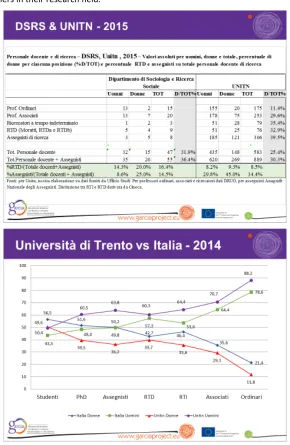
UNITN is one of the Italian universities with the lowest presence of women among its research and academic staff. In 2014, the proportion of women in the university’s entire academic staff (full, associate and assistant professors, postdocs) was 29.7%, while the Italian average was 40.5%. Both the Garcia beneficiary departments are strongly unbalanced in terms of sex distribution along the academic ladder. The lack of women is particularly visible among the top positions: at the DISI there are no female full professors while at the DSRS they were only 2 at the end of 2015. Moreover, in both cases, the level of feminization of the academic staff is systematically lower than the national average of the related academic fields (Ferri et al. 2016).
Considering the target population of the GARCIA project, the incidence of fixed-term assistant professors and postdocs at UNITN reached 42.6% of UNITN academic and research staff, which is about 7 percentage points higher than the Italian average. In the case of DISI the incidence of fixed term researchers exceeds 60% while in the DSRS these positions represent overall 35.5% of the department scientific staff.
26
In the case of the DSRS, out of 17 positions opened between 2010 and 2013, in 8 cases was appointed a female researcher.
Differently by postdocs, fixed term assistant professors are public servants, and the availability of these positions depends from the turnover rules fixed at national level and from the number of retirements within the permanent academic staff. In regard to their selection process, the Committee is composed of three full or associate professors and various evaluation phases are envisaged: a pre-selection (consisting in comparative evaluation of qualifications, CV, and three reference letters); the advice of three external referees appointed by the University Recruitment Committee; admission to the next phase of no fewer than six candidates. Then, a public discussion of the scientific qualifications with the Committee is foreseen. At the end of this phase, the Committee selects the candidates suitable for the appointment. The department board then deliberates on the candidate who will be appointed to the post, according to the Committee’s evaluation. Between 2010 and 2013, 6 selections for fixed term assistant professors (without tenure-track) were opened at the DSRS, while only 2 were carried out at the DISI. At the DSRS, only 3 out of 18 professors who took part to the 7 selection committees were women, and only in one case the committee chair was a woman. In the case of DISI no women were included in the selection committee for fixed term assistant professors. At the end of these selection processes, 3 male and 4 female researchers were appointed at the DSRS, while 1 male and 1 female researchers were appointed at the DISI.
3.2 SET UP OF THE TASK
The goal of this action was to change the gender practices in recruitment, selection and evaluation processes in universities and research institutes. Organising reflexive working groups with committee members and other key players has the goal to promote a climate that decreases gender bias in evaluation moments but also to understand the mechanisms that usually lead this practices. The main policy of the action, indeed, was to raise awareness that evaluation criteria are not objectified truths, and that evaluators’ conceptions of criteria can differ and could lead to disadvantage women.
Given the wide differences between the two departments in terms of gender composition, career development chances, research networks, level of internationalization (see: Bozzon et al. 2015; Murgia et al. 2016; Peroni, et al. 2015), two different workshops were organised with potential committee members in the two Garcia beneficiary departments at UNITN:
1) The first involved associate and full professors from the DISI and STEM disciplines and it took place on May 24th, 2016.
2) The second involved associate and full professors from the DSRS and it took place on June the 8th, 2016.
In the next paragraphs we will detail the set-up process of the two workshops.
3.2.1 STEM department (DISI)
27
international environment. We decided to do so due to the global context in which the department operates: it was in fact important for us to involve the professors of the department and, at the same time, to place the discussion in consideration to the international job market dynamics. For this reason, the workshop took place during COOP 2016 ‐ XII International Conference on the Design of Cooperative Systems (http://www.coop2016.unitn.it/) – held in Trento between May 22th and May 28th 2016.
Figure 3.1. Screenshot of the description of the GARCIA session within the COOP conference
During the conference we decided to place three different moments: the reflexive working groups with committee members, the workshop for prospective applicants and a third session in order to present all the results to the whole audience of the conference (more that 60 people belonging to the DISI department and the COOP conference attendees) during the plenary discussion.
COOP is one of the key European conferences on Cooperative Systems, Computer Supported Cooperative Work (CSCW) and Collaborative Computing and it is affiliated to EUSSET – the European Society for Socially Embedded Technologies. COOP 2016 was the twelfth edition of this biennial conference and took place for the first time in Trento, Italy, organised by the DISI and the Fondazione Bruno Kessler (FBK). The COOP conferences promote the idea that cooperative systems design requires a deep understanding of collective activities, involving both artefacts and social practices, within a context. This year, the programme intended to open up to the topic of collaborative design, with a special emphasis on “Making together”. In our opinion it was a great opportunity to involve the DISI community, in such an open environment, with an intimate setting, facilitating in-depth discussion and feedback in a multi-disciplinary community. The workshop we hosted, thus, was named “Making academic careers together. Recruitment,
precariousness and gender” (https://www.eventbrite.it/e/making
-academic-careers-together-recruitment-and-precariousness-morning-session-registration-23419465251).
28
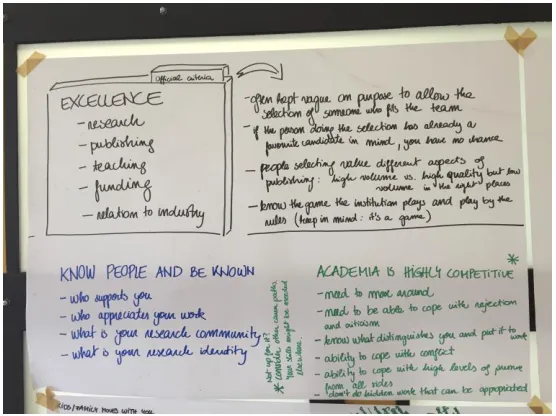
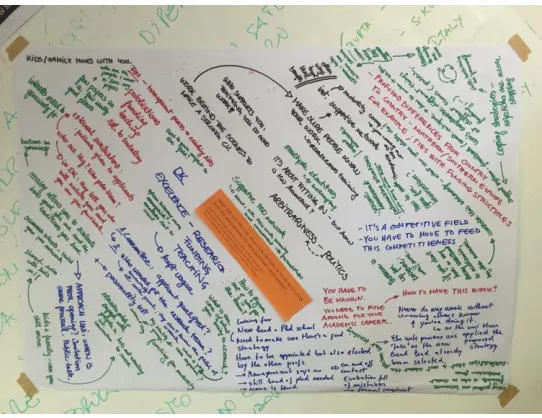
researchers’ wellbeing. Moreover, we wanted to discuss different perceptions of excellence, highlighting the existing gaps between formal criteria and criteria applied in actual decision making.
The session involved professors of the University of Trento and of the COOP community in order to identify the criteria that are used to recruit assistant professors and to question them. The target included committee chairs and members (academics who had been or could be potentially part of selection committees for early career researchers) from UNITN but also from the other universities in Ireland, Denmark, and Finland. They were 3 women and 2 men, all full professors. Moreover, several people from the GARCIA project, belonging both the DISI and the DSRS departments participated to the event.
The facilitators who led the workshop were:
Bianca Elzenbaumer holds a PhD in Design from Goldsmiths, University of London. She currently works as a Research Fellow at Leeds College of Art. In her practice‐led doctoral thesis she explored precarious working conditions in the cultural industries. Since 2015, together with Fabio Franz, she has been running nomadic Precarity Pilot (www.precaritypilot.net) workshops throughout Europe in order to generate ideas for inventive yet feasible actions against precarization.
Fabio Franz is a PhD candidate at the Sheffield School of Architecture. His practice‐led research focuses on the role of design in making of commons and community economies. Since 2005, he has been working together with Bianca Elzenbaumer as the design research practice Brave New Alps (www.brave‐new‐alps.com).
Maurizio Teli holds a PhD in Sociology and Social Research from the University of Trento. He is now Research Assistant Professor at the Madeira Interactive Technologies Institute, after holding the position of Research Fellow at the Department of Information Engineering and Computer Science at the University of Trento. In his research, he investigates the political intersections between the social sciences and the participatory design of digital technologies.
The workshop facilitators opened the session with an icebreaking question: “What would
you never tell someone applying to be an assistant professor?”. From this point the discussion was opened and we got many different feedbacks and point of views, from a gender perspective, but also influenced from personal experiences and their own
institution’ practices. The participants mostly worked in group to identify criteria for
selecting assistant professors. The underling questions we suggested as possible guidelines of the discussion were:
What are official criteria in your institution for the appointment of assistant professor?
What is influencing how strictly these criteria are applied? Have selection criteria been changed in the last decade? What is influencing the application of the official criteria?
What does it take to be able to fulfil these criteria - for instance in terms of work generated and networks someone is part of?