Conformable Eddy Current Array Delivery
Rahul Summan
1, a), Gareth Pierce
1, Charles Macleod
1, Carmelo Mineo
1,
Jonathan Riise
1, Maxim Morozov
1, Gordon Dobie
1, Gary Bolton
2, Angélique
Raude
3, Colombe Dalpé
3, Johannes Braumann
41Department of Electronic and Electrical Engineering, University of Strathclyde, Glasgow, G1 1XW, United
Kingdom
2National Nuclear Laboratory, Chadwick House, Warrington Road, Birchwood Park, Warrington, WA3 6AE,
United Kingdom
3Eddyfi Europe SAS, 110 Allée des Lilas, Les Fenières, Parc Industriel de la Plaine de l’Ain, 01150, Saint -Vulbas,
France
4Association for Robots in Architecture, University for Arts and Design Linz, Hauptplatz 8, 4010 Linz, Austria a)Corresponding author: [email protected]
Abstract.The external surface of stainless steel containers used for the interim storage of nuclear material may be subject to Atmospherically Induced Stress Corrosion Cracking (AISCC). The inspection of such containers poses a significant challenge due to the large quantities involved; therefore, automating the inspection process is of considerable interest. This paper reports upon a proof-of-concept project concerning the automated NDT of a set of test containers containing artificially generated AISCCs. An Eddy current array probe with a conformable padded surface from Eddyfi was used as the NDT sensor and end effector on a KUKA KR5 arc HW robot. A kinematically valid cylindrical raster scan path was designed using the KUKA|PRC path planning software. Custom software was then written to interface measurement acquisition from the Eddyfi hardware with the motion control of the robot. Preliminary results and analysis are presented from scanning two canisters.
INTRODUCTION
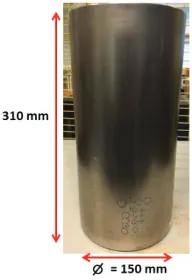
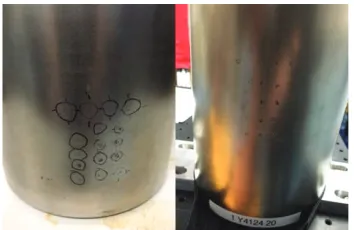
[image:1.612.260.356.539.679.2]Since 2010, the Centre for Ultrasonic Engineering (CUE) has been building expertise in applying industrial multi-axis robotic arms to automate the Non-Destructive Testing (NDT) of complex geometry components at the point of manufacture. The work described in this paper sought to apply this expertise to the problem of scanning the nuclear storage containers in order to increase key metrics such as reliability, throughput and coverage of the inspection in comparison to manual scans. To this end, a fully automated proof of concept system was developed to demonstrate potential improvements in these areas. Since ASICCs are a type of surface defect, an Eddy current sensor was selected for detection. Several containers containing artificially generated ASICCs were manufactured by the National Nuclear Laboratory (NNL) in the UK and made available for test purposes in this work. Two of these containers are shown in Fig. 2. The defects were created by depositing a chloride-salt solution onto the surface in a grid formation and then holding the containers in a humidity controlled environment: the matrix of defects is highlighted in Fig. 2. Through the application of several techniques including optical light microscopy, surface metrology and X-ray radiography it was established that the crack sizes ranged fromV RI ȝPup to a maximum of 3 mm in length. This paper proceeds by describing the system design, data analysis and experimental results.
FIGURE 2. Containers with matrix of artificial ASICCs
SYSTEM DESIGN
A KUKA KR5 Arc HW[2]robot was chosen as the basis of the scanning system, see Fig. 3(a) The six axes of this robot provides great flexibility in positioning the sensor in 3D space; in general there are eight possible joint configurations to reach each point within the work envelope of the robot, see Fig. 3(b). Clearly, the geometry of the container does not require a scanning system with six degrees of freedom, two would suffice. However, the approach developed here is toward a universal NDT scanning system for any part geometry that fits with the working envelope of the robot. Furthermore this technology will directly support future work with the NNL, concerned with scanning complex geometry parts.
FIGURE 3. (a) Experimental setup (b) Work envelope for KUKA KR5 HW Arc [2].
FIGURE 4. (a) ECA probe (b) Coil Topology (c) ECA mounting on the robot
PATH PLANNING
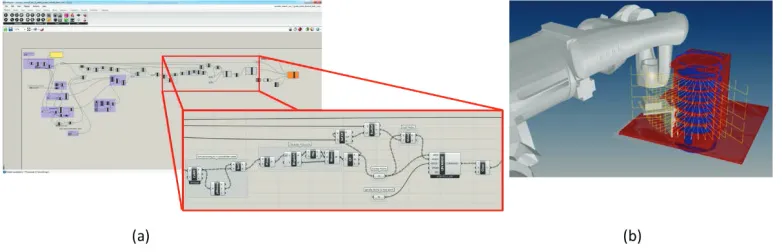
In the context of NDT, path planning is concerned with generating a path for the sensor such that complete surface coverage of the part is achieved [4]. If the required path is simple, it is possible to program it directly on the robot controller online as a sequence of waypoints. However, if the path is more complicated offline programing software is used. Such software provides an environment in which the Computer Aided Design (CAD) model corresponding to the part can be placed within the work envelope of a virtual robot with associated kinematic model. A path lying on the surface of the part is generated and the inverse kinematics can be solved to compute the necessary joint angles to achieve the motion. There exists numerous commercially available software solutions for offline robot programming such as Robotmaster, Delcam and FastSurf. These tend to be complex and expensive software packages. In this work, the KUKA Parametric Robot Control (KUKA|PRC) was used. This is plugin software for the RhinocerosCAD software and provides a visual programming environment in which to parametrically program the robot by connecting blocks, see Fig. 5(a). Importantly the parametric feature of this software means that changes made to the CAD model are immediately reflected in the generated path – this leads to a very rapid development cycle in comparison to the aforementioned packages.
[image:3.612.103.506.273.369.2]output of KUKA|PRC was a KUKA robot language file ready for execution on the robot controller. However, for maximum flexibility in terms of the development cycle, it was decided to control the robot from an external PC, the software system architecture for this is described in the next section.
FIGURE 5. (a) Visual programming in KUKA|PRC (b) Raster scan path
SOFTWARE ARCHITECURE
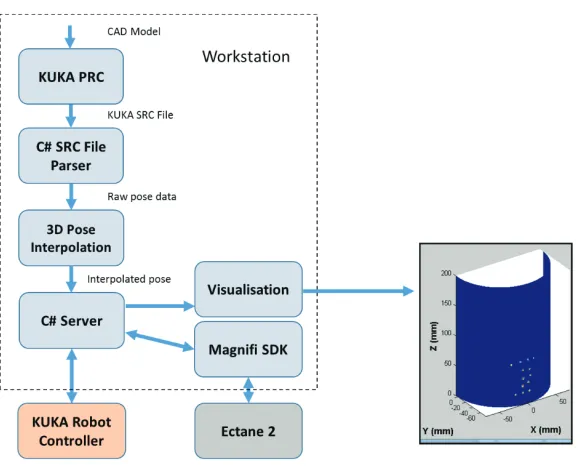
The Robot Sensor Interface (RSI) [5] was chosen to control the robot from an external computer. By doing this, both the robot and ECA controller could be controlled from a single software application. The main advantage of this approach was that a single program could be written for the robot controller which listened for “go to” points arriving on a network connection. This meant that writing programs on the robot controller could be avoided thus resulting in a shorter development cycle. This differs substantially to the traditional use of such robotics systems which have their origins in the car industry. In such a setting these systems run the same program repeatedly 24/7. The approach developed here, however, enabled the path of the robot to be changed frequently and rapidly to execute any kinematically valid set of coordinates.
The robot is a real-time system with an operating cycle of 12 ms while a standard workstation computer running the Microsoft Windows Operating system is a non-deterministic system. Furthermore, the robot controller expects to receive an Extensible Markup Language (XML) packet via an Ethernet connection every 12 ms, if it does not receive a packet within this timeframe the motion of the robot is halted. Careful consideration had to be given to the software design in terms of multi-threading to ensure that this demand could be met. The positions parsed from the KUKA robot language file output by KUKA|PRC are shown in Fig. 6(a). In accordance with the cycle time of robot, these positions and orientations had to be interpolated resulting in a list of coordinates plotted in Fig. 6(b). The interpolation was carried out through MATLAB functions derived from the RoboNDT software [4], an application developed by the University of Strathclyde and TWI Ltd. and targeted to robotic path-planning for NDT tasks.
FIGURE 6. (a) Positions parsed from KUKA|PRC file (b) Interpolated coordinates
FIGURE 7. Software architecture
ROBOT ACCURACY
[image:5.612.163.454.296.532.2]FIGURE 8. (a) Image of calibration container (b) ECA scan of calibration container
[image:6.612.189.424.318.443.2]To quantify the error in the positional estimate from the robots internal resolvers, as a function of the position of the end effector within the working envelope, a small experiment was carried out. A laser prism reflector was mounted to the extremity of the robot and its center was calibrated as the tool center point (TCP) of the robot, the tool is shown in Fig. 9(a). A program was then written to sweep the reflector through a box raster scan visiting 750 locations within the working envelope Fig. 9(b). A Leica AT901-B laser tracker was used to track the end effector. This is a high precision device with an accuracy of ±0.2 μm + 15 μm/m [6] serving as the ground truth system in this experiment.
FIGURE 9. (a) Prism reflector (b) Box raster scan
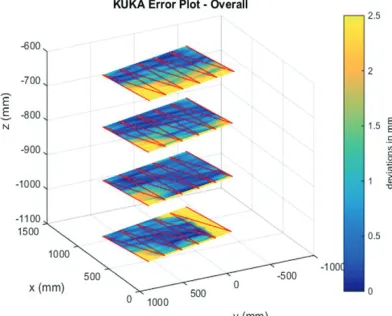
A plot of positional error between the internal resolver and laser tracker is displayed in Fig. 10. A maximum error of 2.7 mm was observed in the overall dataset. The axis-wise errors are shown in Table 1 in terms of the planes plotted in Fig. 10, where plane 1 refers to the lowest plane. It can be seen that a maximum error of approximate 2.7 mm was evident for the X or Z axes for each plane.
[image:6.612.202.398.543.701.2]TABLE 1. Axis wise errors
Deviations X-direction (mm)
Y-direction (mm)
Z-direction (mm)
Average (mm)
Height (mm)
Plane1 2.7268 0.6167 0.3936 1.2457 283
Plane2 1.3365 0.3321 0.2635 0.6440 446
Plane3 1.4148 0.3405 0.2726 0.6760 600
Plane4 1.6915 0.3509 0.2783 0.7736 755
RESULTS
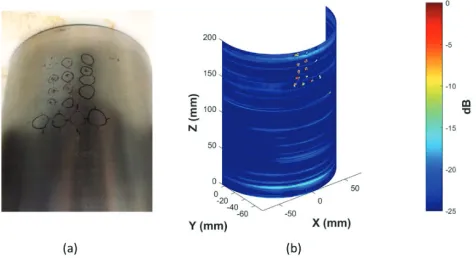
This section presents results for two containers. The probe was driven at 400 KHz and 5 Vpp while the robot was instructed to the move the ECA at 20 mm/s. This resulted in a scan time of approximately 60 s. An image of container 1 is shown in Fig. 11(a) in which the matrix of circular corrosion patches is clearly visible on the surface. Prior to scanning the container, a weak acid was used to remove this corrosion such that there was no visible indication of the defect. The resulting ECA scan (axial) is shown in Fig. 11(b) in which the reactance of the measurements returned from the ECA has been plotted. To produce this image, the measurements across all sub-scans for this container were normalized with respect to the largest value of reactance. These normalized values were then converted to decibels as shown on the color bar in Fig. 11(b).
FIGURE 11. (a) Image of container 1 (b) ECA scan of container 1
[image:7.612.184.422.547.676.2]is suspect that 10 cracks and 3 potential cracks. However as mentioned previously, a smaller coil size would be required to size the dimensions of these cracks.
CONCLUSION
This paper has described the development a proof of concept demonstrator to address a particular problem in the nuclear industry. This problem concerns the NDT of the surface of nuclear storage containers which may be subject to ASICCs as a consequence of the environmental conditions in which the containers are stored. A robot based scanning system making use of an Eddy current array was developed and was capable of performing raster scans of the containers in an automated fashion. The system has shown promising results with respect to detecting anomalous regions on the surface of two test containers. However, a higher resolution probe is required to size these potential cracks, this will be carried out in future work.
REFERENCES
1. National Physical Laboratory, Stress Corrosion Cracking, Online accessed 29/08/2015 http://www.npl.co.uk/upload/pdf/stress.pdf
2. KUKA, KUKA KR5 HW datasheet,
http://www.kukarobotics.com/res/sps/f776ebab-f613-4818-9feb-527612db8dc4_PF0012_KR_5_arc_HW_en.pdf, accessed 29/08/2015
3. Eddyfi, Surface ECA Probe Catalog, April 2015
4. Mineo, Carmelo, et al. "Robotic path planning for non-destructive testing–A custom MATLAB toolbox approach." Robotics and Computer-Integrated Manufacturing 37 (2016): 1-12.
5. KUKA, KUKA.RobotSensorInterface 3.1 Documentation, 2010.
6. Leica, Leica Absolute Tracker ASME B89.4.19-2006 Specifications, http://metrology.leica-
![FIGURE 3. (a) Experimental setup (b) Work envelope for KUKA KR5 HW Arc [2].](https://thumb-us.123doks.com/thumbv2/123dok_us/1560978.108722/3.612.103.506.273.369/figure-experimental-setup-work-envelope-kuka-kr-arc.webp)