Method to generate a pulse train of few-cycle coherent radiation
Bryant Garcia,1,*Erik Hemsing,1Tor Raubenheimer,1 Lawrence T. Campbell,2,3 and Brian W. J. McNeil2 1
SLAC National Accelerator Laboratory, Menlo Park, California 94025, USA 2SUPA, Department of Physics, University of Strathclyde, Glasgow G4 0NG, United Kingdom 3
ASTeC, STFC Daresbury Laboratory and Cockroft Institute, Warrington WA4 4AD, United Kingdom (Received 17 June 2016; published 6 September 2016)
We develop a method to generate a long pulse train of few-cycle coherent radiation by modulating an electron beam with a high power laser. The large energy modulation disperses the beam in a radiating undulator and leads to the production of phase-locked few-cycle coherent radiation pulses. These pulses are produced at a high harmonic of the modulating laser, and are longitudinally separated by the modulating laser wavelength. We discuss an analytical model for this scheme and investigate the temporal and spectral properties of this radiation. This model is compared with numerical simulation results using the unaveraged code Puffin. We examine various harmful effects and how they might be avoided, as well as a possible experimental realization of this scheme.
DOI:10.1103/PhysRevAccelBeams.19.090701
I. INTRODUCTION
There has been a long history of using lasers to manipulate relativistic electron beams to produce tailored radiation pulses[1,2]. These methods may seek to produce high harmonic up-conversion as in the coherent harmonic generation (CHG)[3]or echo-enabled harmonic generation
[4]schemes, which may be used to seed free-electron lasers (FELs) [5–9]. Laser manipulations may also target short pulse length, as can be achieved by so-called femtoslicing in synchrotron sources[10,11]or by interaction with a few-cycle laser pulse to produce an attosecond scale FEL pulse
[12]. One can also endeavor to produce pulse trains of radiation with a fixed phase relationship, either by use of delay stages in an FEL [13], by modulating the electron beam to produce sidebands around the FEL resonant wavelength[14], or through seeding via a pulse train from high harmonic generation (HHG) techniques [15].
Some of these methods are well suited to merely producing coherent radiation, while others must cautiously avoid spoiling the performance of an FEL interaction. Methods of generating short pulses can also require very precise laser timing control or advanced laser systems. Here we introduce a simple but potentially robust method to produce a train of mode-locked, few-cycle, high harmonic coherent radiation pulses using only a powerful modulation laser, one modulating undulator, and a short radiating undulator. In this paper, we refer to the radiation produced
by individual coherently radiating regions of the electron beam as“pulses,”while the assemblage of all such regions over the entire electron beam is referred to as a “pulse train.”We note that a similar situation utilizing extremely large energy modulations was considered in[16], although the analytical formalism in this paper differs considerably from our own and the emphasis is on high harmonic up-conversion, rather than the dispersion-controlled pulse duration.
The fundamental beam line components necessary for the scheme are shown in Fig.1, which shows schematically the production of the few-cycle radiation pulse train. First, a relativistic electron beam copropagates with a high power laser of wavelength λL in a modulating undulator (U1, tuned toλL). The resonant interaction between the laser and
electron beam imprints a roughly sinusoidal energy modu-lation on the beam, and in our case this modumodu-lation amplitude can be up to several percent of the total beam energy. The beam may then optionally be partially “prebunched”by a small magnetic chicane (C1), in order to decrease the need for a long undulator. Next, the modulated electron beam enters a radiating undulator (U2) tuned to a resonant wavelengthλr, which is chosen to be some harmonic of the modulating laser wavelength:
λL¼hλr, for integer h. This undulator is characterized
by the longitudinal dispersion transport matrix element R56¼2Nuλr, where Nu is the number of periods in the undulator. We can write this transport element as a function of distance along the undulator z, noting that for an undulator with periodλu we have the relationNu¼z=λu.
We examine the electron beam in the comoving frame described by longitudinal coordinates¼z−β¯ct, whereβ¯ is the average normalized electron velocity. In this frame as the electron beam traverses this undulator the initial density
*
modulation will be converted into a density modulation, and eventually the beam will overdisperse, as shown in Fig. 2. In this comoving frame, an electron with relative energy deviation δγ=γ will move longitudinally with respect to the reference electron at a rate,
ds dz¼
dR56 dz
δγ
γ ¼2
λr
λu
δγ γ :
Meanwhile, the electrons are also radiating at the resonant undulator wavelength λr. If a localized region
of electrons become confined through this compression to a region smaller than λr, the emission of radiation will be coherent, corresponding to panels (b) and (c) of Fig.2. The longitudinal distance Lp spent in this region thus defines
the duration of coherent emission, and can be found simply by dividing the distance an the electron travels during this coherent emission (λr) by its relative velocity (ds=dz),
Lp≈
λr ds dz
¼ λu
2δγ=γ:
The number of coherent radiation cycles can thus be estimated to beNcyc≈2δγ1=γ, dependent only on the
modu-lation amplitude. Intuitively, it is easy to understand that the larger the relative energy deviation is, the quicker the electrons disperse longitudinally inside the radiating undu-lator, leading to a shorter coherent pulse. Indeed, for modulation amplitudes on the order of a few percent, one can achieve few-cycle pulses.
Furthermore, as is clear from Fig. 2, the electron beam will in general be much longer than the modulating laser wavelength λL, and thus contains many such coherent
radiation segments. These coherent segments are separated longitudinally by the laser wavelength, and thus there exist h radiation wavelengths of space between them. There-fore, if the number of radiated cycles per coherent segmentNcyc< h, the output radiation profile will consist of a long train of coherent, fully separated pulses. This is the essential radiation profile of the scheme we propose.
We note that such a pulse train may also be obtained by a simple CHG beam traversing a short undulator. The method of this paper, however, allows pulse length control via the modulation amplitude with a single undulator, while alter-ing the pulse length in the CHG method would require a new undulator for each desired pulse length.
Here we briefly illustrate the spectral mechanics of such pulse trains. We consider a pulse train made up of cosine waves of frequencyω0, each contained within a Gaussian temporal envelope of widthτand separated temporally byh radiation cycles,
fðtÞ ¼τ−1 X
N
j¼−N
e−ðt−2πjh=ω0Þ2=2τ2cos½ω
0ðt−2πjh=ω0Þ;
where h, j∈Z, and 2N is the total number of pulses contained within the train. While these Gaussian modulated pulses are not entirely accurate for the pulse trains we will discover, this simple form yields the appropriate relation-ships between the various scalesh,N, and ω0.
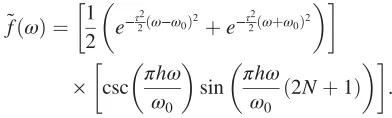
We are interested in the spectral content of such a train, so the Fourier transformf~ðωÞis found as
~
fðωÞ ¼
1 2
e−τ22ðω−ω0Þ2þe−τ22ðωþω0Þ2
×
csc
πhω
ω0
sin
πhω
ω0 ð2Nþ1Þ
:
[image:2.612.66.283.47.116.2]The first bracketed term comes simply from the trun-cated sine (the more familiar square wave window would produce a sinc function instead). The first term gives a Gaussian envelope with width1=τ centered on ω0, while the second term involving ωþω0 can be neglected for FIG. 1. A schematic illustration of the short pulse train
generation scheme. A long-wavelength laser λL modulates the electron beam in the first undulator (U1). This beam may then be optionally precompressed by a small four-dipole magnetic chicane (C1), before radiating in another undulator (U2) tuned to a high harmonic of the seed laser. The result is a train of few-cycle radiation pulses at the up-converted wavelengthλr.
[image:2.612.54.296.477.606.2] [image:2.612.338.534.590.649.2]envelopes covering more than one cycle. The second bracketed term is due to the pulse train character, and features multiple levels of harmonic spikes. This term can be thought of as the result of a finite (only 2N spikes) version of the Dirac comb. There exist large scale spikes with the normal harmonic spacing at ωn¼ω0þnω0=h,
for integer n, appearing as the zeros of the cosecant function. The width of these spikes is found by expanding around themω¼ωnþδωand finding the zero of the sine function. The result is a primary width of 2δω¼2ω0= ð2Nþ1Þh≈ω0=Nh, sinceN is generally large compared to unity.
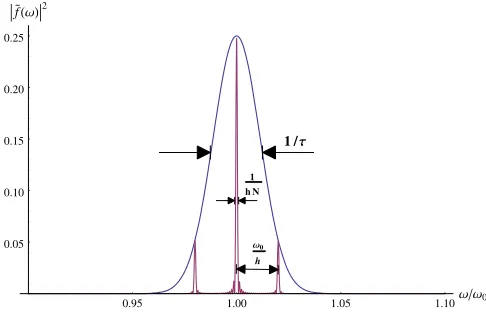
Physically speaking, the sideband frequency of the harmonic spikes is determined by the temporal separation of the pulses, their spectral bandwidths are determined by the total number of pulses in the train, and all the harmonic spikes reside in an envelope determined by the temporal duration of each individual pulse. The relationship between these various frequency scales is shown schematically through the power spectrumjf~ðωÞj2 in Fig. 3.
The situation shown in Fig.3is representative of a train of pulses which never overlap temporally. As the duration of each pulse, hereτ, approaches their temporal separation, 2πh=ω0, the subharmonic peaks fall outside the Gaussian 1=τ spectral bandwidth and the pulse train transitions to being essentially a single Gaussian-sine pulse with tem-poral durationτ →Nτ. This limit provides an essentially distinct, and generally unwanted, mode of operation when compared to the pulse train, and we will revisit it shortly in the context of our short-pulse generation scheme.
II. AN ANALYTIC MODEL
Our analytical model begins with the radiation field and motion due to a single electron in a planar undulator and closely follows the treatment in[17]. The resultant electric
field due to the motion is described by the Liénard-Wiechert field,
~
Eð~x; t0Þ ¼ 1
4πϵ0 q c "
ˆ
n×½ðnˆ−β~Þ×β~_ R0ð1−β~·nˆÞ3
#
ret
; ð1Þ
whereR0is the (retarded) distance from the source particle to observer, nˆ is the unit vector in this direction,β~ is the normalized Lorentz velocity,qis the electron charge, and the subscript “ret” indicates that the expression is to be evaluated at the retarded timet0. We have already omitted near field terms which scale likeR−2, as our analysis is strictly interested in the radiation in the far field. As a corollary, the motion of the electron in the magnetic field of the undulator is insignificant compared to the distance to the observer, and hence the vectornˆ can be considered a constant, here taken to be in the zˆ direction of a right-handed coordinate system. Correspondingly, the retarded distance R0 is identified with some fiducial distance R, taken to be the distance between the observer and, for example, the center of the radiating undulator. The case of off-axis emission is treated in the Appendix A, and the results summarized in Eqs.(A4)–(A6).
The motion in the undulator with undulator parameterK, period λu, and angular frequency ωu≈kuc¼2πc=λu is
described by the simple harmonic equations,
xðt0Þ ¼ K
γku
cosðωut0Þ ð2Þ
zðt0Þ ¼v¯zt0þ K 2 8γ2k
u
sinð2ωut0Þ ð3Þ
with the averagedzvelocityv¯z given by
¯
vz¼c
1− 1 2γ2
1þK2 2
: ð4Þ
We are now assuming that the electron traversing the undulator is fairly relativistic and keep terms up to order
γ−2. Performing the vector arithmetic with these trajectories in Eq.(1)and taking only the leading terms inγ, we get an electric field purely in the xˆ direction given by
Exðt0Þ ¼
4qγ3Kku
πϵ0R cosðωut
0Þ
2−K2þK2cosð2ωut0Þ
½2þK2−K2cosð2ωut0Þ3
:
ð5Þ
[image:3.612.52.295.46.203.2]The bracketed term corresponds to the searchlight wiggler effect for highK values and serves to slightly modify the sinusoidal shape. We are primarily concerned with the frequency shift of the sine wave, which is not affected by this extra term, hence for simplicity it is averaged over one FIG. 3. Power spectrum of a short pulse train demonstrating the
relationship between the different scales. The parameters here are
N¼10,h¼50, andτ¼10π=ω0. Given the artificially smallN
period to a value of ½ ¼161ð1þK2Þ−5=2ð4þ2K2þK4Þ.
In the ultrarelativistic approximation on axis we have the retarded timet0 related to the time of observationtas
t¼
1þK2 2
1
2γ2t0: ð6Þ
Next, we introduce an energy offset from some nominal Lorentz factorγ¼γ0þδγand expand, keeping only terms linear inδγ,
ExðtÞ ¼qγ 3
0ð1þ3δγ=γ0ÞKk~ u
πϵ0R cos½ωrtð1þ2δγ=γ0Þ ð7Þ
with the definition
~
K¼K
1þK2 2 þ
K4
4
ð1þK2Þ−5=2 ð8Þ
and the resonant frequencyωr defined as
ωr¼
2γ2 0ωu
1þK2=2: ð9Þ
This is the electric field from a single electron traversing the undulator. We now generalize this description to a con-tinuous distribution of electrons which are distributed in longitudinal position as in a finite length electron beam. The longitudinal position is quantified by an initial phase offset ϕ0 relative to the resonant frequency,
ωrt→ωrt−ϕ0. This phase can be thought of as a time
offset for when the different electrons enter and exit the undulator. In addition to this phase, the electron distribution may also contain energy deviations δγ from the nominal value ofγ0 which may be correlated with the phase ϕ0.
With such a distribution in mind, we consider that the effect we are interested in involves the slippage between the different electrons in the beam. It is clear to see, from theδγ=γ0term in the cosine of Eq.(7), that particles with different energy deviations evolve in the phase of the cosine wave at different rates. We can expect coherent emission from the electron distribution when all these phases are similar for a short duration of time. Therefore, it is the energy variation inside the cosine which will produce the coherent radiation effect. By contrast, the amplitude varia-tion in Eq.(7)leads to small variations in the amplitude of radiation for different electrons. However, unlike the phase inside the cosine, there is no possibility for these variations to combine coherently, and they serve only to alter slightly the amplitude of the coherent effect. Therefore, in what follows we ignore (or average over) this amplitude varia-tion, instead approximating it as a constant.
For a laser modulated electron distribution the quantities
δγ andϕ0 are not independent, and we choose to express
δγðϕ0Þ. The electric field from an individual electron can then be written in terms of ϕ0 as
Exðt;ϕ0Þ ¼E0cosfωrt½1þ2δγðϕ0Þ=γ0g: ð10Þ
The coefficient E0≡qγ30Kk~ u
πϵ0R ð1þ3δγ=γ0Þ has collected
everything besides theϕ0dependent term for convenience. The total electric field from the entire electron distribution can then be written as an integral over the distribution inϕ0 of the individual electric fieldsExðt;ϕ0Þ,
ETOTðtÞ ¼ Z
Exðt;ϕ0Þρðϕ0Þdϕ0; ð11Þ
where ρðϕ0Þ is the normalized density distribution of particles with respect to the phase ϕ0. All that is left to specify is δγðϕ0Þ, which describes how the electron distribution is prepared, andρðϕ0Þ, which is assumed to be a flat distribution as a function ofϕ0since the electrons are not initially bunched on the radiation wavelength scale.
A. Linear model
A linearly chirped beam was previously considered in
[18]. This study analyzed the coherent emission of a single, linearly chirped Gaussian current electron beam inside a radiating undulator. This single-segment situation could conceivably be produced by a strong rf chirp over the entire electron beam, as the pulse train aspect of the beam was not considered. A linear model also serves as an approximation to the electron dynamics near thes≈λL=2portion of the
sinusoidal modulation shown in Fig.2. We consider a linear variation in energy with the phase modeled as
δγ
γ0 ¼A
ϕ0
h : ð12Þ
The factor ofhhas been included as a reference to the quasilinear chirp of a sine wave of frequency1=htimes the undulator radiation frequency. As previously mentioned, with such a scenario particles are evenly distributed in phase so thatρðϕ0Þ ¼Np=ð2hÞ, with Np the number of
particles, so we have
ElinTOTðtÞ ¼E0Np
2h Z h
−h
cos
ωrt
1−2A
h ϕ0
−ϕ0
dϕ0;
ð13Þ
where the limits are chosen in the rangeð−h; hÞsuch that the energy modulation ranges fromð−A; AÞto approximate the linear portion of a sine-wave modulation of amplitude A. The integrated field from a single chirped electron bunch is then
ElinTOTðtÞ ¼NpE0cosðωrtÞsincðh−2AtωrÞ: ð14Þ
Ncyc≈
1 2A:
From this we also learn the frequency bandwidth of the power spectrum [PðωÞ ¼ jREðtÞeiωtdtj2] signal to be
Δω ωr
≈4A:
We thus arrive at the same essential scaling that we developed in our Introduction: The number of coherent radiation cycles is inversely proportional to the modulation amplitude. In fact, to this level of detail the results are identical.
B. Sinusoidal laser modulation
The far more relevant physical case is that in which a laser interacts with the electron beam inside a short undulator to imprint on it a sinusoidal energy modulation. For this case, in contrast to Eq. (12), we have the more general expression,
δγ
γ0¼Asin
ϕ0 h
: ð15Þ
Again, the factor of h here clearly appears as the scale between the undulator radiation phase and the laser phase, and is identical to the harmonic of the laser being used compared to the undulator radiation wavelength:λL¼hλr. The total field is then given by
Esin TOTðtÞ ¼
NpE0
2h Z h
−h
cos
ωrt
1þ2Asin
ϕ0 h
dϕ0:
ð16Þ
As with the linear case, the normalized density distribution is independent of the initial phase, soρðϕ0Þ ¼Np=2h. The
nested sine functions can be dealt with by expanding in terms of Bessel functionsJn, in particular with the relation
ei2Aωrtsinðϕ0=hÞ ¼ X
∞
n¼−∞
Jnð2AωrtÞeinϕ0=h:
The integration over the phaseϕ0is here carried out over a single laser wavelength, and if we assume the harmonic up-conversionhto be relatively large, we may useð−∞;∞Þas the limits of integration to simplify the result. In this case, all but one of the Bessel modes drops out of the calculation and we are left with
Esin
TOTðtÞ ¼NpE0cosðωrtÞJhð2AωrtÞ: ð17Þ
The form of the net electric field is conceptually identical to the linear case in Eq.(14), except instead of a sinc function we haveJhproviding the modulation envelope. To connect
with both experiment and simulation, however, we note that
our result in Eq. (17) is valid only for a single laser wavelength of the electron bunch. We then sum up each contribution with an appropriate shift in the time domain to obtain the total signal,
EbunchðtÞ ¼ X
j
EsinTOTðt−2jπh=ωrÞHðt−2jπh=ωrÞ; ð18Þ
whereHðtÞis the Heaviside step function, and the sum over j extends far enough to cover the entire electron beam. Already from these solutions we can see that there will be a delay in the emission, since the Bessel function has its maximum when its argument is approximately equal to its order, one must wait until t≈2Ahω
r, which is the same
condition derived from the linear case. This delay is physically represented by having to wait for the electron distribution to shear over from panel (a) in Fig.2to panel (b). This delay can be removed, if it is large, by using a prebunching chicane as shown in Fig. 1 to enter the radiating undulator with a distribution close to panel (b) of Fig.2, thus entering the coherent radiation regime almost immediately.
The production of a pulse train of few-cycle pulses, as opposed to a long radiation pulse defined by the electron bunch length, is governed by the relationship between A and h. The condition can be thought of, roughly, as Ncyc < h for the pulses to be nonoverlapping. Using the schematic dependence in the Introduction, this condition can be rewritten as
1
2≲Ah: ð19Þ
When this condition is satisfied, the radiation pulses from each laser wavelength (each compressed region in Fig.2) will be separated from one another. This condition can be satisfied by freely tuning both the modulation amplitude and harmonic up-conversion, although in practice the transport of beams withA≳0.1may prove challenging.
Although an analytical Fourier transform is not readily available, we can still make several statements about the form of the power spectrum. The pulse-train inherent in Eq. (18) leads to harmonic peaks at regular intervals of
ωr=h(the laser frequency harmonics) which will in general
pedestal by approximating the first Bessel function zeros jh, and the zeros of its first derivativej0h [19],
jh≈hþ1.85h1=3
j0h≈hþ0.808h1=3:
Thus we approximate the full width of the Bessel function peak during which substantial coherent radiation takes place, and, assuming a transform limit, obtain a full width of the power spectrum,
Δω ωr
≈2πAh−1=3: ð20Þ
Unlike the estimate from the linear modulation, here we pick up a slight dependence on the harmonic up-conversion factor which tends to narrow the spectrum for high harmonics. This dependence is due to the nonlinearity of the sheared over sine wave in longitudinal phase space, which is encoded in the Bessel function. As the harmonic factor increases, the nonlinearities are increasingly on a scale larger than the coherence length. On the other hand, for small harmonic factors the nonlinear curvature quickly spreads the electrons outside the coherence length, leading to a shorter pulse of coherent radiation.
We can calculate the energy density contained in the signal using the electric field(17) from
E ¼ Z t
final
0 1 2Z0jEðtÞj
2dt; ð21Þ
whereZ0≈377Ωis the impedance of free space, and the time integral should extend over the duration of emission. For a typical case, we consider a modulated beam which is allowed to disperse in the radiating undulator through only the first Bessel peak, giving a final timetfinal≈2A1ωrð2πþhÞ.
With the reasonable assumption that the duration of coherent emission persists for several radiation periods, and integrat-ing over a spherical shell of radiusRthrough anglesθ<γ−01 the total pulse train energy is given by
E ¼ N2phE20i 16pffiffiffiπγ2
0Z0Aωr
XðhÞ: ð22Þ
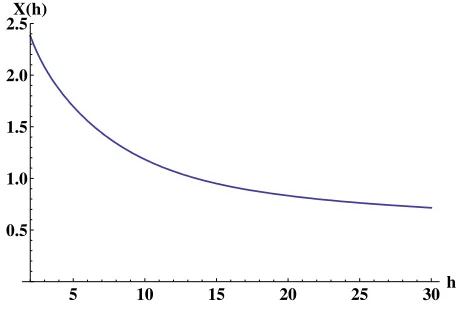
where XðhÞ is a universal, slowly varying function of h shown in Fig.10and the functional form given in Eq.(B4)of the AppendixB. The number of particlesNpshould be taken
to be the number in one modulation wavelength, and for a long beam should be summed up with appropriate weights corresponding to the current profile. The inverse dependence on the modulation amplitudeAis understood as larger values of A lead to shorter pulses, and assuming approximately equal power, a smaller total energy. We briefly note that the averaged quantity hE20i∝ð1þ9A2=2Þ contains a weak
dependence on the modulation amplitudeA, sinceAis quite small compared to unity.
III. COMPARISON WITH SIMULATIONS
The electric field, given by Eq.(18), is compared with a numerical simulation using the 3D unaveraged FEL code Puffin [20]. Since the effect we are interested in involves only longitudinal dynamics, for computational efficiency we use only the 1D mode of the Puffincode, in which the transverse dimensions are neglected. Furthermore, to facilitate comparison with the analytical model developed, we disable the FEL interaction and operate the simulation at low peak current to study only the coherent radiation effects. We consider an electron beam withγ¼401.608in an undulator with K¼1.26 and period λu¼1.8cm, essentially the parameters of the visible-infrared self-amplified spontaneous emission amplifier undulator reso-nant at 100 nm[21]. The electron beam has an approximate lengthcτ¼20μm, possesses negligible current and emit-tance, and has a relative energy spread of 10−5. The electron beam is modulated with a 2500 nm laser, giving a harmonic up-conversion factor h¼25, and attains a maximum modulation A¼0.09. Finally, a magnetic chi-cane is used to prebunch the beam to close to the coherent radiation point to limit simulation time. A comparison of the electric field from the analytical expression of Eq.(18)
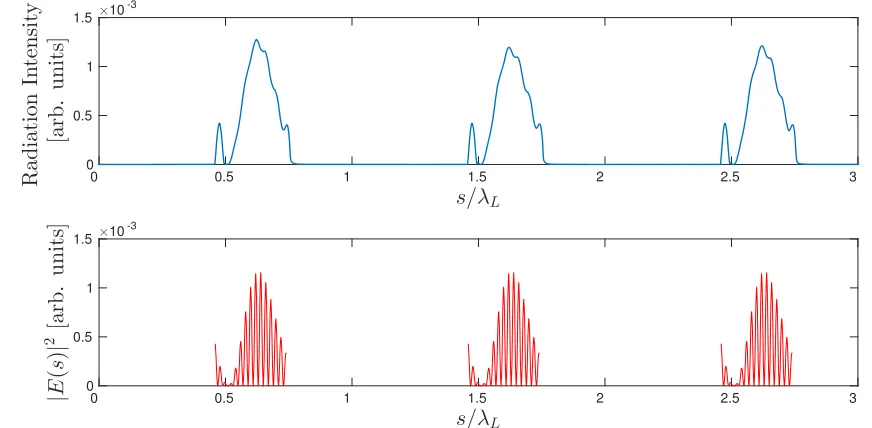
with the radiation intensity is shown in Fig. 4, while a comparison of the analytical and computational power spectra is shown in Fig.5.
For the full field comparison, the squared electromag-netic field amplitude is plotted against the longitudinal coordinates scaled to the laser wavelength λL. From the
analytical expression, the individual cycles are resolvable, whereas the Puffin simulation yields a smoothed intensity over individual radiation cycles. We clearly observe the first Bessel peak in both the analytical and numerical field amplitudes, and the pulse train structure is clearly visible. Note that the simulation was terminated after seven undulator periods, corresponding to the approximate width of the first Bessel maximum, although we observe the second Bessel peak beginning to develop.
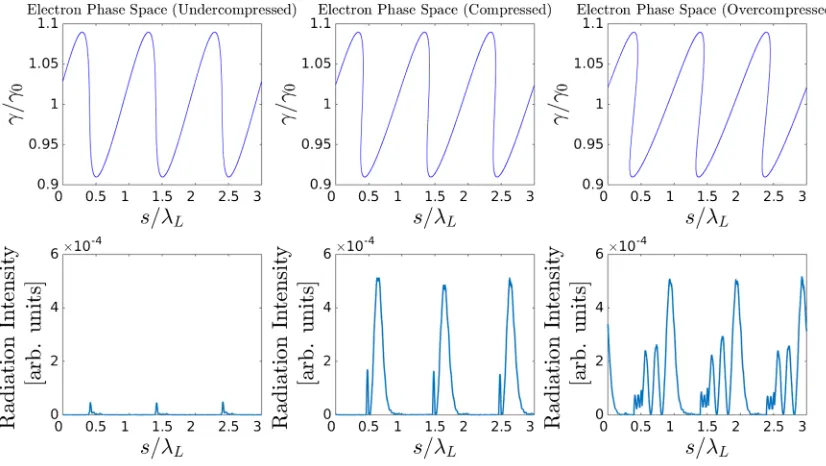
The relationship between the electron beam phase space and the generation of the radiation pulses is shown clearly in Fig.6. We see that the maximum compression, as shown schematically in Fig.2, corresponds to the generation of the main pulse of radiation. If the undulator is not terminated after this point, as it was in Fig.4, the electron beam will continue to radiate at lower intensity on subsequent Bessel peaks, as shown in the rightmost panel of Fig. 6. It is therefore not necessary to terminate the undulator after precisely the first Bessel peak, as the subsequent radiation preserves the pulse train structure if it is for a sufficiently short duration.
features of note. First, the various harmonic spikes appear naturally as the various harmonics of the seed laser as one would expect from an HGHG type source. However, from Eq. (18) we see the same harmonics arise as the simple result of a train of radiation pulses, all at the same frequency ωr and temporally separated by 2πh=ωr, the Fourier transform of which produces submodal spacing at intervals Δω¼ωr=h. We note that because of the short
length of the electron bunch (roughly a dozen laser wave-lengths), the subharmonic peaks possess significantly larger width (consistent with Fig. 3) than they otherwise
would with a more typical ps long electron beam (compare with Fig.9).
We also note the expected width of the main spectral envelope, which is here composed in equal part of the short undulator length as well as the temporal width of the first Bessel function peak. To verify the relationship between this spectral width and the harmonic factor, we run a series of simulations withA¼0.09and various harmonic factors, each of which passes through a 14 period undulator after having been sufficiently prebunched. The results in Fig7
confirm that Eq.(20)is quite a good estimate of the full-width bandfull-width of the power spectrum and the h−1=3
dependence is particularly evident.
IV. DELETERIOUS EFFECTS
The analytical model of Sec. II and computations of Sec. III have neglected several physical effects which potentially conspire to harm the coherent pulse train effect. First, the modulation of the electron beam by several percent of its total energy presents its own challenges. Broadly speaking, when interacting a laser with an electron beam in an undulator, the maximum sinelike modulation amplitudeAachievable scales inversely with the number of periodsA∼1=4Nu, i.e. the modulation must be achieved in fewer than 1=4A undulator periods due to slippage within the modulating undulator. If more periods are used, the phase space will fold over and become highly nonsinusoidal.
We can quantify this nonsinusoidal scale by introducing the parameter κ≡4ANu, so that we require κ<1 for a
[image:7.612.86.522.47.261.2]reasonably sinusoidal modulation. The dependence of the FIG. 4. Comparison of the electromagnetic field intensity from Puffin(top) and the analytical formula(18)(bottom) for the squared electric field showing the pulse train structure. The longitudinal extent of this plot covers three laser wavelengths, and the harmonic up-conversion factor is 25. Note that from the definition ofs, the radiation slips to the right in this plot, so the most recent radiation is found at the leftmost portion of the pulses.
[image:7.612.61.292.496.649.2]modulation profile onκ is shown for some simulations in Fig.8, in which it is clearly seen that forκ>1, the phase space becomes quite nonsinusoidal. Note that the produced longitudinal phase space is not equivalent to a sheared sine wave, as in Fig. 2. Rather, because the electrons slip considerably with respect to the laser phase, the beam acquires a somewhat more bulbous character, which can be seen developing in the final plot of Fig.8. Of course, if the factor κ becomes much larger than unity, the electrons will begin to fill out the buckets in laser phase as is common in inverse FEL accelerators [22] and conventional rf accelerators [23]. Note that this discussion assumes the laser field amplitude to be uniform over the duration of
[image:8.612.97.510.45.278.2]modulation. In the case that the laser field diffracts away prematurely, the full modulation amplitude A is reached before the end of the undulator. In effect, this allows additional undulator length through which the electrons will disperse, possibly prematurely shearing over the electron beam as shown in the last panel of Fig. 2. This undesirable effect could be limited by achieving the required modulation in the shortest undulator possible, or by focusing a diffracting laser beam towards the exit of the undulator.
[image:8.612.319.556.493.650.2]FIG. 6. The electron beam longitudinal phase space (top row) and field intensity profile (bottom row) as the beam traverses the undulator. The beam is first undercompressed and does not radiate significantly (left, two undulator periods), before it becomes optimally compressed and radiates strongly (middle, 12 undulator periods). If allowed to continue, the beam will radiate the lower intensity, subsequent Bessel peaks (right, 20 undulator periods).
[image:8.612.54.294.527.674.2]FIG. 7. Comparison between computational power spectrum full width (blue markers) and the analytical estimate based on Eq.(20).
A related issue is that, depending on the laser wavelength and modulation amplitude, the required drift from modu-lator to radiator may provide a tight requirement on the floor space requirements of this setup. In the ultrarelativ-istic regime the transport matrixR56for a drift of lengthLis given by R56¼L=γ20. To illustrate the point, using a 100 MeV beam and an 800 nm laser with a modulation amplitudeA¼0.05, less than 15 cm is allowable between the modulating and radiating undulators. This requirement arises as the electron beam must not shear over through the coherent regime before reaching the radiating undulator. Of course, these requirements are mitigated when using a higher energy electron beam or longer wavelength laser, but remain an important consideration for constructing an experimental setup utilizing this effect. Depending on the particular setup, then, it may not even be necessary to include a prebunching chicane, as is shown in Fig.1. Due to this practical concern, as well as the fact that all effects considered in this paper happen on a relatively short time scale, we do not consider any possible collective effects arising due to the use of a chicane.
The modulation of the electron beam on the order of several percent of its total energy, and subsequent com-pression, potentially also leads to very high currents and space charge instabilities. In the absence of space charge, an electron beam with modulation amplitude scaled by the slice energy spread, B≡ΔE=σE, when fully compressed by a linear dispersion, produces a peak current enhance-ment [24],
Ipeak I0 ≈
eB
1þB1=e; ð23Þ
where Ipeak is the peak current, and I0 is the nominal uncompressed current. To take a typical example, an electron beam generated from a photocathode may have, after boosting to ∼100MeV, a slice energy spread
σE=E∼10−5. This beam could be modulated by several
MeV, leading to a value of B∼103. From Eq. (23), we would expect compression by a factor of hundreds, which for an initially reasonable beam current can reach the problematic range of tens of kA.
The effect of transverse space charge can be approxi-mated as an associated transverse emittance growth in a drift of length z, which can be found as [25]
ΔϵnðzÞ ¼
Ig
4IAβ2γ2
z; ð24Þ
where IA≈17kA is the Alfvén current, I is the beam
current, β is the normalized electron velocity, andg is a geometric factor of order unity. The drift length z over which the emittance increase will occur can be found as the length through which the particles drift before decom-pression occurs. The width of the current peak (in the lab
frame) obtained by a beam modulated at laser wavelength
λLis approximatelyΔz¼λL=2B, and the longitudinal drift
rate is given byAðdR56=dzÞ ¼A=γ2, yielding a drift length. The result is an emittance increase,
Δϵn¼
gλL
8β2AB I IA:
Note the result is (nearly) independent of beam energy, as we have assumed the beam to be relativistic. Inserting some typical values, A¼0.05, B¼103, λL ¼10.6μm,
the emittance increase is found to be0.7nm=kA. Given the typical normalized emittance of linear machines on the order of one micron, we conclude that the transverse space charge effect is negligible for the cases we are interested in. The longitudinal space charge (LSC), however, has the effect of limiting the peak current, and potentially destroy-ing the longitudinal phase space necessary for coherent emission. We measure the effect of the LSC by the limit it imposes on the peak current attainable. The energy change produced by the LSC can be estimated for a parabolic current profile of peak currentIpeak and lengthδ as[26]
ΔE¼ 3
4δ
eIpeak
8πϵ0β2γ2c
z; ð25Þ
where we have dropped a term which is logarithmic in the ratio of the beam pipe diameter to the transverse beam size. We note that there is a 3D correction to the simple formula of Eq.(25)controlled by the parameterξ¼krb=γ, wherek
is the wave number of interest andrbis the transverse beam
size[27]. These corrections are important for the fine-scale structure of the bunching introduced by the LSC, and become relevant for ξ≳1. We neglect such corrections here, choosing to ignore the fine-scale structure that may arise in order to arrive at a simple scaling law regarding the maximum compressibility of the beam.
Proceeding in analogy to the transverse space charge, the drift distancezis taken to be the beam line distance over which the particles drift through the distance δ=2. This forms a first approximation for the effect, as in reality as ΔEdecreases, the particles will drift slower and the beam distribution becomes highly nonsymmetric. Nevertheless, setting the energy loss equal to the modulation energy, ΔE¼Aγmc2, we arrive at an LSC dominated peak current,
Ipeak¼
16
3 IAβ2γA2: ð26Þ
simulation including the effect of LSC would elucidate the effect on the coherent emission in the crossover regime, but the code Puffin does not currently support LSC modeling. Therefore, we consider our results generally valid only below this LSC dominated peak current.
Beyond these space charge effects, we also note that the nonlinear transport component present in a real machine has the potential to become important for energy deviations of several percent. The nonlinear effects manifest here as the second order transport element T566, defined as 1
2 ∂ 2s
∂ðδp=pÞ2. A numerical analysis of the compression in a
drift including theT566transport component was performed to study this possibility. We observed only a few percent degradation compared to Eq. (23) and the simulations including onlyR56, even with modulation amplitudes up to 10%. The fact that peak current is not significantly degraded due to the T566 component of transport also suggests a minimal impact on the coherent emission studied in this paper.
A more serious, although purely practical, effect is due to the finite laser spot size in the modulating undulator. Since we are dealing with modulations much larger than the intrinsic slice energy spread of the beam, we must also consider the nonuniformity of the modulation itself. In effect, the nonuniformity of the laser modulation can be understood as an effective increase in the beam slice energy spread, and hence a decrease in the parameter B which determines the peak current by Eq. (23).
To understand this effect, consider a transversely Gaussian electron beam with standard deviationσbwhich is modulated by a Gaussian laser beam with transverse standard deviationσL. Combining these two distributions,
we find the point at which the resultant function drops to 1=e its peak value to define its standard deviation. The result is an effective energy spread increase σlaser
E from a
laser with modulation amplitude ΔE and wave vector kL,
depending on the ratio between the two length scales f≡σL=σb,
σlaser
E ðsÞ≈ΔEsinðkLsÞð1−e1=ð1−f
2Þ
Þ: ð27Þ
The result is an energy spread which is dependent upon the transverse bunch position, which combines in quadrature with the intrinsic slice energy spread of the electron beam. A full analysis of the maximal compression of such a bunch is outside the scope of this paper, so we simply report numerical results.
To get a feel for this effect, considerB¼103, andf¼5, which seems reasonable for an electron beam of size 200μm modulated by a laser with spot size of 1 mm. For reference, such a situation in which the electron beam has mean energy 100 MeV, slice energy spread 1 keV, and is modulated by 1 MeV produces a maximal laser induced energy spread σlaserE ≈40keV, 40 times the initial slice energy spread. Nevertheless, simulations show that peak
compression is reduced from the case of f→∞, which providesImax=I0≈190, toImax=I0≈95forf¼5, almost a factor of 2. Even a relatively “safe” choice of f¼10 produces only 80% the maximal peak current due to this effect, while a tightly focused laser withf¼2 produces only 17% the peak current.
Even if the production of the individual radiation pulses is not inhibited, the fixed-phase relationship between all the pulses in the train may be disrupted by irregularities on the scale of the electron beam. Electron beam chirp or quadratic curvature in energy do not present a significant problem, as the imposed energy modulation is generally much larger than the chirp or curvature produced in normal operation modes via rf structures. Variation in the laser temporal intensity, however, is a much larger concern, as differing modulation amplitudes across the beam will cause coherent emission both at differing locations along the undulator and of differing duration.
We can estimate that this effect will become completely destructive when one portion of the beam (modulated at amplitude A) has already passed through its coherent radiation phase while a second part (modulated at A−δA) has not even begun its coherent radiation. From the simple analytical scaling in the Introduction, we deduce the criterion,
δA≪2πA
h :
For parameters whereAis several percent andhis around a dozen, this implies a control on δA on the order of one percent. For Gaussian shaped electron beams and laser pulses, this puts a practical constraint that the rms length of the laser pulse should be on the order of tens of times longer than the electron bunch to ensure good phase coherence between the majority of the radiation pulses.
While some of these effects clearly have more destruc-tive potential than others, all of them can be eliminated or mitigated in practical setups an appropriate choice of laser and electron beam parameters.
V. EXPERIMENTAL PROSPECTS
A simulation of this setup at the ATF was performed using Puffin with an idealized electron distribution. A modulation ofA¼0.04is imprinted on the beam by the CO2 laser, which then radiates in a 12 period helical undulator with K¼0.82 and λu¼1.9cm. The electron
beam has characteristic parameters of the ATF with normalized emittance of 2μm, charge of 100 pC, relative energy spread of10−4, and rms bunch length of 3 ps. The resultant power spectrum is shown in Fig. 9, with a comparison to the spontaneous signal produced with no laser interaction.
The harmonics spikes in the ATF setup spectrum are quite sharp compared to the sample simulation of Fig.5due to the realistic bunch length containing roughly a hundred separate radiation regions. For this case, the individual spikes are about 1 nm wide, which is in good agreement with the expected1=hNestimate from the Introduction. For this experiment, the total pulse train energy from Eq.(22)is 66 nJ, while the Puffinsimulations yield a total energy of 52 nJ—a reasonable agreement given the approximations in Eq.(22). For reference, the spontaneous radiation energy is only 11 pJ.
The resultant spectrum from an ATF-scale experiment is reminiscent of HHG sources, which are capable of pro-ducing a train of attosecond pulse trains with harmonic content down into the extreme ultraviolet wavelength range
[29]. Furthermore, as in the case of the effect in this paper, the individual radiation pulses are in a phase-matched relationship [30], strengthening the analogy between the two methods of harmonic radiation production. The total energy of ≈50nJ produced in the ATF experiment com-pares favorably to HHG sources which, depending on the
configuration, may produce anywhere from nJ toμJ of total energy in the harmonics [31]. However, for the above configuration, conversion from laser energy into harmonics (the electron beam carries only a small fraction of the laser beam energy in this setup) is only10−8, while HHG sources typically produce conversion efficiencies on the order of 10−5–10−6. We note, however, that large gains in efficiency can be obtained by simply increasing the electron beam charge due to the coherent nature of the emission, as seen from Eq.(22).
VI. CONCLUSION
We have described a novel method for the generation of few-cycle pulse trains of coherent radiation. We developed a simple analytical model which yields generic predictions, found to be in good agreement with simulations. The method is ultimately based on strongly modulating an electron beam and allowing it to longitudinally disperse in a radiating undulator. Thus, the method we describe is not applicable for FEL seeding, as the required energy mod-ulations dominate over the FEL bandwidth.
The method, however, is inherently flexible due to the tunability of the laser modulation amplitude. Thus, unlike a facility equipped simply with a short undulator, the length of the pulse train in our scheme can be tailored by adjusting the modulation amplitude. In principle, the length of the pulses achievable is limited only by the energy acceptance limits of the accelerator. In practice however, we observe that space constraints and realistic modulation scenarios may limit achievable modulations to A≲0.1, and thus the cycles to Ncyc≳5. Nevertheless, it appears possible to produce these few-cycle radiation pulse trains with commercially available undulators and lasers at current facilities.
The coherent radiation process could be further strength-ened by using a synthesized waveform in place of a single sine wave. One possibility is to synthesize a triangular or sawtooth waveform by performing the modulation at various harmonics [32]. The resulting bunching regions are more sharply defined, and can possess greater harmonic content as well as a shorter coherent radiation region if issues with the T566 transport element and nonsinusoidal modulation can be avoided.
[image:11.612.55.293.43.242.2]The possibility of a proof of principle experiment at the ATF facility has been presented, in which coherent radi-ation pulse trains in the 800–1000 nm region could be produced as harmonics of a10.6μm modulating laser. The analytical theory developed in this paper makes no refer-ence to a length scale, and so in principle this method should extend down through the optical, through the UV, and beyond. In practice, however, it may be difficult to create experimentally realizable short-wavelength setups for several reasons. For one, short wavelength radiation generally requires higher energy beams, which require significantly more powerful lasers to achieve modulation FIG. 9. The resultant power spectrum from the proposed
amplitudes of a few percent. A good candidate for this modulation might be a high peak power Ti∶Sa 800 nm laser, which in a similar configuration to the ATF experi-ment but with a beam energy of 220 MeV, could produce coherent radiation pulse trains in the 70 nm vacuum ultraviolet region. Extension down into the soft x ray seems possible, but further study is needed to understand if the deleterious effects discussed in Sec.IVincur greater penalties at these short length scales.
ACKNOWLEDGMENTS
L. Campbell and B. McNeil gratefully acknowledge the support of Science and Technology Facilities Council Agreement No. 4163192, Release #3; ARCHIE-WeSt HPC, EPSRC Grant No. EP/K000586/1; EPSRC Grant No. EP/M011607/1; and John von Neumann Institute for
Computing (NIC) on JUROPA at Jlich Supercomputing Centre (JSC), under Project No. HHH20. This work was supported in part by Department of Energy Office of Basic Energy Sciences under Contract No. DE-AC03-76SF00515.
APPENDIX A: OFF-AXIS FIELD DERIVATION
To treat off-axis emission in the undulator, we begin with Eq.(1)and takenˆ ¼ ðsinθcosϕ;sinθsinϕ;cosθÞwhereθ is the angle away from the propagation axis andϕis the azimuthal angle. As the particle is assumed ultrarelativistic, we assumeγ ≫1andθ≪1, keeping terms up to second order inθand commensurate leading order terms inγ (as the productθγmay not be small). From the computation of Eq.(1) we arrive at
Exðt0Þ ¼4eKkuχ 3
πRϵ0 ½γ
3f−ðθ2þ1Þcosðω
ut0Þ½K2cosð2ωut0Þ−K2þ2g
þγ4f4θKχsinð2ω
ut0ÞcosðϕÞ½−K2cosð2ωut0Þ þK2−4g
þγ5f2θ2cosðω
ut0Þð−3ðK2þ2Þχþ3K2χð48K2χsin4ðωut0Þcos2ðϕÞ þsin2ðωut0Þð−8ðK2þ2Þχ
þ16K2χcos2ðωut0Þcos2ðϕÞ−4ð2ðK2þ2Þχ−1Þcosð2ϕÞ þ7Þ þcos2ðωut0ÞÞ þcosð2ϕÞÞg ðA1Þ
Eyðt0Þ ¼
4eKkuχ3
πRϵ0 ½γ
4f2θKsinðϕÞsinð2ω
ut0Þg þγ5f−2θ2χsinð2ϕÞcosðωut0Þ½5K2cosð2ωut0Þ−5K2þ2g ðA2Þ
Ezðt0Þ ¼
4eKkuχ3
πRϵ0
γ3fθcosðϕÞcosðω
ut0Þ½K2cosð2ωut0Þ−K2þ2g
þγ4
4θ2Kχsinðω
ut0Þcosðωut0Þ
1
2K2½−6sin2ðωut0Þcosð2ϕÞ þcosð2ωut0Þ−3 þK2þ6cos2ðϕÞ þ2
; ðA3Þ
where we have defined the variable
χ−1≡K2cosð2ω
ut0Þ þK2−2:
We proceed, as before, by considering only those portions of the field that vary asωut0and averaging over the rest. The
resulting averaged fields are much simplified, and are computed as
¯
Exðt0Þ ¼4eKku
πRϵ0 cosðωut
0Þ
γ3ð1þθ2Þ
4þ2K2þK4
16ð1þK2Þ5=2
þγ5θ2½ð3K8þ14K6þ18K4þ96K2−16Þcosð2ϕÞ−3ðK8þ4K6þ6K4−16K2þ16Þ 64ðK2þ1Þ9=2
ðA4Þ
¯
Eyðt0Þ ¼
4eKku
πRϵ0 cosðωut
0Þ
γ5θ2ðK4þ8K2−8ÞsinðϕÞcosðϕÞ 16ðK2þ1Þ7=2
ðA5Þ
¯
Ezðt0Þ ¼4eKku
πRϵ0 cosðωut
0Þ
−θγ3ðK4þ2K2þ4ÞcosðϕÞ 16ðK2þ1Þ5=2
We note that in the case thatθ¼0we recover the on-axis field result of Eq.(5). We must also take into account the angle in the relationship between the retarded and observation time, which when averaged over a period, is given by
t¼
1þK2 2 þγ2θ2
t0
2γ2: ðA7Þ
The radiation frequency defined in Eq.(9)thus becomes a function of angle. As before we expand this observation time to first order in the energy deviation δγ=γ0, and arrive at
ωut0¼ωrðθÞt
1þ 2ð1þK2=2Þ 1þK2=2þγ20θ2
δγ γ0
ðA8Þ
ωrðθÞ ¼
2γ2 0
1þK2=2þγ20θ2ωu: ðA9Þ
Anticipating once again the coherence effect we are interested in, we choose to ignore the amplitude variation caused by relative energy deviation and focus only on this frequency shift. The salient point of difference in com-parison to Eq.(7)is that the factor of 2 in front of theδγ=γ0 has been replaced by
2 1þK2=2
1þK2=2þγ20θ2≡2YðθÞ: ðA10Þ
Recalling that this factor of 2 also appears in the Bessel function of Eq.(17), we make the replacement2→2YðθÞ to arrive at an angular dependent expression for the resultant xelectric field,
Esinx;TOTðt;θ;ϕÞ ¼NpE0ðθ;ϕÞcosðωrtÞJh½2YðθÞAωrðθÞt;
ðA11Þ
where the factor E0ðθ;ϕÞ now contains the γ3 and γ5 coefficients of Eq.(A4). The angular dependence also gives us resultant fields in the y and z direction of analogous form, merely with coefficients taken from Eqs. (A5)
and(A6) respectively.
We observe that the effect of the angle θ is to, as in a normal undulator, change the resonant wavelength of axis. However, through the factorYðθÞ, we now see that different angular components proceed through coherence at different rates. Off-axis radiation components will thus have a slightly longer coherence time, and produce radiation pulses which are spectrally sharper and temporally broader than their on-axis counterparts. This effect can be significant for undulators with relatively small K values at large anglesθ∼γ−1, asYðθ¼γ0−1Þ→1=2 for K≪1, suggesting a doubling of the resultant pulse length com-pared to the on-axis radiation.
APPENDIX B: THE UNIVERSAL FUNCTION XðhÞ
The universal functionXðhÞis found by computing the integral from Eq.(21),
Z t
final
0 cos 2ðω
rtÞJhð2AωrtÞ2dt; ðB1Þ
where the final emission time tfinal¼2A1ω
rð2πþhÞ.
The cosine term oscillates quickly compared to the Bessel function, so we approximate it by its average hcos2ðω
rtÞi ¼1=2. The relevant integral then becomes
Z t
final
0 Jhð2AωrtÞ
2dt: ðB2Þ
This integral can be computed exactly, and it is found to be
1 4pffiffiffiπAωr
ðhþ2πÞ2hþ1Γ
hþ1
2
2 2F~3
hþ1
2; hþ 1
2;hþ1; hþ 3
2;2hþ1;−ðhþ2πÞ2
; ðB3Þ
whereΓis the Gamma function, andF~ is a regularized generalized hypergeometric function[33]. The normalization with respect to the standard generalized hypergeometric function is provided by Gamma functions of the second set of arguments:pF~qða1 ap;b1 bq;zÞ ¼pFqða1 ap;b1 bq;zÞ=½Γðb1Þ ΓðbqÞ. The universal functionXðhÞis then
defined as the portion dependent only on h:
5 10 15 20 25 30h
[image:13.612.322.554.45.200.2]0.5 1.0 1.5 2.0 2.5X h
XðhÞ ¼ ðhþ2πÞ2hþ1Γ
hþ1
2
2 2F~3
hþ1
2; hþ 1
2;hþ1; hþ 3
2;2hþ1;−ðhþ2πÞ2
: ðB4Þ
The functionXðhÞturns out to vary only slowly withh, and a plot is shown in Fig.10. The full result for the individual pulse energy is then given by Eq.(22).
[1] E. Hemsing, G. Stupakov, D. Xiang, and A. Zholents, Beam by design: Laser manipulation of electrons in modern accelerators,Rev. Mod. Phys.86, 897 (2014). [2] J. R. Henderson, L. T. Campbell, and B. W. J. McNeil, Free
electron lasers using‘beam by design’,New J. Phys.17, 083017 (2015).
[3] B. Girard, Y. Lapierre, J. M. Ortega, C. Bazin, M. Billardon, P. Elleaume, M. Bergher, M. Velghe, and Y. Petroff, Optical Frequency Multiplication by an Optical Klystron,Phys. Rev. Lett.53, 2405 (1984).
[4] G. Stupakov, Using the Beam-Echo Effect for Generation of Short-Wavelength Radiation, Phys. Rev. Lett. 102, 074801 (2009).
[5] L. H. Yu, Generation of intense uv radiation by subhar-monically seeded single-pass free-electron lasers, Phys. Rev. A44, 5178 (1991).
[6] D. Xiang and G. Stupakov, Echo-enabled harmonic gen-eration free electron laser,Phys. Rev. ST Accel. Beams12, 030702 (2009).
[7] Z. Zhao, D. Wang, J. Chen, Z. Chen, H. Deng, J. Ding, C. Feng, Q. Gu, M. Huang, T. Lanet al., First lasing of an echo-enabled harmonic generation free-electron laser,Nat. Photonics6, 360 (2012).
[8] E. Allaria, R. Appio, L. Badano, W. Barletta, S. Bassanese, S. Biedron, A. Borga, E. Busetto, D. Castronovo, P. Cinquegrana et al., Highly coherent and stable pulses from the FERMI seeded free-electron laser in the extreme ultraviolet,Nat. Photonics6, 699 (2012).
[9] E. Allaria, D. Castronovo, P. Cinquegrana, P. Craievich, M. Dal Forno, M. Danailov, G. D’Auria, A. Demidovich, G. De Ninno, S. Di Mitri et al., Two-stage seeded soft-X-ray free-electron laser, Nat. Photonics 7, 913 (2013).
[10] A. A. Zholents and M. S. Zolotorev, Femtosecond X-Ray Pulses of Synchrotron Radiation,Phys. Rev. Lett.76, 912 (1996).
[11] R. W. Schoenlein, S. Chattopadhyay, H. H. W. Chong, T. E. Glover, P. A. Heimann, C. V. Shank, A. A. Zholents, and M. S. Zolotorev, Generation of femtosecond pulses of synchrotron radiation,Science287, 2237 (2000). [12] A. A. Zholents and W. M. Fawley, Proposal for Intense
Attosecond Radiation from an X-Ray Free-Electron Laser, Phys. Rev. Lett.92, 224801 (2004).
[13] N. R. Thompson and B. W. J. McNeil, Mode Locking in a Free-Electron Laser Amplifier, Phys. Rev. Lett. 100, 203901 (2008).
[14] D. Xiang, Y. Ding, T. Raubenheimer, and J. Wu, Mode-locked multichromatic x rays in a seeded free-electron laser for single-shot x-ray spectroscopy, Phys. Rev. ST Accel. Beams15, 050707 (2012).
[15] B. W. J. McNeil, N. R. Thompson, D. J. Dunning, and B. Sheehy, High harmonic attosecond pulse train amplifica-tion in a free electron laser,J. Phys. B44, 065404 (2011). [16] H. Deng and Z. Dai, Ultra-high order harmonic generation via a free electron laser mechanism,Chin. Phys. C34, 1140 (2010).
[17] A. Hofmann, The Physics of Synchrotron Radiation, Vol. 20 (Cambridge University Press, Cambridge, England, 2004).
[18] L. Campbell and B. McNeil, A Simple Model for the Generation of Ultra-Short Radiation Pulses, in Proceed-ings of the 2012 FEL Conference, Nara, Japan, 2012 (JACoW, Nara, 2012), pp. 626–629.
[19] DLMF, NIST Digital Library of Mathematical Func-tions, http://dlmf.nist.gov/10.21.E40, Release 1.0.10 of 2015-08-07.
[20] L. T. Campbell and B. W. J. McNeil, Puffin: A three dimensional, unaveraged free electron laser simulation code,Phys. Plasmas 19, 093119 (2012).
[21] R. Carr, M. Cornacchia, P. Emma, H.-D. Nuhn, B. Poling, R. Ruland, E. Johnson, G. Rakowsky, J. Skaritka, S. Lidia, P. Duffy, M. Libkind, P. Frigolã, A. Murokh, C. Pellegrini, J. Rosenzweig, and A. Tremaine, Visible-infrared self-amplified spontaneous emission amplifier free electron laser undulator, Phys. Rev. ST Accel. Beams4, 122402 (2001).
[22] E. D. Courant, C. Pellegrini, and W. Zakowicz, High-energy inverse free-electron-laser accelerator,Phys. Rev. A 32, 2813 (1985).
[23] S.-Y. Lee, Accelerator Physics (World Scientific, Singapore, 2004).
[24] A. A. Zholents, Method of an enhanced self-amplified spontaneous emission for x-ray free electron lasers,Phys. Rev. ST Accel. Beams8, 040701 (2005).
[25] M. E. Jones and B. E. Carlsten, Space-Charge-Induced Emittance Growth in the Transport of High-Brightness Electron Beams, in Proceedings of the 1987 Particle Accelerator Conference (IEEE, Washington, DC, 1987), p. 1319.
[26] M. Reiser,Theory and Design of Charged Particle Beams (Wiley-VCH, New York, 2008).
[27] M. Venturini, Models of longitudinal space-charge imped-ance for microbunching instability,Phys. Rev. ST Accel. Beams 11, 034401 (2008).
Particle Accelerator Conference, Portland, OR (IEEE, New York, 2003), Vol. 3, pp. 1909–1911.
[29] P. M. Paul, E. S. Toma, P. Breger, G. Mullot, F. Augé, P. Balcou, H. G. Muller, and P. Agostini, Observation of a train of attosecond pulses from high harmonic generation, Science292, 1689 (2001).
[30] T. Popmintchev, M.-C. Chen, A. Bahabad, M. Gerrity, P. Sidorenko, O. Cohen, I. P. Christov, M. M. Murnane, and H. C. Kapteyn, Phase matching of high harmonic generation in the soft and hard X-ray regions of the
spectrum, Proc. Natl. Acad. Sci. U.S.A. 106, 10516 (2009).
[31] G. Sansone, L. Poletto, and M. Nisoli, High-energy atto-second light sources,Nat. Photonics5, 655 (2011). [32] E. Hemsing and D. Xiang, Cascaded modulator-chicane
modules for optical manipulation of relativistic electron beams,Phys. Rev. ST Accel. Beams16, 010706 (2013). [33] DLMF, NIST Digital Library of Mathematical Functions,