City, University of London Institutional Repository
Citation
:
Pino, L., Mahbub, K. & Spanoudakis, G. (2014). Designing Secure ServiceWorkflows in BPEL. Lecture Notes in Computer Science, 8831, pp. 551-559. doi: 10.1007/978-3-662-45391-9_48
This is the accepted version of the paper.
This version of the publication may differ from the final published
version.
Permanent repository link:
http://openaccess.city.ac.uk/5148/Link to published version
:
http://dx.doi.org/10.1007/978-3-662-45391-9_48Copyright and reuse:
City Research Online aims to make research
outputs of City, University of London available to a wider audience.
Copyright and Moral Rights remain with the author(s) and/or copyright
holders. URLs from City Research Online may be freely distributed and
linked to.
City Research Online: http://openaccess.city.ac.uk/ [email protected]
Designing Secure Service Workflows in BPEL
Luca Pino, Khaled Mahbub and George Spanoudakis
Department of Computer Science City University London London, United Kingdom
Abstract. This paper presents an approach that we have developed to support the design of secure service based applications in BPEL. The approach is based on the use of secure service composition patterns, which are proven to preserve composition level security properties if the services that are composed accord-ing to the pattern satisfy other properties individually. The secure service com-position patterns are used for two purposes: (a) to analyse whether a given workflow fragment satisfies a given security property, and (b) to generate com-positions of services that could substitute for individual services within the workflow that cause the violation of the security properties. Our approach has been implemented in a tool that is based on Eclipse BPEL Designer.
1
Introduction
An important concern in the development of a service-based application (SBA) is the ability to assure that the application will have certain security properties. Assuring security is important for any application but acutely so in the case of SBAs. Such applications, in fact, are based on services which might not be under the control of the SBA provider and can compromise critical security properties (e.g., the integrity and confidentiality of data passed to, stored or produced, or the availability).
An increasingly accepted view on how to best assure security is that security proper-ties should be achieved by design rather than be dealt with as an aftermath concern. Despite being increasingly adopted in the design of normal software applications security-by-design is not so well supported in the case of SBAs. SBA design is typi-cally iterative focusing on the development of an orchestration model to coordinate the services that will constitute the SBA [3]. During it, it is necessary to discover services that can fit with the orchestration model that is being designed or, where this is not possible, to change the orchestration model in a systematic manner in order to make it fit with the available services whilst preserving required properties.
Our approach supports the design of secure SBAs. It is based on the use of Secure Service Composition patterns (SSC patterns), which are proven to preserve certain composition level security properties if the services that are composed according to the pattern satisfy other properties individually. SSC patterns are used for two pur-poses: (a) to analyse whether a given workflow fragment satisfies a given security property, and (b) to generate service compositions that could substitute for individual services within a workflow that cause the violation of the security properties required of it. Our approach supports also the replacement of individual services, which violate given security properties, by other individual services or compositions that are dis-covered based on properties identified by the patterns. The satisfaction of security properties at the service level is determined by digital service security certificates. We implemented our approach in a tool that extends Eclipse BPEL Designer [7].
The paper is structured as follows. Section 2 presents scenarios of secure SBA proc-ess design. Section 3 introduces the SSC patterns. Section 4 presents the validation and adaptation supported by the SSC patterns. Finally, Section 5 reviews related work and Section 6 summarizes our approach and outlines directions for future work.
2
Scenarios for Secure Workflow Design
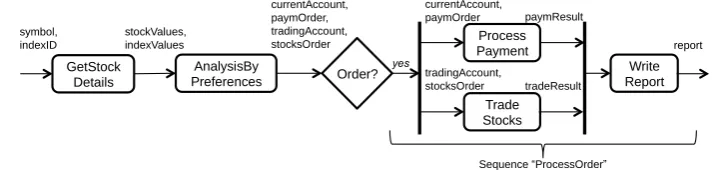
[image:3.595.119.477.460.545.2]To exemplify our approach, assume an SBA, called StockBroker allowing stock in-vestors to buy and/or sell stocks in different stock exchanges. Upon receiving a re-quest from an investor, StockBroker retrieves the investor’s portfolio of stocks, and fetches the trading values of a selected stock and index of the relevant stock market (e.g. NASDAQ, Dow Jones). It then matches these values with the preferences of the investor and contacts different services to carry out the trade and to pay for it.
Fig. 1. The StockBroker BPEL workflow
Fig. 1 shows the workflow that realises StockBroker. This workflow receives a stock symbol and a stock market index ID; invokes a stock information service (cf. activity GetStockDetails) to get the details for the given stock in the particular market; matches these details with preferences (cf. activity AnalysisByPreferences); and, if a trade order is to be placed, it invokes in parallel the payment service (cf. activity ProcessPayment) and the trading service (cf. activity TradeStocks)1. Finally, a report of all results is produced by the reporting service (cf. activity WriteReport).
1
Carrying trading in parallel with payment is possible as clearing of payment transactions can be completed after the trade transaction has taken place.
GetStock Details
symbol, indexID
AnalysisBy Preferences
stockValues, indexValues
currentAccount, paymOrder, tradingAccount, stocksOrder
Order?
Process Payment
Trade Stocks
currentAccount, paymOrder
tradingAccount,
stocksOrder tradeResult paymResult
Write Report
report
yes
In designing secure service workflows, we have identified two scenarios. In the first scenario (Scenario 1), an SBA designer wants to verify if an external service opera-tion, used in the workflow through an invoke activity, satisfies a required security property. In this scenario, if the service that is currently bound to the activity does not satisfy the property, support is offered to discover alternative services that would satisfy the required property and, if no such individual services can be found, to ex-plore if it is possible to build a composition of other services that satisfies the security property and could, therefore, be used as a substitute for the original service. An ex-ample of a composition is shown in Fig. 2. The composition ParallelStockDetails shown calls two service operations in parallel, namely GetStockValues and Get-StockMarketIndex.GetStockValues returns the trading value for a stock, identified by its symbol, and GetStockMarketIndex returns the value of a stock market index.
Fig. 2. Service composition ParallelStockDetails to be substituted for GetStockDetails
The second scenario arises in cases where the SBA designer wishes to verify that a part of a workflow (as opposed to an individual activity of it) satisfies a given security property. Workflow fragments are identified (delimited) by a control flow activity. In the Stock Broker workflow, for instance, a designer might wish to verify whether the sub sequence of activities designated as ProcessOrder in Fig. 1 preserves the confi-dentiality of the personal current account information of Stock Investor.
3
Secure Service Composition Patterns
SSC patterns are used to specify how security properties of whole abstract workflows (i.e., composition level security properties) can be guaranteed via security properties of the individual services used in the workflow. The causal relation between work-flow and activity level properties specified in such patterns is formally proven. An SSC pattern is composed of: (a) an abstract workflow structure (Pattern.WF), called workflow specification, that indicates how services are to be composed and the data flows between them; (b) the composition level security property that the pattern guarantees (Pattern.CSP); and (c) the security properties required of the partner ser-vices that may be bound to the workflow specification (i.e., to the abstract invoke activities of the workflow) to guarantee the security property specified in (b) (Pat-tern.ASP). SSC patterns are expressed as rules of the production system Drools [9], to enable their application for workflow security validation and adaptation.
In the following, we present an example of an SSC pattern that we have encoded specifying the effect of composition on the security property of separability. Separa-bility is a security property introduced in [20] and has been defined as complete inde-pendence between high (confidential) and low level (public) sequences of actions. For
GetStock Values
GetStock MarketIndex
symb
index indexV stockV
stockV, indexV symb,
this property to hold there should be no interaction between confidential and public sequences of actions (e.g., running these actions as two separate processes without any communication between them). The composition of separability, proven in [20][21], is used for specification of the SSC pattern in Drools as given in Sect. 4.1.
4
Application of SSC patterns
SSC patterns are used to infer the security properties that the individual services should have for the workflow to have another security property as a whole. This al-lows to: (a) analyse whether a given workflow (or a fragment of it) satisfies a given security property (security validation); and (b) generate compositions of services that could substitute for individual services, which prevent the satisfaction of the security properties required (security driven workflow adaptation). In the following, we pre-sent the approaches that enable these forms of applications.
4.1 Inferring security properties of workflow activities
SSC patterns are used to infer the security properties, which have to be satisfied by the individual activities (services) of a composition, for the whole composition to satisfy a given security property. In general, there can be zero, one or several alterna-tive combinations of activity level properties, called security solutions, that can guar-antee the security property required of the composition. The algorithm that applies SSC patterns for this purpose is given in Table 1.
Table 1. Algorithm to infer security properties for activities within a composition
Algorithm: INFERSECPROPERTY(WF, RSP, InSolutions): OutSolutions
Inputs: WF – /* workflow specification of a service composition process */
RSP – /* security property requested for WF */
InSolutions– /* list of security solutions used for recursion. Base case: {RSP} */
Output: OutSolutions – /* list of security solutions for the activities in WF */
For each pattern Patt such that Patt.CSP matches RSP do
IfPatt.WF /* i.e. the workflow specification of Patt */ matches WF then For each element E/* i.e. individual activity or a sub-workflow */ of WF do
Properties[E] := security properties for WF.E identified by Patt.ASP
For each security solution S in InSolutionsdo
S’ := replace RSP by Properties in S SolutionListPatt := ADD(SolutionListPatt, S’)
For each element E in WF that is a sub-workflow specification do
SolutionListPatt := INFERSECPROPERTY(E, Properties[E], SolutionListPatt)
OutSolutions := ADDALL(OutSolutions, SolutionListPatt)
Endif
Return OutSolutions
As shown in the table, given an input service workflow WF and a required security property RSP, the algorithm (INFERSECPROPERTIES) tries to apply all the SSC
proper-ties for the matched elements in WF (these can be individual activiproper-ties or sub-workflows). If a matched element E of WF is an atomic activity, the process ends w.r.t it. If E is a sub-workflow, the algorithm is applied recursively for it.
Fig. 3. The workflow patterns of sequence ProcessOrder
As an example of applying INFERSECPROPERTIES consider the case where an SBA designer wishes to verify that the subprocess ProcessOrder (PO) within the Stock-Broker process of Fig. 1 preserves the confidentiality of the Stock Investor current account. This security property can be expressed as separability, with currentAccount being confidential. ProcessOrder can be seen as a sequential workflow consisting of a sub-workflow WF’ and the atomic activity WriteReport that follows it (see Fig. 3). WF’ itself is a parallel workflow involving two atomic activities: ProcessPayment and TradeStocks.
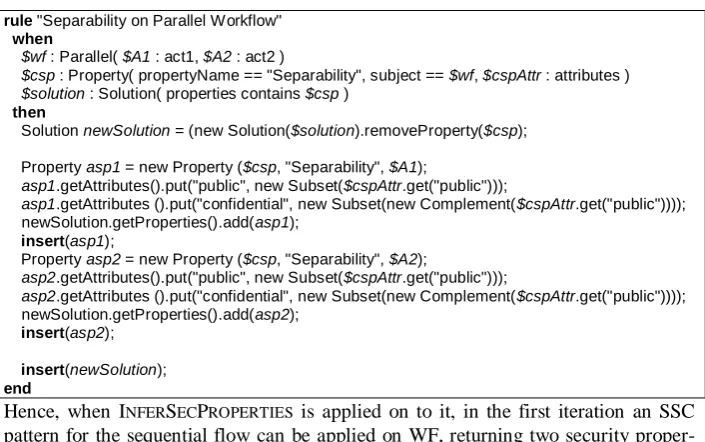
Table 2. Specification of a pattern in Drools
rule "Separability on Parallel Workflow" when
$wf : Parallel( $A1 : act1, $A2 : act2 )
$csp : Property( propertyName == "Separability", subject == $wf, $cspAttr : attributes ) $solution : Solution( properties contains $csp )
then
Solution newSolution = (new Solution($solution).removeProperty($csp);
Property asp1 = new Property ($csp, "Separability", $A1);
asp1.getAttributes().put("public", new Subset($cspAttr.get("public")));
asp1.getAttributes ().put("confidential", new Subset(new Complement($cspAttr.get("public")))); newSolution.getProperties().add(asp1);
insert(asp1);
Property asp2 = new Property ($csp, "Separability", $A2);
asp2.getAttributes().put("public", new Subset($cspAttr.get("public")));
asp2.getAttributes ().put("confidential", new Subset(new Complement($cspAttr.get("public")))); newSolution.getProperties().add(asp2);
insert(asp2);
insert(newSolution);
end
Hence, when INFERSECPROPERTIES is applied on to it, in the first iteration an SSC pattern for the sequential flow can be applied on WF, returning two security proper-ties: one for WF’ requiring confidentiality for currentAccount, paymResult and trad-eResult, and another for WriteReport, requiring confidentiality for paymResult and tradeResult. The second iteration of the algorithm applies another SSC pattern, but for the parallel flow, to WF’. In particular INFERSECPROPERTIES applies SSC patterns
Write Report
currentAccount, paymOrder, tradingAccount, stocksOrder
Process Payment
Trade Stocks
currentAccount, paymOrder
tradingAccount,
stocksOrder tradeResult paymResult paymResult,
tradeResult report
WF’ WF
[image:6.595.123.476.418.639.2]specified as rules of the Drools production system [9]. Table 2 shows the specification of the SSC pattern about separability on parallel flow (see [21]) as a Drools rule. More specifically, the rule defines that if the workflow ($wf) is a parallel composition of activities and the composition level security property is separability ($csp) then the security property of separability is required of the individual activities $A1 and $A2 of the composition (this is expressed by the property asp1 and asp2). Hence, by applying the rule of the SP pattern to WF’, the algorithm creates and adds two security proper-ties to the final solution, i.e., asp1 (separability) for currentAccount and paymResult of ProcessPayment and asp2 (separability) for tradeResult of TradeStocks.
4.2 Validation of Security of Individual Services and Workflow Fragments
In order to validate whether a security property is satisfied by a fragment of a work-flow, we assume that a fragment consists of a BPEL scope or a control flow (i.e., sequence, flow, if-then-else or pick) activity that can contain multiple service invoca-tions (in the form of invoke activities) and further control flow activities.
Given a request to verify whether a workflow fragment (WF) satisfies a required se-curity property (RSP), the algorithm INFERSECPROPERTY is applied to identify the list of alternative security solutions (i.e., combinations of security properties of the indi-vidual services in the fragment) that would guarantee RSP. As explained earlier INFERSECPROPERTY tries to apply different SSC patterns in order to identify these alternative solutions. If such solutions exist, each of them is analysed further to check if the security properties required by it are provided by the services in the fragment. To validate whether an individual service satisfies the security property required of it by a security solution, we express the property as a service discovery query and then use the discovery algorithm described in [8] to match the specification of the individ-ual service with the query and establish if it satisfies the query or not. In applying the service discovery process, we assume the existence of machine-readable security certificates that indicate the security properties that a service S has [8]. If the individ-ual service validation succeeds for all the services of the fragment by even one of the identified security solution, then the fragment is validated. Otherwise, if no security solution can be found, or if none of the found security solution can be satisfied by the services in the fragment, the fragment is reported as not validated.
4.3 Workflow Adaptation
in-voke activities within it. Once a specific security solution is selected, the service adap-tation mechanism is triggered to adapt the workflow.
4.4 Implementation of the approach
Our approach has been implemented in a tool called A-BPEL Designer. This tool is an extension of BPEL Designer, i.e., an Eclipse plugin [7] that offers comprehensive support for the editing and deployment of WS-BPEL processes through Eclipse IDE. In A-BPEL Designer, we have extended BPEL by allowing the specification of secu-rity properties for invoke or control flow BPEL. A-BPEL Designer offers also support for validating security properties of individual partner services or workflow fragments and adapting BPEL processes to ensure security as described. To offer these function-alities, A-BPEL designer has been integrated with the service discovery engine de-scribed in [3] and the service composition tool dede-scribed in [8].
5
Related work
Research related to the security of service based applications focuses on making se-cure an SBA, or verifying its security.
A common approach underpinning research in the former area is to secure SBAs by using additional security services that can enforce the required security properties [12][13][14]. More specifically, an aspect-oriented version of BPEL, called AO4BPEL [12], allows the integration of security specifications in a BPEL process. These specifications are then used to indicate security functionalities that are offered by a special Security Service, and integrate them in the AO4BPEL process.
exhaus-tive verification since its analysis is driven by specific SSC patterns. This is important as it makes security analysis more scalable at the expense of loss of completeness. Some model based approaches [18][19] support also the transformation of from secu-rity requirements into secusecu-rity policies and architectures. This usually happens in an early design phase that must be followed by a subsequent phase where details about the implementation have to be worked out. Our approach offers the possibility to add and address security properties during the workflow design phase, without requiring designer to have a security background.
The METEOR-S project [10] allows annotation of abstract BPEL process to specify semantic-aware QoS properties, including security. The annotations are then used to discover appropriate services for the BPEL process, using an annotated registry. The Sec-MoSC (Security for Model-oriented Service Composition) tool [11] is an exten-sion of the Eclipse BPMN Modeller that allows to design BPMN business processes and to add security properties to them. These two approaches focus only on the vali-dation single service of security properties, while our approach allows the valivali-dation of workflow fragments and the substitution of services with service compositions.
6
Conclusion
In this paper we have presented an approach supporting the validation of security properties of BPEL workflows and the security based adaptation of such workflows during their design. A-BPEL Designer implements this approach in the Eclipse plat-form through the usage of a service discovery engine.
Our approach is based on Secure Service Composition (SSC) patterns, which encode formally proven causal relations between individual service level security properties and composition level security properties. The validation of workflow security is based on identifying (through the SSC patterns) the security properties that the indi-vidual partner services need to have for the workflow to have composition level prop-erties. The identified service level properties are used to check if existing partner services satisfy them, discover alternative services for them in case they do not, and discover service compositions satisfying the services if necessary. Our approach sup-ports also the automatic replacement of security non-compliant services.
Our current implementation supports workflows with sequential, parallel and choice control activities (i.e., BPEL sequence, flow, if-then-else and pick activities), and the replacement of individual service invocations. Hence, in its current form, its applica-tion is restricted to non-transacapplica-tional and stateless services.
Our on-going work focuses on supporting transactional services. We are also conduct-ing performance and scalability tests, in order to compare our results with competconduct-ing approaches (especially approaches based on full verification of security).
Acknowledgment
References
1. Pawar P. and Tokmakoff A. "Ontology-based Context-aware service discovery for pervasive environments." IEEE Int. Work. On Service Integration in Pervasive Environment. June 2006
2. Mikhaiel R. and Stroulia E. "Interface- and Usage-aware Service Discovery." In Proc. Of 4th Int. Conf. on Service Oriented Computing. 2006.
3. Spanoudakis G., Zisman A. "Discovering Services During Service Based Systems Design Using UML, ", IEEE Transactions on Software Engineering, 36(3): 371-389, 2010 4. Fujii K. and Suda T. "Semantics-Based Dynamic Web Service Composition." IEEE
Journal on Selected Areas in Communications, 23(12): 2361- 2372. Dec. 2005.
5. Silva E., Pires L.F. and van Sinderen M. "Supporting Dynamic Service Composition at Runtime based on End-user Requirements." User Generated Services Workshop, International Conference on Service Oriented Computing (ICSOC) 2009.
6. Pino L., Spanoudakis G.: Constructing Secure Service Compositions with Patterns, 8th
IEEE World Congress on Services, June 2012, Hawaii, USA 7. BPEL Designer Project, http://www.eclipse.org/bpel/
8. ASSERT4SOA Consortium, ASSERTs Aware Service Based Systems Adaptation, ASSERT4SOA Project, Deliverable D2.3, Sep 2012.
9. Drools – Jboss Community, http://drools.jboss.org
10. Aggarwal R. et al, “Constraint Driven Web Service Composition in METEOR-S”, in Proc. of the 2004 IEEE Int. Conf. on Services Computing (SCC 2004), Sep 2004 , pp. 23-30. 11. Andre R. Souza, et al. “Incorporating Security Requirements into Service Composition:
From Modelling to Execution”, in ICSOC-ServiceWave '09, 2009.
12. Charfi, Anis, and Mira Mezini. "Using aspects for security engineering of web service compositions." In Proc. of 2005 IEEE Int. Conf. on Web Services, 2005.
13. Hafner, Michael, et al. "SECTET: an extensible framework for the realization of secure in-ter-organizational workflows." Internet Research 16 (5): 491-506. (2006):
14. Gutiérrez, Carlos et al. "Towards a Process for Web Services Security." Journal of Re-search & Practice in Information Technology, 38(1) (2006).
15. Bartoletti M, et al. "Semantics-based design for secure web services." Software Engineer-ing, IEEE Transactions on 34.1 (2008): 33-49.
16. Deubler M., et al. "Sound development of secure service-based systems." In Proc. of the 2nd Int. Conf. on Service oriented computing. ACM, 2004.
17. Geor G., et al. "Verification and trade-off analysis of security properties in UML system models." IEEE Transactions onSoftware Engineering, 36(3): 338-356, 2010
18. Menzel M., Warschofsky R., and Meinel C. "A pattern-driven generation of security poli-cies for service-oriented architectures."In Proc. of IEEE Int. Conf. on Web Services 2010.
19. Séguran M, Hébert C, and Frankova G. "Secure workflow development from early re-quirements analysis."In Proc. of IEEE 6th European Conf. on Web Services. 2008.
20. McLean J. "A general theory of composition for trace sets closed under selective interleav-ing functions." In Proc. of IEEE CS Symposium on Research in Sec. and Privacy, 1994.