Rochester Institute of Technology
RIT Scholar Works
Theses Thesis/Dissertation Collections
2-29-2012
The implementation of the civil service law and a
future merit system : [presentation given February
29, 2012]
Majlinde Sinani-Lulaj
Follow this and additional works at:http://scholarworks.rit.edu/theses
This Master's Project is brought to you for free and open access by the Thesis/Dissertation Collections at RIT Scholar Works. It has been accepted for inclusion in Theses by an authorized administrator of RIT Scholar Works. For more information, please [email protected].
Recommended Citation
AMERICAN UNIVERSITY IN KOSOVO
in partnership with
ROCHESTER INSTITUTE OF TECHNOLOGY
The Implementation of the Civil Service Law
and a Future Merit System
Majlindë Sinani - Lulaj
February 24, 2012
1
Content
Acknowledgments………... 6
Abbreviations……… 7
Executive Summary………..……… 8
Chapter 1 1. KOSOVO CIVIL SERVICE BACKGROUND (PROBLEM BACKGROUND) 1.1. Civil Service before the war (during '90)………... 10
1.2. Civil service under UNMIK administration………... 10
Chapter 2 2. THE CURRENT SITUATION IN KOSOVO’S CIVIL SERVICE ACCORDING TO SURVEYS 2.1. Summary of the first survey……….……….. 13
2.1.1 Participants of the survey………...……. 13
2.1.2 .Few general findings of the survey………...….… 14
2.2.Second survey - Reliability of answers and integrity of data……….……... 17
Chapter 3 3. CIVIL SERVICE CONCEPTS - DEFINITION OF CIVIL SERVICE IN KOSOVO 3.1. What is civil service? ………..….. 18
3.2. Classical Public Administration - Max Weber model of Bureaucracy……… 18
3.3. Woodrow Wilson concept about Public Administration…..……….……… 19
3.4. What is meant by the Kosovo Civil Service? ……….…... 20
3.5.Needs for Public Administration Reform (PAR)………... 25
2
Chapter 4
4. THREE IMPORTANT LAWS IN OVERALL STRUCTURE OF PUBLIC
ADMINISTRATION
4.1 Law on Civil Service……….………. 30
4.2. Law on Salaries of Civil Servants………...…… 33
4.3. Law on State Administration……….…... 34
Chapter 5 5. IMPORTANT COMPONENTS FOR IMPLEMENTATION OF LCS 5.1. Secondary legal acts – process of drafting is still continuing………... 36
5.2. Classification of job positions………... 37
5.3. Job description component and Regulation on job description………. 42
5.4 Performance evaluation component………... 44
5.5. Measurement of performance……….... 46
5.6. Independent Oversight Board for the Civil Service of Kosovo (IOBK)………...… 51
Chapter 6 6. COMPARATIVE CASE STUDIES 6.1. Different countries – different systems and experiences………... 6.2.Kosova ……….. 53 53 6.3. Estonia……… 55
6.4. Slovenia……….. 58
Chapter 7 7. CONCLUSIONS AND RECOMMENDATIONS 7.1. Final discussion..………... 60
3
7.3. Recommendation for political support……….. 63
7.4. Recommending approval of regulation on job classification……….... 64
7.5. Recommending a review of job description and reduction of job titles………... 64
7.6. Recommending the new system of performance evaluation………. 65
7.7. Recommendation for promoting through merit system ……… 66
Apendix 1 ………. 68
Apendix 2………..… 70
Figures
Figure 1 Is the current performance evaluation system appropriate? If “No”-should it be changed?
Figure 2.1 Are you informed that LCS started to be implemented?
Figure 2.2 Are you satisfied with information that you are getting from your supervisors about your institution?
Figure 2.3 Do you think the performance of your colleagues or managers is the reason that your performance is not higher than it is?
Figure 2.4 Does your manager provide constructive feedback?
Figure 2.5 Is the current performance evaluation system appropriate? (If “no” –should it be changed?)
Figure 3.1 Does your institution hold correct competition for vacant job positions?
Figure 3.2 Does your institution select best qualified candidates for vacant job positions?
Figure 3.3 Does your institution select best qualified candidates for vacant job positions?
Figure 3.4 During your experience as a civil servant, do you know of anyone discriminated regarding advancement, even if he/she had a good performance?
Figure 3.5 During your experience as a civil servant, have you perceived discrimination regarding promotion, training opportunities, monetary benefits, etc.
Figure 3.6 Percentage of Civil Servants distributed to each public sector in Kosovo in 2008
Figure 4.1 Interactions between LCS, LSCS and LSA
4
Figure 4.3 Components for classification for salary grades according to LSCS
Figure 4.4 Levels of structure in ministry according to LSA
Figure 5.1 Percentage of assistants, from the total number of civil servants
Figure 5.2 Percentage of officers from the total number of civil servants
Figure 5.3 Did your job description allow you to be creative during your daily work?
Figure 5.4 Did your job description changed during your experience as civil servant?
Figure 5.5 When do you give your maximum to work?
Figure 5.6 Do you have written (approved) performance goals that you are expected to achieve during specified period?
Figure 5.7 Do you have written (approved) performance goals that you are expected to achieve during specified period?
Figure 5.8 Who is completing your evaluation paper?
Figure 5.9 During your experience as a civil servant, did you believe that you are fairly evaluated for your performance?
Figure 5.10 Are civil servants fairly treated in training opportunities?
Figure 5.11 What is your level of performance according to your opinion?
Figure 5.12 What is your level of performance according to your opinion?
Figure 5.13 How often do you receive formal feedback from your supervisors for your work?
Figure 5.14 Number and the percentage of IOBK received appeals
Figure 7.1 Responsibilities of MPA based on LCS
Figure 7.2 Does your institution select best qualified candidates for vacant job positions?
Figure 7.3 Is the current performance evaluation system appropriate? (If “no” –should it be changed?)
Figure 7.4 During your experience as a civil servant, have you perceived discrimination regarding promotion, training opportunities, monetary benefits, etc.
Figure 7.5 Classifications of Job Positions in Functional Categories
Figure 7.6 Has your job description changed during your experience as civil servant?
Figure 7.7 When do you give your maximum to work?
5
List of tables
Table 1 Number of civil servants and job titles in civil service 2006 - 2011
Table 1.2 Number of civil servants and titles in civil service in Kosovo 2006 - 2011
Table 2.1 Participants of the survey, number of questionnaires and their fulfilment
Table 2.3 Participants and number of questionnaires of second survey
Table 4.1 MPA budget & additional costs for administration of civil service based on LCS
Table 4.2 Number of civil servants & additional budgetary costs based on LSCS
Table 5.1 Administrative Instructions based on UNMIK Regulation 2001 / 36, & Regulations based on LCS
Table 5.1 Number of civil servants which are "covered” under the title "Assistant"
Table 5.2 Classification of Salary Grades Positions in Civil Service according to LSCS
Table 5.3 General Classifications of Job Positions in Functional Categories
6
Acknowledgments
I would like to acknowledge and extend my heartfelt gratitude to USAID for a scholarship award and the opportunity to follow my dream of being part of an American University. I realize that there are many options to continue with my work and my studies, but I am convinced that whatever will be, the American spirit will be with me forever!
My sincere gratitude to the Government of Republic of Kosova for making it possible to realize this masters study.
I would like to show my genuine acknowledgement to Prof. Brian Bowen for his help, patience and understanding.
I would like to express my special gratitude to Mrs. Edita Tahiri, for her attention, time and guidance in this Project.
This project would not have been possible without the kind support and help of my colleagues and my friends. I would like to extend my honest thanks to all of them.
Apart from the hard work, the success depends on support and courage of the people that are meaningful for us. I would like to express my gratitude towards my parents, brothers and sisters for their support and courage. But above all else, it would not have been possible to realize these studies and this Project without the love and understanding of my husband and my children.
7
ABBREVIATIONS
DCSA Department of Civil Service Administration
DFID Department for International Development
DMPAREI Department for Management of Public Administration Reform and European Integration
EC The European Commission
FRIDOM Functional Review and Institutional Design of Ministries
GDP Gross Domestic Product
GERAP Group of Experts for Public Administration Reform
LCS Law on Civil Service
LSA Law on State Administration
LSCS Law on Salaries of Civil Servant
MCYS Ministry of Culture, Youth and Sport
MFE Ministry of Finance and Economy
MPA Ministry of Public Administration
MPS Ministry of Public Administration
OPM Office of Prime Minister
PAR Public Administration Reform
PAR Public Administration Reform
PARAP Action Plan for Public Administration Reform
SIGMA Support for Improvement in Governance and Management)
SPAR Strategy of Public Administration Reform
8
Executive summary
[image:10.612.103.538.299.407.2]This Capstone Project addresses the significant challenge of improving the Law on Civil Service (LCS) in Kosovo. It provides an analysis of the current state of the civil service and level of implementation of the LCS. The project analysis was based on surveys, published reports, and professional assessments. Job descriptions, classification of job positions, and performance evaluation, as important components of merit system are elaborated and highlighted. The LCS sets the rules for overall management, organization, rights, obligations, career progression and professional development of civil servants.
Table 1 Number of civil servants and job titles in civil service 2006-2008
JOB TITLES IN CIVIL SERVICE OF KOSOVO
Year Number of civil servants Number of job titles
2006
69 302
923
2008
71 670
950
2011
21 286
868
With the 2010 enactment of the LCS there was a dramatic reduction of over 60 % of the total number of civil servants from the Government payroll list. This reduction was a direct result of the recategorization of civil service which excludes education, medical and uniformed personnel. Even though the number of civil servants has reduced, there remains roughly the same number of job titles on the payroll list (see table above). This is one of a number of irregularities not appearing to comply with the LCS.
This Capstone Project has five major recommendations:
9
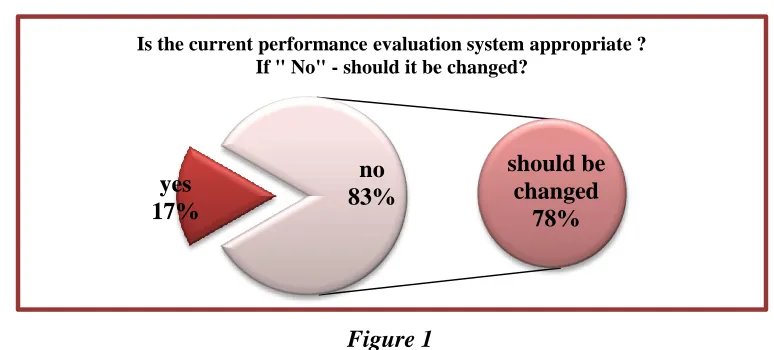
[image:11.612.138.525.148.323.2]2. There must be an accurate classification of job positions and therefore ensure a proper and accurate allocated budget. The capstone project surveys show that existing evaluation system should be changed (see Figure 1)
Figure 1
3. It is essential to have a comprehensive review in job descriptions and reduction of job position titles. In parallel, reviewing of job descriptions would assist analyzing and identifying the real needs for each position within institutions.
4. Civil service career promotion and motivation should be based on revised evaluations and a clear merit based system. The new performance evaluation system should be revised to include clear and realistic objectives, motivating possibilities, punitive measures, and prepared staff to supervise the implantation of merit system.
5. Promoting through merit system - Promotion to higher levels of functional hierarchy in Kosovo Civil Service should be based solely on merit, ability and experience.1 Meritocracy should be respected and also be the motivating force for civil servants to offer qualitative services for all citizens without discrimination.
1
Law on Civil Service, Article 26 Promotions, paragraph 2, pp14,
http://www.kuvendikosoves.org/common/docs/ligjet/2010-149-eng.pdf
yes 17%
should be changed
78% no
83%
10
Chapter 1
1. KOSOVO CIVIL SERVICE BACKGROUND (PROBLEM BACKGROUND)
1.1. Civil Service before the war (during '90)
Prior to the escalation of the Balkans conflicts during 1998-1999, Kosovo was centrally governed from Belgrade, after losing its autonomy. From 1989 until 1999 violent measures were introduced, including Albanian language restrictions, the removal of Albanians from public service, and introduction of new decisions in order to further promote Serbian migration into Kosovo. The Albanian population had been denied involvement in public sector, and particularly in public administration during this period. The Serbian civil servants occupied almost all the key government posts in the country, until Albanians were barred from public office. At the same time there was a restrictive education policy, which mainly favored the Serbian population.
1.2.Civil service under UNMIK administration
After the war, in 1999 the United Nations Interim Administration Mission in Kosovo (UNMIK) established self-governance structures, recruiting local staff at both central and local levels. Because of incoherent and homogenous education and without a training system, civil servants were recruited without reference to any specific educational background related to the Civil Service. Kosovo’s administrative bodies suffered from shortages of experienced civil servants to manage and provide quality services to citizens.
The UNMIK Regulations and administrative directives were the legal base of the civil service structure and functionality for several years. In their Report on the Status of Public Administration in Kosovo (2007), the GERAP found that “The basic legal framework for public administration is in place but is fragmented into over 100 pieces of legislation and therefore
requires consolidation and completion”2, including Regulations and UNMIK administrative instructions regarding public administration.
11 Since 2001, the main legal act on civil service was UNMIK Regulation No. 2001/36 on the Kosovo Civil Service, which reflected the issues identified at the time. This regulation entered into force on 22 December 2001 and regulated the employment and the terms of employment for civil servants in Kosovo. This regulation was a basic fundamental legal infrastructure, but the definition of civil service was too general. Relying on Regulation 2001/36 on Civil Service, the definition of “civil servant” means any employee of an employing authority, whose salary is paid from the Kosovo Consolidated Budget (except for: members of the Board, exempt appointees and members of the Kosovo Protection Corps)3.
The European Commission (EC) in the Kosovo 2006 Progress Report, draws attention that “… for an estimated population of approximately two million, Kosovo has a high number of
68,000 public servants on its payroll. The absence of a general register of civil servants and of a
related inventory of competences as well as unclear and overlapping distribution of tasks makes
it difficult to match needs with the available human resources.”4
The number of civil servants wasn’t decreased. In fact, new institutions and new needs increased the number of civil servants. In 2009 in Kosovo there were approximately 75000 civilian servants (including the personnel of the education system, the personnel of the health service, police officers, customs officers, correctional officers). There was no distinction between civil servants and public employees. The Regulation 2001/36 and the Administrative Direction 2003/2 Implementing UNMIK Regulation No. 2001/36 on the Kosovo Civil Service5 were the basic legal documents to recruit administrative staff to the institutions.
The changes during the years, and institutional needs for new positions, made a large number of titles and grades of staff. Different titles made a complex and confused organizational structure of the institutions. There were no standard criteria to grade the civil servants, or to
3
UNMIK Official Gazette, Regulation No. 2001/36 on Civil Service Law,
http://www.unmikonline.org/regulations/2001/RE%202001-36.pdf
4
Commission Of The European Communitie, Brussels, 08.11.2006, Sec (2006) 1386 Commission Staff Working Document, Kosovo (under UNSCR 1244) 2006 Progress Report, EN, {COM (2006) 649 final}, pp.9,
http://ec.europa.eu/enlargement/pdf/key_documents/2006/nov/ks_sec_1386_en.pdf 5
12 increase the salaries. The job descriptions of various officials that works in the institutions were (and are) not clearly defined.
The FRIDOM project concludes "…to the high managerial positions there is a quasi unique classification of the positions and there are no big differences in levels. On the other
hand in the lower executive positions there is a large diversity of classifications for the same
positions. In some cases there are different positions (different content) with the same name,
whereas there are same content positions with different names. As a result we have in Kosovo
more than 950 positions’ denominations all over the public administration. ”6
(see Table 1.1)
Table 1.1 Number of civil servants & titles in civil service 2006-2011
TITLES IN CIVIL SERVICE OF KOSOVO
Year
Number of civil servants
Number of titles
2006
69 302
7923
72008
71 670
8950
92011
21 286
10868
10Even though the number of civil servants has reduced with the 2010 enactment of the LCS, and reduction of over 60 % of the total number of civil servants (reduction was a result of the recategorization of civil service which excludes education, medical and uniformed personnel), there remains roughly the same number of job titles on the payroll list (see Table 1.1, 2011 data).
6
FRIDOM (Functional Review and Institutional Design of Ministries) Project, Review of the Human Resources Management (Systems and capacities), December, 2008, pg. 18(different denominations/table 1), pp. 3,
http://map.rks-gov.net/userfiles/file/FRIDOM/Rishikimet%20Horizontale/humanresources.pdf
7Group of Experts for Public Administration Reform” Report on the status of Public Administration in Kosovo 2007” February 2007, pp. 12
8
SIGMA - Kosovo Public Service and the Administrative Framework Assessment, May 2008, pp.17,
http://www.sigmaweb.org/dataoecd/48/31/41637624.pdf
9
FRIDOM (Functional Review and Institutional Design of Ministries) Project,
Review of the Human Resources Management (Systems and capacities), December, 2008, pg. 18 (different denominations/table 1), pp. 3,
http://map.rks-gov.net/userfiles/file/FRIDOM/Rishikimet%20Horizontale/humanresources.pdf
10
13
Chapter 2
2. THE CURRENT SITUATION IN KOSOVO’S CIVIL SERVICE ACCORDING TO
SURVEYS
2.1. Summary of the first survey
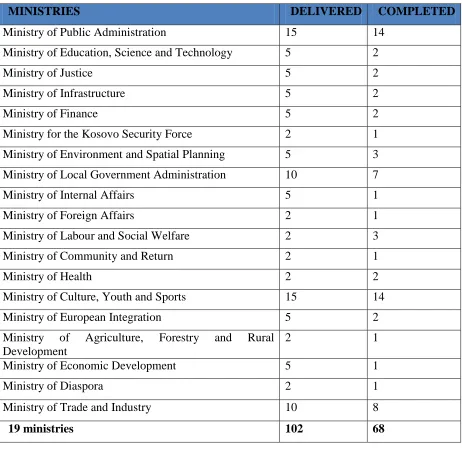
A survey was used, by this capstone project, to understand the current situation in the country’s civil service from the perspective of civil servants. In the capstone project proposal the idea was distributing three separate questionnaires in three levels of civil service: general secretaries, personnel managers and other civil servants. Because of the similar nature of questions, and similar answers in all levels of hierarchical range, for practical reasons, the responses of the questionnaires are collated into only one rendering.
The questionnaire was comprised of multiple choices questions. Questions were focused on components of job description, performance evaluation, and on main principles of civil service. The questionnaires were distributed through ministries, creating balance between different profiles of ministries and respondents into overall survey. The answers were expected to be returned in a timeline of two weeks.
The findings of the survey will be used in particular topics of this capstone, to show the current situation not only from the perception of assessments and reflection from the outside experts, but also from the perspective of respondents which are involved in the implementation of laws, strategies and work plans as civil servants.
2.1.1 Participants of the survey
14
Table 2.1 Participants of the survey, number of questionnaires and their fulfilment
MINISTRIES DELIVERED COMPLETED
Ministry of Public Administration 15 14 Ministry of Education, Science and Technology 5 2
Ministry of Justice 5 2
Ministry of Infrastructure 5 2
Ministry of Finance 5 2
Ministry for the Kosovo Security Force 2 1 Ministry of Environment and Spatial Planning 5 3 Ministry of Local Government Administration 10 7
Ministry of Internal Affairs 5 1
Ministry of Foreign Affairs 2 1
Ministry of Labour and Social Welfare 2 3 Ministry of Community and Return 2 1
Ministry of Health 2 2
Ministry of Culture, Youth and Sports 15 14 Ministry of European Integration 5 2 Ministry of Agriculture, Forestry and Rural
Development
2 1
Ministry of Economic Development 5 1
Ministry of Diaspora 2 1
Ministry of Trade and Industry 10 8
19 ministries 102 68
2.1.2 Few general findings of the survey
15 they were asked if they are informed that the LCS started to be implemented, whereas 13 % of respondents don’t have this information (Figure 2.1)
Figure 2.1 Are you informed that LCS has started to be implemented?
The abovementioned result is more hopeful than the result related to satisfaction with internal institutional communication. Only 57% of respondents are satisfied with information that they are getting from their supervisors about their institution. 28% are partially satisfied and 15% of them answered with “No” on this question. (Figure 2.2)
Figure 2.2 Are you satisfied with the information that you
are getting from your supervisors about your institution?
Internal communication also includes the announcements about new laws or other normative acts and timelines when new legislative acts are enforced. Many times the lack or difficulties of internal institutional communication delays or creates barriers to better and faster movement forward to the aspirant aims or goals.
yes 87% no
13%
yes 57% no
15% partially
16 Working in a bureaucracy does mean that you are in a kind of cog, were everything should get into its shape. Asking the respondents if their performance is not higher than it is, because of the performance of the others around them, 42% of respondents do not impute “fault” to their colleagues regarding their performance level, however another 42% of them believe that colleagues’ performance partially effects in their performance. Only 16% are convinced that performance of their colleagues directly reflects in their performance (Figure 2.3)
Figure 2.3 Do you think that performance of your colleagues or
managers is the reason that your performance is not higher than it is?
Based on the survey 45 % of respondents consider that their managers (supervisors) are providing them constructive feedback. 30% say that a feedback from their managers is partially constructive, whereas 25 % answered with “no” (Figure 2.4)
Figure 2.4 Does your manger provide constructive feedback? yes
16%
no 42% partially
42%
yes 45%
no 25% partially
17
2.2. Second survey - Reliability of answers and integrity of data
To check the reliability of answers and to verify the integrity of data a short questionnaire was used. The time period between the first survey and second one was a month. Mostly the results of the second (reliability) survey were similar with the first one. Table 2.2 reflects the number of distributed and completed questionnaires. Participants of this survey were civil servants of three different departments, which have different specific objectives. (Table 2.2)
Table 2.2 Participants and number of questionnaires of second survey
GOVERNMENT
DELIVERED COMPLETED
Civil servants from three different departments 20 18
Figures which show results from the second survey are ruddy colored, and will be ranged below the first survey figures. Five of the reliability survey questions were the same as the first questionnaire, with one unique question and sub-question related to system of performance evaluation (Figure 2.5). Only 17 % of respondents of the second survey accepted that the current performance evaluation system provide dependable assessments, whereas 83 % say “No”. For the respondents which think that system of performance evaluation does not give the right image of civil servants, 78% of them accepted that this system should be changed. The result of this question is shown on the figure below in Figure 2.5.
Figure 2.5
yes 17%
should be changed
78% no
83%
18
Chapter 3
3. CIVIL SERVICE CONCEPTS - DEFINITION OF CIVIL SERVICE IN KOSOVO
3.1. What is civil service?
If we start from the expression civil + service we come to the easiest explanation that the service that is offered is not uniformed. More explanation can be found in the dictionaries, to have a complete meaning of expression. At least two meanings of expression “civil service”
could be founded:
-Those branches of public service that are not legislative, judicial, or military and in which
employment is usually based on competitive examination.
-The entire body of persons employed by the civil branches of a government.
Actually, these two essential meanings could be basic definition of civil service, but searching
deeply in literature about bureaucracy, there are also more comprehensive definitions about
civil service11
3.2 Classical Public Administration - Max Weber model of Bureaucracy
Max Weber (1864-1920), German sociologist, in his book Economy and Society gives a short description of bureaucracy: “the combination of written documents and a continuous
operation by officials constitutes the “office” (Bureau) which is the central focus of all types of modern organized action.”12
According to Weber "Bureaucratic administration means fundamentally the exercise of control on the basis of knowledge. This is the feature of it which
makes it specifically rational"13
Crucial is the description of role of civil servant and hierarchical control in civil service comparing with the role of politician’s. He emphasizes “To take a stand, to be passionate . . . is the politician's element . . . indeed, exactly the opposite, principle of responsibility from that of
11 http://www.thefreedictionary.com/civil+service 12
Richard Swedberg, Ola Agevall, The Max Weber dictionary: key words and central concepts , pp.19
http://books.google.com/books?id=_c3Mcnh8hCgC&pg=PA19#v=onepage&q&f=false
19
the civil servant. The honor of the civil servant is vested in his ability to execute conscientiously
the order of the superior authorities. . . .Without this moral discipline and self-denial, in the
highest sense, the whole apparatus would fall to pieces.14
The Weber model of bureaucracy was fundamental for the development of private or public enterprises, which had a very important role developing the world.
The ideal type of bureaucracy according to Weber had several specific characteristics:
-hierarchical organization, by defined lines of authority in a stable area of activity,
-each office works based on written rules,
-bureaucrats appointments made on the basis of technical criteria,
-bureaucrats appointments made based on the results of qualifying examinations,
-merit based advancement,
-bureaucratic officials could not have another job, except the job in office where they are employed,
-bureaucratic officials needing training,
-bureaucrats behavior must be under rigorous discipline,
-rules being implemented neutrally,
-career advancement depending on technical qualifications judged by organizations, not by individuals.
3.3 Woodrow Wilson concept about public administration
Woodrow Wilson was one of the main proponents of the politics-administration dichotomy. He argued that politics and administration could be distinguished as the expression of the political will and the executions of that will by the side of administration.
Wilson accepted the concept of organized and effective Government (positive aspects of European administration) and concept of justice and modern government (American concept).
14“Traditional Public Administration versus The New Public Management: Accountability versus Efficiency” Festschrift for Professor Klaus Konig of Speyer, Germany in Institutionenwandel in Regierung und Verwaltung: Festschrift fur Klaus Konig, Arthur Benz, HHeinrich Siedentopf, and Karl-Peter Sommermann, eds.
(Berlin,Germany: Duncker & Humblot, 2004), pp. 443-454
20 He seeks a combination between the European and American concepts. Woodrow Wilson, who promoted the American civil service reform in the 1880s argued for the civil service outside of politics and citizen-oriented administration. This was an important contribution in traditional public administration.
Wilson’s concept about civil service is a concept that the Government of Kosovo is engaged to achieve and is trying to implement in civil service.
3.4 What is meant by the Kosovo civil service?
Based on UNMIK Regulation 2001/36, every public employee whose salary was paid from Kosovo Budget was part of civil service. This definition did not define clear lines between pure bureaucracy and other categories of public employees, and created a huge number of civil servants. That increased difficulties to make changes within the civil service system, because every legal act and each action affected in all categories by this Regulation. Based on data of the Ministry of Finance and Economy (MFE) Budget 2006, there were 76 717 employees or 77 Budgetary Agencies).15
However, equity,
political neutrality and impartiality, integrity,
honesty and accountability, transparency,
merit,
non –discrimination and inclusiveness
-were principles on which the civil service in Kosovo tried to be created and to be built on. Whether this intention is achieved –that is the subject under discussion!
15
21 The LCS has been enforced since 2010. Article 2 of LCS defined term “civil service”
used in this law: “… the entire body of employed administrative personnel, in institutions of central and municipal administration foreseen by this law, which apply policies and ensure
respectability of certain rules and procedures”.
Article 3 of LCS in nine paragraphs defines in general terms the composition, organization recruitment, promotion and management basis of civil service in Kosovo. In paragraph 9 (Article 3) of this law it is written explicitly: “The recruitment, organization, promotion and management of the Kosovo Civil Service is based on the principle of merit;
intended as the appointment of the best person for any given job in the public administration and
the recognition of the good performance of Civil Servants in the exercise of their functions.”
Based on the survey, political or other implications on civil service are evident. 45% of respondents consider that institution don’t hold correct competition for job positions; 15% believe that institutions just partially makes correct competition; whereas 40% of respondents consider that institutions are correct regarding competition.( Figure 3.1)
3.1 Does your institution hold correct competition for a vacant job positions?
Similar results are regarding best qualified candidates for vacant job positions (Figure 3.2)
yes
40%
no
45%
partially
22
3.2 Does your institution select best qualified candidates for vacant job position?
But results were different on the reliability survey. Only 5% of respondents answered with “yes” on the question if the institution selects best qualified candidates for vacant job position; 39 % answered with “no”, while 56 % says “partially”.(Figure 3.3)
3.3 Does your institution select best qualified candidates for vacant job position?
Based on the survey, which included civil servants from different categories of civil service through ministries, 50% of respondents accepted that they are witnesses of discrimination regarding advancement, even if they have good performance. That reflects that the core principles of civil service are broken. Figure (3.4)
yes
42%
no
45%
partially
13%
yes
5%
no
39%
partiall
23
Figure 3.4 During your experience as a civil servant do you know of anyone
discriminated regarding advancement, even if he/she had good performance?
The reliability survey specified more segments of civil service working frames, where probability of discrimination in civil service is higher. The results reflected more discrimination regarding “… promotion, training opportunities, monetary benefits etc.” 78 % of respondents accepted that they know about discrimination regarding these segments, while 22 % denied that they know about discrimination. (Figure 3.5)
Figure 3.5 During your experience as a civil servant, have you perceived discrimination
regarding promotion, training opportunities, monetary benefits, etc.?
Several questions could be propounded in this case:
Is the civil service development based on approved legal acts, and principles of civil service?
yes
50%
no
50%
yes
78%
no
24 Is the civil service impartial and professionally independent?
What is directly influencing the assessment of civil servants?
During the election campaigns (and subsequently), political parties (government(s) also) in Kosovo declared that they will implement professional civil service, detached from politics. What actually happened was contrary to what the declarations were! Interferences in recruitment and advancements of civil servants were apparently done (in all categories and in all levels of civil service).
The European Commission (EC) during its annual Progress Reports for Kosova repeatedly highlighted the unchanged situation regarding negative phenomena.
The EC in the Kosovo 2007 Progress Report (pp. 10) finds that: “… civil servants are still
vulnerable to political interference, corrupt practices and nepotism.”16
EC the 2008 Progress Report about Kosovo repeat the same statement regarding negative phenomena’s in civil service in Kosovo: “Civil servants continue to be vulnerable to political interference, corruption and nepotism.”17
EC Enlargement Strategy and Main Challenges 2009-2010, reports in the same line regarding public administration: “Political interference in the civil service and in the process of public appointments remains a concern.”18
16
Commission Of The European Communities, Brussels, 6.11.2007, Sec(2007) 1433, Commission Staff Working Document, Kosovo Under UNSCR 1244 2007 Progress Report Accompanying The Communication From The Commission To The European Parliament And The Council Enlargement Strategy and Main Challenges 2007-2008 {COM(2007) 663 final}, pp.10,
http://ec.europa.eu/enlargement/pdf/key_documents/2007/nov/kosovo_progress_reports_en.pdf
17
Commission Of The European Communities, Brussels, 5.11.2008, Sec(2008) 2697, Commission, Staff Working Document, Kosovo (Under UNSCR 1244/99) 2008 Progress Report
Accompanying The Communication From The Commission To The European Parliament And The Council, Enlargement Strategy And Main Challenges 2008-2009 ,{COM(2008) 674}, pp.12,
http://ec.europa.eu/enlargement/pdf/press_corner/keydocuments/reports_nov_2008/kosovo_progress_report_en.pdf
18
25 Kosovo 2011 Progress Report in its overall statements concludes: “Kosovo needs to build
a professional public administration free of political interference. This is a key European
Partnership priority and needs to be a high political priority.”19
3.5 Needs for Public Administration Reform (PAR)
Several analyses regarding public administration functionality and modernization have been done in Kosovo, as a need of changes during the years in political, social and economic environments. The first serious effort of Government was to analyze the situation in public administration, including strengths and weaknesses. There was a Report on the Status of Public Administration in Kosovo edited in February 2007 from Group of Experts for Public Administration Reform (GERAP).
This Report was focused on seven main fields:
Human resources
Structure of institutions
Management of public administration
E-governance
Communications with citizens
Anti-corruption
Policies and legislation
Financial public administration
GERAP emphasizes that: “The Public Administration Reform and advancement is considered a necessity to meet the current requests and moreover to fulfill the obligations of
creating a democratic state, so that it can provide efficient services to its citizens and be able to
meet the current and future international obligations”20.
19 Commission Staff Working Paper, Brussels,12.10.2011, Sec (2011) 1207, Kosovo 2011 Progress Report / Communication From The Commission To The European Parliament And The Council/ Enlargement Strategy and Main Challenges 2011-2012, {COM92011)666}, pp.10
http://ec.europa.eu/enlargement/pdf/key_documents/2011/package/ks_rapport_2011_en.pdf
26 Based on the work that GERAP did, and findings in this Report, the Ministry of Public Services (MPS) (since May 2009 MPA) submitted a Strategy for Public Administration Reform (SPAR) and an Action Plan for Public Administration Reform (PARAP), which were the basic documents for forward steps in this direction. PARAP was revised in August 2009. Responsible for monitoring progress was the inter-institutional Working Group.
At the end of 2008 it was assessed that 35% of the planed actions had been improved. In October 2009, the MPA set up a Department for Management of Public Administration Reform and European Integration (DMPAREI). In 2010 the DMPAREI/MPA assessed that only 25 % of activities had been fully completed. Because of new circumstances and new political context created with the declaration of Kosovo’s independence on 17 February, the 2008 Government of the new state was committed to update the PAR Strategy, which should run for the period of three years (up to 2013). After this timeline Government should evaluate achievements.
Based on Public Administration Reform Strategy 2010-2013, PAR vision is guided by three pledges: an effective, efficient and European public administration.21
3.6 Functional Review and Institutional Design of Ministries (FRIDOM Project)
In April 2008, the Government of Kosovo launched a major program of Functional Review and Institutional Design of Ministries (FRIDOM). This program was supported by the Department for International Development (DFID) of the United Kingdom and implemented by the Consortium of International Consulting Companies comprising of Helm (Ireland), CPM (Latvia), Governance Institute (Slovakia), and Altair (Spain).
The FRIDOM Project has given answers on three questions:
What does the Government actually do?
How does the Government do it?
What should the Government do?
21Strategjia e Refoprmës së Administratës Publike 2010-2013, pp.5
27 Three types of reviews were made during the functional review:
The whole of Government Review looking at the structure and organization of public administration.
Sixteen vertical reviews of institutional structure, functions and capacity covering all ministries and the Office of Prime Minister (OPM).
Fourteen reviews of horizontal functions common to all institutions
One of very important reviews of FRIDOM project, and very meaningful material within the scope of this capstone project is Functional review of the systems and capacities of human resources management.
Because of comprehensiveness of different categories and institutions in civil service, in 2008,22 when FRIDOM experts worked on functional review of the Government, the weight of each sector of the public administration in Kosovo was:
Education 44%
Health 18 %
Uniformed services 18%
Central institutions 10 %
Communes administration 8%
Judicial system 2%
Few steps to take different actions related to specific categories were done approving particular decisions from the side of government, for example increasing salaries for health or education category, but that produced another set of problems, related changes on payroll system.
Figure 3.6 indicates the percentage of civil servants distributed to each public sector in Kosovo, in 2008. Making a step of changes or specific rules in public service, when all these categories were in the same group, affected all groups.
22
28
Figure 3.6 Percentage of Civil Servants distributed to each public sector in Kosovo in 2008
To make differences between different categories little formal changes were made in titles in database. These changes increased the number of titles in the payroll list, which is the source of overall list of public servants.
Artificial increase of titles was dictated because of:
Non-divided public service categories,
Non- adequate salary system in civil service,
Non-job classification system
Non-clear job description (non - unique standards and criteria’s)
Decentralized human resources management procedures
One of recommendation of the FRIDOM experts was: “… an urgent measure is the approval
of a new job classification system (with standards and guidelines) that will lead to the
interventions on the salary system.”23 Three years later the job classification is not yet done.
23FRIDOM project, 2008, Rishikimi funksional i sistemeve dhe kapaciteteve të Menaxhimit të Burimeve Njerëzore, pp.3 http://map.rks-gov.net/userfiles/file/FRIDOM/Rishikimet%20Horizontale/humanresources.pdf
Education Health Uniformed services
Central institutions
Comunes administrat.
Judicial system
Series1 44% 18% 18% 10% 8% 2%
29
Chapter 4
4. THREE IMPORTANT LAWS IN OVERALL STRUCTURE OF PUBLIC
ADMINISTRATION
After independence, the needs and expectations changed and moved forward. Recent developments and the needs of Kosovo public administration are specified in the Law on Civil Service (LCS), the Law on Salaries of Civil Servants (LSCS) and the Law on State Administration (LSA), which are the most important laws for sustainable and modern structure of public administration. All these three laws were approved in 2010.
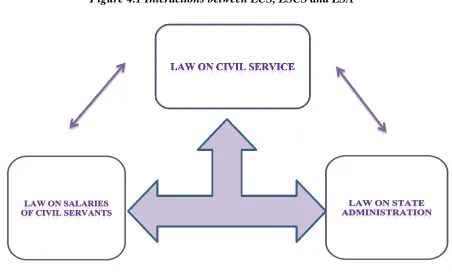
[image:31.612.84.536.374.652.2]The implementation of these three laws is depended on each other. LCS, LSCS and LSA will affect and will reflect between each other. The interaction of these laws is also apparent in related drafting and implementation of secondary legislation which derives from them (Figure 4.1).
30
4.1. Law on Civil Service in Kosovo
During 2009 the draft version of LCS passed in the government. For more than a year this draft law waited to be approved in Parliament. In May, 2010 it was approved by the Assembly, and promulgated by the Decree of the President of the Republic of Kosovo a month later. The sensibility, importance and impact of this Law on civil service structure and on financial aspects, ensured that Members of the Assembly took it into consideration very seriously. But SIGMA in its 2010 Report assessed that “… the draft Law on Civil Service
submitted by the government was subjected to more than 200 amendments (two amendments per
article on average). As a result, the risk of inconsistency is high.”24
In July 2010 when LCS passed, approximately 15 000 workers were defined civil servants, compared to approximately 75 000 employees who had this status based on UNMIK Regulation 2001/36. LCS does not apply to the teaching staff of education system, the medical staff of the health service, art creators and performers, police officers, custom officers, correctional officers, members of the Kosovo Security Force, political appointees, and all the persons appointed in positions by the political appointees, including cabinet of the president, President of the Assembly, Prime-Minister and Ministers cabinets.25
The LCS “... regulates the status of Civil Servants and the terms and conditions of their
employment relationship with the institutions of the central and municipal administrations.”26
In contrast with legislation in other countries, LCS in Kosovo gives a very important role to the process of job evaluation results due to the effects that produces. Effects are related to staff management, impact on career building and assessing the needs for capacity development. Article 34 of LCS defines that:
“1. The results of performance appraisal shall have influence and impacts to establish:
24 SIGMA, Assessment Kosovo under UNSCR 12441, 2010 Civil Service And Administrative Law
http://www.sigmaweb.org/dataoecd/20/62/47074769.pdf
25
Law on Civil Service, Article 4, categories of Public Employees excluded from the Civil Service, pp. 3
http://www.kuvendikosoves.org/common/docs/ligjet/2010-149-eng.pdf
26
Law on Civil Service, Article 1, purpose and scope, pp.1,
31
1.1. the need for training individual or groups of Civil Servants;
1.2. the eligibility of Civil Servants to career advancement;
1.3. the existence of conditions for conversion of probationary appointment or dismissal;
1.4. the existence of conditions for secondment to international assignments;
1.5. the existence of conditions for the concession of special leave entitlements;
1.6. the continuation or termination of employment of with the civil service.”27
The same Article of LCS, paragraph 4, states that the results of performance appraisals shall also be taken into account during the disciplinary procedures.
Based on this law two categories of civil servants will exists:
Positions of career civil servants, who will be in permanent functions
[image:33.612.71.545.346.651.2] Positions of non-career civil servants, who will work on temporary positions
Figure 4.2 Responsibilities of MPA based on LCS
27
Law on Civil Servants, Article 34, Influence and Impacts of Performance Appraisal Results,pp.17-18
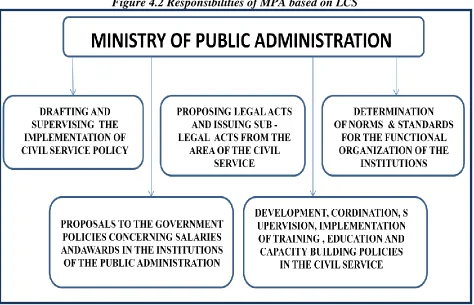
32 Based on LCS (Article 6, paragraph 2), MPA is the ministry in charge for several important competencies regarding civil service, which reflects Figure 4.2 (figure above). In this regard, concerns regarding the capacity of the MPA, in particular DCSA, are valid. Bases on OECD Assessment the DCSA “…is striving to increase its capacity, but it is still far from
having the required skills and resources needed to efficiently play its role as the central policy
and management capacity”.28
Allocated budget for MPA will be used related for administration of civil service. The budgetary costs related to LCS have impact only in the MPA budget. This law does not burden the Budget of Kosovo because the similar job is being done by the MPA. In the explanatory memorandum that the Government has attached to the Draft Law on Civil Service29 (on 2009), it is stated that the work of civil servants will be rewarded through the salary system (LSCS), the budgetary costs for LCS are destined only for administration of civil service costs (Additional costs Table 4.1)
Table 4.1 - MPA budget & additional costs for administration of civil service based on LCS
MPA 2010 2011 2012
Budget € 36.0 M
(US$ 46.0 M)
€ 32.0 M (US$ 43.0 M)
€ 21.0 M (US$ 28 M )
Additional costs € 37,200 (US$ 49,104)
€ 52,200 (US$ 68,904)
€ 45.352 (US$ 68,904)
Table 4.1 shows a decreasing MPA budget over a 2 year period (2010-2012). This is due to the shift in Government priorities. Another reason for the 2012 MPA budget being €10.0 M less than previous years is the transfer of the Statistical Office of Kosova from the MPA, to being an agency under OPM. Therefore, in 2012, the number of civil servants in MPA has fallen from 400 to 260.
28
Support for Improvement in Governance and Management, / A joint initiative of the OECD and the EU, principally financed by the EU/ Assessment Kosovo 2011 http://www.oecd.org/dataoecd/40/29/48970710.pdf
33
4.2. Law on Salaries of Civil Servants
The segment of civil servant salaries’ had been regulated by sub-legal acts, such as the Manual for Salary System and Promotion and Administrative Guide of MPS 2004/11 for setting the Grades in the Civil Service. The LSCS was approved by Assembly on the same day with LCS, because of interaction between these two laws.
The purpose of LSCS is “…is the establishment of a system and structure of salaries,
allowances and other remuneration for Civil Servants, as defined in the Law on the Civil Service
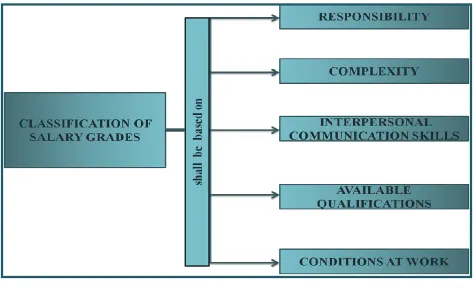
[image:35.612.70.544.379.669.2]of the Republic of Kosovo.”30 In order to define the basic salary, the LSCS (the same as LCS) confirm the categorization of civil service employees into four functional groups. It also classifies the positions and salary grades in one of the fourteen salary grades, through these four functional groups. Components for classification of salary grades are determined in the LSCS (figure 4.3)
Figure 4.3 Components for classification for salary grades according to LSCS
30
Law on Salaries of Civil Servants, Article 1, Purpose and Scope, pp.1,
34 The LSCS have budgetary impact on Kosovo budget, because of the salary system. Kosovo Budget for 2012 is €1.5 billion.31 / US$ 1.9 billion). In the explanatory memorandum attached to the LSCS 32 (on 2009), the additional budgetary costs for new salary system were 8, 719, 241 € (US$11, 509, 398) per year. Based on calculations in the LSCS explanatory memorandum for 2010, the additional costs for 2012 should be approximately € 12, 6 (US$ 16, 7)
This was calculated:
based on the number of civil servants
based on 14 salary grades;
[image:36.612.75.539.320.411.2] based on coefficient value
Table 4.2 - Numbers of civil servants and additional budgetary costs based on LSCS
Year Number of civil servants Additional budgetary costs (€ Million )
2010 14 746 (December, 2008) € 8,7 M
US$ 11, 5
2012 21 286 (October, 2011) € 12, 6
US$ 16, 7
4.3. Law on the State Administration
LSA is an important law among basic legal acts for organizational structure of public administration. “The purpose of this Law is providing a legal framework for the organization, cooperation and management of bodies exercising the executive power.”33
LSA defines the duties and nature of state administration, status and noncompliance of manifestation and political organization in state administration bodies. Organizational, functional and activity structure of state administration bodies are regulated by this law, which is not
3131 Ligji Nr. 04/L-079 Per Buxhetin e Republikes se Kosoves per vitin 2012
http://www.kuvendikosoves.org/common/docs/ligjet/Buxheti%202012.pdf
32
Vleresimi i Ndikimit Buxhetor ne Buxhetin e Kosoves ne Projektligjin per Pagat e Nepunesve Civil, BQ, nr. 91, 01.04.2009
33
Law on State Administration, Article 1, Purpose and Scope, pp.1,
35 applicable to the administration of the Assembly, of the President; of Constitutional Court; of the judiciary and of the prosecution service; of the independent institutions as specified in Chapter XII of the Constitution; of higher public education institution, of local administration of public enterprises. All these institutional categories of public administrations are regulated by relevant specific laws.
Article 70 of LSA, which states: “Changes of civil servants titles resulting from this Law shall be decided in accordance to the respective provisions of the Kosovo civil service
legislation”34 has also direct linkage with LCS and LSCS.
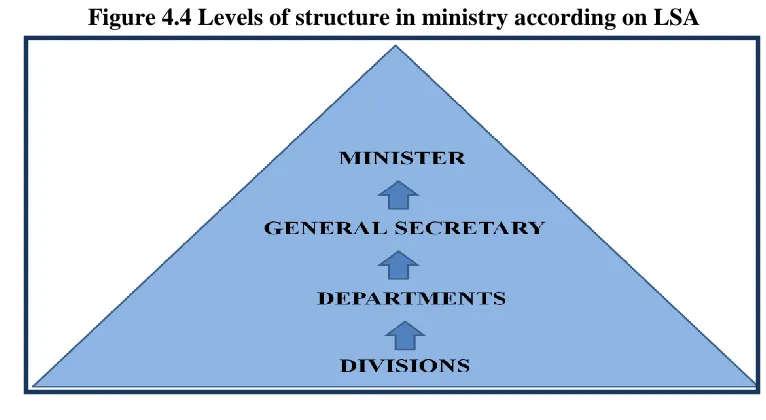
[image:37.612.109.492.464.674.2]This law provides the drafting of regulation on internal organization and systematization of job positions which should include organizational structure, definition of appropriate management levels, functions, and responsibilities; number and level of job positions; allocation of business within the organizational structure to job positions (including title and job description, substitution etc.); conditions for each job position; tasks of deputy ministers and political advisers and their relations with the civil service hierarchy in ministries; and organizational chart (all these components are mentioned within the law). Figure 4.4 below shows how the LSA specifies structure levels in ministries.
Figure 4.4 Levels of structure in ministry according on LSA
34 Law on State Administration, Article 70, pp.25,
36
Chapter 5
5. IMPORTANT COMPONENTS FOR IMPLEMENTATION OF LCS
5.1 Secondary legal acts – process of drafting is still continuing
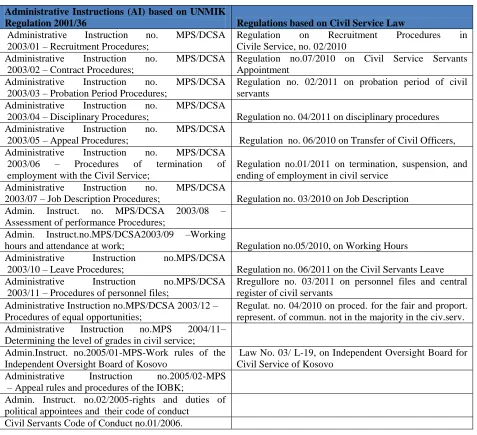
[image:38.612.70.547.274.709.2]The MPA, as the responsible institution for public administration, was in charge to draft secondary legal acts during the first year after the LCS was promulgated, on January 1st, 2011. Until now MPA has approved eleven Regulations. The process of drafting secondary legislation is still continuing.
Table 5.1 Administrative Instructions based on UNMIK Regulation & LCS Regulations
Administrative Instructions (AI) based on UNMIK
Regulation 2001/36 Regulations based on Civil Service Law
Administrative Instruction no. MPS/DCSA 2003/01 – Recruitment Procedures;
Regulation on Recruitment Procedures in
Civile Service, no. 02/2010 Administrative Instruction no. MPS/DCSA
2003/02 – Contract Procedures;
Regulation no.07/2010 on Civil Service Servants Appointment
Administrative Instruction no. MPS/DCSA 2003/03 – Probation Period Procedures;
Regulation no. 02/2011 on probation period of civil servants
Administrative Instruction no. MPS/DCSA
2003/04 – Disciplinary Procedures; Regulation no. 04/2011 on disciplinary procedures Administrative Instruction no. MPS/DCSA
2003/05 – Appeal Procedures; Regulation no. 06/2010 on Transfer of Civil Officers, Administrative Instruction no. MPS/DCSA
2003/06 – Procedures of termination of employment with the Civil Service;
Regulation no.01/2011 on termination, suspension, and ending of employment in civil service
Administrative Instruction no. MPS/DCSA
2003/07 – Job Description Procedures; Regulation no. 03/2010 on Job Description Admin. Instruct. no. MPS/DCSA 2003/08 –
Assessment of performance Procedures;
Admin. Instruct.no.MPS/DCSA2003/09 –Working
hours and attendance at work; Regulation no.05/2010, on Working Hours
Administrative Instruction no.MPS/DCSA
2003/10 – Leave Procedures; Regulation no. 06/2011 on the Civil Servants Leave
Administrative Instruction no.MPS/DCSA
2003/11 – Procedures of personnel files;
Rregullore no. 03/2011 on personnel files and central register of civil servants
Administrative Instruction no.MPS/DCSA 2003/12 – Procedures of equal opportunities;
Regulat. no. 04/2010 on proced. for the fair and proport. represent. of commun. not in the majority in the civ.serv. Administrative Instruction no.MPS 2004/11–
Determining the level of grades in civil service; Admin.Instruct. no.2005/01-MPS-Work rules of the Independent Oversight Board of Kosovo
Law No. 03/ L-19, on Independent Oversight Board for Civil Service of Kosovo
37 Currently being drafted are few regulations, which are important sub legal acts, not only for the implementation of LCS, but for the implementation of LSCS, as well. Table 5.1 lists Administrative Instructions based on UNMIK Regulation 2001/36, and Regulations based on LCS which are approved and automatically are changing relevant Administrative Instructions.
5.2. Classification of job positions
In May 2008, SIGMA in its assessment of Kosovo’s public service and the administrative framework concludes that “The Civil Service Law does not differentiate between civil servants
executing public authority powers and support staff. Despite the tasks assigned to the DCSA, the
civil service legislation provides for decentralized human resources management, i.e. every
institution provides job descriptions and classifications for the posts within the institution. The
absence of a general classification of positions in the public administration and the
inappropriate supervising mechanisms at central level make it possible for individual institutions
to invent new positions and new denominations, leading to an uncontrolled salary level. The
DCSA claims that all managerial positions have the same job classification, while admitting the
existence of problems with regard to executive positions. However, the situation and examples in
practice reveal distortions of the system.”19
Three years later nothing has changed regarding this issue. There are still a huge number of titles, which are ranged in the payroll system. Many times, because of different requests from institutions, the same title is repeated in the payroll list, increasing in this way the number of titles and number of job positions.
38 From the current total number of 862 titles in civil service in Kosovo, there are 67 titles which have the word “assistant” as a part of the job position title. The level of salary is different
even if the title is the same, in the same level of hierarchy of the institutions. From the total number of civil servants in central and local level, the percentage of civil servants that are covered under the title “assistant” is 7%, (Figure 5.1) or expressed with numbers from a total of
[image:40.612.110.502.208.366.2]21286 civil servants, 1464 are “assistants”.
Figure 5.1 Percentages of assistants, from the total number of civil servants
From the total number of civil servants in central and local level, the number of civil servants that are covered under the different nuances of title “officer (official)” is 5461, or 20 % from the
total number (Figure 5.2.). Number of titles to this category is 201. The problem with variation of the level of salaries is identical in the technical and logistic titles also, and less is reflected to the higher levels of civil service hierarchy.
Figure 5.2 Percentages of officers from the total number of civil servants
Percentage of total number of
civil servants 93 %
Percentage of titles which have
the word "assistant"as a part of job title
7 %
Total number of civil servants
80% Number of civil
servants under different nuances of title
[image:40.612.108.504.539.692.2]39 SIGMA (Support for Improvement in Governance and Management) assessment of May 2008 states about classification of the Civil Service in Kosovo: “Deep concern has been largely reported related to the inconsistency and unfairness of the classification system. Given this
situation, the development of an effective central management capacity and the creation of a
proper classification for the civil service should be given priority, before any salary reform.”35.
The World Bank's Strategy in Republic of Kosovo: 2010-2011emphasized that “The lack of a viable pay and grading structure and open-ended contracts (or, minimally, criteria for the
renewal of temporary contracts) introduced considerable discretion in pay and undermined
payroll controls. The wide pay differentials for similar positions in different civil service
organizations and the absence of a stable career structure have frustrated staff, and provided
little incentive to stay in the civil service.36
The Regulation on job classification will enable the categorization of workplaces across the functional categories defined in Article 23 of the LCS that deals with functional positions. This Regulation would have to explain criteria’s and procedures for classification of job positions and grades, in all levels of public administration, based on the LCS and LSCS. According to the LCS the employees will be divided into four functional categories (refer to LCS, Chapter IV, Article 23, Career development - civil service job classification).
Also, the Regulation on job classification should be based in the Law on civil servants' salaries, respectively, Article 6, which determines the classification of positions to salary grades in the civil service. Based on this article "the purpose of determining the base salary in the civil service positions are divided into four functional categories and classified into one of the
fourteen (14) salary grades." (LSCS, Article 6, Classification of Salary Grades Positions in Civil Service).
The reasons why job classification should be done are:
35
SIGMA - Kosovo Public Service And The Administrative Framework Assessment May 2008, pp. 8,
http://www.sigmaweb.org/dataoecd/48/31/41637624.pdf
36 The World Bank’s strategy in Republic of Kosovo: 2010-2011
40
-identification of responsibilities and clear objectives of each job position
-gives a clear view for designing strong and transparent salary system
-helps on managing of differences between job positions within an organization
-creates a level of comparing values between job positions
Based on this partition which determines LSCS, more specified classification could be done through these levels of classification, by ranging job positions based on general classification of their tasks and functions (Table 5.2 reflects general view of mentioned classification).
Table 5.2 Classification of Salary Grades Positions in Civil Service according to LSCS
FUNCIONING CATEGORIES OF CIVIL SERVANTS
Positions under the functioning
categories
Salary grade
civil servants of
senior-level
management
senior manager three (3)
senior manager two (2)
senior manager one (1)
Salary Grade one (1)
Salary Grade two (2)
Salary Grade three (3)
civil servants of
management level
manager four (4)
manager three (3)
manager two (2)
manager one (1)
Salary Grade four (4)
Salary Grade five (5)
Salary Grade six (6)
Salary Grade seven(7)
civil servants of
professional level
implementing and professional three (3)
implementing and professional two (2)
implementing and professional one (1)
Salary Grade eight (8)
Salary Grade nine (9)
Salary Grade ten (10)
civil servants of the
technical
-administrative level
administrative four (4)
administrative three (3)
administrative two (2)
administrative one (1)
Salary Grade eleven (11)
Salary Grade twelve (12)
Salary Grade thirteen (13)
41 The Regulation on Job classification will open the way for internal restructuring of departments in a horizontal line and systematization of job positions. This would enable departments to do job re-description, according to titles and responsibilities. Also this will be in accordance with the respective laws and other normative acts approved in recent years, which have changed in essence the axis of functioning of civil service, while transforming it from a system based on position, to a system of merit. Table 5.3 reflects possible general classifications of Job Positions in functional categories.
42
5.3. Job description component and Regulation on job description
Role and accountability of individuals within an institution is