Beyond WordsVol.2, No.1, May 2014 Widya Mandala Catholic University Surabaya Selecting Extensive Reading Materials
George M Jacobs
Abstract
This article offers guidance to teachers and students in selecting materials for extensive reading
(ER). First, the article explains characteristics of ER and reviews some of the potential gains for
students who do ER. Second, the article considers criteria for teachers to bear in mind when
selecting ER materials. Third, the article then suggests ways that teachers and students can find
ER materials. Fourth, guidance is provided to students for when they select what to read from
among the ER materials available to them. Finally, advice is given on integrating ER with course
textbooks.
Introduction
Understanding spoken and/or written communications in a language comprises an
essential path towards proficiency in that language (Ellis, 2005). “Comprehensible input”
(Krashen, 2011) is a well known term used as part of this concept, with the idea being that
learners build their language competence when they understand communications in the language.
Reading provides a means of obtaining such comprehensible input. To promote reading, many
approaches to language learning include what is called Extensive Reading (ER) (Day &
[image:3.612.75.539.340.713.2]Bamford, 1998; Extensive Reading Foundation, 2011; Jacobs & Farrell, 2012).
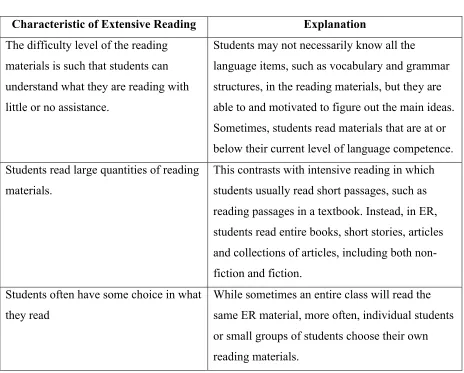
Table 1
Displays Characteristics of ER
Characteristic of Extensive Reading Explanation The difficulty level of the reading
materials is such that students can understand what they are reading with little or no assistance.
Students may not necessarily know all the
language items, such as vocabulary and grammar structures, in the reading materials, but they are able to and motivated to figure out the main ideas. Sometimes, students read materials that are at or below their current level of language competence. Students read large quantities of reading
materials.
This contrasts with intensive reading in which students usually read short passages, such as reading passages in a textbook. Instead, in ER, students read entire books, short stories, articles and collections of articles, including both non-fiction and non-fiction.
Students often have some choice in what they read
After students finish a book or other work, they may do activities, but these activities are designed to enhance thinking and enjoyment and promote further reading. Care is taken to avoid activities that may discourage reading.
Too often, post reading activities have
discouraged students from reading more. With ER, sometimes there may be no post reading task, other than encouragement to read more. In ER, when post reading tasks are used, they tend to be short and involve student in advertising to peers what they have read.
Research suggests that ER boosts overall language competence, including vocabulary,
grammar and spelling knowledge, reading skill, and writing ability, as well as overall knowledge
of the world (Krashen, 2011; Renandya, 2007). The remainder of this article first looks at
characteristics of ER materials. The next and longest part of the article provides ideas of how to
find such materials. Then the article offers guidance to students in selecting from among the ER
material available to them. The final section makes suggestions on how ER can be a well fitting
part of general courses on reading or on
Characteristics of Extensive Reading Materials
Appropriate reading materials constitute an essential foundation of any ER program.
Students need a large quantity of engaging, approachable, readily available materials if they are
to read extensively. This section of the article discusses some points to consider regarding the
type and quantity of ER materials.
Materials’ Reading Level
As suggested in Table 1 above, ER materials should most often be at students’
independent reading level. Reading level can be divided into three categories: frustrational,
instructional, and independent. Students find frustrational level materials too difficult to
materials can be difficult for students, but can become comprehensible with significant
assistance from teachers, peers, and other resources, such as online dictionaries.
Normally, students find ER materials to be at the third reading level: their independent
reading level. In other words, students can comprehend the materials with little or no outside
assistance. Students make such materials comprehensible by using clues, such as contextual
clues, and their knowledge of the content area. Furthermore, some language items need not be
understood in order to comprehend and enjoy a reading text.
Day and Bamford (1998) suggest that reading materials below students’ independent
level can also be suitable for ER. Reasons for the potential suitability of such easier materials
include:
a. Less challenging materials build students’ confidence. Students reading in a new
language may lack confidence.
b. When students understand the language of what they read, they can devote more
cognitive resources to other activities, such as considering how ideas and information in
the reading connect to their own lives.
c. Language challenge can be introduced to easier-to-read materials by adding additional
activities. For instance, during or after reading, students can take part in peer speaking
activities in which they discuss ideas from the reading in groups of two to four.
As stated above, an ER program needs materials at and perhaps below students’
independent reading levels. This becomes complicated because in every class, even in programs
that use streaming to group students according to language level, students in any one class will
probably be reading at somewhat different levels, and students’ levels are likely to rise as they
materials at their independent reading level. Students may turn away from reading if the
materials are too difficult.
As a side point, when students are keen on a topic, an author, or a particular book, they
will put in the effort necessary to comprehend materials above their independent reading level.
For instance, students can bring instructional level materials down to their independent level by
rereading or by consulting online dictionaries and peers. This leads to a second point about
characteristics of ER materials: interest level.
Interest Level
Students may hesitate to read unless they find materials that interest them. Two areas in
which students’ interests may diverge are topics and text types. As to topics, some students enjoy
reading about our fellow animals, while others enjoy materials about food, fantasy, Facebook, or
families. The list of interests is long and growing. In addition to topic, students also vary as to
the types of text they prefer to read. For instance, some students prefer mysteries, while others
are keen on adventure. Furthermore, students’ interests can change. Indeed, one role for teachers
and peers in an ER program involves introducing new topics and text types.
Several means exist for teachers to learn what students want to read. First, teachers can
observe what their students past and present read in various languages. Second, the International
Reading Association’s website offers lists of books popular among different age groups and their
teachers (International Reading Association, 2014). However, books enjoyed by first language
readers may be at the frustrational level of students of the same age reading in a second
language. Third, teachers can consult librarians. Last but not least, teachers can collaborate with
Ideas for Finding Extensive Reading Materials
For an ER program to succeed, students need materials that they are capable of reading
and want to read. Below are 16 ideas for finding such materials, in addition to the standard route
of schools and other educational institutions purchasing the materials. No doubt, readers of this
article and their students will have more ideas.
1. Online materials are becoming increasing available. These materials often come with
audio accompaniment. Unfortunately, any list of sources of online materials quickly goes
out of date. Consult colleagues, librarians, and students for the latest information. One
source is Extensive Reading Central (n.d.). Of course, online resources require reliable
hardware and internet connections.
2. Students can become keypals, i.e., internet friends, with students their age in other
locations. These locations can be other classrooms, schools, cities, or even countries.
Social networks offer a related source of reading materials. Of course, especially with
younger students, care must be taken, as the internet can be a dangerous place.
3. Former students can donate materials that they no longer want.
4. Similarly, graduating students can donate books as farewell gifts to the school and as a
way to leave a bit of themselves behind. They might also want to write a message to
future readers of the books and include their name in the books they donate. For example,
in their notes to future readers, graduating students could explain why the books meant
something special to them when they were younger.
5. Teaching and administrative staff can contribute books. Maybe after a thorough spring
Year Rule,” i.e., if they have not read a book in ten years, it is time to pass it on to
someone more likely to read it.
6. Students’ family members may have reading materials to donate. As with any donation
solicitation, it is important to specify the types of books requested; otherwise, many of
the donated books will not be appropriate to your students.
7. Old magazines, yearbooks, etc. can also become ER materials. Anything that students
might enjoy reading is fine.
8. Civic organizations, foundations, embassies and consulates, and companies are eager to
help education, and almost everyone agrees that reading is fundamental to education.
9. Teachers can exchange ER materials with colleagues. After one class has read many of
the books in one classroom’s collection, why not exchange some of all the books with
another class?
10. Subject files can be compiled with articles from newspapers and magazines. Such files
allow students to pursue their interest in particular topics. Students can help find and
bring in new articles for a particular file, and then can suggest new files on different
topics.
11. Second-hand book shops and families’ moving sales can be treasure troves of reading
materials.
12. Students can swap books with each other. To facilitate the swap, they can draw numbers
to decide who can choose which book or who swaps with who. If Student A receives a
book that Student B wants, Student A can bring the book for the next swap session. After
students read the book they received in the swap, they can give their reaction to the
Swapping can be a regular affair to encourage students to think ahead about which
books they might want to swap with classmates. A good time for swapping is just before
a school break, to help students gather reading materials to enjoy during the break.
13. Student writing, after it has been polished and suitably published, and teacher-written
materials tailored especially for students offer rich veins of ER materials.
14. Libraries and bookstores. For instance, some public libraries periodically have book
sales. What the public libraries in one town do is to invite teachers to shop one day before
the sale is open to the general public. That way, teachers have the best choices in order to
stock their class library. Bookstores often have special bargain sections with
reduced-price books.
15. Some bookstores will give students a tour – highlighting areas of the store of specific
interest to a particular class or to particular students - and a special discount after the tour.
Some students, even older students, have never been to a bookstore, may not know how
they are organized, and may not feel comfortable spending time reading and browsing.
16. On students’ birthdays, students and their families can donate books to the class library.
These can be a new or gently used, but they should be ones that students believe will be
enjoyed by classmates. Students whose birthday falls on a date when school is not in
session can donate on their “half birthday,” i.e., the day six months before their birthday.
Along the same lines, students or others can donate a book to honor:
a. a friend, relative, teacher (such as on the teacher’s birthday or a holiday.
b. a favorite author’s birthday, e.g., Roald Dahl.
If students cannot afford to purchase even a used book for the class library, some options
a. The students tell the teacher the title of a favorite book, and the teacher purchases it using
money from special funds, such as a budget for purchasing books or money from the
school’s Parent Teacher Association.
b. These students select from donated books, read a few, and then choose the one that will
have their name on it.
Helping Students Choose ER Materials Wisely
As noted in Table 1, normally, in ER, students choose their reading materials. The
following questions and suggestions guide students to choose well.
1. What types of books do you enjoy – fiction, non-fiction, comic books, encyclopedias,
joke books? Look for that type of book.
2. What topics do you enjoy? Look for more books on those topics.
3. Who are your 121avourite authors? Can you find more books by them?
4. What is a tv show, video game, or movie that you enjoy? Can you find books that are
connected to them?
5. Does the book have pictures, drawings, and other visuals? Do they help you understand
and enjoy the book? Are you comfortable reading a book that does not have many
visuals?
6. What length of book do you like to read?
7. What about the size of the print? Is it too big, too small, or just nice?
8. What books do your friends and other classmates enjoy?
9. What books do older students and adults say that they enjoyed when they were your age?
10. If you have already read a book, would you enjoy reading it again? Sometimes, you can
11. Spend about five minutes reading a book before you decide to choose it. Is the book
interesting? Is it understandable?
12. Try the “Five Finger Test.” Open the book to any page and start reading. Every time you
meet a word or term that you do not know, put a finger on that word. If you run out of
fingers on one hand before you finish the page, the book may be too difficult for you to
enjoy. To say the same thing another way, if there are five or more unknown words on a
page, you may want to wait a few months before you read that book.
13. It is okay to change your mind. Maybe after you have read a book for a while, you will
change your mind about it. Maybe when you are choosing books, you think you like a
particular book, but after reading it some more, you change your mind. That is okay. Stop
reading that book and start reading another. Therefore, choose more than one book. Then,
Incorporating Extensive Reading with Other Types of Reading
Once ER materials have been obtained and students know how to choose among the ER
materials on offer, finding time for ER becomes a key challenge. Courses dedicated solely to ER
do exist; however, more often ER is a component (sometimes an optional component) of an
overall course on reading or even a four skills (speaking, listening, reading, and writing) course.
The problem becomes finding time in the curriculum for ER. Brown (2009) listed some reasons
why administrators, teachers, students, and other stakeholders may be reluctant to set aside class
time for ER.
1. The positive effects of ER may not emerge on exams until after a year or more (Davis,
1995).
2. ER represents a move away from teacher-fronted direct instruction. Stakeholders may not
be comfortable with this (Renandya & Jacobs, 2002).
3. It can be difficult to monitor whether students are really reading the ER materials.
When considering the place of ER in the curriculum, a key point to understand involves
the interdependence of ER and IR (Intensive Reading). In IR, students read short passages,
seldom more than two to three pages and, in the case of less proficient students, often less than a
page. IR materials are at students’ instructional reading level, i.e., they need assistance provided
by teachers to understand the materials. (See Table 1 near the beginning of this article to
contrast these IR characteristics with the characteristics of ER.)
IR and ER fit together well for a few reasons. First, in IR, students receive explicit
instruction in reading skills, such as guessing meaning from context, understanding the roles of
topic sentences and headings, and self-questioning while reading. Second, IR can also be a time
enhancing the comprehensibility of materials that might otherwise have been too difficult for
students. At the same time, IR needs ER, because to really master skills and information learned
via explicit instruction, students need time for more natural language use (Ellis, 2005). Toward
this end, ER offers a range of topics and genres well beyond what any textbook can hope to do.
Furthermore, while textbooks are often seen as work, ER strives to be a more enjoyable path to
language competence.
Brown (2009) proposed ways that textbooks, a learning vehicle most often associated
with IR, can also foster ER. Below are some of his suggestions.
1. Textbooks can specifically recommend ER. Helgesen, Brown, and Mandeville (2004) is
one reading textbook which does that.
2. Textbooks can suggest generic post reading activities for ER, such as logs in which
students record information on and reactions to the books they have read.
3. Graded readers are books that are specifically written or simplified with language
learners in mind. Textbooks can promote specific graded readers relevant to topics in the
textbook. Excerpts from those graded readers can be included in the textbooks, along
with activities that go with the readers.
Returning to the links between IR and ER, additional suggestions for combining
textbooks and ER include:
1. As students learn conversational skills, such as asking for clarification, they can practice
those skills by discussing the ER they have done, e.g., students in groups of four taking
turns to tell each other about a book they have read (Jacobs & Gallo, 2002).
2. Similarly, as students learn writing skills, those skills can be practiced when writing
3. More and more ER books come with audio, which can be combined with reading in
various ways. (For more on Extensive Listening, join the Extensive Listening list at
https://groups.yahoo.com/neo/groups/extensivelistening/infoor see Renandya, 2012.)
4. Doing ER can be a sponge activity, i.e., something students do to soak up extra time near
the end of an activity, lesson, or day.
Conclusion
This article has explained characteristics of ER, discussed considerations in selecting ER
materials, offered ideas for finding appropriate materials, provided guidance to help students
choose wisely from amongst the available ER materials, and proposed means of incorporating
ER into courses on reading or overall language skills learning. Despite the strong support for ER
from research, theory, and many teachers’ and students’ successful personal experiences with
ER, ER programs do not always succeed. Teachers’ enthusiasm constitutes a key ingredient of
successful ER programs (Renandya & Jacobs, 2002). This article has described ways that
enthusiastic teachers can compile ER materials and guide students to select from and read these
materials. Perhaps equally important is teachers’ role as models of enthusiastic reading of
materials in whatever language, because as Nuttall (1989, p. 192) very aptly wrote, “Reading is
References
Brown, D. (2009). Why and how textbooks should encourage extensive reading. ELT Journal,
63(3), 238-245.
Davis, C. (1995). Extensive reading: An expensive extravagance? ELT Journal, 49(4), 329-336.
Day, R., & Bamford, J. (1998). Extensive reading in the second language classroom. Cambridge,
England: Cambridge University Press.
Ellis, R. (2005). Principles of instructed language learning. The Asian EFL Journal, 7(3), 9-24.
http://www.asian-efl-journal.com/September_2005_EBook_editions.pdf
Extensive Reading Central (n.d.). Library. Retrieved from http://www.er-central.com/library
Extensive Reading Foundation. (2011). Guide to extensive reading. Retrieved from
http://erfoundation.org/ERF_Guide.pdf
Helgesen, M., Brown, D., & Mandeville, T. (2004). English firsthand. Hong Kong, People’s
Republic of China: Longman.
International Reading Association. (2014). Choices reading lists. Retrieved from
http://www.reading.org/Resources/Booklists.aspx
Jacobs, G. M., & Farrell, T. S. C. (2012). Teachers sourcebook for extensive reading.Charlotte,
NC: Information Age Publishing.
Jacobs, G. M., & Gallo, P. (2002, February). Reading alone together: Enhancing extensive
reading via student-student cooperation in second-language instruction. Reading Online,
5(6). Retrieved from:
http://www.readingonline.org/articles/art_index.asp?HREF=jacobs/index.html
Nuttall, C. (1989). Teaching reading skills in a foreign language. Oxford, England: Heinemann
Educational Books.
Renandya, W. A. (2007). The power of extensive reading. RELC Journal, 38, 133-149.
Renandya, W. A. (2012, November). Materials and methods for extensive listening. Paper
presented at the TEFLIN conference, Surabaya, Indonesia. Retrieved from
https://www.academia.edu/2462863/Materials_and_Methods_for_Extensive_Listening
Renandya, W. A., & Jacobs, G. M. (2002). Extensive reading: Why aren't we all doing it? In J. C.
Richards & W. A. Renandya (Eds.), Methodology in language teaching: An anthology of
current practice (pp. 295-302). New York, NY: Cambridge University Press.
Robb, T., & Kano, M. (2013). Effective extensive reading outside the classroom: A large-scale
experiment.Reading in a Foreign Language, 25(2), 234-247. Retrieved