Small Cell Networks
Kan Zheng, Senior Member, IEEE∗, Xuemei Xin∗, Fei Liu∗, Wei Xiang, Senior Member, IEEE†, and Mischa Dohler Senior Member, IEEE‡
∗ Key Lab of Universal Wireless Communications, Ministry of Education
Beijing University of Posts & Telecommunications Beijing, 100088, China
† Faculty of Engineering and Surveying
University of Southern Queensland Toowoomba, QLD 4350, Australia
‡ Centre Tecnologic de Telecommunications de Catalunya (CTTC)
Barcelona, Spain, 08860
Abstract
With the advent of small cell networks (SCNs) to support growing wireless data volumes and thus reduced cell sizes, cooperative communications are significantly facilitated. Applicable to 3GPP LTE-A, we propose a novel channel/queue-aware user pairing and scheduling scheme in a cooperative virtual multiple-input multiple-output (VMIMO) system. The queueing performance of the VMIMO system with the scheduling scheme is analyzed based on the finite-state Markov model (FSMM), and compared with that of non-cooperative systems. Bounds on the average queuing delay of users are derived by using a semi-definite programming (SDP) approach. The presented analyses are validated through comparing the analytical and simulation results. It is found that the introduced VMIMO pairing process is able to significantly reduce service delays, bringing on a positive impact of cooperative techniques on next generation wireless systems.
I. INTRODUCTION
It is a challenging task for traditional cellular networks to meet increasing requirements on ubiquitous
wireless broadband coverage with high data rates. It is well known that cell-size reduction is the simplest
and most effective way to increase network capacity [1]. Towards this end, a new network design concept,
known as “small-cell networks (SCNs)”, is currently being investigated in the 3rd Generation Partnership
Project (3GPP) [2], which can provide cost-effective and energy-efficient solutions to future explosive
traffic growth. SCNs are based on the idea of a very dense deployment of self-organizing, low-cost,
low-power BSs. The idea of small cells is not entirely new. For example, these so-called small cells are
already complemented by picocells for coverage extension and local capacity enhancement. Moreover,
the recent launch of femtocells can be seen as the first step toward an unplanned deployment of
self-organizing SCNs. However, although as a promising concept, SCNs also lead to many new challenges and
opportunities to system design [3]. With a smaller cell size and closer proximity among user equipments
(UEs), some form of cooperation between UEs becomes more convenient and frequent.
Virtual multiple-input and multiple-output (VMIMO), as one form of cooperative communications
among UEs in uplink transmission, has been widely studied in the 3rd generation (3G) long-term evolution
(LTE) and other systems [4] [5]. Also, it is applicable in SCNs of LTE and its advanced embodiment
(LTE-A). Due to size limitation, it is difficult to deploy multiple transmit antennas in a portable UE, which
prevents spatial multiplexing from being directly applied in the uplink. By virtue of cooperative VMIMO
techniques, two or more UEs equipped with only a single antenna can be paired to transmit independent
data streams on the same frequency-time resource block (RB) simultaneously. Compared to traditional
MIMO, multi-user diversity is achieved in VMIMO through the user pairing and scheduling process. How
to select partner users to form a virtual MIMO is crucial for the system performance. Several pairing and
scheduling schemes have been proposed in recent years, which tend to strike a good trade-off between
throughput and fairness. In [6] and [7], the pairing algorithms based on the determinant of the equivalent
channel matrix are studied, which only consider the orthogonality of the channels between users. Then,
the signal-to-interference-plus-noise ratio (SINR)-based paring scheme is proposed [8], where two UEs
with a small difference in SINR are more likely to be paired. However, these schemes ignore user fairness
performance, single proportional-fairness (SPF) and double PF (DSF) schemes are proposed in [9] and
[10] at the expense of throughput loss. Furthermore, joint pairing and resource allocation schemes are
studied in [11] and [12], which can achieve a high throughput at the expense of computational complexity.
To the best of our knowledge, there has no pairing and scheduling scheme proposed to date in the
literature for VMIMO systems considering the effects of the queue status. Existing schemes only take
into account channel conditions but ignore the queue status, which inevitably causes the waste of wireless
resources. Resources are allocated to the users with best channel conditions that may not always have
data to transmit, and thus the allocated resources may not be truly utilized. On the other hand, other
users whose queues are not empty cannot exploit the resources. Therefore, in order to solve this problem,
the scheduler has to take into account not only the channel conditions but the queue states. In other
words, only the users whose queue is not empty are allowed to compete for the resources, while others
are not allocated any resource even under a good channel condition. Towards this end, we propose a
channel/queue-aware scheduling scheme, which selects the user pair and allocates resources based upon
not only the channel state but the queue state of the users. In our proposed scheme, the first user is
selected among the users with a non-empty queue using the round-robin (RR) criterion. In the second
step, this user can transmit its data with or without forming a VMIMO system, which is determined by
the scheduling in accordance with the channel environments and queue states. For the sake of analysis,
the objective of maximizing the channel capacity is chosen for the second step.
Previous pairing and scheduling schemes focus only on the throughput performance. Due to the dynamic
queue status of the system with finite buffer services, the queueing performance becomes very important
as well as the throughput performance. However, since the pairing process may affect the service rate
of the system, the analysis of the queueing performance of a VMIMO system is fairly difficult, which
has not yet been investigated in the literature. The finite-state Markov channel (FSMC) model has been
widely used for modeling wireless channels [13] [14]. A wide range of FSMC applications in performance
evaluation of wireless networks can be found in the literature, e.g., [15] [16]. This paper adopts the
finite-state Markov model (FSMM) to reflect the service rate of the single-input multiple-output (SIMO) and
VMIMO channels. After calculating the average service rate of users under a specific queue state, bounds
BS
UE 2
UE 3 SIMO
VMIMO
UE N
UE 1
(a) System Model
SIMO
UE N 2 1
Q1 …
SIMO
2 1 Q3 …
1 λ
3 λ
VMIMO
N
λ 2 λ
3 2
QN … 1
1 Q2 …
UE 1
UE 2
UE 3
…
[image:4.612.109.518.57.215.2](b) Queue Model
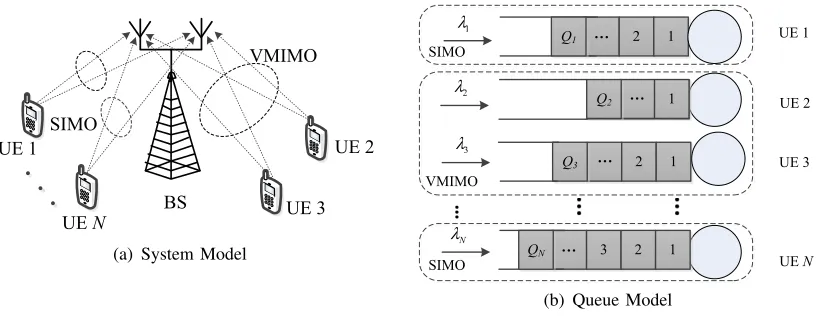
Fig. 1. Illustration of a VMIMO system.
The major contributions of this paper are summarized in the following:
1) A channel/queue-aware pairing and scheduling scheme is proposed, where only the users with a
non-empty queue have the opportunity to be scheduled;
2) We propose a method to analyze the queueing performance of a VMIMO system and apply it to
study the maximal capacity pairing scheme. To the best of our knowledge, prior to this paper, no
good approximation is available for the queueing performance of the VMIMO system; and
3) Analytical bounds for the VMIMO system are derived and validated by means of computer
simu-lations.
The remainder of this paper is organized as follows. In Section II, the flow-level model is formulated for
the purpose of analysis. In Section III, a channel/queue pairing and scheduling scheme is first proposed,
then the analytical method of the VMIMO system is introduced based on the FSMM model. In Section
IV, numerical and simulation results are presented, compared and discussed. Finally, concluding remarks
are drawn in Section V.
II. FORMULATION OF FLOW-LEVELMODEL
A. System Model
Consider an uplink system comprisingN independent UEs, each having one transmit antenna, and a BS
equipped with NR ≤N receive antennas. The BS is assumed to know the ideal channel state information
at the BS, each UE establishes transmission linkages with the BS either independently or cooperatively
through VMIMO, depending on the channel environment and employed scheduling schemes.
If no user is necessary to be paired for transmission, only a single UE, e.g., the nth UE, is scheduled on
a given time-frequency resource block. Then, after passing through a 1×NR SIMO channel, the received
signal at the BS can be expressed as
y′n =√Pnρnhnxn+z= [y′1,n, y2′,n,· · ·, yNR,n′ ]
T ∈CNR×1,1≤n ≤N, (1)
where xn represents the transmitted signal from the nth UE with the transmit power of Pn, ρn denotes
the joint path loss and shadow fading of the nth UE, hn = [h1,n, h2,n,· · · , hNR,n]
T ∈CNR×1 denotes the
complex fading channel vector from thenth UE to the BS, andz= [z1, z2,· · · , zNR]
T ∈CNR×1is modeled
as zero-mean additive white Gaussian noise (AWGN) with the covariance matrix of σNI. The channel
gains between the users’ and BS’s antennas are assumed to be independent, identically distributed (i.i.d.)
Rayleigh fading, i.e., hm,n∼ CN(0, σ2)1, 1≤m≤NR,1≤n≤N, with σ2 =E[|hm,n|2]. For simplicity,
the transmit power is assumed to the same for all the UEs and normalized to one, i.e.,Pn = 1,1≤n≤N.
If the scheduler at the BS choosesK amongN users to share the same time-frequency resource blocks,
a K×NR VMIMO system is constructed. Without loss of generality, the first K UEs are assumed to be
paired. Then, the signal received by the BS can be expressed by
y=√PGhx+z= [y1, y2,· · · , yNR]T ∈CNR×1, (2)
where x = [x1, x2,· · · , xK]T ∈ CK×1 represents the transmitted signals from K different users, the
diagonal matrix P =diag{P1, P2, ..., PK} =IK and G =diag{ρ1, ρ2,· · · , ρK} of K-dimension denote
the transmit power and the path loss/shadow fading of different users, respectively, and the channel matrix
can be represented by
h=[ h1 · · · hK
]
=
h1,1 · · · h1,K
..
. . .. ... hNR,1 · · · hNR,K
∈CNR×K.
(3)
At the BS, coherent detection is employed to recover the transmit signal. Different schemes can be
used depending on the transmission methods. In the case of SIMO transmission, the signals received at
different antennas as shown in (1) are combined with the maximal ratio combining (MRC) principle as
follows
ˆ
xn= NR
∑
m=1
ωmym,n′ = NR
∑
m=1
h∗m,nym,n′ =xnρn NR
∑
m=1
|hm,n|2+ NR
∑
m=1
h∗m,nzm, (4)
where ωm =h∗m,n is the MRC weight for the mth branch. Then, the resultant signal-to-noise ratio (SNR)
after MRC is simply the sum of the SNRs of each received antenna, i.e.,
γnSIM O =
NR
∑
m=1
γm,nSISO, (5)
where γSISO
m,n =ρ2n|hm,n|2/σ2N is the SNR of the mth received antenna.
If VMIMO transmission is adopted, the zero-forcing (ZF) receiver is used to detect the users’ signals.
The equalized signal is given by
˜
x=wZFy=Gx+ (hHh)−1hHz, (6)
where wZF is the linear detection weight vector defined as
wZF = (hHh)−1hH. (7)
Thus, the post-processing SNR corresponding to the signal transmitted by thekth antenna, i.e., the antenna
of the kth UE, can be calculated as [17]
γkVMIMO= ρ
2
k
σ2
N(hHh)−
1
k
,1≤k ≤K, (8)
where (A)−k1 represents the kth diagonal element of the inverse of A.
For illustrative purposes, our study focuses on the scenario with NR= 2, i.e., the BS is equipped with
two antennas. Meanwhile, only two users are scheduled on the same resource blocks, i.e., K = 2. It is
noted that such a configuration is consistent with many practical application scenarios [18].
B. Channel Rate Process Model
The finite-state Markov channel model has been widely adopted as an effective model for characterizing
wireless fading channels. By partitioning the range of the capacity into a finite number of intervals, an
FSMM for the channel capacity can be constructed as shown in 2. Since the channel capacity achieved
State 1
State 2
State 3
……State
L
Fig. 2. Illustration of Channel Rate Process Model.
modes. For the implementation of scheduling, the same number of capacity states is used with the same
set of capacity thresholds. However, due to the different features of the received SNRs with either SIMO
or VMIMO, the capacity state probabilities of the two FSMMs are different, which will be discussed in
the following. On the other hand, the transition probability of the FSMM is not needed for our analyses
so that they are not presented in this paper.
1) SIMO channel: Under the FSMM, at any timet, the SIMO channel of a user is described by a set
of capacity states Sˆ={ˆs1,sˆ2,· · · ,sˆL}, where Ldenotes the number of capacity states of the underlying
fading channel. Let Λl, l∈ {1, . . . , L+ 1}, be the capacity threshold between the lth and (l+ 1)th states
of the Markov model for the user. These threshold values are in increasing order with ΛL+1 =∞. The
SIMO channel is in state sˆl if the instantaneous capacity is between Λl and Λl+1. Corresponding to each
state sˆl, l ∈ {1,2,· · · , L}, we denote by rl the service rate of the channel serving workload depending
on the wireless channel condition. The rate set, corresponding to L states of the channel, is denoted by
V ={r1, r2,· · · , rL}. By convention, the service rate in the worst channel state is set to zero, i.e., r1 = 0.
The stationary probability of the FSMM for the SIMO channel capacity can be defined as follows
ˆ
πn(l) =P{Sˆt = ˆsl},1≤n≤N,1≤l≤L. (9)
According to Shannon’s capacity theorem, the normalized capacity of the SIMO channel for the nth
user is given by
Cn = log2
(
1 +γnSIMO), (10)
which is a monotonically increasing function of γSIMO
n . The probability that the channel capacity state in
state ˆsl is determined by the SNR distribution of the SIMO channel, which is given as follows [19]
fS(γ) =
1 ¯
γm
e−γ/¯γ
(n−1)!γ
where γ¯ is the average SNR and m = max{NR, K}. Specially, when NR= 2 and K = 1, the stationary
probability of the FSMM for the SIMO channel capacity of the nth user can be calculated by
ˆ
πn(l) =
∫ Γl+1
Γl
fS
(
γnSIMO)dγnSIMO (12)
=
(
1− Γl+1 ¯
γn
)
e−
Γl+1 ¯
γn −
(
1− Γl ¯ γn ) e− Γl ¯ γn,
where Γl = 2Λl−1 is the SNR threshold corresponding to the capacity threshold for the state partition.
2) VMIMO channel: Besides the SIMO channel, an FSMM is constructed for the VMIMO channel
capacity when users are paired for transmission, i.e.,S ={s1, s2,· · · , sL}with the same capacity threshold
of Λl, l ∈ {1, . . . , L+ 1} and the rate set of V ={r1, r2,· · · , rL}.
The associated SNR γkVMIMO has been shown to be a chi-square random variable with 2(NR−K+ 1)
degrees of freedom [20]. The cumulative distribution function (CDF) ofγkVMIMO∼χ2(NR−K+ 1), with
variance 1/2 for the participating Gaussian random variables, is
F (γkVMIMO)= 1−e−γkVMIMO/¯γk
NR∑−K+1
i=1 ( γVMIMO k / ¯
γk)i−1
(i−1)! . (13)
Specially, when two UEs, i.e., UE iand UE j, are paired to form a VMIMO system with two received
antennas at the BS, i.e., NR =K = 2, the probability distribution function of γkVMIMO can be derived as
g(γkVMIMO) = 1 ¯
γk exp
(
−γkVMIMO
¯
γk
)
, k=i, j. (14)
The BS can calculate the corresponding VMIMO channel capacity as
Ci,j = log2(1 +γiVMIMO) + log2(1 +γjVMIMO). (15)
Then, its CDF can be computed by
fV (c) =
1 ¯
γi¯γj (ln 2) 2
2ce
1 ¯
γi+
1 ¯ γj c ∫ 0 e 1 ¯
γi2 x+1
¯
γj2 c−x
dx. (16)
The stationary probability of the FSMM for the VMIMO channel capacity can be computed as
πi,j(l) =P {St=sl}=
Λ∫l+1
Λl
fV (c)dc=
1 ¯
γiγ¯j (ln 2)
2 e 1 ¯ γ i +1 ¯ γ j
Λ∫l+1
Λl 2c c ∫ 0 e 1 ¯ γ i
2x+1 ¯
γ j
2c−x
……
( )
2n
N t
……
( )
1n
N t
1
t
2
[image:9.612.127.499.59.175.2]t
Fig. 3. Illustration of the Dynamic Flow with the Poisson distribution.
C. Dynamic Flow Model
In this paper, we focus on the performance at the flow level in a dynamic setting with random finite-size
service demands. A dynamic flow model with elastic traffic is assumed, where a new flow arrives at the
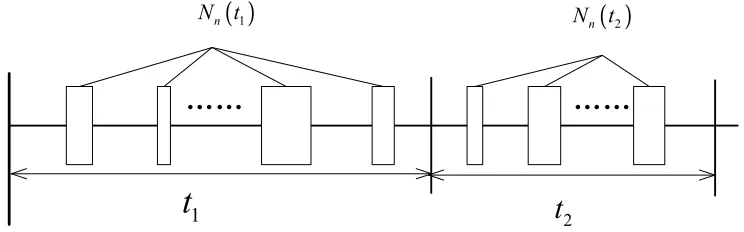
system with a finite-length file request, and leaves the system after the file is transmitted. As shown in
Fig. 3, the flow of user n arriving at the network follows a Poisson distribution with an average arrival
rate of λn. The number of arrivals Nn(t) of user n in a finite interval of length t obeys the Poisson
distribution, i.e.,
P {Nn(t) = m}=
(λnt)m
m! e
−λnt. (18)
The exponential flow sizes are independent and identically distributed, which can be expressed as
P {Fn≤a}= 1−e−a/
¯
Fn, (19)
where Fn is the file length of user n, and F¯n= E[Fn] is the mean size of the flow for user n. The flows
are served with a first-come first-serve (FCFS) policy at each link. Each UE is assumed to start a new
transmission only after the old one is finished, and each new transmission by the same UE is treated
as a new flow. After a flow is sent over, it is cleared off from the user queue, and the queue length is
decreased by one. Let Q(τ) = {Qn(τ), n= 1,2, ..., N} be the queue length of every user at time τ,
and Θ(τ) = {Θn(τ), n= 1,2, ..., N} denotes the queue status, where Θn(τ) can take only on values
of 0 or 1 with Θn(τ) = 1 indicating that the queue of user n is not empty. Note that Θ(τ) can take
2N possible values. Q
n(τ) as well as Θn(τ) depend on both the packet arrival process and the different
scheduling strategy at time τ. When user n is scheduled, the queue length of user n is decreased. The
TABLE I
SUMMARY OF MAIN ABBREVIATION AND SYMBOLS
Acronym/Symbol Definition
VMIMO Virtual multiple-input multiple-output
SIMO Single-input multiple-output
AWGN Additive white Gaussian noise
MRC The maximal ratio combining
ZF Zero-forcing
FSMM the finite-state Markov model
N The number of UEs in the uplink system
NR The number of receive antennas of the BS
K The number of UEs chosen to construct VMIMO
L The number of capacity states of underlying fading channel
xn The transmitted signals from thenth UE
ρn The joint path loss and shadow fading of the nth UE
Pn The transmit power of thenth UE
γnSIMO The sum of the SNRs of each received antenna corresponding to thenth UE γSISOm,n The SNR of themth received antenna corresponding to thenth UE
γkVMIMO The post-processing SNR corresponding to the signal transmitted by the antenna of thekth UE Cn The normalized capacity of the SIMO channel for thenth UE
Ci,j The corresponding VMIMO channel capacity for theith and thejth UE
ˆ
sl Thelth capacity state of the FSMM model of the SIMO and VMIMO channel
Λl The capacity threshold between thelth and(l+ 1)th states of the FSMM model of the SIMO and VMIMO channel
rl The service rate of the channel serving workload depending on the wireless channel
Qn(τ) The queue length of thenth UE at timeτ
Θn(τ) The queue status(empty or non-empty) of thenth UE at timeτ
ˆ
π(nl) The stationary probability that the SIMO channel capacity state of thenth UE is in thelth state
π(i,jl) The stationary probability that the corresponding VMIMO channel capacity state of theith and thejth UE is in thelth state
As a large number of acronyms and symbols are used in this paper, Table I lists the important ones.
III. A CHANNEL/QUEUE-AWARESCHEDULINGSCHEME
The proposed scheduling scheme can accommodate time-varying channel environments due to fast
fading and physical locations of different users, and select proper users in consideration of their channel
conditions. Considering the balance between resource efficiency and communication reliability, the
sched-uler can assign resources to UEs to establish communication either by being paired with each other or
by directly communicating with the BS. Besides considering the channel environment, the queue states
A. Maximize Capacity Pairing and Scheduling (MCPS) Scheme
The essential idea is to narrow the scheduling space of the users, allocating resources to the users who
have data to transmit rather than all the users in the system. For example, under the specific queue case
of Θ(τ), when
N
∑
i=1
Θi(τ) =Nq(τ), the scheduling decision is only made among the Nq(τ) users instead
of N users. Therefore, the opportunity that the users with a non-empty queue are scheduled is increased.
There are two steps in the scheduling scheme. In the first step, all the RBs are assigned to all the UEs
by the RR criterion. In other words, any one of the UEs is selected among the N users by RR as the
primary user to occupy one of the RBs. Usually, the number of RBs is larger than that of the users. For
example, in the case of 5 MHz bandwidth, the LTE system has 25 RBs, whilst there are usually only 1˜5
UEs in a cell in small cell networks. Thus, each UE can be a primary user occupying at least one RB.
Without loss of generality, let us take UE 1 as an example for the the purpose of elaboration. In the second
step, according to a specific objective or principle, the scheduler decides whether UE 1 solely occupies
this RB for SIMO transmission or shares it with a secondary user with a non-empty queue to form a
VMIMO system. In other words, as the primary user, UE 1 has two possible ways to transmit its data on
this allocated RB, i.e., SIMO and VMIMO. On the other hand, it is possible that UE 1 may be paired
with other UEs as a secondary user of a VMIMO system on this RB when other UEs are scheduled with
the RR criterion. Different pairing schemes lead to different probabilities of these three types of events.
In the following, we propose the maximizing capacity pairing and scheduling (MCPS) scheme, which
always chooses the user or a pair of users with the largest capacity for transmission, or equivalently, the
best transmission data rate is guaranteed in every scheduling instant.
At the beginning, the index of the UE that may be paired with UE 1 can be found after exhaustive
search, i.e.,
j∗ = arg max
j=2,3,···,N;Θj(τ)=1
C1,j. (20)
Then, the capacities of SIMO and VMIMO transmissions are compared in order to choose the suitable
transmission mode, where the one with larger capacity is selected. For VMIMO transmission, the channel
it equals the capacity of the SIMO channel between UE 1 and the BS, i.e.,
η1 =
{
ρ1,jC1,j, for VMIMO
C1, otherwise
(21)
where ρ1,j = log2(1 +γ1VMIMO)/{log2(1 +γ1VMIMO) + log2(1 +γjVMIMO)}.
Evidently, as shown in (20), the dimension of such a user pair subset isNq(τ). Consequently, the search
complexity can be significantly reduced if the number of UEs to be possibly paired is reduced, e.g., set
the SNR threshold before pairing.
B. Performance Analysis
Since the instantaneous transmission rate of a flow varies with time due to channel fading, its delay
and throughput performances are difficult to analyze. However, assuming that channel fading is much
faster than the flow number variation speed, the rate fluctuation of a flow is “averaged out” during its
transmission period, and the flow transmission rate can be approximated by a deterministic value [15].
Moreover, the deterministic transmission rate of a flow varies with the number of flows in the system,
due to the scheduling gain of the opportunistic scheduler. It is stated in [15] that if an opportunistic
scheduler can ensure fair resource sharing in the OFDM system, its queueing behavior can be analyzed
by a processor-sharing (PS) model, where the service rate of each flow varies with the number of flows
(states) in the system. Obviously, the queueing model of the RR scheduler can be represented by a PS
queue with a constant unit service rate. Then, the system can be formulated as a PS model with the
average arrival rate vector {λn, n = 1, . . . , N}. Each flow shares a 1/Nq(τ) fraction of the total service
rate at time τ.
Without loss of generality, let us take UE 1 as an example to analyze the the effective throughput
performance in a VMIMO system by using the FSMM. The MCPS algorithm may assign the resources
to either SIMO or VMIMO transmission under the following three cases:
• Case 1: Only when its SIMO channel capacity is larger than its VMIMO counterpart with any of all
the possible pairs among UEs with non-empty queues, i.e., C1 > C1,j, j = 2,3,· · · , N,Θj(τ) = 1,
UE 1 will not be paired with other UEs but transmits its data solely using the assigned RB;
C1, j∗ = arg max
j=2,3,...,N, Θj(τ)=1
C1,j, UE 1 will be paired as the primary user with the UE with the
maximum VMIMO channel capacity; and
• Case 3: UE 1 may also be paired as a secondary user with UE i as the primary user when the
capacity of the VMIMO channel between UE 1 and UE iis larger than that of others, i.e., Ci,1 > Ci
and Ci,1 > Ci,j, j = 2,3,· · · , N, i̸=j,Θj(τ) = 1.
Under the condition that UE 1 is in the given channel state of either sˆk for SIMO or sk for VMIMO,
the probabilities of these three cases can be computed as follows
α1(k) = P{C1 > C1,j, j = 2,3,· · · , N,Θj(τ) = 1|Sˆ= ˆsk} (22)
=
N
∏
j=2,Θj(τ)=1
(k−1 ∑
l=1 π1(l,j)
)
β1(k,j) = P{C1,j∗ > C1, j∗ = arg max
j=2,3,...,N, Θj(τ)=1
C1,j|S =sk} (23)
=
(k−1 ∑
l=1 π1(l)
) N
∏
n=2,n̸=j,Θn(τ)=1
(k−1 ∑
l=1 π(1l,n)
)
θi,(k1) = P{Ci,1 > Ci, Ci,1 > Ci,j, j = 2,3,· · · , N, i̸=j,Θj(τ) = 1|S =sk} (24)
= P{Ci,1 > Ci|S =sk}P{Ci,1 > Ci,j, j = 2,3,· · · , N, i̸=j,Θj(τ) = 1|S =sk}
=
(k−1 ∑
l=1 π(il)
) N
∏
n=2,n̸=i,Θn(τ)=1
(k−1 ∑
l=1 π(i,nl)
)
.
Correspondingly, the transmission rates under the three cases are rk, ρ1,jrk and ρ1,irk, respectively.
Therefore, under the specific queue case of Θ(τ), the average service rate for UE 1 can be computed by
µΘ(1 τ) = 1
Nq(τ) ¯F L
∑
k=1
(ˆπ(1k)α(1k)rk+ N
∑
j=2,Θj(τ)=1
π1(k,j)β1(k,j)ρ1,jrk+ N
∑
i=2,Θi(τ)=1
πi,(k1)θ(i,k1)ρ1,irk). (25)
Then, the average service rate for other UEs, i.e., µΘ(n τ), n= 2,3,· · · , N, can also be calculated by using
this method. The service rate of the queue depends on the subset of queue states in the system with a
non-empty length, where the number of possible subsets is 2N.
Next, bounds of the queue length in the VMIMO system can be obtained by a semi-definite
programming-based approach. These bounds can be made progressively tight at the expense of the computational
complexity of the associated semi-definite program. The queueing system is assumed to be stable with
as a continuous-time Markov chain with the service rate calculated above. The continuous-time Markov
chain can be uniformized because it is bounded by ξ = ∑Nn=1λn+N µ∗. The state of the uniformized
discrete-time Markov chain at time τ is denoted by Q(τ) = {Qn(τ), n = 1,2,· · · , N}, where Qn(τ) is
the queue length of UE n at time τ. As mentioned before, Θ(τ) is the states of the queues of all UEs.
The transition probabilities for the uniformized Markov chain are given below
P{Arrival into queue n} = λn
ξ , n= 1,2,· · · , N, (26)
P{Departure from queue n} = µ
Θ(τ)
n εn
ξ , n= 1,2,· · · , N,
P{No change in state} = 1−
∑N
n=1(λn+µ Θ(τ)
n εn)
ξ
where εn is equal to one only if Θn(τ) = 1, or it is zero.
This uniformized Markov chain has the same steady state queue length distribution as the original one.
Its evolution can be represented by the following stochastic recursion
Q(k+ 1) =Q(k) +X(k), k= 0,1,· · · , (27)
where X(k) = {Xn(k), n = 1,2,· · · , N} is the increment of the queue length. X(k) = 1 represents an
arrival into queue n at iteration k, whereas X(k) = −1 indicates departure. Moreover, X(k) = 0 if the
transition corresponds to a self-loop. It is clear that the distribution of X(k) is dependent on Θ(k) and
Q(k).
After obtaining the transition probabilities of the uniformized Markov chain, the moments ofX(k) can
be calculated. Then, the lower and upper bounds of the average queue length of each user, denoted by
¯
Qn, can be solved by using a semi-definite programming approach developed in [21]. Next, the average
queuing delay of each user is derived using Little’s Law, i.e.,
¯
ϕn = ¯Qn/λn, n = 1,2,· · ·, N. (28)
Also, the average user throughput can be calculated by
C. Computational Complexity and Overhead
The computational complexity of the proposed scheduling scheme is due mainly to not only SNR
estimation but also exhaustive search. According to (5) and (8) for SNR estimation, the addition and
multiplication operations can be omitted in comparison with the operations for the multiplication and
the inverse of the channel matrix in (8), which depends on the matrix dimension, i.e., O(K2NR) and
O(min(K, NR)3) respectively. For the exhaustive search shown in (20), the number of comparisons is
determined by the number of users with a non-empty queue, i.e., Nq. SNR estimation has to be carried out
for each comparison. Therefore, the total computational complexity isO(min(K, NR)3Nq)+O(K2NRNq).
All the control is done by the network. That is, resource allocation for both uplink and downlink, user
paring and transmission mode selection (VMIMO or SIMO) is controlled by the BS. At each transmission
time, the eNB informs UE of resource allocation on uplink via the control channel. It is not necessary for
a UE to know what the transmission mode is, i.e., VMIMO or SIMO. Since the BS made the scheduling
decision, it know how to detect the received signals from UEs by which transmission mode. Therefore,
there is no additional signaling overhead necessary for feedback in the case of the scheduling with paring
compared to the traditional method without paring.
IV. NUMERICAL AND SIMULATIONRESULTS
In this section, the queueing performance of the VMIMO-based multi-user wireless network is evaluated
through numerical methods as well as Monte Carlo simulations. Main parameters and configurations of
the network in our simulations are listed in Table II. Due to the constraint of computational complexity,
only a single cell is considered, where the receive antennas in the BS is assumed to be two and the
transmit antennas of the UEs is 1. ZF detection is employed on the uplink of VMIMO transmission.
For simplicity, a periodical source with the same process is assumed for each user. The flows arriving
to the network follow a Poisson process with the same average arrival rate, i.e., λn, n = 1,2,· · ·, N, and
the mean size of the flows is set to F¯n= 1 Mbits.
Our simulation program is built up on the MATLAB platform. Each user has its buffer, where the arrival
TABLE II SIMULATION PARAMETERS
Parameter Value
Carrier frequency 2 GHz Bandwidth 5 MHz Time slot 1 ms
Antenna configuration UE:1 Tx BS:2 Rx Channel model Rayleigh fading UE transmit power 20 dBm for 5 MHz Arrival process Poisson
VMIMO detection ZF
TABLE III
AVERAGE SERVICE RATE UNDER THE GIVEN QUEUE STATES(3 UES)
Queue State Service Rate (Mbps)
UE1 UE2 UE3 UE1 UE2 UE3
1 0 0 18.738 0 0
0 1 0 0 23.356 0
0 0 1 0 0 28.14
1 1 0 13.25 18.479 0
0 1 1 12.815 0 23.244
1 0 1 0 17.256 22.539
1 1 1 8.625 13.202 19.147
to users according to the adopted channel sharing scheme. After scheduling, the number of the packets in
each user’s buffer is counted to analyze the backlog performance. Meanwhile, the sojourn time of each
packet in the buffer is recorded when the packet is transmitted. The queueing time of the ith flow in the
queue of UE n is denoted by Tn,i , which is the duration from its arrival at the queue to the departure
after being served. Then, the average delay of UE n can be collected as the mean sojourn time of all its
flows, i.e. ,
¯
ϕ′n =
∑NF i=1Tn,i
NF
, n= 1,2,· · · , N, (30)
where NF is the number of flows with the Poisson distribution arriving at the queue of UE n during
simulations.
For the purpose of elaboration, the simple case of 3 UEs is first studied, where the average received
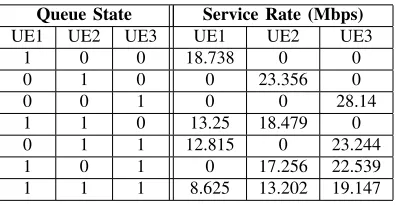
SNRs areγ¯1 = 9dB, ¯γ2 = 12dB, and γ¯3 = 15dB. The queue-state-dependent service rates of all the UEs
are calculated and shown in Table III. Each UE can be served by different rates according to its channel
environment only when its queue is not empty. If only one of the UEs has data in its queue, the radio
resources are dedicated to the UE with a high service rate with SIMO transmission. When more than one
2 3 4 5 6 0.04
0.06 0.08 0.1 0.12 0.14 0.16 0.18 0.2
D
e
l
a
y
(
s
)
Bound Simulation
UE 1 (9dB)
UE 2 (12dB)
UE 3 (15dB)
[image:17.612.138.457.81.329.2](1/s)
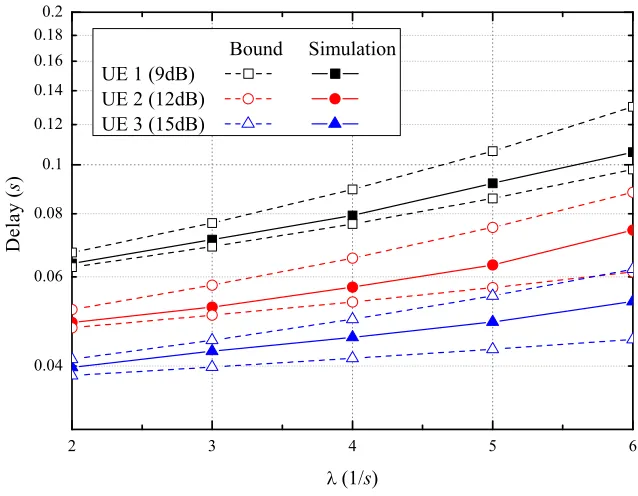
Fig. 4. Comparison of simulation results and analytical bounds for a VMIMO system (3 UEs).
although the service rate of an individual UE is not the highest from its own point of view, the sum of
the service rates becomes larger, which is desirable from the system point of view. Fig. 4 compares the
analytical bounds and simulation results of a VMIMO with 3 UEs under various average arrival rates,
where the average arrival rates for all UEs are assumed to be same. The analytical results are in line with
the simulated ones, which demonstrates the effectiveness of the proposed analytical approach. The figure
shows that, with the increase of the average arrival rate per user, the delay increases as expected.
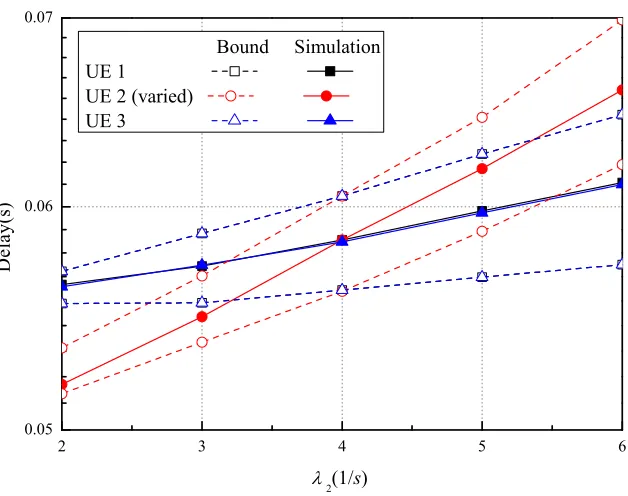
Fig. 5 shows the delay performances of three UEs with the same SNR of 12 dB, when varying the
average arrival rate for UE 2 and with the given average arrival rate of 4s−1 for UE 1 and UE 3. It is
expected that the delay performance deteriorates with the increase of the average arrival rate, especially
for UE 2. Since the network is essentially a queueing system whose the service rate is limited by the
wireless channel, the classic queueing theory states that the delay increases with the system load.
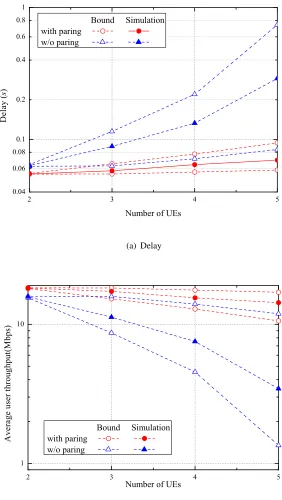
Fig. 6 shows the delay and average user throughput performances of the systems with or without pairing,
where the number of users varies. The average arrival rate is set to 4s−1, and the SNRs of all the UEs
2 3 4 5 6 0.05
0.06 0.07
D
e
l
a
y
(
s
)
(1/s) Bound Simulation
UE 1
UE 2 (varied)
[image:18.612.143.457.78.326.2]UE 3
Fig. 5. Delay performances of UEs with the same SNRs (3 UEs,λ1=λ3= 4 s−1 ).
significantly improves the delay performance as well as the average throughput compared with the one
without using any pairing scheme. Furthermore, due to the multi-user scheduling gains, the delay and
average user throughput performances of the system with paring and scheduling will not significantly
degrade with an increase in the number of users. However, those without pairing deteriorate rapidly with
more users in the system. Moreover, it is noted that the bound error becomes larger with the number of
users, which can be reduced by increasing the moment of the X(k) in the SDP approach at the expense
of computational complexity.
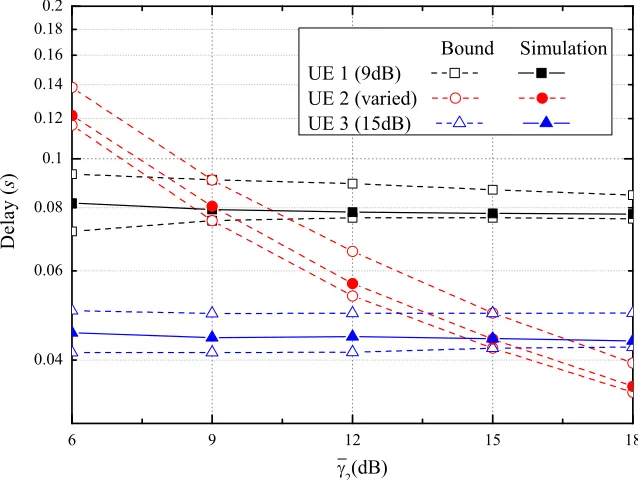
Finally, in order to observe the effect of the channel environment on the delay performance, we only
change the SNR of UE 2 while keeping that of the other two UEs unchanged, i.e., γ1¯ = 9 dB andγ3¯ = 15
dB. The average arrival rate is kept be 4s−1. As can be seen from Fig. 7, the higher the SNR that UE 2
has, the better its delay performance is. This is attributed to the fact that, when the SNR increases, the
channel is more likely (in total probability) to be paired as demonstrated by the stationary probability
vectors. This implies that the user is more likely to be served in time, reducing the delay of the system.
2 3 4 5 0.04
0.06 0.08 0.1 0.2 0.4 0.6 0.8 1
D
e
l
a
y
(
s
)
Number of UEs Bound Simulation with paring
w/o paring
(a) Delay
2 3 4 5
1 10
Bound Simulation with paring
w/o paring
A
v
e
r
a
g
e
u
s
e
r
t
h
r
o
u
g
h
p
u
t
(
M
b
p
s
)
Number of UEs
[image:19.612.162.444.137.637.2](b) Average user throughput
6 9 12 15 18 0.04
0.06 0.08 0.1 0.12 0.14 0.16 0.18 0.2
2
(dB)
D
e
l
a
y
(
s
)
Bound Simulation
UE 1 (9dB)
UE 2 (varied)
[image:20.612.138.457.84.324.2]UE 3 (15dB)
Fig. 7. Delay performance under different SNR in a VMIMO system (3 UEs).
In summary, the performances including delay and throughput can be improved by using VMIMO with
the proposed paring schemes. The system performances are dependent on several parameters such as the
user number, the SNR difference and the average arrival rate. With the increase of the SNR, the delay
reduces while the service rate of the system increases. However, since the system is essentially a queueing
system, the average arrival rate should not be more than the service rate limited by the wireless channel.
Our numerical results are in line with the simulated ones. However, the bound error becomes larger when
the user number is large.
V. CONCLUSIONS
In this paper, the analytical methodology for the delay bounds of a VMIMO system with multiple users
is developed based on the FSMM. To better exploit limited radio resources, a channel/queue-aware pairing
and scheduling scheme was proposed in consideration of the effects of not only the channel environments
but also the queue states. A semi-definite programming approach was applied to approximate the average
queue length of each user, which leads to the derivation of the bounds of the average queuing delay. Both
indicating a sufficiently good match between the analytical bounds and the simulation results and thereby
validating our presented theoretical analyses. Under the considered scenarios, it was shown that using
VMIMO outperforms non-cooperative systems in terms of service delays. Typically, a delay improvement
by a factor of two is achievable due to an increasing number of pairable users in the system. We believe that
the scheduler design jointly considering channel and queue states allows the use of cooperative VMIMO
techniques in forthcoming LTE/LTE-A wireless systems.
By using the proposed methodology, we derived the queue performances of cooperative virtual MIMO
in small cell networks without time-consuming simulations. One limitation of our analyses is that the
bound error becomes larger with the user number, which has to be dealt with by the more
computation-intensive SDP approach. The trade-off between accuracy and computational complexity needs be further
investigated. Moreover, in this paper, we have assumed the greedy algorithm, i.e., MCPS, which is optimal
only in terms of capacity-approaching but not so under other criteria. For example, the greedy algorithm
does not ensure fairness among users. There are many other scheduling algorithms for wireless networks,
which may perform better than the greedy algorithm under certain criteria. It will be interesting to
investigate how to extend our current analyses to other paring and scheduling algorithms in the future.
ACKNOWLEDGMENT
This work was funded in part by China NSFC (No.61271183), National Basic Research Program of
China (973 Program: 2012CB316005), and Program for New Century Excellent Talents in University
(NCET-11-0600).
REFERENCES
[1] Z. Roth, M. Goldhamer, N. Chayat, A. Burr, M. Dohler, N. Bartzoudis, C. Walker, Y. Leibe, C. Oestges, M. Brzozowy, and I. Bucaille, “Vision and Architecture Supporting Wireless GBit/sec/km2 Capacity Density Deployments,” Future Network and Mobile Summit 2010, 16-18 June 2010, Florence, Italy.
[2] RWS-120002, NSN, Release 12 and beyond forC4 (Cost, Coverage, Coordination with small cells and Capacity), June 11-12, 2012.
[3] J. Hoydis, M. Kobayashi, and M. Debbah, “Green Small-Cell Networks,”IEEE Veh. Technol. Mag., vol. 6, no. 1, pp. 37- 43, 2011. [4] C.S. Park, Y. Wang, G. Jongren, and D. Hammarwall, “Evolution of uplink MIMO for LTE-advanced,”IEEE Communications Magazine,
vol. 49, no. 2, pp.112-121, Feb, 2011.
[5] M. Dohler, E. Lefranc, and A.H. Aghvami, “Virtual Antenna Arrays for Future Wireless Mobile Communication Systems,” in Proc. ofIEEE ICT’2002, Beijing, China, June 2002.
[6] 3GPP TSG-RAN1 WG1 #43, R1-051422, “UL virtual MIMO system level performance evaluation for E-UTRA,” Seoul, Korea, Nov. 2005.
[7] B. Fan, W. Wang, Y. Lin, L. Huang, and K. Zheng, “Spatial multi-user pairing for uplink virtual-MIMO systems with linear receiver,” in Proc ofIEEE conference on Wireless Communications & Networking Conference,WCNC’09, pp. 1807-1811, 2009.
[9] 3GPP TSG-RAN1 #46, R1-062052, “UL system analysis with SDMA,” Tallinn, Estonia, Aug. 2006.
[10] X. Chen, H. Hu, H. Wang, H. Chen, and M. Guizani, “Double proportional fair user pairing algorithm for uplink virtual MIMO systems,”IEEE Trans. Wireless Commun., vol. 7, no. 7, pp. 2425C2429, July 2008.
[11] J. W. Kim, I. S. Hwang, and C. G. Kang, “Scheduling for virtual MIMO in single carrier FDMA (SC-FDMA) system, in Proc. ofInt. Inf. Commun. Technol. Convergence Conf, pp. 115C119.
[12] J. Fan, G. Li, Q. Yin, B. Peng, and X. Zhu, “Joint User Pairing and Resource Allocation for LTE Uplink Transmission,” IEEE Transactions on Wireless Communications, vol. 11, no. 8, pp. 2838 - 2847, 2012.
[13] H. Wang and N. Moayeri, “ Finite-state Markov channel-a useful model for radio communication channels,” IEEE Transactions on Vehicular Technology, vol.44, no.1, pp. 163- 171, 1995.
[14] Q. Zhang and S. Kassam, “ Finite-state markov model for rayleigh fading channels,” IEEE Transactions on Communications, vol.47, no.11, pp.1688 -1692, 1999.
[15] L. Lei, C. Lin, J. Cai, and X. Shen, “Flow-level Performance of Opportunistic OFDM-TDMA and OFDMA Networks,”IEEE Trans. Wireless Commun., vol. 7, no. 12, pp. 5461-5472, Dec. 2008.
[16] J. Ramis, and G. Femenias, “Cross-Layer Design of Adaptive Multirate Wireless Networks Using Truncated HARQ,”IEEE Transactions on Vehicular Technology, vol. 60, no. 3, pp. 944 - 954, 2011.
[17] A. Hedayat, and A. Nosratinia, “ Outage and Diversity of Linear Receivers in Flat-Fading MIMO Channels,”IEEE Transactions on Signal Processing, vol. 55, no. 12, pp. 5868 - 5873, 2007.
[18] 3GPP TR 36.814, V9.0.0, “Further advancements for E-UTRA, physical layer aspects,” Mar. 2010. [Online]. Available: http://www.3gpp.org
[19] Theodore S. Rappaport, Wireless Communications: Principles and Practice (2nd Edition), Prentice Hall, 2001.
[20] M. Rupp, C. Mecklenbrauker, and G. Gritsch, “High diversity with simple space time block-codes and linear receivers,” in Proc. of
IEEE GLOBECOM, San Francisco, CA, November 2003, pp. 302-306.