Fault Tolerance using Whole-Process Migration and
Speculative Execution
Thesis by
Justin David Smith
In Partial Fulfillment of the Requirements for the Degree of
Master of Science
California Institute of Technology Pasadena, California
2003
c 2003
Acknowledgements
This thesis would not have been possible without contributions and support from a number of individuals. It has been a great pleasure to interact with my colleagues in the course of my research. I am also truly amazed at the number of people who have supported me in achieving my dreams throughout my life, and to those people I offer my most sincere gratitude. Below I will acknowledge some of the major contributors and supporters of this thesis.
I am very grateful to my advisor, Professor Jason Hickey, who introduced me to the field of compilers and formal methods, and has offered constant inspiration and guidance throughout my graduate-level research. I also thank everyone in the PRL/Mojave group for their insight in the development of this work; in particular, Brian Aydemir, Adam Granicz, Nathaniel Gray, and Cristian T¸ ˘apu¸s contributed to the formalization of the Mojave compiler that is described in this thesis.
My family and friends have always encouraged me to follow the road less traveled, no matter how intimidating the obstacles might seem. They have never faltered in their support of my aspirations, no matter how high, and they have always been there to offer guidance when I needed it. I offer my deepest thanks to my parents, Janet and David Smith, who have always been there for me, and who taught me the importance of seeking my dreams; their support has been the most valuable contribution to my life. I also offer deep thanks to everyone in my extended family, and to all of my friends — their love and support have given me the strength I needed to make it this far.
The teachers I’ve had throughout my life are responsible for my rich academic background that has allowed me to pursue studies at such a prestigious institute. I thank all of my teachers, and in particular I would like to thank Mrs. Dolores Veselka, who encouraged my early studies in mathematics, and Mr. Henry Veselka, who taught me my first programming languages, inspiring me to study computer science. The Veselkas have continued to follow my academic career and support my work, and for that I am very grateful.
Abstract
This thesis examines programming language concepts that facilitate fault-tolerant distributed pro-gramming. New language primitives are introduced for whole-process migration, which allows an active process to be transferred from one machine to another, and speculative execution, which enables optimistic computing based on an unverified assumption. These primitives are developed in the context of the Mojave Compiler Collection, a multi-language multi-architecture compiler with ties to the MetaPRL theorem prover.
The new primitives are first discussed from a theoretical perspective. The primitives are imple-mented as part of a functional intermediate language in the Mojave compiler, which has a formal operational semantics and complete typing rules. The operational semantics and typing rules are extended to accommodate whole-process migration and speculative execution, and the implications these primitives have for program safety are discussed.
Contents
Acknowledgements iii
Abstract iv
Contents v
List of Figures viii
1 Introduction 1
1.1 The distributed application problem . . . 1
1.1.1 Checkpoints in distributed applications . . . 2
1.1.2 Grid computation . . . 3
1.2 Capturing snapshots of a process state . . . 4
1.2.1 Whole-process migration . . . 4
1.2.1.1 Load balancing . . . 4
1.2.1.2 Active messages . . . 5
1.2.1.3 Fault tolerance in distributed programming . . . 6
1.2.2 Speculative execution . . . 6
1.2.2.1 Fault isolation and transaction-like behavior . . . 7
1.2.2.2 Fault tolerance in distributed programming . . . 8
1.2.2.3 Generalization of speculative evaluation . . . 8
1.3 The Mojave Compiler Collection (MCC) . . . 9
1.4 Organization of this thesis . . . 10
2 Semantics of Process Migration and Speculation 11 2.1 The FIR syntax . . . 11
2.1.1 FIR type system . . . 12
2.1.2 FIR statements . . . 13
2.1.2.1 Atoms . . . 13
2.2.1 Heap and store values . . . 16
2.2.2 Kinds . . . 16
2.2.3 Contexts and judgments . . . 17
2.3 FIR operational semantics . . . 18
2.3.1 External calls . . . 19
2.3.2 Process migration . . . 19
2.3.3 Speculations . . . 20
2.3.3.1 Speculations and external state . . . 21
2.3.3.2 Speculations and transactions . . . 21
2.3.4 Subscripting operations . . . 21
3 Safety 23 3.1 Typing rules . . . 23
3.1.1 External call typing rule . . . 23
3.1.2 Migration typing rule . . . 24
3.1.3 Speculation typing rules . . . 24
3.1.4 Subscripting typing rules . . . 25
3.2 Preservation . . . 26
3.3 Progress . . . 27
3.4 Runtime safety checks . . . 29
4 Implementation of Process Migration and Speculation 30 4.1 Runtime implementation . . . 30
4.1.1 Runtime data structures and invariants . . . 31
4.1.2 Data blocks and the heap . . . 32
4.1.3 Pointer table . . . 33
4.1.4 Function pointers . . . 34
4.1.5 Pointer safety . . . 35
4.2 Compiling FIR to assembly code . . . 35
4.3 Process migration . . . 36
4.3.1 Using process migration in the FIR . . . 37
4.3.2 Runtime support for migration . . . 38
4.3.2.1 Thepackandunpackoperations . . . 38
4.3.2.2 Themigrateoperation . . . 39
4.4 Speculative operations . . . 40
4.4.2 Speculation state . . . 41
4.4.3 Speculation properties and invariants . . . 42
4.4.3.1 Invariants related to the organization of the heap . . . 44
4.4.3.2 Invariants related to pointer difference tables . . . 44
4.4.3.3 Liveness invariant . . . 44
4.4.4 Implementation of speculations . . . 44
4.4.4.1 Theentryoperation . . . 45
4.4.4.2 Copy-on-write faults . . . 45
4.4.4.3 Thecommitoperation . . . 45
4.4.4.4 Therollbackoperation . . . 46
5 Garbage collection 47 5.1 Heap and pointer table properties . . . 47
5.1.1 Garbage collector state . . . 48
5.1.2 Garbage collection and speculations . . . 49
5.2 Garbage collector main algorithm . . . 50
5.3 Mark operation . . . 51
5.4 Minor collection . . . 53
5.5 Major collection . . . 55
6 Conclusion 58 6.1 MCC benchmarks . . . 58
6.2 Future work . . . 60
Bibliography 61
List of Figures
1.1 Example of grid computation using checkpoints . . . 3
1.2 Fault tolerance using migration in a heterogeneous network . . . 5
1.3 File transfer operation using lightweight transactions . . . 7
1.4 Design of the MCC compiler . . . 9
2.1 FIR base terms . . . 12
2.2 FIR type system . . . 13
2.3 FIR atoms and expressions . . . 14
2.4 FIR operators . . . 16
2.5 Heap and store values . . . 17
2.6 Program contexts and judgments . . . 17
4.1 Data block header format . . . 32
4.2 Pointer table representation . . . 33
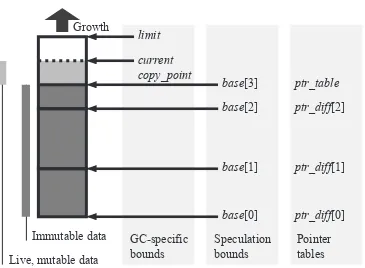
4.3 Function header format . . . 34
4.4 Speculation variables . . . 42
4.5 Heap data with multiple speculation levels . . . 43
5.1 GC variables . . . 48
5.2 GC properties in presence of speculative operations . . . 49
5.3 GC main function . . . 50
5.4 Mark operation in garbage collector . . . 51
5.5 Illustration of pointer inversion in mark phase . . . 52
5.6 GC minor collection . . . 53
5.7 GC minor collection, mark phase . . . 54
5.8 GC minor collection, sweep phase . . . 55
5.9 GC major collection . . . 55
5.10 GC major collection, mark phase . . . 56
Chapter 1
Introduction
We propose a new model for addressing fault tolerance in distributed computation, by introducing two new language primitives for whole-process migration and speculative execution. Both primi-tives are implemented as extensions to the Mojave Compiler Collection (MCC), a compiler under development which compiles multiple source languages into a functional intermediate representation. This chapter will formulate problems in distributed computing which these primitives are designed to address, and will give a general introduction to migration and speculation. The remainder of the thesis will address the theoretical properties and implementation of these primitives in the Mojave compiler.
1.1
The distributed application problem
Consider an application that is distributed across many machines, ornodes, that are connected by a network backbone. Each node runs one or more processes that perform a set oftasks. In this dis-tributed system, there are a number of potential failures that can disrupt the application. Hardware failures with individual machines or with the underlying network can disrupt coordination of the processes in the application, and software failures can cause the processes to enter an inconsistent state. An unanticipated failure at any of these points causes the entire application to fail. If the application spans tens of thousands of nodes, or if it is run over an unreliable network such as the Internet, then the odds of experiencing a failure somewhere in the system are significant.
Traditionally, distributed application developers implement a substantial amount of error han-dling code to respond to each of these faults. Since error detection and recovery code must be written for every operation where the process communicates with another node, this can lead to “spaghetti code,” where the error handling code is tightly intertwined with code for the computation being performed. Programmers have difficulty analyzing this code for correctness, since it is difficult to isolate the computation from the error handling code.
total order communication protocol guarantees that messages will be delivered in a well-defined order to every node in the distributed system that is alive. When a node fails, the total-order protocol ensures that surviving nodes continue to receive messages as expected, however it does not provide a mechanism for recovering the computation that was being performed on the failed node. Therefore the programmer must still write a substantial amount of code to recover the lost computation or to reassign the failed node’s tasks to surviving nodes. This is a significant improvement over the naive implementation since much of the error recovery code is isolated in the communication primitives, but it is only a partial solution as a fault recovery model.
In the error recovery paths for distributed systems, the programmer is often attempting to revert the system’s state to a consistent state immediately before the failure. A large portion of the error recovery code is devoted to identifying the failed node, determining what tasks were running on the failed node, and reassigning those tasks to a surviving node. The programmer may have to undo many computations that were already performed on the surviving nodes, because the computations relied on results from the failed node that were not saved to a persistent store and must be recomputed. All of this recovery code emphasizes the restoration of the distributed system to a consistent state that is prior to the failure.
Tasks evaluated in a distributed system must be capable of moving from one node to another; otherwise a failure on the node a task is running on will block all tasks that are dependent on it, which potentially covers the entire distributed system. Since tasks may need to be reassigned to surviving nodes, either each node in the system must contain code to evaluate each possible task, or else we must have a mechanism for migrating executable code into an arbitrary node. In grid computations, where every node runs the same algorithm but on a different data set, task migration simply involves copying the data set to a new node; however, in a heterogeneous distributed system, where each task is running a different algorithm, a mechanism to migrate executable code from one node to another will greatly simplify the programmer’s work.
1.1.1
Checkpoints in distributed applications
3: — Mark a synchronization point for error recovery.
4: checkpoint()
5: — Now, compute. This computation is free of error-recovery code. If an error is
6: — detected, an exception is raised that automatically restores the checkpoint.
7: compute for one iteration 8: end while
Figure 1.1: Example of grid computation using checkpoints
Checkpoints can be provided by a service library or using primitives in a language specialized for distributed computation. When checkpoints are embedded in the language, the compiler is able to optimize checkpoint performance by choosing internal representations of the data that are easy to save and restore. The compiler is well-suited to generating checkpoint code, since it has a record of the internal representation of each process’s state.
By encapsulating all of a process’s state into a single object, it becomes possible to migrate entire tasks from one machine to another, allowing the system to automatically revive tasks lost because of a node failure onto a surviving node. If architecture-independent data representations are used, then migration is feasible even for heterogeneous distributed networks. With checkpoints as a language primitive, much of the work of transmitting the process state can be automated by the compiler.
Specialized languages can also include automatic detection of failed nodes, so the programmer simply marks which parts of the distributed system reflect a consistent state. On a failure, built-in language primitives can rollback all process and I/O state using the most recent checkpoint of the system. This approach puts the burden of fault detection and recovery on the compiler itself, and with proper language design, error handling code can be clearly separated from the algorithms.
1.1.2
Grid computation
Grid computation is a class of distributed applications where a data set is divided and distributed among nodes in the system, and each node performs the same computation on its data set. Typically, this is used in scientific computing for physical simulations, where an iterative computation is run in parallel on a largen-dimensional data space, with each node responsible for a particular region of the space. These computations are often performed on high-performance distributed clusters containing tens of thousands of nodes connected by a dedicated, high-speed network backbone. These clusters have a low mean time between failure, on the order of one day, and as a result any long-term computation must be prepared for several failures during its lifetime.
handling code, but with checkpoints, the overhead in the source language for such a computation can be as minimal as is illustrated in Figure 1.1, where the error handling is encapsulated in a single language primitive, and is clearly separated from the computation itself. On a failure, the runtime which supports the language can automatically revert surviving processes to the last successful checkpoint and resurrect tasks that were lost on surviving machines. All of the fault recovery is transparent to the programmer.
1.2
Capturing snapshots of a process state
We develop language primitives for checkpointing as part of the Mojave compiler, which is described in more detail in Section 1.3. The Mojave compiler utilizes two tools to take snapshots of the process state. The first is whole-process migration, where an entire process state is migrated from one machine to another, or recorded to a persistent storage device for later execution. The second mechanism is an adaptation of transactions, which we refer to asspeculative execution. Speculative execution allows a process state to be rolled back, but unlike whole-process migration, speculative execution is not persistent.
1.2.1
Whole-process migration
Whole-process migration can be used to migrate an active process from one machine to another, and to record a process’s state to a persistent storage device. Migration provides persistence of computations, which is necessary to accommodate machine failures.
Whole-process migration has been widely studied [6, 19]. The JoCaml system [4] provides process mobility for OCaml programs based on the join calculus [7]. The Mojave compiler’s approach to process migration is heavily influenced by Cardelli’s work on the Ambient Calculus [2, 3], however the Mojave compiler only supports whole-process migration at this time, and does not yet support the fine-grained mobility described in the ambient calculus.
This thesis emphasizes migration’s role in the simplification of fault-tolerant computing. Each node in a distributed computation can use migration to take periodic persistent checkpoints, which are used to recover the computation on another machine if the node fails. Migration can also be used to improve the performance and simplify development of distributed systems.
1.2.1.1 Load balancing
?
Figure 1.2: Fault tolerance using migration in a heterogeneous network
all machines. Therefore load balancing can be performed without any special support from the processes.
1.2.1.2 Active messages
Migration can be used to passactive messages, or messages that include executable code and data. To pass a message from one process to another, the process may start a new thread, and migrate the thread (including all necessary state) to the machine hosting the other process.
This can be particularly useful for database queries. When the database is hosted on a remote machine, it is highly inefficient to run a query on the local machine that transfers the entire database over the network to extract the few records which the query is interested in. Mainstream database systems work around this by supporting a query language used to describe the query. The local machine sends the text of the query, which is then run on the server. However, these languages are highly specialized and are not sufficiently expressive for many types of inquiries. Process migration allows arbitrary programs to migrate to the remote machine, allowing far greater expressiveness using a more general mechanism.
1.2.1.3 Fault tolerance in distributed programming
Migration provides a mechanism for persistent storage of the process state and the ability to resurrect the process on any machine. Therefore, when a node in a distributed network fails, migration can be used to revive all tasks that were running on the system prior to the failure. With a machine-independent representation of the code and data for each process, tasks can be resurrected on an arbitrary node in a heterogeneous distributed network, as illustrated in Figure 1.2.
Since the checkpoints may be recorded infrequently, the revived processes will be at an earlier point in the computation than the surviving processes. They can replay the original computation up to the point of failure, given the same inputs as the original process.
1.2.2
Speculative execution
In a distributed computation, the processes involved must synchronize periodically. Ideally, a process would speculatively continue computing across a synchronization point, even if it has not received confirmation that all other processes have reached the same synchronization point. In this case, a process can enter a new speculation as it passes the synchronization point and continue comput-ing. If a process in the system fails, the remaining processes can agree on the last known-good synchronization point using a consensus algorithm, and then roll back to that synchronization point to continue the computation.
Speculations share many traits with traditional distributed transactions, one of the earliest and simplest abstractions for reliable concurrent programming [9]. Transactions provide source-level fault isolation: from a process’s point of view, a failure cannot occur during a transaction; if a failure occurs, it must occur before or after. While transactional models are ubiquitous in the database community, they have not been frequently applied to traditional programming languages. As part of the Venari project, Haines et.al. [10] implement a transaction mechanism as part of Standard ML, utilizing a mutation log produced by a generational garbage collector to implement undoability.
Speculations share the same operations as transactions, but speculations provide weaker prop-erties. For one, transactions are atomic; a process that is not involved in the transaction is not allowed to view the intermediate state of the processes that are participating in the transaction. This external process must either block until the transaction is completed, or else it must access an older copy of the state from before the transaction was entered. Speculations do not need to be atomic; if another process depends on a value generated during a speculation, the other process may simply join the existing speculation, so the processes will be rolled back in unison in the event of a failure.
2: i:=read(file1)
3: if readfailedthen returnfailure 4: j:=read(file2)
5: if readfailedthen returnfailure
6: if write(file1, i−k) failedthen returnfailure 7: if write(file2, j+k) failedthen
8: — Undo file1
9: write(file1, i)
10: — Unrecoverable if this write fails
11: returnfailure 12: returnsuccess
2: speculate
3: i:=read(file1)
4: j:=read(file2) 5: write(file1, i−k)
6: write(file2, j+k) 7: returnsuccess 8: catch
9: returnfailure
Figure 1.3: File transfer operation using lightweight transactions
as it receives confirmations that the other nodes have reached the synchronization point. Since the confirmations typically arrive in temporal order, the process will usually commit the oldest spec-ulation in the system, which is opposite the behavior a traditional distributed transaction would provide. In a speculation, if multiple speculations are active when a particular speculation is com-mitted, the committed speculation is simply folded into the next-oldest speculation. This gives speculations more flexibility than traditional transactions provide.
1.2.2.1 Fault isolation and transaction-like behavior
Like transactions, speculations allow for fault isolation. Frequently, error-recovery code in a program exists to revert the state to a known-consistent state. As a simple example, consider a banking program that wishes to transfer a sum of moneyk from one account to another. If a failure occurs during the transfer, the program must take steps to ensure that the amountk remains credited to the original account. Code to perform this operation is illustrated in Figure 1.3.
In the traditional case, the programmer must manually revert the state of all modified files if an I/O failure occurs. Note that the error-recovery code itself requires some form of error-recovery; it is entirely possible that line 9 will fail, at which point it is not clear how the program should proceed. By contrast, speculations allow the programmer to automatically roll back the entire process state to the state on entry to this operation, without requiring the programmer to explicitly recover the state.
1.2.2.2 Fault tolerance in distributed programming
Speculative execution enables a “monitor and recover” programming model [15], where processes monitor in the background for failures in the distributed system, and roll back their computation on discovery of a failure. The surviving processes will need to roll back their state in order to return to a consistent state for the overall distributed system.
It is possible to implement rollback of a surviving process using whole-process migration, since all processes are periodically written to persistent storage. However, this would require recovery of the full process state from the relatively slow persistent storage device. By comparison, speculations can utilize the current state of the process to roll back more efficiently, by keeping track only of the changes to the state since the last speculation. This mutation log is likely to be much smaller than the full process state, and therefore more efficient to utilize.
1.2.2.3 Generalization of speculative evaluation
In general, a speculative execution is based on an assumption A that may or may not be true, but is not immediately evaluated. The speculative execution is committed if A is verified to be true, and aborted if the process later determines A is false. For fault-tolerance, A represents the assumption that no machine in the distributed network will fail, and for fault isolation,Arepresents the assumption that no exception will be raised. In these cases, Acannot be assessed in advance, sinceAis dependent on the code that will be evaluated during the speculation.
There are other situations where it may be possible to evaluateAin advance, but for performance reasons it is more advantageous to defer the evaluation of Auntil part of the speculative code has been executed. In these situations,Aitself may be dependent on information from other computers, and may be a slow computation due to network latencies. If A is likely to be true, and the cost of a speculation is low, then it is in the process’s best interests to assume A and rollback if the assumption proves to be false later.
Intermediate
Functional
Language
Executable
Code
Theorem
Prover
Runtime
Library
C
Pascal
ML
Java
Figure 1.4: Design of the MCC compiler
1.3
The Mojave Compiler Collection (MCC)
We implement whole-process migration and speculative execution as part of the Mojave Compiler Collection (MCC)1. MCC is a multi-language compiler that compiles C, Pascal, ML, Java, and other languages to a common, functional intermediate language (FIR). The FIR is a concise semi-functional representation of the code, where variables in the FIR are immutable, but heap values can be modified. Looping constructs are expressed using recursion, and all internal function calls are expressed as tail-calls. The FIR also contains primitive features to support its source-level languages in a type-safe manner. MCC can be integrated with MetaPRL [12], a theorem prover capable of reasoning about programs written in the FIR language. The MCC architecture is illustrated in Figure 1.4.
MCC utilizes formal reasoning of programs and runtime safety checks to ensure that programs compiled using MCC are safe — that is, they will not attempt to access illegal areas of memory, or use values with inappropriate types. MCC’s safety properties allow mutually untrusting systems to exchange and evaluate code, and reduce the need for explicit security boundaries in distributed systems. They also allow programmers to develop modules for execution directly in kernel space, with the assurance that no MCC-compiled module will errantly tamper with other kernel modules. MCC is able to impose an architecture-independent representation of data and can migrate code using the architecture-independent FIR representation. This makes it an ideal platform for developing whole-process migration primitives in an efficient manner. Also, MCC’s heap design is easy to extend to support speculative execution models.
MCC provides an active test bed for research in several areas of distributed systems research. Several projects are conducted by members of the Mojave group to include a distributed filesystem [8] and distributed shared memory [5] with MCC, taking advantage of the features offered by the compiler. These projects extend the concepts of migration and speculation to the design of persistent storage and distributed communication technologies.
1.4
Organization of this thesis
Chapter 2
Semantics of Process Migration
and Speculation
Process migration and speculation are implemented as extensions to MCC. The semantics of mi-gration and speculation is defined as part of the FIR, the intermediate language used internally by MCC. The complete FIR language, including the FIR operational semantics, is described in detail in a technical report by Hickey, Smith, et al. [11]. The FIR presented here is a subset of the full FIR language; only the properties of the FIR that are relevant to this thesis are discussed here.
The formal discussion of migration and speculation will be with respect to the FIR. This chapter introduces basic FIR syntax and provides the operational semantics for migration and speculation. Safety properties for migration and speculation are given in Chapter 3, and the runtime support required to implement these primitives is discussed beginning in Chapter 4.
2.1
The FIR syntax
The following conventions are used in the descriptions below. In general, the meta-variablesi, j,k, andlto refer to arbitrary integers, and the meta-variablesmandnto refer to arbitrary nonnegative integers. The meta-variable v refers to program variables. The meta-variables t and u refer to program types, while the Greek lettersα, β, γand the meta-variable tv refer to type variables.
In most cases, the meta-variable m enumerates type parameters α1, . . . , αm, and the
meta-variablenenumerates actual parametersv1, . . . , vn. The notationdvie n
1 is a shorthand denoting the vectorv1, . . . , vn, where the index variable is implicitlyi. An alternate notationdvje
n
j=1 explicitly uses a different index variablej.
Entity Description
v1, v2, . . . Variable names
tv1,tv2, . . .
α, β, . . . Type variables
i ::= . . .| −1|0|1|. . . Integer constants
set ::= [i11, i12], . . . ,[in1, in2] Integer interval set
pre ::= 8|16|32|64 Integer precisions
sign ::= signed|unsigned Integer signedness
r ::= (i,pre,sign) Raw integer constants
Figure 2.1: FIR base terms
2.1.1
FIR type system
The FIR has two classes of types, the basic types, shown in Figure 2.2, and the type definitions, which are parameterized types of the form Λα1, . . . , αm.t.
The type Zbox refers to tagged, signed integers. Native integers with bit precision pre and
signednesssignare represented usingZsign
pre , and must be boxed when stored into memory. Floating-point values are also supported by the implementation, but are not described here.
Memory values are represented by several types. The tuple type ht1, . . . , tni represents a tuple
hv1, . . . , vni, where each value vi has type ti. The array type t array resembles a tuple, but the
elements of an array all have the same type, and an array has arbitrary nonnegative dimension. Both tuples and arrays are seen as safe types — the compiler guarantees that values in these memory areas have the appropriate types. MCC also supports tagged tuples, or unions, but they are omitted here for simplicity.
The unsafe typedatarepresents arbitrary data. Values of typedataare normally used to rep-resent data aggregates for imperative programming languages, such as C, that allow the assignment of values to the data area without regard for the data type. Data areas with thedatatype have no explicit substructure.
The function type (t1, . . . , tn) → t includes the functions that return a value of type t, given
arguments of typest1, . . . , tn.
For polymorphic types, MCC provides type application tv[t1, . . . , tm], which applies arguments
to a type definition. If the definition is a parameterized type Λα1, . . . , αm.t, the typetv[t1, . . . , tm]
is defined as the type t[t1/α1, . . . , tm/αm]. For example, in a context containing the definition
γ= Λα, β.hα, βi, the typeγ[Zbox,Zsigned32 →Zbox] is the same as the type
D
Zbox,Zsigned32 →Zbox
E
. The universal type ∀α1, . . . , αm.t defines a polymorphic type, where t must be a function
type. The existential type ∃α1, . . . , αm.t defines a type abstraction. The values in an
existen-tial type have the formty pack[∃α1, . . . , αm.t](v, t1, . . . , tm), wherev has typet[t1/α1, . . . , tm/αm].
| Zsignpre Native integers
| void Void type
| ht1, . . . , tmi Tuple data
| tarray Array data
| data Unsafe data
| (t1, . . . , tm)→t Function type
| α, β, . . . Polymorphic type vars | tv[t1, . . . , tm] Type application
| ∀α1, . . . , αm.t Universal types
| ∃α1, . . . , αm.t Existential types
| v.i Abstract type
tydef ::= Λα1, . . . , αm.t Parameterized types
Figure 2.2: FIR type system
v=ty pack[∃α1, . . . , αm.t](v0, t1, . . . , tm) has type∃α1, . . . , αm.t, thenv.iis equivalent to ti.
Type definitions define parameterized types. A type definitiontydef has the form Λα1, . . . , αm.t,
wheret is a type abstracted over type parametersα1, . . . , αm. Type definitions will appear as part
of the program context.
2.1.2
FIR statements
Statements in the FIR are divided into two classes: the atomsaand general expressionseshown in Figure 2.3.
2.1.2.1 Atoms
The atomsarepresent values, including numbers, variables, and basic arithmetic. Atoms are func-tional. Apart from arithmetic exceptions1, the order of atom evaluation does not matter. The atoms include the following.
The boxed integers int(i) have type Zbox. The raw integers rawint(r) are native, unboxed
integer constants with typeZsign
pre . There are two forms for arithmetic: unary operationsunopa, and binary operations a1binop a2. The operators, shown in Figure 2.4, include the normal operations for arithmetic.
The variables v represent values defined in the program environment, described in Section 2.2. Variables are immutable: the FIR does not include a variable assignment operation.
There are three kinds of polymorphic operations. The ty apply[t](v, t1, . . . , tm) atom is a
type application of a polymorphic value v to type arguments t1, . . . , tm. For the application
Definition Description
a ::= int(i) Boxed integers
| rawint(r) Raw integers
| v Variables
| ty apply[t](a, t1, . . . , tm) Type application
| ty pack[t](v, t1, . . . , tm) Existential pack
| ty unpack(v) Existential unpack
| unopa Unary operation
| a1binopa2 Binary operation
e ::= letv:t=aine Basic operations | letv:tv= (“s” :ts)(a1, . . . , an)ine Calls to the runtime
| a(a1, . . . , an) Tail-call
| specialtailop Special tail-call | matchawithdsi7→eien1 Case analysis
| letv=allocine Allocation | letv:t=a1[a2]ine Load from heap | a1[a2] :t←a3; e Store into heap
Figure 2.3: FIR atoms and expressions
to be well-formed, the variable v must have universal type ∀α1, . . . , αm.u; the atom has type
t = u[t1/α1, . . . , tm/αm]. The ty pack[t](v, t1, . . . , tm) atom performs type abstraction. It has
type t = ∃α1, . . . , αm.u when v has type u[t1/α1, . . . , tm/αm]. The ty unpack(v) atom is the
elimination form for type abstraction. If v has existential type∃α1, . . . , αm.u, the atom has type
u[v.1/α1, . . . , v.m/αm]. The typev.irepresents the type parametertiin the original pack operation.
2.1.2.2 Expressions
Theletv:t=aineexpression forms a new scope, where the variablevis bound to the value of the atom expression ain the expression e. For the expression to be well-formed, the atom must have typet, and the expressionemust be well-formed for an arbitrary valuevof typet.
The external-call expression letv:tv = (“s” : ts)(a1, . . . , an) in e is used to provide access to
the runtime and operating system. The string “s” represents the name of a runtime function to be called with arguments a1, . . . , an. For the expression to be well-formed, the runtime function “s”
must have typets= (u1, . . . , un)→tv, each atomai must have typeui, andemust be well-formed
given a valuev with typetv.
The tail-calla(a1, . . . , an) represents a function call to the functionawith argumentsa1, . . . , an.
Functions are statically defined as part of the program context, discussed in Section 2.2.1, and function definitions may not be nested. The atom ain a tail-call is always a variable v or a type-application v[t1, . . . , tm] where v is defined in the context. For the tail-call to be well-formed, the
functionamust have some type (u1, . . . , un)→void, and each argumentaimust have typeui. The
The special-call specialtailop represents a call for process migration, or one of the speculation operations. Thetailop operations are shown in Figure 2.4.
• The operator migrate[i, ap, ao] afun(a1, . . . , an) defines a process migration. The argument
(ap, ao) specifies the destination (for example, the name of a migration server), and the
argu-ment afun(a1, . . . , an) specifies a function to be called once the process migrates, along with
its arguments.
• The operatorspeculateafun(aconst, a1, . . . , an) specifies entry into a speculation. This
opera-tion effectively takes a process checkpoint, which can be restored if the speculaopera-tion is aborted. Once the speculation is entered, the functionafun is called with argumentsaconst, a1, . . . , an.
• The operatorrollback[alevel, aconst] is used to abort a speculation. The atomalevelis the name
of the speculation to be aborted (the speculation checkpoints are saved in a list). Speculations are restarted on failure, and the atomaconst is a new argument to be passed to the speculation entry point when the speculation is restarted.
For example, if the speculation was entered with speculateafun(aconst, a1, . . . , an), and the
speculation is aborted with the rollback [a0level, a0const], the speculation is resumed with the tail-callafun(a0const, a1, . . . , an).
• The operator commit [alevel] afun(a1, . . . , an) commits the speculation identified by alevel. The speculation checkpoint identified by alevel is discarded, and the function afun is called with argumentsa1, . . . , an.
The match statementmatchawithdsi7→eien1 is a pattern match of an integer against multiple
sets. Each match case si 7→ ei specifies an integer (or raw integer) set si and an expressionei to
be evaluated if a ∈ si. Evaluation is ordered and total. Evaluation chooses the first match that
succeeds, and the match statement is well-formed only if there is a match case for any possible value ofa.
The aggregate data areas include tuples, arrays and raw data. Theletv=allocineexpression allocates a data aggregate, using one of thealloc forms shown in Figure 2.4.
Definition Description
unop ::= − |!| · · · Unary operations
binop ::= +| − | ∗ |/| · · · Binary operations
alloc ::= ha1, . . . , ani:t Tuple allocation
| array(asize, ainit) :t Array allocation | malloc(a) :t Rawdata allocation
tailop ::= migrate[i, ap, ao]afun(a1, . . . , an) System migration
| speculateafun(aconst, a1, . . . , an) Speculation entry
| rollback[alevel, aconst] Speculation rollback | commit[alevel] afun(a1, . . . , an) Speculation commit
Figure 2.4: FIR operators
2.2
Judgments
All judgments, including type and well-formedness judgments, are defined with respect to an envi-ronment Γ, also called a context. The environment contains both variable declarations of the form
v: t, and variable definitions of the form v: t=b. The declarationv: t specifies that a variablev
has an unspecified value of typet. The definitionv:t=b specifies that variablev has the valueb, andbhas type t.
2.2.1
Heap and store values
The definitions in the context use values of two sorts: heap valuesh, and store values b, shown in Figure 2.5. The heap values represent atoms that have been fully evaluated. In general, an atom evaluates to a number, a label, or a variable that represents a store value. Thestore values are the values in a program store. These include heap values, functions, “packed” values with existential type, and data in each of the aggregate data types: tuples, arrays, and rawdata.
Functions are universally quantified, with type parameters α1, . . . , αm and actual parameters
v1, . . . , vn. Elements of typedataare represented abstractly using the formhci; the elements in the
data area are not explicitly described.
2.2.2
Kinds
The program types are also defined as part of the context Γ. For presentation purposes, the program types are classified withkinds, which have the following form.
ks ::= ω|Ω
| rawint(r) Raw integers
| v Variables
b ::= h Heap values
| Λα1, . . . , αm.λv1, . . . , vn.e Functions
| ty pack[t](v, t1, . . . , tm) Type packing
| hh1, . . . , hni Tuples
| hci Raw data
Figure 2.5: Heap and store values
Definition Description
def ::= v: t Variable declaration | v: t=b Variable definition | tv:k Type declaration | tv:k=tydef Type definition
Γ ::= Empty environment
| Γ,def Adding a definition
Γ` Context Γ is well-formed
Γ`tydef1=tydef2:k tydef1 andtydef2are equal type definitions (or types) Γ`tv1=tv2:k tv1 andtv2are equal type definitions
Γ`a:t Atomahas type t
Γ`b:t Store valuebhas typet
Γ`e:t Programehas typet
Figure 2.6: Program contexts and judgments
The kind ks classifies the type definitions tydef as “small” types ω and “large” untagged types
Ω, primarily to support efficient garbage collection. The general kind k =ωm → k
s represents a
parameterized type definitiontydef. The number of parametersmmay be any nonnegative integer. Ifm= 0, the type parameters may be omitted.
2.2.3
Contexts and judgments
A program context Γ is defined as a set of mutually-recursive declarations and definitions, as shown in Figure 2.6. There are two forms of definitions. The type definition tv:k=tydef defines a type namedtv, having kindk, and valuetydef. The variable definitionv:t=bdefines a variable named
v, with typetand store valueb. For each definition form there is a correspondingdeclaration form. This thesis assumes each variable and type variable in a context is defined/declared at most once, and uses alpha-renaming to rename variables as appropriate. The meta-variable dis used to represent a definition or declarationdef.
its declarations and definitions are well-formed. For each declarationv:tand definitionv:t=b, the termtmust be a well-formed type, and the valueb must have typet. Similarly, all type definitions in Γ must be well-formed.
The type system includes an equational theory of types. The judgment Γ`tydef1=tydef2:k
is a type definition equality judgment. When the judgment is true, tydef1 and tydef2 have the specified kind, and they are equal. There is no separate membership judgment Γ`tydef :k.
The judgments Γ`a:t, Γ`b:t, Γ`e:texpress typing relations for atoms, store values, and expressions, respectively.
2.3
FIR operational semantics
Evaluation is defined onprograms, which include three parts: the current environment Γ, a check-point environment C, which is an ordered list of checkpoints, and an expression e to be evalu-ated. Checkpoints are required for speculations, which are discussed in Section 2.3.3. A checkpoint hΓ, f(, a1, . . . , an)icontains a context Γ, and a functionf(, a1, . . . , an), where is a special
spec-ulation parameter. The function is called if evaluation is resumed from the checkpoint.
C ::= hΓ, f(, a1, . . . , an)i Single checkpoint
C ::= Cm;. . .;C1 Checkpoint environment Definition 2.3.1 Fully-defined contexts
A context Γ is said to be fully-definedif every variablev in the context is defined with the form
v: t=b and every type variable tv is defined with the form tv:k=tydef .
Definition 2.3.2 Programs
A programis either the special termerror, or it is a triple (Γ| C |e)that satisfies the following conditions.
• Γ is fully-defined andΓ`e:void,
• For each hΓ0, f(, a
1, . . . , an)i ∈ C, the context Γ0 is fully-defined, and the judgment
Γ0, vconst:Zsigned32 `f(vconst, a1, . . . , an) :voidholds.
Intuitively, the errorterm specifies a runtime error during program evaluation (such as an out-of-bounds array access, or a runtime type error during a subscripting operation). Theerrorterm is similar to an exception, and may assume any type.
Evaluation is a relation on programs. The relation
(Γ| C |e)→error
specifies that evaluation of the program (Γ| C |e) results in a runtime error in one step. This thesis only describes the rules for external calls, special-calls, and several subscripting operations on the heap. The complete operational semantics is described in the technical report [11].
2.3.1
External calls
For external calls, we defer to a semantic interpretation function [[“s”]] that specifies the interpretation of the built-in function named “s”.
(Γ| C |letv:t= (“s” : (u1, . . . , un)→t)(h1, . . . , hn)ine)→
(Γ, v:t= [[“s”]](h1, . . . , hn)| C |e) Red-LetExt
It is important to note that the semantic interpretation function [[“s”]] may reference data both within and external to the context Γ. This is significant in determining what state is included in checkpoints.
2.3.2
Process migration
When a process migrates, the entire process (including Γ,C, and the continuation function) migrates to a new location, which is just another runtime environment. The operational definition of migration is transparent by design. The program context must not change during process migration. This decouples the process execution from the process location, allowing transparent fault recovery in distributed systems. This decoupling is fairly significant, since otherwise a process might have to spend considerable time reacquiring machine-specific resources and rebuilding its state when it is transferred to another machine.
In the migrate [j, aptr, aoff] afun(a1, . . . , an) special-call expression, the atoms aptr and aoff specify a string (as a rawdata block and offset) that describes the migration protocol and target (for example, a machine name). The numberj is a unique identifier used by the runtime. Operationally, evaluation of the expression leads to process migration followed by the evaluation of the tail-call
afun(a1, . . . , an).
(Γ| C |special migrate [j, hptr, hoff]f(h1, . . . , hn))→(Γ| C |f(h1, . . . , hn)) Red-SysMigrate
The implementation of these semantics is discussed in Section 4.3.
code are migrated. I/O to files and devices is not supported directly by the FIR at this time, and must use the external call interface. The I/O state is not currently migrated.
2.3.3
Speculations
Speculations are entered with the special-callspeculateafun(aconst, a1, . . . , an). The runtime adds
a process checkpoint to the checkpoint environment C. This checkpoint can be restored later if the speculation is aborted. Evaluation proceeds with a tail-call afun(aconst, a1, . . . , an), and the
speculative call is treated identically to this tail-call for typing purposes. For technical reasons,
aconst must have typeZsigned32 .
(Γ| C |special speculatef(hconst, h1, . . . , hn))→
(Γ| hΓ, f(, h1, . . . , hn)i;C |f(hconst, h1, . . . , hn)) Red-Spec
The rollback [alevel, aconst] special-call aborts a speculation. It is possible to enter several speculations simultaneously (in the source program, speculations are typically nested). The atom
alevel is an integer that identifies the speculation level, andaconst is a speculation parameter. When a speculation checkpoint hΓ, afun(, a1, . . . , an)i is rolled back with the rollback [i, j]
special-call expression to level i with speculation parameter j, evaluation proceeds as a tail-call
afun(j, a1, . . . , an), using the original process context Γ and the truncated checkpoint environment
Ci;. . .;C1. All checkpoints with level higher thani are discarded. The level that was rolled back is re-entered by this primitive; in effect, the state that is restored is the state captured immediately after the level was entered.
(Γ0 |Cm;. . .;Ci=hΓ, f(,dhke n
k=1)i;. . .;C1|special rollback[i, j])→ (Γ|Ci;Ci−1;. . .;C1|f(j,dhke
n k=1))
wheni∈ {1. . . m} Red-Spec-Rollback
In most cases, rollback operates on the most recently entered level. As a short-hand, wheni= 0 the runtime will roll back only the most recent level.
(Γ0|Cm=hΓ, f(, h1, . . . , hn)i;. . .;C1|special rollback[0, j])→
(Γ|Cm;. . .;C1|f(j, h1, . . . , hn)) Red-Spec-Rollback-2
Also, it is an error to specify a checkpoint that does not exist.
(Γ|Cm;. . .;C1|special rollback[i, j])→error
wheni /∈ {0. . . m} ∨m= 0 Red-Spec-Rollback-Error
Speculations are committed with the special-callcommit[i]afun(a1, . . . , an). Operationally, the
checkpoint is deleted from the checkpoint context and evaluation continues with a tail-call to the functionafun(a1, . . . , an).
(Γ|Cm;. . .;C1|special commit[i]f(h1, . . . , hn))→
(Γ|Cm;. . .;Ci+1;Ci−1;. . .;C1|f(h1, . . . , hn))
the runtime will commit the most recent level.
(Γ|Cm;. . .;C1|special commit[0]f(h1, . . . , hn))→
(Γ|Cm−1;. . .;C1|f(h1, . . . , hn)) Red-Spec-Commit-2
Also, it is an error to specify a checkpoint that does not exist.
(Γ|Cm;. . .;C1|special commit[i]f(h1, . . . , hn))→error
wheni /∈ {0. . . m} ∨m= 0 Red-Spec-Commit-Error
The FIR does not syntactically require entry and commit operations to be balanced. Instead, programs that attempt to rollback to or commit a checkpoint that does not exist evaluate to the errorterm. The implementation of these semantics is discussed in Section 4.4.
2.3.3.1 Speculations and external state
All state recorded inC can be rolled back by a speculation. However, state that is external to C, such as the machine state accessed through external calls, including I/O to files and devices, is not currently rolled back.
2.3.3.2 Speculations and transactions
Speculations bear a certain resemblance to database transactions. Indeed, on a single-process system there is little difference, as both mechanisms accommodate rollback to a known-consistent state when an abnormal condition occurs. However, in the presence of other processes, speculations can be more flexible than traditional transactions, particularly with regard to atomicity. For a process in a traditional transaction, any state modifications it makes must be opaque to processes not involved in the transaction. An external process wishing to utilize the state modifications must block until the transaction is committed or aborted. With speculations, we can conceive other processes dynamically joining a speculation that is in progress, optimistically assuming that the speculation will complete with the new state in place.
2.3.4
Subscripting operations
The subscripting operations correspond to the aggregate values: tuples, arrays, and rawdata. The projection for a tuple hh0, . . . , hn−1i and index j is the element hj. A tuple operation is
always successful because the offset is a constant, and the type system discussed in Chapter 3 ensures that the offset is within bounds.
((Γ0, v2: u0=hh0, . . . , hn−1i)asΓ| C |letv1:u=v2[j]ine)→
(Γ, v1:u=hj| C |e) Red-LetSub-Tuple
((Γ0, v: u0=hh0, . . . , hn−1i)asΓ| C |v[j] :u←h; e)→
Arrays are similar to tuples when the array index is in bounds.
((Γ0, v2:u0=hh0, . . . , hn−1i)asΓ| C |letv1:u=v2[j]ine)→ (Γ, v1:u=hj | C |e)
whenj∈ {0. . . n−1} Red-LetSub-Array
((Γ0, v:u0=hh
0, . . . , hn−1i)asΓ| C |v[j] :u←h; e)→ (Γ0, v:u0=hh0, . . . , hj−1, h, hj+1, . . . , hn−1i | C |e)
whenj∈ {0. . . n−1} Red-SetSub-Array
It is an error for an array subscript to be out-of-bounds.
((Γ0, v2: t2=hh0, . . . , hn−1i)asΓ| C |letv1: t1=v2[j]ine)→ error
whenj /∈ {0. . . n−1} Red-LetSub-Array-Error
((Γ0, v: t1=hh0, . . . , hn−1i)asΓ| C |v[j] :t2←h; e)→ error
whenj /∈ {0. . . n−1} Red-SetSub-Array-Error
For the unsafe aggregates, the subscript operations perform a runtime type check. Rather than specify the operations here, we rely on an operational semantics provided by the runtime, described in Chapter 4.
For aggregates of datatype, we assume existence of a runtime functionruntime(Γ| hci[j] :t) that projects a valid valuehof typetfrom data areahci, or results in an error. We also assume the
existence of a runtime functionruntime(Γ| hci[j] :t←h) to store a value in a rawdata aggregate, returning a new valuehc0ior producing an error.
runtime(Γ| hci[j] :t) =
(
h if Γ`h:t
error otherwise
runtime(Γ| hci[j] :t←h) =
(
hc0i assignment succeeds error otherwise
Given these runtime functions, a rawdata subscript operation returns the value given by the runtime, or produces an error.
((Γ0, v2:u0=hci)asΓ| C |letv1:u=v2[j]ine)→ (Γ, v1:u=h| C |e)
when runtime(Γ| hci[j] :u) =h Red-LetSub-RawData
((Γ0, v2:u0=hci)asΓ| C |letv1:u=v2[j]ine)→error
when runtime(Γ| hci[j] :u) =error Red-LetSub-RawData-Error
((Γ0, v:u0=hci)asΓ| C |v[j] :u←h; e)→ (Γ0, v:u0=hc0i | C |e)
when runtime(Γ| hci[j] :u←h) =hc0i Red-SetSub-RawData
((Γ0, v:u0=hci)asΓ| C |v[j] :u←h; e)→error
Chapter 3
Safety
The FIR features a strong typing system that is used to ensure the safety of programs. By showing that a FIR program is well-typed, we can prove that the program issafe — it will not perform an illegal memory operation, and it will only branch to an execution point that is an entry point for either a function within the program, or a predetermined external function. With this property, system migration can be performed in a safe manner, even among machines that are not mutually trusting.
This chapter describes the properties of the FIR type system that contribute to demonstrating the safety of programs. The type rules give rise to preservation and progress theorems, which ensure that a program’s type is preserved during evaluation and that evaluation will not stall. This chapter also introduces the runtime safety checks that are required to enforce certain typing rules in the presence of unsafe aggregate types (such asdatafor C programs).
3.1
Typing rules
The typing rules for FIR terms are presented in this section as a set of inference rules. Only syntactically valid terms are covered by these rules. Each rule consists of a judgment from Figure 2.6 as the conclusion, and a list of judgments and other “side-conditions” (such asi∈Zbox) as premises.
The shorthand Γ` dJien1 denotes a list of judgments. This is equivalent to listing all judgments
Γ`J1,. . ., Γ`Jn. Whenn= 0, this notation expands to no judgments. This thesis only describes
the rules for external calls, special-calls, and subscripting operations. The complete type system is described in the technical report [11].
3.1.1
External call typing rule
to the runtime and beyond the scope of this thesis. For our purposes, we assume there is some interpretation [[“s”]] that defines a function that corresponds to the runtime operation.
Γ` dai:uie n
1 Γ, v:t1`e:t2 Γ`[[“s”]] : (u1, . . . , un)→t1
Γ`letv:t1= (“s” : (u1, . . . , un)→t1)(a1, . . . , an)ine:t2 Ty-LetExt
3.1.2
Migration typing rule
For simplicity, the expression typing rule Ty-Special-Call uses a common form for all of the special-calls. Iftailop is a special-call, thenspecialtailop is an expression.
Γ`tailop:specialt
Γ`specialtailop :t Ty-Special-Call
Process migration is specified with the migrate[j, aptr, aoff] af(a1, . . . , an) special-call
expres-sion, which is described in Section 4.3. The atoms aptr and aoff specify a string (as a rawdata block and offset) that describes the migration protocol and target (for example, a machine name). Section 4.3.1 describes the possible protocols available for system migration. Theaf(a1, . . . , an) is
a tail-call to be performed once the process has migrated. The numberj is a unique identifier used by the runtime.
Γ`aptr :data
j∈Zbox Γ`aoff :Zsigned32 Γ` dai:tien1 Γ`af : (t1, . . . , tn)→void
Γ`migrate[j, aptr, aoff]af(a1, . . . , an) :special void Ty-SysMigrate
3.1.3
Speculation typing rules
The speculation special-calls are described in Section 4.4. The speculate af(aconst, a1, . . . , an)
expression specifies entry into a new speculation which may be later committed or rolled back. The speculate call instructs the runtime to establish a process checkpoint that may be used for rollback (or discarded if the speculation is committed). Otherwise, the speculate call acts exactly like a tail-call to a function af with arguments (aconst, a1, . . . , an). For technical reasons, the first argument
is currently restricted to have typeZsigned32 . Γ`aconst :Zsigned32 Γ` dai:tie
n
1 Γ`af : (Zsigned32 , t1, . . . , tn)→void
Γ`speculateaf(aconst, a1, . . . , an) :special void Ty-Spec
discarded and the program state is restored to the state immediatelyafter entry into the speculation. If the speculation was initiated withspeculatea0fun(a0const, a10, . . . , a0n), therollback [alevel, aconst] special-call expression resumes execution with a tail-call toa0fun(aconst, a01, . . . , a0n).
Γ`alevel:Zsigned32 Γ`aconst:Zsigned32
Γ`rollback[alevel, aconst] :special void Ty-SpecRollback
Speculations can be committed in any order. The expression commit [alevel] af(a1, . . . , an)
specifies that speculation alevel be committed. Committing a speculation instructs the runtime to discard the program checkpoint identified byalevel. Once committed, the commit call acts like the tail-callaf(a1, . . . , an).
Γ`alevel:Zsigned32 Γ` dai:tie n
1 Γ`af : (t1, . . . , tn)→void
Γ`commit[alevel]af(a1, . . . , an) :special void Ty-SpecCommit
3.1.4
Subscripting typing rules
Elements in the aggregate types (tuples, arrays, and rawdata) are accessed using the letv: t1 =
a1[a2] in eexpression. All entries in aggregate blocks are mutable; an entry is replaced using the
a1[a2] :t1←a3; eexpression.
In general,letv: t1=a1[a2]ineis a well-formed expression if all of the following are true: the atom a1 has an aggregate type, the atoma2 is a valid index intoa1, the element ofa1 at location
a2 has typet1, and expressioneis well-formed assumingvhas type t1.
Similarly, a1[a2] :t1←a3; eis well-formed if the following are true: the atoma1 has aggregate type, the atoma2 is a valid index intoa1, the element ofa1 at locationa2 has typet1, the atoma3 has typet1, and expression eis well-formed (with no extra assumptions).
For the subscripting operation a1[a2] on tuple aggregates, the index a2 must be a constantj. If the tuplea1 has typehu0, . . . , un−1i, the element has typeuj.
Γ`a1:hu0, . . . , uj−1, u, uj+1, . . . , un−1i Γ, v1: u`e:t
Γ`letv1:u=a1[j]ine:t Ty-LetSub-Tuple
Γ`a1:hu0, . . . , uj−1, u, uj+1, . . . , un−1i Γ`a3:u Γ`e:t
Γ`a1[j] :u←a3; e:t Ty-SetSub-Tuple Unlike tuples, all the elements in an array have the same type. The subscripting operationa1[a2] is well-formed if the index a2 is a valid index, the aggregate a1 has array typeu array, and the element being accessed has typeu.
Γ`a1:uarray Γ`a2:Zbox Γ, v:u`e:t
Γ`a1:uarray Γ`a2:Zbox Γ`a3:u Γ`e:t
Γ`a1[a2] :u←a3; e:t Ty-SetSub-Array For data blocks used by C programs, the load and store operations may manipulate values in memory with arbitrary types. Therefore, the typing rules cannot determine the type of the value being accessed. For safety, the runtime environment generates a runtime safety check to verify that the value being accessed has a compatible type. Runtime safety checks are discussed in more detail in Section 4.1.5.
Γ`a1:data Γ`a2:Zbox Γ, v:u`e:t
Γ`letv:u=a1[a2]ine:t Ty-LetSub-RawData
Γ`a1:data Γ`a2:Zbox Γ`a3:u Γ`e:t
Γ`a1[a2] :u←a3; e:t Ty-SetSub-RawData
3.2
Preservation
The proof of type-safety has two parts. ThePreservationtheorem 3.2.1 shows that types are pre-served during program reduction. TheProgresstheorem 3.3.1 shows that for well-typed programs, if the expression e being evaluated is not a value, then there is a reduction rule that can be used to evaluate the program one more step. These safety properties allow for provably safe migration of code and data from one system to another, in networks where the machines are not mutually trusting.
Theorem 3.2.1 PreservationIf(Γr| Cr|er)is a program and(Γr| Cr|er)→(Γc | Cc|ec), then
(Γc| Cc|ec)is a valid program.
This can be proven by a case analysis on the reduction. The proof for the full FIR language is given in the technical report [11]. This thesis gives a sketch of the proof for the special calls only. Note that if the program (Γr| Cr|er) is valid, we can construct a typing proof that Γr`e:void.
SysMigrate Suppose the reduction uses the ruleRed-SysMigrate.
(Γr| Cr|special migrate [j, hptr, hoff]f(h1, . . . , hn))→(Γr| Cr|f(h1, . . . , hn))
The proof of typing must use the ruleTy-SysMigrate.
Γr`hptr :data
j∈Zbox Γr`hoff :Zsigned32 Γr` dhi:tie
n
1 Γr`f : (t1, . . . , tn)→void
Γr`migrate[j, hptr, hoff]f(h1, . . . , hn) :special void
From the premises Γr ` dhi:tien1 and Γr ` f : (t1, . . . , tn)→ void, we can infer that Γr `
(Γr| Cr|special speculatef(hconst, h1, . . . , hn))→
(Γr| hΓr, f(, h1, . . . , hn)i;Cr|f(hconst, h1, . . . , hn))
The proof of typing must use the ruleTy-Spec.
Γr`hconst :Zsigned32 Γr` dhi:tie n
1 Γr`f : (Zsigned32 , t1, . . . , tn)→void
Γr`speculatef(hconst, h1, . . . , hn) :special void
From the premises Γr `hconst :Zsigned32 , Γr` dhi:tie n
1, and Γr`f : (t1, . . . , tn)→void, we
can infer that the checkpointhΓr, f(, h1, . . . , hn)iis well-formed, and that Γr`f(h1, . . . , hn) :
void.
SpecRollback Suppose the reduction uses the ruleRed-Spec-Rollback.
(Γ0r|Cm;. . .;Ci=hΓr, f(,dhke n
k=1)i;. . .;C1|special rollback[i, j])→ (Γr|Ci;Ci−1;. . .;C1|f(j,dhke
n k=1)) wheni∈ {1. . . m}
By assumption, the checkpoint context Cr is well-formed, and Γr ` f(j, h1, . . . , hn) : void.
Since the reduction only removes checkpoints from the context, the checkpoint context remains well-formed. The argument forRed-Spec-Rollback-2is similar.
SpecCommit Suppose the reduction uses the ruleRed-Spec-Commit.
(Γr|Cm;. . .;C1|special commit[i]f(h1, . . . , hn))→
(Γr|Cm;. . .;Ci+1;Ci−1;. . .;C1|f(h1, . . . , hn))
wheni∈ {1. . . m}
The proof of typing must use the ruleTy-SpecCommit.
Γr`i:Zsigned32 Γr` dhi:tie n
1 Γr`f : (t1, . . . , tn)→void
Γr`commit [i]f(h1, . . . , hn) :special void
From the premises Γr ` dhi:tien1 and Γr ` f : (t1, . . . , tn)→ void, we can infer that Γr `
f(h1, . . . , hn) :void. The argument forRed-Spec-Commit-2 is similar.
3.3
Progress
Theorem 3.3.1 Progress If (Γr| Cr|er)is a program, and er is not a value h, then there is a
program (Γc| Cc|ec)such that (Γr| Cr|er)→(Γc | Cc|ec), or(Γr| Cr|er)→error.
This can be proven by induction on the length of the proof Γr`er:t. The proof for the full FIR
SysMigrate Supposeer =special migrate [j, hp, ho] hfun(h1, . . . , hn). The typing rule that
ap-plies is Ty-SysMigrate.
Γr`hptr :data
j∈Zbox Γr`hoff :Zsigned32 Γr` dhi:tie
n
1 Γr`hf : (t1, . . . , tn)→void
Γr`migrate[j, hptr, hoff]hf(h1, . . . , hn) :special void
Sincehf : (t1, . . . , tn)→void, it must be defined in the context as a functionf =λv1, . . . , vn.e.
TheRed-SysMigraterule applies.
(Γr| Cr|special migrate [j, hptr, hoff]f(h1, . . . , hn))→(Γr| Cr|f(h1, . . . , hn))
Spec Suppose er = special speculate hf(hconst, h1, . . . , hn). The corresponding typing rule is
Ty-Spec.
Γr`hconst :Zsigned32 Γr` dhi:tie n
1 Γr`hf : (Zsigned32 , t1, . . . , tn)→void
Γr`speculatehf(hconst, h1, . . . , hn) :special void
Since hf : (hconst, h1, . . . , hn)→void, it must be defined in the context as a functionf. The
Red-Specrule applies.
(Γr| Cr|special speculatef(hconst, h1, . . . , hn))→
(Γr| hΓr, f(, h1, . . . , hn)i;Cr|f(hconst, h1, . . . , hn))
SpecRollback Suppose er = special rollback [hlevel, hconst]. The corresponding typing rule is
Ty-SpecRollback.
Γr`hlevel:Zsigned32 Γr`hconst :Zsigned32 Γr`rollback[hlevel, hconst] :special void
The value hlevel must defined in the context as a variable or a constant. In the former case, there is a rule in the full FIR, Red-Atom-Var, which will expand the variable. Otherwise, leti=hlevel, and suppose the checkpoint contextCr containsmcheckpointsCm, . . . , C1. If 1≤i≤m, then theRed-Spec-Rollbackrule applies.
(Γ0r|Cm;. . .;Ci=hΓr, f(,dhke n
k=1)i;. . .;C1|special rollback[i, j])→ (Γr|Ci;Ci−1;. . .;C1|f(j,dhke
n k=1)) wheni∈ {1. . . m}
Ifi= 0∧m >0, then theRed-Spec-Rollback-2rule applies.
(Γ0
r|Cm=hΓr, f(, h1, . . . , hn)i;. . .;C1|special rollback[0, j])→ (Γr|Cm;. . .;C1|f(j, h1, . . . , hn))
wheni /∈ {0. . . m} ∨m= 0
SpecCommit Supposeer=special commit[hlevel]hf(h1, . . . , hn). The typing rule which applies
isTy-SpecCommit.
Γr`hlevel:Zsigned32 Γr` dhi:tie n
1 Γr`hf : (t1, . . . , tn)→void
Γr`commit[hlevel]hf(h1, . . . , hn) :special void
The value hlevel must be a variable or a constant. In the former case, the Red-Atom-Var rule applies. Otherwise, let i = hlevel, and suppose the checkpoint context Cr contains m
checkpoints Cm, . . . , C1.
If 1≤i≤m, then theRed-Spec-Commitrule applies.
(Γr|Cm;. . .;C1|special commit[i]f(h1, . . . , hn))→
(Γr|Cm;. . .;Ci+1;Ci−1;. . .;C1|f(h1, . . . , hn))
wheni∈ {1. . . m}
Ifi= 0∧m >0, then theRed-Spec-Commit-2rule applies.
(Γr|Cm;. . .;C1|special commit[0]f(h1, . . . , hn))→
(Γr|Cm−1;. . .;C1|f(h1, . . . , hn))
Otherwise, theRed-Spec-Commit-Errorrule applies.
(Γr|Cm;. . .;C1|special commit[i]f(h1, . . . , hn))→error
wheni /∈ {0. . . m} ∨m= 0
3.4
Runtime safety checks
Chapter 4
Implementation of Process
Migration and Speculation
Previous chapters focus on the formal properties of process migration and speculation. This chapter focuses on the implementation details, particularly of the construction of a runtime environment that satisfies the operational semantics and safety properties imposed in previous chapters. Process migration and speculation interact closely with a compacting garbage collector, which is described in Chapter 5.
4.1
Runtime implementation
The FIR is machine-independent, and the Mojave compiler architecture is designed to support mul-tiple back-ends, including both native-code and interpreted runtime environments. Currently, our primary runtime implementation is a native-code runtime for the Intel IA32 architecture [1]. An additional runtime environment is available that simulates RISC architectures. Object code genera-tion is performed in two stages: the FIR is first translated to a machine intermediate representagenera-tion (MIR), which introduces runtime safety checks in a machine-independent form. The MIR language is not discussed in detail here; the language itself is similar to the FIR with a simpler type system, and the process of generating MIR code is a straightforward elaboration of the FIR code. In the second stage, the final object code is generated for the target architecture from the MIR program.
The runtime consists of the following parts and invariants.
• Aheap, containing the data for tuples, arrays, and rawdata. A data value in the heap is called
a block, and the heap contains multiple (possibly non-contiguous) blocks. Values are stored in the heap in an architecture-independent format.
• A text area, containing the program code. This includes both native machine code and a representation of the FIR code. The FIR code is immutable at all times, and the native machine code is immutable at all times except during process migration. The native code is modified during process migration, when the machine code is regenerated from the FIR for the target architecture.
• A set ofregisters. Each variable in the FIR program is assigned to a register, which is usually
a hardware register. Some architectures have a limited number of hardware registers, so some FIR variables may be stored in memory locations known as register spills.
At any time during program execution, a register may contain a value in one of several machine types: a pointer into the heap, a function pointer, or a numerical value. The machine type is statically determined from the variable’s type in the FIR. Register spills have the same properties as registers, and additionaltemporary registersare introduced during assembly code generation which have very short live ranges. Registers may represent values in a machine-dependent manner.
Invariant: at each function boundary and garbage collection point: if a register contains a
pointer, it contains the address of the beginning of a block in the heap; if a register contains a function pointer, it contains the address of a function entry point in the text area.
Note that temporary registers that are generated during assembly generation may contain “hybrid” pointers, however these temporaries are never live at a function boundary or garbage collection point.
• A pointer table, containing pointers to all valid data blocks in the heap.
Invariant: all non-empty entries in the pointer table contain pointers to valid blocks in the
heap, and every valid block in the heap has an entry allocated for it in the pointer table.
It is possible that there will be valid blocks in the heap whose pointer table entry refers to a different block; Section 4.4 discusses this special case.
Unsafe block format
msb lsb
size: 30 (words) 0 R
index : 30 (words) 1 M
data0 .. .
datasize−1
Safe block format
msb lsb
tag : 7 size: 23 (words) 0 R
index : 30 (words) 0 M
data0 .. .
datasize−1
Figure 4.1: Data block header format
Invariant: all entries in the function table contain the address of a function entry point in
the text area.
• A checkpoint record, containing descriptions of all live program checkpoints. Checkpoints are discussed in Section 4.4.
4.1.2
Data blocks and the heap
The heap represents the FIR store, and it contains the store values b defined in Figure 2.5, also calledblocks. The runtime representation of a block contains two parts: a header that describes the size and type of information stored in the block, and a value area containing the contents of the block.
There are two types of data blocks in the heap. Unsafe data corresponds to values of typedata; memory accesses within adatablock are unrestricted. Safe data corresponds to theht1, . . . , tniand
t array types. Memory operations on safe data blocks can be statically validated, to ensur