1
Simulation of irrigation control strategies for cotton using Model Predictive 1
Control within the VARIwise simulation framework 2
3
Alison C McCarthy1*, Nigel H Hancock2 and Steven R Raine3 4
5
* corresponding author 6
7
National Centre of Engineering in Agriculture 8
Institute of Agriculture and the EnvironmentUniversity of Southern Queensland 9
West Street 10
Toowoomba, Queensland 4350 11
Australia 12
13 1
Telephone: 61 7 4631 2189 14
Email: [email protected] 15
Facsimile: 61 7 4631 1870 16
17 2
Telephone: 61 7 4631 2552 18
Email: [email protected] 19
Facsimile: 61 7 4631 1870 20
21 3
Telephone: 61 7 4631 1691 22
Email: [email protected] 23
Facsimile: 617 4631 2526 24
2 Abstract
26
Model-based irrigation control strategies applied to irrigation make decisions (on 27
water application and/or timing) using a crop and/or soil production model. Decisions 28
are made with respect to an optimisation objective which, for irrigation, can be either 29
short-term (e.g. achieving/maintaining a set soil-water deficit) or predicted end-of-30
season (e.g. maximising final yield) by predicting how the crop will respond at the 31
end of the season. In contrast, sensor-based irrigation strategies rely on achieving a 32
performance that is measurable during the crop season to provide the feedback 33
control, and may not necessarily optimise overall crop performance. Model-based 34
control potentially avoids this limitation. 35
36
This paper describes the application of Model Predictive Control (MPC) methodology 37
to the feedback control of irrigation via a model-based irrigation strategy implemented 38
in the irrigation control simulation framework ‘VARIwise’. The requirement to also 39
accommodate spatial and temporal differences in crop water requirement across a 40
heterogeneous field is met by defining management ‘zones’ according to differing soil 41
and crop properties across the field and separately applying the control algorithm for 42
each of these zones. 43
44
Case studies were conducted to evaluate MPC for a centre pivot irrigation machine-45
irrigated cotton crop (under typical Australian growing conditions) with: (i) different 46
in-season performance objectives (maintaining soil-water deficit; maximising square 47
count); (ii) different predicted end-of-season performance objectives (maximising 48
yield; maximising water use efficiency); and (iii) maximising yield with different field 49
3
significantly higher simulated yields and water use efficiency than an industry-51
standard irrigation management strategy; and (in most but not all situations) direct 52
sensor-based adaptive control strategies. 53
54
Research Highlights 55
• Model Predictive Control was simulated for site-specific irrigation in 'VARIwise' 56
• MPC accommodated both short-term (in-season) and long-term performance 57
objectives 58
• MPC delivered the best performance when optimising crop yield 59
• MPC resulted in higher (simulated) yield than sensor-based strategies 60
• MPC required extensive data to accurately calibrate crop model 61
62
Keywords 63
Variable-rate irrigation, centre pivot, lateral move, scheduling, irrigation automation, 64
Model Predictive Control 65
66
1. INTRODUCTION 67
The development of the control simulation framework ‘VARIwise’ has enabled the 68
evaluation of site-specific, spatially-variable irrigation control strategies on field crops 69
(McCarthy et al. 2010a). VARIwise permits spatially and temporally varied 70
simulation and accommodates sub-field scale variations in all input parameters down 71
to metre-scale zone size. Simulations of ‘sensor-based’ strategies showed potential 72
improvements in yield and water use efficiency (McCarthy et al. 2013). These 73
strategies compared the field measurements with a desired response (e.g. soil-water 74
4 76
1.1 Model Predictive Control (MPC) applied to irrigation 77
In contrast, an alternative ‘advanced process control’ approach to irrigation uses crop 78
production models to aid the irrigation decision making process. These ‘model-79
based’ control strategies use the available field measurements to calibrate the crop 80
model. The model is then repeatedly executed to determine the optimal irrigation 81
volume and timing that will achieve the desired performance objective (e.g. predicted 82
end-of-season yield). 83
84
The methodology of Model Predictive Control (MPC) involves using a model to 85
predict the optimal input signal at the current time considering future events over a 86
finite time period (Kwon and Han 2005). This is referred to as a ‘control horizon 87
length’. Only the first optimal control action is implemented after each time step. 88
MPC is applicable to irrigation since a soil-plant-atmosphere model may be used to 89
evaluate the application of various irrigation volumes on a fixed number of 90
consecutive days; for example, the model may be used to, firstly, determine the best 91
irrigation volume to apply on each zone for each of the next three days; and, secondly, 92
determine which day resulted in the best overall performance. The future process 93
outputs used to evaluate the irrigation scheme may be predicted daily with 94
measurements of crop response (e.g. for cotton, square/boll count, leaf area index) or 95
soil-water. Alternatively, the simulated final crop yield or water use efficiency may 96
be used to evaluate the various irrigation schemes. 97
98
From the control perspective, the ‘process model’ evolves during the growth of the 99
5
used by the MPC strategy must be continuously re-calibrated using the currently 101
available field data. The plant growth and soil-water dynamics in the cotton model 102
OZCOT (Wells and Hearn 1992) implemented within VARIwise, can be accurately 103
calibrated (McCarthy et al. 2011. The calibrated OZCOT model has also been found 104
to accurately simulate yield (Richards et al. 2001). Using one season’s field 105
experiment data McCarthy et al. (2011) found that OZCOT was most effectively 106
calibrated (and therefore able to predict the soil and crop response to irrigation 107
application) using full data input, whilst for situations where only two data inputs 108
were available, the simulations suggested that either weather-and-plant or soil-and-109
plant inputs were preferable. 110
111
Park et al. (2009) developed two MPC systems for centre pivot irrigation which both 112
used measured soil and weather inputs to calibrate a soil-water model. Their first 113
implementation used the calibrated model to determine the irrigation volumes which 114
would fill the soil profile for irrigation events on fixed days; whereas their second 115
implementation used the calibrated model to determine the irrigation timing for a 116
fixed irrigation volume application which would fill the soil profile. Neither 117
implementation incorporated the crop growth response. 118
119
1.2 MPC and crop production models 120
The performance objectives set for MPC applied to irrigation can range from a short-121
term objective such as achieving a preset soil-water deficit following each irrigation 122
to a ‘whole season’ objective such as maximising predicted end-of-season yield. 123
6
In addition, crop production models (such as OZCOT for cotton, discussed below) 125
have sophisticated prediction capabilities which may be utilised in the implementation 126
of MPC. For example, a performance objective to maximise the number of plant 127
fruiting sites during growth should maximise potential predicted end-of-season yield. 128
This additional crop response capability typically requires measurements of the plant 129
to calibrate the crop production model according to the measured plant growth 130
parameters (e.g. fruiting), which in turn requires infield plant sensors to provide 131
calibration data. To maximise uptake of the site-specific irrigation control system by 132
growers it is desirable to minimise the sensor requirements. A reduction in 133
measurements could be achieved by using only the data types that are more influential 134
in the model calibration or by reducing the spatial or temporal resolution of data. 135
However, the data used to calibrate the model should still enable sufficient accuracy 136
of the model. An insufficient range of measurements to calibrate the model used by 137
MPC will influence the accuracy of the model and the model’s ability to predict 138
irrigation and crop performance. 139
140
Hence, this paper aims to: 141
• identify the optimal combination of performance objective and data input 142
combination amenable to practical MPC strategies; and also 143
• explore the impact of different control horizon lengths (period of time for 144
forecasting future events) on the performance of MPC. 145
146
The strategies simulated in this paper explore the viability of the use of MPC in the 147
simulation of a ‘realistic’ irrigation situation with spatial and temporal variation 148
7
the MPC methodology in VARIwise and, for the example of cotton grown in 150
Australia, presents results for a range of simulations having different performance 151
objectives. The results are presented as three case studies, A, B and C, which, in 152
order, evaluate the potential of MPC to optimise: 153
A. short-term responses of square count or soil-water; 154
B. predicted end-of-season crop yield or water use efficiency with (i) low and high 155
soil nitrogen content, and (ii) crop seasons with and without rainfall; and 156
C. predicted end-of-season crop yield with different combinations of sensory input 157
data to calibrate the model. 158
A comparison is then made between the MPC strategies and simulations of ‘sensor-159
based’ strategies for adaptive irrigation control (McCarthy et al. 2013). 160
161
2. IMPLEMENTATION 162
The simulation framework ‘VARIwise’ (McCarthy et al. 2010a) was created to 163
develop, simulate and evaluate site-specific irrigation control strategies for centre 164
pivot and lateral move irrigation machines on non-uniform (spatially and temporally 165
varied) fields. The framework enables evaluation of strategies with different sensor 166
data availability (both spatial and temporal); for example, the performance of the 167
control strategies with spatial gaps in measured response is explored in McCarthy et 168
al. (2010b). In addition, the framework can provide evaluation of different irrigation 169
system capacity constraints and when supplied with real-time weather and/or other 170
field data, the framework will provide direct machine actuation. 171
172
For the simulation (and management) of cotton irrigation, the cotton production 173
8
automatically and continuously calibrated according to the currently available 175
weather, soil and plant data. Details are set out in McCarthy et al. (2011). To 176
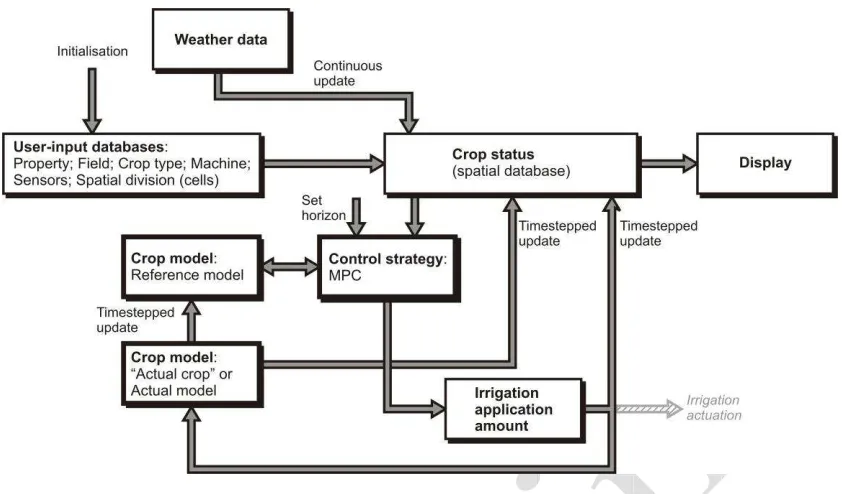
illustrate the VARIwise configuration used to evaluate MPC a general schematic is 177
presented in Figure 1, in which the central blocks and data flows are explained in the 178
following sections. 179
180
Insert Figure 1 here 181
182
The MPC algorithm predicts how much each output (e.g. soil-water, fruit load) will 183
deviate from a time series trajectory within the prediction horizon. A MPC cost 184
function J(k) is calculated for each possible set of input actions in the current time 185
step k using a least squares algorithm of the following form (Maciejowski 2002): 186
187
(1) 188
189
where: 190
J(k) = cost function at instant k
C = length of prediction/control horizon N = number of system outputs
= weighting coefficient for output j
= predicted value of jth output at future instant
= target value of jth output at future instant
191
The control action that minimises the cost function (i.e. that produces the smallest 192
9
optimisation is repeated at each sample time step to update the optimal input 194
trajectory after a feedback update. Hence, this MPC algorithm calculates the 195
sequence of control action adjustments over a specified future time interval. 196
197
In an irrigation context, the system outputs used to calculate the cost function will 198
typically have different units and magnitudes, and the same percentage change in 199
variables of different units and magnitudes may cause unintentional bias toward 200
variables that are generally larger in magnitude. For example, a particular percentage 201
difference in soil-water will produce a larger cost function than the same percentage 202
difference in leaf area index. Hence, the MPC algorithm was modified (equation 2) to 203
calculate a performance index that represents a percentage difference in the predicted 204
outputs rather than a least squares objective function (equation 1). The control action 205
that maximises the performance index PI(k) is then implemented in each time step, 206
and is calculated using the equation: 207
208
(2) 209
210
The MPC methodology was implemented to determine irrigation timing and site-211
specific irrigation volumes on a daily basis by means of the following four-step 212
procedure: 213
1. Update measured and forecast weather data 214
2. Calibrate crop model 215
3. Optimise irrigation volume for each zone 216
4. Optimise day of next irrigation 217
10
The details of each step in relation to the following case studies are set out below. 219
This procedure is independently applied to each ‘management zone’, where each zone 220
in the field is defined according to differing soil and crop properties across the 221
heterogeneous field. 222
223
2.1 Step 1: updating measured and forecast weather data 224
For each day of the crop season, the meteorological data input file for the integrated 225
crop model was updated to include the previous day’s weather and the updated 226
weather forecast for the farm’s location. In a field implementation of MPC, the 227
‘previous day’s weather’ could be obtained from an on-site weather station and the 228
‘updated weather forecast’ could be obtained from the Bureau of Meteorology. 229
However, to simulate the performance of MPC for a whole season (where there was 230
no field implementation) both ‘previous day’s weather’ and ‘updated weather 231
forecast’ had to be obtained from historical data. 232
233
Because of the high variability of Australian climate and the difficulty in picking a 234
‘typical’ year, an artificial daily meteorological dataset was created by averaging the 235
day-on-day data of the five years (1999 to 2004 inclusive) appropriate to the location 236
of Dalby (Latitude -28.18°N E, Longitude 151.26°), a major cotton-growing region of 237
south-east Queensland, Australia, and this dataset was used for all simulations. Daily 238
data comprised maximum and minimum temperature, solar radiation and rainfall, and 239
was sourced from Australian Bureau of Meteorology SILO patched point 240
environmental dataset (QNRM 2009). SILO is an enhanced climate database 241
containing Australian climate data from 1889. 242
11
Forecast weather data, to be used predictively during the simulations, was created by 244
imposing a Gaussian distribution of variability on the daily values of the five-year-245
averaged dataset using standard deviations of ±5°C, ±5°C, ±5 W.hr/m2 and ±50% for 246
maximum temperature, minimum temperature, daily solar radiation and rainfall, 247
respectively; i.e. for any given day, the forecast one, two and three days ahead, then 248
values for each variable randomly generated within each distribution by taking that 249
day’s values as the mean. For each day, only three days of the forecast weather data 250
were used. This is because the two Australian short-term numerical weather 251
prediction models forecast three and seven days ahead and are combined to improve 252
the prediction accuracy (Ebert 2001). The three-day forecast would be more accurate 253
than one model on its own because both models could predict weather to three days. 254
A three-day forecast would ensure short-term prediction accuracy in the predictions, 255
particularly as regards rainfall in south-east Queensland, Australia, where the summer 256
rainfall is dominated by frontal bands of isolated cumulo-nimbus storms. 257
258
2.2 Step 2: calibrating the crop model – ‘actual’ and ‘reference’ models 259
The crop model OZCOT is utilised by VARIwise and can be automatically and 260
continuously calibrated according to the ‘currently’ available weather, plus soil and 261
plant data, using the procedure set out in McCarthy et al. (2011). The procedure for 262
calibrating the production/growth model OZCOT in a real-time implementation, i.e. 263
for actual irrigation machine control, involves automatically and iteratively adjusting 264
the parameters used to predict soil water status and plant growth until the difference 265
between the predicted and sensed variables reached a minimum. For the cotton model 266
OZCOT, the plant variables (leaf area index, boll count, square count), soil variables 267
12
minimum and maximum temperature, rainfall and solar radiation in weather input 269
file) are interdependent. The plant behaviour can be calibrated by adjusting 270
parameters in a crop properties file, whilst the soil moisture behaviour was calibrated 271
by adjusting parameters in a soil properties file. These parameters were adjusted 272
between the minimum and maximum values of the corresponding parameters in the 273
predefined soil properties and crop variety parameter profiles. The parameters 274
adjusted in the crop properties file included squaring rate (the rate of new flower buds 275
being produced), growth rate of leaf area and plant population constant; whilst the 276
parameters adjusted in the soil properties file were the initial soil moisture content and 277
drained upper limit in each soil layer. 278
279
A ‘reference’ model, labelled ‘RefModel’, is used to provide the crop growth 280
prediction scenario for MPC. However, for the present case studies there was no 281
measured field data input to calibrate the model. To overcome this, a second OZCOT 282
model of the cotton crop was used in place of ‘actual’ field conditions. This model is 283
referred to as the ‘actual crop’ model, labelled ‘AcModel’ and the parameters were 284
different to those in RefModel to emulate RefModel not exactly following the field 285
conditions. In a field implementation the AcModel is not required as field 286
measurements would be used. AcModel was then used to calibrate RefModel (Figure 287
1). 288
289
The crop and soil properties of AcModel were obtained from the user-specified soil 290
and plant measurements (and these varied between simulations, as set out below). 291
Within RefModel the crop variety was specified by the user at commencement. 292
13
areal variation in available soil-water imposed via a Gaussian distribution of 294
variability having a standard deviation of ±25 mm (water depth equivalent). 295
296
2.3 Step 3: optimising irrigation volumes for each zone 297
Optimal irrigation volumes were determined by iteratively simulating the daily 298
application of sixteen different irrigation volumes at 1 mm increments between 0 and 299
15 mm on each zone in the field. For each irrigation volume applied (for management 300
zone k), a performance index PI(k) was calculated using equation (2). For variables 301
that are maximised to achieve the optimal irrigation strategy (e.g. square count, yield, 302
crop water use efficiency), the target value is taken to be the maximum realistic 303
commercially attainable value (e.g. 15 bales/ha for cotton yield, 3 bales/ML for crop 304
water use efficiency). 305
306
The predicted process outputs used to calculate the PI were taken one day after the 307
irrigation application. The optimal irrigation volume for each zone was the irrigation 308
volume with the highest PI; however, if more than one irrigation volume had the same 309
PI then a water-efficient approach was taken and the optimal irrigation volume was 310
the lowest quantitative volume that achieved the maximum PI. The irrigation volume 311
was then calculated for each zone in the order in which the irrigation machine was to 312
pass over the field. 313
314
2.4 Step 4: optimising the timing (day) of the next irrigation 315
The optimal day for the next irrigation event was determined using the calibrated 316
RefModel. This involved performing the irrigation volume optimisation of the 317
14
the assumption that the irrigation event could occur on only one of the days. The 319
maximum horizon length was set to three days since three days of predictive weather 320
were used. 321
322
The sixteen irrigation volumes tested on each zone depend on the irrigation day being 323
tested. This is because, unless rainfall occurs, it was assumed that the crop water 324
requirement (and hence irrigation application volume) increases for each day the 325
irrigation event is delayed. For the first day irrigation volumes of 0 to 15 mm were 326
tested with increments of 1 mm; for the second day 0 to 31 mm were tested with 327
increments of 2 mm; and for the third day 0 to 47 mm were tested with increments of 328
3 mm. 329
330
A PI is calculated for each irrigation day by summing the individual PI values for 331
each zone. The day with the highest total PI is taken to be the optimal day for the 332
next irrigation event. The irrigation event is scheduled if the first day in the horizon 333
had the highest PI and there are a minimum number of zones requiring irrigation 334
greater than 0 mm. This ensures that the irrigation application is practical and 335
irrigations are not initiated for only a small number of zones in the field. The 336
threshold, i.e. the minimum proportion of zones requiring irrigation, was arbitrarily 337
selected to be 15% for the case studies presented. 338
339
2.5 Subsequent iteration 340
After the optimal irrigation action – which may, of course, be a ‘nil irrigation’ action 341
15
subsections above was repeated every day throughout the crop season, with the 343
irrigation events ending on a day specified by the user. 344
345
3. MPC CASE STUDY A: optimisation of short-term responses using different 346
combinations of daily input data 347
The MPC strategy was evaluated with daily input data to predict and control irrigation 348
applications to achieve either a short-term soil (e.g. deficit) or plant growth (e.g. leaf 349
area index) target. A range of combinations of input variables for control were used 350
to determine which input data stream was most useful for MPC. 351
352
3.1 Methodology for Case Study A 353
The field was automatically divided into 44 zones, each of area approximately 0.3 ha, 354
and the irrigations occurred daily. This number of zones enabled the simulations to be 355
executed in a timely manner with spatially variable soil properties across the field. 356
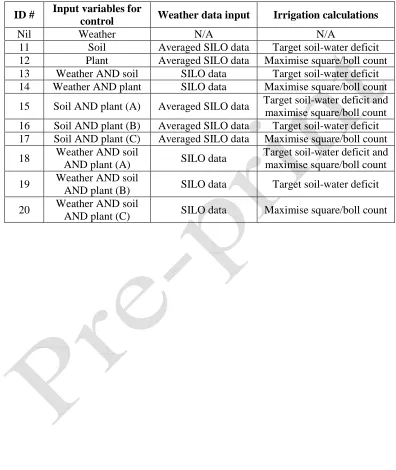
The MPC strategy was evaluated for ten combinations of data input (Table 1). The 357
input data combinations represent the data used both as input variables to calibrate 358
RefModel and the variables used for control. For the simulations using both soil and 359
plant data, the weighting on each variable was set to be 0.5. The strategies with soil 360
data input aimed for soil-water deficit equal to 10% of the plant available water 361
capacity in each zone. 362
363
Insert Table 1 here 364
365
In each simulation, the RefModel (to be calibrated) used the Siokra V16RR cotton 366
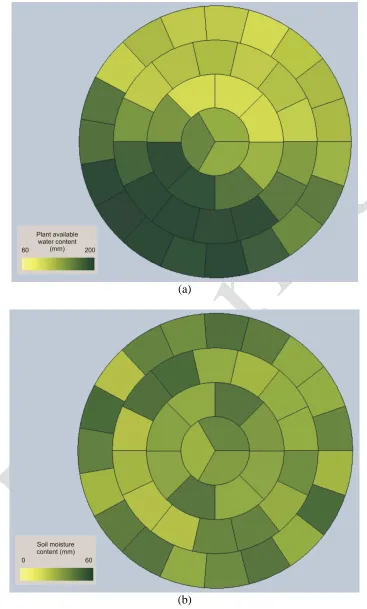
16
starting soil-water deficit as set out in Figure 2. The starting soil-water deficit map 368
was generated by assigning a starting soil-water deficit value of 30 mm across the 369
field and imposing a Gaussian distribution of variability with standard deviation ±10 370
mm on each zone. The PAWC map was generating by assigning PAWC values of 60, 371
150 and 200 mm on three zones of the fields, spatially interpolating the PAWC using 372
ordinary kriging and by similarly imposing a Gaussian distribution of variability with 373
standard deviation ±10 mm on each zone. The PAWC ranges from 60 to 200 mm in 374
the simulated field to ensure the control strategies could deal with the different soil 375
types that often exist within fields. 376
377
Insert Figure 2 here 378
379
The measured crop response (AcModel) used the Sicot 73 cotton variety and soil 380
variability map of Figure 2. Siokra V16RR is a “Roundup Ready” late-maturing 381
cotton variety, whilst Sicot 73 is a full season cotton variety with high yield potential 382
(CSD 2009). The prediction horizon was one day and it was practical for irrigation 383
events to occur daily. 384
385
3.2 Case Study A – Results and discussion 386
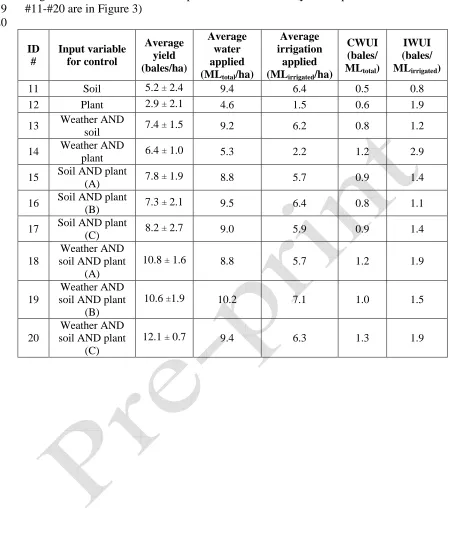
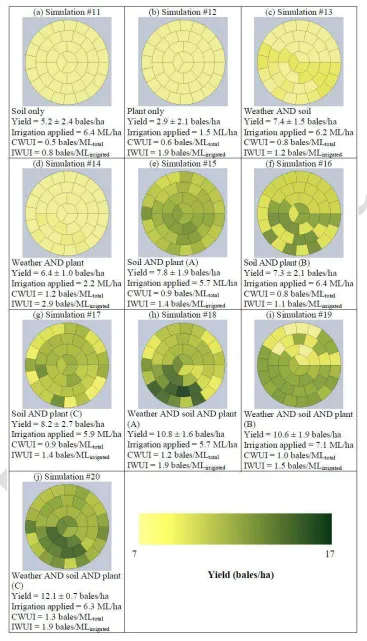
Table 2 sets out the numerical results of the MPC Case Study A, whilst Figure 3 387
illustrates the spatial variability of the yield for each simulation of the case study. The 388
performance of the control strategies are compared based on the average and 389
variability of the yield, irrigation applied, Irrigation Water Use Index (IWUI) and 390
Crop Water Use Index (CWUI) across the zones in the field. The variability reflects 391
17
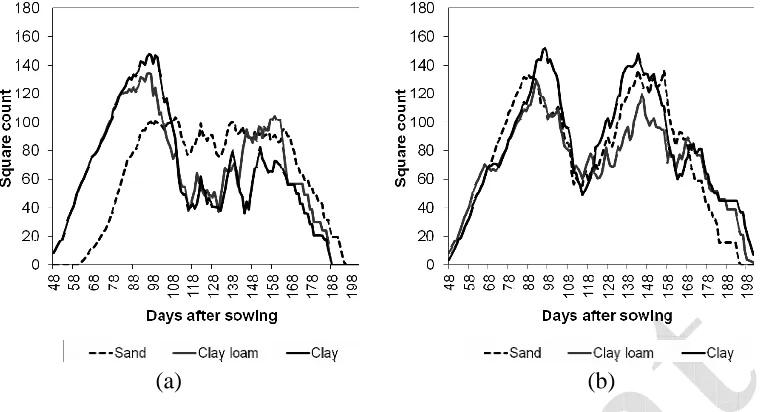
The strategies that use weather-and-plant data to calibrate and target a fixed soil-393
water (simulation #19) and maximise square/boll count (simulation #20), are also 394
compared using the simulated soil-water deficit (Figure 4) and simulated square count 395
(Figure 5) throughout the crop season. 396
397
Insert Table 2 here 398
Insert Figure 3 here 399
Insert Figure 4 here 400
Insert Figure 5 here 401
402
The simulated yield and water use efficiency increased as more data streams were 403
included in the input data combination. This is shown in Table 2 as the single-input 404
simulations produced the lowest yields and water use efficiencies (simulations #11 405
and #12) while the three simulations having three data inputs (simulations #18, #19 406
and #20) performed better than all of the five simulations having two data inputs 407
(simulations #13 to #17 inclusive). 408
409
The data combinations with soil data and no plant data (simulations #11 and #13) 410
resulted in higher yields than those with plant data and no soil data (simulations #12 411
and #14). This result suggests that if only one data input is available then soil data 412
input is most effective for calibrating RefModel and for irrigation control. The 413
simulations using combinations of soil and plant data input to determine the irrigation 414
volumes (simulations #15 and #18) generally produced lower yields and water use 415
efficiencies than those using only plant data input to determine the irrigation volumes 416
18
example, for the strategies with soil and plant data available to calibrate RefModel, a 418
higher yield was simulated when the strategy maximised the square/boll count 419
(simulation #17) than when the strategy attempted to both maintain soil-water and 420
maximise square count (simulation #15). Hence, in this case there was no obvious 421
benefit in the using multiple variables to determine the application volumes. 422
423
The MPC strategy accurately maintained the soil-water deficit threshold during low 424
rainfall periods of the crop season for simulation #19 (63 to 85 days after sowing, 425
Figure 4(a)). For the MPC strategy that maximised square/boll count (simulation 426
#20), the soil-water deficit was always higher than the soil-water deficit threshold that 427
was approximately maintained in simulation #19 throughout the crop season (Figure 428
4(b)). The soil-water deficit was also lowest in the sand zone (with the lowest plant 429
available water capacity) and highest in the clay zone (with the highest plant available 430
water capacity) throughout the crop season for the strategy optimising square count. 431
This indicates that to maximise the square count, the soil-water deficit should be 432
reduced in proportion with the plant available water capacity of the soil. 433
434
The highest yield was achieved using weather-soil-and-plant input and maximising 435
square count (simulation #20). The square count was higher throughout the crop 436
season for this simulation compared with that for MPC maintaining soil-water deficit 437
(simulation #19) (Figure 5). Hence, the implemented MPC strategy successfully 438
increased the simulated square count and improvements in yield (by 14%) and crop 439
water use efficiency (by 30%) were observed by maximising square count instead of 440
targeting soil-water. 441
19
4. MPC CASE STUDY B: optimisation using a predicted end-of-season yield or 443
water use efficiency target 444
The MPC strategy uses RefModel to forecast the response of cotton crop with specific 445
environmental conditions and soil and crop properties; hence, the irrigation 446
volume/timing may be adjusted to achieve a desired predicted end-of-season output, 447
in this case a final yield or water use efficiency. This is in contrast to Case Study A in 448
which the MPC strategy used daily input data (e.g. square count, soil-water) to predict 449
the best short-term response to a range of irrigation volumes. 450
451
4.1 Methodology for Case Study B 452
The field was automatically divided into 44 zones as per the previous case study and 453
the irrigations could occur daily. The MPC strategy was evaluated for crop seasons 454
with and without rainfall and with two levels of initial nitrogen content (120 kg/ha 455
and 250 kg/ha). The same weather dataset was used for both these sets of 456
simulations; however the daily rainfall was set to zero for the simulations without 457
rainfall. In the simulations with rainfall there was high rainfall during days 63 to 85 458
after sowing. 459
460
The MPC strategy was used to optimise the predicted Irrigation Water Use Index 461
(IWUI), Crop Water Use Index (CWUI) and yield assuming the machine capacity 462
enabled the machine to traverse the field once every day. An algorithm maximising 463
IWUI or CWUI may decide to apply no irrigation to minimise the irrigation volume 464
but would also produce low yield. Hence, to ensure that the IWUI and CWUI 465
optimisation would irrigate the crop, the minimum acceptable yield was arbitrarily set 466
20 468
4.2 Case Study B – Results and discussion 469
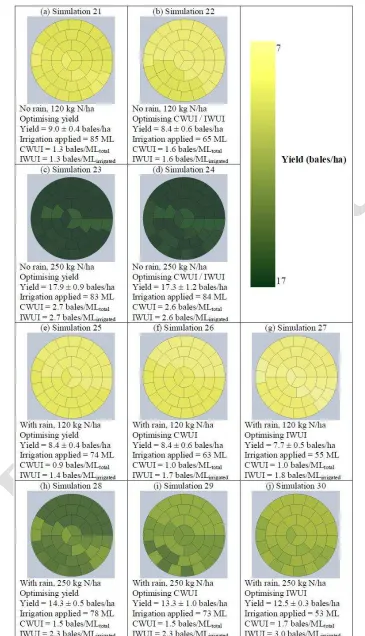
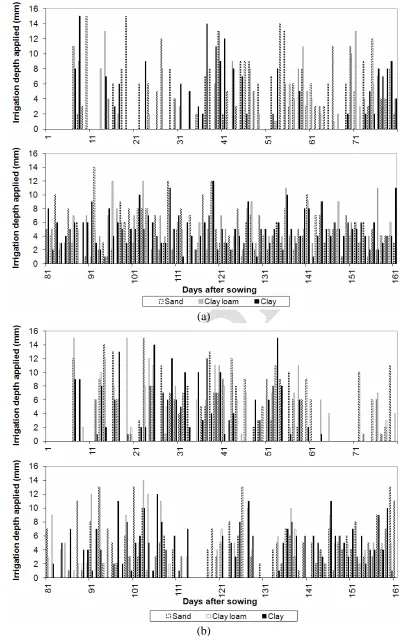
The simulation results are displayed in Table 3 and Figure 6 and the spatially varied 470
irrigation volumes applied are compared with different in-season rainfall and starting 471
nitrogen content at commencement (Figure 7 and Figure 8, respectively). 472
473
Insert Table 3 here 474
Insert Figure 6 here 475
Insert Figure 7 here 476
Insert Figure 8 here 477
478
For each set of field conditions (i.e. starting nitrogen content and in-season rainfall), 479
the simulated yield was highest for the MPC strategy that optimised yield (simulations 480
#21, #23, #25 and #28). Similarly, the strategies optimising IWUI (simulations #27 481
and #30) and CWUI (simulations #26 and #29) produced the highest respective IWUI 482
and CWUI of the simulations with the same field conditions. This indicates that MPC 483
strategy could adjust the irrigation application to improve either yield or water use 484
efficiency. 485
486
Increasing the starting nitrogen content significantly improved the simulated yield and 487
water use efficiency. This is shown in Table 3 as the yield for the no-rainfall 488
simulation with the higher nitrogen content of 250 kg N/ha (e.g. 17.9 bales/ha for 489
simulation #23) was nearly double that of the simulation with the lower nitrogen 490
content of 120 kg N/ha (e.g. 9.0 bales/ha for simulation #21). Since the irrigation 491
21
IWUI of the higher nitrogen content simulations were also nearly double that of the 493
lower nitrogen content simulations. Hence, nitrogen application had a significant 494
effect on the final yield without greatly affecting the irrigation volume required to be 495
applied. 496
497
Rainfall significantly affected the simulated yield and CWUI (Table 3). Table 3 498
shows that the yields, irrigation applications and CWUI of simulations #21-#24 499
(without rainfall) are higher than those of simulations #25-#30 (with rainfall). This 500
suggests that the crop is easier to control with less rainfall in the season. The 501
difference in yield and CWUI is most noticeable for simulations with high nitrogen 502
content (e.g. simulation #28 with rainfall and simulation #23 without rainfall) because 503
the simulated yields are higher and the differences between the yields are more 504
apparent. It follows that during the period of the crop season with high rainfall (63 to 505
86 days after sowing), lower irrigation volumes were applied compared to the periods 506
of no rainfall (87 to 105 days after sowing) (Figure 7). 507
508
The rainfall did not generally affect the IWUI for the simulated set of field conditions 509
(e.g. simulation #21 with no rainfall versus simulation #25 with rainfall). This is 510
because more rainfall caused both the yield and irrigation application (which are used 511
to calculate the IWUI) to decrease by approximately the same proportion. 512
513
5. MPC CASE STUDY C: optimisation using a predicted end-of-season target, 514
with limited calibration data 515
The MPC simulations of the Case Study B assumed that the full data input of weather, 516
22
data streams may not be available in a field implementation. Case Study C evaluates 518
the usefulness of different data streams to calibrate RefModel in a MPC strategy with 519
a predicted end-of-season target. 520
521
5.1 Methodology for Case Study C 522
The seven possible input data combinations (Table 2) were separately evaluated as 523
input for RefModel calibration. The datasets were obtained daily from the cotton 524
model Sicot 71B and used to calibrate the Siokra V16RR cotton model. The field and 525
weather conditions were as used in the earlier case studies, the MPC strategy 526
optimised yield and the irrigations occurred daily. 527
528
5.2 Case Study C – Results and discussion 529
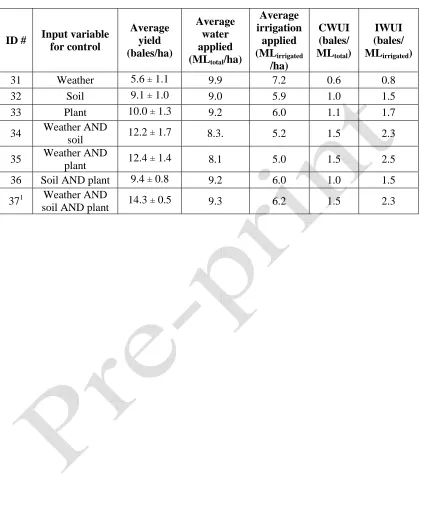
Table 4 and Figure 9 set out a comparison of an MPC strategy that maximises yield 530
with different combinations of input data to calibrate RefModel. The use of more 531
information in the input data combination generally increased the average yield and 532
water use efficiency (Table 4). Table 4 shows that MPC performance with all three 533
input variables (simulation #37/#28) was superior to that with any two variables 534
(simulations #34-#36); and similarly performance with two input variables was 535
superior to that with any single input variable alone, except plant input (simulation 536
#33) versus soil-and-plant input (simulation #36). This suggests that the MPC 537
calibration performs better with soil data input than plant data input. 538
539
Insert Table 4 here 540
Insert Figure 9 here 541
23
The lowest yields and water use efficiencies were simulated with only weather data 543
input (e.g. simulations #31). This is because the weather data (without field-specific 544
soil or crop data) provides no information to adequately parameterise the crop model 545
used by the MPC strategy. This could lead to insufficient model calibration and sub-546
optimal irrigation volumes being determined. The irrigation water use efficiency was 547
higher using the weather and plant combination (simulation #35) than using the full 548
data input (simulation #37/#28): this is because the yield was maximised rather than 549
the water use efficiency in this case study. 550
551
6. GENERAL DISCUSSION 552
A Model Predictive Control strategy was successfully implemented in VARIwise. 553
The controller uses currently available field data to calibrate the OZCOT cotton 554
production model and then evaluates a range of irrigation volumes and timings in each 555
zone. The controller then implements the site-specific irrigation volumes on the day 556
that achieves the highest water use efficiency or yield averaged over the field, as user 557
specified. 558
559
Three alternative optimisation possibilities were identified and explored, and the 560
conclusions for each, and their comparison, are as set out below. In each case the 561
MPC strategy performed successfully in the (simulated) task of controlling an 562
automatic irrigation machine applying spatially-varied irrigation amounts. For 563
convenience, Table 5 gathers together the particular simulation outputs referred to in 564
this section. Table 5 also compares results of MPC with two sensor-based control 565
strategies, namely Iterative Learning Controller (ILC) and Iterative Hill Climbing 566
24
with 1266 zones, and the same weather profile and crop variety (as detailed in 568
McCarthy et al. 2013). These sensor-based strategies refine the estimate of each 569
successive irrigation volume applied by: 570
[ILC] – iteratively adjusting the irrigation volume applied in each zone of the field 571
using the incremental response, i.e. the OZCOT-determined plant growth arising 572
from the change in particular field sensor information which has resulted from the 573
previous water application, in each zone; or 574
[IHCC] – similarly adjusting the irrigation volumes, but based on multiple sensor 575
increment information, using a range of irrigation volumes applied within a group 576
of homogenous zones. 577
578
Insert Table 5 here 579
580
The performance of the MPC strategy was also compared with an industry-standard 581
irrigation strategy (first line of Table 5). This strategy applied a uniform irrigation 582
treatment (25 mm) across the field and initiated irrigation events when the soil-water 583
deficit reached a set amount (30 mm) in one point in the field (in the cell with sandy 584
soil). The soil-water deficit was taken in the cell with the lowest plant available water 585
capacity, as this is the most limiting soil. To ensure validity of the comparison this 586
simulation was executed using the same weather conditions and spatially variable 587
plant available water capacity and starting soil-water, and crop variety as the reference 588
model. The nitrogen content was set to 250 kg/ha. 589
590
The MPC strategy was evaluated with different combinations of input data (section 3 591
25
maximised the square count and calibrated the model using all three streams of data 593
input (weather, soil and plant, simulation #20). The yield and water use efficiency 594
were also higher than those of the industry-standard irrigation management strategy 595
(McCarthy et al. 2013), and also ILC (simulation #1) and IHCC (simulation #9) with 596
either weather-soil-and-plant, weather-and-soil or weather-and-plant data input 597
available (likewise refer McCarthy et al. 2013). However, the MPC (optimising daily 598
input data) performed worse than the ILC and IHCC where there was only either soil 599
input (simulation #11) or weather-and-plant (simulation #14) input data available. 600
601
The controller successfully adjusted the irrigation to improve the yield, CWUI or 602
IWUI, as appropriate (Section 4). The yield was higher with high nitrogen content 603
(e.g. simulation #28) than with low nitrogen content (simulation #25) and with no 604
rainfall during the crop season (simulation #23) compared with high rainfall 605
(simulation #28). This is because the control strategy could better control the water 606
applied in response to the other environmental factors. The simulated average yields 607
and water use efficiencies were significantly higher than the industry-standard 608
irrigation management strategy, ILC strategy (simulation #1) and IHCC strategy 609
(simulation #9) (McCarthy et al. 2013). 610
611
MPC was evaluated with different combinations of input data available to calibrate 612
the model (Section 5). The controller performed best with input of weather-soil-and-613
plant data (simulation #28), but still produced higher yields and water use efficiencies 614
with weather-and-soil (simulation #34) or weather-and-plant (simulation #35) input 615
than the irrigation-standard irrigation management strategy, and ILC (simulation #1) 616
26 618
Higher yields and water use efficiencies were produced for MPC optimising predicted 619
end-of-season data (simulation #28) than for MPC using daily input data to maximise 620
square count (simulation #20). However, both of these control strategies required 621
either the full data input, weather-and-soil or weather-and-plant data input to obtain 622
yields higher than the ILC or IHCC strategies. 623
624
7. CONCLUSION 625
The Model Predictive Control strategy implemented in the control simulation 626
software VARIwise performed successfully in the task of controlling an automatic 627
irrigation machine applying water to a simulated cotton crop grown in typical 628
conditions for south-east Queensland, Australia. In all simulations the MPC strategy 629
specified ‘sensible’ irrigation amounts typical of irrigation practice in this region. 630
Simulations using the MPC strategy indicated that the MPC strategy could be 631
successfully used to either maximise crop yield, or crop and irrigation water use 632
efficiencies. 633
634
The MPC strategy produced significantly higher yield and crop water use efficiency 635
than the sensor-based strategies for the same (simulated) field conditions (similarly 636
simulated in VARIwise and reported in McCarthy et al. 2013). However, MPC 637
required weather-soil-and-plant, weather-and-soil or weather-and-plant information to 638
accurately calibrate the crop model. This indicates (for cotton grown as stated) that 639
whilst the MPC-based strategies are potentially superior, sensor-based strategies may 640
be more appropriate for field implementations where there is limited data availability. 641
27
Finally, we note here that direct field evaluation is particularly challenging, because 643
direct comparison requires replicated plots having the same soil types and 644
distributions, and with simultaneous operation such that each experiences the same 645
weather conditions. In principal at least, an alternative to achieve such a comparison 646
would be to determine variability of soil properties under an irrigation system, a 647
priori, and then define plots of the same soil type such that the irrigation application 648
could be adjusted according to different MPC strategies, and in comparison with 649
industry-standard control (e.g. calculated using evapotranspiration or soil-water). 650
651
Field evaluations would enable the sensing and control hardware requirements and 652
performance of autonomous, adaptive control strategies to be compared with industry-653
standard irrigation. These control strategies would determine irrigation application 654
and timing using a black-box control system based on sensed inputs and sends control 655
signals to irrigation actuation hardware. This will potentially lead to the optimisation 656
of irrigation water use and yield under different climate scenarios and water 657
availability situations. 658
659
Acknowledgements 660
The authors are grateful to the Australian Research Council and the Cotton Research 661
and Development Corporation for funding a postgraduate studentship for the senior 662
author; and to the anonymous reviewers for suggestions concerning potential field 663
evaluation. 664
665
28
CSD (2009) Cotton Seed Distributors Ltd. Viewed 10 December 2009, 667
http://www.csd.net.au/. 668
669
Ebert, EE (2001) Ability of a poor man’s ensemble to predict the probability and 670
distribution of precipitation. Monthly Weather Review 129:2461-2480. 671
672
Kwon, W. and Han, S. (2005) Receding horizon control: model predictive control for 673
state models. Advanced textbooks in control and signal processing, Springer-Verlag, 674
London. 675
676
Maciejowski, J.M. (2002) Predictive control with constraints. Pearson Eduation 677
Limited, Essex. 678
679
McCarthy, A.C., Hancock, N.H. and Raine S.R. (2010a) VARIwise: a general-680
purpose adaptive control simulation framework for spatially and temporally varied 681
irrigation at sub-field scale. Computers and Electronics Agriculture 70(1):117-128. 682
683
McCarthy, A.C., Hancock, N.H. and Raine, S.R. (2010b) Simulation of site-specific 684
irrigation control strategies with sparse input data. In: CIGR 2010: Sustainable 685
Biosystems Through Engineering, 13-17 June 2010, Quebec City, Canada. 686
687
McCarthy, A.C., Hancock, N.H. and Raine, S.R. (2011) Real-time data requirements 688
for model-based adaptive control of irrigation scheduling in cotton. Australian 689
Journal of Multi-disciplinary Engineering 8(2):189-206. 690
29
McCarthy, A.C., Hancock, N.H. and Raine, S.R. (2013) Development and simulation of 692
sensor-based irrigation control strategies for cotton using the VARIwise simulation 693
framework. Submitted to Computers and Electronics in Agriculture 694
695
Park, Y., Shamma, J. and Harmon, T. (2009) A receding horizon control algorithm for 696
adaptive management of soil moisture and chemical levels during irrigation. 697
Environmental Modelling and Software 24(9):1112-1121. 698
699
QNRM (2009) Queensland Natural Resources and Mines enhanced meteorological 700
datasets. Viewed 4 March 2008, http://www.longpaddock.qld.gov.au/silo/. 701
702
Richards, Q., Bange, M. and Roberts, G. (2001) Assessing the risk of cotton 703
‘earliness’ strategies with crop simulation. In: ‘Proceedings of the 10th Australian 704
Agronomy Conference’, The Australian Society of Agronomy, Hobart. 705
706
Wells, A. and Hearn, A. (1992) OZCOT: a cotton crop simulation model for 707
30 Figures and Tables
[image:30.595.98.494.181.651.2]709 710
Table 1: Simulations (identified by ID #) conducted to compare interactions between 711
control strategies and input variables for Model Predictive Control. N/A indicates 712
non-applicable and SILO indicates use of historical climate data. (Simulations #1 to 713
#10 not tabulated here are those undertaken for sensor-based control, McCarthy et al. 714
(2013).) 715
716
ID # Input variables for
control Weather data input Irrigation calculations
Nil Weather N/A N/A
11 Soil Averaged SILO data Target soil-water deficit 12 Plant Averaged SILO data Maximise square/boll count 13 Weather AND soil SILO data Target soil-water deficit 14 Weather AND plant SILO data Maximise square/boll count 15 Soil AND plant (A) Averaged SILO data Target soil-water deficit and maximise square/boll count 16 Soil AND plant (B) Averaged SILO data Target soil-water deficit 17 Soil AND plant (C) Averaged SILO data Maximise square/boll count 18 Weather AND soil
AND plant (A) SILO data
Target soil-water deficit and maximise square/boll count 19 Weather AND soil
AND plant (B) SILO data Target soil-water deficit 20 Weather AND soil
31
Table 2: Performance of the model predictive control strategy with variable-rate 717
irrigation machine for different input data combinations (yield maps of simulations 718
#11-#20 are in Figure 3) 719
720
ID #
Input variable for control
Average yield (bales/ha)
Average water applied (MLtotal/ha)
Average irrigation
applied (MLirrigated/ha)
CWUI (bales/ MLtotal)
IWUI (bales/ MLirrigated)
11 Soil 5.2 ± 2.4 9.4 6.4 0.5 0.8
12 Plant 2.9 ± 2.1 4.6 1.5 0.6 1.9
13 Weather AND
soil 7.4 ± 1.5 9.2 6.2 0.8 1.2
14 Weather AND
plant 6.4 ± 1.0 5.3 2.2 1.2 2.9
15 Soil AND plant
(A) 7.8 ± 1.9 8.8 5.7 0.9 1.4
16 Soil AND plant
(B) 7.3 ± 2.1 9.5 6.4 0.8 1.1
17 Soil AND plant
(C) 8.2 ± 2.7 9.0 5.9 0.9 1.4
18
Weather AND soil AND plant
(A)
10.8 ± 1.6 8.8 5.7 1.2 1.9
19
Weather AND soil AND plant
(B)
10.6 ±1.9 10.2 7.1 1.0 1.5
20
Weather AND soil AND plant
(C)
32
Table 3: Performance of the model predictive control strategy with variable-rate 721
irrigation machine for different weather data inputs, starting nitrogen contents and 722
optimised variables (yield maps of simulations #21-#30 are in Figure 6) 723
724
ID #
Optimised variable
Rainfall (mm)
Initial nitrogen
content (kg/ha)
Average yield (bales/
ha)
Average water applied (MLtotal/ha)
Average irrigation
applied (MLirrigated/ha)
CWUI (bales/ MLtotal)
IWUI (bales/ MLirrigated)
21 Yield 0 120 9.0 ± 0.4 6.8 6.8 1.3 1.3
22 CWUI/Yield 0 120 8.4 ± 0.6 5.2 5.2 1.6 1.6
23 Yield 0 250 17.9 ±
0.9 6.6 6.6 2.7 2.7
24 IWUI/Yield 0 250 17.3 ±
1.2 6.5 6.5 2.7 2.7
25 Yield 302 120 8.4 ± 0.4 9.0 5.9 0.9 1.4
26 CWUI 302 120 8.4 ± 0.6 8.1 5.0 1.0 1.7
27 IWUI 302 120 7.7 ± 0.5 7.5 4.4 1.0 1.8
28 Yield 302 250 14.3 ±
0.5 9.3 6.2 1.5 2.3
29 CWUI 302 250 13.3 ±
1.0 7.8 4.7 1.7 2.8
30 IWUI 302 250 12.5 ±
33
Table 4: Performance of the model predictive control strategy optimising yield for 725
crop season with rainfall and 250 kg/ha of available nitrogen for different input data 726
combinations, where simulation #371 is a duplication of simulation #28 for 727
comparison (yield maps of simulations #31-#37 are in Figure 9) 728
729
ID # Input variable for control
Average yield (bales/ha)
Average water applied (MLtotal/ha)
Average irrigation
applied (MLirrigated
/ha)
CWUI (bales/ MLtotal)
IWUI (bales/ MLirrigated)
31 Weather 5.6 ± 1.1 9.9 7.2 0.6 0.8
32 Soil 9.1 ± 1.0 9.0 5.9 1.0 1.5
33 Plant 10.0 ± 1.3 9.2 6.0 1.1 1.7
34 Weather AND
soil 12.2 ± 1.7 8.3. 5.2 1.5 2.3
35 Weather AND
plant 12.4 ± 1.4 8.1 5.0 1.5 2.5
36 Soil AND plant 9.4 ± 0.8 9.2 6.0 1.0 1.5
371 Weather AND
34
Table 5: Control strategy simulation outputs where the initial nitrogen content is 250 730
kg/ha and there is rainfall during the crop season unless otherwise noted. 731
732
ID # Control strategy Input variable for control Average yield (bales/ha) Average water applied (MLtotal/ha)
Average irrigation
applied (MLirrigated/ha)
CWUI (bales/ MLtotal)
IWUI (bales/ MLirrigated)
N/AA
Industry-standard Nil 9.1 ± 1.9 10.2 6.8 0.9 1.4
1A ILC Soil 12.2 ± 1.5 11.0 7.3 1.1 1.7
9A IHCC Soil AND
plant 12.4 ± 1.6 12.2 8.1 1.0 1.5
11 MPC (daily
input) Soil 5.2 ± 2.4 9.4 6.4 0.5 0.8
14 MPC (daily input)
Weather AND plant
6.4 ± 1.0 5.3 2.2 1.2 2.9
20 MPC (daily input)
Weather AND soil
AND plant
12.1 ± 0.7 9.4 6.3 1.3 1.9
23 MPC (end- of-season input)1
Weather AND soil
AND plant
17.9 ± 0.9 6.6 6.6 2.7 2.7
25 MPC (end- of-season input) 2
Weather AND soil
AND plant
8.4 ± 0.4 9.0 5.9 0.9 1.4
28/ 37
MPC (end- of-season input)
Weather AND soil
AND plant
14.3 ± 0.5 9.3 6.2 1.5 2.3
34 MPC (end- of-season input)
Weather
AND soil 12.2 ± 1.7 8.3 5.2 1.5 2.3
35 MPC (end- of-season input)
Weather AND plant
12.4 ± 1.4 8.1 5.0 1.5 2.5
A
From McCarthy et al. 2013
733
1
Crop season has no rainfall
734
2 Initial nitrogen content is 250 kg/ha
735
Abbreviations: ILC is Iterative Learning Control, IHCC is Iterative Hill Climbing Control and MPC is
736
Model Predictive Control
35 738
[image:35.595.89.510.68.315.2]739
Figure 1: The simulation framework VARIwise configured to evaluate (in simulation 740
mode) the model-based adaptive control strategy Model Predictive Control (MPC). In 741
this mode, the block ‘AcModel’ (also an OZCOT formulation) has replaced the field 742
data measurements which would normally update ‘RefModel’. (This diagram is 743
adapted from the full VARIwise flowchart presented as Figure 2 of McCarthy et al. 744
36 746
(a) 747
748
749
(b) 750
[image:36.595.113.480.70.679.2]751
Figure 2: Soil variability as calibrated in model predictive control implementation: (a) 752
37 754
[image:37.595.115.482.68.709.2]755
Figure 3: Yield maps and average yield and irrigation outputs of model predictive 756
control strategy for different combinations of data input and legend for yield maps for 757
38 759
(a) (b)
[image:38.595.93.489.72.284.2]760 761
Figure 4: Simulated daily soil-water deficit in sand, clay loam and clay zones for 762
strategies that use weather, soil and plant data for model calibration (RefModel). Set 763
(a): targeting fixed soil-water deficit (simulation #19); and set (b): maximising 764
39 766
(a) (b)
[image:39.595.105.487.78.284.2]767 768
Figure 5: Simulated daily square count in sand, clay loam and clay zones for strategies 769
that use weather, soil and plant data for model calibration (RefModel). Set (a): 770
targeting fixed soil-water deficit (simulation #19); and set (b): maximising square 771
40 773
[image:40.595.114.479.68.704.2]774
Figure 6: Yield maps and average yield and irrigation outputs of model predictive 775
control strategy with variable-rate irrigation machine and legend for yield maps for 776
41 778
(a) 779
780
[image:41.595.94.496.73.709.2](b) 781
Figure 7: Irrigation volumes applied to sand, clay loam and clay zones for simulations 782
#24 and #27 to evaluate effect of rainfall during crop season. The model predictive 783
controller optimised IWUI with 250 kg/ha of available nitrogen and for crop season 784
42 786
(a) 787
788
789
[image:42.595.81.495.67.711.2](b) 790
Figure 8: Irrigation volumes applied to sand, clay loam and clay zones for simulations 791
#25 and #28 to evaluate effect of nitrogen content; the model predictive controller 792
optimised yield for crop season with no rainfall and available nitrogen of: set (a) 120 793
43 795
[image:43.595.90.508.71.612.2]796
Figure 9: Yield maps and average yield and irrigation outputs of model predictive 797
control strategy with variable-rate irrigation machine and legend for yield maps, 798
where simulation #371 is a duplication of simulation #28 for comparison (numerical 799