Using a web-based game to prevent posttraumatic
stress in children following medical events: design
of a randomized controlled trial
Meghan L. Marsac
1,2*, Kristen L. Kohser
3, Flaura K. Winston
3,4,
Justin Kenardy
5, Sonja March
6and Nancy Kassam-Adams
3,71
Child and Adolescent Psychiatry and Behavioral Science, The Children’s Hospital of Philadelphia, Philadelphia, PA, USA;2Department of Psychiatry, University of Pennsylvania, Philadelphia, PA, USA; 3
Department of Pediatrics, The Children’s Hospital of Philadelphia, Philadelphia, PA, USA;4Division of General Pediatrics and Leonard David Institute for Health Economics, University of Pennsylvania, Philadelphia, PA, USA;5Schools of Medicine and Psychology, University of Queensland, Brisbane, Australia;6Department of School of Psychology, Counselling and Community, University of Southern Queensland, Toowoomba, Australia;7Department of Pediatrics, University of Pennsylvania,
Philadelphia, PA, USA
Background: Medical events including acute illness and injury are among the most common potentially traumatic experiences for children. Despite the scope of the problem, only limited resources are available for prevention of posttraumatic stress symptoms (PTSS) after pediatric medical events. Web-based programs provide a low-cost, accessible means to reach a wide range of families and show promise in related areas of child mental health.
Objectives: To describe the design of a randomized controlled trial that will evaluate feasibility and estimate preliminary efficacy of Coping Coach, a web-based preventive intervention to prevent or reduce PTSS after acute pediatric medical events.
Method: Seventy children and their parents will be randomly assigned to either an intervention or a waitlist control condition. Inclusion criteria require that children are aged 812 years, have experienced a medical event, have access to Internet and telephone, and have sufficient competency in the English language to complete measures and understand the intervention. Participants will complete baseline measures and will then be randomized to the intervention or waitlist control condition. Children in the intervention condition will complete module 1 (Feelings Identification) in the hospital and will be instructed on how to complete modules 2 (Appraisals) and 3 (Avoidance) online. Follow-up assessments will be conducted via telephone at 6, 12, and 18 weeks after the baseline assessment. Following the 12-week assessment, children in the waitlist control condition will receive instructions for completing the intervention.
Results: Primary study outcomes include data on intervention feasibility and outcomes (child appraisals, coping, PTSS and health-related quality of life).
Discussion: Results will provide data on the feasibility of the implementation of the Coping Coach intervention and study procedures as well as estimations of efficacy to determine sample size for a larger study. Potential strengths and limitations of this design are discussed.
Keywords: Trauma;early intervention;prevention;Internet;PTSD
*Correspondence to: Meghan L. Marsac, Center for Injury Research and Prevention, The Children’s Hospital of Philadelphia, 3535 Market St., Suite 1150, Philadelphia, PA 19104, USA, Email: marsac@email. chop.edu
Received: 3 May 2013; Revised: 25 June 2013; Accepted: 26 June 2013; Published: 26 July 2013
E
vents related to injury, acute medical illness, and medical treatment are among the most common traumatic experiences of children (Murray & Lopez, 1996). Worldwide, injuries are a leading cause of death and disability for youth (Peden, 2008), with 20 million children suffering unintentional injuries annuallyin the United States alone (Grossman, 2000). Countless children across the globe also experience illnesses that involve disruptive, painful, and potentially traumatic disease episodes and treatment procedures (Marks & McQueen, 2001). For many children, it is not physi-cal recovery but psychosocial sequelae that determine
European Journal of Psychotraumatology 2013. #2013 Meghan L. Marsac et al. This is an Open Access article distributed under the terms of the Creative
Commons Attribution-Noncommercial 3.0 Unported License (http://creativecommons.org/licenses/by-nc/3.0/), permitting all non-commercial use, distribution,
functioning after acute traumatic events. A meta-analysis of medical traumatic stress studies found that an average of 19% children with injuries and 12% children with illness experience significant posttraumatic stress symptoms (PTSS) following their medical event (Kahana, Feeny, Youngstrom, & Drotar, 2006). PTSS are a key predictor of functional outcome and health-related quality of life (HRQOL), may interfere with adherence to medical regi-mens, and have been linked to poorer health outcomes (Graham-Bermann & Seng, 2005; Holbrook et al., 2005; Landolt, Buehlmann, Maag, & Schiestl, 2009; Landolt, Vollrath, Gnehm, & Sennhauser, 2009; Zatzick et al., 2008). Thus, PTSS resulting from medical events are a major health concern for children.
While research has suggested risk and protective factors and mechanisms involved in the development of psycho-logical symptoms following medical trauma, this knowl-edge has not been translated into widely available preventive interventions (Sabin, Zatzick, Jurkovich, & Rivara, 2006; Ziegler, Greenwald, DeGuzman, & Simon, 2005). The Internet provides a low-cost, accessible method for delivery of psychological and health information and interventions. More than 75% of US and European children have Internet access at home (Child Trends DataBank, 2003; Livingstone & Haddon, 2009). Further-more, there is growing empirical support for the efficacy of using the Internet to deliver cognitive behavior inter-ventions to children and parents (Magee, Ritterband, Thorndike, Cox, & Borowitz, 2009; March, Spence, & Donovan, 2009; Ruzek et al., 2011; Spence et al., 2011; Spence, Holmes, March, & Lipp, 2006). In particular, Internet interventions have demonstrated efficacy in delivering education and intervention to large numbers of individuals exposed to traumatic events (e.g., military service members; Ruzek et al., 2011). Beyond their broad accessibility, Internet-facilitated interventions may also represent a potentially cost-efficient avenue for the delivery of preventive psychosocial care in the acute phase post-trauma (Mouthaan, Sijbrandij, Reitsma, Gersons, & Olff, 2011). Web-based preventive interventions have the potential to provide children and parents with accessible, just-in-time psycho-education and practical tools for coping with the aftermath of a traumatic medical event.
Coping Coach is an innovative and interactive e-health application that aims to prevent persistent traumatic stress and promote emotional recovery in school-age children after an acute traumatic event. Content and interactive activities were developed for the intervention based on evidence regarding the etiology of traumatic stress, risk and protective pathways, and effective inter-ventions for trauma and anxiety in children.
Targets for preventive intervention
Risk and etiological variables associated with children’s psychological reactions after exposure to acute traumatic
events include pretrauma factors (pre-existing trauma exposure or psychological symptoms); peri-trauma fac-tors (perceived life threat, acute heart rate, and physiolo-gical arousal), and posttrauma factors (acute stress reactions, maladaptive cognitive appraisals, types of cop-ing Bryant, Salmon, Sinclair, & Davidson, 2007a, b; Ehlers, Mayou, & Bryant, 2003; Kahana et al., 2006; Kassam-Adams, 2006; Landolt, Vollrath, & Ribi, 2002; Salmon, Sinclair, & Bryant, 2007; Zehnder, Prchal, Vollrath, & Landolt, 2006). While pre-existing factors are not amenable to change, malleable posttrauma etiolo-gical factors provide an opportunity for secondary pre-vention programs to enhance adjustment (i.e., improve HRQOL) and reduce the development or escalation of psychological symptoms (Graham-Bermann & Seng, 2005; Holbrook et al., 2005; Landolt, Vollrath, Gnehm, & Sennhauser, 2009; Zatzick et al., 2008). Potential malleable targets for the prevention of posttraumatic stress in children that are supported by research evidence include negative appraisals about safety and vulnerability to future harm (Bryant et al., 2007a; Ehlers et al., 2003; Meiser-Stedman, Dalgleish, Glucksman, Yule, & Smith, 2009), the coping strategy of seeking social support (Stallard, Velleman, Langsford, & Baldwin, 2001), and early avoidance behaviors (Ebata & Moos, 1991). Given the strong support for the effectiveness of cognitive-behavioral theory (CBT) interventions to treat mood and anxiety symptoms in children and teens (Cohen & Mannarino, 2008; Kenardy, Spence, & Macleod, 2006; March et al., 2009; O’Kearney, Kang, Christensen, & Griffiths, 2009; Spence et al., 2011), secondary prevention may also benefit from a CBT approach. Coping Coach uses CBT principles, integrating interactive activities and content, to address each malleable intervention target (i.e., appraisals, social support, avoidance behaviors) in the early posttrauma period.
Web-based health interventions
youth. An initial randomized controlled trial (RCT) (N 56) showed not only a reduction of anxiety and a trend for reduced PTS symptoms among higher risk children but also suggested a need for greater engagement of children with site activities (Cox & Kenardy, 2010). Given the success of BRAVE-online with its interactive features, it may be that increasing the interactive nature of Kids and Accidents could improve its effectiveness. Much remains unknown about optimizing content and imple-menting web-based preventive interventions for youth exposed to acute medical trauma. A thorough evaluation of web-based interventions, such as Coping Coach, can help improve understanding about the most potent intervention targets.
Current study
We created the Coping Coach intervention to address the unmet need of supporting children emotionally following acute traumatic events. In this paper, we describe the design of a RCT evaluating the impact of the Coping Coach intervention on proximal targets (coping, apprai-sals) and later child health outcomes (PTSS, HRQOL). Specific objectives for the RCT are three-fold: (1) to determine whether the intervention will be used as intended; (2) to examine the feasibility of study proce-dures; and (3) to estimate efficacy to determine the sample size needed for an outcome evaluation study. In this paper, we share the design of this RCT, including strengths and limitations, with the intention of informing future study designs for web-based intervention research.
Coping Coach intervention description
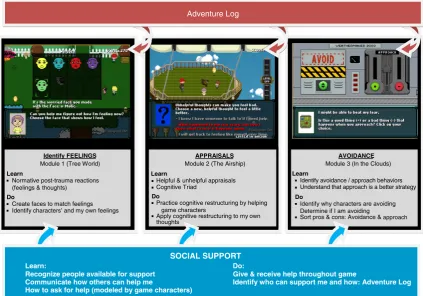
Coping Coach utilizes an interactive, developmentally appropriate, game-like format to provide practical in-formation and teach children adaptive coping strategies. The intervention is developed for the early posttrauma period and will be implemented as a novel, cost-effective, and widely accessible delivery mechanism*the Internet. Children are primary users of the intervention, with parents providing supervision. Coping Coach contains three modules (focusing on feelings identification, ap-praisals, and avoidance) that are used sequentially, and an adventure log that spans all modules. Identifying and using social support is folded throughout the interven-tion, as children engage with characters and provide and receive help and support. Each module can be completed in 2030 min and can be repeated to solidify skills and learning. The feelings module targets recognition and communication of emotions after potentially traumatic experiences. The appraisals module teaches the ‘‘cognitive triad’’ including the relationship of helpful or unhelp-ful thoughts to feelings and behavior. The avoidance module aims to reduce reliance on avoidance as a coping response. The adventure log encourages children to personalize their learning to their own experience and
reinforces the skills in each module. Every module of Coping Coach requires the child to interact with the game content, going beyond information provision, with the aim of children learning through experience. While children are primary users of Coping Coach, parents are encouraged to support their child’s engagement in Coping Coach. The website which presents the game for children also provides information for parents about how and when to seek professional help for their child. See Fig. 1 for an overview of the intervention.
Method
Participants
Our study sample will consist of 70 children receiving medical treatment for acute medical events and their parents. We define an acute medical event as a sudden, unexpected, and new medical event for a child (i.e., new injury or illness diagnosis, or a sudden exacerbation of a chronic condition). Inclusion criteria for this study are the following: (1) child is aged 812 years; (2) child has experienced an acute medical event within the past 2 weeks; (3) child perceives the event as potentially traumatic, based on a brief set of validated screening questions administered prior to enrollment (i.e., meet-ing DSM-IV A2 criteria; see Assessments); (4) child’s Glasgow Coma Score is greater than 12; (5) child speaks English well enough to complete measures and understand the intervention; and (6) child has access at home to the Internet and telephone. Exclusion criteria are the follow-ing: (1) child’s current medical condition or cognitive limitations preclude participating; (2) child’s acute medi-cal event is due to family violence or suspected child abuse; (3) child or parent has been arrested or is subject to legal proceedings related to the medical event; and (4) in the index event, child or parent was a perpetrator of violence.
Study design
study protocol has been reviewed and approved by the Institutional Review Board at The Children’s Hospital of Philadelphia and is registered at clinicaltrials.gov
Procedure
Potential participants will be identified via the hospital registries. Children who meet initial eligibility criteria and their caregivers will be approached by a member of the research team who will explain the study and invite par-ticipation in screening. After verbal consent and assent are obtained to participate in the screening phase of the study, we will collect basic demographic information and the child will complete four questions (subjective rating of the event as potentially traumatic). If the child’s responses indicate that the event is perceived as poten-tially traumatic, the child is eligible for the RCT portion of the study (see Assessments). Those eligible will be offered participation in the full study, will provide written consent and assent, and will complete baseline measures (i.e., demographics, child trauma history, coping and cop-ing assistance, cognitions and appraisals, HRQOL, and PTSS). Subsequently, participants will be randomized to one of two study conditions: 35 to the intervention and 35 to waitlist control.
Those in the intervention condition will complete the first module of Coping Coach (i.e., feelings identification) and will receive log-in instructions to complete the
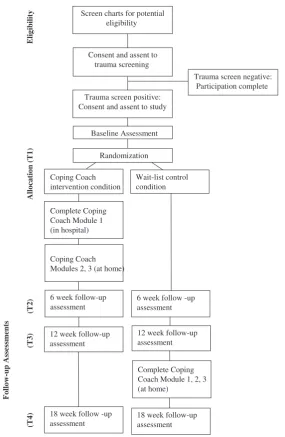
intervention online over the following month. After the 12-week assessment, those in the waitlist control condi-tion will receive log-in instruccondi-tions. Between baseline and 6 weeks, parents and children in the intervention group will receive tailored weekly reminders via email, text, or phone to encourage children to complete the remaining Coping Coach activities. Between 12 and 18 weeks, participants in the waitlist control condition will receive these reminders. Follow-ups will be conducted with all participants at approximately 6, 12, and 18 weeks post-baseline assessment via the telephone, by research assistants blinded to the child’s study condition. Follow-up assessments include measures of coping and coping assistance, cognitions and appraisals, HRQOL, and PTSS. Measures of intervention satisfaction and engage-ment will be administered separately at either 6 or 18 weeks, depending on the intervention condition. See Fig. 2 for an overview of the study procedures.
Assessments
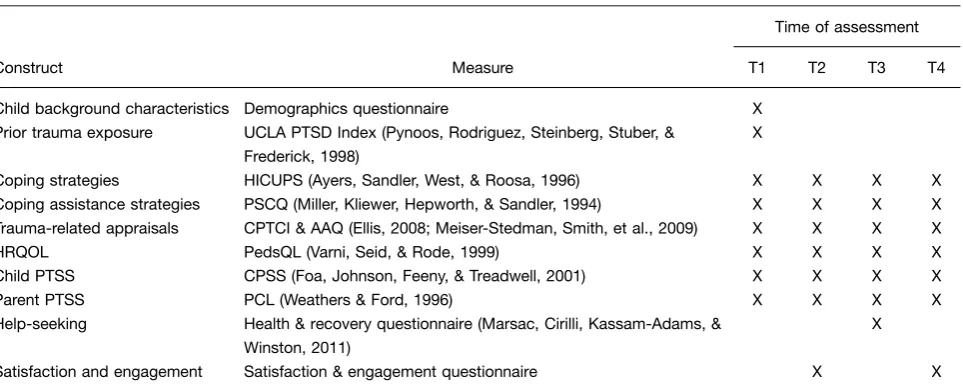
See Table 1 for a summary of measures included at each assessment time-point. See below for detailed measure descriptions.
Eligibility screening
Screen of potentially traumatic events. This measure assesses children’s subjective rating of the event as APPRAISALS
Module 2 (The Airship)
Learn
Helpful & unhelpful appraisals Cognitive Triad
Do
Practice cognitive restructuring by helping game characters
Apply cognitive restructuring to my own thoughts
AVOIDANCE
Module 3 (In the Clouds)
Learn
Identify avoidance / approach behaviors Understand that approach is a better strategy
Do
Identify why characters are avoiding Determine if I am avoiding
Sort pros & cons: Avoidance & approach
Identify FEELINGS
Module 1 (Tree World)
Learn
Normative post-trauma reactions (feelings & thoughts)
Do
Create faces to match feelings Identify characters’ and my own feelings
Adventure Log
SOCIAL SUPPORT
Learn: Do:
Recognize people available for support Give & receive help throughout game
[image:4.595.86.510.72.368.2]Communicate how others can help me Identify who can support me and how: Adventure Log How to ask for help (modeled by game characters)
potentially traumatic (Kassam-Adams, 2006). Children will provide a brief description of the medical event(s) that brought them to the hospital and will answer a validated four-item screen to assess whether the child perceives the event as potentially traumatic. Each item is rated on a 3-point scale (0never/not true; 1sometimes/somewhat true; 2often/very true). Endorsing one or more item as ‘‘often/very true’’ suggests that the child perceives the event as potentially traumatic and qualifies the child to partici-pate in the study. The screen is derived from the Acute Stress Checklist for Children.
Intervention use, satisfaction, and engagement
Online tracking. Automated electronic tracking during participants’ use of the web-based intervention will capture the time and date of each log-in, duration of
each session in which the participant uses Coping Coach, completion of each intervention task or module, and participant responses to questions and activities that are built into the interactive intervention.
The satisfaction and engagement questionnaire (parallel parent and child versions). This questionnaire was created for this study and is designed to gather overall impressions of and satisfaction with the Coping Coach intervention. It is divided into three sections: (1) several open-ended questions elicit strengths and areas for improvement, (2) items rated yes/no and on a 3-point Likert scale (yes, maybe, and no) ask the respondent to assess the intervention’s visual appeal, functionality, and the trustworthiness and comprehensibility of the inter-vention content, and (3) several open-ended questions
Wait-list control condition Screen charts for potential
eligibility
Allocation (T1)
Eligibility
(T3)
Trauma screen negative: Participation complete
Complete Coping Coach Module 1 (in hospital)
Consent and assent to trauma screening
Trauma screen positive: Consent and assent to study
Randomization
Coping Coach Modules 2, 3 (at home)
6 week follow-up assessment
12 week follow-up assessment
18 week follow -up assessment
6 week follow -up assessment
12 week follow-up assessment
Complete Coping Coach Module 1, 2, 3 (at home)
18 week follow-up assessment
Follow-up Assessments
(T4)
(T2)
Baseline Assessment
[image:5.595.161.447.65.503.2]Coping Coach intervention condition
assess how families engaged in the intervention at home and any barriers incurred to completing the Coping Coach activities at home.
Trauma history
The trauma screen from UCLA PTSD index for DSM-IV. This trauma history measure is comprised of 12 items that assess prior exposure to a variety of trau-matic events (e.g., natural disaster, accident, war, vio-lence, and medical treatment) and is intended for use with children aged 7 and older. (Pynoos, Rodriguez, Steinberg, Stuber, & Frederick, 1998).
Coping and coping assistance
The How I Coped Under Pressure Scale. The How I Coped Under Pressure Scale (HICUPS) is a self-report questionnaire that is used to assess children’s use of adaptive coping strategies with regard to their recent medical event (Ayers, Sandler, West, & Roosa, 1996). The HICUPS has well-established reliability and validity. The measure has been used with children of different ethnicities and socioeconomic status facing a variety of stressors (e.g., Landolt, Vollrath, & Ribi, 2002; Lengua, Long, & Meltzoff, 2006). In this study, specific subscales that match content covered in the intervention will be administered (Positive Cognitive Restructuring, Distrac-tion, Support Seeking, and Avoidance Coping).
The Parent Socialization of Coping Questionnaire. The Parent Socialization of Coping Questionnaire (PSCQ) parallels the HICUPS and assesses parent encourage-ment or coaching of children’s coping strategies (Miller,
Kliewer, Hepworth, & Sandler, 1994). Parents rate the extent to which they have encouraged or discouraged each specific child coping strategy by responding on a 7-point Likert scale. Parallel PSCQ subscales will be administered to parents. Research has suggested that the PSCQ is a reliable and valid assessment of parental coping assistance.
Cognitions and appraisals
The Child Posttraumatic Cognitions Inventory. The Child Posttraumatic Cognitions Inventory (CPTCI) is a 25-item scale adapted from the Posttraumatic Cognitions Inven-tory [developed for adults (Foa, Ehlers, Clark, Tolin, & Orsillo, 1999)] to be used with children (Meiser-Stedman, Smith, et al., 2009). The CPTCI was developed and validated within a large sample of children and adoles-cents aged 618 years. Principal components analysis suggested a two-component structure, labeled ‘‘perma-nent and disturbing change’’ and ‘‘fragile person in a scary world’’. Each subscale has good internal consis-tency, testretest reliability, convergent validity, and discriminant validity. The reliability and validity of these sub-scales was confirmed both in the acute phase and several months after a trauma.
[image:6.595.59.541.87.282.2]The Adaptive Appraisals Questionnaire. The Adaptive Appraisals Questionnaire (AAQ) is a 21-item measure that assesses the extent to which a child perceives the medical event as time limited or in the past, expects a successful outcome, sees potential benefit, and perceives personal strength or self-efficacy regarding the medical event (Ellis, 2008).
Table 1. Construct and measures administered by time point
Time of assessment Construct Measure T1 T2 T3 T4 Child background characteristics Demographics questionnaire X
Prior trauma exposure UCLA PTSD Index (Pynoos, Rodriguez, Steinberg, Stuber, & Frederick, 1998)
X
Coping strategies HICUPS (Ayers, Sandler, West, & Roosa, 1996) X X X X Coping assistance strategies PSCQ (Miller, Kliewer, Hepworth, & Sandler, 1994) X X X X Trauma-related appraisals CPTCI & AAQ (Ellis, 2008; Meiser-Stedman, Smith, et al., 2009) X X X X HRQOL PedsQL (Varni, Seid, & Rode, 1999) X X X X Child PTSS CPSS (Foa, Johnson, Feeny, & Treadwell, 2001) X X X X Parent PTSS PCL (Weathers & Ford, 1996) X X X X Help-seeking Health & recovery questionnaire (Marsac, Cirilli, Kassam-Adams, &
Winston, 2011)
Health-related quality of life
The Pediatric Quality of Life Inventory. The Pediatric Quality of Life Inventory (PedsQL) is a well-validated measure of child HRQOL (Varni, Seid, & Rode, 1999). It is developmentally appropriate, with child self-report and parent-report instruments available for children aged 218 years. The PedsQL has four scales with a total of 23 items: Physical health/physical functioning (eight items), Psychosocial health/emotional functioning (five items), Psychosocial health/social functioning (five items), and Psychosocial health/school functioning (five items).
Posttraumatic stress symptom
The Child PTSD Symptom Scale. The Child PTSD Symptom Scale (CPSS) is a 24-item self-report instru-ment that yields both a PTSD symptom severity score (possible range 051) and a determination of likely PTSD diagnostic status (Foa, Johnson, Feeny, & Treadwell, 2001). Seventeen CPSS items correspond to the DSM-IV symptom criteria and seven items assess impairment from those symptoms. The CPSS has shown excellent internal consistency (a0.89), testretest reliability (0.84), and convergent validity with structured clinical interview measures of PTSD (Foa et al., 2001). Confirmatory factor analyses also support the construct validity of the measure (Kassam-Adams, Marsac, & Cirilli, 2010).
The PTSD Checklist. The PTSD Checklist (PCL) is a well-validated 17-item self-report questionnaire that yields both a PTSD symptom severity score (possible range 1785) and a determination of likely PTSD diagnostic status (Blanchard, Jones-Alexander, Buckley, & Forneris, 1996; Weathers & Ford, 1996). PCL items correspond to DSM-IV symptom criteria. The PCL has demonstrated strong internal consistency (a0.94), test retest reliability, and convergent and discriminant validity. The PCL has been utilized (Manne, Du Hamel, Gallelli, Sorgen, & Redd, 1998) to assess PTSD symptoms in parents of ill or injured children.
Child health and recovery
The health and recovery questionnaire. This 8-item ques-tionnaire will be used to collect information at the 12-week follow-up assessment about help-seeking and services used (health care, mental health care, informal psychosocial support) over a specified period after an index medical event (Marsac, Cirilli, Kassam-Adams, & Winston, 2011).
Sample size
A primary goal of this RCT is to estimate effect sizes for a later full-scale RCT. Within the constraints of a pilot study, there will be reasonable power to detect a clinically meaningful effect for proximal outcomes (appraisals and coping at 6 weeks) and child health outcomes (PTSS and HRQOL at 12 and 18 weeks). With a sample
of 70 participants (35 randomized to each condition), we project that we will have 60 (85%) retained to all follow-up assessments. With this sample size, a difference of 0.5 SD between conditions [based on an Analysis of covariance (ANCOVA)] with 80% power, while control-ling fora0.05, can be detected.
Data analysis
ANCOVA is the primary analytic approach for examin-ing outcomes and for initial estimation of effect sizes. ANCOVA can adjust for baseline differences between groups (intervention vs. waitlist control), as imbalances may occur despite randomization. The dependent vari-able in each ANCOVA will be a 6-week proximal outcome or a 12- or 18-week child health outcome, the corresponding baseline score of the outcome measure will be the covariate, and group (condition) will be the qualitative factor. Other covariates that may help explain variation in intervention effects (e.g., age, gender, prior trauma, and parent PTSS) will be considered for inclu-sion in these analyses. Multivariable regresinclu-sion analysis will also be used to examine the hypothesized role of proximal outcomes in predicting each health outcome. An intent-to-treat approach will be applied to help handle missing data.
Discussion
The high prevalence and significant impact of acute traumas on children’s functioning warrant innovative approaches of delivering effective secondary prevention of psychosocial sequelae. Coping Coach translates re-search on etiology and malleable risk and protective factors into a novel web-based intervention. The inter-vention integrates evidence-based components of CBT techniques and Internet interventions, applying these to prevention by targeting early appraisals, coping, and support-seeking. Coping Coach is designed to require interaction with the game content to facilitate engage-ment and learning. The current RCT will provide us with pilot data to prepare for a larger-scale evaluation of Coping Coach. Specifically, this study will examine the feasibility of the Coping Coach intervention as well as the study procedures. In addition, the current RCT represents a unique opportunity to estimate the efficacy of Coping Coach in promoting positive child health outcomes and preventing or reducing negative psychological sequelae. Toward this goal we will examine proximal outcomes of appraisals and coping along with long-term child health outcomes, PTSS and HRQOL. We expect that the results of this RCT will augment the existing literature by producing new information (pilot data) on the effective-ness of web-based preventive interventions for children after acute medical trauma.
clinically meaningful short- and long-term effects of Coping Coach. Data from this RCT will help to refine our program theory and potentially modify existing conceptual models for the development of psychological symptoms after an acute medical event (i.e., hypothesized etiological mechanisms). This RCT will also enable us to estimate effect sizes for proximal and child health outcomes and inform modifications of Coping Coach prior to a larger scale trial. The electronic tracking built into the study design allows us to examine actual comple-tion of the intervencomple-tion modules to determine if there is a necessary minimum intervention ‘‘dose’’ and allows us to evaluate how children interact with game content. Finally, this RCT will allow us to evaluate factors that may impact child engagement and adherence and to identify ways to increase potency of intervention effects. Possible limitations of this RCT include technical difficulties that may be experienced by participants. To meet this challenge, we have worked to ensure accessibility and functionality of the intervention. Another potential limitation is that some participants may not finish all intervention modules after discharge from the hospital. We will attempt to minimize this by sending tailored, weekly reminders to children and families and providing a small incentive for children who complete all Coping Coach modules. In addition, we will track the completion of the intervention electronically, so that we will be able to determine what intervention components were completed by each participant. Other potential limitations include recruitment challenges or possible sampling bias. We will attempt to prevent this by closely monitoring weekly recruitment and retention rates. We will adjust strategies as needed to achieve recruitment targets, and address any significant deviations of sample demographics from the pool of eligible patients.
If results suggest that Coping Coach can prevent emotional sequelae and improve child health outcomes, the intervention would provide a promising avenue to help children cope in the aftermath of a traumatic medical event. Given its web-based modality, Coping Coach can provide widely accessible tools to promote positive child health outcomes. In addition, Coping Coach could be provided as a resource that physicians, mental health professionals, social workers, and teachers could recommend for children at risk for PTSS.
Acknowledgements
We acknowledge Aimee Hildenbrand and Melissa Morrison for their contributions to this manuscript.
Conflict of interest and funding
There is no conflict of interest in the present study for any of the authors. This work was supported by the Eunice
Kennedy Shriver National Institute of Child Health & Human Development [NICHD; R21HD069832], and a Mentored Career Award grant 1K23MH093618-01A1 from the National Institute of Mental Health.
References
Ayers, T., Sandler, I., West, S., & Roosa, M. (1996). A dispositional and situational assessment of children’s coping: Testing alter-native models of coping.Journal of Personality,64(4), 923958. Blanchard, E., Jones-Alexander, J., Buckley, T., & Forneris, C. (1996). Psychometric properties of the PTSD Checklist (PCL).
Behavior Research and Therapy,34(8), 669673.
Bryant, R. A., Salmon, K., Sinclair, E., & Davidson, P. (2007a). A prospective study of appraisals in childhood posttraumatic stress disorder.Behaviour Research and Therapy,45, 25022507. Bryant, R. A., Salmon, K., Sinclair, E., & Davidson, P. (2007b). The relationship between acute stress disorder and posttraumatic stress disorder in injured children.Journal of Traumatic Stress,
20(6), 10751079.
Cohen, J., & Mannarino, A. (2008). Trauma-focused cognitive behavioral therapy for children and parents.Child and Adoles-cent Mental Health,13(4), 158162.
Cox, C., & Kenardy, J. (2010). A randomised controlled trial of a web-based early intervention for children and their parents following accidental injury.Journal of Pediatric Psychology,35, 581592.
Child Trends DataBank. (2003).Home computer access and Internet use.Bethesda, Maryland: Child Trends DataBank.
Ebata, A., & Moos, R. (1991). Coping and adjustment in distressed and healthy adolescents. Journal of Applied Developmental Psychology,12(1), 3354.
Ehlers, A., Mayou, R., & Bryant, B. (2003). Cognitive predictors of posttraumatic stress disorder in children: Results of a pro-spective longitudinal study.Behaviour Research and Therapy,
41(1), 110.
Ellis, A. (2008).Cognitive and social support factors in ASD, PTSD and depression in children and adolescents following single-incident trauma. (Unpublished doctoral dissertation). Adelaide, Australia: Flinders University.
Foa, E., Ehlers, A., Clark, D., Tolin, D., & Orsillo, S. (1999). The Posttraumatic Cognitions Inventory (PTCI): Development and validation.Psychological Assessment,11(3), 303314. Foa, E., Johnson, K., Feeny, N., & Treadwell, K. (2001). The child
PTSD symptom scale: A preliminary examination of its psychometric properties.Journal of Clinical Child Psychology,
30(3), 376384.
Graham-Bermann, S., & Seng, J. (2005). Violence exposure and traumatic stress symptoms as additional predictors of health problems in high-risk children.Journal of Pediatrics, 146(3), 349354.
Grossman, D. (2000). The history of injury control and the epidemiology of child and adolescent injuries.The Future of Children,10(1), 2352.
Holbrook, T., Hoyt, D., Coimbra, R., Potenza, B., Sise, M., & Anderson, J. (2005). Long-term posttraumatic stress disorder persists after major trauma in adolescents: New data on risk factors and functional outcome. Journal of Trauma-Injury Infection and Critical Care,58(4), 764769.
Kassam-Adams, N. (2006). The acute stress checklist for children (ASC-Kids): Development of a child self-report measure.
Journal of Traumatic Stress,19(1), 129139.
Kassam-Adams, N., Marsac, M. L., & Cirilli, C. (2010). PTSD symptom structure in injured children: Relationships with functional impairment and depression symptoms. Journal of the American Academy of Child and Adolescent Psychiatry,
49(6), 616625.
Kenardy, J., Spence, S. H., & Macleod, A. (2006). Screening for posttraumatic stress disorder in children after accidental injury.
Pediatrics,118, 10021009.
Landolt, M. A., Buehlmann, C., Maag, T., & Schiestl, C. (2009). Brief report: Quality of life is impaired in pediatric burn survivors with posttraumatic stress disorder.Journal of Pedia-tric Psychology,34(1), 1421.
Landolt, M. A., Vollrath, M., & Ribi, K. (2002). Predictors of coping strategy selection in paediatric patients.Acta Paedia-trica,91, 945960.
Landolt, M. A., Vollrath, M. E., Gnehm, H. E., & Sennhauser, F. H. (2009). Post-traumatic stress impacts on quality of life in children after road traffic accidents: Prospective study.
Australian and New Zealand Journal of Psychiatry, 43(8), 746753.
Lengua, L. J., Long, A. C., & Meltzoff, A. (2006). Pre-attack stress-load, appraisals, and coping in children’s responses to the 9/11 terrorist attacks.Journal of Child Psychology and Psychiatry,
47(12), 12191227.
Livingstone, S., & Haddon, L. (2009).EU kids online: Final report. London, UK: The London School of Economics and Political Science.
Magee, J., Ritterband, L., Thorndike, F., Cox, D., & Borowitz, S. (2009). Exploring the relationship between parental worry about their children’s health and usage of an internet interven-tion for pediatric encopresis.Journal of Pediatric Psychology,
34(5), 530538.
Manne, S., Du Hamel, K., Gallelli, K., Sorgen, K., & Redd, W. (1998). Posttraumatic stress disorder among mothers of pediatric cancer survivors: Diagnosis, comorbidity, and utility of the PTSD checklist as a screening instrument.Journal of Pediatric Psychology,23(6), 357366.
March, S., Spence, S. H., & Donovan, C. (2009). The efficacy of an Internet-based cognitive-behavioral therapy intervention for child anxiety disorders.Journal of Pediatric Psychology,34(5), 474487.
Marks, J. S., & McQueen, D. V. (2001). Chronic disease. In C. E. Koop, C. E. Pearson, & M. R. Schwarz (Eds.),Critical issues in global health(pp. 117126). San Francisco, CA: Josey-Bass. Marsac, M. L., Cirilli, C., Kassam-Adams, N., & Winston, F. K.
(2011). Post-injury medical and psychosocial care in children: Impact of traumatic stress symptoms.Children’s Health Care,
40(2), 116129.
Meiser-Stedman, R., Dalgleish, T., Glucksman, E., Yule, W., & Smith, P. (2009). Maladaptive cognitive appraisals mediate the evolution of posttraumatic stress reactions: A 6-month follow-up of child and adolescent assault and motor vehicle accident survivors.Journal of Abnormal Psychology,118(4), 9. Meiser-Stedman, R., Smith, P., Bryant, R., Salmon, K., Yule, W.,
Dalgleish, T., et al. (2009). Development and validation of the Child Post-Traumatic Cognitions Inventory (CPTCI).Journal of Child Psychology and Psychiatry,50(4), 432440.
Miller, P., Kliewer, W., Hepworth, J., & Sandler, I. (1994). Maternal socialization of children’s postdivorce coping: Development of a measurement model. Journal of Applied Developmental Psychology,15, 457487.
Mouthaan, J., Sijbrandij, M., Reitsma, J., Gersons, B., & Olff, M. (2011). Internet-based prevention of posttraumatic stress symptoms in injured trauma patients: Design of a randomized controlled trial. European Journal of Psychotraumatology, 2, 82948303.
Murray, C., & Lopez, A. (1996). The global burden of disease: A comprehensive assessment of mortality and disability from diseases, injuries, and risk factors in 1990 and projected to 2020. Cambridge, MA: Harvard University Press.
O’Kearney, R., Kang, K., Christensen, H., & Griffiths, K. (2009). A controlled trial of a school-based Internet program for reducing depressive symptoms in adolescent girls.Depression and Anxiety,26(1), 6572.
Peden, M. M. (2008).World Health Organization: World report on child injury prevention. Dallas: UNICEF.
Pynoos, R., Rodriguez, N., Steinberg, A., Stuber, M., & Frederick, C. (1998).UCLA PTSD Index for DSM-IV. Los Angeles, CA: Trauma Psychiatric Services.
Ruzek, J. I., Hoffman, J., Ciulla, R., Prins, A., Kuhn, E., & Gahm, G. (2011). Bringing Internet-based education and intervention into mental health practice: Afterdeployment.org. European Journal of Psychotraumatology, 2, 72787286.
Sabin, J., Zatzick, D., Jurkovich, G., & Rivara, F. (2006). Primary care utilization and detection of emotional distress after adolescent traumatic injury: Identifying an unmet need.
Pediatrics,117(1), 130138.
Salmon, K., Sinclair, E., & Bryant, B. (2007). The role of maladaptive appraisals in child acute stress reactions.British Journal of Clinical Psychology,46, 203210.
Spence, S. H., Donovan, C. L., March, S., Gamble, A., Anderson, R. E., Prosser, S., et al. (2011). A randomized controlled trial of online versus clinic-based CBT for adolescent anxiety.Journal of Consulting and Clinical Psychology,79(5), 629642. Spence, S. H., Holmes, J., March, S., & Lipp, O. (2006). The
feasibility and outcome of clinic plus internet delivery of cognitive-behavior therapy for childhood anxiety. Journal of Consulting and Clinical Psychology,74(3), 614621.
Stallard, P., Velleman, R., Langsford, J., & Baldwin, S. (2001). Coping and psychological distress in children involved in road traffic accidents. British Journal of Clinical Psychology, 40, 197208.
Stinson, J., Wilson, R., Gill, N., Yamada, J., & Holt, J. (2009). A systematic review of internet-based self-management interven-tions for youth with health condiinterven-tions. Journal of Pediatric Psychology,34(5), 495510.
Varni, J., Seid, M., & Rode, C. (1999). The PedsQL: Measurement model for the pediatric quality of life inventory.Medical Care,
37(2), 126139.
Weathers, F., & Ford, J. (1996). Psychometric review of PTSD Checklist (PCL-C, PCL-S, PCL-M, PCL-PR). In B. Stamm (Ed.), Measurement of stress, trauma and adaptation
(pp. 250251). Lutherville, MD: Sidran Press.
Zatzick, D., Jurkovich, G., Fan, M., Grossman, D., Russo, J., Katon, W., et al. (2008). Association between posttraumatic stress and depressive symptoms and functional outcomes in adolescents followed up longitudinally after injury hospitalization.Archives of Pediatrics & Adolescent Medicine,162(7), 642648. Zehnder, D., Prchal, A., Vollrath, M., & Landolt, M. A. (2006).
Prospective study of the effectiveness of coping in pediatric patients. Child Psychiatry and Human Development, 36(3), 351368.