International Journal of Innovative Technology and Exploring Engineering (IJITEE) ISSN: 2278-3075,Volume-8 Issue-12, Oct 2019
Abstract: In the present time several techniques have been developed in managing and storing thermal energy. Use of Thermal energy storage systems (TES) are one of the solutions for this issue. Hence in the present work, phase change materials (PCM) are used for storing thermal energy. D-mannitol and Hydroquinone are the two PCM materials used in double pipe heat exchanger and simulations are carried out analytically on ANSYS. Study of temperature variation is done with respect to time and values are calculated for time, t = 200, 500, 2200 and 4200 seconds. The results also include contour plots and numerical values for mass fraction for each of the case. The result shows, that with increase in the time step, the temperature gradually increases for both the cases of PCM materials.
Keywords: phase change material, thermal energy storage system, Ansys, heat exchanger, mass fraction.
I. INTRODUCTION
I
n this century of technology, storage of Energy has gained a great importance in the sector of Renewable energy system. Thermal energy storage (TES) is a method that saves thermal power through cooling or heating a storage medium so the preserved power can be used effectively at a later time for heating and cooling functions.(Zheng, Zhang, and Liang 2017) and power generation(Ma, Glatzmaier, and Kutscher 2012) TES systems are used specifically in buildings and in industrial activity. Benefit of using TES in an energy system include an rise in overall effectiveness and satisfactory, and it can route to better economics, decrease in running cost and investment, and automatically reduction in pollution., i.e., low carbon dioxide (CO2) emissions(Zheng, Zhang, and Liang 2017) Solar thermal systems, distinct the photovoltaic systems with an extent power, which are used for the development of manufacturing company development and by taking major use of Sun’s thermal major power during the day. Yet, the energy which we receiving from sun’s thermal power does not have an enough thermal storage that we can use that energy at a time when solar radiations are not available or during the low radiations hours. TES is increasing with great importance in electricity with focusing on the concentrating solar power ( CSP ) plants where we canRevised Manuscript Received on October 10, 2019
* Correspondence Author
Prashant Geete*,Research Scholar, Suresh Gyan Vihar University, Jaipur (Raj) e-mail: [email protected]
Neeraj Kumar, Professor, Suresh Gyan Vihar University, Jaipur (Raj) e-mail: [email protected]
Sunil K Somani, Professor (Vice- Chancellor), Medi-Caps University Indore (M.P) e-mail: [email protected]
Anshul Gangele, Professor, Suresh Gyan Vihar University, Jaipur (Raj) e-mail: [email protected]
stored this solar energy for the production of electricity that we can use it at a time when there is low availability of sunlight. Researchers are continuingly working on the new material, characterization and enhancement of properties in order to get 24 hour operation from TES.(Sarbu and Sebarchievici 2018)
A. Submission of the paper PCM (Phase Change
Material)
The materials which utilize for storing latent heat are termed as phase change materials. (Niyas and Muthukumar 2018)(Elias and Stathopoulos 2019). PCM materials are group of such materials which interchange and alter as specific amount of thermal energy under the given range of temperature as latent heat which includes change of phase of the material. Further, PCMs also exchange this sensible heat outside their temperature window. There are several PCM available out of which the solid-solid in addition with the solid-liquid are most generally used. The transition of phase from liquid-gas and Solid- gas have negligible implementations since huge amount of volume is altered in the PCM despite of large transfer of energy required to change the phase.. (Iliopoulos et al. 2018).In the last decade the field of PCMs are broadly researched for TES since the requirement for efficient energy increased and demand for effective TES needed for applications.(Du et al. 2018).A research article published on September 2018 entitled “phase change materials” in addition with restricting under “thermal energy storage systems” provided 1392 hits in that year.(Applied and Science 2018)
Phase change materials can be effectively implemented on regulating thermal energy systems as well as plain thermal energy storage systems. The thermal based energy systems incorporating phase change materials has great utility in maintaining thermal comfort in large spaces and buildings since they overcome huge alterations in temperature. Several other engineering fields have big advantage in regulating temperature such as aerospace (Kim et al. 2013), textiles and photovoltaic (Ling et al. 2014), and batteries (Khateeb et al. 2005). Phase Change material is used as a waste heat storage in the following applications agriculture applications, building applications, thermal industrial storage, or in a fuel cells(Koukou et al. 2018), (Kumar et al. 2011).
On the basis of Chemical quality PCM can be divided into following categories for instance organic based, in addition with inorganic based and eutectics, or basis of the their phase of transitions which they undergo as solid-solid PCM, liquid-gas PCM, Solid-Liquid PCM, Solid-Gas PCMs.
“Simulation of Double Pipe Heat Exchanger
with Implementation of PCM”
Further on the basis of organic nature of PCMs they are divided in i) Paraffin or Non-paraffin for example glycols, polymers, fatty acids, esters, or alcohols, ii) Inorganic PCMs includes alloys and metals or salt hydrates. Iii) Eutectics include organic-inorganic, inorganic-inorganic, and organic-organic. After the first application of Phase Change Material as in aerospace by NASA, a huge quantity of material or a mixture of two or more materials are included in researches as for use as a Phase change Material. By utilizing traditional trends of chemistry as well as biocatalysts to convert animal fat into eutectic organic phase change materials( Gallart-Sirvent et al. 2017). A complete list of available and studied PSMs can be found here(Veera kumar and Sree kumar 2016).
Working temperature ranges (-20oc to +2000c) under which range PCMs are used. Four temperature ranges are used mainly for the PCMs. Four different ranges varies for their applications; low temperature (-20° C to +5° C)on this temperature range phase change material are used for domestic and refrigeration. Medium low temperature range (+5° C to +40° C)on this range of PCM, they mostly used in cooling and heating applications in commercial buildings, A range for solar based heating electronic application and cooling lies from (+40° C to +80° C), and for the absorption cooling electricity generation and waste heat recovery temperature range lies from (+80° C to +200° C or above)(Zheng, Zhang, and Liang 2017).
II. LITERATUREREVIEW
(Bista et al. 2018) In this review paper, they studied various research papers and investigate on the available approaches of PCMs in a field of refrigeration systems. On studying the applications of PCM in refrigeration cycles based on vapor compression, it elaborates significant changes on several functions of the system, such as on-off cycle and declination in the utilization of electrical energy. The materials used for PCM should be very stable in terms of chemical reactivity and thermal behaviors so that it can conserve huge amount of freezing as well as melting point temperatures. Due to this it can strongly work under conditions of refrigerator. The temperature of phase change material and the thickness of the PCM are investigated in the research based on the working efficiency of the refrigeration system and their impacts on the complete system. Later, review of different components including their benefits and disadvantages are discussed such as evaporator, condenser in addition with compressor etc. The fluctuations in the thermal load can be stabilized by help of PCM in the evaporator and further the variation in the temperature within the compartment degrades. During the consolidating of PCM at the evaporator that expands running time of the compressor at the starting point and upsurge the condensation temperature, numerous researches has been function for incorporation of PCM at the condensation segments. As the danger and harmful effects were increasing by the increased use of refrigeration, the use of PCMs on refrigeration play a successfulpart in order to elevate the effectiveness of refrigerators and additionally depress the utilization of energy.
(Saeed et al. 2019) In this review, a load-shifting is studied by using a thermal energy storage vessel through experimental investigation. Within this framework, the PCM is operating as medium for storing energy and the plate vessel
as a unit of heat exchanger comprised of working fluid which is water. Several conditions of inlet such as temperature of water at exit, coefficient of heat transfer, rate for storing heat, efficiency, time for storage, overall capacity of storage and effectiveness which are complete thermal features of the heat exchanger were categorized as functions. The research showed that, 83.1% effectiveness was obtained despite of utilizing low thermal conductivity PCM. It is also found that the suggested design of energy storage system not only delivers significant results working as thermal energy storage medium, but it is also providing other benefits like in saving infrastructure, equipment’s and operation compared to conventional systems
(Royo et al. 2019)In this research paper, it has been reviewed that how feasible to implement PCM-TES in energy-intensive industries at high temperature range. The motive of stored energy is to pre-heat the air which is entering into the furnace by the means of phase change material which having a melting point of 885oC. By this approach, a suitable design found on mass and energy conservation equations is explained by heat transfer simulation. The thermal execution is examined for solidification and melting processes, the phase transition and its impact on the process of heat transference. Further the results were obtained from the temperature profile exemplified for the phase change material and combustion air stream. These results will show the presence of high temperature levels (from 700oC to 800oC) of combustion air which is preheated in ceramic furnace. So, it is confirming that the energy and natural efficiency increases to the initial condition showing an air outlet at 650oC.
International Journal of Innovative Technology and Exploring Engineering (IJITEE) ISSN: 2278-3075,Volume-8 Issue-12, Oct 2019
In the evaluation the results depicted variation in coefficient of the Root Mean Squared Error and Normalized Mean Bias Error which was used in the analysis, in addition with it provides the option for the present model in establishing right model that can generate PCM with heat exchanger with greater accuracy.
III. PROBLEMSTATEMENT
In recent years, the use of energy has increased to a higher extend due to the raise in usage of utilities for human comfort. Renewable energy sources have emerged as a source of energy in the recent past due to extensive availability and forms a cheapest mode of energy provider. Among the renewable energy sources, solar energy has been utilized more adequately due to its wide availability and being a reliable source of energy source. Solar cooling and refrigeration has emerged as a basic need for human comfort along with food conservation. However, since the renewable energy sources are time dependent, there are problems that occur due to mismatch of energy supply and energy demand. Hence to resolve the issues, thermal energy storage techniques where used which stores the energy and provides uninterrupted energy based on the requirement. Phase change materials were used for this purpose since PCM has better capacity in terms of storing energy and isothermal behavior during both charging and discharging processes.
The major problem that exists in Thermal energy storage based on PCM is related to the consistency in supplying in energy based on the demand. Here we intent to propose a model which makes use of micro encapsulated phase change materials for thermal storage process. We define various optimal parameters which are to be considered while designing the approach along with various thermal and rheological properties of the material for proper energy utilization.
IV. METHODOLOGY
In the present study, following methodology has been followed;
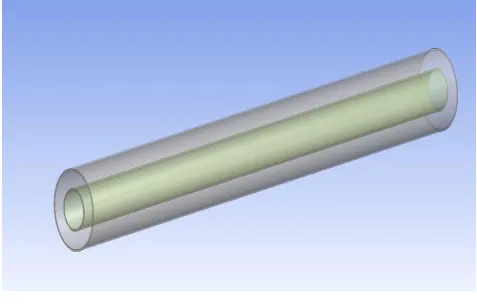
In the present work, CFD analysis on thermal storage system is performed considering the temperature range of 140-200oC. For the modeling of thermal storage system two concentric pipes of same length but different diameter were modeled shown in fig 1 having the length as 500 mm and inner diameter of inside pipe as 25mm and outer diameter as 27mm having the constant thickness of 2mm throughout. Whereas outside pipe of thermal storage system was modeled with inner diameter as 55mm and outer diameter as 57mm with constant thickness of 2mm throughout the length. Both the pipes were designed considering the insulation to trap the heat produced inside the thermal storage system providing no loss of energy during the working procedure (GhahramaniZarajabad and Ahmadi 2018b). After the modeling procedure further the model is imported in meshing workbench to perform the meshing operation on it. In the meshing workbench, grid independence is performed to find the behavior of mesh generation in our study. Similar analyses were performed on the geometry having fine meshing and course meshing respectively. From the grid independence study it is seen that there is no significant change observed in the analysis having fine and course meshing so it can be
[image:3.595.307.546.88.240.2]concluded that our geometry is mesh independent. Below figure 1 shows the fine mesh geometry used for the further analysis procedure.
Fig. 1.3D model of proposed model
Inner pipe Dimensions: Outer pipe dimensions: Diameter: 25mm inner dia: 55mm Outer diameter: 27mm outer dia: 57mm Length: 500mm length; 500mm In the performed analysis of model, required analysis reports were are as follows,
1. Temperature vs time graph
(Showing the charging and discharging process) a. When Hydroquinone is used
b. When d-mannitol is been used 2. Temperature vs time graph
(Showing the time and temperature of the charging process for both the PCM’s)
3. Energy vs time graph
(Showing, Stored energy during the charging process for both the PCM’s)
4. Final PCM vs energy storage difference graph.
In order to find out which PCM has got the better energy generation;
For the analysis we have modeled two concentric pipes in which the working fluid will flow in the inner pipe and the PCM will present in between the outer and the inner pipe the modeled geometry as per the figure 1.
[image:3.595.306.550.605.728.2]The generated 3D model is saved in .STP format in order to make it compatible with ANSYS tool. From the generated model, we perform analysis in the ANSYS design modular. For carrying out of analysis we need to mesh the generated model for the meshing we used the Ansys in built meshing software. The meshed model is shown in the below figure 2.
In this we have used two phase change materials for the analysis of thermal energy storage method the two phase change materials are
• D-Mannitol • Hydroquinone
After meshing next step in the fluid and heat transfer analysis is the grid independency test. In this we have run the simulations for coarser and medium and finer grid but we haven't observed any change in the melting fraction of the pcm. From this we can conclude that the results are not changing with the finesse of the grid which concludes that our model is grid independent. Now we can enter into the actual simulation with the final grid that we used in the grid independency test.
A. Material properties of the PCM material used in the present work
[image:4.595.318.538.49.187.2]The following table 1 below shows the properties of D-mannitol and hydroquinone
Table- I: Properties of PCM material PCM materials Hydroquinone D-mannitol
Melting point (°C) 173-174°C 167-170 °C Boiling point (°C) 287°C 295°C Density (g/cm3) 1.328 1.52 Chemical formula C6H4(OH)2 C6H14O6
B. Governing Equations used in CFD
V. RESULT
Temperature vs. time graph
Showing the charging and discharging process
The following results are obtained for the D-mannitol shown in graph form in figure 3
Time Melting
fraction
Energy stored
400 s 0.27 485.87 (Kj)
Fig. 3.Graph plot for D-mannitol (time vs temperature)
The charging and discharging profile is captured in the temperature vs time graph in this we can observe the change in the temperature with respect to the time.
A. For hydroquinone
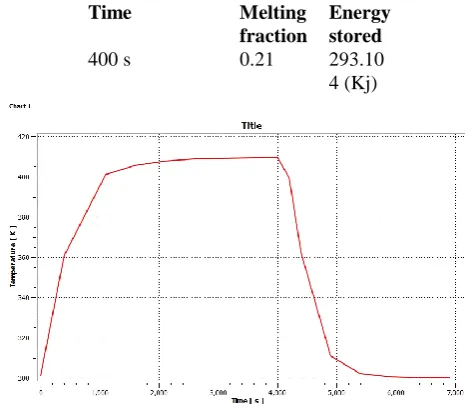
The following results are obtained for the Hydroquinone, shown in graph form in figure 4
Time Melting
fraction
Energy stored
400 s 0.21 293.10
[image:4.595.306.543.303.510.2]4 (Kj)
Fig. 4.Graph plot for Hydroquinone (time vs temperature)
The charging and discharging profile is captured in the temperatures time graph in this we can observe the change in the temperature with respect to the time.
B. Energy vs. time graph
Showing, Stored energy during the charging process for both the PCM’s,
Material Energy Storage
D-mannitol 485.87 (KJ) Hydroquinone 293.104 (KJ)
C. Final PCM vs energy storage difference graph Showing that the PCM has got the better energy generation, By observing the results we obtained from the analysis we can conclude that under the same operating conditions and time we observed that the
[image:4.595.54.268.385.685.2]International Journal of Innovative Technology and Exploring Engineering (IJITEE) ISSN: 2278-3075,Volume-8 Issue-12, Oct 2019
obtained results we can suggest that the D-Mannitol is the best suited as the PCM for thermal energy storage process. Other plots/Images and explanation:
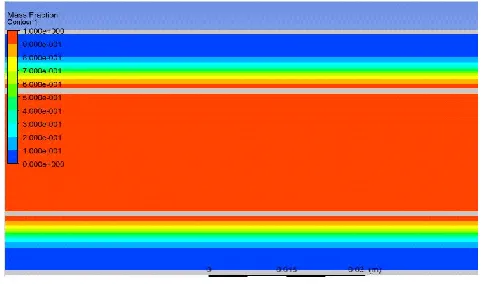
[image:5.595.306.547.50.192.2]A thermal storage system is nothing but the collection of individual units of the geometry which we have considered for the analysis a full thermal energy storage system has huge number of considered models. For the ease of the computational analysis we have considered the individual unit for analysis we can dub that each and every unit will work similarly, and further reducing the computational load here we are charging the PCM for 4000 sec in both cases and the compare the both PCMs for the maximum energy storage from this we can understand that which PCM can be used for the best storage of the energy in a thermal energy storage systems. Below we can understand how the charging and discharging of the PCM take place with the help of contours. This contour is captured at the time t=200 sec as shown in figure 5, here we can see that the melting of the pcm is not yet started the PCM near the wall is in a phase change process.
Fig. 5.Contour plot at time, t = 200 seconds
This contour is captured at the time t=500 sec, as shown in figure 6, here we can see that the pcm near to the wall is melted and converted into the liquid phase and the phase change region iis penetrated further into the PCM.
Fig. 6.Contour plot at time, t = 500 seconds
This conture is captured at t=2200 sec as shown in figure 7, here the thickness of the melted region is increased and the phase change region is further penetrated into the pcm heating more pcm. This process will continue for 4000 sec and then the cooling process will start.
Fig. 7.Contour plot at time, t =2200 seconds
[image:5.595.48.280.278.428.2]This conture is captured during cooling at time instance of t=4200 sec as shown in figure 8, here we can see that the bright orange color which is present in the near wall is completely disappeared and the phase change region is getting down towards the inner pipe wall.
Fig. 8.Contour plot at time, t =4200 seconds
From these contours we can understand how charging and the discharging of the pcm takes place in the TES.
VI. CONCLUSION
[image:5.595.305.552.283.436.2] [image:5.595.46.287.513.661.2]REFERENCES
1. Amin, N. A.M., M. Belusko, F. Bruno, and M. Liu. 2012. “Optimising PCM Thermal Storage Systems for Maximum Energy Storage
Effectiveness.” Solar Energy 86(9): 2263–72.
http://dx.doi.org/10.1016/j.solener.2012.04.020.
2. Applied, Industrial, and Data Science. 2018. “1. Introduction.” (October): 19–20.
3. Bista, Subhanjan, Seyed Ehsan Hosseini, Evan Owens, and Garrison Phillips. 2018. “Performance Improvement and Energy Consumption Reduction in Refrigeration Systems Using Phase Change Material (PCM).” Applied Thermal Engineering 142(June): 723–35. https://doi.org/10.1016/j.applthermaleng.2018.07.068.
4. Dinesh, Battula Venkata Sai, and Anirban Bhattacharya. 2019. “Effect of Foam Geometry on Heat Absorption Characteristics of PCM-Metal Foam Composite Thermal Energy Storage Systems.” International
Journal of Heat and Mass Transfer 134: 866–83.
https://doi.org/10.1016/j.ijheatmasstransfer.2019.01.095.
5. Du, Kun et al. 2018. “A Review of the Applications of Phase Change Materials in Cooling, Heating and Power Generation in Different Temperature Ranges.” Applied Energy 220(March): 242–73. https://doi.org/10.1016/j.apenergy.2018.03.005.
6. Elias, Charalambos N., and Vassilis N. Stathopoulos. 2019. “A Comprehensive Review of Recent Advances in Materials Aspects of Phase Change Materials in Thermal Energy Storage.” Energy Procedia 161: 385–94. https://doi.org/10.1016/j.egypro.2019.02.101. 7. Gallart-Sirvent, Pau et al. 2017. “Fatty Acid Eutectic Mixtures and
Derivatives from Non-Edible Animal Fat as Phase Change Materials.” RSC Advances 7(39): 24133–39.
8. Ghahramani Zarajabad, Omid, and Rouhollah Ahmadi. 2018a. “Employment of Finned PCM Container in a Household Refrigerator as a Cold Thermal Energy Storage System.” Thermal Science and
Engineering Progress 7: 115–24.
https://doi.org/10.1016/j.tsep.2018.06.002.
9. 2018b. “Numerical Investigation of Different PCM Volume on Cold Thermal Energy Storage System.” Journal of Energy Storage 17(April): 515–24. https://doi.org/10.1016/j.est.2018.04.013. 10. Gil, Antoni et al. 2014. “Experimental Analysis of Hydroquinone Used
as Phase Change Material (PCM) to Be Applied in Solar Cooling Refrigeration.” International Journal of Refrigeration 39: 95–103. 11. Iliopoulos, I. et al. 2018. “Evaluation of Organic Coatings for
Corrosion Protection of Condensing Economizers.” Procedia
Structural Integrity 10: 295–302.
https://doi.org/10.1016/j.prostr.2018.09.041.
12. Iten, Muriel, Shuli Liu, and Ashish Shukla. 2016. “A Review on the Air-PCM-TES Application for Free Cooling and Heating in the Buildings.” Renewable and Sustainable Energy Reviews 61: 175–86. http://dx.doi.org/10.1016/j.rser.2016.03.007.
13. Khateeb, Siddique A. et al. 2005. “Thermal Management of Li-Ion Battery with Phase Change Material for Electric Scooters: Experimental Validation.” Journal of Power Sources 142(1–2): 345–53.
14. Kim, Taig Young, Bum Seok Hyun, Jang Joon Lee, and Juhun Rhee. 2013. “Numerical Study of the Spacecraft Thermal Control Hardware Combining Solid-Liquid Phase Change Material and a Heat Pipe.”
Aerospace Science and Technology 27(1): 10–16.
http://dx.doi.org/10.1016/j.ast.2012.05.007.
15. Koukou, Maria K. et al. 2018. “Experimental and Computational Investigation of a Latent Heat Energy Storage System with a Staggered Heat Exchanger for Various Phase Change Materials.” Thermal
Science and Engineering Progress 7: 87–98.
https://doi.org/10.1016/j.tsep.2018.05.004.
16. Kumar, Ravindra et al. 2011. “Phase Change Materials: Technology Status and Potential Defence Applications.” Defence Science Journal 61(6): 576–82.
17. Ling, Ziye et al. 2014. “Review on Thermal Management Systems Using Phase Change Materials for Electronic Components, Li-Ion Batteries and Photovoltaic Modules.” Renewable and Sustainable
Energy Reviews 31: 427–38.
http://dx.doi.org/10.1016/j.rser.2013.12.017.
18. Ma, Zhiwen, Greg C. Glatzmaier, and Charles F. Kutscher. 2012. “Thermal Energy Storage and Its Potential Applications in Solar Thermal Power Plants and Electricity Storage.” (April): 447–56. 19. Niyas, Hakeem, and P. Muthukumar. 2018. “A Novel Heat Transfer
Enhancement Technique for Performance Improvements in Encapsulated Latent Heat Storage System.” Solar Energy
164(February): 276–86.
https://doi.org/10.1016/j.solener.2018.02.060.
20. Oró, Eduard et al. 2012. “Thermal Energy Storage Implementation Using Phase Change Materials for Solar Cooling and Refrigeration Applications.” Energy Procedia 30: 947–56.
21. Roccamena, Letizia, Mohamed El Mankibi, and Nikolaos Stathopoulos. 2019. “Development and Validation of the Numerical Model of an Innovative PCM Based Thermal Storage System.” Journal
of Energy Storage 24(April): 100740.
https://doi.org/10.1016/j.est.2019.04.014.
22. Royo, Patricia et al. 2019. “High-Temperature PCM-Based Thermal Energy Storage for Industrial Furnaces Installed in Energy-Intensive Industries.” Energy: 1030–40.
23. Saeed, Rami M., J. P. Schlegel, R. Sawafta, and V. Kalra. 2019. “Plate Type Heat Exchanger for Thermal Energy Storage and Load Shifting Using Phase Change Material.” Energy Conversion and Management
181(September 2018): 120–32.
https://doi.org/10.1016/j.enconman.2018.12.013.
24. Sarbu, Ioan, and Calin Sebarchievici. 2018. “A Comprehensive Review of Thermal Energy Storage.” Sustainability (Switzerland) 10(1).
25. Veerakumar, C., and A. Sreekumar. 2016. “Phase Change Material Based Cold Thermal Energy Storage: Materials, Techniques and Applications - A Review.” International Journal of Refrigeration 67(2016): 271–89. http://dx.doi.org/10.1016/j.ijrefrig.2015.12.005. 26. Vivekananthan, Mayilvelnathan, and Valan Arasu Amirtham. 2019.
“Characterisation and Thermophysical Properties of Graphene Nanoparticles Dispersed Erythritol PCM for Medium Temperature Thermal Energy Storage Applications.” Thermochimica Acta 676: 94–103. https://doi.org/10.1016/j.tca.2019.03.037.
27. Zheng, Lin, Wei Zhang, and Fei Liang. 2017. “A Review about Phase Change Material Cold Storage System Applied to Solarpowered Air-Conditioning System.” Advances in Mechanical Engineering 9(6): 1–20.
AUTHORSPROFILE
Prashant Geete Research Scholar (PhD, Mechanical) working in the field of refrigeration in last many years. He has Around 10 publications and academic experience of 15+ Years. He is active member of Indian Society of Heating, Refrigeration & Air conditioning Engineering (ISHRAE)
Dr. Neeraj Kumar PhD (Mechanical Engg.) and working in the field of Optimization, manufacturing and composite engineering field from last few years. He has around 75 national and international paper in his name. He is the member of various technical education societies and has an experience of 15 years.
.