DOI: xxx/xxxx
SPECIAL ISSUE PAPER
Stochastic Gradient Descent Based Support Vector Machines
Training Optimization on Big Data and HPC Frameworks
Vibhatha Abeykoon*
1| Geoffrey Fox
1| Minje Kim
1| Saliya Ekanayake
2| Supun
Kamburugamuve
1| Kannan Govindarajan
1| Pulasthi Wickramasinghe
1| Niranda Perera
1| Chathura
Widanage
1| Ahmet Uyar
1| Gurhan Gunduz
1| Selahatin Akkas
11Intelligent Systems Engineering, Indiana
University Bloomington, Indiana, United States
2Performance and Algorithm Research,
Lawrence Berkeley National Laboratory, California, United States
Correspondence
*Vibhatha Abeykoon. School of Informatics, Computing and Engineering, Indiana University Bloomington, Email: [email protected]
Summary
Support Vector Machines is one of the widely used lightweight machine learning algorithm which can do efficient training on smaller data sets. In this research, we focused on highly scaleable gradient descent based approach. In providing a scal-able solution, we propose to use high-performance computing model and big data computing model (dataflow). Designing this algorithm with MPI like programming model has been widely used. In this paper, our, objective is to enhance a training model designed by us with math kernels and analyze how C++ and Java program-ming languages can be used to design optimized algorithms. We also discuss the overheads in the applications and optimization techniques used to improve the per-formance. In this research, our objective is to build this algorithm with the support of multiple dataflow design mechanisms involving iterative and ensemble training models. For this purpose, we use Twister2, a big data tool kit which provides the basic infrastructure to address this kind of problems. And also we compare the performance of Twister2-APIs with Spark RDD and MPI. In our research, we show-case how the high-performance computing stack and big data programming stack can be used to optimize the training of SGD-based SVM algorithm in distributed environments.
KEYWORDS:
Svm, Dataflow, High-Performance Computing, Machine Learning
1
INTRODUCTION
Support vector machines are one of the most used classification algorithms in the machine learning domain. In designing a highly scale-able algorithm, the most important thing is to identify the bottlenecks in the existing implementations. The batch size is a very sensitive number which affects the accuracy and the execution time of the algorithm. For various use cases, there is a requirement of designing appropriate programming models to support these requirements. In an early research1, we thoroughly
Vibhatha Abeykoon
based on programming languages. In this research, we analyze how C++ and Java programming languages can be used to design optimized applications. Performance improvement under optimized library usage and default compiler optimization are discussed in this paper. In terms of data, there can be streaming data and already existing batch data. In terms of programming models, high-performance programming model and dataflow programming models are used by most of the researchers.
For batch data, high-performance computing model has been used over a couple of decades with great success. But the appli-cation development overhead involved with big data processing and data pipeline design needs to be handled with effective solutions. In order to do effective computations each of these data types, dataflow methods have to be used. In the high-performance computing world, MPI2programming model is the most prominent methods adopted in solving computationally
intensive problems on large datasets. In Dataflow community, Hadoop3,4, Apache Spark5, Apache Flink6, Apache Storm7,
Twitter Heron8 and Google Dataflow9 are prominent tools. The dataflow programming models also have different types of
abstractions. The low-level dataflow programming model involves designing a task graph and designing the full dataflow model using basic building blocks. This model is very flexible and easy to add optimization. But the programming model abstraction is important in designing better design patters for the ease in designing complex models. Providing all these programming abstrac-tions along with high-performance model compatibility is vital in designing scientific applicaabstrac-tions. Twister210is such a big data
tool kit which allows designing applications supporting both HPC and dataflow model applications. Twister2 implicitly sup-ports MPI applications to run within its programming model. Aforementioned communication level APIs, task-level APIs and higher-level data abstraction APIs are available in Twister2. In this paper, first, we discuss how the SGD-based SVM algorithm can be scaled in a single node and multiple nodes with basic MPI programming models. We design these models on Java and C++ programming languages. On top of these models, we try to optimize the process level performance by using BLAS level operations on vector vs vector dot products and vector vs scalar products. In parallel to this, we also observe how each language is behaving with this optimization to provide optimum performance. In addition to this, we also analyze how ensemble model SGD-based SVM can be implemented in Twister2, Spark and MPI and compare how each framework provides optimization.
2
RELATED WORK
In the machine learning domain, Support Vector Machines (SVM) by Cortes and Vapnik11can be considered as the groundwork done on developing this classification algorithm. SVM is one of the lightweight algorithms in machine learning domain for supervised learning-based classification problems. Inspired by this work, Libsvm12one of the initial work done on developing a complete library on providing a wide range of programming tools to do SVM based classifications for multi-class classifications. It also supports multiple kernels and multiple optimization algorithms. One of the most important works done on optimizing the sequential SVM algorithm is the Sequential Minimal Optimization-based SVM by Platt13. This is one of the prominent sequential
optimization done. Followed by this work, simplified versions of SMO14 has also been widely used to develop a lightweight version of this algorithm. But the main issue with the simplified model is the lesser accuracy. In improving performance by means of sequential optimization, DC-SVM15 a divide and conquer based sequential model was developed with K-Means clustering involved. Sequential level optimization can provide performance improvement to a certain level. When the data size is increasing, a distributed version of this algorithm is vital to provide the required performance. PSVM16,17is one of the prominent work done on a parallel version of SVM algorithm. But in this approach, the traditional Lagrangian multiplier based optimization is not used, but a matrix-based decomposition method is used to do factorization to find the solution to the optimization problem. SMO based parallel applications have also been developed by Keerthi et al18. In the progression of SVM optimization, stochastic gradient
obtain performance boost within a process, BLAS23,24,25,26,27 level operators are vital to do vector-based calculations in an
efficient manner. In improving SMO-based SVM, BLAS operations have been used in previous research as well as28. On the other hand, it is very important to see how compiler level optimization involves providing performance improvement.
Java-related JIT(Just-In-Time)29 is a runtime performance improving compiler. In C++ similarly, compile-time optimiza-tion is done using O3, O2 and OFast level optimizaoptimiza-tion30. In big data related frameworks like Apache Spark5, Apache Flink6,
Google Dataflow9, Apache Storm7,31, Heron8dataflow based solutions has been provided to solve big data-related problems in both streaming and batch mode datasets. In each of these frameworks, a well-defined data pipeline is provided for the applica-tion users to design big data applicaapplica-tions on distributed environments. All these frameworks provide big data-oriented soluapplica-tions. Twister232,10a big data tool kit designed to provide a variety of functionality to both HPC and Big Data world, provides a set of
programming abstractions to design distributed applications. Twister2: Net33an optimized communication library contains an MPI-like communication style with MPI-like communication and TCP-based communication. Application development abstrac-tions are important to design applicaabstrac-tions with efficiency. TSet34API in Twister2 is another big data programming abstraction to develop optimized applications similar to Spark RDD format. SGD-based SVM is a very flexible model that can be developed in both the HPC model and dataflow model with less development complexity.
3
METHODOLOGY
In this research, we develop our scope of analysis in the following way. The methodology adopted in this research is divided into two main components. The first one is the HPC model-based performance analysis with BLAS routines and without BLAS routines. The other model is to conduct experiments on distributed dataflow model on Big Data stack. In the HPC model, we discuss how MPI based parallel processing improves performance. Then we observe how within process performance can be improved with BLAS operations. For the distributed applications, we consider an ensemble model of the distributed algorithm. In this, we use the same core algorithm but we only focus on model design and scale-up. For this, we use Spark-RDD, Twister2-Task and Twister2-TSet frameworks to develop the application. On top of this, we also design the same ensemble model with MPI designed with OpenMPI 3.0.0 and compare HPC vs Dataflow model performance on a distributed scale.
3.1
Anatomy of the Algorithm
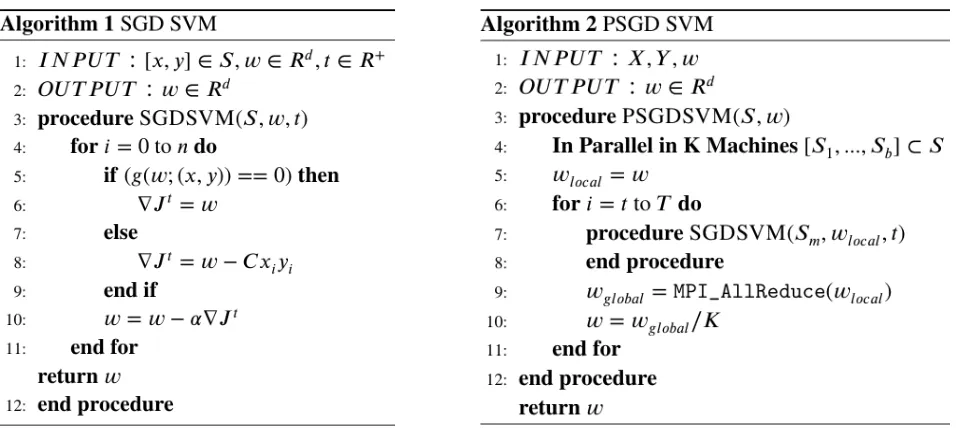
The core optimizer iterates through the data points and does the optimization to calculate the weights. The distributed algorithm shows how the iterative training is done for a considered amount of iterations (or iterations until convergence).
𝑆= {𝑥𝑖, 𝑦𝑖}
where𝑖= [1,2,3, ..., 𝑛], 𝑥𝑖∈𝑅𝑑, 𝑦𝑖 ∈ [+1,−1] (1)
𝛼∈ (0,1) (2)
𝑔(𝑤; (𝑥, 𝑦)) = max(0,1 −𝑦⟨𝑤|𝑥⟩) (3)
𝐽𝑡 = min 𝑤∈𝑅𝑑
1 2𝑤
2+𝐶 ∑
𝑥,𝑦∈𝑆
𝑔(𝑤; (𝑥, 𝑦)) (4)
The sample space of the data distribution is defined in 1. Learning rate𝛼range is defined in 2. In the SGD approach, minimize the objective function in (4) with the constraint on the optimization defined in (3).
3.2
HPC Model Based Performance Analysis
Vibhatha Abeykoon
FIGURE 1SGD SVM Algorithm FIGURE 2PSGD SVM Algorithm
feature sizes, especially with Java. From the conclusions obtained from the work done in the parallel stochastic gradient descent with model synchronization research1, algorithm in figure 2 was designed by calling the core optimizer algorithm in figure 1.
3.2.1
BLAS Optimization
In considering the core algorithm 1, to optimize the dot products and vector scalar multiplications, BLASlevel operations can be applied. For this research, we selected the OpenBlas standard of Blas implementations on Red Hat Enterprise Linux Server 7.6 (Maipo) operating system. In order to implement Blas level operations, the equation and BLAS operation mappings are in 5, 6, 7 and 8.
𝑔(𝑤; (𝑥, 𝑦))⇐⇒𝑚𝑎𝑥(0,1 −𝑦⟨𝑤|𝑥⟩)⇐⇒𝑚𝑎𝑥(0,1 −𝑑𝑑𝑜𝑡(𝑑, 𝑥, 𝑖𝑛𝑐𝑥, 𝑤, 𝑖𝑛𝑐𝑦)); (5)
⟨𝑋𝑗, 𝑦𝑖⟩⇐⇒𝑑𝑎𝑥𝑝𝑦(𝑑, 𝑦𝑖, 𝑋𝑗, 𝑖𝑛𝑐𝑥, 𝑥𝑖𝑦𝑖, 𝑖𝑛𝑐𝑦); (6)
𝑤=𝑤−𝛼𝐶𝑋𝑖𝑦𝑖⇐⇒𝑑𝑎𝑥𝑝𝑦(𝑑, 𝛼, 𝑥𝑖𝑦𝑖, 𝑖𝑛𝑐𝑥, 𝑤, 𝑖𝑛𝑐𝑦) (7)
𝑤=𝑤−𝛼𝑤⇐⇒𝑑𝑎𝑥𝑝𝑦(𝑑, 𝛼, 𝑤, 𝑖𝑛𝑐𝑥, 𝑤, 𝑖𝑛𝑐𝑦); (8)
3.3
Big Data Frameworks for SVM
TABLE 1Datasets
DataSet Training Data (80%) Testing Data (80%) Sparsity Features
Ijcnn1 39992 9998 40.91 22
Webspam 280000 70000 99.9 254
Epsilon 320000 80000 44.9 2000
4
EXPERIMENTS
The experiments in this research were conducted in the Victor and Juliet cluster group in the Future Systems cluster at Indiana University Bloomington. For the single node experiments, we used a maximum of 32 slots in a node and for distributed mode experiments, we used an equal number of processes per machine over a group of 16 nodes. Victor cluster nodes comprises of Intel(R) Xeon(R) Platinum 8160 CPU @ 2.10GHz configuration. Juliet cluster nodes comprises of Intel(R) Xeon(R) CPU E5-2670 v3 @ 2.30GHz configuration. For the single node experiments, we considered a range of parallelisms from 2 to 32 with powers of 2. In distributed experiments, parallelism from 2 to 256 was used among 16 nodes such that for each parallelism each machine gets an equal number of processes. From parallelism 2 to 8, a single process per machine among 2 to 8 machines. And for parallelism 16 to 256, each machine gets an equal number of processes among all 16 machines. For the big data stack based applications we considered the processor affinity and configured Twister2 and Spark such a way that a single process is run per core in the distributed mode experiments. And the MPI Java application also consumed a single process per core.
4.1
Dataset Configuration
For the experiments, we used 3 data sets considering the features per data point, sparsity and data size as shown in table 1.
4.2
Java and C++ Performance Benchmark
For both Java and C++ based MPI applications. Both applications use the compiler level optimization done by each compiler. C++ one uses the 03 level optimization while Java uses compiler level optimization along with JIT (Just in Time) compiler optimization at runtime. The purpose of this experiment is to see how the same algorithm developed in each language performs to the scaling done within a node. Here we carried out two sets of experiments. The first one just uses compiler optimization from each language. In the other setting, each language uses the Blas level optimization for vector vs vector and vector vs scalar multiplications. In these settings, we analyzed how each implementation from each language behaves for three data sets with various sparsity, features and size.
4.3
Blas Configurations
For Blas optimizations, we used OpenBlas as the Blas standard for our experiments. C++ applications have complied with the support of this version directly. To provide support to Java applications, we use netlib-java library which supports Blas level operations on a Blas installed system.
4.4
Big Data Benchmark Configurations
Vibhatha Abeykoon
5
RESULTS
5.1
Java and C++ based MPI Application
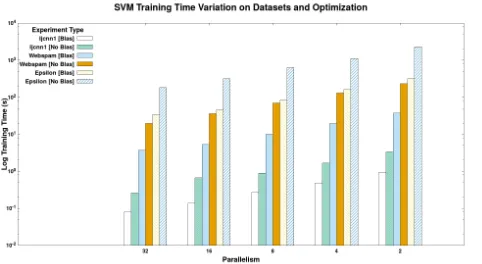
In single-node experiments, the parallelisms 2 to 32 was used in the same machine in the cluster for both Java and C++ exper-iments. In considering the performance concerning the compiler level optimization in both Java and C++ we can see a clear pattern concerning each dataset. In figure 6, the results show that compiler level optimization is done by Java and Just In Time compiler optimization in runtime provides better performance over C++ compiler level performance with 03 level optimization. Java performance better over C++ language level optimization in single node experiments. In referring to the results from Blas based optimization in figure 5, in C++ for all three datasets Blas based optimization always do better for all three datasets in both distributed and single node experiments in figure 3. This behaviour is expected as Blas level operation provides a boost for vector vs vector and vector vs scalar calculations involved with the SVM algorithm. In Java, the behaviour is entirely different concerning the figure 4. For Ijcnn1 and Webspam datasets the Blas optimization is always slower than the just compiler level optimized version. But with the epsilon dataset, we can observe that the Blas level optimization has provided a performance boost. The reason for this behaviour is a part of the process Java using to get this performance boost. To obtain the Blas level optimization, Java cannot directly obtain it from the Blas level operators. The reason is these optimization libraries are written in C++/C by accessing native operating system level functionality. Java cannot obtain the native operating system level func-tionality as Java is running on a virtual machine called JVM (Java Virtual Machine). To obtain the library funcfunc-tionality written in C++/C, Java needs to use an interface called JNI (Java Native Interface) which provides the ability to call a native function or library or to be called by such one. To this to happen, how JNI works have to be understood. JNI native functions are imple-mented in C++/C medium. When JVM invokes a native function, a JNIEnv pointer is being passed along with a jobject pointer and any Java arguments declared by the corresponding Java method. The env pointer holds interface to JVM. In these function calls going from either side, JNI functions are converting native arrays to and from Java arrays when the vector vs vector or scalar vs vector computations are called in Blas level operations. To gain a performance improvement, the data conversion time and the computation time all together must be lesser than the just compiler optimized code in Java. For smaller data sets the conversion time with computation time is lesser as the array sizes involved in dataset Ijcnn1 is 22 and in the dataset, Webspam is 254. But in dataset epsilon, the array size is 2000 and the computation is 100 to 10 times higher than earlier scenarios. So the computation advantage obtained with Blas level operations provides better performance. From this observation, we decided to carry out the distributed experiments with Blas support in both Java and C++ applications. But the main observation is to keep track of the performance obtained per Epsilon dataset related experiments. Because it is the common dataset which pro-vides a better performance improvement over Blas optimization. Referring to figure 5, it is clear that Epsilon dataset performs better with C++ language than Java. The reason for this issue is the Blas level optimization improvement is diluted by the data conversion to either side from native to Java and Java to native due to the iterative nature of the application over a large dataset. In analyzing this fact further, we conducted experiments on the sequential version of the algorithm by considering a variable feature size and constant data size by using random data generated using a Gaussian distribution. The results in figure 9, shows that the Blas level performance is becoming better than compiler level optimized code when the array size grows up. The data conversion overhead makes C++ a better platform to develop scalable solutions on larger datasets with higher dimensions. To improve the performance of Java-based developed applications the JNI function calls have to be minimized meaning the iterative algorithm can be run in C++ end and do the data conversion just once before algorithm starts and the algorithm ends.
In evaluating the performance boost obtain from Blas optimizations, we observed the ratio of training time with BLAS level operations and without BLAS level operations on dataset epsilon. These experiments were carried out for both single-node and distributed domain experiments. The performance improvement for Java was not as significant as that of C++. Figures 7 and 8 depicts the aforementioned fact.
5.2
Big Data Ensemble Model for SVM Training
FIGURE 3C++ Single Node Experiments FIGURE 4Java Single Node Experiments
FIGURE 5Java and C++ Distributed Node Experiments with Blas
FIGURE 6Java vs C++ Compiler Level Optimization Based Performance
FIGURE 7Performance Improvement on Single Node Exper-iments with Epsilon Dataset
FIGURE 8Performance Improvement on Distributed Node Experiments with Epsilon Dataset
[image:7.595.86.537.428.569.2]Vibhatha Abeykoon
[image:8.595.297.545.57.191.2]FIGURE 9Java Blas Performance Against Vector Size Varia-tion
FIGURE 10 Big Data Stack vs HPC Benchmark on Dis-tributed Ensemble SVM
6
CONCLUSION
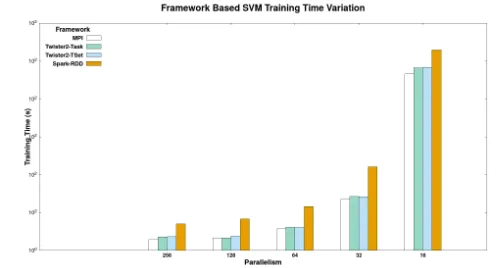
In obtaining better performance for distributed SGD-based SVM applications, there are multiple tools which can provide a wide range of benefits over multiple aspects. The performance gain is always a trade-off that has to be dealt with the level of programming abstractions we trying to adapt to the development model. To gain, the native performance it was evident that using Blas level operations on top of C++ based solution can provide much better performance with higher scalability. In comparing this with the same programming abstraction involved with Java, the barrier behind data transformation from the native environment to JVM and vice versa causes a performance drop down when it is compared to C++ solution. But it was evident that for smaller vectors the C++ or Java solution can be used to get close performance by using Blas with C++ and just use Java with compiler level optimization. This fact is not true when it comes to larger vector size and larger data size. In the development life cycle, managing a Java application is much easier than a C++ application and this trade-off has to be handled with good care when developing applications. But it was evident from the experiments that, the development abstraction in Java can be leveraged to design the data pipeline but using C++ based application to run the iterative algorithm and sending the final results back to Java-based data pipeline can gain performance and a better application development abstraction. In referring to the big data stack-based application benchmark, by using a similar optimization done in MPI for model synchronization, big data stack can also leverage a performance boost.
References
1. Abeykoon VL, Fox GC, Kim M. Performance Optimization on Model Synchronization in Parallel Stochastic Gradi-ent DescGradi-ent Based SVM. In: 2019 19th IEEE/ACM International Symposium on Cluster, Cloud and Grid Computing (CCGRID). ; 2019: 508-517
2. Gabriel E, Fagg GE, Bosilca G, et al. Open MPI: Goals, concept, and design of a next generation MPI implementation. In: Springer. ; 2004: 97–104.
3. Shvachko K, Kuang H, Radia S, Chansler R, others . The hadoop distributed file system.. In: . 10. ; 2010: 1–10.
4. Dean J, Ghemawat S. MapReduce: simplified data processing on large clusters.Communications of the ACM2008; 51(1): 107–113.
5. Zaharia M, Xin RS, Wendell P, et al. Apache spark: a unified engine for big data processing.Communications of the ACM
2016; 59(11): 56–65.
6. Carbone P, Katsifodimos A, Ewen S, Markl V, Haridi S, Tzoumas K. Apache flink: Stream and batch processing in a single engine.Bulletin of the IEEE Computer Society Technical Committee on Data Engineering2015; 36(4).
7. Iqbal MH, Soomro TR. Big data analysis: Apache storm perspective. International journal of computer trends and
8. Kulkarni S, Bhagat N, Fu M, et al. Twitter heron: Stream processing at scale. In: ACM. ; 2015: 239–250.
9. Akidau T, Bradshaw R, Chambers C, et al. The dataflow model: a practical approach to balancing correctness, latency, and cost in massive-scale, unbounded, out-of-order data processing.Proceedings of the VLDB Endowment2015; 8(12): 1792–1803.
10. Kamburugamuve S, Govindarajan K, Wickramasinghe P, Abeykoon V, Fox G. Twister2: Design of a big data toolkit.
Concurrency and Computation: Practice and Experience2017: e5189.
11. Cortes C, Vapnik V. Support-vector networks.Machine learning1995; 20(3): 273–297.
12. Chang CC, Lin CJ. LIBSVM: A library for support vector machines.ACM transactions on intelligent systems and technology (TIST)2011; 2(3): 27.
13. Platt J. Sequential minimal optimization: A fast algorithm for training support vector machines. 1998.
14. Yang J, YE Cz, Quan Y, CHEN Ny. Simplified SMO algorithm for support vector regression. Infrared and Laser
Engineering2004; 5.
15. Hsieh CJ, Si S, Dhillon I. A divide-and-conquer solver for kernel support vector machines. In: ; 2014: 566–574.
16. Chang EY. Psvm: Parallelizing support vector machines on distributed computers. In: Springer. 2011 (pp. 213–230).
17. Chang EY. Psvm: Parallelizing support vector machines on distributed computers. In: Springer. 2011 (pp. 213–230).
18. Cao LJ, Keerthi SS, Ong CJ, et al. Parallel sequential minimal optimization for the training of support vector machines.
IEEE Trans. Neural Networks2006; 17(4): 1039–1049.
19. Shalev-Shwartz S, Singer Y, Srebro N, Cotter A. Pegasos: Primal estimated sub-gradient solver for svm.Mathematical
programming2011; 127(1): 3–30.
20. Zeyuan AZ, Weizhu C, Gang W, Chenguang Z, Zheng C. P-packSVM: Parallel primal gradient descent kernel SVM. In: IEEE. ; 2009: 677–686.
21. Zinkevich M, Weimer M, Li L, Smola AJ. Parallelized stochastic gradient descent. In: ; 2010: 2595–2603.
22. Lin Y, Lv F, Zhu S, et al. Large-scale image classification: fast feature extraction and svm training. In: IEEE. ; 2011: 1689–1696.
23. Kestur S, Davis JD, Williams O. Blas comparison on fpga, cpu and gpu. In: IEEE. ; 2010: 288–293.
24. Sam Halilday YYEA. Netlib-Java.
25. Open Blas.
26. Wang Q, Zhang X, Zhang Y, Yi Q. AUGEM: automatically generate high performance dense linear algebra kernels on x86 CPUs. In: IEEE. ; 2013: 1–12.
27. Xianyi Z, Qian W, Yunquan Z. Model-driven level 3 BLAS performance optimization on Loongson 3A processor. In: IEEE. ; 2012: 684–691.
28. Dong Jx, Krzyżak A, Suen C. A fast parallel optimization for training support vector machine. In: Springer. ; 2003: 96–105.
29. Cramer T, Friedman R, Miller T, Seberger D, Wilson R, Wolczko M. Compiling Java just in time.IEEE Micro1997; 17(3): 36–43.
30. Kuhn BM, Binkley DW. An enabling optimization for C++ virtual functions. In: . 17. ; 1996: 420–428.
Vibhatha Abeykoon
32. Kamburugamuve S, Govindarajan K, Wickramasinghe P, Abeykoon V, Fox G. Twister2: Design of a big data toolkit.
Concurrency and Computation: Practice and Experience2017: e5189.
33. Kamburugamuve S, Wickramasinghe P, Govindarajan K, et al. Twister: Net-communication library for big data processing in hpc and cloud environments. In: IEEE. ; 2018: 383–391.