Optimizing Task Scheduling for HPC using
Software Defined Network
Vidya Chitre, Deven Shah
Abstract: Features of cloud computing in terms of reliability, scalability, and resource pooling have inveigled scientists to deploy high performance computing (HPC) applications on cloud. Nevertheless, HPC applications have major challenges on cloud that emasculate gained benefits. This study aims to analyze challenges that are faced by HPC applications on cloud and focus on how the performance of cloud can be increased through a platform. In this paper, different approaches are discussed for improving HPC task1 scheduling performance on cloud using software-defined networking. Moreover, a task scheduling architecture is proposed to manage task scheduling of HPC applications, which can be later on used as a service to improve the profit of service providers. Bandwidth and capacity of virtual machines are the main parameters that are considered. Index Terms: Software Defined Network, Task Scheduling, HPCaaS, Mininet, Virtualization
I. INTRODUCTION
A characteristic of cloud computing (CC) that is time and again not considered crucial but rather as an unexpected result of resource pooling involves multitenancy. High performance computing (HPC) applications usually run with direct physical access to hardware thereby offering paramount performance. Consequently, traditional HPC platforms are tremendously perfected to obtain best performance of parallel processing. RedeployingHPC applications straightforwardly to cloud can cause performance penalty and snuff out the advantages gained from cloud services[1].
Software-defined networking (SDN) is an emerging network architecture that splendidly fits with the network virtualization of cloud [2]. The unique architectural design of SDN offers programmability that decouples network intelligence from data plane and has controller plane as a separate layer. SDN’s controller plane possesses complete network information and decides network rules and routing policies to improve performance by scheduling HPC tasks on cloud.
This study aims to analyze and improve the performance of HPC applications through SDN-enabled task scheduling algorithm. The proposed algorithm performs better as the number of shared tenants increase thereby maximizing benefits through resource sharing between additional tenants and not only improving resource utilization but also improving scalability of HPC applications for HPC users.
Revised Manuscript Received on May 25, 2019. Vidya Chitre, Dr. Deven Shah
Research Scholar, Department of Information Technology,Terna Engineering College, Mumbai, India, Research Guide,Department of Information Technology, Thakur College of Engineering and Technology, Mumbai, India
The remainder of this paper is organized as follows. Section II discusses about high-performance-computing-as-a-service (HPCaaS) and SDN. Section III describes related work in task scheduling for HPCaaS using SDN. Section IV illustrates about the proposed methodology. Section V describes implementation strategy of the proposed system. Section VI concludes the study.
II. RELATEDWORK
A. High-performance-computing-as-a-service (HPCaaS)
Most of the HPC applications require high computational capacity as well as selection of careful network consideration. Cloud offers computing services such as processing power, storage, and network bandwidth to end users. CC is a technology that offers on-demand access to a pool of configurable computing resources. Its major characteristics include on-demand self-service, broad network access, resource pooling, rapid elasticity, and measured service [3]. Cloud offers a variety of services such as software-as-a-service (SaaS), platform-as-a-service (PaaS), and infrastructure-as-a-service (IaaS). In addition to these, HPCaaS is an upcoming service in this field [4]. Cloud intends to provide computational capacity by offering a number of resources as a service. Deploying HPC applications on cloud and using cloud infrastructures for HPC programs is known as HPCaaS. Note that primary motivations for deploying HPC applications on cloud are coordinated with typical benefits of CC such as resource utilization, cost efficiency, and flexibility.
B. Benefits of HPCaaS
Cloud possesses the capability to offer countless unique advantages for HPC users in addition to the general benefits of CC [4].
Easy maintenance and administration
Most of the HPC users are scientists and physicians who do not have sufficient amount of computer background. As a result, they give importance to ready running service and maintenance of an HPC cluster.
Resource utilization
Cloud offers a dynamic and scalable infrastructure for applications, and depending on the demand of an application for business, it can be dynamically scaled up and down. According to a survey, HPC users do not require resources for a long time period.
Occasionally, there could be a possibility for huge and
requirement. As a result, requirement of cloud-based resources and its utilization shall benefit on-demand pay-per-use model thereby converting capital expenses to operational expenses.
C. HPCaaS-based challenges on cloud
Several research works compared the performance of HPC applications on cloud with on-premise infrastructure and concluded that today’s cloud cannot contend with supercomputers because of the following reasons [5].
Multitenancy
It is an essential characteristic of cloud that allows cloud providers to share resources amongst multiple tenants. Cloud providers can maximize benefits by increasing the degree of multitenancy. However, HPC applications demand direct access to dedicated hardware using batch scheduling, while shared resources on cloud complicate the performance of HPC applications. Resource sharing degrades performance as same resources are utilized by different applications.
Virtualization overhead
Virtualization in hypervisor includes unwanted overhead by adding a software layer and preventing applications to have direct access to hardware resources. Note that virtualization overhead may be different for different hardware. Because of hardware support, virtualization overhead for processors is remarkably less than network virtualization overhead [6].
Network bandwidth and latency
Network interconnects resource sharing in cloud that is shared by several tenants. Therefore, bandwidth may keep changing and network latency may be unpredictable. The bandwidth that is obtained in many cases is much less than expected.
D. SDN
It is an emerging network architecture that not only decouples network control but also packet flow in data plane [1, 7].
The proposed method makes network management adaptable for high bandwidth and dynamic nature of today’s highly scalable applications. Centralized programmable control plane is permitted by network technology to manage entire data plane.It allows open application programming interface (API) communication between hardware and operating system (OS) and network elements and OS. However, SDN integration with cloud management software, i.e., OpenStack, has not been investigated.
III. LITERATURESURVEY
Of late, HPC users have joined large community of cloud users by deploying applications on cloud. However, standard clouds dissatisfyunique HPC application requirements such as batch processing, access to hardware, bypassing OS kernel, and high-performance execution. Research about HPC on cloud can be divided into two groups.
• Performance analysis • Performance improvement
A. Performance analysis
Leite et al. [8] proposed a cloud
architecture—Excalibur—running parallel applications. It involves a distributed file system, a job scheduler, and workflow management alongside other components. The proposed framework minimizes data movement to reduce cost and execution time and adjusts workloads to minimize job makespan. In addition, the architecture possesses the capability of expanding dynamically by inserting more instances in an autonomic manner. Results of autonomic configuration of the proposed architecture revealed 73% and 84% reduction in execution time and cost, respectively.Gupta et al. [9] carried out extensive work for evaluating cloud architecture for HPC applications to reduce cost. Eucalyptus and Open Cirrus were used as cloud testbeds, and their performance and cost were compared with a physical traditional HPC-optimized cluster. Their study revealed that Open Cirrus exhibited better performance than Eucalyptus. However, cloud environments were not able to overcome the performance of physical cluster when there is an increase in the number of cores and size of applications. Analysis in terms of cost and performance indicated that cloud is more cost-effective for parallel applications that do not require high network communications. Kim and Feamster [10] discussed about HPC performance evaluation on cloud that considers an application’s turnaround time and cost. They compared Amazon EC2 public cloud with HPC clusters at Lawrence Livermore National Laboratory. Results of their study proved to be promising for cloud as the turnaround time for some applications was less than that for physical clusters. Conversely, as anticipated, HPC cluster’s raw performance was superior to cloud.According to a survey, the two main challenges for HPCaaS identified by various studies are networking and virtualization overheads.
B. Performance improvement
AbdelBaky et al. [11] introduced a framework to transform a supercomputer into cloud that supports HPC resource accessibilitythrough IaaS, PaaS, and SaaS abstractions. They were of the opinion that efforts to provide HPC resources for scientific applications in the form of HPC in cloud, HPC plus cloud, and HPC as a cloud have not reached completely caused by underlying commodity hardware’s limited capabilities, lack of high-speed interconnections, and physical or geographical distance between servers and virtualization overhead. Furthermore, their study identified ease of use, elasticity, and accessibility of cloud as the primary benefits of HPCaaS.Taifi et al. [12] proposed a paradigm of HPCaaS architecture for developing HPC clusters over a private cloud. High-throughput connections were used, and an Ethernet network was connected. Infinity band can be used for connection of VM, and use of computing nodes can offer better performance. These high bandwidth interconnects personate an imperative part in
convalescing network
performance, which is
necessitous for HPC
their study identified three foremost benefits for HPCaaS, namely resource flexibility, efficiency, and cost reduction. Nevertheless, to achieve the abovementioned advantages, challenges such as virtualization overhead, administrative complexity, and a programming model need to be dealt with.
IV. TASKSCHEDULERONCLOUD
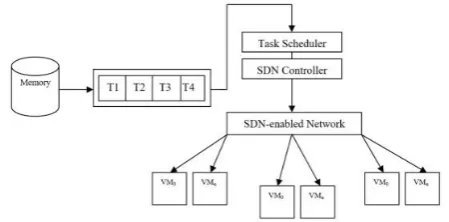
Multitenant cloud network gives rise to erratic and unplanned bandwidths with extra average latency. Even though controlling rapid changes in bandwidth is not easy without dedicating a link to a tenant, it is effortless to monitor changes using SDN controller’s API and take necessary actions. Thus, to be aware of current system bandwidth, a task scheduling system is proposed that benefits from SDN technology.Figure 1 shows the conceptual architecture for SDN-enabled task scheduler. The job scheduler is responsible for dividing HPC jobs into several tasks and placing them in queue for task scheduler. Tasks comprising metadata of required data from shared file system are allocated to a suitable VM worker by task scheduler that takes advantage of SDN controller to be aware of all bandwidth links. Note that a task scheduling algorithm runs within a task scheduler and not within a job scheduler.
The queue is split into two parts:
• Running state: A state where a task queue is full and the task is ready to execute; so, VM is launched.
• Waiting state: A state in which VM is not launched.
For a switch’s empty port, VM is considered to be in waiting state.
Fig. 1. Conceptual architecture for SDN-enabled task scheduler
A. SDN-enabled task scheduling algorithm
This algorithm runs within a task scheduler in our proposed system. As the controller is always aware of network properties, it is connected to a load balancer. For VMs that are not yet launched, the next available idle time (Ti) will be same as the that is time needed for them to launch and become ready (Ri). The task scheduler can calculate a task j’s finishing time on all VMs and select only that task that has minimum value.
∀i =1 to N, ∀j = 1 to M; Time j = MIN;
i = 1 to N (Ti + DTij + Rij);
Where
N = number of VMs, M = number of tasks,
Time j = Duration of the completion time of task j, D = Size of data (bytes)
SDN-enabled task scheduling algorithm:
• Determine data transfer time for data of task j to VM I (duration time)
• Calculate task j’sfinishing time on all VMs and select only that task that has minimum value.
• Assign the selected task to VM • If job queue is full, then launch VM else
terminate VM
V. IMPLEMENTATION
The proposed system is implemented on a network emulator Mininet. Based on infrastructure and platforms, Mininet is deployed on cloud that is integrated with OpenDaylight—a popular community-led and industry supported open-source SDN controller framework that accelerates adoption of SDN and network function virtualization[13]. The OpenDaylight SDN controller collects information about available links and provides it to a task scheduler. Next, the task scheduler uses those links to determine suitable paths and idle machines to work on.
A. Mininet SDN platform
There are countless simulation or emulation platforms that can be used to scrutinize and estimate the concept of SDN in virtual environments. Mininet emulator is believed to be one of the most well-liked and competent SDN-based OpenFlow platform because of its integrity, flexibility, availability, and simplicity in developing SDN networks. Note that such networks include OpenFlow switches, controllers, and hosts that can be connected either through Ethernet or secure interfaces based on secure shell (SSH) protocol in a single Linux kernel. Mininet makes use of Ubuntu Linux distribution with a different version as an OS. Mininet also possesses the capability to use Fedora Linux OS but with a few limitations in supporting numerous features. Moreover, it uses lightweight virtualization methods to offer efficient test environment in a single test machine, which in turn provides a developer or researcher a wide-ranging vision about real testbed network performance.In Mininet, controllers as well as switches can be installed and run either on user or kernel namespace to accelerate performance. Furthermore, every single host in Mininet represents an individual shell process that acts like an authentic real machine, which can be used to represent either a terminal edge in network or a server program such as HTTP and FTP servers. A host in Mininet
unequivocally connects with
the main Mininet
[image:3.595.61.286.468.579.2]example of a small network in Mininet. Network elements can interact with each other, and debugging is carried out using command line interface. This method of virtualization delivers preeminent sharing mechanism for resources of OS, rapid network booting, and easy to setup network elements.
[image:4.595.56.261.125.310.2]
Fig. 2. Example of a small network in Mininet
Conversely, Mininet suffers from limitations like scalability for a large network that entirely relies on emulating machine specifications such as CPU type and frequency and system and RAM memory size [13]. The hardware and software resources that were used in this research were Intel Core™ i5-3320 MB [email protected] with RAM: 8GB, 128 GB SSD, 500 GB hard disk with Ubuntu 12.04 LTS-32-bit, and a kernel Linux 3.11.0-15-generic as OS.
B. Methodology
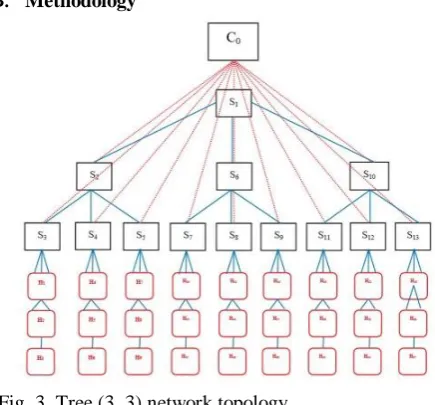
Fig. 3. Tree (3, 3) network topology
Tests in this research consist of the effect of load balancing scheduling algorithms with changing CPU time values. Mininet package has numerous Python script examples that are used to define Mininet capability, and a user can alter them to create contemporary functionality. To instigate an affluent method of designed test in Mininet, .py script was modified to implement tree topology (depth = 3, fan out = 3),
as shown in Figure 3, where the network has 10 switches and 8 hosts in three cases. First, an OpenFlow network was built that used Open vSwitch, which supports v1.3 and is controlled by either OpenFlow remote controller or control and administration tool to augment practical flow entries. Second, an Open vSwitch was used in standalone mode (i.e., non-OpenFlow) to epitomize traditional network. Third, the network possesses OpenFlow as well as non-OpenFlow switches to exemplify a hybrid network. Note that end-to-end throughput is calculated for each network case (i.e., testing is performed between first host in network h1 and last host in network h27) by means of scheduling algorithms with changeable CPU time values (i.e., from 1% to 100%).
Fig. 4. Methodology of scheduling algorithm tests using remote controller.
[image:4.595.340.522.240.658.2] [image:4.595.58.276.479.681.2]VI. RESULTSANDDISCUSSIOON Step 1:Beginning OpenDaylight
OpenDaylight is used as a controller running on Mininet OS.
Step 2:Create custom topologies
Custom topologies can be easily created through Mininet. For instance, creating custom topologies for 10 switches and 8 hosts require a few lines of coding in Python. Note that complex, flexible, and robust topologies can also be created. Moreover, such topologies can be configured based on several parameters that are to be passed, and topologies can be reused for several experiments.
Mininet connects to OpenDaylight Controller and establishes a three-level tree topology.
Step 3:Display topology via YANG data model
With OpenDaylight Controller and Mininet running, as illustrated in previous sections, log into web interface.
YANG is a modeling language written to support network configuration protocol (NETCONF)-based devices. However, in OpenDaylight, this model is used to describe the structure of data provided by controller components.
•T ConfigT Generator:T ItT usesT NETCONFT (i.e.,T itT providesT aT NETCONFT endpoint).T InT addition,T ConfigT subsystemT usesT modelsT toT generateT code.T TheT scopeT ofT
configT generatorT isT toT makeT availableT dependencyT injectionT andT configurationT duringT theT runtimeT ofT aT server,T whichT isT toT aT certainT extentT similarT toT anT outlineT inT openT serviceT gatewayT initiativeT butT externalizesT XMLT fromT jarT files.T Consequently,T aT runningT OpenDaylightT canT beT connectedT viaT NETCONFT andT pushT XMLT thatT reconfiguresT theT server.T ForT instance,T mountingT ofT aT newT Netcong/bgp/openflowT nodeT needsT toT beT carriedT out,T simplyT connectT theT nodeT viaT NETCONFT andT pushT theT change.T ThisT isT oppositeT ofT howT blueprintT works,T becauseT inT blueprint,T XMLT forT eachT bundleT needsT toT beT edited,T repackaged,T andT deployed,T andT thenT theT containerT needsT toT beT started.T YANGT inT configT subsystemT isT specificallyT usedT toT generateT configT javaT skeletonsT asT wellT asT typeT safeT layerT soT thatT NETCONFT clientT canT performT partialT validation.
Config generator is used to describe the structure of data provided by controller components.
Step 4:Determine inventory configuration
Step 6:Run load balancing algorithm based on load
Sending the flow from host 1 to 4, IP addresses for host to switch, switch to switch, and controller to switch link connection can be obtained, as shown below.
Step 7:Obtain result by using optimal path based on load-based balancing algorithm
Two paths are available on host 4 (i.e., from switches 10 and 21), and then based on traffic, Dijkstra’s shortest path algorithm can be applied and the final path with minimum cost can be selected.
VII. CONCLUSION
ThisT studyT identifiedT theT followingT benefitsT thatT wereT obtainedT byT deployingT HPCT applicationsT onT cloud:T (i)T automaticT costT efficiency,T (ii)T straightforwardT useT ofT HPCT resourcesT evenT withoutT backgroundT knowledgeT inT HPCT clusterT administrationT andT maintenance,T andT (iii)T resourceT scalabilityT inT cloudT andT theT abilityT toT scaleT upT andT downT asT perT applicationsT andT userT demand.T However,T HPCaaST needsT toT overcomeT theT followingT challenges:T (i)T networkT latencyT andT throughput,T (ii)T lowT performanceT dueT toT cloudT multitenancy,T andT (iii)T lowT performanceT causedT byT virtualizationT overhead.T TheT proposedT systemT hasT scalableT andT dynamicT architectureT thatT makesT useT ofT SDNT features.T SDN-enabledT taskT schedulingT algorithmT canT considerT VMT costT andT enableT theT schedulerT toT decideT targetT VMsT soT thatT optimalT performanceT canT beT achieved.
REFERENCES
1. Gupta,T A.,T &T Milojicic,T D.T (2011,T October).T EvaluationT ofT HPCT applicationsT onT cloud.T InT 2011T SixthT OpenT CirrusT SummitT (pp.T 22-26).T IEEE.
2. McKeown,T N.T (2009).T Software-definedT networking.T INFOCOMT keynoteT talk,T 17(2),T 30-32.
3. Goecks,T J.,T Nekrutenko,T A.,T &T Taylor,T J.T (2010).T Galaxy:T aT comprehensiveT approachT forT supportingT accessible,T reproducible,T andT transparentT computationalT researchT inT theT lifeT sciences.T GenomeT biology,T 11(8),T R86.
4. Gong,T C.,T Liu,T J.,T Zhang,T Q.,T Chen,T H.,T &T Gong,T Z.T (2010,T September).T TheT characteristicsT ofT cloudT computing.T InT 2010T 39thT InternationalT ConferenceT onT ParallelT ProcessingT WorkshopsT (pp.T 275-279).T IEEE.
5. Expósito,T R.T R.,T Taboada,T G.T L.,T Ramos,T S.,T Touriño,T J.,T &T Doallo,T R.T (2013).T PerformanceT analysisT ofT HPCT applicationsT inT theT cloud.T FutureT GenerationT ComputerT Systems,T 29(1),T 218-229. 6. Yang,T C.T T.,T Wang,T H.T Y.,T Ou,T W.T S.,T Liu,T Y.T T.,T &T Hsu,T C.T H.T
(2012,T December).T OnT implementationT ofT GPUT virtualizationT usingT PCIT pass-through.T InT 4thT IEEET InternationalT ConferenceT onT CloudT ComputingT TechnologyT andT ScienceT ProceedingsT (pp.T 711-716).T IEEE.
Nunes,T B.T A.T A.,T Mendonca,T M.,T Nguyen,T X.T N.,T Obraczka,T K.,T &T Turletti,T T.T (2014).T AT surveyT ofT software-definedT networking:T Past,T present,T andT futureT ofT programmableT networks.T IEEET CommunicationsT SurveysT &T Tutorials,T 16(3),T 1617-1634.
7. Leite,T A.T F.,T Raiol,T T.,T Tadonki,T C.,T Walter,T M.T E.T M.,T Eisenbeis,T C.,T &T deT Melo,T A.T C.T M.T A.T (2014,T April).T Excalibur:T AnT autonomicT cloudT architectureT forT executingT parallelT applications.T InT ProceedingsT ofT theT FourthT InternationalT WorkshopT onT CloudT DataT andT PlatformsT (p.T 2).T ACM.
8. Gupta,T A.,T Kalé,T L.T V.,T Milojicic,T D.T S.,T Faraboschi,T P.,T Kaufmann,T R.,T March,T V.,T ...&T Lee,T B.T S.T (2012,T June).T ExploringT theT PerformanceT andT MappingT ofT HPCT ApplicationsT toT PlatformsT inT theT Cloud.T InT ProceedingsT ofT theT 21stT internationalT symposiumT onT High-PerformanceT ParallelT andT DistributedT ComputingT (pp.T 121-122).T ACM.
9. Kim,T H.,T &T Feamster,T N.T (2013).T ImprovingT networkT managementT withT softwareT definedT networking.T IEEET CommunicationsT Magazine,T 51(2),T 114-119.
10. AbdelBaky,T M.,T Parashar,T M.,T Kim,T H.,T Jordan,T K.E.,T Sachdeva,T V.,T Sexton,T J.,T Jamjoom,T H.,T Shae,T Z.Y.,T Pencheva,T G.,T Tavakoli,T R.T andT Wheeler,T M.F.,T 2012.T EnablingT high-performanceT computingT asT aT service.T Computer,T 45(10),T pp.72-80.
11. Taifi,T M.,T Khreishah,T A.,T &T Shi,T J.T Y.T (2013).T BuildingT aT privateT HPCT cloudT forT computeT andT data-intensiveT applications.T InternationalT JournalT onT CloudT Computing,T 3(2),T 20.