International Journal of Innovative Technology and Exploring Engineering (IJITEE) ISSN: 2278-3075, Volume-8 Issue-10, August 2019
Abstract: Technology has always been behind the paradigm shifts in the business. The businesses have seen their growth by marketing their product through TV, which was considered to be salesman at home that is going to provide all the information. With the advancement in the telecommunication system that has seen a major shift. With the launch of mobile phone things became very easier for business communication. Later with android and iOS introduction everything took by storm. Now most of the viewing is on mobile rather than TV. This research paper highlights the importance of use of mobile based technology to cater the better needs of the consumers. This paper highlights the various upcoming model to cater the market based on the upcoming technologies. This paper shows how the technology is helping the companies in attracting the customers.
Index Terms: Mobile marketing; TV marketing; Technological Shift; ANN; MDS;
I. INTRODUCTION
Advertising has a big role to play in the society for both people and business. It is the basic technique of marketing and has so much to offer. Advertising does not confine to the geographical boundaries. It is essential to market the product using advertising whether, it is new product or old product. The objectives of the advertising vary from imparting information to the customers to stimulate sales and increase profits. Advertising can be considered a mirror of society (Aaker and myers 1987). According to the American Marketing Association, “ It is any form which has an known sponsor and is being done in the form of non-personal presentation and which is always paid form. In the modern era there is no dearth of the media that the marketer can use in order to reach to the customers. The marketers are becoming creative and the customers are becoming informative. Earlier TV was considered to be a salesman in every home (O'Barr 2010). The growing use by shoppers of
mobile devices raises the necessity to
continue learning. However, these new mobile digital platforms would be leading a context for the changing the interaction way and mode of communication between the brands and their shoppers. The augmented consumption of mobile digital media has allowed the enlargement within
Revised Manuscript Received on August 03, 2019.
Amandeep Singh, Chitkara Business School, Chitkara University, (Punjab), India.
Ashu Jain, Associate Professor.
Babita Singla, Chitkara Business School, Chitkara University, (Punjab), India.
the variety and quality of techniques through that brands wi llproduce and maintain a lot of lasting relationships with shoppers.
II. ROLEOFMOBILE
While there is a substantial quantity of portable advertising literature, its concept has not yet been strengthened (Varnali & Toker, 2010; Leppäniemi, Sinisalo, & Karjaluoto, 2006). Portable marketing is defined as "the collection of activities that allow organisations to interact and engage with their public through any network or portable phone in an interactive and meaningful way." Some subsequent terms are given a more particular position by some academics. For instance, in 2009 Shankar and Balasubramanian describe portable advertising as "the use of medium, device or mobile technology to communicate and promote double or multiple routes between a business and its clients." It is the employment of wireless suggests that to supply customers with customized knowledge in actual moment, sensitive to geographical place, seeking to encourage product, services or concepts, delivering benefits to all or any participants. (Scharl, Dickinger, and Murphy 2005, p. 125). It is more exciting that at least four distinct words have been used to attempt to refer to the notion of portable advertising. According to Dehkordi et al. in 2012, “Among these is the accompanying: portable showcasing, versatile publicizing, remote promoting and remote publicizing.” To tackle the problem correctly, it is essential to know the features of the appliances that have exacerbated this shift in today's culture and give fresh possibilities for advertising activities to innovate. These features are: Ubiquity: It relates to users ' capacity to obtain data and perform operations where they are and whenever they need it (Clarke, 2001). This capacity is practical because of the way that these gadgets are turned on nearly consistently; moreover, clients more often than not take it with them wherever they proceed to check it much of the time. Personalization: The cell phone is an extremely close to home gadget and is infrequently utilized by somebody other than its holder (Bauer et al., 2005). It additionally gives individual data through its supporter recognizable proof module (SIM), which is truly profitable for promoting groups (Junglas and Watson, 2003).
Technological Advancement-Based Paradigm
Shift: A Focus Shift from Large Screen to Small
Screen
Furthermore, the gadget turns into a system of self-articulation not just by its image, structure and mechanical properties, yet in addition since it can likewise be a form of different personalization by ringtones or various songs chosen by clients, just as outside defenders accessible in different Designs that reflect distinctive identity types. Two-way communication: This is a main characteristic of prospective advertising apps. These phones enable the establishment of continuous communication with customers more than any other instrument (Schierholz, Kolbe, & Brenner, 2007). It enables for a higher rate of use for other appliances requiring a continuous physical link, generating more possibilities to create significant interaction encounters around brands. Place: It comprises of the capacity by locating their machine to recognize the geographical position of a user (Clarke, 2001). This function is focused on the use of technology for geographic location, including the worldwide positioning scheme recognized as GPS. With the use of GPS now companies can focus on the potential customers located at different corners of the world. With techniques such as RFID, it is very probable that more location-based advertising apps are presently being created, as writers such as Bruner and Kumar (2007) have studied in latest years. Based on these features, a balance within mass advertising (Marketer depends upon the use of various media used for mass marketing such as printed media, TV and radio) and portable advertising appearing. On the other side, in 2012 Kaplan describes portable marketing as "any promotional exercise performed via an omnipresent network to which customers are continuously attached via a private phone." This writer also suggests a manner to rank portable advertising apps into four major categorizations. For this purpose, it utilizes two factors: (1) consumer recognition level and (2) communication activation level. The use of a portable phone enables businesses to customize posts for each of their customers in terms of customer identity, as per the concept given in advertising one by one (Peppers, Rogers, & Dorf, 1999). It becomes essential in distinguishing, however, that companies that provide mobile service are probable to have a higher capacity to recognize individual customers relative to other businesses seeking to attain this amount of customer base understanding. The impulse communication (push), launched by the business, differentiates from snap interaction, launched by the customer, with regard to the activation stage of the interaction. The businesses distributed a particular message to a big amount of customers within the first category (low commitment / push). This means that the business is unable to find out which customers were ultimately affected by what is being communicated. This gathering is known as the "unknown". Inside the second gathering (low commitment/pull), buyers get data however are not unmistakably distinguished at the time they are playing out this activity. The organizations along these lines don't know which clients are by and large explicitly related, which is the reason this gathering is known as the "devotees”. In the third gathering (high commitment/push), the organizations know their customers exclusively and can send messages and data without first mentioning their assent
for such sending. In this gathering are the "people in question”. In the last gathering (high commitment/pull) are customers who deliberately give their consent to be reached and give individual data. This is the perfect type of customer connection as it enables one to perform advertising strategies one by one, with a reduced danger of annoying or dissatisfying consumers. This group is referred to as "periodic supporters." The above terms imply because its nature is mainly engaging and may include marketing, advertising and client service operations, among other actions aimed at building long-term consumer interactions. In today's evolving competitive setting, these advertising operations have gained significance (Bolton & Shruti-Saxena, 2009).
III. FINDINGSANDDISCUSSIONS
The changing need of advertisement and rise of internet-based technologies has given rise to the following models, which is a vast improvement on the previous models. They are
1. ANN: Artificial Neural Networks 2. MDS: Multidimensional Segmentation 3. LCM: Latent Class Models
4. FOC: Fuzzy and Overlapping Clustering 5. OBS: Occasion‐based Segmentation
1) ANN: Starting within the early 1990’s, artificial Neural Networks are developed to deal with a number of analytical issues. The attractiveness and therefore the nemesis and of ANN’s is that they need not any explicit underlying model formulation and they don’t need any explicit organization, which is being said in, multivariate analysis or correlational analysis.
Figure1: Artificial Neural Network Flow Chart
Generally, ANN's are assigned a group of variables as input and a group of notable outcomes, and also the algorithmic program is run to seek out the most effective relationship
between the them. Afterwards, the
International Journal of Innovative Technology and Exploring Engineering (IJITEE) ISSN: 2278-3075, Volume-8 Issue-10, August 2019
The algorithmic program then it saves backs up through one or additional "hidden layers" of input junctures, or neurons, and change the load of every input to it somatic cell to maximise its role in accurately predicting the end result. This learning procedure is continual repeatedly for every somatic cell till the method is halted by user
specifications, or there's 100% accuracy within
the prediction of a separate check sample. Results are tested and valid with different samples.
2. MDS: Segmentation theme supported just one set of bases of variables which could limit the utility of the knowledge to the firm as a result of varied users of segmentation schemes have totally different wants. For instance, development managers might want the market segmentation on perceived values and edges sought; selling communications managers might want the market segmental into teams of patrons with similar wants, desires, or psychographic profiles; and sales managers might want the market segmentation on sales potential or profit. A segmentation theme supported multiple dimensions, exploitation separate segmentation schemes for everyone, is usually additional helpful and additional versatile for designing selling strategy and capital punishment selling techniques. Thus, one could think about completely different segmentations on a sample of patron’s exploitation different bases, say, performance wants, means that (the ability to pay), and needs regarding product‐user identity.
Figure2: The MDS model
This approach provided a far cleaner and a lot of intelligible segmentation theme. We have a tendency to tried to dump all 3 sets of measures into one cluster effort. Alone, this segmentation approach provides appreciable insight into the marketplace structure. However, every cell of the segmentation theme, at the side of means that and distributions of all descriptor variables, may be place into a info and manipulated to produce a lot of dynamic understanding of the market structure and permit the user to reform the cells into new segmentation schemes. With a well-designed phase manager program, the user will have combination cells into specific market segments supported the varied desires of various internal practical and division users, whereas employing a common base of homogeneous cells for all of the segmentation schemes within the company. Thus, any specific plan of action segmentation theme may be directly coupled to the strategic segments or to the other plan of action segmentation theme.
3. LCM: Unlike different segmentation approaches, LCM relies upon applied mathematics modelling; typically
involving variable quantity relationships characterized by regression and logic specifications. It assumes that a combination of distributions generates knowledge, and therefore the analysis involves at the same time estimating section level models and crucial section identities. once the estimation method, individual respondents are often allotted into segments primarily based upon their posterior chance of membership. As an example, victimization solely product-selection alternative knowledge wherever respondent’s area unit ne'er directly asked concerning complete, price, and options, a latent category analysis will reveal segments that area unit complete loyal, value sensitive, feature sensitive, etc. Through Associate in Nursing examination of the ensuing constant estimates. In observe, the employment of latent category analysis in joint and separate alternative applications has received a lot of attention, and user‐friendly software package is currently without delay accessible. Cohen and Ramaswamy (1998) cited 2 studies terminals that latent category joint was superior to many completely different segmentation applications to joint knowledge in terms of match, descriptive validity, and prophetical validity.
4. FOC: Most cluster algorithms are programmed so all cases are assigned to at least one and just one cluster. That is, the algorithms need that the results be reciprocally exclusive and thorough. The fundamental plan in FOC is to permit one case to be assigned to quite one cluster, or instead to assign some of a case to quite one cluster. A much better result will be obtained by exploitation the subsequent algorithmic rule. Create a random information set. For duplicability, initialize the random variety generator to its default price.
rng('default') data = rand(100,2);
Specify exponents of fuzzy partition matrix. M = [2.1. 1.0 3.1 0.4];
The exponent values in M should be larger than one, as values which are smaller specify that there is a lower degree of fuzzy overlap. In alternative words, as M approaches one, the boundaries within the cluster becomes narrow.
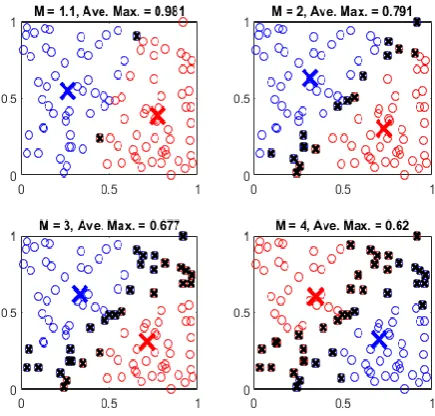
In FOC all the information should be clustered for every overlap exponent. Then every datum has to be classified into the cluster that it's has the very best degree of membership. Next is to lookout the information points with most associated values below 0.6. These are the points which have a fuzzier classification.
To know what is the degree of fuzzy overlap, calculate the typical most membership price across all information points. A better average most membership price indicates that there's less fuzzy overlap.
Plot the bunch results for i = 1:4
% Cluster the data.
points.
maxU = max(U);
index1 = find(U(1,:) == maxU); index2 = find(U(2,:) == maxU);
% Find data points with lower maximum membership values.
index3 = find(maxU < 0.6);
% Calculate the average maximum membership value. averageMax = mean(maxU);
% Plot the results. subplot(2,2,i)
plot(data(index1,1),data(index1,2),'ob') hold on
plot(data(index2,1),data(index2,2),'or')
plot(data(index3,1),data(index3,2),'xk','LineWidth',2) plot(centers(1,1),centers(1,2),'xb','MarkerSize',15,'LineWidt h',3)
plot(centers(2,1),centers(2,2),'xr','MarkerSize',15,'LineWidt h',3)
hold off
title(['M = ' num2str(M(i)) ', Ave. Max. = ' num2str(averageMax,3)])
end
A given datum is assessed into the cluster that it's the very best membership worth, as indicated by maxU. A most membership worth of 0.5 indicates that the purpose belongs to each clusters equally. The information points marked with a black x have most membership values less than 0.6. These points have a larger uncertainty degree in their cluster membership. More knowledge points with low most membership values indicate a larger degree of fuzzy overlap within the agglomeration result. The typical most membership worth, averageMax, provides a quantitative description of the overlap. Associate averageMax worth of one indicates crisp clusters, with lesser values indicating a lot of overlap.
[image:4.595.315.533.57.265.2]More knowledge values with least most membership values indicate a bigger fuzzy overlap degree within the bunch result. The common most membership price, averageMax, provides a quantitatively details of the overlap. Associate degree averageMax price of one indicates crisp clusters, with lesser values indicating additional overlap.
Figure 3: Overlapping Cluster Solution
Most bunch routines assume cases square measure classified into hyper‐spheroids in flat house. Cases square measure appointed to a cluster supported their variable distance from the middle of the ellipsoid of revolutions or supported their likelihood of happiness to every spheroid. within the scenario wherever a specific case is almost equal distant, or has nearly equal likelihood of happiness to quite one ellipsoid of revolution, the quality bunch program can assign the case to the nearest one, even though it takes 5 decimal points to try to to it. Several statisticians and analysis methodologists believe that there ought to be another for the bunch algorithmic program to assign the case to every of the clusters.
5) OBS: The main difficulty in market segmentation study is a way to form segments once circumstances or occasions drive goods & services, preferences and choice. For instance, it's acknowledge that brewage complete preference and complete choice is commonly driven by the situational circumstances of the buyer at the time of usage. Building choice is additionally acknowledge to be addicted to occasion and circumstance. Automatically, this is often not terribly tough. All because it takes may be a completely different manner of observing the info input data to plain agglomeration routines. A case becomes an event with individual respondent info appended to every occasion‐case. Here is associate degree example. Allow us to say we tend to area unit activity the relative influence on complete selection of a collection of brands, product attributes, and worth variations for effervescent soft drinks (CSD's) for immediate consumption during a kind of store sort settings grocery, convenience, mass merchandise, deli, and drug. Every individual is asked to execute some extent allocation of importance of every of the attributes, and worth and name, on influencing their choice for every store setting that they need tough within the last ten
International Journal of Innovative Technology and Exploring Engineering (IJITEE) ISSN: 2278-3075, Volume-8 Issue-10, August 2019
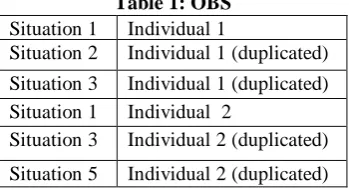
[image:5.595.82.257.132.227.2]Additionally, we tend to raise demographic and consumption-volume profile info to higher describes the respondent. We'd like to construct the information file as shown below, showing the primary 2 individuals.
Table 1: OBS
Situation 1 Individual 1
Situation 2 Individual 1 (duplicated) Situation 3 Individual 1 (duplicated) Situation 1 Individual 2
Situation 3 Individual 2 (duplicated)
Situation 5 Individual 2 (duplicated)
Here, every set of purpose allocation information for every store setting becomes a case. The individual's identification information is appended to every set of occasion ratings. At this time, we've 2 selections. we have a tendency to might execute a agglomeration of the purpose allocation information for every sort of looking trip, so explanation segments supported importance drivers inside store kind, separately. Alternatively, we have a tendency to give all of the purpose assigned information to a agglomeration rule and notice clusters or segments wherever the importance drivers are similar inside every cluster and totally different between clusters, despite the occasion. The ensuing clusters could or might not differentiate within store sorts. In any of the way, we've dead occasion-based segmentation
IV. CONCLUSIONS
The use of technology is creating a need to create a different type of segments that may be used to cater the needs of the customers in a better way. The use of smartphones is increasing globally and it is penetrating in each and everybody’s life. It become very important to see how the users of this technology are reacting to new technological driven marketing tactics. These tactics provide a lot of differences as compared to traditional methods. These instruments show significant distinctions from those in the conventional combination of communications and advertising campaigns. These incorporate the reality that smartphones, unlike laptops, are private equipment that are sometimes on and are checked by customers during the day with a large rate. This opens up new chances to convey progressively customized correspondences at the perfect time and spot to affect shopper purchasing choices. Additionally, critical is the future capability of portable advertisers from the perspective of the client profile, since the section that has the most elevated development rate in the utilization of these cell phones are youthful grown-ups or Millennials. In the event that brands need to speak with these new shoppers, they should see how they are identifying with these versatile correspondence advances. The primary features of this fresh digital media include user-friendliness, the capacity to submit custom material and the capacity to create educational interactions. The pace of advancement of these
versatile correspondence advances has been fast to the point that the underlying apparatuses, for example, instant messages (SMS) have offered path to the incredible assortment of conceivable outcomes offered by Smartphones. The chance has also been created that mobile marketing can boost clients ' understanding of importance. One of the fundamental territories of research in this field has concentrated on the acknowledgment of innovation related with the utilization of administrations on the Internet. A portion of the models connected to the investigation of versatile advertising selection incorporate the Diffusion of Innovation Model created by Rogers (1995) and the Technology Acceptance Model (TAM) (Davis, 1989) which thus gets from the Theory of Reasoned Action (TRA) (Fishbein &Azjen, 1975). This fresh customer truth offers a environment for organisations to create and spend in mobile marketing activities that adjust in aspects of web browsing and application utilization to fresh behavior models. Nonetheless, there is as yet the need to perform more research from a hypothetical viewpoint about advanced buyer conduct issues, so as to help basic leadership in authoritative and the executive’s science, explicitly those identified with the promoting capacity. It's evident that portable showcasing examination is just in its underlying stage, and albeit a few investigations have been done on applicable perspectives, a few issues stay unaddressed by promoting research at both hypothetical and exact dimension.
REFERENCES
1. Baghla, A., & Garai, A. (2016). Service quality in the retail banking sector-A study of selected public and new Indian private sector banks in India. IJAR, 2(6), 598-603.
2. Boyd, Westfall & Stasch (2005),” Marketing Research”, AITBS
3. Charlie Nelson (August 2002) “Market Segmentation: The role of future
research”, Foresee change, Australia
4. Kotler Philip(2000), “Marketing Management- Millennium edition”,
Prentice Hall of India Private Limited
5. Leo Lingham (2008), “Market segmentation for FMCG products,
Management consulting services”, viewed on 25 December 2010 http://en.allexperts.com/q/Management-Consulting-2802/2008/11/Marke ting-Management-1.htm
6. Lieberman, Michael (2003) "A beautiful segmentation", Quirk's Marketing Research Review
7. Luck & Rubin,(2007) “Marketing Research”, Prentice Hall India
8. McKenna, R.(1988), "Marketing in the age of diversity", Harvard Business Review
9. Michael Richarme (2007),”Business Segmentation: Emerging Approaches
to More Meaningful Clusters”, Decision Analyst Inc.
10. Segmentation in the maturing marketplace (2005), Hot Marketing, Issue
No. 7, The Chartered Institute of Marketing.
11. Singh A. & Chandhok A. (2010). FMCG sector in India: a strategical view. Asian Journal of Management Research.
12. Singh A. & Chandhok A. (2010). Study of the Key Market Segmentation
and Targeting Strategies Followed by the Leading FMCG Companies in India. Asian Journal of Management Research.
13. Singh A. & Singh G. (2016). Cohorts in Marketing: A Review Paper. International Journal of Computer Applications.
14. Singh A. & Singh G. (2017). Customers Perception Towards Service Quality - A Study of Selected Public and New Indian Private sector Banks in India [An Empirical Study of Malwa Region]. International Journal of Commerce and Management Research, 2(7), p82-88
15. Singh, A. (2010). Market Segmentation in FMCG: Time to Drive New
16. Singh, A. (2011). Impact of Demographical Factors on the Purchasing Behaviour of the Customers’ with Special Reference to FMCG: An Empirical Study. Internal Journal of Research in Commerce Management, 2(3)
17. Steenkamp and Ter Hofstede (2002) "International market segmentation:
issues and perspectives", Intern. J. of Market Research, vol 19, p 185-213
18. Wedel, Michel and Wagner A. Kamakura (2000). Market Segmentation:
Conceptual and Methodological Foundations. Amsterdam: Kluwer
19. William D. Neal, John Wurst (2001),” Advances in Market
Segmentation”, Marketing Research: A Magazine of Management and Applications.
AUTHORSPROFILE
Dr. Amandeep Singh has done BIT MBA Ph.D. and he is also UGC-NET qualified. Currently he is working as Professor Chitkara Business School, Chitkara University, Punjab, India. He is having more than 14 years of teaching experience. He has served as Dean / Principal in various reputed Universities and colleges. He has published 28 research papers in various journals and conferences. He has also chaired many National and International Conferences. He is on the editorial board for 3 International Journals. He was awarded as the Best Teacher in 2008.
Dr. Ashu Jain is an M.B.A., M.Phil. UGC NET Qualified & Ph.D. He is having more than 12 years of teaching experience. He has served as Assistant Professor in Amity University for more than 10 years. He has published 10 research papers in various International and National journals and presented 11 research papers in various International and National conferences. He is on the editorial board for 2 International Journals and he has participated as Chair person and Resource person for different International and National seminars and conferences. He has been awarded with MTC-Global 2014 for outstanding knowledge sharing.