Abstract: Interval data mining is used to extract unknown patterns, hidden rules, associations etc. associated in interval based data. The extraction of closed interval is important because by mining the set of closed intervals and their support counts, the support counts of any interval can be computed easily. In this work an incremental algorithm for computing closed intervals together with their support counts from interval dataset is proposed. Many methods for mining closed intervals are available. Most of these methods assume a static data set as input and hence the algorithms are non-incremental. Real life data sets are however dynamic by nature. An efficient incremental algorithm called CI-Tree has been already proposed for computing closed intervals present in dynamic interval data. However this method could not compute the support values of the closed intervals. The proposed algorithm called SCI-Tree extracts all closed intervals together with their support values incrementally from the given interval data. Also, all the frequent closed intervals can be computed for any user defined minimum support with a single scan of SCI-Tree without revisiting the dataset. The proposed method has been tested with real life and synthetic datasets and results have been reported.
Index Terms: Data mining, Interval data, Closed Interval, Support Count, Minimum Support.
I. INTRODUCTION
Interval data refers to those data where intervals of distance, time etc. which are associated with events. In many real world data we often encounter intervals. Mining from interval data is comparatively a new field of research in data mining. It is used to extract unknown patterns, rules and relationships hidden in dynamically increasing large data that has intervals associated with them. The concept of closed interval is important because by using the set of closed intervals and their support counts, the support of any given interval can be computed. In this work, we consider a dataset of interval transactions. Each interval transaction has a start and end point. For example, in a temperature recoding system that records the minimum and maximum temperature per day, if we extract closed intervals of temperatures then it is possible to find out the dominant temperature intervals in a particular period. This can help the system to predict temperature. Similarly, in an online e-learning portal by using
Revised Manuscript Received on August 05, 2019.
Dwipen Laskar, Assistant Professor, Department of Computer Science, Gauhati University, Gauhati, India.
Naba Jyoti Sarmah, Assistant Professor, Department of B.Voc.(IT), Nalbari Commerce College, Nalbari, Assam.
Anjana Kakoti Mahanta, Professor, Department of Computer Science, Gauhati University, Gauhati, India.
the recorded user login and logout times, the administrator can extract the closed intervals to design strategies to involve maximum number of users taking part in a discussion.
In this paper we propose an incremental algorithm for finding all closed intervals and their support counts from interval datasets. The proposed algorithm constructs a tree of Closed Interval with Support counts. The tree is named as SCI-Tree that keeps the information of all the closed intervals along with their support counts present in the dataset. Whenever a new interval comes in, the algorithm updates the SCI-Tree to generate the new closed intervals along with support counts without visiting the dataset. All the frequent closed intervals can also be computed for any user given minimum support with a single scan of the SCI-Tree. No separate scan of the database is necessary to do this. In [1] authors have proposed an efficient incremental algorithm for computing all closed intervals. They have used a data-structure called CI-Tree (Closed Interval Tree) for storing the closed intervals. When new intervals come in, CI-Tree is updated to generate the new closed intervals. However this method could not calculate the support values of the closed intervals. It is necessary to visit the interval database separately again to compute the supports of closed intervals.
In Section II, some of the earlier works related to the problem at hand are discussed. In Section III, some basic definitions related to closed interval mining problem are given. In Section IV, an incremental approach of closed interval mining is discussed in details. Section V provides details about SCI-Tree. In section VI, construction of SCI-Tree is explained. Proposed algorithm is discussed in section VII .In Section VIII explains Performance analysis of the proposed algorithm. The experimental results are given in section IX. We conclude and outline the scope of future work in section X.
II. RELATEDWORKS
Very limited research works have been found in interval data. J. F. Allen [2] had shown that between two temporal intervals can be related in thirteen possible ways. He had put forward a method for mining knowledge from time-related intervals using these 13 relationships.
Kam and Fu [3] pointed out some limitations in the Allen’s method [2] by showing that ambiguity arises with composite patterns depending on the
ways of combining the relationships and proposed a
SCI-Tree: An Incremental Algorithm for
Computing Support Counts of all Closed
Intervals from an Interval Dataset
new method removal of these ambiguities.
In S. Wu and Y. Chen [4], proposed a algorithm called as
TPrefixSpan to mine non-ambiguous temporal patterns from interval-based event data. Villafane et al. [5][6] proposed containment relationship in time series data by treating them as interval events. They also put forward an algorithm to discover patterns using these relationships.
Patel et al. [7] put forward a lossless hierarchical representation of temporal interval-based events and extends proposed an algorithm called IEMiner for extracting frequent time-interval based patterns from interval data. Based on the discovered time-interval patterns, a classifier called
IEClassifier was build to classify closely related classes. Chen et al. [8] put forwarded an end-point representation of event intervals and event sequences to simplify the complex relations between events of interval. Any event E is represented by using the endpoint sequence E+E-, where E+
and E- represents the start-time and finish-time of the event E. A parenthesis is used to represent the endpoints occurred at the same time. E.g. the endpoint sequence, (X+Y+)(Y-)(X-)
represents that event X and Y starts at the same time but Y
finishes before X. For handling multiple occurrences of events, an occurrence number is used that is attached with the endpoints. Based on these representations he proposed an algorithm called CEMiner for mining closed time interval patterns from large interval dataset.
J. Lin [9] first introduced the concept of maximal frequent intervals suitable for intervals in discrete as well as continuous domain. A data structure called I-Tree is used to store the frequencies of the intervals in an interval database. He proposed a Pre-order traversal algorithm to extract the maximal frequent intervals by scanning the I-Tree once. Pasquier et al. [10] was the first to introduce the notion of closed frequent set. They defined the framework of closed itemset lattices and proposed an algorithm called A-Close to discover frequent closed itemsets.
M. Dutta and A. K. Mahanta [11] extended the idea of closed frequent itemsets to interval dataset and proposed a method to compute closed frequent intervals by using the set of maximal frequent intervals present in that interval dataset. M. Dutta [12] proposed an efficient method of construction of I-Tree as designed by Lin [9] and developed an algorithm called MIntMiner for mining maximal frequent intervals. A data structure called IS- Tree is also proposed to discover closed frequent intervals.
N. Sarmah et al. [1] proposed an incremental approach by defining a new data structure called CI-Tree to mine all closed intervals in the interval dataset. When never a new interval comes in to the interval dataset, the CI-Tree is updated without scanning the dataset. The major disadvantage in
CI-Tree is that it cannot store the support count of discovered closed intervals. In our work, we modify the CI-Tree to construct a new data structure called SCI-Tree (Support Closed Interval Tree) which can store all the closed intervals and their respective support values. It also stores the information to differentiate between the generated closed intervals and input closed intervals. a generated closed interval is a closed interval but not an interval in the input interval dataset. Remaining all closed intervals are input closed intervals.
III. PROBLEMDEFINITION }
,..., , {r1r2 rn
TDB is a database consisting of a set of records ri , where each record riis a triplet,
l,f,r
. Here,
l,r is an interval with l and ras the left and right endpoint of it. The symbol f denotes the frequency of the interval. The objective of present work is to discover all closed intervals and their support counts in the interval dataset. It is assumed that the interval domain is discrete and if
l,r , an interval in the interval dataset andpis a point in that interval thenlpr.Let L{l1,l2,...,lL}denotes the distinct left endpoints and sorted in the ascending order, i.e. l1l2...lL . Similarly, let R{r1,r2,...,rR} denotes the distinct right endpoints and sorted in the ascending order. i.e.
R r r
r1 2... .
If I1
l1,r1
and I2
l2,r2
are any two intervals and if2 1 1 2 l r r
l thenI1is said to be contained in intervalI2
and it is represented asI1I2. If s is the total number of intervals that contains I1 in the interval dataset, then it is called as the support counts ofI1. An interval I1is said to be properly contained in another interval I2 if and only ifl2l1r1r2or l2l1r1r2orl2l1r1r2, and is
denoted asI1I2.
Any interval I1is called as a closed if the support of any interval properly containing I1is less than the support of
2
I i.e. if I1I2and ifs1 and s2 are support of I1 and
2
I respectively thens2s1.
A closed interval I is termed as an input closed interval and if ITDB, otherwise it is denoted as a generated closed interval.
Properties of closed intervals are based on following theorems [1].
Theorem-1: ifI1andI2are any two intervals in the dataset and if I1I2 with s1 and s2 are support of I1 and
2
I respectively thens2s1.
Theorem-2: for any interval
l,r in the dataset, all the closed intervals are denoted as
l,r , wherer r
l andpart
r l.Theorem-3: If
l,r is a closed interval then r is a right endpoint in the dataset andpart
r l.IV. INCREMENTALMETHODFORMINING
CLOSEDINTERVALS
Algorithm proposed by Sarmah et al. [1] extracts all closed intervals in an interval dataset by using the data structure
CI-Tree. The CI-Tree consists of a header list H. Each element in that list is a node I which is linked with a distinct left endpoint lL Lin the
also contains a sub-list SIof distinct right endpointsrR R. The elements in H are sorted in ascending order of the left endpoints lL Land those in SIare sorted in ascending
order of right endpointsrR R. An interval I[l,r]is a closed interval iff a node I for the left endpoint, l occurs in H
and a node for the right endpoint r occurs inSI. Since our proposed algorithm in based on the work done in [1], for the sake of completeness a short description of the CI-Tree together with its construction is elaborated below with diagrams.
The building of CI-Tree has two steps. In the first step, the algorithm uses Header_ Modify function to modify the header list and in the second step, it uses SubList_Modify function to modify the sub lists. In the updation of header list, H if the left endpoint of the newly inserted interval is present in H then it modifies the right value of the respective header node in case it is less than the right value of newly inserted interval. Otherwise, the new interval is inserted in H maintaining the sorted order. The modification of closed intervals in CI-Tree is based on two conditions [1].
Condition-1: If I
I.left,I.right
is the newly inserted header node and H
H.left,H.right
is an existing header node in the CI-Tree then ifH.leftI.leftI.rightH.right or H.leftI.leftI.rightH.right then it adds all those endpoints epHin SH to SIsuch that I.leftepH I.right, where SHand SIrefers to the sub lists of header node H and Irespectively. [Theorem 2]
Condition-2: If I.leftH.leftI.rightH.right then right
I. is added to the sub list SH [Theorem 3]. Example
[image:3.595.309.530.102.194.2]Let TDB is transactions of intervals as shown below in
[image:3.595.313.544.252.435.2]Table I and construction of CI-Tree is elaborated below with diagrams.
Table I. Interval Dataset, TDB
TID 1 2 3 4 5 6 7
I [6,9] [1,5] [2,7] [1,7] [2,4] [8,10] [7,11]
I=Interval
Now, Initial Header-List, HNULL.The input Interval, ]
9 , 6 [
I , is added to the H as header node IH [6,9](using
Header_Modify). Now, 9is added to the sub-list SHof the newly created header node IH (condition 2).
Fig. 1. CI-Tree after the insertion of interval [6, 9]
For the Interval, I[1,5], H does not contain an entry with 1
.left
H . So, node I is added to H as IH [1,5]maintaining the sorted order. 5 is added to the sub-list SH of IH (condition 2).
Fig. 2. CI-Tree after the insertion of interval [1, 5]
For the input Interval, I [2,7], H does not contain an entry with H.left2. So, node I is added to H as IH [2,7] maintaining the sorted order. 7 is added to the sub-list of
H
I using condition-1. 5 is added to the sub-list of IH and 7 is added to the sub-list of header node
6,9 (condition-2).Fig. 3. CI-Tree after the insertion of interval [2, 7]
For the Interval, I [1,7], H contains a header node ]
7 , 1 [
H
I with IH.left1and IH.rightI.righti.e. 57. So, IH.right of the node IH is updated to 7 , i.e.
7 .right
IH . Also, 7 is added to the sub-listIH .Since, right
[image:3.595.313.545.536.700.2]I. is present in the sub-lists of all the following header nodes, so no modification is required in the tree.
Fig. 4. CI-Tree after the insertion of interval [1, 7]
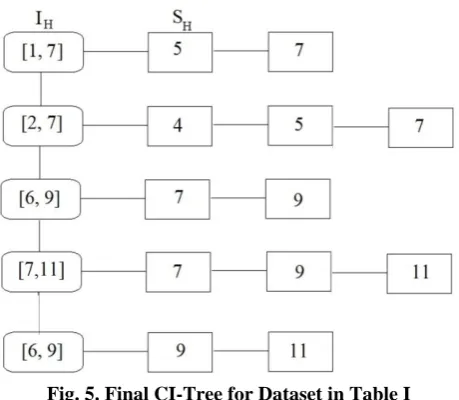
Following the same process for all the remaining input intervals in TDB, I
2,4,8,10, 7,11
as discussed above, the final CI-Tree constructed [image:3.595.47.294.542.616.2] [image:3.595.117.226.692.738.2]Fig. 5. Final CI-Tree for Dataset in Table I
So, the final CI-Tree, indicated that {[1,7], [1,7], [2,4], [2,5], [2,7], [6,7], [6,9], [7,7], [7,9], [7,11], [6,9], [6,11]} are the closed intervals extracted from the input interval dataset
TDB.
V. SCI-TREEFORSTORINGCLOSEDINTERVALS
WITHSUPPORTCOUNTS
The CI-Tree as described above stores all the closed intervals generated from all input intervals. As input intervals are closed too, the input intervals are stored in the tree as well. There is no distinction kept to identify the input intervals from the generated closed intervals. In this new approach called
SCI-Tree, the concept of CI-Tree is extended to mine the support counts of all closed interval incrementally by keeping a distinction between generated closed interval and input closed interval.
If I[l,r], is an input interval, then it generates closed intervals [l,r], where lrr and part(r)l . It also generates closed intervals [l,r] ,where llr and
) (l part
r (Theorem 2). The support counts of all closed intervals with right endpoint as ris computed differently from other closed intervals as stated in section-VI. Thus, in SCI-Tree, there is need to differentiate between generated closed intervals and input closed intervals as the support values of an interval is a count of the number of input intervals containing that interval. A flagis maintained in an interval to do so.
The proposed SCI-Tree contains two types of lists of nodes-a Header list, Hand Sub lists, SIfor each node Iin the header list as in CI-Tree. A node I in H contains four fields (l,rmx,h_next,s_next) , where lL and if
R r r
r, ,..., R}
{1 2 is set of distinct right endpoints
associated with lin the dataset then rmx is the largest of }
., ,... ,
{r1 r2 rR . For each distinct left endpoint, liL,
} ,..., 2 , 1
{ L
i in the dataset, there is a corresponding node,
i
l
l in the header list H with lli liand nodes in the header list are sorted in ascending order of their left endpoints l. The
next
h_ and s_nextare two pointers, where h_nextpoints
the node next of I in the header list and s_nextpoints to the node in the sub list, SIassociated to the header node I.
Each node epI in sub-list, SI of a header node, I contains five field (l,sup,freq,flag,s_next), where ris a right endpoint in the dataset, sup is the support count of the interval [l,r]with l as left endpoint in I and r as right endpoint in epI, freqis frequency count of the same interval
] ,
[l r in the input interval dataset, flag contains a value,
0,1
flag to distinguish between generated closed interval and input closed interval and s_nextpoints to the node next to epI in the sub list SI. If a node epI in sub-list SIwith right value equal to ris associated with the header node
] , [l rmax
I then [l,r] is a closed interval iff I.rmaxepI.r. The general structure of SCI-Tree is as given in Fig- 6.
Fig. 6. Illustration of SCI-Tree
In the above SCI-Tree, [l1,r11],[l1,r12],……….,[l1,r1w], ]
,
[l2 r21 ,..., [ln,rzz] are closed intervals and
11
sup ,sup12,……..,sup1w,sup21,sup22,……,supnzare the supports of the intervals respectively.
VI. CONSTRUCTIONOFSCI-TREE
The algorithm for construction of SCI-Tree has two parts. In the first part, it updates the header list using
Header-Update procedure and in the second part, it updates the sub lists using SubList-Update procedure. The sub-list in SCI-Tree maintains closed intervals, their respective frequency, freq and support counts, sup. For an intervalI[l,r], l is the left endpoint and ris the right endpoint of I . i.e. lpart(r) and rpart(l) . In the header list updation, if the left endpoint of the newly inserted interval, Iis present in a node hin the header list H, say
] , [l r
h and h.lI.land h.rI.r, then the right value of his updated to l.r. i.e. his updated as h[l,r]. Otherwise, Iis inserted in the correct position of the header list.
In the SCI-tree constructions three counters are used: contain
I , Icontain_below and Icurrent . Icontain contains the frequency counts of the
newly inserted interval ]
, [l r
[image:4.595.310.544.268.437.2]number of intervals in interval dataset containing I .Icontain_belowcontains the frequency counts of the newly generated closed interval [l,r] in the interval dataset, where
l
l . i.e. the total number of intervals in interval dataset containing I. The counterIcurrentcontains the support counts of the intervals [l,r] in the interval dataset, where lli.e. total number of intervals in interval dataset containing
I . Icontain , Icontain_below and Icurrent are initialized to
zerobefore the sub-list modification starts for each newly inserted input interval.
When a new interval I[l,r], with frequency, Ifreqis added to the interval data set TDB, the sub list Sof all the header nodes in the header list are traversed and two types of updates are done in the sub-lists updation:
1) Generation of new closed intervals together with computing their support counts, and
2) Incrementing support counts of all existing closed intervals that are contained in the new input intervalI.
Depending on the nature of updates, the sub lists in the SCI-Tree can be treated as of three types.
Type-1: Sub list SHof the header nodes HHhaving left end
point less than l. i.e.HH.ll
For the new interval I[l,r], sub list SHwill not require any changes to be made, i.e. no new node will be added to SH and no change in the support values of the all existing nodes
H
ep in SH. However, an interval, [HH.l,epH.r], for any node epH in SH in the SCI-Tree having non-empty intersection with the input interval i.e. HH.llHH.rand
r r
epH. , will generate new closed intervals [l,epHr]and is therefore added as a node epIwith epI.repH.rto the sub list SI of the header node HI in correct position. The support count of a newly generated interval is initialized as
sup . sup
. H
I ep
ep . Since, [l,epI.r]is not an input interval, flagand freqare set to zero. i.e.epI.flagepi.freq0. But, if a node epIwith epI.repH.ris already present in
I
S i.e. [l,epI.r]already exists then only support value is updated for that interval if required. i.e. epI.sup is updated as epH.supiff epI.supepH.sup. The frequency counts of
] , [l r
I for all input closed intervals in SHis also computed and is stored in Icontaini.e. for all nodes epH in SH ,
ep freq
Icontain H. , where repH.r and epH.flag1. The sum of frequencies of the input closed interval is considered because they merely contribute in the support counts of the input closed interval [l,r]. At the end of traversal of the sub lists SH, all the closed intervals in SIwill have the updated support counts before the inclusion of newly inserted input interval I[l,r]in the interval database. The final support counts of all these close intervals are computed in the next sub list SI of the header nodes HIhaving left end point less than i.e. HI.ll.
Type-2: Sub list SI of the header nodes HI having left
end point equal to l. i.e. HI.ll
Since, the support counts of a closed interval I
r ep l
Hl., I. ]
[ (say, epIis a node in SI) is equal to sum of its existing support and the frequency of the new interval I, so, the support counts of all the existing closed interval in the sub list SIhaving right endpoint less than rare incremented by adding the frequency (Ifreq) of the newly inserted interval I. i.e. for all the nodes epIin SIwith epI.rr, its support
sup . I
ep is set to epI.supIfreq. The modification in SIfor the input closed interval [Hl.l,epI.r]I is performed as explained below.
If a node epI for a closed interval [Hl.l,epI.r] with r
r
epI. is already present in SIthen only the support of this interval is updated as epI.supepI.supIfreq, because its existing support is obtained from the previous sub lists. The computed support is stored in Icurrentas Icurrent epI.sup. The interval [Hl.l,epI.r] is marked as an input closed interval if it is previously marked as a generated closed interval. The marking is done by changing the flag in epIas
1
,flag
epI . The frequency, freq of epI is updated as
freq I
I freq ep freq I
ep . . as well. Otherwise, a new node
K
ep is added to SIin correct position for the new input closed interval [Hl.l,epK.r] with epK.rr. The sum of frequencies of all the input closed intervals [Hl.l,epI.r] which contains [Hl.l,epK.r]in SIis computed and is added to Icontaincomputed in previous list. i.e. for all nodes epIin
I
S , IcontainIcontain
epI.freq, where, epI.flag1and rr p
e I. . The support counts of the newly generated input closed interval [Hl.l,epK.r] is computed as
freq contain
K I I
ep .sup . This is because, the support of this interval will be the sum of frequencies of all the input intervals in the interval database including its own frequency. The currently computed support of the closed interval
] . , .
[Hll epK r is stored in Icurrentas Icurrent epk.sup
Type-3: Sub list SJof the header nodes HJhaving left end
point greater than l. i.e. HJ.ll.
For all the closed intervals in SJ having non empty intersection with Iwill require changes for support updates and creation of new closed intervals i.e. for all intervals in
J
S withHJ.lr . Since, the support counts of a closed interval [HJ.l,epJ.r]I (say, epJis a node in SJ) is equal to sum of its existing support and the frequency of the new interval I, so, the support counts of all the existing closed interval in the sub list SJ having right endpoint less than rare incremented by adding the frequency (Ifreq) of the newly inserted intervalI.i.e. for all the nodes epJin SJwith
r r
freq J
J ep I
ep .sup .sup .The modification in SJ for the interval [HJ.l,r]is only required when HJ.lrHJ.rand is performed as explained below.
If a node epJ for a closed interval [HJ.l,epJ.r] with r
r
epJ. is already present in SJthen only the support of this interval is updated as epJ.supepJ.supIfreq, because its existing support is obtained from the previous sub lists. The computed support count is stored in Icurrent as
sup . J current ep
I . Otherwise, a new node epKis added to
J
S in correct position for the new input closed interval ]
. , .
[HJl epKr with epK.rr.
The sum of frequencies of all the input closed intervals ]
. , .
[HJl epIr which contains [HJ.l,epK.r] in SJis computed and is stored in Icontain_below.i.e. for all nodes epIin SJ ,
, . _
_ I ep freq
Icontain below contain below
I where, epI.flag1and rr p
e I. . The support counts of the newly generated closed interval, [HJ.l,epK.r] is computed as
current below contain
K I I
ep .sup _ . This is because the support of
the closed interval [HJ.l,epK.r] will be the sum of frequencies of all the input intervals in the interval database plus its current support. The currently computed support of the closed interval [HJ.l,epK.r] is stored in Icurrent as
sup . k current ep
I and is followed by other sub-lists in
SCI-Tree in order.
Example
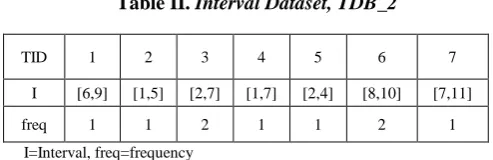
Let us consider the following interval transaction database, TDB_2 as shown in TABLE II and construction of
[image:6.595.45.292.489.569.2]SCI-Tree is elaborated below with diagrams: Table II. Interval Dataset, TDB_2
TID 1 2 3 4 5 6 7
I [6,9] [1,5] [2,7] [1,7] [2,4] [8,10] [7,11]
freq 1 1 2 1 1 2 1
I=Interval, freq=frequency
[image:6.595.48.293.619.769.2]For the better visualization of SCI-Tree, we use following notations:
Table III. Notations for SCI-Tree Symbols/Not
ation Meaning
H Header List
H
S Sub-list of Header List H
] Input closed interval (flag=1) } Generated Closed interval (flag=0) Bold integer Bold text integer represents support
counts of the interval with that value. e.g. 5. i.e. sup=5
Normal underlined integer
Normal text integer represents frequency counts of the interval with that value. e.g. 4 i.e. freq=4
Since, initial Header-List, H=NIL, so I[6,9], is added to the H as header node IH [6,9](using Header_Update). Now, r9is added to the sub-list SHof the newly created header node IHwith flag1, freq1(i.e. type-2 sub-list in SCI-Tree as stated in section-VI).
The support count of the interval is sup=1 and Icurrent 1. Fig. 7 shows the updated SCI-Tree after insertion of I[6,9]
Fig-7: SCI-Tree after the insertion on interval [6, 9].
For, the input Interval, I[1,5], Ifreq 1 Initialization: Icontain0, Icurrent 0
Using the Header_Update procedure,Iis added to the header list H as header node IH [1,5]before header node [6,9]. Now, r5is added to the sub-list SHof the newly created header node IHwith flag1, freq1(i.e. type-2 sub-list in SCI-Tree as stated in section-VI). The support count of the interval is =1 and Icurrent 1. Fig. 8 shows the updated SCI-Tree after insertion of I [1,5]
Fig-8: SCI-Tree after the insertion on interval [1, 5].
For, the input Interval, I[2,7], Ifreq2 Initialization: Icontain0, Icurrent 0
Using the Header_Update procedure, I, is added to the header list H as header node IH [2,7]in sorted order. From the header node[1,5], r5is added as a node to the sub list SH of IH with flag0, freq0,sup=1 (i.e. type-1 sub-list in SCI-Tree as stated in section-VI).
Since, [2,7] is not contained by any of the input intervals in the sublist of header node [1,5], so Icontain0. The support values of all the nodes in the sub-list of IHwith rvalue less than r7is incremented by Ifreq 2and also is Icontain computed for the interval I in SH. There is no change in
contain I .
Now, r7is added to the sub-list SHof the newly created header node IHwith flag1, freq2(i.e. type-2 sub-list in SCI-Tree as stated in section-VI) and there is no change in
contain
2 0 2
supIfreqIcontain andIcurrent 2.
Now, r7is added to the sub-list of the header node ]
9 , 6
[ with flag0, freq0(i.e. type-3 sub-list in SCI-Tree as stated in section-VI) and Icontain_below is computed in this
sub list and therefore, Icontain_below1.
The support count, sup of the interval [6,7] is 3
1 2
supIcurrent Icontain_below and Icurrent 3 for the header node next to [6,9].
Fig. 9 shows the updated SCI-Tree after insertion of ]
7 , 2 [
[image:7.595.314.544.51.215.2]I
Fig-9: SCI-Tree after the insertion on interval [2, 7].
Following figures (i.e. Fig.10, Fig.11, Fig.12 and Fig. 13) indicates the SCI-Trees obtained after the insertion of input intervals:[1,7],[2,4],[8,10]and [7,11].
[image:7.595.50.291.83.361.2]Fig-10: SCI-Tree after the insertion on interval [1, 7].
Fig-11: SCI-Tree after the insertion on interval [2, 4].
Fig-12: SCI-Tree after the insertion on interval [8, 10].
Fig-13: SCI-Tree after the insertion of interval [7, 11]
The output of the final SCI-tree in Fig.13 shows all the closed intervals along with their frequencies and support count. It also keeps the differentiation between generated closed intervals and input closed intervals. A total of 12
closed intervals obtained from the interval dataset TDB_2, out of which 5 closed intervals are generated closed intervals. For example, the header node [8,10] has two closed intervals associated with it: one generated closed interval indicated by ‘}’ symbol and one input closed interval indicated by ‘]’. The generated closed interval of this node is [8, 9] and its support count is 4, frequency is 0. The input closed interval of it is [8,10] with support as 3 and frequency count as 2.
VII. ALGORITHMFORCONSTRUCTIONOF
SCI-TREE Header-Update
Input: SCI-Tree,
Interval I[I.left,I.right] frequency of IIfreq Algorithm:
[image:7.595.316.544.137.420.2] [image:7.595.53.284.428.696.2]//
e
H.
l
→ Left data point of the Header Nodee
H //e
H.
r
max→ Right data point of the Header Nodee
H1. if H is empty 2. add a new node I in H
//create & add node I in H
3. else if (H has a node eH [l,rmax]and eH.lI.left) 4. If eH.rmaxI.right then
5. eH.rmaxI.right
// modify the right value of header node eHas I.right
6. else
7. Add node I to H in sorted order
// Create and add node I in H and place according to ascending order sorted position
SubList-Update Input:
SCI-Tree,
Interval I[I.left,I.right] frequency of IIfreq
Algorithm:
1. IcontainIcurrent 0; // initialize Icontain, Icurrent to 0
2.for all header nodes Hthe in the Header List { 3. if (H.ll.leftH.r) {
4. for all endpoints epHin the sub-list of H { 5. if ( I.leftepH.rI.right) {
6. if (a node epIwith epI..repH.ris not in SI) { 7. create a new node epIand add to SI
maintaining the sorted order; 8. epI.repH.r;
9. epI.flagepI.freq0; 10. epI.supepH.sup; 11. }
12. else
13. if (epI.supepH.sup) 14. epI.supepH.sup; 15. }
16. if (I.rightepH.rand epH.flag1) 17. IcontainIcontainepH.freq; 18. }
19. }
20. if (H.lI.left) {
21. flag0,flag_10;//used to check existence of a node 22. for all endpoints epIin the sub-list of SI {
23. if (epI.rI.right) { 24. flag_11;
25. epI.supepI.supIfreq; 26. if (epI.flag0)
27. epI.flag1;epI.freqIfreq; 28. else
29. epI.freqepI.freqIfreq; 30. Icurrent epI.sup;
31. }
32. if (epI I.right )
33. epI.supepI.supIfreq;
34. if (epI..rI.rightand epI.flag1) 35. IcontainIcontainepI.freq ; 36. }
37. if (flag_10) // I.rignt is not present in SI { 38. create a new node epKand add it to
SIMaintaining sorted order; 39. epK.rI.right; epK.flag1; 40. epK.freqIfreq;
41. epK.supIcontainIfreq; 42. Icurrent epk.sup; 43. }
44. }
45. if (I.leftH.lI.right) {
46. Icontain_below0; flag_20;
47. for all endpoints epHin the sub-list of H { 48. if (epH.rI.right) {
49. flag_21; epH.supepH.supIfreq; 50. Icurrent epH.sup;
51. }
52. if (epH.rI.rightand epH.flag1) 53. Icontain_belowIcontain_belowepH.freq; 54. if (epH.rI.right)
55. epH.supepH.supIfreq; 56. }
57. if (flag_20) // I.rignt is not present in SH { 58. if (H.lI.rightH.r) {
59. create a new node epKand add it to SH maintaining sorted order;
60. epK.rI.right; epK.flag0; 61. epK.supIcontain_belowIcurrent; 62. epK.freq0;Icurrent epK.sup; 63. }
64. } 65. }
66. H Hnext; 67. }
VIII. PERFORMANCEANALYSISOFSCI-TEE In SCI-Tree, Header List, His sorted in increasing order of the left endpoints land sub list, SIof each header node I is also sorted in increasing order of right endpointsr. Linked list implementation is used for both Hand theSI’s. So,O(n)steps are required
If an interval I=[l,r]with frequency f newly comes into the existing interval dataset then to modify the SCI-Tree appropriately, two routines Header-Update and
Sublist-Update are needed to be executed. Header-Update looks for a node with left endpoint as l inH . If such a node is not found then it is inserted inH . This therefore takes
) (n
O steps. After this, in Sublist-Update, for each node for
lin H withll, Slis modified in O(n)steps and support counts of each node in Slis updated simultaneously. For each node for l in Hwith ll, Slis modified in O(n)steps and their support counts is updated at the same time. Finally,
l
S is further modified in O(n)steps with support counts updated all together. Since, there are at most nnumber of sub-lists and length of each sublist is at most n, so the
Sublist-Update routine requires O(n2)steps. Therefore, the worst case time complexity for construction of SCI-tree for one input interval is ((O(n)O(n2))O(n2). If the dataset has n intervals then for inserting n intervals in SCI-Tree, the algorithm will require n*O(n2)O(n3)time in worst case.
IX. RESULTANDDISCUSSION
The proposed algorithm has been implemented by developing programs in C++. We used a Linux PC having Intel Core i3 processor with 1GB RAM. To test the algorithm, it has been applied to the dataset that contains a total of 10031 records collected from Bodhidroom”, [1][2]. The records contain the information about the login and logout time of the users of the web portal from 31/3/2009 to 14/10/2011. Adding all the intervals in SCI-Tree incrementally,we have found 11780 closed intervals with support counts in this dataset. The same dataset was used in [1] for finding the set of closed intervals where the same number of closed intervals (shown in Table IV) was obtained, verifying the correctness of our method and its implementation.
Table IV. Results of CI-Tree and SCI-Tree as applied on dataset obtained from “Bodhindrom”
No of Intervals
No of Closed Intervals with Support Count in
CI-Tree
No of Closed Intervals with Support Count in proposed SCI-Tree
10031 11780 11780
The proposed method is also verified by using a synthetic datasets used in [12], where a sequence of n intervals with left endpoints are generated a data generator. The left endpoints are distributed uniformly between land a givenlmax.
The Poisson distribution with a given mean is used to distribute the lengths of these intervals. The synthetic datasets are generated with max1000and mean200.
[image:9.595.311.549.73.178.2]We implemented both CI-Tree [1] and SCI-Tree for the generated synthetic datasets and the results are found as follows-
Table V. Results of CI-Tree and SCI-Tree as applied on Synthetic dataset
No of Intervals
No of Closed Intervals with Support Count in
CI-Tree
No of Closed Intervals with Support Count in proposed SCI-Tree
1000 70351 70351
2000 136474 136474
3000 167414 167414
4000 181588 181588
5000 190504 190504
X.
CONCLUSION AND FUTURE WORKIn this paper, we proposed an incremental algorithm for computing the support counts of all closed intervals in a interval transaction database. The extraction of all closed intervals and their support counts is important because by using the set of closed intervals and their respective support counts, it is possible to extract the support of any interval in an interval dataset. The existing CI-Tree algorithm can mine all the closed intervals from an interval dataset but it cannot compute the support counts. So, the proposed method is an enhancement of existing incremental CI-Tree. In addition, if any user defined threshold of minimum support is given as input, all the frequent closed intervals can be extracted by a scan of the SCI-Tree formed. The tree also keeps a flag to differentiate the generated and input closed intervals. The frequency of input intervals is also maintained along with the support counts. The effectiveness of the proposed algorithm is verified by testing on both real-life datasets and synthetic data sets. Our proposed algorithm can be more useful in mining meaningful information from real time interval datasets by using its associated information such as support counts, frequency etc. . Future works include extending the proposed algorithm to mine multi-dimensional closed intervals, discovery of periodicities in temporal events etc. Attempts can also be made to improve the performance of the algorithm by using other suitable data structures.
REFERENCES
1. N. Sarmah, A. K. Mahanta, “An Incremental Approach for mining all Closed Intervals from an Interval Database”, IEEE International Advance Computing Conference (IACC), pp. 529-532, Feb 2014. 2. J. F. Alen, “Maintaining Knowledge about Temporal I ntervals”,
Communication of the ACM, Vol.26, Nov 1983.
3. Po-shan Kam, Ada Wai-chee Fu, “Discovering Temporal Patterns for Interval-based Events”, Proceedings of the second International Conference on Data Warehousing and Knowledge Discovery, p. 317-326, 2000.
4. S. Wu and Y. Chen, "Mining nonambiguous temporal patterns for interval-based events," IEEE Transactions on Knowledge and Data Engineering, vol. 19, no. 6, pp. 742-758, June 2007.
5. R. Villafane, K. Hua, D. Tran, B. Maulik, “Knowledge Discovery from Series of Interval Events,” Journal of Intelligent Information Systems, vol. 15, no. 1, pp. 71-89, 2000.
6. R. Villafane, K. Hua, D. Tran, B. Maulik, “Mining Interval Time-series,” Data Warehousing and Knowledge Discovery, pp. 318-330, 1999.
7. D. Patel, W. Hsu, M. Lee, “Mining Relationships Among Interval-based Events for Classification,” Proceedings of the 2008 ACM SIGMOD International Conference on Management of Data, pp. 393-404, 2008. 8. Yi-Cheng Chen, Wen-Chih Peng, Suh-Yin Lee, “CEMiner – An
Efficient Algorithm for Mining Closed Patterns from Interval-based Datasets”, 11th IEEE
9. J. Lin, “Mining Maximal Frequent Intervals”, Proceedings of 2003 ACM symposium on Applied Computing, p.426-431, ACM, New York, 2003.
10. N. Pasquier, Y. Bastide, R. Taouil, L. Lakhal, “Discovering Frequent Closed Itemsets for Association Rules” In Proc. of 7th International Conference on Database Theory (ICDT’ 99), pages 398-416, Jerusalem Israel, Jan 1999.
11. A. K. Mahanta, M. Dutta, “Mining Closed Frequent Intervals from Interval Data”, International Journal of Applied Science and Advance Technology, Vol.1, pp.1-3, January-June 2012.
12. M. Dutta, “Development of Efficient Algorithms for Some Problems in Interval Data Mining,” Ph.D thesis, Gauhati University, 2012.
AUTHORSPROFILE
Dwipen Laskar, M.Tech in Information Technology and Assistant Professor at department of Computer Science at Gauhati University, Guwahati, Assam. He has more than 12 years of teaching experiences and a member in IARA, IACSIT and IAENG. His research area covers data mining and image processing.
Naba Jyoti Sarmah, Ph.D. from Gauhati University, is an Assistant Professor at department of B.Voc.(IT), Nalbari Commerce College, Nalbari, Assam. His current area of research includes interval data mining, temporal data mining etc.
![Fig. 4. CI-Tree after the insertion of interval [1, 7]](https://thumb-us.123doks.com/thumbv2/123dok_us/8182486.255331/3.595.313.545.536.700/fig-ci-tree-insertion-interval.webp)
![Fig. 9 shows the updated SCI-Tree after insertion of [7,2]](https://thumb-us.123doks.com/thumbv2/123dok_us/8182486.255331/7.595.53.284.428.696/fig-shows-updated-sci-tree-insertion.webp)