International Journal of Innovative Technology and Exploring Engineering (IJITEE) ISSN: 2278-3075, Volume-8 Issue-7, May, 2019
Dynamic Seismic Evaluation of Irregular
Multi-Storey Buildings Using Bracing in Zone V as Per
Is: 1893-2016
Lovneesh Sharma, Sandeep Nasier
ABSTRACT:
There are mainly 2 different types of irregularity
in the structure, one is plan irregularity and another is vertical irregularity. The introduction of irregularity in the structure creates complex design and construction problems as irregular structures behave differently from regular structure. The response of such structure under seismic load depends on various factors and it is a dire need to understand the behavior of such irregular structure for the development of new design and construction technique through which the performance of the same shall be evaluated. Therefore, in order to understand the behavior of irregular structure with bracing system, the present study was conducted. For this, different types of irregularities were chosen for 12 storey building i.e. H-shape, L-shape and O-shape. The introduction of V-type bracing has its own significance in the present study. Heavy mass was placed at 6th floor and 9thfloor but not simultaneously. Dynamic seismic analysis in seismic zone V was adopted and it was carried out in Staad. Pro software. The evaluation of the irregular building along with the effectiveness of bracing was found out as it was the ultimate objective of the present study. It concluded that the lateral sway of the column shows very little variation when the heavy mass was transferred from 6thfloor to 9th floor as the value of displacement is almost same. But L-Shaped 12 storey building shows poor performance while resisting the lateral forces as it entails maximum value of displacement i.e.82.405 mm.With the introduction of heavy masses on floor, bending moment and shear force has increased 1.46 and 1.50 times respectively.Keywords:Static and Dynamic Seismic Analysis, Staad.Pro.
I. INTRODUCTION
Today, most of the infrastructures are being widely constructed as irregular structures. A structure is a regular structure when its configurations (dimensional parameters) are almost symmetrical about all the axis. And when the structure is unsymmetrical and discontinuity in plan, elevation, mass or load bearing members, then the same shall be considered as irregular structure. This non symmetrical and discontinuity behavior of the structure causes large torsion forces which makes the structure imbalanced with respect to torsion force. Regular buildings are those buildings which have same appearance either from plan or elevation. But irregular buildings have irregular distribution in their mass, strength, stiffness, covered area etc along the height of the building. Irregular buildings constitute a large portion of the modern urban infrastructures.
Revised Manuscript Received on May 07, 2019.
Lovneesh Sharma, M.Tech Student, Civil Engineering Department, Chandigarh University, Gharaun, Mohali, Punjab, India.
Sandeep Naiser, Assistant Professor Civil Engineering Department, Chandigarh University, Gharaun, Mohali, Punjab, India.
The building configuration has been described in BNBC-2006 as regular or irregular in terms of the size and shape of the building, arrangement of structural the elements and mass. Irregularity of the building is of different types as mentioned below:
Plan Irregularity of the building: this type of irregularity is concerned with the cover area of the building. L-shape, Plus-shape, U-Shape, O-shape is the most common irregular structures plan wise. The building is said to be irregular if the two adjacent sides are not orthogonal to each other.
[image:1.595.315.526.393.659.2] Vertical irregularity of the building: Stiffness irregularity, mass irregularity, vertical geometric irregularity etc comes under vertical irregularity of the building. This is more common than plan irregularity.
Figure 1. Various Types of Irregularities in Elevation.
The response of such structure under seismic load depends on various factors and it is a dire need to understand the behavior of such irregular structure for the development of new design and construction technique through which the performance of the same shall be evaluated. Major failures (like shear failure) occurred due to irregularities like soft storey, mass irregularity etc. Moreover, more deflection can be seen in irregular buildings than regular buildings.
II. OBJECTIVES AND METHODOLOGY
The main objectives of the present study are as follows:
To analyze the different storey buildings (with plan and vertical irregularity) with dynamic seismic analysis in zone V as per the earthquake code IS: 1893-2016.
To find all the structural parameters like axial force, displacement, bending moment etc in a scrutinized way and comparison shall be made.
To compare the effect of mass irregularity and V-bracing at different floors of same building in terms of Displacement and cost analysis.
To draw the final conclusions towards the behavior of irregular structures under seismic forces as per the code IS: 1893-2016 for RCC framed structures.
Various phases of present study which were used for the research methodology are mentioned below:
Phase I: Modeling Various Irregular structuresModels that have been prepared for the present investigational study is being represented in the table 1. As total 6 models were made, for 12 storey building as shown below:
Table 1. Different Models for Present Study.
Type Floors Shape Heavy Mass
Floor
Type of Bracing
1 12 Storey H 6th floor V Type
2 12 Storey H 9th floor V Type
3 12 Storey L 6th floor V Type
4 12 Storey L 9th floor V Type
5 12 Storey O 6th floor V Type
6 12 Storey O 9th floor V Type
Storey height in all the models is taken as 3 m.
No. of bays are as per plan.
[image:2.595.298.542.50.178.2] Size of each bay is taken as 5 m x 5 m.
Table 2. Sectional Properties for H, L and O Shaped 12 Storey Building.
Floors Column (mm)
Beam (mm)
Bracing (mm)
1 to 4 750 x 750 525 x 450 450 x 450
5 to 8 600 x 600 450 x 375 375 x 375
9 to 12 450 x 450 375 x 300 300 x 300
Dead Load:
External Wall Loading: 12.4 kN/m
Interior Wall Loading: 6.2 kN/m
Parapet wall loading: 2.9 kN/m2
[image:2.595.367.489.313.458.2]Live Load:Floor load: 3 kN/m
Figure 2. H-Shaped Building
[image:2.595.365.486.520.670.2]International Journal of Innovative Technology and Exploring Engineering (IJITEE) ISSN: 2278-3075, Volume-8 Issue-7, May, 2019
Figure 4. O-Shaped Building.
Phase II: Response Spectrum Analysis:
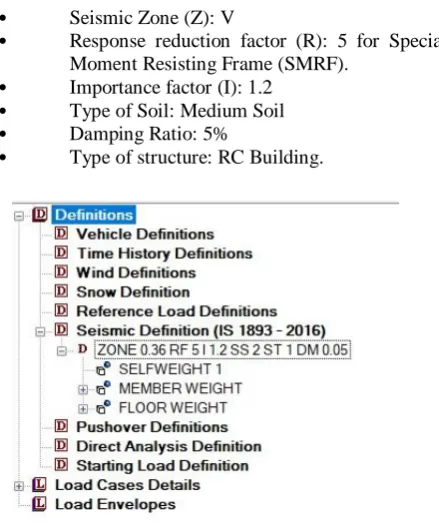
After modeling all the structures with various parameters, seismic analysis was carried out with Response Spectrum Method (dynamic seismic analysis). For this purpose, various seismic parameters were defined in staad.pro as shown below and in figure 6:
Seismic Parameters:
• Seismic Zone (Z): V
• Response reduction factor (R): 5 for Special Moment Resisting Frame (SMRF).
• Importance factor (I): 1.2
• Type of Soil: Medium Soil
• Damping Ratio: 5%
[image:3.595.309.548.330.477.2]• Type of structure: RC Building.
Figure 5. Seismic Parameters.
Grade of Various Material:
M30 Grade of concrete is used.
Fe 500 grade of steel reinforcement is used.
Phase III: Cost Analysis:
After the analyzing the structures, a careful study was carried for various members and components. Therefore, the post-processing of Staad.Pro software were scrutinized and results were recorded for different parameters and were interpreted. Cost analysis was also done for the purpose of better comparison so that final outcome of the study is achieved. For this, following material rates were assumed:
• Rate of Concrete per cumec: Rs. 4000/.
• Rate of steel per kg: Rs. 40/.
III. RESULTS AND DISCUSSION
The results of 12 storey irregular building were recorded and are represent as under:
[image:3.595.66.286.380.645.2]From figure 6, it was concluded that the variation in bending moment with the introduction of heavy masses varies from 1.40 times to 1.46 times.
Figure 6. Maximum Bending Moment (kN-m) in Beams for 12 Storey Building.
Results of shear forces shows that its value increases1.5 times with the introduction of heavy mass between the floors.
[image:3.595.305.550.578.700.2]Table 3, 4 and 5 shows the displacement results of the inner and corner columns of H shaped building, L shaped building and O shaped building respectively.
Table 3. Displacement (mm) in Column of 12 Storey H-Shaped Building.
Floor
Corner Column Inner column
Type 1 Type 2 Type 1 Type 2
1 2.172 2.080 2.081 2.111
2 3.695 3.546 5.950 6.017
3 5.298 5.094 10.242 10.329
4 7.101 6.838 14.628 14.727
5 9.294 8.964 20.339 20.510
6 11.667 11.277 26.519 26.940
7 14.086 13.639 32.493 33.177
8 16.496 15.993 38.217 39.060
9 19.066 18.487 46.181 46.700
10 21.605 20.951 54.171 54.372
11 24.014 23.292 60.192 60.333
12 26.271 25.489 63.687 63.865
Table 4. Displacement (mm) in Column of 12 Storey L-Shaped Building.
Floor
Corner Column Inner column Type 3 Type 4 Type 3 Type 4
1 4.256 4.278 2.446 2.485
2 7.534 7.586 7.077 7.171
3 11.122 11.214 12.252 12.368
4 15.212 15.351 17.569 17.684
5 20.279 20.486 24.422 24.597
6 25.866 26.158 31.888 32.421
7 31.650 32.028 39.262 40.282
8 37.493 37.949 46.549 48.008
9 43.834 44.339 56.863 58.358
10 50.167 50.707 67.791 69.104
11 56.164 56.737 76.326 77.448
12 61.753 62.361 81.390 82.405
Table 5. Displacement (mm) in Column of 12 Storey O-Shaped Building.
Floor
Corner Column Inner column Type 5 Type 6 Type 5 Type 6
1 2.815 2.817 1.985 1.989
2 5.355 5.377 5.727 5.735
3 8.258 8.311 9.920 9.923
4 11.536 11.631 14.228 14.225
5 15.579 15.739 19.843 19.880
6 20.014 20.257 25.976 26.238
7 24.554 24.884 31.889 32.448
8 29.107 29.510 37.465 38.283
9 34.071 34.517 44.980 45.789
10 39.015 39.484 52.629 53.310
11 43.637 44.122 58.566 59.164
International Journal of Innovative Technology and Exploring Engineering (IJITEE) ISSN: 2278-3075, Volume-8 Issue-7, May, 2019
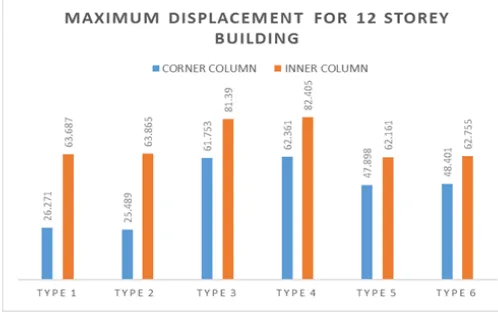
Figure 8. Maximum Displacement (mm) in Columns for 12 Storey Building.
[image:5.595.46.295.52.210.2] [image:5.595.68.290.349.512.2]The total material required for the various types of building has been represented in the figure 9 and the results of cost analysis of these materials have been represented in the figure 10 which ultimately tells that there is a slight variation in cost when the heavy mass is transferred from one floor to another.
Figure 9. Total Material Quantity for 12 Storey Building.
Figure 10. Total Cost of 12 Storey Building. IV. CONCLUSION
All the results have been represented in tables and figures after evaluating all the irregular structure i.e. 12 storey buildings. And final conclusions of the present research, which were drawn from results after a scrutinized study, have been concluded in the following section:
With the introduction of heavy masses on floor, bending moment and shear force has increased 1.46 and 1.50 times respectively for 12 storey irregular building.
The lateral sway of the column shows very little variation when the heavy mass was transferred from one floor to another as the value of displacement is almost same. But L-Shaped 12 storey building shows poor performance while resisting the lateral forces as it entails maximum value of displacement i.e.82.405 mm.
There was very little variation in total quantities and total cost of the building. Therefore, it can be concluded that when the heavy mass is transferred from 6th floor to 9th floor in 12 storey building, it had negligible effect on the quantity and cost of the building.
REFERENCES
1. Ansari K. Md., Vidhyadhar S. H., 2016, Siesmic Analysis Of Multi Storied Rc Building Having Verical Mass Irregularity With And Without Shear Wall, International Research Journal of Engineering and Technology, Volume: 03 Issue: 06, pp-1867-1875.
2. Anwade B. A., Aher B. S., Barate D. A., Raghuvanshi S. & Kuralkar S., 2018, Seismic Analysis, Design and Comparative Study of RC Structure Using Different Codes, International Research Journal of Engineering and Technology, Volume: 05, Issue: 04, pp-4984-4990. 3. Barbude P., Momin F. M., Boob T. N., 2017, An Overview
of Seismic Performance of Reinforced Concrete Frame for Vertically Irregular Buildings, International Journal of Engineering Technology, Management and Applied Sciences, Volume 5, Issue 5, pp-70-74.
4. Chandrika S. M., Swamy S. B., 2018, Effect Of Damper Locations On Behaviour Of Plan Irregular Steel Structure Subjected To Dynamic Loading, International Research Journal of Engineering and Technology, Volume: 05, Issue: 06, pp-674-680.
5. El-Shaer M. A. A., 2013, Seismic Load Analysis of different R.C. Slab Systems for Tall Building, International Journal of Current Engineering and Technology, Vol.3, No.5, pp-2034-2046.
6. Gaikwad S. P., Tolani K. K., 2015, Review Paper on Dynamic Analysis of Building, International Journal of Current Engineering and Technology, Vol.5, No.2, pp-974-975.
7. Gaikwad S. P., Tolani K. K., 2015, Study Of Dynamic Effect On Unsymmetrical Building (RCC& Steel), International Journal of Research in Engineering & Advanced Technology, Volume 3, Issue 3, pp-104-109. 8. Georgoussis G., Tsompanosa A., Makario T., 2015,
[image:5.595.69.291.590.766.2]9. Harsha S. B., Vikranth J., 2014, Study And Comparison Of Construction Sequence Analysis With Regular Analysis By Using Etabs, International Journal of Research Sciences and Advanced Engineering, Volume 2, Issue 8, pp-218 – 227.
10. Himaja S. V. G., Ashwini L. K., Jayaramappa N., 2015, Comparative Study on Non-Linear Analysis of Infilled Frames for Vertically Irregular Buildings, International Journal of Engineering Science Invention, Volume 4, Issue 6, pp-42-51.
11. Mahesh S., Rao P. B., 2014, Comparison of analysis and design of regular and irregular of multi Story building in various seismic zones and various types of soils using ETABS and STAAD, IOSR Journal of Mechanical and Civil Engineering, Volume 11, Issue 6, pp-45-52.
12. Sarkar P., Prasad M. P., Menonb D., 2010, Vertical geometric irregularity in stepped building frames, Engineering Structures 32(ELSEVIER) 2175-2182 13. Singh R., Singh K. V., 2018, Analysis of Seismic Loads
acting on multistory Building as per IS: 1893-2002 and IS: 1893-2016 :- A comparative Study, Journal of Civil Engineering and Environmental Technology, Volume: 04, Issue: 05, pp-405-408.
AUTHORSPROFILE
Lovneesh Sharma, M.Tech Student, Civil Engineering Department, Chandigarh University, Gharaun, Mohali, Punjab, India.
Sandeep Naiser, Assistant Professor Civil Engineering Department, Chandigarh University, Gharaun, Mohali, Punjab, India.