International Journal of Innovative Technology and Exploring Engineering (IJITEE) ISSN: 2278-3075,Volume-8 Issue-10, August 2019
Abstract: Hoodlums have since quite a while ago utilized the strategy of veiling their actual character, from masks to nom de plumes to guest id blocking. It should not shock anyone at that point, that crooks who lead their accursed exercises on systems and PCs should utilize such methods. IP ridiculing is one of the most widely recognized types of on-line cover. In IP ridiculing, an assailant increases unapproved access to a PC or a system by causing it to give the idea that a malignant message has originated from a confided in machine by "caricaturing" the IP address of that machine. IP mocking is a strategy used to increase unapproved access to PCs, whereby the aggressor sends messages to a PC with a manufacturing IP address demonstrating that the message is originating from a confided in host. IP ridiculing has been utilized in circulated refusal of-administration (DDoS) assaults and interruptions. It is additionally vital for reflector DDoS assaults, where servers answer to ridiculed demands and these answers overpower the unfortunate casualty whose address was abused.
Keywords:Cyber-security, IP address validation, software-defined networking.
I. INTRODUCTION
Ip source address ridiculing or IP mocking assault, it alludes to aggressors discharge bundles with fashioned IP source addresses so they can disguise their genuine characters and dispatch assaults, e.g., reflect organize deals to flood unfortunate casualty has. When enduring such assault, it is difficult for injured individual to follow back to culprits and recognize their genuine characters, which seriously bargains Internet responsibility without a doubt. From the point of view of system, IP parodying danger is gotten from the structure that Internet parcel sending in switches just depends on bundle's goal IP address, yet disregards the approval of parcel's IP source address to confirm sender validness. Taking this powerlessness, assailants can dispatch genuine assaults against indicated targets, and actually, a large portion of assault straightforwardly related with this volubility, i.e., TCP-SYN flooding [1], DDoS [2] and Smurf [3]. In spite of hostile to IP satirizing has been considered broadly in the previous decade, in any case, achievable and incorporated arrangements that spread both of intra-space and between area degrees still under the method for research. Truly, the IP
Revised Manuscript Received on August 15, 2019.
* Correspondence Author
T. Sree Kala *, Department of Computer Science, VISTAS, Chennai, India. Email: [email protected]
V. Rajakumaran, Department of Computer Science, VISTAS, Chennai, India, Email: [email protected]
Dr.S.Saradha, Department of Computer Science, VISTAS, Chennai, India, Email: [email protected]
mocking marvels in Internet did not improve much over the most recent couple of years. As per the Center for Applied Internet Data Analysis (CAIDA's) measurements [4], by end of October 2017, the spoofable location space, prefix, and AS have up to 26.7%, 33.6% and 34.1%, individually. Additionally, the worldwide digital security occasion recording demonstrates that the quantity of IP ridiculing and related assaults has strongly expanded in most recent couple of years [5]. More than that, the yearly report [6] in regards to Chinese Internet security status affirms that the new IP caricaturing related assault implies, for example, Distributed Reflection Denial of Service (DRDoS) [7], DNS demand reflection, Network Time Protocol (NTP) synchronization reflection, are flourished and mishandled to focus at some high-esteem sites. So as to relieve this risk, numerous intra-space or between area arrangements have been proposed. The previous for the most part explain the issue inside Autonomous System (AS), while the last spread the territory between ASes. In Detail, arrangements inside space for against IP-caricaturing can be ordered into parcel separating, address encryption and convention change. Bundle separating is a typical practice for hostile to mocking in numerous area systems, e.g., designing Access Control List (ACL) rules onto intra-space switches or switches so they can drop parcels with startling/unlawful IP source addresses or prefixes. With regards to the lawful IP address set, it might be characterized by administrators (e.g., passable IP prefix rundown) or AI based methodologies (e.g., jump tally history and blossom sifting). In any case, such techniques share three parts of disadvantages in any event: (1) ACL is demonstrated to be mind boggling and may strife with existing principles; (2) It is resolute and difficult to adapt to circumstances, for example, topology elements and steering asymmetry; (3) Filtering exactness is additionally a major worry since the method for self-learning would bring about false positive or false negative issues to certain degrees. Likewise, the rest two sorts of arrangements are additionally looked with normal difficulties in framework usage and sending cost, since either IP address encryption or convention/have stack adjustment will unavoidably present additional expenses, e.g., Public Key Infrastructure (PKI) frameworks and switch/have programming overhauls. Between spaces arrangements principally focus on three headings: end-based, start to finish and way based separating End based sifting strategy indicates
Detecting IP Spoofing Attack with SDN-Based
Integrated Architecture using Distributed Packet
Filtering
AS fringe gadget drops the inbound bundles with source delivers have a place with the neighborhood AS and the outbound parcels whose source delivers have a place with other area. Start to finish sifting thought builds up an association between two ASes' fringe gadgets and disregards ASes along the way. What's more, each source-goal pair ASes shares a mystery key with the goal that the source AS can label the bundles header to goal AS and the goal AS can check the parcels credibility. Way based sifting proposition confirm the bundles by the ways they move through as the assailant more often than not can't control the sending way. In spite of the fact that these arrangements accomplish great impact for against parodying between ASes, despite everything they face numerous issues to settle. For instance, end-based separating techniques are difficult to fulfill organize administrators' sifting exactness requests since the separating space is isolated into neighborhood area and outside space regions, and start to finish sifting could be endured assaulted in the circumstance of shared keys traded off, while way based sifting may experience the framework versatility issue since directing in between area is dynamic.
II. LITERATUREREVIEW
A. Bremler-Barr and Y. Koral, Current security apparatuses, utilizing "signature-based" identification, don't deal with compacted traffic, whose piece of the overall industry is continually expanding. This paper centers on compacted HTTP traffic. HTTP utilizes GZIP pressure and requires some sort of decompression stage before playing out a string coordinating. This work present a novel calculation, Aho-Corasick-based calculation for Compressed HTTP (ACCH) that exploits data assembled by the decompression stage so as to quicken the usually utilized Aho-Corasick design coordinating calculation. By dissecting genuine HTTP traffic and genuine Web application firewall marks, we show that up to 84% of the information can be skipped in its sweep. Shockingly, it demonstrates that it is quicker to perform example coordinating on the packed information, with the punishment of decompression, than on ordinary traffic. Apparently, the principal paper that breaks down the issue of "on-the-fly" multipattern coordinating on compacted HTTP traffic and propose an answer.
C. Duma, M. Karresand, N. Shahmehri, and G. CaronniCommunitarian interruption location frameworks (IDSs) have an extraordinary potential for tending to the difficulties presented by the expanding forcefulness of current Internet assaults. Be that as it may, one of the real worries with the proposed shared IDSs is their defenselessness to the insider danger. Pernicious interlopers, invading such a framework, could harm the community oriented indicators with false alerts, upsetting the interruption recognition usefulness and setting in danger the entire framework. In this paper, we propose a P2P-based overlay for interruption identification (overlay IDS) that tends to the insider danger by methods for a trust-mindful motor for relating cautions and a versatile plan for overseeing trust. This framework utilizing JXTA system and assessed its adequacy for anticipating the spread of a genuine Internet worm over an imitated system. The assessment results demonstrate that our overlay IDS
fundamentally builds the general survival rate of the system A. El-Atawy, E. Al-Shaer, T. Tran, and R. BoutabaA noteworthy risk to information systems depends on the way that some traffic can be costly to order and channel as it will experience a more drawn out than normal rundown of sifting rules before being rejected by the default deny rule. An aggressor with some data about the entrance control list (ACL) sent at a firewall or an interruption recognition and avoidance framework (IDS/IPS) can create bundles that will have greatest expense. This paper, present a method that is light weight, traffic-versatile and can be conveyed over any separating system to pre-channel undesirable costly traffic. The procedure uses Internet traffic attributes combined with a unique painstakingly tuned portrayal of the arrangement to create early safeguard approaches. In this work utilize Boolean articulations worked as twofold choice outlines (BDD) to speak to loosened up variants of the strategy that are quicker to assess. In addition, it is ensured that the procedure won't include an overhead that won't be remunerated by the increase in sifting time in the basic separating technique. Assessment has demonstrated impressive investment funds to the general sifting process, along these lines sparing the firewall handling power and expanding by and large throughput. Additionally, the overhead changes as per the traffic conduct, and can be tuned to ensure its most pessimistic scenario time cost
C.J. Fung, O. Baysal, J. Zhang, I. Aib, and R. Boutabathe precision of distinguishing an interruption inside a system of interruption location frameworks (IDSes) relies upon the proficiency of joint effort between part IDSes. The security itself inside this system is an extra worry that should be tended to.This paper, present a trust-based system for secure and viable coordinated effort inside an interruption identification organize (IDN). Specifically, characterize a trust model that enables every id to assess the dependability of others dependent on close to home involvement. This work demonstrate the rightness of our methodology in ensuring the IDN. Moreover, exploratory outcomes exhibit that our framework yields a huge improvement in identifying interruptions. The trust model further improves the heartiness of the community oriented framework against malevolent assaults.
International Journal of Innovative Technology and Exploring Engineering (IJITEE) ISSN: 2278-3075,Volume-8 Issue-10, August 2019
A.K. Ghosh, J. Wanken, and F. Charron, The pervasiveness of the Internet association with work areas has been both a help to business just as a reason for worry for the security of computerized resources that might be unconsciously uncovered. Firewalls have been the most ordinarily conveyed answer for secure corporate resources against interruptions; however firewalls are helpless against mistakes in design, questionable security strategies, information driven assaults through permitted administrations, and insider assaults. The disappointment of firewalls to enough shield advanced resources from PC based assaults has been a help to business interruption location apparatuses. Two general ways to deal with recognizing PC security interruptions continuously are abuse discovery and peculiarity identification. Abuse recognition endeavors to recognize known assaults against PC frameworks. Inconsistency recognition utilizes learning of clients' ordinary conduct to identify endeavored assaults. The essential preferred position of abnormality recognition over abuse discovery strategies is the capacity to distinguish novel and obscure interruptions. This paper exhibits an examination in utilizing neural systems to recognize the presence of atypical and obscure interruptions against a product framework utilizing the peculiarity discovery approach. S. Ioannis, D. Vasilis, P. Dionisios, and V. Stamatis, As Intrusion Detection Systems (IDS) utilize progressively complex language structure to productively depict complex assaults, their handling necessities increment quickly. Equipment and, significantly more, programming stages face challenges in staying aware of the computationally escalated IDS errands, and face overheads that can considerably reduce performance. This paper present a bundle pre-sifting approach as a way to determine, or if nothing else ease, the expanding needs of present and future interruption discovery frameworks. It is exceptionally uncommon for a solitary approaching bundle to completely or somewhat coordinate in excess of a couple of many IDS rules. This perception choosing a little part from every id guideline to be coordinated in the pre-sifting step. The after effect of this fractional match is a little subset of principles that are contender for a full match. Given this pruned set of standards that can apply to a parcel, a second-arrange, full-coordinate motor can support higher throughput. The proposed work use DefCon follows and late Snort IDS decide set, and show that coordinating the header and up to a 8-character prefix for every payload rule on every approaching bundle can confirm that by and large 1.8 guidelines may apply on every bundle, while the greatest number of principles to be checked over all parcels is 32. Viably, bundle pre-separating avoids coordinating at any rate 99% of the SNORT rules per parcel and subsequently limits preparing and improves the adaptability of the framework. This research propose and assess the expense and execution of a reconfigurable design that uses numerous handling motors so as to misuse the advantages of pre-separating.review criteria
This journal uses double-blind review process, which means that both the reviewer (s) and author (s) identities concealed from the reviewers, and vice versa, throughout the review process. All submitted manuscripts are reviewed by three reviewer one from India and rest two from overseas. There should be proper comments of the reviewers for the
purpose of acceptance/ rejection. There should be minimum 01 to 02 week time window for it.
III. SYSTEMARCHITECTURE
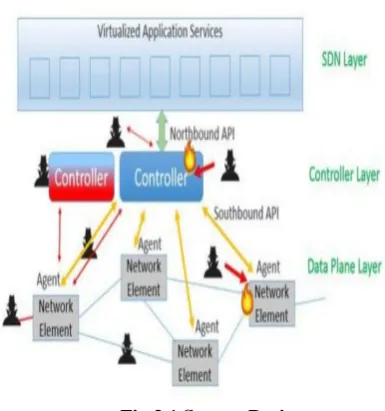
[image:3.595.325.518.273.479.2]Actually, outskirt switches and the majority of the L3 access switches arrangement can address the IP source address ridiculing issue. In any case, considering most systems are as yet customary systems with heritage gadgets, the greatest worry of them is the means by which to let down the front-end speculation and accomplish this enemy of ridiculing reason. In this way, inside the inheritance and SDN gadget cross breed arrange, limiting SDN gadget sending proportion yet fulfilling the alluring IP prefix-level enemy of ridiculing inclusion proportion in a similar time turns into our ideal objective. To understand this, build up a system model to formulize this issue and shown in Fig 3.1.
Fig 3.1 System Design
IV. PROPOSEDSYSTEM
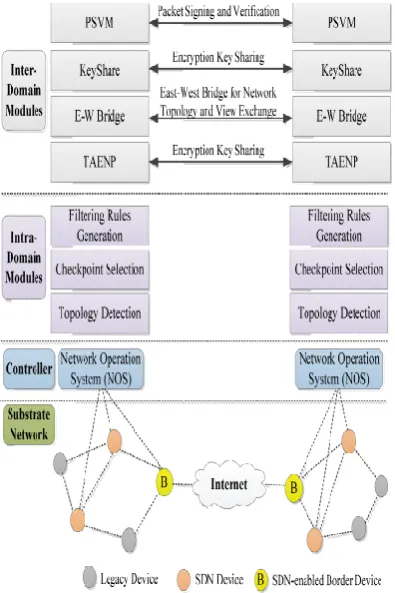
[image:4.595.61.259.167.464.2]SPM safeguard at the traffic's goal relates a source independent framework (AS) with a mystery it traded with the guard. The source marks bundles with this mystery. One of a kind worldly key K(S, D) related with each pair requested quality of source goal systems. Switch nearer to the goal checks genuineness of the source address of the bundle. Powerful and gives impetus to ISP's executing SPM.
Fig 4.1 System Flow
Signing in is generally used to enter a particular page, which trespassers can't see. When the switch is signed in, the login token might be utilized to follow what moves the switch has made while associated with the site
A. IP Source Address Filtering
Contingent upon the acting positions, sifting arrangements can be isolated into three sorts: entrance, departure and switch based separating, which checks parcel authenticity in switch's entrance ports, departure ports and inner modules, individually. For example, the unicast Reverse Path Forwarding (uRPF) is a deployable entrance separating arrangement, which was pushed by Cisco and connected to its items. At the point when uRPF capacity is empowered, for each parcel, switch's entrance port first looks into its Forwarding Information Base (FIB) with bundle's IP source address, so it can confirm the parcel's legitimateness dependent on whether the sending port matches the present entrance port or not. Nonetheless, uRPF is restrictive system and it is difficult to adapt to the circumstances when both the person in question and the aggressor are a similar way, directing asymmetry and so forth.
B. IP Source Address Encryption
So as to verify correspondence reporters, a few specialists give their answers from the point of supplanting the IP source address with the scrambled one. For instance, Cryptographically Generated Addresses (CGA) and Accountable Internet Protocol (AIP) scramble IP source address with the awry key cryptography so that keys sharing the two finishes can confirm one another. Be that as it may, such plans need extra secure key understanding conventions since key age and open key appropriation are cultivated by individual hosts without Certificate Authority (CA), which is non-reasonable for enormous scale systems. To address this issue, TrueIP takes IP source address as the open key and uses the Identity Based Cryptography (IBC) to deliver the private key, so journalists can check the legitimacy of one another straightforwardly without open key acquirements. Be that as it may, it is uneasy to deny IBC keys since all keys should be recovered on the off chance that one private key is undermined
C. Convention and Host-Stack Redesign
There are additionally some different plans demonstrating their benefits from the part of convention/have stack update. For example, SPM and Base tackle this issue by utilizing some once in a while utilized fields (e.g., ToS) in the IP header and supplanting them with altered labels. Yet, this structure may irritate other unique applications (e.g., Quality of Service).
The most widely recognized kinds of projects written in the Java programming language are applets and applications. In the event that you've surfed the Web, you're presumably officially acquainted with applets. An applet is a program that holds fast to specific shows that enable it to keep running inside a Java-empowered program. Be that as it may, the Java programming language isn't only for composing charming, engaging applets for the Web. The broadly useful, abnormal state Java programming language is likewise an incredible programming stage. Utilizing the liberal API, you can compose numerous sorts of projects. An application is an independent program that runs legitimately on the Java stage. An exceptional sort of use known as a server serves and supports customers on a system. Instances of servers are Web servers, intermediary servers, mail servers, and print servers. Another specific program is a servlet. A servlet can nearly be thought of as an applet that keeps running on the server side. Java Servlets are a well-known decision for structure intelligent web applications, supplanting the utilization of CGI contents. Servlets are like applets in that they are runtime expansions of utilizations. Rather than working in programs, however, servlets keep running inside Java Web servers, arranging or fitting the server.
V. RESULTSANDDISCUSSION
International Journal of Innovative Technology and Exploring Engineering (IJITEE) ISSN: 2278-3075,Volume-8 Issue-10, August 2019
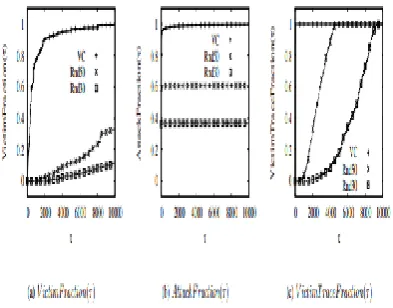
[image:5.595.62.259.456.610.2]The presentation of IDPFs utilizing the three execution measurements (VictimFraction(τ ), Attack Fraction(τ ), and VictimTrace Fraction(τ)) under various circumstances. What's more, likewise contemplated the effect of utilizing BGP refreshes rather than exact directing data to develop bundle channels, explored the impact of covering prefixes in the Internet, and considered IDPFs with and without system entrance separating. Before we depict the reproduction brings about detail, we quickly condense the notable discoveries. IDPFs can altogether confine the parodying capacity of an assailant. For instance, with the V C IDPF inclusion on the 2004c informational index, an assailant in beyond what 80% of ASes can't effectively dispatch any satirizing put together assault with respect to the Internet (expecting no covering prefixes are reported). Besides, with a similar design, the AS enduring an onslaught can limit the genuine cause of an assault bundle to be inside 28 ASes, hence, significantly decreasing the exertion of IP traceback. In this outline, except if indicated something else, all model information depend on the VC IDPF inclusion on the 2004c informational index with the suppositions that IDPF hubs are likewise equipped for entrance separating and that there are no covering prefixes The situation of IDPFs assumes a key job in the adequacy of IDPFs in controlling satirizing based assaults. It is significantly more powerful to send IDPFs on ASes with high availability, (for example, level 1 ISPs) than conveying IDPFs on irregular ASes. For instance, sending IDPFs on 5% of ASes chosen by the Top strategy is more compelling than conveying IDPFs on 30% of ASes chosen by the Rnd technique in the majority of the three execution measurements.
Fig 5.1 Victim Trace Fraction
In contrast with developing channels with exact steering data, building channels with BGP updates does not fundamentally corrupt the IDPF execution in constraining parodied parcels. Be that as it may, the IDPF traceback capacity is influenced considerably. For instance, the quantity of hubs that can't dispatch any mocking based assaults drop from 84% to 80% (a slight abatement) while the quantity of ASes that an AS can pinpoint as the potential genuine inception of an assault parcel increments from 7 to 28 (a genuinely huge increment).
VI. CONCLUSION
This paper proposed an incorporated IP mocking approving arrangement named ISASA for both intra-area and between space situations. The intra-area part conspire first figures key system hubs and takes SDN changes to supplant conventional gadgets in these hubs, with the goal that it can pick up a harmony between phony bundles sifting rate and sending cost. Further, exploiting SDN design, separating principles can be created and circulated by focal controller dependent on system ongoing topology. In the interim, the between space part plan proposes a period synchronized parcel mark marking and check convention between AS partnerships. Through the built up associated relationship, two ASes can trade mystery key, organize dynamic view and other data. In the long run, parcels transport between the two ASes will be labeled mark header and expelled after they have been confirmed in the goal AS. Ultimately, actualized the framework model, and our directed analyses demonstrate ISASA presents attractive execution.
In the future, based on some new research, enhance the system architecture design and joint with network equipment manufacturer, so that this resarch can produce related products onto market and apply them into real network scenarios.
REFERENCES
1. P. Ferguson and D. Senie,“Network Ingress Filtering: Defeating Denial
of Service Attacks which employs IP Source Address Spoofing”, The Internet Society,Jan 1998.
2. R. Beverly and S. Baue,“The Spoofer Project: Inferring the Extent of
Internet Source Address Filtering on the Internet” In Proc. of SRUTI, 2006.
3. D. Moore, C. Shannon, D. J. Brown, G. M. Voelker, and S.
Savage,“Inferring Internet denial-of-service Activity”, ACM
Transactions on Computer Systems (TOCS), , May 2006.
4. D. Kawamoto,“DNS recursion leads to nastier DoS attacks”,
ZDNet.co.uk, March 2006.
5. Haining Wang, , Cheng Jin, and Kang G. Shin, “Defense Against
Spoofed IP Traffic Using Hop-Count Filtering”,IEEE/ACM
Transactions on Networking, Vol. 15, No. 1, February 2007.
6. K. Park and H.Lee, “On the Effectiveness of Route-Based Packet
Filtering for Distributed DoS Attack Prevention in Power-Law Internets”. In Proc. of ACM SIGCOMM, 2006.
7. Z. Duan, X. Yuan, and J. Chandrashekar,“Constructing Inter-Domain
Packet Filters to Control IP Spoofing Based on BGP Updates”. In Proc. of INFOCOM, 2006.
8. A. Bremler-Barr and H. Levy, “Spoofing Prevention Method”, In Proc.
of INFOCOM, 2005.
9. X. Liu, X. Yang, D. Wetherall, and T. Anderson, “Efficient and Secure
Source Authentication with Packet Passports”, In Proc. of SRUTI, 2006.
10. ArpitaNarayan ,UpendraKumar, “A Defence Mechanism: DNS based