
Alyawarr children's variable present temporal reference
expression in two, closely-related languages of Central
Australia
Sally Jane Dixon
A thesis submitted for the degree of Doctor of Philosophy of The
Australian National University.
May, 2017
Except for where otherwise stated, this thesis is entirely my own work. Signed:
Acknowledgements
I wish to acknowledge the most wonderful set of supervisors imaginable: Jane Simpson, Gillian Wigglesworth, Catherine Travis, Johanna Rendle-Short. Jane has provided me with much practical advice and material support, in addition to her challenging and insightful probing of my work. She has also borne the various extended interruptions to my candidature (including two stints of maternity leave, and leave for other work opportunities) with patience and indeed excitement for what life has brought my way. Most fundamentally, she has engaged with my work and been an enthusiastic advocate of me, and this has a direct impact on my willingness to seek opportunities and
resources that have made all the difference in the completion of my dissertation.
Everyone should have a supervisor like Jane. Gillian has read and commented on much of my work over the years, provided resources and work-arounds, and shared
opportunities to present and publish our collective work. I’m so grateful to have been stewarded by someone with such enthusiasm and capacity for making research happen. Catherine has shown me the way into the exciting world of variationist linguistics. She has been generous with her time, reading multiple drafts, and helping me through the early stages of analysis. I greatly admire the rigour and meticulousness with which she approaches matters of linguistic analysis, and I very much hope this has rubbed off. Johanna Rendle-Short served on my supervisory panel early on, and passed on her love of conversation analysis. While my thesis ultimately took a different methodological turn, I hope to incorporate CA into future work, and am grateful for her support during the publication of one paper under this framework.
I wish to acknowledge and thank my co-conspirators on the ACLA2 project: Susan Poetsch, Gemma Morales, and Debbie Loakes. In particular I am grateful for the many supportive conversations that Susan and I have shared over the years. Before this, the baton was passed by the ACLA1 team: Felicity Meakins, Carmel O’Shannessey, Samantha Disbray and Karin Moses. All of these women have provided such an excellent model for fieldwork in sensitive contexts and I am truly indebted to them for the path they have blazed, and their ongoing interest in the ACLA project and my work. I give special thanks to Samantha Disbray who first introduced me to Ipmangker
I have been fortunate to enjoy the input and insight of James Walker and Greg Guy during visits to the ANU. I am grateful for their time and contributions. I wish to thank the faculty members at the ANU School of Literature, Languages and Linguistics: in particular, Harold Koch for being a constant source of useful references and typological insights, and Anna Wierzbicka for taking an interest in my work and providing
challenging feedback that has always progressed my thinking.
During part of the time over which this thesis was completed I worked as part of the Language Perspectives team in Education Queensland. There, I learnt an enormous amount from the leader of that unit, Denise Angelo, and the team she built. When Denise moved to Canberra to conduct research at the ANU, we shared many coffees that went too long (despite sometimes setting timers), in my bid to absorb as much as I could from her mighty brain. I’m so grateful for these times, and I hope that I have done it justice in this work. It has also been my great pleasure to have ‘on tap’ access to Cath Hudson. My work has greatly benefited from her experience and insight into language assessment.
This thesis was completed with funding through the ACLA2 project, which was funded via an Australian Research Council Discovery Grant (DP0877762). Government support was provided in the form of an Australian Postgraduate Award scholarship. I also received, and am thankful for, the Susan Kaldor scholarship from the Australian Linguistics Society which funded travel to a conference and practicum in Germany/UK in 2010.
I wish to acknowledge the tremendous work done by the research assistants in Ipmangker community. Ms G. Kelly had real talent and enthusiasm for language description, and this was not extinguished by long hours of language transcription. A true linguist. She has sadly passed away and I am very sad that we will not get to work together again. It was also a pleasure to work with Michelle Dobbs on transcriptions and I thank her for her commitment to this work. Linda Dobbs simply made everything happen and I appreciate her trust and commitment to this project. She also spent many hours teaching me Alyawarr, a most beautiful language.
The most crucial element of linguistic research is of course the participants. Without speakers of languages agreeing to participate in research there would be very little for us to study. One thousand thank yous to the families and children who participated in this project and allowed us to eavesdrop on their lives (I preserve anonymity by refraining from using names).
In that vein, I also wish to acknowledge and thank the teachers and teaching assistants at Murray Downs Primary school who facilitated this project and participated in recordings: in particular Stuart, Dora, Blanche, Hilton, Kristen, Doris, Elicia, Nathan, Pam, Sharon and Jeffrey. You have constantly impressed me by your frank and open commitment to the children and community you serve.
Abstract
In a small, remote central Australian community, young children go about their daily lives mainly speaking Alyawarr English (AlyE), a new Central Australian contact language. At school they are acquiring Standard Australian English (SAE) as a second language. Much of what they encounter in SAE will seem familiar and much will be obviously different. In between, there will be many subtle differences that are possibly harder to detect, parse and maintain. This study investigates this remarkable bi-varietal language use, considering whether separate ‘codes’ are indeed evidenced, how they can be quantitatively modelled, and what they tell us about the impact of formal similarity between languages and emerging bilingualism.
The use in childhood of multiple closely-related languages is somewhat of a final frontier for several strands of research: child language development, second language acquisition, and creole studies. However, the methodologies common in these fields don’t easily import to the present scenario: for while the assumption of existing, separate codes may be operationally practical (even if theoretically contestable), the presence of overlapping structures (i.e. morphemes that are used in both AlyE and SAE) in the present data set makes code separation on structural grounds problematic. The solution tested here takes a corpus of 50+ hours of naturalistic video recordings of six focus children, and first creates two maximally contrastive, contextually defined data sets: HOME (home, Alyawarr interlocutor) and SCHOOL (school, non-Alyawarr
interlocutor).
Each data set is then analysed using the Comparative Variationist method. Three variables of present temporal references clauses were selected: aspect morphology with variants V (e.g. ‘look’), Ving (e.g. ‘looking’), and Vbat (e.g. ‘lookbat’), 1sg subject pronouns (‘I’ and ‘AM’) and verb transitivity marking (-im and unmarked). In both
HOME and SCHOOL data, variants, their distributions, respective envelopes of variation
and variable grammar (modelled using logistic multiple regression conducted in Goldvarb X) are examined.
The results show that code-separation is evidenced for all three variables, but that the locus of change is not the same in each case. For transitive marking and 1sg subject pronouns, the same variable grammar is deployed in both HOME and SCHOOL data, while
thus the envelope of variation for the SAE-compatible variant (i.e. -Ø and ‘I’) expands its range of use on the way to becoming the categorical variant in the children’s SAE. For aspectual morphology, the locus of change is located within the variable grammar where complex patterns of reorganisation are evidenced (e.g. HOME V is strongly
associated with ‘stative’ clauses; SCHOOL V with ‘stative’ and ‘habitual’). Additionally,
fundamental changes in the envelope of variation (e.g. Ving is not used on transitive verbs in the HOME but is in the SCHOOL) and the range of variants (e.g. Vbat is not used
in the SCHOOL) indicate that these remain central considerations in the use of all three
variables.
This study therefore breaks new ground in both methodological terms, with the
T
ABLE OF CONTENTSList of Abbreviations i
Conventions used in transcription and glossing i
List of figures ii
List of Tables iv
1 INTRODUCTION 1
1.1 Context 1
1.2 Problem orientation 3
1.3 (Closing) the research gap 8
1.4 Overview of the data and method 9
1.5 Overview of thesis 11
2 SPEAKING A CONTACT LANGUAGE AND ACQUIRING A STANDARDIZED
LANGUAGE: ISSUES AND RESEARCH 13
2.1 Introduction 13
2.2 Linguistic aspects of second dialect acquisition 16
2.3 Linguistic aspects of contact languages in acquisition 23
2.4 Socio-political aspects of SDA 25
2.5 Conclusion 27
3 THE PATH TO A NEW METHODOLOGY FOR ANALYSING BI-VARIETAL CHILD
LANGUAGE 29
3.1 Introduction: the challenge of analysing closely-related languages in acquisition 29
3.2 An overview of comparative work within the variationist framework 41
3.2.1 Language variation in second language acquisition 41
3.2.2 Comparative Variationist work & creolistics 52
3.2.3 Variationist Typology 57
3.2.4 Summary 59
3.3 Unresolved questions and opportunities for further synthesis 60
3.3.1 The role of the L1: issues of code separation and transfer 60
3.3.2 What drives ‘transformation under transfer’ in L2 acquisition? 61
4 DATA & METHODOLOGY 69
4.1 Introduction 69
4.2 Field Site 69
4.2.1 Early contact period 71
4.2.2 Station days 72
4.2.3 Ipmangker Community 73
4.2.4 The Community Today 74
4.3 Language Use 78
4.3.1 Demographic diversity 79
4.3.2 Language Attitudes 86
4.4 Data Collection 87
4.4.1 Method 87
4.4.2 Corpus description 89
4.4.3 Equipment 90
4.4.4 Processing and transcribing 91
4.5 Application of the variationist method to the corpus data 91
4.5.1 Forming the L1 and L2 data sets 92
4.5.2 Variable selection 94
4.5.3 Variable-rule analysis 95
4.5.4 Longitudinal and cross-sectional design 96
4.5.5 The individual and the group 97
4.6 Transcription conventions 98
4.7 Conclusion 99
5 VARIATION IN TENSE-ASPECT MORPHOLOGY: PRELIMINARY
CONSIDERATIONS 101
5.1 Introduction 101
5.2 Present tense, present temporal reference and aspect in overview 104
5.2.1 Present temporal reference and aspect in English 104
5.2.2 Present temporal reference and aspect in Australian contact languages 107
5.2.3 Alyawarr 114
5.3 Minor (verbal) forms of present temporal reference in the corpus 115
5.4 The variable: present temporal reference 120
5.4.1 A priori exclusions 121
5.5 Accounting for the variation: Factor groups and factors 125
5.5.1 Syntactic Factors 125
5.5.2 Semantic Factors 126
5.5.3 Speaker features 131
5.5.4 Excluded factor groups 132
5.6 Summary 136
6 VARIATION IN TENSE-ASPECT MORPHOLOGY: ANALYSIS 137
6.1 Introduction 137
6.3 The variable context 142
6.4 Analysis of speaker-related factors 146
6.5 Multivariate analysis of linguistic factors 150
6.6 Revisiting Lexical Aspect 164
6.7 Discussion 171
6.8 Conclusion 178
7 VARIATION IN SUBJECT PRONOUNS 181
7.1 Introduction 181
7.2 What factors might explain the variation? 187
7.3 The HOME and SCHOOL repertoires 190
7.4 The variable context 191
7.5 Analysis of speaker-related factors 192
7.6 Multivariate analysis of linguistic factors 194
7.7 Discussion 198
7.8 Conclusion 207
8 VARIATION IN TRANSITIVE MARKING 209
8.1 Introduction 209
8.2 What factors might explain the variation? 212
8.3 The HOME and SCHOOL repertoires 215
8.4 The variable context 217
8.5 Analysis of speaker-related factors 221
8.6 Multivariate analysis of linguistic factors 224
8.7 Discussion 228
8.8 Conclusion 236
9 DISCUSSION 237
9.1 Summary of findings 237
9.2 Understanding bi-varietal language use 240
9.3 Revisiting key issues in modelling transformation and the study of bi-varietal language
use and languages in contact 247
9.5 Conclusion 261
10 CONCLUSION: BI-VARIETAL LANGUAGE USE IN PEDAGOGICAL AND FUTURE
PERSPECTIVE 263
BIBLIOGRAPHY 269
APPENDICES 285
Appendix I: Lexical Aspect coding for chapters 5 & 6 285
List of Abbreviations
ABL ablative
ADV adverb(ial) ALL allative AUX auxiliary
BAT verb aspect morpheme, most closely with habitual/iterative semantics in child Alyawarr English
DEM demonstrative pronoun
DET determiner
DU dual
EMPH emphasis
EY unknown verb ending
HAV having
ING verb aspect morpheme, most closely associated with progressivity in child Alyawarr English
INTR intransitive
LOC locative
NA ‘na’ discourse particle
OBJ object
P person
PL plural
POSS possessive
PREP preposition PRES present tense RECIP reciprocal
SBJ subject
SG singular
SUB subordinating conjunction
TAG tag question
TR transitive marker
Conventions used in transcription and glossing
plain font Alyawarr English and SAE - morpheme break
italics Alyawarr-derived morphemes = clitic boundary bold font point of interest/contrast _ used for one-to-many
List of figures
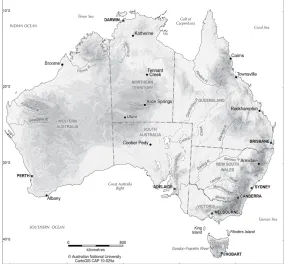
Figure 1-1: Australia showing state borders, capital cities, major cities, elevation, lakes and rivers. ___ 1 Figure 1-2: The Northern Territory of Australia, with major highways marked. Communities and towns referred to in this thesis are marked. ________________________________________________________________ 2 Figure 2-1: Different starting points for SLA and SDA ____________________________________________________ 17 Figure 2-2: Possible relationships between D1 and D2 variant sets for the same variable. ____________ 20 Figure 3-2: Different comparisons of the linguistic repertoire of language learners ___________________ 64 Figure 4-1: Classification of clauses into social context categories ______________________________________ 93 Figure 5-1: RIGHT Number of tokens included in HOME and SCHOOL data sets, and excluded sub-contexts LEFT proportion of V, Ving and Vbat tokens in excluded sub-context data. __________________ 124 Figure 6-1: Distribution of present temporal reference variants V, Ving and Vbat, HOME and SCHOOL contexts ____________________________________________________________________________________________________ 140 Figure 6-2: HOME and SCHOOL repertoires per TRANSITIVITY condition ________________________________ 141 Figure 6-3: Distribution of present temporal reference variants V, Ving and Vbat, HOME and SCHOOL contexts ____________________________________________________________________________________________________ 146 Figure 6-4: Distribution of V and Ving per AGE, SCHOOL context ________________________________________ 148 Figure 6-5: Distribution of V, Ving and Vbat per AGE, HOME context ____________________________________ 149 Figure 6-6: Rates of use of V, Ving and Vbat by SPEAKER, HOME context. _______________________________ 150 Figure 6-7: Rates of use of V and Ving by SPEAKER, SCHOOL context. ___________________________________ 150 Figure 6-8: Probabilities of V occurring in three aspectual conditions, HOME transitive and HOME intransitive contexts. ______________________________________________________________________________________ 155 Figure 6-9: Probabilities of V and Vbat occurring in three aspectual conditions, HOME transitive contexts. ____________________________________________________________________________________________________ 156 Figure 6-10: Probabilities of Ving and Vbat occurring in three aspectual conditions, two subject person conditions and two subject number conditions, HOME intransitive contexts.. ___________________________ 158 Figure 6-11: Probabilities of V, Vbat and Ving occurring in two aspectual conditions, HOME intransitive contexts. ____________________________________________________________________________________________________ 159 Figure 6-12: Probabilities of V and Ving occurring in three COMBINED ASPECT conditions, SCHOOL context. _____________________________________________________________________________________________________ 162 Figure 6-13: Rates of V and Ving in three COMBINED ASPECT conditions, in transitive and intransitive data, SCHOOL context. ______________________________________________________________________________________ 163 Figure 6-14: Rates of V and Ving in two SUBJECT PERSON conditions, in transitive and intransitive data, SCHOOL context. ______________________________________________________________________________________ 163 Figure 6-15: Distribution of V, Ving and Vbat forms per LEXICAL ASPECT, HOME context and SCHOOL context _____________________________________________________________________________________________________ 166 Figure 6-16: Across-category distribution of Ving forms, per age, SCHOOL context _____________________ 168 Figure 6-17: Proportion of V and Ving forms per lexical aspect, across three ages, SCHOOL context. __ 169 Figure 6-18: Probabilities of V (left) and Ving (right) occurring in three COMBINED ASPECT
List of Tables
Table 8-4: Constraints on the use of the -im marker in HOME and SCHOOL contexts _____________________ 226 Table 8-5: Summary of categorical and variable constraints in two systems of variable -im marking, HOME and SCHOOL contexts. ________________________________________________________________________________ 229 Table 9-1: Summary of comparison of three variables and their shared ( ) or not-shared ( ) patterns of use in HOME (L1) and SCHOOL (L2) contexts. ____________________________________________________________ 237 Table 9-2: Summary of T1:L1:L2:T2 relationship of each variable _____________________________________ 239 Table 9-3: Three variables and their variants in Alyawarr English and Standard Australian English (repeated from Table 3-5). ________________________________________________________________________________ 243 Table 9-4: Possible relationships between L1:L2 variable contexts for V and Ving variants __________ 248 Table 9-5: Five possible L1:L2 relationship types for languages in contact, based on degrees of
1 I
NTRODUCTION1.1 Context
The setting for this thesis is a small community in the middle of Australia’s arid, central cattle-droving region. A few hours’ drive north of Alice Springs along the Stuart
Highway, followed by an easterly turn and another 45 minutes along an unsealed road and you arrive at Ipmangker community. It is a small community of around 100-150 mostly Alyawarr, Warlpiri and Kaytetye people, excised from the surrounding cattle station. Here the children speak a language variety which displays elements of Alyawarr, the first language of their grandparents, Kriol and English. This variety is not
immediately comprehensible to native speakers of English. I will refer to it as Alyawarr English, a term decided on after some consultation with adult speakers.
[image:21.595.183.473.440.704.2]When the children of this community enter formal schooling, they encounter an environment in which Standard Australian English (SAE) is the language of formal assessment, however they will experience various Englishes as the mediums of instruction. During the span of fieldwork for this research, students experienced teaching staff who were first and second language speakers of (Australian) English, as well as speakers of other world English varieties, and Aboriginal English. They were aided in their learning by Teaching Assistants who often speak Alyawarr, and also English, or Alyawarr English.
Figure 1-2: TheNorthern Territory of Australia, with major highways marked. Communities and towns referred to in this thesis are marked. [Source:CartoGIS, College of Asia and the
Pacific, The Australian National University]
[image:22.595.156.384.305.610.2]of English, except for what might ‘double up’ in the regular ‘literacy’ focused components in the curriculum. This context is reflective of the situation that many Indigenous students find themselves in, around the Northern Territory and beyond. Outside the school context exposure to SAE is very limited: consequently, outnumbered, the teacher is linguistically ‘immersed’ but the students are not. But this is not
systematically or explicitly addressed in the curriculum, pedagogy or even informal classroom practices. In spite of this, and intriguingly, considerable second language learning is taking place in the early years.
1.2 Problem orientation
Childhood multilingualism in Australia is a phenomenon as old as human occupation of the island continent. English, while now the national language, is itself a recent arrival to these shores, brought by colonists from the United Kingdom who arrived in 1788. Prior to this cataclysmic event, some 300+ languages were spoken by Indigenous peoples who have occupied the land for many thousands of years. Today, a small minority of these languages are spoken on a daily basis, and there are vibrant efforts to awaken those languages which are sleeping. In their place, new language varieties have emerged. Contact language varieties such as creoles (Kriol e.g. Schultze-Berndt, Meakins & Angelo 2013; Torres Strait Creole e.g. Shnukal 1991; Cape York Creole e.g. Crowley & Rigsby 1979), mixed languages (Gurindji Kriol e.g. Meakins 2015; Light Warlpiri e.g. O’Shannessy 2013), dialects of English (Aboriginal Englishes (Eades, 2014), and others (Wumpurrarni English e.g. Disbray 2008a; various Queensland contact varieties e.g. Sellwood & Angelo 2013) have proliferated1 in the many varied, and often imposed, sites of sustained language contact since invasion.
Australia’s present state of linguistic diversity is also the result of long term immigration over the past century, a process that has produced several integrated bilingual
immigrant communities in urban centres such as the Italian, Greek and Chinese
communities of Sydney and Melbourne. More recent waves of immigration, and refugee
resettlement have brought peoples from the Middle East, and Africa in increasing numbers.
This linguistic diversity is reflected in the general student population: 20% speak a language other than English at home (ABS 2013). However this national figure obscures the vast variation in student language repertoires at the school level: for some remote schools located in Indigenous communities, and for some urban schools with large recent immigrant populations this figure approaches 100%. Many of these children, while exposed to English in the broader community and through media, will first start their acquisition of Standard Australian English (SAE)2 in the classroom. Across educational jurisdictions, individual schools and classrooms, there are and have been a range of responses to this. For example, across all states and territories schools can usually access special intensive ESL support for children who have migrated under particular visa categories. Several schools in Indigenous communities in the Northern Territory, South Australia and Western Australia have operated as bilingual schools, so students can receive basic education in their first language and then transition to SAE as proficiency develops3. Indigenous students who attend mainstream schools (i.e. non-bilingual, mixed cohort of students) have in recent years also been able to access money for ESL support through various state/territory and federal initiatives such as ‘ESL for Indigenous Languages Speaking Students’ (ESL-ILSS) 4.
However, access to these supports is in the first place dependent on being identified as a student who does not bring to school prior acquisition of SAE. Indigenous speakers of ‘low profile’ contact varieties (i.e. ones for which there is not, for example, a history of description, nomenclature or self-declared speakership) and Aboriginal English varieties very much constitute a ‘hidden’ group of SAE learners (Sellwood & Angelo 2013; Dixon & Angelo 2014). This has several aspects, from inaccuracies in student data collection (Dixon et al 2014; Angelo & McIntosh 2014), to the development and validation of curricula and effective teaching methodologies (Angelo 2012), and the development and
2 I use the term Standard Australian English here to specifically refer to the variety of English spoken in Australia that is explicitly reinforced in the education system. There is of course all the ‘usual’ variation in English spoken in the community, though sociolinguistic investigation of specific phenomena is still in its infancy.
use of appropriate diagnostic and assessment tools (Angelo 2012, Hudson & Angelo 2014; Wigglesworth, Simpson & Loakes 2011).
One example of the latter is the slew of proficiency scales in use across the state-based educational jurisdictions. Proficiency scales are multifaceted documents primarily designed for assessment but also to guide educators through the expected pathway for learners of English as a second language, and to enable them to plan appropriate content and instruction. The first of their kind in Australia were published in the early 90s as the National Languages and Literacy Institute of Australia (NLLIA) ESL Bandscales (McKay, Hudson & Sapuppo 1994), henceforth NLLIA Bandscales. It is likely that this has acted as a ‘foundation document’ to some extent for all subsequent iterations, so it is
important to note that the NLLIA Bandscales were focused solely on ESL students with overseas language backgrounds. It deliberately did not describe learners of SAE as an additional dialect, nor did it purport to have any validity for Indigenous first language (‘L1’) speakers of traditional languages, who are learning Standard Australian English as an additional language at school and who in some ways are similar to immigrant
children in terms of the distinctness of the L1 from L2, but are generally learning SAE in profoundly different educational contexts.
Subsequent to the release of these scales, all State and Territory education departments have produced local iterations. For example, the ‘Northern Territory Curriculum
Framework: ESL Early Childhood and Primary Learners’ (NTDET 2014), is intended for use with all ESL students regardless of language background or learning context. In general, very little is published about the local developments of these scales in Australia, and so it is difficult to assess the extent to which accommodations to local conditions have been made, and what the nature of these changes might be. In particular, it is generally not clear, nor does there appear to be a public record of how L1 speakers of contact varieties have been accommodated5 (see also Malcolm 2011 for a discussion of related issues in Western Australia).
A notable exception is the ongoing work surrounding the development of specialised scales for Indigenous leaners of English as a second language/additional dialect in
Queensland6. This has resulted in the Bandscales for Aboriginal and Torres Strait
Islander Learners (Education Queensland 1999/2002) and the subsequent Bandscales for English as a Second Language/Dialect (ESL/D) Learners (EQ 2008) (henceforth ‘ESL/D bandscales’), which is inclusive of the Indigenous students targeted in the 1999/2002 iteration. The project teams responsible for these documents have directly grappled with the need to be both inclusive of Indigenous ESL/D students in ESL interventions on the one hand, and also with how to reflect teachers’ direct experience that Indigenous ESL/D students might travel a different pathway from other ESL students with overseas language backgrounds.
Hudson & Angelo (2014) describe in detail the rationale and iterative process that has unfolded in the production of the two bandscales. In doing so they outline a number of underlying considerations. I want to highlight two that relate the most directly to the issue of whether L1 speakers of contact languages constitute a separate learner cohort (i.e. when learners of the lexifier7 language) to L1 speakers of typologically distinct languages (with respect to the L2). These are the inter-related issues of whether learners of English as an additional dialect require support to separate out their L1 from the L2 (i.e. SAE) target, and if so, which aspects of SAE might be the most challenging and require the most attention (which I’ll refer to as ‘feature transparency’)?
The issue of code-separation has pervaded the modest set of studies relating to second dialect acquisition, as we’ll see in the following section (§1.2) and chapter 2. It has also informed early and influential bi-dialectal school approaches in the Kriol-speaking regions of northern Australia. For example, the Fostering English Language In Kimberley Schools (FELIKS) (e.g. see Berry & Hudson 1997) project in part focused on raising the profile of Kimberley Kriol as a valid and fully-formed language, and utilised
comparative analysis of linguistic structures, both as a way of addressing a perceived need for students to ‘separate’ their L1 from the SAE target: a pre-requisite for students to be able to acquire the systems and structures of SAE and thus, for example, effectively ‘code-switch’ between Kriol and SAE8. Similarly, a focus on building increasing levels of
6 see also the ‘Kimberley Bandscales’ used in Western Australia (Buist et al 2002)
7 The term ‘lexifier language’ refers to the language that has made a dominant contribution to the vocabulary in the resulting creole or contact language.
language awareness, for both student and teacher (and parents/guardians and other key participants), to raise the profile of contact language varieties (and multiple other outcomes), is a key component of a recent school support/teacher training program run throughout a number of Queensland schools (see Angelo 2006a, 2006b).
Concomitantly, the complex issues of code-separation and feature transparency is addressed explicitly in the ESL/D Bandscales, for example, in explaining the noted tendency for L1 creole speakers to ‘plateau’:
Some students, e.g. students who speak creoles, may plateau at level 3 in
listening because of the lack of understanding that the language they speak is not SAE. That is, it may be erroneously assumed by both student and teachers that the students are SAE users and therefore they ‘should’ be able to understand what is being said in the classroom [EB_EP_Levels1-4_Implications, cited in Hudson & Angelo 2014:56)]
Or to explain ongoing use of the L1 features (here ‘home language’ (HL)) in classroom contexts:
[The student is] developing awareness (if creole speaker) of differences in language varieties (i.e. SAE v. Home Languages) and needs assistance from teachers to expand these early understandings to avoid the student adapting HL rather than learning SAE [EB_MP_L Level2_Descriptor (cited in Hudson & Angelo 2014:59)]
1.3 (Closing) the research gap
The point at which the mapping and assessment tools discussed above ‘give out’ in terms of the detail they provide about the L2 language learning pathway of L1 creole speakers is mirrored by a ‘gap’ in the supporting language acquisition literature.
Child speakers of creoles who are tasked with learning the standardised lexifier language in educational settings sit precisely in the rather quiet crossroads of several strands of research. On the one hand the considerable overlap between L1 and L2 features may make their situation comparable to the situation termed ‘second dialect acquisition’ (SDA). However, SDA studies have tended to focus on phonology, because the languages in focus have not had many morphological or syntactical differences to compare. Whereas creoles differ across all levels of language. In this sense, the second language acquisition (SLA) literature offers a broader base for considering, for example, the L2 acquisition of morphosyntax.
Yet, as we’ll see in chapters two and three, contact languages have not received much attention here, possibly because many SLA approaches tend not to focus on the impact of L1 and its differences from L2. By contrast, SDA studies are more concerned with evaluating the potential impact of L1 transfer, and consider the potential bonus from overlapping structures and surface forms, but also the confusion that arises from small, non-communicatively essential differences as well as ‘camouflaged’ forms (Wolfram and Schilling-Estes 1998; Kellerman 1977; Wode 1978; Long 2007) (transparency phenomena by another name). And these concerns apply to creoles as well.
this claim, there is yet to be a quantitative study that models these processes, allowing the testing of hypotheses regarding the shifting functions of morphosyntax.
There is therefore both a practical and a research need for a deeper understanding about the pathway that speakers of contact languages travel on the road to acquiring the standardised L2. I will expand on these issues in greater detail across Chapters 2 and 3.
1.4 Overview of the data and method
Data for this thesis come from the corpus of recordings made for the Aboriginal Child Language Acquisition 2 (ACLA2) project9 a longitudinal study of the interaction of home and school languages in Australian Indigenous communities. This project has several other field sites, and multiple aims. The design of the recording schedule was focused on capturing naturalistic language use in a range of different home and school contexts. Recordings were made in Ipmangker community, at the school and various home locations, over a period of two years.
From the resulting Ipmangker sub-corpus, I initially began sketching out a rough description of the children’s use of Alyawarr English, and their use of SAE. I quickly became overwhelmed with the degree of variability in the corpus. It was impossible to take even the first step of a ‘traditional’ multilingual corpus and tag clauses as ‘Alyawarr English’ or ‘SAE’. Features that are not part of SAE would nevertheless occur in
otherwise English-seeming clauses (and contexts), and SAE-sounding features and clauses were also used at home. This is understandable: as learners of SAE as a second language the children were likely to use some L1 features at times, and as still young speakers of Alyawarr English some ‘backwash’ from SAE is also understandable. But how is the researcher to know what the case is in every clause? There were some clear instances of code-switching, in which a clause was said one way to an Alyawarr
Teaching Assistant, and then immediately another way to a non-Alyawarr teacher. But I could not rely on such (infrequent) cases to resolve the fact that many language features seemed common to both English and Alyawarr English, and so could not definitively signal which language a clause or phrase belonged to.
My first challenge, therefore, was developing an approach that could remain agnostic regarding which features were shared, and which features were contrastive in the children’s Alyawarr English and SAE. Furthermore, because this high degree of
variability and density of overlapping language features typified the children’s language use, it quickly became clear that traditional ‘target based’ approaches to second language acquisition (such as error analysis, Ellis & Barkhuizen, 2005) would insufficiently
capture the complexity of the task undertaken by these young children10. The data demanded an approach that would focus on variability as a phenomenon that is inherent to language change and therefore central to understanding language acquisition.
Such an approach was found in the research agenda pioneered by the quantitative sociolinguistics of Labov (e.g. 1972a), and more recently extended to conduct multiple comparative analyses across time, per the Comparative Variationist Method developed by Poplack and Tagliamonte (1996; 2001). This approach has been used to assess contemporary language use such as the nature of substrate influence in creoles (e.g. Meyerhoff 2009a, 2009b), the degree of overlap in a regionally variable creole (e.g. Walker 2000), and how L2 learner language differs from native speaker data (e.g. Schleef, Meyerhoff and Clark 2011). I have taken the principal components of identifying features that are variable in two (or more) related data sets, applying a (logistic multiple regression) quantitative analysis to determine which factors are conditioning the variation in each data set, and comparing the similarity of this ‘underlying grammar’ across data sets. However, the use of this approach in a context which combines elements of creole and second-language data constitutes an important new application of this methodology.
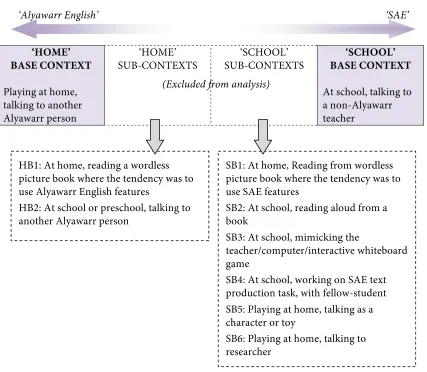
To address the issue of creating separate sets of ‘Alyawarr English’ and ‘SAE’ data based on formal properties (the problems with which are further explored in section §3.1) I operationalise each language variety on contextual grounds: that is, a HOME data set was compiled of utterances made at home, and to an Indigenous interlocutor. A SCHOOL data set was compiled of utterances made at school, to a non-Indigenous interlocutor. The rationale and details of this approach are further outlined in chapter 4 (§4.5.1).
Three main language features (or ‘variables’) were chosen as the focus of comparison between these HOME and SCHOOL data sets. These are: aspect morphology, transitivity and pronominal subject expression. Each of these independently meet the basic criteria for variationist analysis (which I detail in Chapter 4 §4.5.2), but it is the combination of these three features that I would like to highlight here. Each of these features differs from the other in the extent to which the same range forms are present in Alyawarr English and SAE. As shown in Table 1-1, present temporal reference has three
morphological expressions in Alyawarr English, two of which are shared with SAE. An additional morpheme also occurs in the Alyawarr English 1st singular subject pronoun set, although the additional form ‘Am’ is potentially analogous to the contracted ‘I’m’ form in SAE. Transitivity is variably marked with a verb stem-final suffix -im in Alyawarr English, and not at all in SAE. Since the children in this study bring most of the HOME forms to school with them (i.e. all forms appear in both HOME and SCHOOL data sets), the varying degree to which this occurs will facilitate discussion regarding the relative learnability of different types of language features.
Table 1-1: Three variables and their variants in Alyawarr English and Standard Australian English
Alyawarr English Standard Australian English tense-aspect morphology V~Ving~Vbat V~Ving
1sg Subject Am~I I
transitive marking -im ~ -ø -
1.5 Overview of thesis
of the complexity which typifies language use in contact situations. As an alternative, I then lay out a plan for the application and extension of the Comparative Variationist method (Poplack & Tagliamonte 2001) to the present data, in order to compare language use in the HOME and at SCHOOL. Following this detailed grounding in the theoretical and methodological issues informing the thesis, chapters 5-8 constitute the three main analysis chapters, each focusing on one aspect of grammar: present temporal reference, transitivity and subject pronominals, respectively. Each of these chapters is presented as a somewhat stand-alone analysis, examining the extent to which particular morphology operates the same way in Alyawarr English and the children’s Standard Australian English. In the discussion chapter (Chapter 9), I synthesise the results of these three grammatical case studies and examine what they tell us about the nature of bi-varietal language use in young children. I also explore the implications for the results on how we understand and model variation, and offer some reflections on the
2 SPEAKING A CONTACT LANGUAGE AND ACQUIRING A
STANDARDIZED LANGUAGE: ISSUES AND RESEARCH2.1 Introduction
This thesis sits at the intersection of three areas of linguistic research: second language acquisition, language contact and language variation. Insights from each of these fields inform the present research in different ways. Variationist approaches to language description and language contact (per the ‘comparative variationist method’) provide the main methodological and interpretative framework, and I will detail this in the following chapters. In this chapter I will delve into the vast field of second language acquisition. In particular, I will focus on research that attempts to understand how the similarity between the first and second languages impacts the process of acquisition. Very broadly, this question has been approached from two different perspectives, with seemingly contradictory predictions. First, research into second language acquisition (SLA) has tended to predict that it is easier to learn a second language (L2) that is more like the first language (L1) than not. For example, for a native English speaker it would likely be easier to learn German than Chinese. On the other hand, researchers who examine the acquisition of a second language that is very much like the first, tend to discuss how subtle differences can be difficult for learners to navigate. For example, it can be almost impossible for a native speaker of British English (BrE) to fully acquire Australian English (SAE) even after very long immersion. Individuals in this situation often report no longer sounding completely native to either their family ‘back home’ or their ‘new’ friends (Siegel 2010:60-1). In fact, Haugen (1964: 125) observes that
“scholars have agreed it is harder to keep two similar languages apart than two very different ones”.
2010). In order for two languages to be mutually intelligible, the degree to which they can differ is somewhat limited. Speakers can cope with somewhat different phonological inventories (i.e. ‘accents’), but beyond this, differences in the lexicon, morphology and syntax become quickly fatal to comprehension. Of course, factors other than the purely linguistic can and do readily interfere with communication, even when the basic linguistic code is largely shared. It may well be that speakers’ own language perceptions and attitudes regarding which ways of speaking are similar to theirs (their
‘psychotypology’, per Kellerman 1977) not only impact on comprehension, but also matter very much in terms of adoption of other dialect features1.
Contact languages2, such as creoles and mixed languages, are languages that have developed rapidly, in a site of language contact. The resulting variety shares elements with each of the languages that contributed to their genesis (called substrate or superstrate languages depending on the contribution made: grammar versus lexicon, respectively). However, because of the innovation that happens during creole formation, the differences between contact languages and their super-/substrates tend to be greater than between dialects, both in terms of extent and type (i.e. differences in morphology and syntax as well as lexicon and phonology). Mutual intelligibility might be achieved if speakers (usually the speaker of the creole) can accommodate their speech to some degree but there is also ample opportunity for misapprehensions to go unnoticed because the same words may signal slightly different meanings for each speaker. For L1 speakers of contact languages who want to learn one of the super-/substrate languages, does the fact that these languages are replete with shared or partially shared feature sets act as a help or a hindrance to learning, or indeed a bit of both?
The main language spoken by the participants in this thesis is a contact language that I refer to as Alyawarr English. Alyawarr English is a new language that has emerged in the community probably within the last twenty years, and shows evidence of a variety of source languages: Standard Australian English (SAE), Kriol (Schultze-Berndt et al., 2013), Aboriginal English varieties (Koch, 2000a; Malcolm and Kaldor, 1991), and
1And potentially resulting in intermediate forms or ‘compromise morphemes’ e.g. Vousten & Bongaerts (1995), or
overgeneralisations e.g. Tagliamonte and Molfenter (2007)
2 It has become somewhat customary in Australia over recent years to use the term ‘contact language’ as an
Alyawarr, a Pama-Nyungan language of the Arandic sub-group (Yallop, 1977). These languages have contributed different elements to Alyawarr English: verb morphology derives largely from SAE/Kriol, and most nominal morphology derives from Alyawarr. The lexicon is mainly derived from SAE/Kriol with some Alyawarr words also in common usage. Because of this mix of sources, when Alyawarr English-speaking children first hear SAE they encounter a language that has lots of features shared with their own.
(1) He put’m along the shelf
Consider example sentence (1)3. If an Alyawarr English-speaking child heard this sentence being said by an SAE-speaking teacher, there are a number of ways in which misunderstandings could arise due to overlapping or competing structures. Firstly, the subject pronoun ‘he’ specifies a male referent in SAE, but is gender nonspecific in Alyawarr English. Secondly, the verb ‘put’ expresses past tense in SAE (with a ‘he’ subject), but the same form in Alyawarr English is present tense: past is formed with the pre-verbal auxiliary ‘bin’ (i.e ‘bin put’), and there is no third singular agreement suffix (-s) as in SAE. So an Alyawarr English-speaker could easily interpret this as present tense, ongoing action (as we’ll see Alyawarr English does not share the strong SAE preference for active verbs to occur with the -ing suffix in present temporal reference). Thirdly, the contracted object could either mean ‘him’ or ‘them’ in SAE. In Alyawarr English it could also be interpreted as a transitive marker, in which case the object of the sentence would be unexpressed (which seems to be a somewhat regular occurrence in AlyE). Finally, ‘along’ sounds very similar to the AlyE preposition lang. However, the latter can also mean something more like ‘alongside’ or ‘under’ in Alyawarr English. In which case, expecting a broader semantic scope, the AlyE recipient might be less sure about the precise location of the object in this case.
It’s clear that for AlyE-speakers, learning SAE has elements of the two predictions outlined above. On the one hand there are many similarities that probably put an AlyE-speaker ahead of a AlyE-speaker of a foreign language. In this example alone ‘he, ‘put’ and ‘shelf’ are shared lexicon, there is shared use of a preposition rather than a case suffix (although this is not always the case) and constituent order is the same. On the other
hand, the extent of the differences goes beyond the kinds of phonological contrasts that characterise dialects. There are partially overlapping grammatical patterns and
semantics that need sorting out. And in many cases this means ‘reassigning’ existing morphemes to new functions. The example above demonstrates that AlyE-speaking children will have to learn to use the form ‘put’ as the (irregular) past tense form (whereas in AlyE past clauses it will always appear with the preverbal past tense auxiliary bin) while also retaining it as a (non-3sg) present tense form, when speaking English. The following illustrates these various uses of the form ‘put’ in both AlyE and SAE past and simple present constructions:
Alyawarr English PASTbin V bin put SIMPLE PRESENTV put
Standard Australian English
PAST Ved patted
VedIRREG put, ate, hung
SIMPLE PRESENT V put Vs puts
In the following sections I will explore the literature relevant to understanding how acquisition might proceed in cases such as these. I will divide the relevant studies into two sections. First (§2.2) I will examine studies in which the languages are more like the British/Australian English dialects described above, since these constitute the kind of contexts to which the bulk of research has been addressed. Following this (§2.3) I will discuss situations in which the languages more closely resemble the Alyawarr English-SAE relationship outlined above. Both of these sections will focus on the linguistic aspects of second dialect acquisition; however I will finish the chapter with a discussion of some of the socio-political factors that tend to prevail in situations where contact language speakers enter formal schooling, and can also play an important role in shaping acquisition (§2.4).
2.2 Linguistic aspects of second dialect acquisition
From the earliest studies of second dialect acquisition, a large focus has been on
elucidating the limits of this process, even for children. Payne (1976, 1980) and Trudgill (1986) both examined child immigrants who moved to second dialect contexts
features seem to be more readily acquired than others, some features change from the pattern of the first language even if they don’t quite end up exactly like the second dialect, and some features seem relatively intractable for quite some time (Tagliamonte & Molfenter 2007). Why should some linguistic features be more ‘learnable’ than others?
The range of answers put forward in response to this question have not been so different from those seeking to explain the processes of second language acquisition. For
example, aspects of the target feature such as salience and rule complexity have been explored in both SDA and SLA research. Similarly, the impact of cross-linguistic influence such as first language ‘transfer’ has been considered (to varying extents) in both SLA and SDA contexts. In order to understand what potentially makes SDA specifically challenging, we first need to take a step back and compare what the task of learning a second language or dialect looks like. Siegel (2010: 137) depicted the
difference in these tasks with Figure 2-1. This diagram depicts how a learner of a second language, say a German L1 speaker learning Standard American English (SAmE), starts with no prior knowledge of the target language. The beginning point (‘x’) is at the farthest left point of the path to acquisition (‘z’). By contrast, speakers of British English (BrE) learning SAmE will start very close to the finish point, as depicted by D2. In fact, very little other than phonology, some lexical items and a handful of grammatical rules constitute the gap between x and z. Siegel (2010) also points out that advanced second language learners have probably arrived at the point at which SDA learners begin. This characterises the job of SDA learners as traveling only the ‘last mile’ on the road to ‘full’ acquisition.
SLA
x z
L2
SDA
x z
D2
Figure 2-1: Different starting points for SLA and SDA (reproduced in part from Siegel 2010: 137
What is not quite captured in this diagram is that, in second dialect acquisition, travelling the distance from x to z usually involves tinkering with structures and
sometimes differ in the forms used for past tense and past participle. British English has a higher incidence of irregular past/participle forms, as exemplified in Table 2-1, either by means of voicing contrast on the final -(e)d morpheme per (a), or an additional vowel change per (b). In rarer cases, the SAmE past/participle form is the irregular variety per (c).
Table 2-1: Examples of contrasting past tense and past participle verb forms in British English (BrE) and North American Standard English (SAmE). Sourced from data presented in Trudgill
& Hannah 2013: 60-61.
Present British English American
English
(a) burn burnt burned
dwell dwelt dwelled
(b) kneel knelt kneeled
leap leapt leaped
(c) dive dived dovePAST/divedPP
get got gotPAST/gottenPP
Moreover, the forms presented above don’t represent a categorical distinction in usage; they are the most frequently used forms in the respective varieties, but both forms are often found. Trudgill and Hannah (2013) point out that the irregular ‘British’ forms are readily found in more formal and literary registers of SAmE. In order for a native speaker of BrE to acquire SAmE norms in this feature, they must first detect this difference in the preferred form (i.e. different rates of use). Secondly, once candidate verbs have been identified, they must essentially re-write the rule for this verb. In this example, the rule for producing the target regular forms exists in the D1, but in other cases new ‘D2’ rules might apply. It is these two tasks that broadly encapsulate the special nature of second dialect acquisition. I will now look at both of them in more detail.
The initial task of a second dialect learner is to detect differences between their first dialect and the second (i.e. which features are in the x-z gap above)4. Just what makes a contrastive language feature ‘detectable’ or otherwise has been a major focus of SDA research, and it has largely been discussed in terms of salience. For researchers focused
4 While some linguists make a case for this detection involving conscious processes such as awareness and attention
mainly on phonological variants, characteristics such as the phonetic distance between the articulation of a sound in D1 versus D2 (Trudgill 1986, or similarly ‘articulatory distance’ per Auer, Barden & Grosskopf 1998), and whether D1 and D2 variants exist in continuous or dichotomous relationships (Auer et al 1998) can make the D2 feature more or less salient for D1 speakers (more distant and dichotomous features are more salient). Likewise, for morphological variables the (somewhat reduced) focus has been on measures of ‘perceptual prominence’ (Kerswill and Williams 2002: 84), such as whether morphemes occur as stressed syllables (Bortoni-Ricardo 1985). Moreover, social practices around particular language features are also very important in drawing attention to dialect differences. For example, stigmatisation or stereotyping and
representation in vernacular writing (Auer et al 1998) have the capacity to bring awareness to contrastive features and have been shown to be important in dialect acquisition (Kerswill and Williams 2002).
While some feature attributes and speaker behaviour may make prominent particular language features, the other side of the coin is that some contrastive language features remain non-salient or ‘hidden’. It has been proposed that superficial similarity of form and function impedes detection, and subsequently acquisition (e.g. Wolfram and Schilling-Estes 1998: 328-333). This is particularly the case“if the L2 structures are perceptually nonsalient and/or communicatively redundant” (Long 2007: 122). For example, Spears (1982) discusses a distinct use of come in African American English (AAE) where it can be used as an auxiliary verb to express indignation or negative evaluation, as in the following sentence (p854):
(2) We sitting there talking, and he come hitting on me for some money.
In this example, ‘he’ is one of the people already ‘sitting there talking’, so this use of come is not describing motion towards the speaker. Rather, this use of come displays the speaker’s disapproval at being asked (‘hit on’) for some money. The difference between this use of come and its use as a regular main verb of motion could be easily missed by speakers of Standard American English (SAmE), particularly because either
have been called ‘camouflaged’ language features (Spears 1982), and ‘transparency phenomena’ (e.g. Hudson & Angelo 2014).
The concepts of salience and ‘hiddenness’ are not the end of the acquisition story. The detection of difference is a necessary, but far from sufficient condition for the
acquisition of contrastive dialect variants. The new feature (or feature set) and its
attendant rules must then be acquired. When it comes to assessing what makes a feature more or less learnable, a range of factors have been explored including frequency effects (type and token e.g. Rys 2007), rule complexity measures (Chambers 1992), and word class (Foreman 2003). In many cases the same hypotheses for learnability have been examined in second language acquisition. By contrast, other factors address more directly the idea that acquiring a D2 variant (or set of variants) involves re-writing (or ‘restructuring’ per Payne 1980: 156) the D1 pattern: that is, when using the D2 it involves eliminating old rules as well as acquiring new ones in their place (Chambers 1992: 695)5. For this, D2 rule complexity may, for example, matter less than whether or not a feature is differently organised in the D1 and D2.
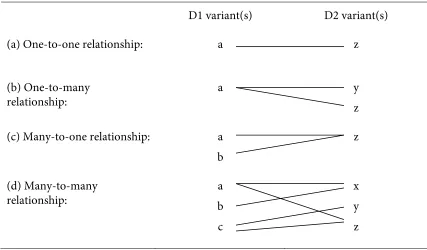
D1 variant(s) D2 variant(s)
(a) One-to-one relationship: a z
(b) One-to-many
relationship: a y z
(c) Many-to-one relationship: a
b
z
(d) Many-to-many
relationship: b a
c
[image:40.595.50.477.399.649.2]x y z
Figure 2-2: Possible relationships between D1 and D2 variant sets for the same variable. Adapted from Rys (2007:96-6).
5 Chambers 1992 choice of terms reflects the dominance in the literature of contexts where D2 learners assimilate to
One operationalization of this concept postulates that D2 variables are easier to learn if they directly correspond to a single variable in the D1. For example, Vousten (1995) found that Standard Dutch speakers who were acquiring the regional Venray dialect, learnt the [i] phoneme faster than the [u] and [y] phonemes. Vousten accounts for this in terms of the speakers’ D1: the [i] phoneme directly replaces a single Standard Dutch phoneme (/ɛi/), whereas the [u] and [y] phonemes map onto a single Standard Dutch phoneme (/œy/). So for [i] there was a one-to-one mapping between the D1 and D2 (as depicted in Figure 2-2 (a)), whereas for the [u] and [y] phonemes there was a one-to-many mapping (as depicted in Figure 2-2 (b)).
Rys (2007) tested the hypothesis that D2 acquisition was easier when the number of competing variants in the relationship between the D1 and D2 approaches 1:1. She found that the many-to-one relationship did impact on learning the D2, while the one-to-many did not. However, other researchers have found the opposite: that acquiring new contrasts is harder than acquiring new mergers (e.g. Trudgill 1986). While these studies have addressed phonology, the number of D1:D2 variants could equally apply to morphology, though I’m not aware of studies that have tested this.
An additional layer of complexity could arise from the extent to which the D2 recycles the D1 morpheme form(s) into a new, more complex set of morphemes; potentially further obscuring the function of the ‘shared’ morpheme in relation to the other forms in the set. As we will see, this is precisely the situation in the present study with regard to present temporal reference verb morphology: the D1 has three forms ing, ø, and -bat, whereas the D2 has only the first two.
intelligibility criterion, they can and do use their first dialect and navigate occasional misunderstandings as they arise, also using their D1. Learners of second languages cannot use their first language to this extent: anyone who has ever tried to learn a second language knows the frustration of having more to say than one can actually express.
As I noted above, the role of the first language of second language learners has previously taken a much more prominent analytic position in the field of SLA. For example, the ‘contrastive analysis’ program of research sought to describe and predict the L1/L2 pairings that would be most advantageous for second language learning, based on the assumption that similarities between L1/L2 features would facilitate acquisition. However, since “differences between languages alone were found to be inadequate as an explanation of learning outcomes” (Long & Sato 1984: 254) the field has moved on to other causes (in particular the search for universal processes in SLA), though across-group comparisons are still sometimes the focus of study (e.g. Jarvis 2002, Sabourin et al 2006; Ionin & Zubizarreta 2010). While the L1 demonstrably, at times, impacts on L2 acquisition (as phenomena such as L1 ‘transfer’ or ‘interference’) it does not appear to be the global template for the L2. In this way, the acquisition of a second dialect seems to be fundamentally different from second language acquisition: the learner approaches a second dialect as a process of D1 modification or extension, rather than an entirely new linguistic endeavour.
‘bi-dialectal’, switching between contrastive features in a manner that might be similar to bilinguals and their multiple language repertoires6.
In this section I have presented an overview of the task of second dialect acquisition. This involves firstly detecting differences between the D1 and D2 (a job that may be helped or hindered by the salience of target features and the extent to which they are camouflaged by surface similarity). Secondly, the new rules must be acquired, a task which may depend on how differently organised the feature is in the D1 and D2 (i.e. whether the same number of forms/range of distinct functions per form etc), and possibly the extent to which the same or similar D1 forms are ‘recycled’ in the D2. Thirdly, over time speakers need to maintain which rule belongs to which variety. Although this acquisition process shares many important factors generic to SLA (and first language acquisition for that matter; for example, rule complexity and input frequency impact on learning in each case), and although L1 patterns do also
demonstrably play a role in learning a second language, SDA and SLA are specifically different in the extent to which the D1 acts as a template for D2 acquisition.
2.3 Linguistic aspects of contact languages in acquisition
In this section I will examine studies of language acquisition in contexts where the difference between L1 and L2 goes beyond accent and minimal grammatical items. In these studies the relationship between the L1 and L2 is much more like the relationship between Alyawarr English and Standard Australian English.
In order to establish whether language acquisition in these contexts is subject to processes similar to those characteristic of second dialect acquisition, I will focus specifically on what these studies reveal about 1) the extent to which the L1 is demonstrably the base for L2 acquisition and 2) the extent to which the subsequent development of the L1 and L2 as separate codes (as opposed to one more complex code or language) is evidenced.
6 Some studies with subjects that demonstrate this kind of bidialectalism to varying extents include Kobayashi (1981),
Stern’s (1988) study of Swiss-German (SG) speaking children’s acquisition of Standard German (StG), demonstrated that they initially “rely strongly on the SG lexical base, transforming the phonological and morphological surface structure of SG into StG” (p139). He thus likens early acquisition to the development of a new register within the L1. Acquisition of tense morphology proceeds in a more complex manner, however, showing both evidence of systematic derivation from a SG base, and arrays of expressive strategies typical of other learners of German as a first or second language (such as relying on an ‘’do’ aux + infinitive’ combination to express past). Though the second question of whether there is evidence of development of separate codes is not directly addressed by Stern, the final stage of acquisition is mastery of the L2 system; suggesting the acquisition of two separate tense systems.
Fairclough’s (2005) comparative study of Standard Spanish learners of either English or non-Standard Spanish backgrounds7 reveals similar processes. While learners who speak a Standard Spanish variety overall performed better than learners with non-Spanish backgrounds, they also had unique characteristics. For example, in a cloze exercise targeting hypothetical forms, native speakers of non-Standard Spanish systematically produced either the target form or the equivalent L1 form. By contrast native English speakers produced a range of non-target forms, with a “tendency to use indicative forms or to leave blank spaces” (p125). Because the native-Spanish speakers continued to produce L1 forms to some extent throughout the longitudinal study (i.e. post-instruction), Fairclough concludes that their second language acquisition seems to be an “additive process in which the home variety competes with the standard dialect, thus generating a more complex linguistic system” (p131). In other words, these learners “do not seem to differentiate their Spanish as two separate systems” (p131).
In a series of studies of L1 speakers of Caribbean creole varieties leaning Standard English in the mainland United States, Clachar (2004; 2005) demonstrated that speakers of basilectal creole L1s went through an additional stage of tense-aspect acquisition prior to the ‘universal’ processes of second language acquisition (in this case as predicted by the Aspect Hypothesis, which is discussed in detail in Chapters 6 (§6.6)). At this earlier stage, their Standard English is demonstrably more similar to their L1
7 Speakers in this category were from a variety of South and Central American countries, as well as native Spanish
than the patterns predicted by the Aspect Hypothesis (contrary to other L2 learners whose first stage was predicted by the Aspect Hypothesis). Clachar (2004: 163) further concludes that these students “have difficulties building a separate mental
representation for standard English because of the blurred boundaries between standard and creole-English”.
The results of these studies appear to support the argument that the L2 of contact language-speakers is built on a L1 dialect/creole base, contrary to other second language learners but like the second dialect speakers described above. In each case it was also asserted that, at least for some time, these learners fail to differentiate between aspects of their L1 and their newly acquired standardised variety.
2.4 Socio-political aspects of SDA
As well as the linguistic factors already discussed, second dialect acquisition also often occurs in contexts with a specific set of social and political challenges. (In this section I use the term ‘dialect’ to cover both dialects and contact languages discussed in sections 2.3 and 2.4 above.) This thesis deals with child learners, so I will focus on how these factors play out within education systems, since for many child SDA learners, the school is the first site of language contact. Of particular relevance are situations in which children bring with them a vernacular (and usually largely unwritten) D/L1 variety, and are exposed to a standardised D/L2 variety in schools. In Australia, regional and
remote-living Aboriginal and Torres Strait Islander children often speak a variety of English at home that is not the same as Standard Australian English (SAE), which is the medium of instruction in schools.




![Table 6-3: Distribution of V, and Ving forms per TRANSITIVITY, SCHOOL context [significant χ2(2, N=321)=31.777, p<.001]](https://thumb-us.123doks.com/thumbv2/123dok_us/8211079.263209/161.595.142.444.417.723/table-distribution-ving-forms-transitivity-school-context-significant.webp)
