International Journal of Innovative Technology and Exploring Engineering (IJITEE) ISSN: 2278-3075, Volume-9 Issue-2, December 2019
Link Availability Based Routing Protocol for
Mobile Ad-Hoc Networks based on Link Life Time
Prediction
K.Sangeetha Supriya, Ramesh.Vatambeti
Abstract: A self-configured MANET has a set of wirelessdevices. With no prior administration, the Mobile Nodes (MNs) communicate via the wireless links. The limited bandwidth, transmission errors, dynamic topology, energy constraints, and link stability fluctuations lead to node mobility. The links between nodes are unreliable and might break on account of such node mobility. Link breakage leads to the rerouting process at the sender node (where the link breakage occurs) or Source Node (SN). This work proposed Link availability based routing protocol (LBRP) for MANET to attain load balancing via the Multi-Path (MP) communication. The traffic data could completely pass through parallel multiple paths, which enhances the protocol efficiency. On weighing against the existing routing protocols (RPs), the LBRP chiefly considers frequent link failures and unpredictable change in topology. The simulation outcomes validate the proposed LBRP. The LBRP performs well when contrasted to the DSR, ZRP, and AODV in all the experiments. This work would serve as the groundwork for examining and optimizing certain network protocols, and could help in designing algorithms for transport control and medium access.
Keywords: Link quality, Link availability table, Link lifetime, Path availability.
I. INTRODUCTION:
A dynamically reconfigurable wire-less network termed “ad hoc network” has no preset infrastructure. Its host moves in a random mode and works as a router [13, 18]. The end host along with the intermediary nodes should be mobile for an active link [2]. Hence, the routes tend to break frequently. And thereby it reroutes to discover another link for repairing or a new path for recovering communication [19]. These operations use the existent bandwidth and power in MANETs. They tend to cause extra delay and congestion, which affect the QoS of certain voice and video application and decline network performance [3].
Nevertheless, the recommended RPs centered on the minimum hops and shortest path could not avert the performance degradation resulting from link failure (LF) [5, 7, 8]. Consequently, it is noteworthy to have an LBRP.
II. RELATED WORK:
As the security, communication interruption, scalability, and unstable paths create problems for the MANET routing, the MP-Optimized Link Stability Protocol (MPOLSR) was suggested [5].
Revised Manuscript Received on December 05, 2019.
* Correspondence Author
K.Sangeetha Supriya, Assistant Professor, CSE, HKBK College of Engineering, Bangalore, India. E-Mail: [email protected].
*Ramesh.Vatambeti, Dept. of CSE, Presidency University, Bangalore, India. E-Mail: [email protected]
The Dijkstra Algorithm was extended and used for MP routing. To elevate the service quality, the loop and path detection were employed in the recommended scheme. The disjoint paths of node and link were chosen for the data transmission. As this protocol follows On-Demand routing, it was grounded on the source routing. The loop check and path recovery were done in this source routing to avert the short-termed link deterioration. The source routing issues were resolved utilizing the route recovery process. The main demerit of MP-OLSR was that it fails to offer a solution to the collision.
More reliability and stability were endeavored to proffer in MP quality of service (QOS) multicast RP (SR-MQMR) for MANETs. In this approach, concerning the requisite bandwidth, the nodes’ signal strength was utilized to pick the utmost stable nodes. Then, a route with high stability and low delay was picked utilizing the number of hops together with route expiration time [4]
On account of the node mobility, the recurrent changes happened in a network topology and those changes caused frequent LFs. The restricted node battery power and radio interferences brought out the interrupted data transmission. As the RP was inclined to the recurrent topological changes, it imposed problems on the protocol design. For resolving this issue, this approach predetermines the link stability [6]. It needed the entire network topology information to ascertain the link stability. The location information was attained via the periodic trade of beacon messages, which elevated the routing overhead (RO). This was concerned as the chief demerit of this suggested approach.
As long-lived paths were chosen for data packets transmission, the stable paths were requisite for data communication to diminish the control traffic and connection interruption [7]. For which, the instable links were lessened along the chosen path and the residual lifetime of the picked path was lessened to minimize the reroute discoveries. The RPs’ performance was elevated on account of the subsequent factors. The diminution of too young and old links was averted in the path selection. After determination, the path lifetime was disseminated to other nodes, which aids to elevate the protocol efficiency. Thereby, the sustenance of the information about global topology elevated the RO.
The QoS of the routing was the chief problem to the protocol design in MANET. Link State MP Qos RP [8] bolstered communication with limited bandwidth and it ascertained the bandwidth at the Destination Node (DN). For proffering the required bandwidth, accurate bandwidth information was evaluated. For which, the MP routing was done under a Time - and Control -Division Multiple Access communication channels. In a
Prediction
generate the combined communication path for transmitting data. This phase bolstered the bandwidth calculation. The link bandwidth information was registered in every single data packet and thereby, it elevated the RO.
The chief issue of the MANET routing was the path selection with utmost reliability. The dynamic mobility rendered recurrent breaks specifically in the radio links. Therefore, reliable paths were requisite for effectual communication [9]. The path reliability was reliant on the link availability amongst the MNs. Both the signal- and link- stability were regarded while choosing the communication paths. It assists in estimating the future status of link’s stability. In the prediction centered determination, the continual link stability was updated on the node cache. In the measurement centered scheme, the link stability was gauged via the periodical exchange of updated packets. The correlation factor amongst the nodes was evaluated to ascertain the route lifetime. The link available tendency was reflected via the evaluation of link stability and the maintenance of information about topology elevated the RO. This was the chief demerit in the prediction centered link estimation.
The RP performance was reliant on the link availability. The available links amongst the destination and SNs were ascertained utilizing the correlation factor [10]. The single-path routing needed rerouting discovery owing to the dynamic mobility. It rendered less node-battery power and hence the MP-RP was recommended. It retained variant paths to every single link. In the estimation of prevailing links utilizing an enhanced prediction centered scheme, the intuitive parameter was proffered. It assisted to augment the link estimation adaptability to disparate mobility designs. In enhanced prediction centered link availability estimation, the original evaluation of link availability was weighed against the enhanced prediction centered link availability computation. It proved that the enhanced prediction centered calculation proffered accurate information for the existing links as of the SN to the DN.
The existent dynamic RPs implemented the distributed algorithm. It assisted to resolve the shortest route problem and recommended the Simple Path Vector Problem (SPVP) [11]. In the inter-domain protocols, the policy centered metrics override the distance centric metrics but it fails to offer global coordination.
III. PROPOSED APPROACH: LINK
AVAILABILITY-BASED ROUTING PROTOCOL (LBRP)
In the routing algorithms, the link availability considers path selection and path update to attain high-level performance. On account of the MANETs’ dynamic property, the metrics centered on hop count may misjudge the link quality [6, 7, 20]. For which, the LBRP is proposed.
A. Significance of Link Quality
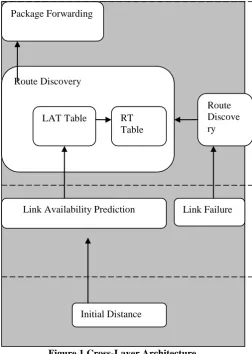
The proposed RP pays attention to the link quality. The LBRP is weighed against other RPs in respect of frequent LF and topology change (TC). As in Fig-1, the link quality is appraised at the link layer of the network protocol stack.
[image:2.595.304.557.61.416.2]
Figure 1.Cross-Layer Architecture
The link availability information is attained as of the link layer. Hence, the LBRP is a hybridized protocol with cross-layered architecture. Recently, it is found that a conventional layering network strategy (separating routing, power control, scheduling, and rate) is not effectual for Ad-Hoc. This is chiefly due to the interaction of links via interference, which implies that a change in the schedules or power allocation on one link could alter the capacities of all links in the nearby area and performance of flows that do not pass over the modified link.
B. LBRP
The proposed LBRP integrates the On-Demand-driven and Table-driven routings. The protocol has two tables: i) Link Availability Table (LAT) and ii) Routing Table (RT). The LAT stores the details about wireless links as of the node to its one-hop neighbors. On account of the node mobility in MANETs, the LAT content must be refreshed periodically. RT is as well found in other RPs. In LBRP, the information in RT is updated once a transmission session is initiated. The package definition could be comprehended using Fig 2.
Package Forwarding
Route Discovery
Route Discove ry
LAT Table RT
Table
Link Availability Prediction Link Failure
International Journal of Innovative Technology and Exploring Engineering (IJITEE) ISSN: 2278-3075, Volume-9 Issue-2, December 2019
Figure 2: Package Definition
As in Fig 2, the data structure highlights that it has four subfigures. The first two subfigures are LAT and RT. The remaining are RREQ and RREP control packages which are utilized in the LBRP protocol. The LAT content must be periodically refreshed since the LBRP is a Table-driven RP. In the meantime, RT information is updated once a transmission session begins. So, LBRP is as well a demand-driven RP.
C. Algorithm to Predict the Link Life Time For finding the best path as of the SN to the DN, the link lifetime is concerned [7, 8]. The highest route availability path is picked for communication. The path availability indicates the probability of a multi-hop path. It could be deducted utilizing the availability of the links across the path. In on-demand multi-hop RPs for MANETs say DSR and AODV, a basic requirement for peer-to-peer connectivity is to ascertain routes to a remote node with the flooding of RREQs. LBRP follows the same processes.
i. Link stability replaces the hop count
Unlike DSR and AODV, the link stability substitutes the hop Count in LBRP [9]. Hence, frequent LF and unpredictable TC are common phenomena in MANETs. Link quality is a prime metric in this comparison. In contradiction to DSR and AODV, the route metric is centered on the link quality rather than the hop count. The LBRP aims to build an optimizing path with the highest path availability. The succeeding code elucidates the construction of the optimizing path. The optimizing path is ascertained utilizing the prediction framework (Michael Gerharz and Christian de Waal, 2004; Timothy G et al 2002). First, the RREQ package is managed and then the RREP package is managed.
ii. RREQ package
[image:3.595.306.548.44.309.2]The SN transfers RREQ package to the nearby nodes while creating the optimizing path.
Figure 3 RREQ Message iii. RREP Package
As in Fig3, the RREQ package of LBRP has a field termed link quality, unlike the traditional RREQ package. Link quality indicates the path availability from the SN to the current node. If the nearby nodes fail to possess the route information to the DN, then they retransfer the RREQ packet. iv. RREP package
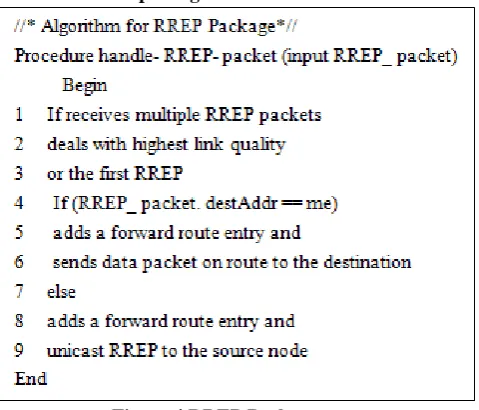
Figure 4 RREP Package
The RREP packets are forwarded back to the SN when the intermediate nodes and DN have a path in-between. When an RREP package is attained by a node, the node validates whether it is a reduplicate package. If it is a reduplicate one, then the package with topmost link quality or the initial package is preferred by the node. If the current node is the DN of the package, then forward route entry is constructed and the data package is forwarded to the DN. Else a forward route entry is constructed and the RREP package is unicasted to the SN.
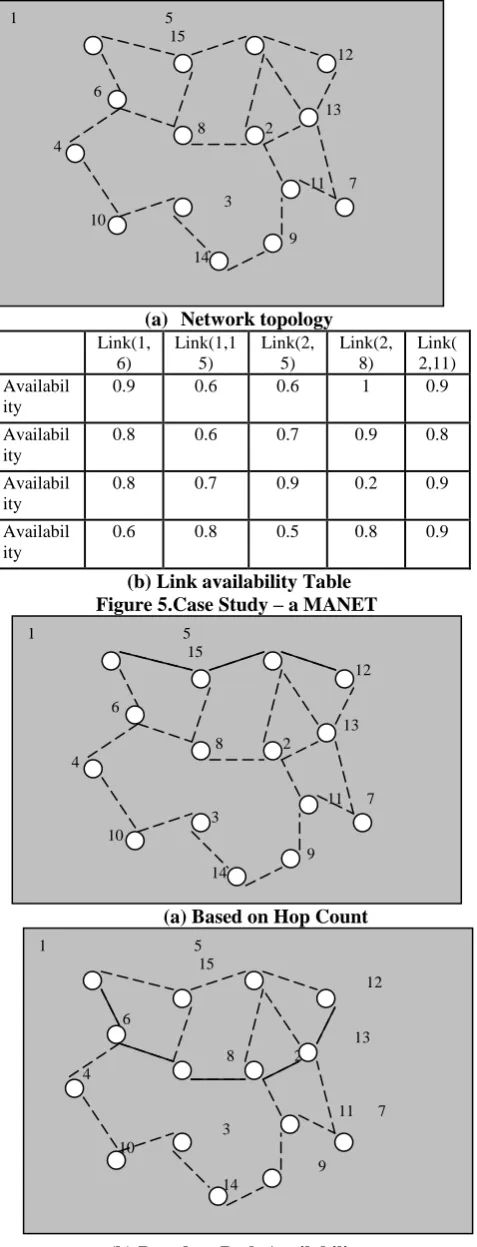
D. Estimation of Link Availability and Routing Table Fig 5 (a), demonstrates MANET topology. Nodes 1 and 12 are regarded as SN and DN, correspondingly. The quality information of wireless links from every node to its one-hop neighbors is depicted in
Figure 5 (b). SN provokes the process of route discovery
Neig
h
Add
r
Neig
h
Seq
Link
Qual
ity
Len
gth
Life
Tim
e
Pkt
Ty
pe
Bc
ast
Id
De
st
Ad
dr
De
st
Se
q
Src
Ad
dr
Src
Se
q
Las
t
Ad
dr
Lin
k
Qu
l
Dest
Add
r
Dest
Seq
Link
Qual
ity
Next
Hop
Life
Tim
e
Pkt
Typ
e
Src
Add
r
Dest
Add
r
De
st
Se
q
Link
Qual
ity
[image:3.595.46.284.46.263.2] [image:3.595.309.549.376.581.2]Prediction
(RD) when the routing information betwixt SN and DN is unavailable. Path availability is significant for RD. Hence, the path with maximal path availability rather than the one with minimal hop count is referred to as the optimal route path as evinced in Fig 5.
(a) Network topology
Link(1,
6)
Link(1,1 5)
Link(2, 5)
Link(2, 8)
Link( 2,11) Availabil
ity
0.9 0.6 0.6 1 0.9
Availabil ity
0.8 0.6 0.7 0.9 0.8
Availabil ity
0.8 0.7 0.9 0.2 0.9
Availabil ity
0.6 0.8 0.5 0.8 0.9
(b) Link availability Table Figure 5.Case Study – a MANET
(a) Based on Hop Count
(b) Based on Path Availability
Figure 6 Route Path Based on Different Metrics Fig 6 (a) is the route path for DSR and AODV on account of hop count. The route with a least number of hops is regarded as the best route. Here, 1–15–5–12 is the best route.
Nevertheless, for LBRP, the link availability is considered and its route path is proffered in Fig 6 (b). Here, the optimum route path is 1–6–8–2–13–12 and its reliability is 0.9 × 0.9 × 1.0 × 0.9 × 0.8 ¼ 0.5832, which is superior to that of other route paths.
IV. PERFORMANCE EVALUATION
The performance shown by the proposed LBRP protocol is assessed utilizing the simulator GloMoSim.
A. Simulation parameter
[image:4.595.50.289.108.732.2]GloMoSim, the network protocol simulation software which simulates wired and wire-less network systems is employed to perform the simulation for assessing the LBRP. With the aid of the GloMoSim simulator, a comparison of the LBRP performance with the existing DSR, ZRP, and AODV is done. They are well-adjusted for the GloMoSim execution and acts as representatives for wireless RPs.
Table 2 Simulation parameters - performance of RPs
B. Simulation metrics Packet Delivery Fraction (PDF):
It is the ratio of a total number of packets reached at the DNs and the number of packets sent as of the SNs at the time of simulation.
The concept behind the protocol’s effectiveness in providing the packets to the application layer is depicted by the PDF estimate. A high PDF value shows that most of the packets are supplied to the higher layers and this value is a positive indicator of the protocol performance.
Average End to end delay of data packets:
n0
i
Total
Number
of
Packets
Received
Sent)
Packet
of
Time
Recived
packet
of
(Time
AED
The AED indicates the average time consumed as of the beginning (SN) to the end (DN) of packet transmission. The data delay includes, buffering data packets throughout the RD, delays amid retransmission at the MAC, transfer and propagation times and queuing at the interface queue. Evaluate the mean of send(S) time (t) and receive (R) time (T) once their values are found.
Number of Received Packets PDF =
Number of Sent Packets
1 5
15
12
6
13
8 2
4
11 7
3
10
9
14
1 5
15
12
6
13
8 2
4
11 7
3
10
9
14
1 5
15
12
6
13
8 2
4
11 7
3 10
9
International Journal of Innovative Technology and Exploring Engineering (IJITEE) ISSN: 2278-3075, Volume-9 Issue-2, December 2019
[image:5.595.71.271.288.497.2]Figure 7 Number of Nodes Vs Packet Delivery Ratio Fig 7 contrasted the LBRP with the existing DSR, ZRP, and AODV in respect of the nodes’ PDF.
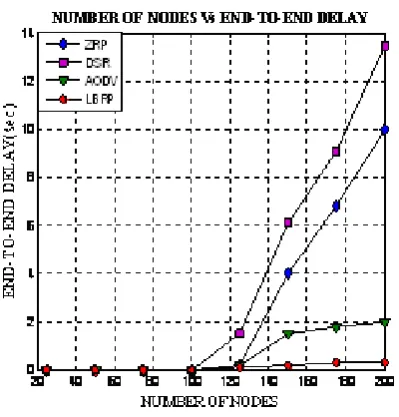
Figure 8 Number of Nodes Vs End-to-End Delay Fig 8 contrasted the LBRP with the existing DSR, ZRP, and AODV in respect of End to End Delay.
V. CONCLUSION
On contrasting to other existing RPs, the LBRP chiefly considers frequent LF and unpredictable TC. The simulation outcomes confirm the proposed approach’s effectiveness. The performance shown by LBRP is weighed against the DSR, AODV, and ZRP and the outcome revealed that the LBRP performs well in all the experiments. This work forms the base for examining and optimizing further network protocols and could help in designing effectual algorithms for transport control and medium access.
REFERENCES
1. kerBekmezci and OzgurKoraySahingoz and amilTemel Flying Ad-Hoc Networks (FANETs): A surveyAd Ad-Hoc Networks, 2013 volume 11, number 3, pp. 1254–1270
2. Badarneh, Osamah S. and Kadoch, Michel. MulticastRouting Protocols in Mobile Ad Hoc Networks: A Com-parative Survey and Taxonomy. EURASIP Journal onWireless Communication Networking, Hindawi Publish-ingCorpartion, New York, NY, United States, jan 2009,pp. 26:1–26:42
3. Gaurav Singal, Vijay Laxmi, Vijay Rao, Swati Todi, Manoj Singh Gaur, Improved multicast routing in MANETs using link stability and
route stability, International Journal of Communication Systems, Wiley, Vol 10, No. 11, 2017.
4. Mina Ghafourivaighan, Mohammad Ali, JabraeilJamali, “A multipath QoS multicast routing protocol based on link stability and route reliability in mobile ad-hoc networks, Journal of Ambient Intelligence and Humanized Computing, January 2019, Volume 10, Issue 1, pp 107–123.
5. Jiazi Yi, AsmaaAdnane, Sylvain David, and BenoîtParrein, (2011) “Multi-Path optimized link state routing for mobile Ad-Hoc networks”, Ad-Hoc Networks, Vol. 9, issue 1, pp. 28–47.
6. T. Bheemarjuna Reddy, I. Karthigeyan, B.S. Manoj, and. Siva Ram Murthy, (2010) “Quality of service provisioning in Ad-Hoc wireless networks: a survey of issues and solution”, Ninth International Symposium onDistributed Computing and Applications to Business Engineering and Science (DCABES), pp. 259 – 262.
7. Michael Gerharz, Christian de Waal, and Peter Martini, (2003) “Strategies for finding stable paths immobile wireless Ad-Hoc networks”, 28th Annual IEEE International Conference on Local Computer Networks LCN '03, pp. 130-139.
8. Yuh-Shyan Chena, Yu-Chee Tsengb, Jang-Ping Sheuc, Po-HsuenKuo, (2004) “An on-demand, link-state,Multi-Path QoS routing in a wireless mobile ad-hoc network”, Computer Communications, Vol. 27, issue 3, pp. 27–40.
9. Shengming Jiang, Yaoda Liu, YumingJian and Qinghe Yin, (2004) “Provisioning of adaptability to variable topologies for routing schemes in MANETs”, IEEE Journal on Selected Areas in Communications, Vol. 22 , issue7,pp. 1347 – 1356.
10. V.Ramesh, Dr.P.Subbaiah, “Mobility scenario-based Performance Evaluation of Preemptive DSR Protocolfor MANET”, WSEAS Transactions of Communications, Vol 12, Issue 5, May 2013. 11. Hasan MZ, Al-Turjman F, Al-Rizzo H (2017) Optimized
multi-constrained quality-of-service multipath routing approach for multimedia sensor networks. IEEE Sens J 17(7):2298–2309. 12. Moussaoui A, Boukeream A (2015) A survey of routing protocols
based on link-stability in mobile ad hocnetworks. J NetwComput Appl. doi: 10.1016/j.jnca.2014.09.007
13. V.Ramesh, Dr.P.Subbaiah, “Energy Management Scheme with Load balancing for Preemptive DynamicSource Routing for MANET” , Journal of Theoretical and Applied Information Technology , Vol 51, Issue 3, pp 454-460, 2013.
14. Ghulam Abbas, ZiaulHaq Abbas and AlamgirNaushad, A Novel Efficient Traffic Estimation Strategy Using Hello Messaging Through Local Link Connectivity in MANETs, WirelessPersonalCommunications,10.1007/s11277-019-06603-8, (2019).
15. V.Ramesh, Dr.P.Subbaiah, N.Koteswar Rao, “ Performance Comparison and Analysis of Preemptive DSR &TORA”, published in the International Journal of Ad Hoc, Sensor and Ubiquitous Computing, Vol-1, Issue 3, September 2010 pp 47-60.
16. LuoJunhai and Xue Liu and Ye Danxia. Research onmulticast routing protocols for mobile ad-hoc networks Computer Networks, Elsevier 2008, volume 52, number5, pp. 988–997
17. M. Jain and S. Chand, “Issues and Challenges in Node Connectivity in Mobile Ad Hoc Networks: A Holistic Review,” Wireless Engineering and Technology, vol. 07, no. 01, pp. 24–35, 2016. 18. V.Ramesh, Dr.T.StephenThangaraj, J.V.Prasad, “ An Efficient path
lossPrediction mechanism in Wireless Communication Network Using Fuzzy Logic”published in the International Journal of Advanced Research inComputerScience & Software Engineering(IJARCSSE), Vol 02, Issue 1, January 2012.
19. Q. Song, Z. Ning, S. Wang, and A. Jamalipour, “Link stability estimation based on link connectivity changes in mobile ad-hoc networks,” Journal of Network and Computer Applications, vol. 35, no. 6, pp. 2051–2058, 2012.