International Journal of Innovative Technology and Exploring Engineering (IJITEE) ISSN: 2278-3075, Volume-8 Issue-8S2, June 2019
Abstract :Background/Objectives: This study utilized TAM to explain the adoption process of KakaoBank(internetprimary bank). Innovativeness and perceived trust(PT) were established as antecedent constructs for perceived usefulness(PU) and perceived ease of use(PEOU).
Methods/Statistical analysis: Online survey was conducted for 4 weeks from March 19, 2018 through April 13, targeted at 245 undergraduates who had used KakaoBank within the last month. Participants voluntarily participated in the study for extra credits. For statistical analysis, SEM was conducted using LISREL 8.53 program.
Findings: First, innovativeness and PT are important antecedent constructs that can explain the adoption process of KakaoBank. Service providers need to make efforts to give information on trustworthiness of their services such as management of customer information, targeted at people of high innovativeness. Second, PEOU is an important mediator that can explain ITU of KakaoBank. PEOU has no directly effect on ITU of KakaoBank, but has an indirect effect on ITU through PU. KakaoBank needs to raise people’s interests of KakaoBank by providing information on the convenience of KakaoBank’s services such as account transfer, which would ultimately lead to connecting with information on PU.PU is an important construct that can increase the use of KakaoBank. PU has a significant direct effect on KakaoBank’s ITU, while PEOU does not. Therefore, it is important to emphasize the benefits earned by using KakaoBank, such as the amount of time and money saved.
Improvements/Applications: This research was only targeted at undergraduates. A follow-up research needs to expand its subjects to people in their 30s and 40s to generalize the results.
Keywords: Internet Primary Bank, KakaoBank, Innovativeness, Trust, TAM
I.INTRODUCTION
KakaoTalk, the largest messenger service in South Korea launched KakaoBank, an internet primary bank service, in July 2017. An internet primary bank is a non-store untact bank that provides services online through PCs and mobile phones, without physical bank offices for customers and bank clerks to meet with each other.
What is noteworthy is that it has been a huge success when it when it hasn't yet been cleared what internet primary banks
Revised Manuscript Received on May 22, 2019.
Myung-il Choi, Department of Advertising and Public Relations, Namseoul University, CheonAn, South Korea.
are. There are several reasons. KakaoTalk, the service provider, has earned huge popularity and trust among the users. Internet primary bank has removed the certificate processes, making it easy for everyone to quickly open a bank account. It is also convenient to send and receive money easily with friends who are registered with KakaoTalk messenger.
However, it is premature to say that KakaoBank has established itself as a fully successful financial service in our society. This is because it is difficult to immediately respond to problems or emergency situations that can occur in the process of performing complex and professional services such as loan application, and the risk of personal information leakage through hacking is high. For example, there is a high risk of name theft because of the way non-store untact bank account is opened. Since KakaoBank is a new financial service compared to other services such as internet banking or mobile banking, it is very likely to cause many unexpected problems.
There are always positive and negative sides to new IT-based services like KakaoBank. The important thing is to understand why people accept or resist such service, and to establish a success strategy that enhances the likelihood of adoption without causing social turmoil. Some of the key theories that explain the adoption process of IT-based services such as KakaoBank are Theory of Planned Behavior (TPB) and the Technology Acceptance Model (TAM). Previous studies were actively conducted to find a model that better describes the adoption of IT-based services such as Internet banking among TPBs and TAMs. TAM was found to be more descriptive than TPB[1,2]. Therefore, this study will explain the process of adopting KakaoBank by applying TAM.
TAM explains the adoption process through two belief constructs, perceived usefulness(PU) and perceived ease of use(PEOU). PU was defined as “the degree to which an individual believes that using a particular system would enhance his or her job performance.” PU is “the degree to which an individual believes that using a particular system would be free of physical and mental effort”[3]. When applied to KakaoBank, PU refers to the individual belief that
using KakaoBank will
enhance banking services. KakaoBank allows users to
A Comparative study on Intention of Using
Kakao Bank (Internet Primary Bank) in South
Korea: Focused on Technology Acceptance
Model(TAM)
access their banking accounts from any time, any location and so supply enormous benefit to users. PU refers to individual belief that using a KakaoBank will be easy to learn or operate.
KakaoBank is an IT-based service that relies on customers’ voluntary choices. The internet banking that we are accustomed to makes it easy for us to easily and conveniently process basic services like account transfer without the help of bank tellers. KakaoBank, however, requires the customers to process all types of banking services on their own such as opening of bank account, loan through smartphones. Since this type of service may seem strange and difficult, the kind of attitude of customers may decide whether or not to use KakaoBank.
Innovativeness is a concept that can explain the attitude of customers in choosing new services like KakaoBank. Innovativeness is the level of voluntary will to experimentally use new products, services, and technology[4]. People with higher innovativeness are more likely to take the risk of uncertainty, making them more likely to use new financial services like KakaoBank. Thus innovativeness is a construct that is often used in studies on acceptance of new products or services[5,6]. In fact, innovativeness has been applied in studies on accepting new services or technologies such as mobile banking[7]. It has been found that innovativeness is the independent construct of PU and PEOU of new technology[8]. Therefore, this is study sets out research hypotheses as follows:
H1: The innovativeness of KakaoBank users will have a positive effect on PU.
H2: The innovativeness of KakaoBank users will have a positive effect on PEOU
In many studies, trust is a key antecedent construct that can explain adoption of new financial service such as internet and mobile banking[9]. Trust is important because services like internet banking deals with properties and money. It is likely that customers will refuse to use services if it is difficult to quickly respond to problems or difficulties that may arise with banking operations, such as bank transfers or if they are unsure of their post management.
Study utilizing TAM has considered trust as an important antecedent construct[10]. Actually, Perceived trust(PT) has a positive effect on PU and PEOU how foreign residents in Korea accept mobile banking[11].
The same applies to the case of KakaoBank. Since it has just begun its service, it is important to make customers believe that their information and assets are securely protected. An internet primary bank has started its service recently in China, and it has turned out that trust plays an important role in people’s choosing internet primary
bank[12]. Therefore, this study sets out research hypotheses as follows:
H3: PT will have a positive effect on PU. H4: PTwill have a positive effect on PEOU.
The basic premise of TAM lies in the PU as an antecedent construct. PEOU and PU are also antecedent constructs for adoption of new information system or services, and PEOU is an antecedent to PU[4]. The basic premise of TAM is consistent in the study results applied with meta-analysis[13].
Specifically, previous studies on adoption of internet and mobile banking are showing results that are consistent with TAM’s basic premises – relations among PU, PEOU, and ITU.PEOU and PU have meaningful effects on American adults’ adoption process of mobile banking[14]. Other studies have shown PEOU[15] and PU[16] have meaningful effects on adoption of mobile and internet banking. Therefore, this study sets out research hypotheses as follows:
H5: PEOUwill have a positive effect on PU. H6: PEOUwill have a positive effect on ITU. H7: PUwill have a positive effect on ITU.
II.MATERIALSANDMETHODS 2.1. General Procedure
In this study, online survey was conducted for 4 weeks from March 19, 2018 through April 13, targeted at 300 undergraduates who had used KakaoBank within the last month. Participants voluntarily participated in the study for extra credits. Since KakaoBank provides its service through mobile phones without physical stores, its main customers are smartphone users. It is thus proper to invite undergraduates in their 20s to participate in the survey.
Excluding irrelevant responses from 55 participants, I used 245 responses in the final analysis. 81 of the participants are men (33.1%), and 164 are women(66.9%). Age ranges from 20 to 29, averaging 22.6 years of age (2.20 standard deviation). On average, participants used the service 5 times within the last month(S.D=7.4)
2.2.Measurement
In this study, we administered a questionnaire that included constructs of the proposed research models. We used five-point Likert-type scales(1=strongly disagree, 7=strongly agree) to record participants’ responses. As shown in <Table 1>, we was modified measures from previous studies for KakaoBank(internet primary bank).
Table 1: MeasurementItem
Construct Measurement Items Preceding
research
International Journal of Innovative Technology and Exploring Engineering (IJITEE) ISSN: 2278-3075, Volume-8 Issue-8S2, June 2019
1-2.I know more about new technologies such as internet banking
1-3.I tend to use new technology first
Perceived Trust(PT)
2-1. When using KakaoBank, I believe my account information is kept confidential
[10,11] 2-2. When using KakaoBank, I believe my
transactions are secured
2-3. When using KakaoBank, I believe the banking environment is safe
Perceived Ease of Use (PEOU)
3-1. KakaoBank will be easy to learn
[2,16] 3-2. It is easy to use KakaoBank to accomplish my
banking tasks
3-3. KakaoBank will be easy to operate
Perceived Usefulness(PU)
4-1. Using KakaoBank will save time
[2,16] 4-2. Using KakaoBank has more advantages
4-2. Using KakaoBank will improve my performance in conducting banking services
Intent to Use(ITU)
5-1. When dealing with banking affairs, I prefer to using KakaoBank
[10,11] 5-2. When dealing with banking affairs, I intend to
use KakaoBank
5-3. When dealing with banking affairs, I would use KakaoBank
III.RESULTSANDDISCUSSION 3.1. Results of measurement model analysis
Confirmatory Factor Analyses(CFA)were performed to test the suitability of the measurement model(Innovativeness, PT, PEOU, PU, ITU). LISREL 8.53 program was used along with Maximum-likelihood estimates(ML). No problems have been found with the assumptions of multivariate analysis, such as multicollinearity and normality.
CFA indicates that overall model fit is generally satisfactory( χ2
(80) = 128.60, p<.01, SRMR = .037, CFI =
.99, RMSEA = .05, NNFI = .99). This is because CFA and NNFI above .90 with RMSEA and SRMR below 0.10 can be considered recommended values for the common model fit[17].
To evaluate constructs validity, convergent and discriminant validity were analyzed. Convergent validity is when the factor loading for each construct are significant. As shown in <Table 2>, factor loading has a value of .65~.97, all of which are significant(p<.01). Therefore, it can be judged that convergent validity is secured for each construct.
Table 2: Result of confirmatory factor analysis
Construct
No. of Measurement Items
Mean Standard
Deviation
Factor
loading* t-value
Composite Reliability
Innovativeness
1-1 4.03 0.68 0.65
.86
1-2 4.11 0.67 0.82 8.32
1-3 3.82 0.84 0.69 8.27
Perceive Trust(PT)
2-1 3.26 0.87 0.87
.94
2-2 3.34 0.83 0.92 20.45
2-3 3.18 0.90 0.90 19.78
Perceived Ease OfUse(PEOU)
3-1 4.02 0.82 0.91
.97
3-2 4.03 0.80 0.95 26.72
3-3 4.01 0.80 0.93 25.56
Usefulness (PU)
4-2 3.97 0.82 0.89 17.99
4-3 3.84 0.87 0.82 15.86
Intent to Use(ITU)
5-1 3.27 1.13 0.93
.94
5-2 3.00 1.17 0.93 28.30
5-3 3.12 1.18 0.97 32.89
*Standard coefficient
Model fit index: χ2(80) = 128.60, p<.01, CFI = .99, NNFI = .99, SRMR = .037, RMSEA = .05
To test the discriminant validity, Average Variance Extracted(AVE) of all the constructs should be larger than
[image:4.595.75.520.207.396.2]their squared correlation. As shown in <Table 3>, all AVEs are larger than the squared correlation, so it can be said that discriminant validity has been achieved.
Table 3: Result of discriminant validity between construct>
Construct AVE*
squared correlation between construct
Innovativenes s
Perceived Trust(PT)
Perceived Ease
ofUse(PEOU)
Perceived Usefulness (PU)
Intent to Use(ITU)
Innovativeness .668 1
Perceived
Trust(PT) .846 .16 1
Perceived
Ease of use(PEOU) .912 .12 .31 1
Perceived
Usefulness(PU) .803 .12 .32 .47 1
Intent to Use(ITU) .832 .06 .38 .31 .38 1
*AVE: Average Variance Extracted
3.2. Result of research model analysis
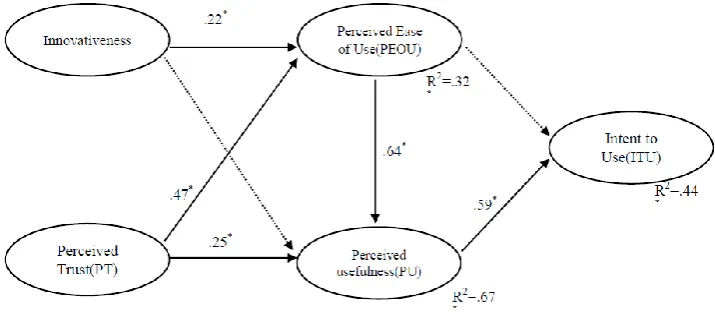
Structural Equations Modeling(SEM) was conducted to evaluate our proposed research model. As shown in <Fig. 1>, Model fit index was satisfactory, considering the recommended values for the common model fit(χ2(82) =
159.77 p<.01, SRMR = .063, CFI = .99, RMSEA = .062, NNFI = .98). In terms of Squared Multiple Correlations, this research model explains 32% of the amount of variation of PEOU, 67% of PU, 44% of ITU.
Figure 1. Result of Structural Equation Model
1. χ2(82) = 159.77 p<.01, SRMR = .063, CFI = .99, RMSEA = .062, NNFI = .98
2. *p <.01
3. The coefficients for all paths are standardized values. 4. Non-significant paths are indicated with dotted lines.
3.3. Result of research hypothesis test
H1predicted that innovativeness of KakaoBank users is likely to have a positive effect on PEOU. This study indicates that innovativeness have a positive effect on PEOU(γ=.22,
t=3.20, p<.01). Thus, H1 are supported. While H2 predicted that innovativeness of KakaoBank users will have a positive effect on PU, but this study reveals that it is statistically non-significant. Thus, H2 are rejected.
H3 predicted that PT towards KakaoBank will have a positive effect on PEOU, and the study shows it is significant (γ=.47, t=7.38, p<.01).
[image:4.595.128.486.496.652.2]International Journal of Innovative Technology and Exploring Engineering (IJITEE) ISSN: 2278-3075, Volume-8 Issue-8S2, June 2019
a positive effect on PU, and this study shows it is significant (γ=.25, t=4.45, p<.01). Thus, H4 are supported.
H5 predicted that PEOU towards KakaoBank will have a positive effect on PU. The study shows it is significant(β=.64, t=10.14, p<.01) and H5 are supported. H6 predicted that PEOU towards KakaoBank will have a positive effect on ITU, but it was statistically non-significant. Thus, H6 are rejected. Lastly, H7 predicted that PU towards KakaoBank will have a positive on ITU, and it was significant(β=.59, t=5.80, p<.01). Thus, H7 are supported.
IV.CONCLUSION
This study utilized TAM to explain and analyze the adoption process of KakaoBank, an internet primary bank. Innovativeness and ITU were established as antecedent constructs for PU and PEOU in order to enhance the explanation power. Responses from 245 male and female undergraduates who have used KakaoBank were collected. For statistical analysis, SEM was conducted using LISREL 8.53 program.
As a result of analysis, innovativeness has a positive effect on PEOU. PT has a positive effect on PU and PEOU. PEOU has a positive effect on PU. PU has a positive effect on ITU. Following conclusions can be drawn from these findings. First, innovativeness and PT are important antecedent constructs that can explain the adoption process of internet primary bank such as KakaoBank. Service providers need to make efforts to give information on trustworthiness of their services such as management of customer information, targeted at people of high innovativeness. They will likely to attract more customers to use KakaoBank with this strategy. Second, PEOU is an important mediator that can explain ITU of KakaoBank. PEOU has no directly effect on ITU of KakaoBank, but has an indirect effect on ITU through PU. KakaoBank needs to raise people’s interests of KakaoBank by providing information on the convenience of KakaoBank’s services such as account transfer, which would ultimately lead to connecting with information on PU(KakaoBank’s benefits).
Third, PU is an important construct that can increase the use of KakaoBank. PU has a significant direct effect on KakaoBank’sITU, while PEOU does not. Therefore, it is important to emphasize the benefits earned by using KakaoBank, such as the amount of time and money saved. Stressing the simplicity and convenience of KakaoBank may increase the interests of people, but it does not lead to increase in the usage. In order to increase the use of KakaoBank, service providers need to give direct information on PU.
The study is meaningful in that it was targeted at KakaoBank, an Internet primary bank that has yet to be actively researched. Nevertheless, it has a few limitations. First of all, this study used ITU as a dependent construct. A follow-up research needs to look at the relation between the ITU and the actual usage. Secondly, this research was only targeted at Korean students. The use of internet primary bank such as KakaoBank can vary depending on the ability to use
smartphones. A follow-up research needs to expand its subjects to people in their 30s and 40s to generalize the results.
ACKNOWLEDGMENT
Funding for this paper was provided by Namseoul University.
REFERENCES
1. MathiesonK.Predicting user intentions: Comparing the technology acceptance model with the theory of planned behavior. Information Systems Research. 1991 Sep;2(3):173-91.
2. Ok SJ, Shon JH.A study on the intention to use of internet banking.International Commerce and Information Review. 2007
Sep;9(3):81-103.Available from:
http://www.dbpia.co.kr/Article/NODE01700009.
3. Davis FD.Perceived usefulness, perceived ease of use, and user acceptance of information technology.MIS Quarterly, 1989 Sep;13(3):318-39. 4. AgarwalR, Karahanna, E. Time flies when you’re having fun: Cognitive
absorption and beliefs about information technology usage. MIS Quarterly. 2000 Dec;24(4):665-94.
5. Agarwal R, Prasad J. A conceptual and operational definition of personal innovativeness in the domain of information technology.Information Systems Research.1998 Jan;9(2):204-15.
6. GaoT, RohmAJ, Sultan F, HuangS.Antecedents of consumer attitudes toward mobile marketing: A comparative study of youth markets in the United States and China. Thunderbird International Business Review. 2012 Feb;54(2):211-24.
7. Sulaiman A, JaafarNI, Mohezar S. An overview of mobile banking adoption among the urban community.International Journal of Mobile Communications. 2007 Jan;5(2):157-68.
8. LewisW, Agarwal R, SambamurthyV. Sources of influence on beliefs about information technology use: An empirical study of knowledge workers. MIS Quarterly. 2003 Dec;27(4):657-78.
9. Yuan Y, LaiF, Chu Z.Continuous usage intention of internet banking: A commitment-trust model. Information System and e-Business Management.2018 May;16(2):1-25.
10. LuarnP, Lin HH.Toward an understanding of the behavioral intention to use mobile banking.Computers in Human Behavior.2005 Nov;21(6):873-91.
11. Pham U, Han KS.An empirical study on understanding customer behavioral intention towards mobile banking: Focused on English-Speaking Vietnamese consumers residing in Korea. Enture journal of Information Technology.2015 Aug;14(2):57-69.Available from:http://kiss.kstudy.com/search/detail_page.asp?key=3349896. 12. ZhangY, Chen X, LiuX, Zhu N.Exploring trust transfer between internet
enterprises and their affiliated internet-only banks: An adoption study of internet-only banks in China. Chinese Management Studies. 2018Jan;12(1):56-78.
13. WuJ,LedererA.A meta-analysis of the role of environment-based voluntariness in information technology acceptance. MIS Quarterly, 2009 Jun;33(2):419-32.
14. Chen LD.A model of consumer acceptance of mobile payment.International Journal of Mobile Communication. 2008 Jau;6(1):32-52.
15. Chitungo SK.Extending the technology acceptance model to mobile banking adoption. Journal of Business Administration and Education. 2013 Jan;3(1):51-79.