Abstract— IoT (Internet of Things) have shaped the world in such a way that many objects can recognize, connect and share all information organized in exact way with one other on public and private Internet protocol networks. The data is collected on regular basis by organized things which is supplementary evaluated and used to initiating actions. These are further very suitable in planning, decision making, and management at required stages. There are also numerous sensors, devices and mainframes which are interconnected to each other by fiber and wireless etc. Many varied networks are also created when data travels from source to its destination and at the same time platforms face a lot of trials associated to the data crowding and falling due to the collision. In addition, it also leads to the bottle neck used for data traffic, which is generated due to connections of many devices on internet. There are a lot of architectures and simulation which are very useful in briefing data distribution in IoT. The paper illustrates about approach that should be followed to select the most suitable platform for data delivery in IoT. We have also researched most of the existing data delivery methods for delivering real time data in a typical IoT implementation using hot-data and cold-data.
Keywords: IoT, hot-data, cold-data, data delivery, simulation
1. INTRODUCTION
An increased huge amount of things which are connected to IoT for monitoring and controlling the systems which helps in enabling smart homes. Further there are also many other fields and situations in which it also plays an important outstanding role that leads to better quality of lives in fields like healthcare, transportation, automation, industrial and also response to all emergency related to man-made and natural calamities where taking an important decision is very difficult. IoT keep everyone connected with each other, anywhere and at any point of time. Objects communicate to each other via Wireless Sensor Network (WSN), Radio Frequency Identification (RFID), Zigbee, etc. The IoT is a set of physical things which helped to talk and sense, i.e. for interstate interaction, outside environment. It has set of wireless protocols, advanced sensors, economical processors and bevy of start-ups and businesses that are fully established and which also develop the vital administration.
The main objectives of interconnect devices i.e. sensors are to gather data and to produce condition alertness and helpful in making technologies, applications, and human operators
Revised Version Manuscript Received on September 06, 2019.
Parth Brahmbhatt, Ph.D. Scholar, Department of Computer Science, Sankalchand Patel University, Visnagar-384315, Gujarat, India. Email: [email protected]
Rajan Patel, Department of Computer Engineering, Gandhinagar Institute of Technology, Moti-Bhoyan-382721, Gujarat, India. Email: [email protected]
for well understanding of the neighboring environments. Understanding this context and situation further helps services and application to take well decisions and thereby responding to changing aspects of their environments. Thus the data thereby collected from several sensors and devices are multi-modal i.e. for eq. light, sound, temperature, etc., various in nature (the gathered data differ with the change in devices from time to time and it is it is typically place and time reliant). Variety, ubiquity and instability of data helps in dealing out combine and thereby realise the real-world data as a very challenging job. The total amount of information on Web and Internet are awesome. It is increasing by spectacular hop. Ordinary about 2.5 quintillion bytes of statistics are generated, and the projections show that 90% of statistics nowadays are produced in last two years (IBM, 2012). Information collected form devices which includes the citizen sensors, (Sheth, 2009a) which is further connected to various events and occurrences are examined. It can further used as actionable information to stretch a detailed understanding on physical world and additional value-added products and services. For illustration, electric meter analyses can be enhanced projected, and power feeding can be balanced in smart grids, pollution, weather and congestion, traffic arrangements. The records of these sensory data collected helps in best city management and managing traffic, and thereby also examine and process sensory devices which are connected to the patients or elderly for providing good health care. Thus, such way of information change technique can be improved established by using the best information pyramid [1].
The paper is organized as follows: first section presents the introduction part and the importance of information in Internet of Things (IoT), second section provides the survey on different techniques used for real time data delivery in IoT, third section discusses on selection of right platform for data delivery in IoT using the concept of hot-data and cold-data and finally concluded with remarks in last section.
2. DIFFERENT TECHNIQUES IN IOT FOR REAL TIME DATA DELIVERY
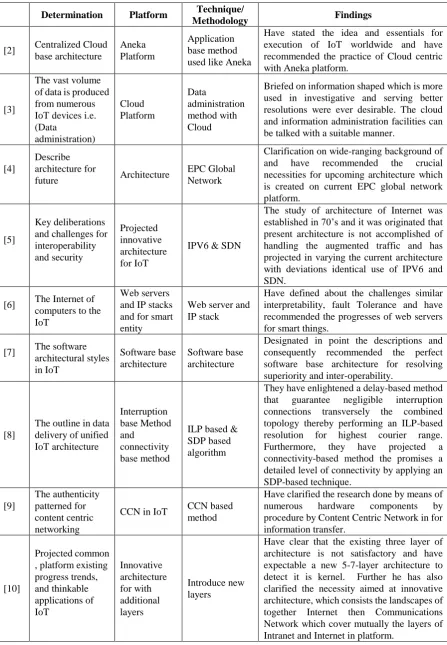
There are a lot of architectures which helps in explaining the information distribution in IoT and literature of extensive rage is accessible for IoT. The table I helps for checking and reviewing of research area with various architecture and related technique used in regard to data delivery in IoT.
Data Delivery in Internet of Things using
Hot-Data and Cold-Data
Table -I Techniques for Data Delivery on Internet of Things
Determination Platform Technique/
Methodology Findings
[2] Centralized Cloud base architecture
Aneka Platform
Application base method used like Aneka
Have stated the idea and essentials for execution of IoT worldwide and have recommended the practice of Cloud centric with Aneka platform.
[3]
The vast volume of data is produced from numerous IoT devices i.e. (Data
administration)
Cloud Platform
Data
administration method with Cloud
Briefed on information shaped which is more used in investigative and serving better resolutions were ever desirable. The cloud and information administration facilities can be talked with a suitable manner.
[4]
Describe architecture for
future Architecture
EPC Global Network
Clarification on wide-ranging background of and have recommended the crucial necessities for upcoming architecture which is created on current EPC global network platform.
[5]
Key deliberations and challenges for interoperability and security
Projected innovative architecture for IoT
IPV6 & SDN
The study of architecture of Internet was established in 70’s and it was originated that present architecture is not accomplished of handling the augmented traffic and has projected in varying the current architecture with deviations identical use of IPV6 and SDN.
[6] The Internet of computers to the IoT
Web servers and IP stacks and for smart entity
Web server and IP stack
Have defined about the challenges similar interpretability, fault Tolerance and have recommended the progresses of web servers for smart things.
[7] The software architectural styles in IoT
Software base architecture
Software base architecture
Designated in point the descriptions and consequently recommended the perfect software base architecture for resolving superiority and inter-operability.
[8]
The outline in data delivery of unified IoT architecture
Interruption base Method and
connectivity base method
ILP based & SDP based algorithm
They have enlightened a delay-based method that guarantee negligible interruption connections transversely the combined topology thereby performing an ILP-based resolution for highest courier range. Furthermore, they have projected a connectivity-based method the promises a detailed level of connectivity by applying an SDP-based technique.
[9]
The authenticity patterned for content centric networking
CCN in IoT CCN based method
Have clarified the research done by means of numerous hardware components by procedure by Content Centric Network in for information transfer.
[10]
Projected common , platform existing progress trends, and thinkable applications of IoT
Innovative architecture for with additional layers
Introduce new layers
[11] The review on MQTT: a procedure of IoT
MQTT
protocol MQTT protocol
Have classified that numerous push protocols are accessible i.e. MQTT and AMQP in which MQTT is maximum broadly utilized. The important typical of MQTT is light weight and bandwidth productivity.
[12]
IOT data management: design primitives and key
Data managing framework covers of six layers
Layered base architecture
Have reflected some data administration keys which are projected for the IoT, directing on the essential component plan which shall be talked in order to deliver a whole resolution. The primary strategy stating the three core purposes in offering data, in what way can it be composed, how can it be deposited and how it can be handled.
[13]
The Hourglass: structure for linking instrument networks and application
Information gathering network
Hourglass technique
Hourglass strategy infrastructure address a lot of contests to overcome for allowing the extensive arrangement of sensor network submissions. It is planned as an architecture and exam bed that preserve real long-lived reasonable flow of information between the manufacturers and the clients during unbalanced connectivity and incredible difference in contributor abilities.
[14]
A NiagaraCQ: a accessible nonstop query system for Internet databases
NiagaraCQ (Incremental grouping)
Query system Niagara CQ
Have established & clarified about an Internet-scale nonstop request system by means of using group optimization solving that numerous nonstop quires on Internet will have around likenesses. Have planned an original “incremental grouping” way that types cluster more improvement and accessible.
[15] Data on centric networking
Information centric networking method
Information centric network
Have emphasized the importance of ICN based on resolutions to attraction from the present characteristic central service, by plotting the titles data to thing or the data produced by it.
[16]
The ultimate architectural reference model for v3.0
Reference of architecture for and procedures
Offer guideline for standard architecture
Have expressed the situation architecture for and devoted procedures near architecture as per business usual.
[17] Comparative investigation of architectures
Design principal for perfect architecture
Proposed principals for IoT
Have anticipated some deviations in current architecture rather than making an original architecture for a perfect platform from the limitations of additional architectures which report procedure matters connected to IoT.
[18]
IOT Definition &
architecture
Introduction on detail and standard description of IoT
After studying the different architecture, have detected that here is no typical description worldwide and knowledges are changing form seller to seller which is interpretable.
[19] IOT: Wireless Sensor Networks
Have mention the changes for
standardize WSN architecture
Wireless Sensor Network
Have clarified the utilization and progress of WSNs in wider context and have verified
recommendation for executing
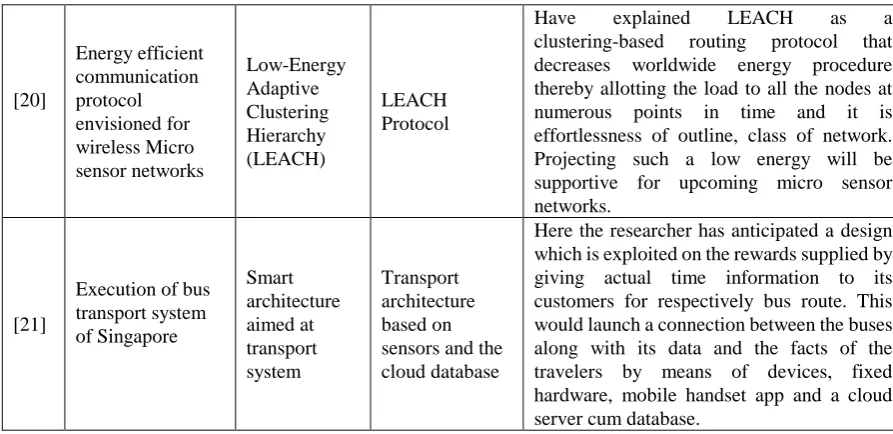
[20]
Energy efficient communication protocol envisioned for wireless Micro sensor networks
Low-Energy Adaptive Clustering Hierarchy (LEACH)
LEACH Protocol
Have explained LEACH as a
clustering-based routing protocol that decreases worldwide energy procedure thereby allotting the load to all the nodes at numerous points in time and it is effortlessness of outline, class of network. Projecting such a low energy will be supportive for upcoming micro sensor networks.
[21]
Execution of bus transport system of Singapore
Smart architecture aimed at transport system
Transport architecture based on sensors and the cloud database
Here the researcher has anticipated a design which is exploited on the rewards supplied by giving actual time information to its customers for respectively bus route. This would launch a connection between the buses along with its data and the facts of the travelers by means of devices, fixed hardware, mobile handset app and a cloud server cum database.
3. DATA DELIVERY FOR TECHNIQUE AND ARCHITECTURE & RESULTS
It is discouraging to choose an accurate database platform(s) for IoT solution. IoT solution are also circulated across the geographical regions. Opposite to unified cloud-based solutions there are a lot of solutions that accept a mixture of fog which compute at the edge and cloud computing. In the same way database platforms should also offer the elasticity to procedure the data at the network and further it should match with the servers and cloud. Depending on IoT applied situations, database facility require range from filtering and aggregation of data, read operations near-zero latency, real-time data streaming, high availability, instant analytics, geo distribution, and schema flexibility. There are
four steps to opt the right data base platforms for IoT which is explained here:
Step 1. Data categorize in support of require solution The IoT based solutions are mainly dependent on processing and gathering of data which are connected to the devices, which created intelligent decision i.e. activate notification, actions, real-time analytics calculation, gathering designs from historic data. In general, IoT solutions can have devices, actuators which are fitted across the organization. Many devices and actuators are connected to edge server. IoT resolution gather information gather data from these devices on regularly and thereby take immediate decision on controlling devices and actuators, alerts system monitors at the time of any uncommon action occurs and thereby offers a detailed past opinion of analytics to its end
[image:4.595.71.518.60.277.2]users as describe in figure 1.
Figure 1. Setting the phase for illustration IoT solution. Determining the available databases and services which go
along with them, it is important to have the clarity on data use and where it is used. Some examples are state below which helps in prioritizing and understanding the data needs: (1) What decision making and processing are provided for edge
Step 2. Independent application services for breakdown solution
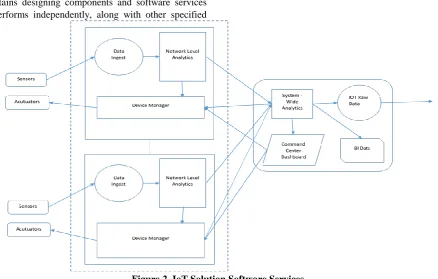
The data which is collected frequently by unified things are more analysed and useful in initiating movements which are used for administration, result making and planning [22]. The step contains designing components and software services which performs independently, along with other specified
[image:5.595.83.522.122.401.2]tasks. As discussed before by breaking down solution of IoT sample, we have the design as show in figure 2. Solution of IoT itself is circulated geographically, in which around components is connected to the edge network and outstanding components are kept at the central place.
Figure 2. IoT Solution Software Services.
Architecture braked into services, evaluating their tasks and the date requirements:
Information Ingest- resolution is to gather, stock the messages and logs from devices Database Requirements: very high speed write procedures are supported due to arrival of data in bursts and confirmation on the data captured and no lost of the same in any unusual circumstances.
Edge Analytics- resolution is data arrangement, combination, translation, filtering, and purposes for all inward data. It is used for result creating at edge. Database Requirements: it supports high speed writes and read with sub-millisecond latency and deliver with the guidelines and tools to complete all composite logical additions for data.
Device Manager- resolution is to link all the communications to the devices. Database Requirements: messages entree and allocate to the devices with low latency.
Wide System Analytics- determination is to gather information from edge servers and initiate analytics and change operations. Database Requirements: send instructions to do calculation, which is logical on data, store them for long as essential by analytic machine.
C&C Dashboard- determination of delivering detailed visual image of current IoT ecosystem. Database Requirements: keeps information accurate and up to date, deliver them with sub millisecond latency.
Business Intelligence- Read historical data, track queries,
run reports. Database requirement: store data for longer period, very cost effective, analyse and provide tools to query.
IoT Data Stream Outlet- Regularize the data in common setup and thrust them to subscribers. Database Requirements: Do procedures in a skilled manner related to data transformation, helps in subscribing and publishing capabilities.
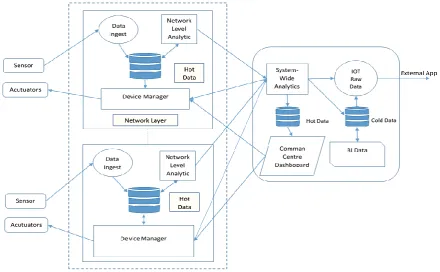
Step 3: Identification of services and selection of the right database
Figure 3. Databases with Software services In figure 3, services are grouped in two main databases that
are Hot-data and Cold-data database. The database with hot-data is unite to the IoT hardware to reduce latency of network. Hot-data are frequently accessed, like the business-critical information is frequently accessed because it is regularly used by the company for its quick decision making. In the same way, Cod-data storage mention to the inactive data that are accessed rarely. Thus, it is retained for a long term basis or for ever for business and compliance purposed of the business. For Hot-data, selection of memory database is more affordable. Memory database deliver data with least latency for read and write skills. But while making a choice for hot-data the following additional capabilities and features help for selection: the flexibility with data formats - support and provide help to an extensive choice of devices and communication arrangements. Querying abilities - helps in tracking efficient quires immediately. Messaging and queuing - initiate all data exchange and communication. Tiered memory model - make available a very cost effective memory model and high presentation. Very High accessibility and the disaster recovery - help to be in business all time. Geo-distribution - helps in geo distributed IoT arrangement. Binary safe- support in storing of binary data.
Cold database: IoT solution intended historical data produce too many terabytes and surpass to petabyte in some cases. Shared selections with store past data also contain storage solutions on the commodity hardware. In some cases, queries also follow map-reduce pattern. These old data are also indexed search engine for data aggregation and for pattern similar. And for data stored in the cloud, to pattern with the cloud provider for the lowest cost-effective data storage in the province.
Step 4: Evaluation of charge and resource efficiency
hot-data. Similarly, in the case of cold-data, there is a variety of options from relational databases to data leaks. The designer makes a mistake of generating a polyglot architecture by a specific database for every service and thus leads to the trouble of request stack and increase the working overhead and cost. The cost owing a database is a job of many constraints. The cost of database itself is small percentage of the cost.
Some examples of the costs are below:
Cost for license - here the cost included the function of number of CPUS, size of database, cluster share numbers, throughput (maximum operations per second) time (hourly, monthly, annually etc.), multiple regions obtainability on the cloud, high availability and recovery features etc. The database that is available as an open source software depends as type of authorization where the database cost may even be Nil.
Infrastructure cost - this cost is subject to the proficiency of the database. For example, thread - safe database and lightweight database require very less servers, but in the case of traditional database it requires more servers to provide the similar result. With the database efficiency, the cost of the hardware in the main purpose of throughput amount of RAM, CPUs, data size, network cards etc. Database with high availability also plays an important part, for example architecture created on non-quorum wants two copies of data to evade.
Cost for functioning Overhead- Automation is a refrain of achievement. The database controlling the automate operations such as scaling, deployment, failover, provisioning, data dividing, monitoring and alerts, backup, recovery, and many other things which function professionally.
CONCLUSION
Most frequently access data for administration mentions to the information accessed repeatedly on the fast storage, hence hot-data is infrequently retrieved information and is kept on the leisureliest storage. However an organization has a cold-data, during the time of developing this type of solutions a traditional of key performance indicators for taking data. Further to this it also helps in both working and taking important business results connecting data. When matter is to decide to pick the correct database for next generation IoT solution, there is a risk of loss of plethora of databases which is available at present. When IoT solution is broken into component service we understand the needs for database and can narrow down the choices for the database. IoT solutions are mostly depended on hot-data for actual data gathering, dealing out, analytics, messaging and cold database to supply old data and gather business intelligence and thus variety architecture very modest, lean and strong.
REFERENCES:
1.Payam Barnaghi, Wei Wang, Cory Henson, Kerry Taylor, "Semantics for the IoT : Early progress and Back to the Future", International Journal on Semantic Web & Information Systems, Volume 8, Issue 1, pp. 1-21, (January 2012).
2.Jayavardhana Gubbi, Rajkumar Buyya, Slaven Marusic, Marimuthu Palaniswami, “IoT: A vision, architectural elements, and future directions”, Journal Future Generation Computer Systems, Volume 29, Issue 7, pp. 1645-1660, (September, 2013).
3.Michael Endler, "Microsoft azure intelligent systems: 4 facts," InformationWeek magazine [Apr. 25, 2014].
4.Dieter Uckelmann, Mark Harrison, Florian Michahelles, “An architectural approach towards the future IoT”, Architecting the Internet of Things, pp 1-24, (2011). DOI 10.1007/978-3-642-19157-2-1.
5.Liang Zhou, Han-Chieh Chao, "Multimedia traffic security architecture for the IoT”, IEEE Network, vol.25, no.3, pp.35-40, (May-June 2011).
6.Friedemann Mattern, Christian Floerkemeier, “From the Internet of computers to the IoT", n Lecture Notes in Computer Science, Vol 6462, Springer, Berlin, Heidelberg.
7.Evertson Croes, "Software architectural styles in the IoT", Radboud University Nijmegen Master Thesis, (2015). 8.Ashraf E. Al-Fagih, "A framework for data delivery in
Integrated Ioo architecture", Submitted at Queen’s University Kingston, Ontario, Canada (April, 2013). 9.Bell Labs, Alcatel-Lucent, Villarceaux, "A reality check for
content centric networking”, Proceedings of the ACM SIGCOMM workshop on information-centric networking, pp. 44-49. Toronto, Ontario, Canada. (2015). 10.Pallavi Sethi, Smruti Sarangi, "Architectures, protocols, and applications", Journal of Electrical and Computer Engineering, Volume 2017, (2017).
11.Dipa Soni, Ashwin Makwana, "MQTT: a protocol of IoT", International Conference on Telecommunication, Power
Analysis and Computing Techniques ICTPACT, (2017). 12.Mervat Abu-Elkheir, Mohammad Hayajneh, Najah Abu Ali,
"Data management for the IoT: design primitives and solution", MDPI Sensors, Vol. 13, Issue 11, pp. 15582-15612, (2013). DOI:10.3390/s131115582 13.Jeff Shneidman Peter Pietzuch, Jonathan Ledlie, Mema
Roussopoulos, "Hourglass An Infra structure connecting sensor network and application", Computer Science Group, Harvard University, Cambridge, Massachuserrs. (2004).
14.Jianjun Chen David J. DeWitt Feng, Tian Yuan Wang, "NiagaraCQ: a scalable continuous query system for Internet databases", Proceedings of the ACM SIGMOD, International conference on Management of data, pp. 379-390, (2000).
15.Marica Amadeo, Claudia Campolo, Jose Quevedo, Daniel Corujo, Antonella Molinaro, Antonio Iera, Rui L. Aguiar, Athanasios V. Vasilakos, "Information centric networking for the IoT: challenges and opportunities", IEEE Network, Volume 30, Issue 2, pp. 92-100, (April 2016).
16.Elisha Colmenar, Fadi Al-Turjman, Mohammad Biglarbegian, "Data delivery and gathering in applications: an overview", 13th Annual IEEE Workshop on Wireless Local Networks, WLN Edmonton, Canada, pp. 806-811. (2014).
17.Martin BauerMathieu BoussardMathieu BoussardNicola BuiNicola Bui at el., “Internet of Things – architecture IoT-A deliverable D1.5 – final architectural reference model for the IoT v3.0”, Project on Internet of Things - Architecture (IoT-A), Report number: D1.5, (2013). 18.Ravi Teja Guthikonda, Sai Srikar Chitta, Shraddha Tekawade,
Tripti Attavar, "Comparative analysis of architectures", in TLEN 5710 Capstone (April 25, 2014).
19.Shu Yinbiao, "IoT wireless sensor networks", White paper in International Electrotechnical Commission, ISBN 978-2-8322-1834-1.
20.Wendi Rabiner Heinzelman, Anantha Chandrakasan, Hari Balakrishnan, "Energy-Efficient communication protocol for wireless microsensor networks", Proceedings of the 33rd Hawaii International Conference on System Sciences, IEEE Computer Society Washington Vol. 8, Page 8020, (2000).
21.Menon, R. Sinha, D. Ediga, Subba Iyer Menon, "Implementation of IoT in bus transport system”, Asian Journal of Engineering Research, (Dec 2013).
22.Parth Brahmbhatt, Rajan Patel, “Data delivery on Internet of things: a survey on different technique and architecture”, Second International Conference on Computing Methodologies and Communication (ICCMC), (Feb -2018).
AUTHOR PROFILE
Mr. Parth Brahmbhatt: Parth
and in 2016 became a Manager (ICT). His primary responsibility is taking care of the City Command and Control Center. His current research interests include the Internet of Things (IoT) with a different kind of IoT architecture and IoT data storage system. Mr. Parth Brahmbhatt is a Fellow of the Gujarat Forensic Science University, member of Computer Society of India and working as a volunteer to Suraksha Setu Society – a unit of CID Crime.
Dr. Rajan Patel: Dr. Rajan Patel is an Associate Professor in Computer Engineering, Department of Gandhinagar Institute of Technology, Gandhinagar. He has worked as
faculty (Associate Professor, Assistant
Professor, Sr. Lecturer and Lecturer) in
Computer Engineering Department of
Sankalchand Patel College of Engineering (Faculty of Engineering and Technology), Sankalchand Patel University, Visnagar. He has 15 years of teaching experience in the field of Computer Science and Engineering and also associated with the IT industry. Dr. Patel has more than 14 professional memberships. He completed his B.E. (Computer Engineering) from Saurashtra University and M. Tech (Computer Engineering) from NIT, Surat. He did his Ph.D. (Computer Engineering) from RK University. Dr. Patel published and presented research and survey articles in International/National level of indexing Conferences and Journals including IEEE, Science Direct, Springer, Elsevier. Dr. Patel received more than 11 Award/Honored/Excellence/Appreciation from academic bodies such as Certificate of Excellence as a coordinator for conduction of sponsored ICT (MHRD) two-week ISTE workshop from IIT, Bombay in 2014, Appreciation from the Dewang Mehta Innovation IT award in 2015, Honored in the Technical Communication workshop from IIT-Bombay in 2015, Paper Presenter Award at International Conference by CSI in 2017. Dr. Patel coordinated and organized many STTPs/Seminars/Talks and also
having the participation of more than 39
Conferences/STTPs/Seminar/Workshop. Dr. Patel is acted as a Reviewer/TPC member of IEEE, Springer and other International/National conferences and IET Network Journal. Dr. Patel also worked for ISEAP