International Journal of Innovative Technology and Exploring Engineering (IJITEE) ISSN: 2278-3075, Volume-8 Issue-11, September 2019
Architectural Framework for Cloud Reliability
Model using Fault Tolerance Techniques
Mridula Dhingra, Neha Gupta
Abstract: Cloud Computing is an essential podium for workable and impracticable users. It achieves high quality reliable services provided to the users via data storage servers. The key challenge in cloud architecture is to run the facilities without any hazel to the users. In today’s world of information technology, most of the applications are real time. The major constraint of the systems used in real time applications is that, they are prone to failure. The failure may be due to the following reasons:
a) Failure to complete the task in prescribed time threshold value.
b) Failure to achieve prescribed reliability value.
Virtualization and Internet-based Cloud computing causes diverse types of failures to occur and so necessity for reliability and availability have turn out to be of vital concern. To ensure reliability and availability of cloud technologies, methods for fault tolerance need to be developed and deployed. The proposed work will focus on adaptive behavior during the assortment of replication and fine-grained check pointing methods for achieving a reliable cloud platform that can grip diverse client requests. In addition to this, the proposed work will also conclude the best suitable fault tolerance scheme to each chosen virtual machine.
Key words: Cloud Computing, Virtualization, Fault Tolerance, Reliability, Replication, Fine grained check pointing, Reliability Assessment, Decision Mechanism.
I. INTRODUCTION
Cloud computing is a promising area that provides computing and storage space to the end-users as a service. Cloud computing is well-known for its contribution in numerous areas like research, business, health, e-commerce etc. As the demand of cloud computing is rising day by day, the cloud vendors should provide various services to users to meet up their desired eminence needs. The advantages of cloud architecture are reduction in cost, services on demand, guaranteed quality of service etc. The major issue is to deal with reliability against services to the users and the clients in cloud architecture. Reliability can be defined as a particular job is completed within a specific point of time without failure. Reliability has the proficiency of a computer-related hardware or software elements to persistently accomplish the task coherent to its description. The factors of reliability are throughput, response time, availability, serviceability. Throughput is the amount of data passing through a system or process in a specific time. Completion time of a particular process is known as response time. To enhance the reliability, throughput ought to be high and response time must be less. Availability
able to accomplish the task as it is intended, then the whole structure turn out to be less reliable or there can be the incidence of breakdown. As the computation in cloud is implemented on remote systems, so the possibility of failures become high and the fault tolerance abilities are essential to overcome the system’s faults to execute the task correctly as the failure arise.
A. Fault Tolerance Methodology
Like every technology, cloud computing undergoes from some severe issues like fault tolerance of real time systems. The main factors which can cause the failure in real time environment are implementation, recurrent modifications, up gradations, maintenance and exhaustive workload. The reliability of systems will be decreased if the realistic actions are not considered while handling the probable failures in cloud systems. Real time systems are scrutinized on the basis of timeliness and fault tolerance factors. Timeliness is the capability of a real time system to complete the proposed assignment within a specific time and fault tolerance is the ability of the system to work elegantly in the occurrence of fault. Now a days as the requirement of cloud computing is growing day by day, real time systems can be carried out on cloud environment. In most of the real time cloud applications, execution is done on remote cloud computing nodes. So the probability of errors become high because of undecided latency of computing node but on the contrary most of real time systems are safe and extremely reliable and to conquer the reliability of real time systems in cloud computing, there is huge demand of fault tolerance amongst users. To attain reliability the cloud computing, vendors implements a variety of fault tolerance methods to run the system in case of faulty conditions.
B. Need of Fault Tolerance Methodology
• Fault tolerance provides the method or module to do the task effortlessly even though in the incidence of malfunction.
• Fault tolerance assures quality of service for users by definite recital.
• User can rearrange and append software instructions in accordance with their needs.
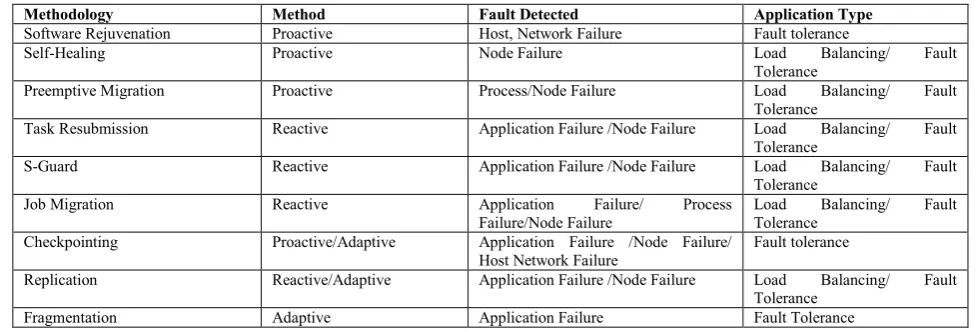
Proactive Fault Tolerance Method:-In this method, fault is predicted in advance and it proactively swaps the suspected apparatus and senses the troubles before it actually occurs. Different methodologies of proactive fault tolerance are: software rejuvenation, self-healing, preemptive migration etc. Reactive Fault Tolerance Method:-In this method faults are handled when the failure occurs. Various methodologies are used in reactive fault tolerance are task resubmission, s-guard, job migration etc.
[image:2.595.71.561.175.341.2]Adaptive Fault Tolerance Method:- One of the fault tolerance methods is adaptive fault tolerance method in which system is monitored at each and every state and reconfigured in order to attain the reliability. In Adaptive Fault Tolerance Method, all events are completed repeatedly, according to the condition and it guarantees the reliability of significant elements. Methodologies which are used in adaptive fault tolerance method are checkpointing, replication, fragmentation etc.
Table I: Comparative analysis between different Fault Tolerance Methodologies (Dhingra& Gupta 2017)
Methodology Method Fault Detected Application Type
Software Rejuvenation Proactive Host, Network Failure Fault tolerance
Self-Healing Proactive Node Failure Load Balancing/ Fault
Tolerance
Preemptive Migration Proactive Process/Node Failure Load Balancing/ Fault
Tolerance
Task Resubmission Reactive Application Failure /Node Failure Load Balancing/ Fault
Tolerance
S-Guard Reactive Application Failure /Node Failure Load Balancing/ Fault
Tolerance
Job Migration Reactive Application Failure/ Process
Failure/Node Failure
Load Balancing/ Fault
Tolerance
Checkpointing Proactive/Adaptive Application Failure /Node Failure/
Host Network Failure
Fault tolerance
Replication Reactive/Adaptive Application Failure /Node Failure Load Balancing/ Fault
Tolerance
Fragmentation Adaptive Application Failure Fault Tolerance
II. RELATED WORK
In cloud computing a lot of work has already been carried out by researchers in real time systems, but still there is a lot of scope to work on it. Sometimes it is difficult to identify the latency of nodes as users do have not the exact idea about the location of processing nodes and because of the dynamic nature of virtual machines, any node can be added or removed at any point. Most of the real time systems needs fault tolerance mechanism. Malik & Rehman (2005) have proposed a model “Time stamped fault tolerance of distributed RTS”. In this model, the concept of time stamping with output of real time applications has been introduced but the reliability of virtual nodes using fault tolerance has not discussed so far.A model “Adaptive Fault Tolerance in Real Time Cloud Computing” has been proposed by (Sheheryar & Fabrice 2011). In AFT RC, if any of the node gets failed and does not provide the correct results, the complete model is not producing results.
“Fault Tolerance Model for Cloud Computing” has been
discussed by (Meshram, Sambare & Zade 2013) in this model a virtual machine is selected for execution on the basis of reliability and that node can be detached if it thatInternational Journal of Innovative Technology and Exploring Engineering (IJITEE) ISSN: 2278-3075, Volume-8 Issue-11, September 2019
Table II. Existing Fault Tolerance Models with their procedure and limitations (Dhingra & Gupta 2017)
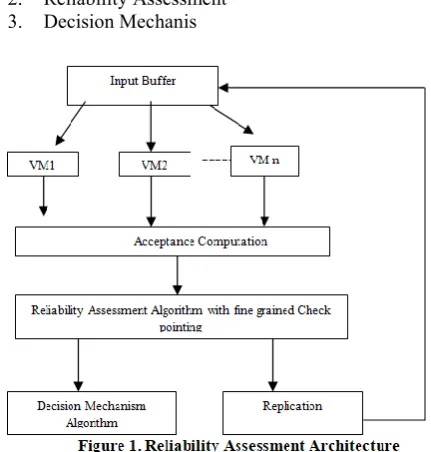
III. PROPOSED RELIABILITY FRAMEWORK The proposed model will consist of N virtual nodes. Each node will take the input data from the input buffer and then the input will be given to the each virtual machine. Every time the input will be taken by the node, it will perform the operation and provide the result. All the results will be passed to further modules for reliability calculation and decision making. The proposed reliability framework will primarily divided into three modules, these are:
1. Acceptance Computation 2. Reliability Assessment 3. Decision Mechanis
responsible for the verification of output generated by each virtual machine. Verification of output symbolizes the correctness of results. If the results are correct then AC module will further calculate and verify the threshold time required to complete the task assigned to virtual machine. If the results are found incorrect then backward recovery will be performed through replication technique. If the results will exceeds the minimum threshold time then the node will be considered faulty and backward recovery will be performed through fine-grained checkpointing, otherwise the results will passed to reliability assessment module to measure the reliability of virtual machines and further to decision mechanism module. Reliability Assessment (RA):- The reliability is a continuous measure and changes its value after every computation cycle. By default, initial value of reliability of each virtual node is 100 %. In this module reliability assessment algorithm (proposed) will be used to measure the reliability of virtual machines. After computation, if a virtual machine provides the correct results, i.e. the reliability value of virtual machine exists between minimum reliability and maximum reliability then output will be forwarded to decision making module. However, if the reliability value of virtual machine will be less than the minimum reliability then the backward recovery will be performed by the system through fine- grained check pointing. Decision Mechanism (DM):- This module will choose the concluding output for a computing
Model Name Procedure for Fault Tolerance Limitations
Fault Tolerance Management (FTM) Jhawar & Piuri (2012)
This model depends upon
virtualization method to examine fault tolerance that clearly enhances the reliability , availability of systems employed in cloud architecture, Jhawar & Piuri (2012)
In this approach, detailed analysis of fault tolerance services is not mentioned.
Low Latency Fault Tolerance (LLFT) Zhao, Smith & Moser (2010)
In this approach, distributed
applications for fault tolerance are discussed which have set up inside a cloud architecture. It creates the replica of nodes by using a variety of replication procedures to protect the applications from various faults. Zhao, Smith & Moser (2010)
This approach is expensive in terms of cost for maintaining replicas of virtual machines.
Fault Tolerance Model for Cloud (FTMC) Meshram, Sambare & Zade (2013)
It measures the reliability of
computing nodes and the node with the highest reliability is selected Meshram, Sambare & Zade (2013)
Additional variables should have been used for result assessment to improve the reliability.
Dynamic Adaptive Fault
Tolerance (DAFT) Sun, Chang, Gao, Jin & Wang (2012)
In this approach check pointing and
replication techniques are
implemented to enhance the services of cloud nodes, Sun, Chang, Gao, Jin & Wang (2012)
Backward recovery is not discussed much in this model.
Adaptive fault tolerance model in
real time cloud computing
(AFTRC) Sheheryar & Fabrice (2011).
Backward recovery is focused through check pointing to increase the reliability of nodes. Sheheryar & Fabrice (2011).
In DM module, system reliability level (SRL) will be predefined by the system. SRL will be the minimum reliability level to be accomplished to pass the result. In this module decision mechanism algorithm (proposed) will be used to evaluate the best reliable node with the SRL and the best reliability must be greater than or equal to the SRL. If
International Journal of Innovative Technology and Exploring Engineering (IJITEE) ISSN: 2278-3075, Volume-8 Issue-11, September 2019
IV. IMPLEMENTATION
In the proposed framework Cloudsim will be used to perform the results. CloudSim offers a generalised simulation framework that allows faultless model and replication of application execution. CloudSim is a simulation tool that permits developers to check the performance of their guidelines in a convenient situation and it is free of cost. It is a toolkit for cloud environments which evaluates resource provisioning algorithms. The classes of the package permit the development of algorithms based on fault tolerance which in turn can supervise virtual nodes towards the identification of failures and then later resolves them. In the proposed framework to measure the results through CloudSim, netbeans will be used and script will be written in Java programming language. This provision will deploy acceptance computation, reliability assessment, decision mechanism. This package will also apply fine-grained checkpointing and replication mechanism (Damodhar & Poojitha 2017). This simulator offers the capability to calculate availability, throughput, time overhead and monetary cost overhead.
V. CONCLUSION
As we know that failures are inevitable in the cloud environment. To solve this problem, in this paper an adaptive fault tolerance method is proposed to provide reliability of cloud nodes. Backward recovery technique will also be implemented to make the system fault tolerant and the calculated reliability value of virtual nodes will help in replacing the failure nodes making the cloud platform more reliable and will also enhance the performance of cloud nodes. The adaptive nature of the proposed method specifies that the cloud’s performance will be appreciably enhanced.
REFERENCES
1. M. Dhingra and N. Gupta, “Comparative analysis of fault tolerance
models and their challenges in cloud computing”, in International Journal of Engineering and Technology , vol 6(2), 2017, pp.36–40.
2. M. Damodhar and S. Poojitha, “An Adaptive Fault Reduction Scheme
to Provide Reliable Cloud Computing Environment”, in IOSR Journal of Computer Engineering (IOSR-JCE), vol. 19(4), 2017, pp.64-73.
3. 3. I. Goiri, F. Julia, J. Guitart and Torres, “Checkpoint-based Fault –
tolerant Infrastructure for Virtulized serviceProvider”, in IEEE/IFIP
Network Operations and Management Symposium, April 2010, pp.
455-462.
4. A. Meshram, A.S. Sambare and S.D. Zade, “Fault Tolerance Model for
Reliable Cloud Computing”, in International Journal on Recent and Innovation Trends in Computing and Communication,vol. 1(7), 2013,pp.600-603.
5. A.K. Rai, P. Kumar and P. Manisekaran, “High Adaptive Fault
Tolerance in Real Time Cloud Computing”, in IOSR Journal of Engineering (IOSRJEN),2013,vol. 4(3), pp. 24-27.
6. M. Sheheryar and H. Fabrice, “Adaptive Fault Tolerance in Real Time
Cloud Computing”, in IEEE World Congress on Services, November 10, 2011, pp. 280-287.
10. W. Zhao, P. M. Melliar-Smith and L.E. Moser, “Fault tolerance middleware for cloud computing”, in Cloud Computing 40 International Journal of Engineering & Technology
(CLOUD), 2010 IEEE 3rd International Conference, July 2010, pp. 6774.
11. S. Malik, M.J. Rehman, “Time Stamped Fault Tolerance in Distributed Real Time Systems”, in IEEE International Multitopic Conference, Karachi, Pakistan, 2005.
12. J. Cao, M. Simonin, G. Cooperman and C. Morin, “Checkpointing as a service in heterogeneous cloud environments”, in Proc. 15th IEEE/ACM Int. Symp. Cluster, Cloud Grid Comput., Shenzhen, China, May 2015, pp. 61–70.
13. K. Ganga and S. Karthik, “A fault tolerent approach in scientific workflow systems based on cloud computing”, in Proc. Int. Conf. Pattern Recognit., Informat. Mobile Eng. (PRIME), Febuary 2013, pp. 378–390.
14. P. Das, and P.M. Khilar, , “VFT: A virtualization and fault tolerance approach for cloud computing”, in Proc. IEEE Conf. Inf. Commun. Tech- nol. (ICT), April 2013, pp. 473–478.
15. D.W. Sun, G.R. Chang, S. Gao, L.Z. Jin andX.W. Wang, “Modeling a dynamic data replication strategy to increase system availability in cloud computing environments”,in Journal of computer science and technology, vol. 27(2),2012, pp. 256-272.
AUTHORS PROFILE
Mridula Dhingra is a Research Scholar at Faculty of Computer Applications at Manav Rachna International Institute of Research and Studies, Faridabad campus. She has completed her Masters in Computer Applications from Maharishi Dayanand University, Rohtak. She has total of 12+ year of experience in teaching and research. She has authored and coauthored 4 research papers in various National and International Journals.