Baillie, M. and Azzopardi, L. and Crestani, F. (2006) Towards better
measures: evaluation of estimated resource description quality for
distributed IR. In: First International Conference on Scalable Information
Systems, 2006-05-30 - 2006-06-01. ,
This version is available at
https://strathprints.strath.ac.uk/2753/
Strathprints is designed to allow users to access the research output of the University of Strathclyde. Unless otherwise explicitly stated on the manuscript, Copyright © and Moral Rights for the papers on this site are retained by the individual authors and/or other copyright owners. Please check the manuscript for details of any other licences that may have been applied. You may not engage in further distribution of the material for any profitmaking activities or any commercial gain. You may freely distribute both the url (https://strathprints.strath.ac.uk/) and the content of this paper for research or private study, educational, or not-for-profit purposes without prior permission or charge.
Any correspondence concerning this service should be sent to the Strathprints administrator: [email protected]
The Strathprints institutional repository (https://strathprints.strath.ac.uk) is a digital archive of University of Strathclyde research outputs. It has been developed to disseminate open access research outputs, expose data about those outputs, and enable the
Baillie, M. and Azzopardi, L. and Crestani, F. (2006) Towards better measures:
evaluation of estimated resource description quality for distributed IR. In:
First International Conference on Scalable Information Systems
(INFOSCALE 2006), Hong Kong.
http://eprints.cdlr.strath.ac.uk/2
753
/
Strathprints is designed to allow users to access the research
output of the University of Strathclyde. Copyright © and Moral
Rights for the papers on this site are retained by the individual
authors and/or other copyright owners. Users may download
and/or print one copy of any article(s) in Strathprints to facilitate
their private study or for non-commercial research. You may not
engage in further distribution of the material or use it for any
profitmaking activities or any commercial gain. You may freely
distribute the url (
http://eprints.cdlr.strath.ac.uk
) of the Strathprints
website.
Towards Better Measures: Evaluation of Estimated Resource Description
Quality For Distributed IR
Mark Baillie
Leif Azzopardi
Fabio Crestani
Computer and Information Science Department
University of Strathclyde
Glasgow, United Kingdom
{
mb, leif, fabioc
}
@cis.strath.ac.uk
Abstract
An open problem for Distributed Information Retrieval systems (DIR) is how to represent large document reposi-tories, also known as resources, both accurately and effi-ciently. Obtaining resource description estimates is an im-portant phase in DIR, especially in non-cooperative envi-ronments. Measuring the quality of an estimated resource description is a contentious issue as current measures do not provide an adequate indication of quality. In this pa-per, we provide an overview of these currently applied measures of resource description quality, before propos-ing the Kullback-Leibler (KL) divergence as an alternative. Through experimentation we illustrate the shortcomings of these past measures, whilst providing evidence that KL is a more appropriate measure of quality. When applying KL to compare different QBS algorithms, our experiments provide strong evidence in favour of a previously unsupported hy-pothesis originally posited in the initial Query-Based Sam-pling work.
1
Introduction
The acquisition and representation of an information re-source still remains an unresolved issue particulary when applied to an uncooperative distributed retrieval environ-ment (e.g. the hidden-web [5] or digital libraries [11]). When cooperation with an information resource provider cannot be guaranteed, it is necessary to obtain an unbias and accurate description of the underlying content, with re-spect to a number of constraints including costs (computa-tion and monetary), considera(computa-tion of intellectual property, handling legacy and non-cooperative systems and different indexing choices of the resource provider [2]. The accepted solution for resource acquisition is Query-Based Sampling (QBS) [3] and subsequent related methods [5, 7, 9]. During
QBS, a sample of documents is retrieved from the underly-ing resource by submittunderly-ing random queries to that resource. The queries are randomly selected to ensure that an unbi-ased resource estimate is achieved, with the varying QBS strategies differing on how the query term(s) are chosen. Sampling is terminated when it is believed that a sufficient representation of the actual resource has been obtained.
Typically, the estimated contents of a resource is rep-resented by the distribution of terms, document frequen-cies, and number of documents within the resource (the es-timated database size). The resource descriptions can then be utilised by both resource selection and data-fusion al-gorithms [2, 4, 10, 13, 15, 16]. It is therefore crucial to measure the resource description quality for a number of reasons: (1) how to determine whether a sufficiently good and unbiased resource description is obtained, (2) how to compare competing QBS algorithms, (3) how to compare competing resource descriptions, and (4) how to develop sensible termination methods based on resource description quality. The former three reasons ensure resource selec-tion accuracy, while the later ensures efficient resource es-timation. When using the currently applied measures [3, 5] to compare resource estimation techniques (and hence es-timated resource descriptions), antidotal evidence exists to suggest that the findings from current measures are ambigu-ous and contradictory [1, 3].
While it is unclear which QBS selection method actu-ally obtains a better resource representation, the accepted selection method is based on uniform query term sampling. However, in Callanet al.[3], it was originally hypothesised that selecting frequently occurring terms would be more effective at obtaining a random and unbias sample of the documents in the resource (and a better resource estimate as a consequence). It was assumed that those terms that were like stopwords would retrieve a more “random” sam-ple of documents, minimising the likelihood of the QBS al-gorithm becoming trapped sampling a particular subset of the resource. This hypothesis was not supported. The cur-rent measures instead concluded that the uniform selection method was preferable and this method has been used ex-tensively in subsequent research [3, 7, 11, 12, 13, 14].
In defence of the original hypothesis, we believe that it was not the assumption at fault but rather the measures used for evaluation. This anomaly is the underlying motivation of this work and so we reinvestigate this hypothesis. To ad-dress this issue either the two measures are required to be combined in some manner or an alternative measure em-ployed. In this paper, we argue and show that the Kullback-Leibler divergence (KL) provides a more appropriate and natural measure for ascertaining the quality of a resource, with respect to the resource selection process, and that this hypothesis holds. Hence, the remainder of this paper is a follows. Section 2 introduces the current measure as well as KL, providing a qualitative discussion concerning the strengths and weaknesses of each measure. An empirical study of the measures is then undertaken, where in Section 3 the experimental methodology applied in the paper is out-lined, and in Section 4 the results are reported. Finally, in Section 6, we conclude by summarising our findings in the context of Distributed IR, outlining future research direc-tions.
2
Measuring Resource Description Quality
The different measures that have been applied for mea-suring the resource description quality are Collection Term Frequency(CTF), Spearman Rank Correlation Coefficient (SRCC) [3], and the Kullback-Leibler(KL) divergence[5]. The merits of each measure are argued in the context of measuring resource description quality.
2.1
Collection Term Frequency
To measure the quality of a resource description, it was assumed that the number of terms contained in the estimate could be used as a yard stick[3]. To avoid bias by low fre-quency terms, the proportion of terms was instead measured using the proposed Collection Term Frequency (CTF) ratio. The CTF ratio measures the proportion of term occurrences
in the actual resource which are covered by terms in the es-timated resource description. The term coverage for a given estimated resource description (RDe) with respect to the actual resource description (RDa) is derived by consider-ing the intersection of termstand their frequencies inRDa, such that,
CT F =
P
t∈RDen(t, RDa) P
t∈RDan(t, RDa)
(1)
wheren(t, RDa)is the number of timestoccurs inRDa. It is assumed that as the CTF ratio approaches one, the quality of the resource description improves e.g. the cover-age of terms inRDetends toward the actual resourceRDa. For example, if CTF ratio for a resource description is 0.8, that would indicate that the resource description accounts for 80% of all the term occurrences in the actual collection. However, CTF would be inaccurate in indicating resource quality when a document that contains a large proportion of the vocabulary is sampled. For instance, a dictionary or glossary of terms used in the resource. A resource de-scription containing a high coverage of terms but with little knowledge of term frequency information will potentially have a negative impact on resource selection. To address this shortcoming, the Spearman Rank Correlation Coeffi-cient was also proposed to provide additional information on the quality of the resource description.
2.2
Spearman Rank Correlation
Coeffi-cient
SRCC accounts for the relative position of the term rank-ing shared between the actual and estimated resource vo-cabulary (or the intersection), by measuring the (Spearman Rank) correlation between the term rankings withinRDe andRDa[3]. SRCC is defined byρsuch that,
ρ= 1−
6 n3−n(
P
d2i +121
P
(fk3−fk) +121 P(g3m−gm))
r
(1− P
(f3 k−fk)
n3−n ) r
(1− P
(g3 m−gm)
n3−n )
(2) wheredi is the ranked difference between the terms in the intersection, where the terms are ranked with respect to their document frequency values from both the actual end esti-mated resource.nis the total number of unique terms,fkis the number of ties in thekthgroup, andgmis the number of ties in themthgroup. The number of ties are considered because within two vocabularies there are many terms that share the same document frequency value e.g. very infre-quent terms at the tail of the vocabulary distribution.
An initial drawback identified with measuring SRCC for resource description quality is that it becomes computation-ally expensive as the vocabulary in the estimate resource description increases. The other and more serious draw-back is that only the rank of the terms are compared, while the frequency information is ignored. Given the potential scenario of sampling a glossary/dictionary document con-taining most of the terms in the resource, the SRCC score will be low because we have encountered many terms but we have not enough data to accurately estimate the correct term rank. However, the corresponding CTF score will be high due to the number of new terms now contained in the estimated resource description. Overall, SRCC would ap-pear to be a better measure than CTF because if the terms are accurately ranked, then the frequency information may be inferred by using Zipf’s law.
2.3
Kullback-Leibler
The Kullback-Leibler divergence (KL) is specifically de-signed for measuring the difference between two probabil-ity distributions[6]. When applied to the problem of re-source description quality, KL measures the relative entropy between the probability of a term t occurring in the ac-tual resourceRDa(i.e. p(t|RDa)), and the probability of the termtoccurring in the resource descriptionRDe(i.e.
p(t|RDe)). KL is defined as,
KL(RDa||RDe) =
X
t∈V
p(t|RDa)log
p(t|RDa)
p(t|RDe) (3)
where,
p(t|RDa) =
n(t, RDa)
P
t∈RDan(t, RDa)
(4)
and,
p(t|RDe) =
P
d∈RDen(t, d) +α P
t(
P
d∈RDen(t, d) +α)
(5)
n(t, d)is the number of timestoccurs in a documentdand αis a small non-zero constant (Laplace smoothing). The smaller the KL divergence the more accurate the resource description is, with a zero KL score indicating two identical distributions. To account for the sparsity within theRDe, Laplace smoothing was applied to alleviate the zero proba-bility problem[16] and to ensure a fair comparison between each estimated resource description (RDe)1
While KL has been applied previously to the problem of resource description quality, it was only computed across the common intersection of terms that exist between the
1It is important to note that to compare two estimates it is required
thatK L(RDa||RDe)is computed and notK L(RDe||RDa), as the KL
divergence is not symmetric.
RDe and RDa[5]. Hence, the KL scores are not di-rectly comparable between different resource description estimates because of the mismatch in vocabularies.
With respect to the goal of acquiring an accurate de-scription of the resource for the selection process, the KL divergence is intuitively appealing. The probability distri-butions of the actual and estimated resources capture the relative (or normalised) term frequencies, which is per-tinent to many of the state of the art resource selection algorithms[4, 10, 14, 16]. Apart from avoiding the need to employ two measures, KL also fulfills the criteria set forth in [3], of (1) measuring the correspondence between the estimated and actual resource vocabulary while not overly weighting low frequency terms (CTF), and also (2) measur-ing the correspondence between the estimated and actual frequency information (SRCC). Essentially, the KL diver-gence measures this phenomena precisely, while CTF and SRCC are surrogate indicators of resource description qual-ity.
3
Experimental Methodology
The three measures were analysed using a similar exper-imental approach performed in [3]. Resource descriptions were estimated for each data collection using one of three QBS selection strategies, where the query terms were se-lected according to document frequency (df) the average term frequency (avetf), or uniformly (unif). To initialise sampling, a single query term was selected at random from an existing resource. In[3], the initial query term was se-lected from a superset of one of the resources. To avoid po-tential bias, we used a subset of the Reuters corpora when selecting the initial seed.
Four documents were retrieved with each query submit-ted, with QBS document sampling being curtailed once 500 unique documents were seen. After each query the CTF, SRCC and KL values were recorded. The entire process was repeated 10 times per QBS method, with different ran-domly drawn query terms, to obtain an estimate of the vari-ance in performvari-ance measures.
100 200 300 400 500 0.8
0.85 0.9 0.95
Number of seen documents
CTF ratio
unif sampling
[image:6.595.60.281.71.250.2]df sampling avetf sampling
Figure 1. The change in CTF as the number of documents sampled increases. Error bars in-dicate the variability across runs (shown only at various intervals). For clarity, the plot of the CTF measure only displays the results af-ter a number of documents have been added.
4
Results
The CTF ratio for each sampling method increased rapidly as more documents were sampled, eventually con-verging around 90% (see Figure 1). A sharp rise in CTF was found during the first 100 documents sampled across all QBS methods not shown in Figure 5. Both the unif
and avetf methods obtained similar resource descriptions in terms of CTF after 500 documents were sampled. In fact, both unif andavetf generated resource descriptions that recorded significantly higher CTF ratios in comparison todf.
This result would suggest theunif andavetf approaches estimated better resource description representations, how-ever, when examining the same resource descriptions using the SRCC measure, a different trend was found (see Fig-ure 2). Thedf method obtained resource descriptions with (significantly) higher SRCC, followed byunif then avetf. This result was a reverse of the CTF findings, indicating thatdfobtained resource descriptions that were more highly correlated to the actual resource when compared against the other term selection strategies.
An interesting observation when evaluating resource de-scriptions using the SRCC measure, was that as the number of documents sampled increased, many resource descrip-tion estimates displayed increased variance and fluctuadescrip-tion (in terms of SRCC). In some cases, the mean resource de-scription SRCC score deteriorated dramatically before in-creasing again. Theavetf method in particular displayed
1 100 200 300 400 500
0.5 0.55 0.6 0.65 0.7
Number of seen documents
SRCC correlation
[image:6.595.314.537.108.290.2]df sampling unif sampling avetf sampling
Figure 2. The change in SRCC as the number of documents sampled increases.
1 100 200 300 400 500
1 1.5 2 2.5 3 3.5 4
Number of seen documents
K−L Divergence
unif sampling avetf sampling df sampling
[image:6.595.318.536.420.601.2]many local minima, with a very sharp decrease in correla-tion after approximately 80 documents were sampled.
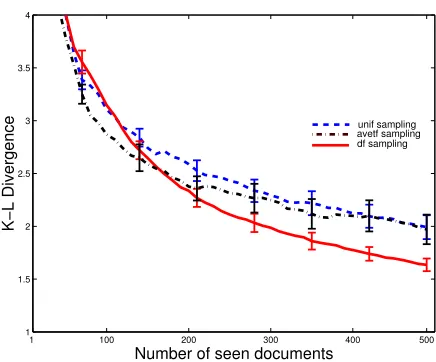
In contrast, when evaluating the same resource descrip-tions with the KL measure (Figure 3),dfgenerated resource descriptions that were significantly closer to the actual re-source, with little difference betweenunif andavetf tech-niques after 500 documents. A sharp drop in KL divergence was found for all QBS techniques during the first 100 doc-uments sampled, not shown in Figure 3. Initially,unif ob-tained better estimates before converging quickly, while the
df method steadily improved up until 500 documents were seen. Overall, when using KL as a measure it would ap-pear the resource descriptions improved steadily in quality as more documents were sampled (as expected).
4.1
Relationship between the measures
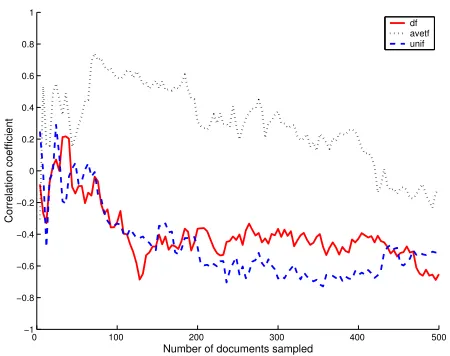
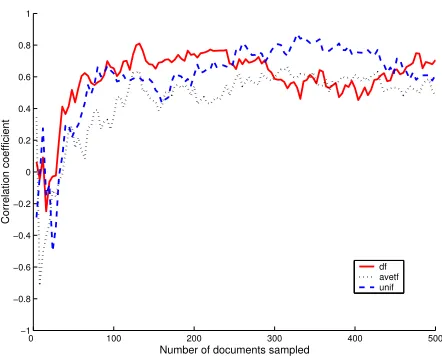
From the results, it would appear that if CTF is high then SRCC will be low on average, and vice versa. To examine this result in more detail, we calculated the correlation be-tween CTF and SRCC at each query sampling, across all QBS approaches. This correlation was used for quantifying the strength of the agreement between the two measures. That is, CTF was high and SRCC was also high, then a pos-itive correlation would exist. Alternatively, if one is high and the other is low, then we would see an negative corre-lation between the measures. Intuitively, we would prefer both measures to be in agreement i.e measuring the same thing. Figures 4, 5 and 6 display the results of this experi-ment where the x-axis represents the number of unique doc-uments sampled, and the y-axis is the correlation between the two measures. The three lines display each term selec-tion method:df,unif andavetf.
Figure 4 displays the comparison between CTF and SRCC. We note the change in the correlation as more docu-ments were sampled. Here we can see that a negative corre-lation existed, confirming our hypothesis that both measures do provide contrary evidence. We posit that this result is due to the limited number of documents sampled and if we were to sample more documents, we would expect this relation-ship to eventually turn positive. Further work is required to determine when this state exists and whether significantly more sampling is required to obtain agreement between the measures. Otherwise, since CTF and SRCC measure differ-ent aspects of resource description quality - term coverage and ranking, then a trade off is required and it becomes un-clear which QBS method is preferable. A solution would be the combination of CTF and SRCC into a single point esti-mate of resource description quality. Alternatively a differ-ent measure that combines both aspects could be adopted.
We also compared the relationship between KL and the two existing measures, see Figures 5 and 6. After 500 docu-ments were sampled, there was a strong negative correlation
0 100 200 300 400 500
−1 −0.8 −0.6 −0.4 −0.2 0 0.2 0.4 0.6 0.8 1
Number of documents sampled
Correlation coefficient
[image:7.595.314.539.70.248.2]df avetf unif
Figure 4. A plot of the relationship between the CTF and SRCC measures as more docu-ments are sampled.
between CTF and KL (Figure 5), particulary when usingdf
andunif as term selection strategies. This would indicate the a resource description estimate with a high CTF ratio would have a low KL score, as expected.
Conversely, there was a strong positive relationship be-tween KL and SRCC (Figure 6). This highlighted that a resource description with a high correlation would have a poorer KL score. In other words, a resource description es-timate with a similar term ranking to the actual collection, when comparing the vocabulary intersection, will invariably have a poorer KL score. The poor KL score would indicate that the term probability distribution of the estimate would be further apart from the actual collection. Intuitively, this result is not what we would expect as KL also measures the term rank (and also term frequency) between the actual and estimated resource descriptions.
5
Discussion
These initial experiments have highlighted a problem with the current metrics applied for measuring resource de-scription quality. The results revealed that both CTF and SRCC produce contrary results. For example, both the
0 100 200 300 400 500
−1 −0.8 −0.6 −0.4 −0.2 0 0.2 0.4 0.6 0.8 1
Number of documents sampled
Correlation coefficient
[image:8.595.57.281.107.291.2]df avetf unif
Figure 5. A plot of the relationship between the CTF and KL measures as more docu-ments are sampled.
0 100 200 300 400 500 −1
−0.8 −0.6 −0.4 −0.2 0 0.2 0.4 0.6 0.8 1
Number of documents sampled
Correlation coefficient
df avetf unif
Figure 6. A plot of the relationship between the SRCC and KL measures as more docu-ments are sampled.
If both measures are an indication of resource description quality, then this result would imply that during QBS, a trade off has to be considered between high CTF and strong SRCC correlation. In other words, a middle ground would have to be found between balancing high CTF ratio and SRCC correlation to find the ‘optimal’ resource description. Such a result raises doubts about the validity of employing both metrics together when measuring resource description quality, providing evidence to support our initial concerns.
When analysing both in isolation, there were also doubts on the validity of either measure. For example, CTF mea-sures the coverage of terms in the resource description com-pared to the actual resource. It is not clear if high cover-age of terms does indeed reflect resource description qual-ity, especially as term frequency information is not reflected by CTF. A resource description covering a high number of terms, but without no indication as to term contribution may be meaningless, as many terms will not contribute to the content stored in a resource[8]. A resource description with a poor estimate of the actual term frequencies could be cho-sen over a better resource description that has worse term coverage. Such a scenario would have a negative impact on the overall quality of the DIR system.
Focusing on the SRCC measure, it was discovered that all QBS methods produced highly variable estimates. As further documents were seen, the correlation between the estimate and the actual resource fluctuated instead of rising steadily as expected. A possible reason for this fluctuation could be the vocabulary intersection. Only the correlation between the common terms shared by the actual and esti-mated resource description is measured with SRCC. There-fore, as more documents are seen by a resource description, new unseen terms are also included, increasing the vocab-ulary intersection as a consequence. When a large number of content rich documents containing new unique terms are added, the term ranking accuracy initially deteriorates. The correlation only improves again when further documents are added which provide a enough information to correctly re-rank the terms rankings, which in turn is reflected by an increase in SRCC. This evidence raises doubts on calcu-lating the SRCC of the vocabulary intersection, with a fol-lowup analysis required to determine if this is a true mea-sure of description quality, or most likely, a problematic metrics.
[image:8.595.57.278.434.615.2]and also (2) measuring the correspondence between the es-timated and actual frequency information. A key finding when analysing resource descriptions with KL, was that the original QBS hypothesis of selecting more frequent occur-ring (df) query terms from the estimated resource descrip-tion would obtain better, unbiased representadescrip-tions of the re-source.
As expected a strong relationship was found between CTF and KL, where an estimate with a high CTF score would have a low KL score. This result indicated, that those resource description estimate with high term cover-age, would also have a closer term probability distribution to the actual collection. This we assume is an indication of the quality of the resource description estimate obtained through QBS. Conversely, the relationship between SRCC and KL was the reverse of what we expected indicating po-tential problems with analysing only the vocabulary inter-section between the actual and estimated resource descrip-tion.
Finally, a common limitation of all three measures em-ployed in this work, is that they all require that the actual collection description to be known, a priori. This is not problematic in the development phase of DIR, where full control is possible. However, in an operational setting such measures are impractical, because this information is un-available. This highlights the need to identify techniques for assessing resource quality that can be employed without recourse to the actual resource description. This is espe-cially so in environments where the resources are dynamic and as a consequence resource descriptions are continually required to be updated. For example, a measure of the qual-ity of the resource would help notify the DIR system when resources are required to be updated, and also when to stop QBS sampling. For a number of reasons, intelligent mecha-nisms for QBS termination are desirable over the currently applied stopping criteria that are based on heuristics. QBS is expensive in terms of time and resources, so only the optimal number of documents for accurate resource selec-tion and data fusion should be sampled. Also, by applying threshold based rules such as a maximum number of unique documents seen, cannot generalise to varying collections (in terms of the number of documents, length and type of documents, etc). Therefore, adaptive approaches based on resource description quality, which are not reliant on prior resource knowledge, are required to maximise QBS while minimising wastage. The development of such a technique would provide a solution to this unresolved problem and is left to future work.
6
Conclusions and Future Work
We have argued and shown that the current measures CTF and SRCC are problematic in nature for measuring
re-source description quality. The application of KL provided an intuitive indication of description quality which implic-ity captured what CTF and SRCC were trying to measure. When using KL for comparing different QBS techniques the previously unsupported hypothesis that more frequent terms will obtain better resource description estimates was supported. This is a significant finding because much subse-quent research has employed the previously accepted sam-pling technique[3, 7, 11, 12, 13, 14]. Further analysis is still required to provide conclusive evidence that KL is indeed a reliable indicator of resource description quality in the con-text of overall DIR performance. The real litmus test being whether there is a correlation between KL and resource se-lection accuracy. Future research will be directed in this direction in order to achieve a better understanding of the impact of resource description quality on both resource se-lection and data-fusion, so that more intelligent sampling techniques may be developed.
7
Acknowledgements
This research was undertaken as part of the PENG project. PENG, “PErsonalised News content programminG Information”, is a Specific Targeted Research Project (IST-004597) funded within the Sixth Program Framework of the European Research Area. The authors would also like to thank Murat Yakici for his helpful comments throughout this work.
References
[1] M. Baillie, L. Azzopardi, and F. Crestani. An evaluation of resource description quality measures. InThe 21st Annual
ACM Symposium on Applied Computing (ACM SAC 2006),
Dijon, France, April 23-27 2006. ACM.
[2] J. P. Callan.Advances in information retrieval, chapter Dis-tributed information retrieval, pages 127–150. Kluwer Aca-demic Publishers, 2000.
[3] J. P. Callan and M. Connell. Query-based sampling of text databases.ACM Trans. Inf. Syst., 19(2):97–130, 2001. [4] L. Gravano, H. Garc´ıa-Molina, and A. Tomasic. GlOSS:
text-source discovery over the Internet. ACM Transactions on Database Systems, 24(2):229–264, 1999.
[5] P. G. Ipeirotis and L. Gravano. When one sample is not enough: improving text database selection using shrinkage. InSIGMOD’04, pages 767–778. ACM Press, 2004. [6] S. Kullback. Information theoery and statistics.Wiley, New
York, 1959.
[7] J. Lu and J. P. Callan. Pruning long documents for dis-tributed information retreival. InCIKM’02, pages 332–339. ACM Press, November 4-9 2002.
[9] G. Monroe, J. French, and A. Powell. Obtaining language models of web collections using query-based sampling tech-niques. In HICSS’02-Volume 3, Washington, DC, USA, 2002. IEEE Computer Society.
[10] H. Nottelmann and N. Fuhr. Evaluating different methods of estimating retrieval quality for resource selection. InSIGIR ’03: Proceedings of the 26th annual international ACM SI-GIR conference on Research and development in informaion retrieval, pages 290–297, New York, NY, USA, 2003. ACM Press.
[11] H. Nottelmann and N. Fuhr. The mind architecture for het-erogeneous multimedia federated digital libraries. InACM SIGIR 2003 Workshop on Distributed Information Retrieval, Canada, 2003. ACM.
[12] P. Ogilvie and J. P. Callan. Experiments using the lemur toolkit. InText REtrieval Conference, 2001.
[13] L. Si and J. P. Callan. Unified utility maximization frame-work for resource selection. InCIKM ’04: Proceedings of the thirteenth ACM conference on Information and knowl-edge management, pages 32–41, New York, NY, USA, 2004. ACM Press.
[14] L. Si and J. P. Callan. Modeling search engine effectiveness for federated search. InTwenty Eighth Annual International ACM SIGIR Conference on Research and Development in Information Retrieval, Salvador, Brazil, 2005.
[15] L. Si, R. Jin, J. P. Callan, and P. Ogilvie. A language mod-eling framework for resource selection and results merging. InCIKM ’02: Proceedings of the eleventh international con-ference on Information and knowledge management, pages 391–397, New York, NY, USA, 2002. ACM Press.