THE ECONOMIC BACKGROUND
THE INTERNATIONAL ENVIRONMENT The outlook for Scottish trade
The trading environment for Scottish business seems set to improve following a bleak year in
1993. World GDP continued to recover last year and is estimated to have grown by 2.3% following 0.7% growth in 1991 and 2.3% in 1992. However, this strong growth was not reflected in Scotland's key export markets of England and continental Europe. The global recovery is due to a strong performance in North America, Australasia and the industrialising economies of Latin America and the Pacific Rim.
The weakness of the European and Japanese economies caused world trade growth to moderate to 2.4% in volume terms following growth of 4Vi% in 1992. Trade volumes in the G7 countries stagnated despite exports growing by 5lA% in the US and 10.1% in Canada whilst US imports grew by 12.7% and Canadian imports by 1014%. World Trade prices weakened sharply, with manufacturing prices down by 7%, oil by 11 Vi% and non-oil commodities by 3.8%. The fall in oil prices contributed to a weakening of import demand in oil producing areas which further dampened world trade performance.
The forthcoming Scottish input-output tables for 1989 indicate that 10.2% of Scottish output is sold in the UK and 7.0% in the rest of the world. In the case of manufacturing, 36.0% of output is placed south of the border whilst 33.1% is exported overseas. The most recent Scottish Council estimates indicate that 58.7% of Scottish manufacturing exports are destined for the European Union with a further 7.6% due to the EFTA nations. North America accounts for 13.3% of manufacturing exports and the Far East 10.8%.
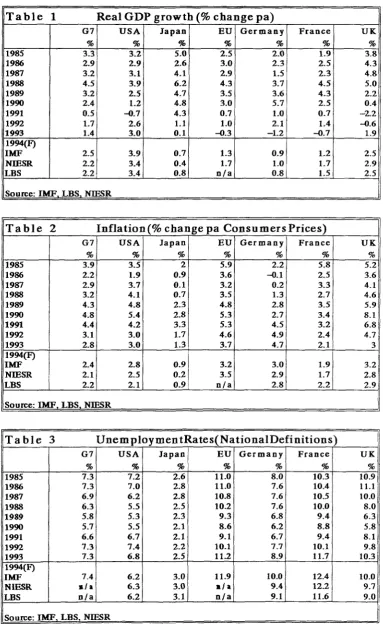
The growth profile for Scotland's major trading partners is set out in Table 1. This indicates that British GDP recovered weakly last year whilst GDP in the EU contracted by 0.3%. Indeed the combined imports volumes of EU members contracted by 7.1% last year as private and public consumption stagnated, investment contracted by 4.8% and stock
levels were cut by 0.7%. This is hardly a backdrop against which Scottish manufacturing was set to thrive and, excepting Silicon Glen, all sectors performed modestly in 1993.
The outlook for this year is distinctly better. World GDP is set to grow by over 3% with growth in the major G7 countries improving to 2.5% and recovery evident in the EU where growth of over l'/4% is expected. Consumers expenditure in the EU is projected to rise by circa 1%, whilst public consumption is expected to fall by up to '4% as governments address their mounting deficits. The European recovery is based firmly on increases in capital expenditure, exports and a modest trend in stockbuilding.
The continuing difficulties in major EU countries mean that European trade growth will remain less buoyant than globally. In 1994, world trade volumes are expected to grow by nearly 6% with non oil prices recovering. The industrialised countries are expected to increase both export and import volumes sharply as the EU and Japan start to recover. We expect that volumes imported by EU members to rise by 3Vt% in 1994. Thus, whilst
1994 will be considerably better than 1993 for Scotland's EC oriented exporters, the prospects are better still in 1995.
World trade growth will increase to 6'/2% pa in 1995 with prices growing modestly. Next year, we expect EU growth to easily top 2>/2% with the UK growing at 2%%. European consumers expenditure will average 1.9% but growth in public consumption will remain weak. Investment in both stocks and plant and equipment is set to recover sharply but the main motor of growth is expected to be an expansion of exports both within and outwith the Union. In 1995, the combined imports of EU members will grow by 5%. Thus, it will be 1995 and beyond before key Scottish overseas markets recover.
The outlook for world inflation
demand has resulted in the moderation of inflation in all areas. In the G7, inflation peaked in 1990 at 4.8%. At this point, it was the English speaking economies which had engendered the worst cases of inflationary expansion whilst continental Europe appeared better placed. The policy corrections were implemented first in the US, Canada, Australasia and the UK where inflation began to moderate in
1991.
On the continent the story is different. European inflation continued to accelerate after 1990 due to overheating in Germany caused by re-unification. The financing of re-unification largely through borrowing caused German interest rates to rise in face of the global world trend until 1992. These were transmitted through Europe causing growth to moderate later than in the world generally. Thus, the EU is behind the rest of the world in terms of the economic cycle. It is this disjunction which allows Cabinet Ministers to place great store in the argument that the UK is outperforming the EC in 1994. The UK is simply at a different phase in the economic cycle from the rest of Europe.
In 1993, G7 inflation moderated to 2.8% with falls evident in all countries except Canada. Inflation is particularly subdued in Japan where the economy is mired due to debt deflation and an overvalued yen. Last year, the fastest growth of consumer prices was evident in Germany, Italy and, thus, the EU. It would appear that the various policy corrections have engendered a convergence of inflation rates around a low rate. A key issue facing the world economy is whether this new low inflation environment will prove sustainable.
In the short run, there will be no strong inflationary pressure due to commodity price trends. Non fuel commodity prices have been falling steadily since 1988. Last year the price of non oil commodities fell by 7% with strong falls in both agricultural products and metals. The oil price has likewise been falling since 1990 when Brent Crude averaged $23.5 pb. Last year oil prices fell by ll1/2% to average $17.5 pb. Given that it takes circa 1 year for changes in raw material prices to affect domestic consumer prices, it appears that there will be downward pressure in 1994 stemming from previous commodity price weakness.
In recent months, commodity prices have been rising steadily. Whilst this is an early pointer to forthcoming industrial recovery, there will be no sustained rise in prices. The recent prices rises have been inflated by financial market pressures. The rise
in some commodity prices such as coffee has caused a move by institutions into commodities generally, this herd effect having been exacerbated by computerised trading. However, there is no generalised surge in commodity prices such as that experienced in the early 1970s. Metals prices are projected to decline by lVi% due to weakly recovering demand and high stocks. In 1995 and beyond, metals prices will grow more strongly and agricultural commodity price increases will moderate. This recovery will provide a threat to enduring low inflation in industrialised economies unless suitable corrections are undertaken in advance.
Oil prices are forecast to fall by a further 20% to average $14.1 pb in 1994. The roots of the weakness are low industrial demand at a time of high stocks and production. In the short term there is little prospect that the OPEC cartel will be able to secure any agreement to restrict supply and boost prices. Saudi Arabia is effectively refusing to countenance production cuts due to the certainty that cash strapped Latin American and African producers would immediately breach lower quotas and, together with non OPEC suppliers, act to restrict price rises. This would result in revenue transfers from Saudi to these areas.
At present, OPEC seems resigned to weak prices which stem investment in new capacity, particularly in high cost areas such as the North Sea. OPEC seems prepared to maintain market share at low prices and to allow weaker members to correct fiscal deficits by breaching output quotas. With the exception of Saudi, OPEC is currently operating at circa 90% capacity with output is set to rise strongly from 1995 onwards as 3 strong sets of demands coincide. First, OECD demand is set to rise sharply as Germany and the EU recover strongly, Second, the recent fast growth of the Pacific Tigers is heavily oil intensive and is set to continue. Third, we expect a strong growth in demand from the former Soviet Union, particularly if fast inward investment from the West strengthens industrial capacity and output quality.
energy. The position of Iraq depends on long run political developments but there is the potential for increases in Iraqi shipments to undermine upward price movement. We expect oil prices to rise by circa 5% in 1995 and to increase more sharply thereafter.
In the next 2 years, we are facing a period of low and relatively stable inflation both at home and abroad. In Europe, high output gaps, increased competition from LDCs, weak input prices and subdued inflationary expectations will all act to contain inflationary pressure as recovery gathers pace. This year, EU inflation is expected to moderate to 3% from 3.7% in 1993. A further reduction to circa 2Vi% is likely in 1995 based on a strong trend in Germany. However, in most EU and OECD countries, inflation will accelerate in
1995 compared with this year.
Given the likely trend in both oil and non oil commodity prices, there will be a strong external pressure on consumer prices in 1996 and thereafter. As capacity utilisation recovers and oil and other commodity prices rise, there is the potential for wage-price spirals if policymakers fail to curb domestic demand sufficiently. In the forthcoming decade, low and stable inflation will continue to demand unspectacular growth and high unemployment.
The prospects for world unemployment
Table 3 sets out the recent trends in unemployment in the G7, European Union and in 5 major economies. Unemployment in the G7 countries stabilised at 7.3% in 1993. In 1993, the average jobless rate continued to rise in Germany, Japan, France and the UK whilst falling sharply in the US and Italy and more modestly in Canada. The jobless rate in the EU averaged 11.2% last year compared with 6.8% in the States and an artificially low 2Vi% in Japan.
In 1994, the G7 unemployment rate is projected to increase to 1VI% despite expected growth of over 2'/2% which will engender employment growth of '/2%. The bulk of employment growth is evident in the US and Canada where growth is averaging over 3y2%. This year, unemployment in the US is projected to fall from 6.8% to 6V*% and in Canada from 11.2% to 11%. The EU jobless rate seems set to rise further in 1994 to circa 12%. Despite output growth of over 1V4% employment is projected to decline by a further %%, with particularly marked falls in Germany, France and Italy. In the UK
which is further advanced in recovery, output growth of 2%% results in a rise in employment demand of over Vi% which causes the jobless rate to fall from 10.4% in 1993 to an average of 93/>% this year.
Next year, we expect G7 unemployment to abate slightly to lVt% as output growth again averages over 2'/2% and employment rises by circa 1%. Next year, the US economy will slow and employment growth moderate to 1V4% causing the jobless rate to decline further to 5%%. In Canada, expected growth in over 4% will cause employment to rise by circa 2%% which induces a fall in the unemployment rate from 10%% to 10%. In Europe, anticipated growth of over 2'/2% engenders a 0.6% increase in employment. The unemployment rate is projected to fall to 11%% next year. Thus, in recovery, the EU is set for a modest trend in employment creation to which the term jobless growth might well apply.
The poor employment outlook in Europe and elsewhere has prompted the OECD to produce a report into ways of improving the job creation effort, particularly in the EU. The report contains some 60 detailed proposals which cover improved technology transfer, faster new firm formation, the promotion of flexibility of wage and non wage costs, the expansion of training and temporary work schemes and reform of social security systems. There is something in the report applicable to every' country.
In the UK, Ministers have made particular reference to areas which chime with the present approach of labour market flexibility and de-regulation. In particular, the report has been used to hammer the minimum wage proposals of the Labour opposition. The government have had less to say about the emphasis on social consensus and cohesion, the need to finance improved and extended lifetime training opportunities and the clear warnings concerning the social implications of adopting a deregulated US style model. The report is likely to compliment and advance the similar micro proposals set out in the EU's recent White Paper on Growth, Competitiveness and Employment.
pressure to be weak and for monetary policy to remain generally loose with interest rates remaining low. Fiscal policy will tighten as governments seek to reduce public sector deficits. Expansion will be export and investment led with the trend in public and private consumption subdued relative to the mid to late 1980s.
Growth based on a transfer of resources into exports and capital will prove a strong platform for the remainder of the decade if emerging domestic and international inflationary pressure can be absorbed without recourse to sharp contractions of output. Much depends on whether policy can continue to contribute to a moderation of inflationary expectations, particularly on the part of both sides of the wage bargaining process.
Germany
Germany is Scotland's biggest overseas market accounting for 15% of Scottish manufactured exports in 1992/93. Last year, the German economy continued to pay the consequences of attempting to absorb the inefficient Eastern lander. Inflation reached an 11 year high of 4Vi% in the 3rd quarter of 1993 whilst GDP contracted by circa \lA% last year in response to a period of high interest rates. This comprises a fall of circa 2% in the West and rise of over 7% in the east as re-industrialisation and infrastructure investment continue apace.
In West Germany, personal consumption was static in 1993 whilst public consumption fell by IV*%. Capital investment slumped by 7% and the destocking accounted for almost %% of GDP. German export volumes contracted by 5% with a substantial weakening in prices. In consequence, German import volumes are estimated to have contracted by 10% last year which did not augur well for Scottish exports.
The Bundesbank began to cut interest rates in 1993 and this has continued into 1994. Inflation peaked in July 1993 and continues to moderate as output recovers. At present, German inflation is benefiting from a weak trend in wage settlements and relatively strong Mark. Consumer price inflation is set to average circa 3% this year whilst output in the unified Germany is set to grow by over \xh% and by 1% in the West.
German personal consumption is projected to be static this year due to the weak earnings trend and the prospect of higher taxes in 1995. Public consumption is set to decline by a further %% but
investment will increase by 2Vi% due to activity in the East. The outlook for investment in the Western Lander remains poor. Stockbuilding is expected to resume in a modest fashion whilst export volumes are expected to grow by 4Vi% on the back of a weakening DM. This emerging recovery will cause import volumes to stabilise and grow by 1%.
The German Economy will to recover more clearly in 1995. High unemployment will continue to check pay settlements contributing to a further moderation in consumer price inflation to 2V*%. The Mark will weaken slightly and this will further boost German competitiveness. Output is expected to grow by circa 1%% in the West and by 214% in the unified state.
Personal consumption will grow by over 1% whilst public consumption is likely to contract by a further */2%. The emerging recovery will bolster confidence and investment is set to grow by 4V»% again swelled by faster growth in the East. Export volumes are expected to increase by a further 414%. This growth in demand will engender a 5V4% growth in import volumes. In 1995, the prospects for Scottish exports to Germany will be considerably improved and rapid growth is expected.
France
France represents the 2nd largest foreign market accounting for 13% of Scottish manufactured exports in 1992/93. French economic management is based on the Franc Fort policy which seeks to arrange domestic conditions in order to maintain the value of the Franc against the DM. This involves maintaining French interest rates in line with Germany, a practice that the French autitorities have maintained despite the wider 15% ERM bands. This has contributed towards a period of low and stable French inflation. However, the cost has been high and persistent unemployment.
This year recovery is underway assisted by falls in interest rates in line with Germany. French GDP is forecast to grow by over l'/2% whilst inflation is likely to moderate further due to slow earnings growth and the strength of the currency. Personal consumption is projected to grow by 1% and public consumption by \Vi%. Investment is recovering and is expected to grow by 1%% this year whilst stocks are set to increase by Vi-%% of GDP. Export volumes are likely to grow by a modest 3%. Import volumes will recover and are expected to increase by 4'/2%
Next year, the French economy will continue to recover with GDP growing by 2V4% and inflation increasing marginally due to the strong Franc and a weak trend in wage settlements. Employment will grow by less than Vi% and unemployment will fall modestly to 12.1% from 12V4% in 1994. These levels of unemployment both reduce social cohesion and act as a brake on wage bargainers expectations. The Franc Fort policy if pursued is likely to result in modest growth of circa 2Vi% pa, low inflation of circa 2-2lA% pa whilst unemployment will not fall below 11% for the rest of the decade. It is not clear that French policymakers can survive electorally on the basis of this outlook and we expect strong pressure to moderate these deflationary trends.
Personal consumption is projected to grow by 2% and public sector consumption by a further 114%. The recovery will be driven by exports, which are forecast to increase by 5Vi% and by capital expenditure which is expected to grow by 4%. In addition, French business is expected to increase stocks by the equivalent of %% of GDP. Import volumes are forecast to increase circa 7V4%. Clearly, France is will be an important market for Scottish manufacturers in the coming period. However, it is likely to be at least the 2nd half of this year before France can contribute strongly to Scottish manufacturing recovery.
The United States of America
The USA is Scotland's 3rd largest export market accounting for 12% of Scottish manufacturing exports. The US economy has been experiencing a period of strong growth at it is likely that Scottish and UK business have been attempting to increase trade in this area. The US went through recession early experiencing the cyclical trough in 1991 and has recovered strongly on the basis of an ongoing trend in falling interest rates. Last year, US GDP grew by 3.0% following growth of 2.6% in 1992.
Consumer price inflation has been falling steadily to average 2Vi% in the first quarter of this year but is expected to accelerate due to the economy being close to capacity and a likely weakening of the currency.
Last year, the strong 3% growth was due to strong growth in all private sector components of demand. Personal consumption grew by 3Vi% but public current spending fell by 3A% as the Democrats began to address their disastrous fiscal inheritance. Capital Expenditure is estimated to have increased by 11% due to a 11%% growth in business investment and an 8V2% growth in housing investment. In addition, US business increased stocks by circa !4% of GDP. Export volumes increased by 414% whilst import volumes increased by over llWfo. The US is expected to have accounted for an increased share of Scottish exports in 1993.
The issue facing US policymakers is the extent to which interest rates require to be raised in order to stem inflationary pressure. The high demand for labour is expected to cause earnings growth to accelerate but a strengthening of the currency due to higher interest rates is expected to moderate inflationary pressure. This year, we expect US GDP to increase by 3.4% but to moderate to 2'/2% as policy tightens from the second half of this year. Demand for labour is likely to increase by 1 W7c pa across the 1994-95 period and employment rates to fall to 5%% in 1995.
In 1994, we expect output to grow by 3.4% due to a further strong performance by the private sector. Inflation is expected to accelerate this year but to remain lower, on average, than in 1993. Personal consumption is expected to grow by 3%% whilst government consumption is projected to grow by V2-%%. Investment growth is likely to moderate to 8.6% with housing and business spend increasing a broadly similar rate. Exports volumes are forecast to grow by 5%% and import volumes by 9V*% suggesting that the US will continue to be an attractive focus for UK and Scottish exporters.
and import volumes by 6%. Thus, the US will remain a strong prospect for Scottish Exporters.
Other key markets
Holland is Scotland's 4th largest market for Scottish manufacturing exports. Holland, went into recession last year when GDP growth averaged a modest >4%pa. There was no serious inflation in Holland and this weakness reflects the export of German recessionary pressure. This year we expect Dutch growth to recover as interest rates fall in line with Germany and that GDP will grow by 1% this year and by 2V4% in 1995. Again the prospects for Scottish exporters improve more clearly in 1995. Much the same can be argued with respect to Italy, Spain and Belgium where output is expected to recover this modestly this year and mor strongly in
1995.
The Far East accounts for 10%% of Scottish manufactures exports in 1992/93 with Japan comprising 4Vi% The Japanese economy remains in the doldrums but is expected to grow by a modest '/2% this year and by over 2J/2% in 1995 with no inflationary pressure in prospect. The Japanese economy is mired in recession due to debt deflation and an overvalued yen. The industrialising countries in Asia grew by 8'/2% last year and are expected to average 1VI% pa in the 1994-95 period.
The Japanese recovery will be led by public sector investment and private residential investment. Export growth will be weak due to a strong yen and import growth is projected to increase sharply as Japan attempts to open up it's economy. The Japanese visible trade balance is likely to contract reducing the current account balance, at least in the short term. At present Japan has surpluses with most industrialised economies and increasingly with the Pacific Tigers. This is due to Japanese companies providing inputs to plants based in these economies. In the medium term, these surpluses are likely to persist and to strain trade relationships, particularly with the US and EU. However, Japan may well be a critical source of new and increased Scottish export business next year and thereafter as Japan takes measures to reduce it's trade surpluses.
Concluding remarks
Our assessment of the economies of Scotland's key foreign trading partners indicates that last year, our exporters faced a poor outlook in Europe and Japan but better prospects in North America and elsewhere. This situation is projected to improve
slowly and it will be 1995 before one would be tempted to argue that key export markets have recovered. Thus, we expect that Scottish manufacturing will grow steadily this year and perform considerably better in 1995.
We project that, in the short term, there is little to need to fear inflationary pressure. Outside the US, output gaps are high, labour markets subdued and demand is weak. In addition, there will be no strong external pressure from commodity prices before 1996. However, if inflation is to be avoided later in the decade, policy will require to remain tight in order to constrain demand. This will mean no strong trend in employment creation and unemployment rates are generally expected to be high.
The UK economy
UK macroeconomic trends
In the first quarter of 1994, the provisional estimate of GDP at market prices - 'money' GDP - rose by 1.3%. After allowing for inflation and adjusting for factor costs, GDP grew by 0.7% during the quarter, the same increase as recorded in the fourth quarter of 1993. Over the year to the first quarter, 'real' GDP is estimated to have risen by 2.6%, and now stands at the same level as the last peak in the second quarter 1990 which preceded the recession.. When oil and gas extraction are excluded 'real' GDP is estimated to have risen by 0.6% in the first quarter and by 2% over the same period a year ago.
The output of the production industries in the first quarter 1994 is provisionally estimated to have risen by 0.7% over the fourth quarter 1993, with output rising by 3.8% compared with the same period a year ago. Within production, manufacturing experienced an increase in output of 1.3% on the previous three months, output of the other energy and water supply industries fell by 6.2%, and production of oil and gas (including mining & quarrying) rose by 1.8%. Manufacturing output in the first quarter was still 4.1% below the second quarter 1990 peak. The output of the service sector is provisionally estimated to have risen by 0.6% in the first quarter.
upturn in the spring of that year. The shorter leading index, which attempts to indicate turning points about six months in advance, fell in February and fell again in March and April after rising continuously since the Autumn of 1992. The longer leading index, which purports to indicate turning points about one year in advance, fell in the middle of last year and has been relatively flat since.
In the first quarter of 1994, real consumers' expenditure rose by 0.7% after rising by 1.1% in the fourth quarter 1993. Spending during the first quarter 1994 rose by 3.4% on the same period a year earlier.
nsumer vxpendlture ^IMOprtcss
The provisional official retail sales volume figures - seasonally adjusted - for May, 1994, were unchanged over the April level, which on revised data was 0.1% above the March figure. Over the year to May, the volume of sales rose by 3.9%. Taking the three months to May, the volume of retail sales rose by 0.9%.
The underlying determinants of consumers' spending continue, on balance, to strengthen. The consumer credit figures for April show that net lending to consumers by finance houses and other specialist credit grantors (excluding bank loans) fell to £413m in April from £518m in March. Even though the figure was lower in April, net lending to
consumers in the three months to April rose to £ 1,282m compared with £ 1,079m in the previous three months. The saving ratio fell in the fourth quarter of 1993 to 10.2%, a decrease of 0.8 percentage points on the 11% recorded in the third quarter. The underlying increase in average weekly earnings in the year to April 1994 is provisionally estimated to have been 3.75% and the underlying annual increase in average earnings continues to fall. Real personal disposable income is estimated to have risen by 0.1% in the fourth quarter 1993 to a level 0.6% higher than in the same period in 1992.
General government final consumption fell by 0.5% in the first quarter 1994. Government consumption in the first quarter was 0.1% lower than in the corresponding quarter of 1993.
Real gross fixed investment rose in the first quarter 1994. Gross domestic fixed capital formation rose by 2.2% to a level 3.4% higher than in the first quarter 1993.
Turning to the balance of payments, the deficit on current account for the fourth quarter 1993 was, on revised figures after seasonal adjustment, £2.56bn, compared with £1.78bn in the third quarter. For 1993 as a whole the deficit stood at £10.67bn compared with £9.97bn in 1992 and £7.65bn in 1991. On visible trade, the fourth quarter deficit stood at £3.6bn compared with £3.18bn in the third quarter. The surplus on the oil account fell from £712m in the third quarter to £700m in the fourth quarter.
The UK labour market
Employment and unemployment
Earnings and productivity
Since last December, the underlying rate of growth of average earnings has risen from an annual average of 3% to 4%. This is after a virtually uninterrupted fall in wage inflation since July 1990. The rise in wages continues to be greater in manufacturing than services, although the rate of wage inflation rose in all sectors in the last quarter. After the major increases in labour productivity which peaked in the first quarter of 1993, the annual growth in output per employee continues to fall in the whole economy, but appears to have stabilised for manufacturing. The result is that in manufacturing unit labour costs, which had declined throughout 1992 and to the second quarter of 1993, have started again to rise, and this rise appears to be accelerating. Whole economy unit labour costs are also increasing for the third and fourth quarters of 1993, though it must be stressed only at a relatively moderate rate.
UK outlook
In the first quarter of this year, the economy finally returned to the pre-recession level of output. With growth over the year of 2.6%, first quarter GDP reached the level attained at the last peak in the second quarter 1990. However, strong growth of oil and gas output during 1993 meant that GDP excluding oil and gas grew at 2% in the year to the first quarter. Growth therefore remains below trend implying that there is still considerable spare capacity to be taken up. In the first quarter, manufacturing output was growing quite strongly and faster than the service sector, although output still remained some 4% below the level attained before the recession began. The growth of domestic demand now appears to be providing the main stimulus to the growth of output. Retail sales are performing strongly despite the apparent slackening in May and are 3.9% higher than a year ago. Export volumes fell and import volumes rose in the first quarter, although continuing data problems with the measurement of intra-EC trade are clouding the picture. Inflation remains low despite the recovery of consumer demand and is clearly being helped by strong price competition, particularly in retailing, and continued moderation in the growth of average earnings. House prices are also rising only moderately.
Year-on-year growth for 1994 is expected to approach 3%. Consumer demand will continue to be the main motor of growth, notwithstanding the tax increases. Export growth is expected to continue to
be weak, with net exports contributing negatively to growth. However, a stronger performance from the German economy may help UK exports towards the end of the year. Fixed investment and investment in stocks are expected to pick up during the year and will contribute increasingly to the \rate of growth. Employment growth should be positive during 1994 but with continuing strong productivity growth the increase is unlikely to be great and will be less than 1%. However, unemployment will continue to fall disproportionately to the increase in employment as there are additional withdrawals from the workforce particularly into further and higher education. Price inflation will remain low and the underlying rate -excluding mortgage interest payments - should still be below 3% in the final quarter of the year. Nevertheless, we should expect to see some pick up in earnings growth as increased labour demand and lower post-tax pay increases the pressure for wage rises.
Table
1985 1986 1987 1988 1989 1990 1991 1992 1993 1994(F) IMF NIESR LBS Source: IM1 Real GDP growth (% chai
G 7 % 3.3 2.9 3.2 4.5 3.2 2.4 0.5 1.7 1.4 2.5 2.2 2.2
U S A % 3.2 2.9 3.1 3.9 2.5 1.2 -0.7 2.6 3.0 3.9 3.4 3.4
F , LBS, NIESR
Japan % 5.0 2.6 4.1 6.2 4.7 4.8 4.3 1.1 0.1 0.7 0.4 0.8 E U % 2.5 3.0 2.9 4.3 3.5 3.0 0.7 1.0 -fl.3 1.3 1.7 n / a
age pa)
G e r m a n y% 2.0 2.3 1.5 3.7 3.6 5.7 1.0 2.1 -1.2 0.9 1.0 0.8 France % 1.9 2 . 5 2 . 3 4 . 5 4 . 3 2 . 5 0.7 1.4 -0.7 1.2 1.7 1.5 U K % 3.8 4.3 4.8 5.0 2.2 0.4 -2.2 -0.6 1.9 2.5 2.9 2.5
Table
1985 1986 1987 1988 1989 1990 1991 1992 1993 1994(F)I M F
NIESR
LBS
Source: EM
2 Inflation (% change pa Consumers
G 7 % 3.9 2.2 2.9 3.2 4.3 4.8 4.4 3.1 2.8 2.4 2.1 2.2
U S A % 3.5 1.9 3.7 4.1 4.8 5.4 4.2 3.0 3.0 2.8 2.5 2.1
F , LBS, NIESR
Japan % 2 0.9 0.1 0.7 2.3 2.8 3.3 1.7 1.3 0.9 0.2 0.9 E U % 5.9 3.6 3.2 3.5 4.8 5.3 5.3 4.6 3.7 3.2 3.5 n / a
G e r m a n y
% 2.2 -0.1 0.2 1.3 2.8 2.7 4.5 4.9 4.7 3.0 2.9 2.8
Prices)
France % 5.8 2.5 3.3 2.7 3.5 3.4 3 . 2 2.4 2.11.9 1.7 2 . 2
U K % 5.2 3.6 4.1 4.6 5.9 8.1 6.8 4.7 3 3.2 2.8 2.9
Table
1985 1986 1987 1988 1989 1990 1991 1992 1993 1994(F) IMF NIESR LBS Source: IM3 Unempl
G 7 % 7.3 7.3 6.9 6.3 5.8 5.7 6.6 7.3 7.3 7.4 * / » n / aU S A % 7.2 7.0 6.2 5.5 5.3 5.5 6.7 7.4 6.8 6.2 6.3 6.2
F, LBS, NIESR
oymentRates(NationalDefinitions
Japan % 2.6 2.8 2.8 2.5 2.3 2.1 2.1 2 . 2 2.5 3.0 3.0 3.1 E U % 11.0 11.0 10.8 10.2 9.3 8.6 9.1 10.1 11.2 11.9* / a n / a
G e r m a n y
[image:9.514.64.448.59.687.2]