Rochester Institute of Technology
RIT Scholar Works
Theses
Thesis/Dissertation Collections
2007
Exploring Visual Expressions to Articulate
Thoughts on Human Existence
Mieko Tachibana
Follow this and additional works at:
http://scholarworks.rit.edu/theses
This Thesis is brought to you for free and open access by the Thesis/Dissertation Collections at RIT Scholar Works. It has been accepted for inclusion
in Theses by an authorized administrator of RIT Scholar Works. For more information, please contact
Recommended Citation
ROCHESTER
INSTITUTE OF
TECHNOLOGY
A Thesis
Submitted
to the
Faculty
ofThe College
ofImaging
Arts
andSciences
In
Candidacy
for
the
Degree
ofMASTER OF FINE
ARTS
Exploring
Visual Expressions
to
Articulate Thoughts
onHuman Existence
By
Mieko Tachibana
Thesis Committee Approvals
Chief Advisor
Signature
Date
Associate Advisor
Signature
Date
Associate Advisor
Signature
Date
Department Chairperson
Signature
Date
Dr. Thomas Lightfoot
Alan Singer
Keith Howard
Don Arday
I,
Mieko Tachibana
, hereby grant permission to the Wallace Memorial
Library of RIT to reproduce my thesis in whole or in part. Any
reproductions will not be for commercial use or profit.
Date
To my
husband,
Khosrow
Vakhshouri,
who encouragedCONTENTS
Preface
viIntroduction
1
Concept
My
Views
toward the
Human Race
2
Research
for
Concept Development
5
The Western
Philosophy
5
Cognitive Sciences
8
Influence
ofthe
Western
Philosophy
and
Cognitive
Sciences
onMy
Work
10
Video Work
Materials
1 1
Music
1 1
Plot
ofVideo
11
Conceptual Description
andGoals
ofthe
Video Work
12
Installations
Installation
1
Materials
1 8
Music
1 8
Visual Description
1 8
Scenario
withthe
Audience
20
Linguistic Expression
-Influence
of
Conceptual Art
2 1
Audience Participation
26
Goals
oftheInstallation
andReflections
28
Installation
2
Materials
30
Word
onthe
Wall
31
Visual Description
32
Conceptual Description
33
Goals
andExpression
through
Forms
37
Reflections
39
Installation 3
Materials
4 1
Visual Description
4 1
Conceptual Description
43
Reflections
47
Conclusion
56
Bibliography
andWork Cited
58
PREFACE
I
have been
thinking
about ontological questions sincemy
childhood.At
nightsin
bed,
my
mind would wonder about questions such as where wasI
before
I
wasbom?,
what willhappen
afterI
die?,
why
do
I
exist?,
whatis
existence?,
what exists outsideofthe
universe?,
whatis time?,
if
there
is
abeginning
and an endto
time,
whatexistedbefore
and what willhappen
aftertime?
and ...soon.These
questions madethe
existence ofeverything
that
I
saw and experienced questionable.These
questionsmade mefear
that
my
existenceitself
was unrealand coulddisappear
atany
time.
I
assumethat
everyonehas
thought
aboutthese
questionsin
oneform
or another.Most
peopleforget
orstop
thinking
aboutthem, because
eitherthey
aretoo
busy
witheveryday life
orthey
considerthat
it is
absurdto
ponderquestionsthat
probably have
nodefinite
answers.But,
I
remained curious.
I
wasthe
type
of child whohad
thousands
of questionsabouteverything;
from
the
dog
next
door
to
the
universe.Schools
andexperiencesgave me some ofthe answers,
but my
curiosity
abouthuman behavior
andexistencehas developed
overtime.
When
I
wasin
elementary
school,
I
sawmenwalkonthe
moon onTV. A
reporter wasproudly
explaining
aboutthis
achievement of scienceandtechnology,
andhow
muchthis
project cost.On
the
nextchannel, there
werethe
broadcast
scenesofpeoplesuffering
anddying
from
serious starvationin
impoverished
countries.I
askedmy
father,
thatifthere
wasmoney
to
spend onthe
Apollo
projectwhy
they
did
notfeed
the
starving
peoplefirst?
My
father
replied,
"You
willknow
whenyou growup."
I
thinkI
know
whathe
meantnow.
The
purposeofthe
Apollo
project wasto
further
ourknowledge
andunderstanding
ofscience with whichwe
hoped in
turn
oneday,
wouldhelp
uscure starvation.But
our realintentions
arefar
morecomplex.We feel sorry
for
thestarving
peoplebut
we caneasily ignore
them.Biologically
we are not programmedto take
careof andprovidehappiness
to
others.We
live
by
taking
otherlives.
Although
wedon't
eat eachother,
wedo
fight
overpowerin
our society.Interestingly,
wehave developed
a sense ofmorality in
oursociety
that
wishesnoharm
to
others.This
behavioral
conflictinterests
me.The
recentdevelopment
of animal and environmentalrights issues
further
complicatesthis
dichotomy;
both
the
feeling
ofcaring
for
otherliving
creatures andthe
needto take
otherlives in
orderto
survive.Recently,
my
interests
have led
meto the
study
ofself-consciousness,
because
the
possessionof self-consciousnessis
oneofthe
important
elementswhich separates usfrom
othercreatures and givesus ouridentity
as"human
beings". The
existenceofhuman beings
andtheiridentity
interests
meandhas
givenmethemotivationto
createINTRODUCTION
The
purpose ofthis thesis
is
to
broaden
my
thoughts
onhuman
existence andidentity
in
nature and
the
universe.It
is
alsoto
explorethe
variedvisual expressionsofmy
thoughts,
feelings,
and waysto
engagethe
audiences.I
aminterested
in
thepurposebehind
human
existence,
human behavior
andits
relationship
to
nature.Our
brains
arefar
moredeveloped
comparedto
other creatures,and as a
result,
weare ableto
sustainourrace onthis
planet.But
atthe
sametime,
the
same
brain
makesusinquisitive
and curiouscreatures,
compelling
usto
ask questionslike
"why
do
weexist?"
We
have
tried to
find
the
purposeto
ourexistencefor
centuries,
but
sofar
have
notfound
a good explanation.Without
knowing
ourpurpose,
we areforced
to
participatein
a survivalgamefrom
the
momentwe areborn
into
thisworld.Human
beings have
survivedwell onthis
planet.We
have
overpopulatedthis
planet andhave disrupted its
naturalbalance.
We kill
othersbut
wedo
sofor
oursurvival andthis
makes us
feel
guilty.Ironically
with ouradvancedbrain
comes a moralresponsibility
that
burdens
and complicates ourlives. This
is
the
price wepay for
ourevolution.To
refinethese
thoughts,
I
researched otherpeople'sthoughts
aboutthe
existence ofhuman
beings,
especially
focusing
on westernphilosophy
andcurrentcognitive sciencesboth
ofwhichhave
had
greatinfluence
onthis thesis
project.I
tried
to
experiment with various possible visualizations ofmy
thoughts
andfeelings
through
four different installations. Video
andinstallation
1
is
aboutthe
existence ofhuman beings. In Installation
1,
1 limited my
personalvisualimages,
andinstead
usedlanguage
to
convey my
thoughts.Installation 2 is
aboutthe
relationship
between human
beings
andnature,
andis
expressedthroughpersonalimages
aboutthis
issue
using
mixedCONCEPT
My
Views
toward the
Human
Race
Human
beings have
endured onthis
planetby
using
their
prominentbrains. As
aresult,
we
enjoy
the
fruits
ofourprosperity.But
weforget
that
we arejust
a partof natureandbehave
asif
our existenceis
special.We
consumenature asif everything in
this
worldbelongs
to
us.Mountains
are cutthrough.
Green forests
andprairiesturninto
the
gray
forests
of concrete.We
keep
multiplying
andconsuming
natural resources recklessly.This
has led
to
numerous numbers ofliving
creatureslosing
the
opportunity
tosurvive,
and so
they
have
perished.The
wastesthathumans
produce(both biological
andnon-biological)
are noteasily
recyclednaturally.This
accumulation pollutesthe
environment.We
areout ofthefood
chain cycle.One
can comparehumanity
withcancer,
whicheatsaway
athealthy
environments,
andthen
metastasizesto
other untouchedhealthy
environmentsleaving
behind nothing but
adesolate,
barren
wasteland.We
treat
otheranimals asif
weownthem.
Many
animalsareforced
to
have
painfullives. Domestic
hens,
for
instance,
are coopedin
small cages withhundreds
andthousands
of otherhens
withonly
the
spaceto
movetheir
necksto
feed.
They
cannotmoveorspread theirwings.
Their
entirelives
arespenteating
andlaying
eggs withoutsocializing
with others.Similarly,
monkeyswho arechainedin
laboratories for
the
purposeof medical researchare
too readily
expendable.We
projecta"ruling"
attitudetowards ourplanet,
but
wedon't
evenknow
who we areand
the
reasonwhy
we exist.Biologically,
the
purpose of existenceofany
speciesis
to
leave behind descendants. It
is
programmedin
ourDNA,
andourwillcannot controlit.
We
areborn
andacquirethetools
neededto
survivein
thisworld.We
fall
in
love,
marry,
While
otherslive
eachday
through theiranimalinstincts,
wehumans
spendatremendousamountof
time
andenergy
searching for
the
answersto
whoweare andwhy
we exist.Anthropologist,
Loren
Eiseley
described
wellthe
isolation
ofhuman
beings from
naturein his
book,
Star
Thrower
:"There
is nothing
more alonein
theuniversethanman.He
is
alonebecause
he
has
the
intellectual
capacity
to
know
that
he is
separatedby
avast gulf of socialmemory
and experimentfrom
the
lives
ofhis
animal associates.He has
enteredinto
the
strange worldofhistory,
ofsocial andintellectual
change,
whilehis
brothers
ofthe
field
andforest
remain subjectto the
invisible laws
ofbiological
evolution.Animals
are moldedby
naturalforces
they
do
notcomprehend.To
their
mindthere
is
no past and nofuture.
There
is
only
the
everlasting
present of a single generation-its
trails
in
the
forest,
its hidden
pathways ofthe
airandin
thesea.Man,
by
contrast,
is
alone withthe
knowledge
ofhis
history
untilthe
day
ofhis
death.
When
wewerechildren wewantedto
talkto
animalsand struggledto
understandwhy
this
wasimpossible.
Slowly
we gaveup
the
attempt as we grewup into
the
solitary
world ofhuman
adulthood;
therabbit wasleft
onthe
lawn,
the
dog
was relegatedto
his
kennel."(Loren
Eiseley,
37)
Ironically
the
sameorgan, the
brain,
that
has
madehuman
beings
flourish
on earthhas
alsoisolated
usfrom
otherspecies andhas
resultedin
ourrestlesssearchfor
ourownidentity. Our
fear
andanxiety
towards the
unknownhas
givenriseto
ourreligiousbeliefs. We
usereligionto
explainthe
unknownhoping
that
it
will giveus peace ofmind.Unfortunately
different
religiousbeliefs have led
to
discord,
hate
and evenwars.As
aconsequence, there
will neverbe
peacein
ourminds.All
religionsin
principleteach
usto
careaboutothers,
sodo
ourmorals.We
care aboutsynthetic
detergent
anddisposable
utensils and recyclewastesonly
whenwefeel
like
recycling.
We
arehypocrites.
But,
thisself-centered andself-serving
behavior
is
aninstinct
that
every
life
form
possesses
in
orderto
survive.We
build
ourlife from
otherlife forms
in
nature.We
dominate
and manipulate our environmentto
createthe
best
possiblelife for
ourselves.This
is
seenin
Darwin's
theoriesofevolution,
whichdescribes
the
origin of moralsashaving
a self-centered purpose.Take
the
example oftwo types
ofbirds;
those thatgroomeach other andthose
that
groomthemselves.
The
former group
survivesbetter
asthey
remove
life-threatening
ticks
from
eachotherin
areasthey
themselves
can't reach.These
birds
groom each otherbecause
of self-centeredinterests.
Human
moralshave developed
from
thesesame animalinstincts
overthousands
of years(Uchii). But
overtime
wehave
blurred
the
line between
the
animalisticinstinct
to survive,
andthe
moralinstinct
to take
Research for
Concept Development
In
orderto
further
my
understanding
ofhuman
existence,
I
researchedthe
western philosophies andtheir
thoughts
onhumans
andtheir
relationship
withtheir
naturalsurroundings,
as well as a more objective and cognitiveexplanationsasthoughtin
the
field
of cognitive sciences.(The Western philosophy)
What
is
thepurpose oftheworld?Is
theworldeverything
that
weperceive,
oris
there
morethatexistsbeyond
our comprehension?What
is
the
purposeofhuman beings in
relationto the
world?Why
do
we exist?These
werethe
ultimate philosophicalquestionsthat
have been
ponderedby
westernphilosophersfor
centuries.They
tried to
understandthe
existence of objectsin
theworld andtheirrelationship
to
human
perception.
For
example,
if
anapple existsin front
oftwo people,
how do
weknow if
the
two
people seethe
applein
the
same way?Perception
is
aprivateexperience andwe acknowledgethe
objectssubjectively in
our own ways.Furthermore,
the
philosophers thoughtthat
aslong
as werecognizeobjectssubjectively
we couldnot understandthe
"real"
or "true"
existence of
the
objectsin
the
world.As
aresult, the
philosophers questionedhow
wecould acknowledgethe
existenceof objects objectively.Plato believed
that there
weretwo
realmsin
the
world:the
visible realm(subjective
world)
andthe
intelligible
realm(objective
world).The
objectsin
thevisible realm canbe
recognizedby
the
five
senses.On
the
otherhand,
in
theintelligible
realmthere
areabsolute
entities,
called"Truth" or
"Essence"
whichare not
identifiable
through the
five
senses.The intelligible
realmis
eternal,
absolute and superiorto the
objectsin
the
visible realmbecause
objectsin
the
visible realmphysically
change overtime
andhow
one viewsthem
is
subjective.But,
the
objectsin
the
intelligible
world are acknowledged objectively.According
to
Plato,
ahuman's
ultimate goalshouldbe
to
reachthe
highest
realm(intelligible realm) but
ratherthe"essence"
ofall visibleobjects are comprehended
On
the
otherhand,
somephilosophersbelieved
that there
wasonly
one'sself-existence,and
the
world around us wasjust
a phenomenonin
our minds.Such
believers
werecalled"Solipsists." Descartes'
famous
statement,
"Cogito
ergosum"
(I
think,
thereforeI
am or
I
amthinking,
therefore
I exist)
describes
solipsism.We
canendlessly
questionwhether
the
thingsin
this
worldreally
exist ornot.But
we are notableto
provethe
existence of objects
in front
of us or eventhe
existence of our ownbodies,
because it
could
be
adream
thatwe are experiencing.However,
themerefact
that
we engagein
thinking
activities,
suggeststhat the
mind(which
recognizes"I")
must exist(Takeda 25).
Kant
assertedthat
it did
not matter whetherthe
intelligible
realmexisted ornot, the
cognitive
ability
ofhuman beings
is limited
sothat
wecan't acknowledgethe
"Truth"orappreciate objects objectively.
We
alsocannot answer questionssuchaswhatis
existence
(whether it be
ours, the world,
orGod). We
canonly
comprehendphenomenaand
the
appearance ofthings
around us(Takeda 28).
On
the
otherhand,
Hegel
arguedthat
wecould acknowledgethe
"Truth."As
adults andchildren
have different
cognitiveabilities, the
level
ofhuman's
cognitive abilitiesgradually increases
overtime
andeventually
wecan reachthe
level
ofthe
"Truth"(Ross 143).
Nietzsche
insisted
that
the
"Truth"orthe
intelligible
realmdoes
notexist,
but
instead,
there
areonly
variousinterpretations
of reality.Individuals have different
interpretations.
There
is
noright
orwrong interpretation (Takeda 32-33).
Husserl's
theory
was similarto
Kant's
theory
in
thattherewas noway
to
understandthe
objective
truth.
However,
we areableto
distinguish between dream
andreality
because
we acknowledge
the
existenceofobjectsin
thisworldby
how
ourperception works.Human
beings' consciousnessis
roughly divided
into
memory,
imagination,
thoughts
andperception.
We
can controlthesefactors
by
eithervoluntarily recalling
themorrepressing
them.
However,
this
does
notapply
to
perception.Perception
is
the
awarenessthat
there
is
morethan
just
self-existence,that
there
is
something
else outsideHeidegger further
askedthefundamental
question;
"what
does
it
meanto
existin
the
first
place?"
He
assertedthatthe
relationship between human beings
andthe
world createdthe
meaning
to
existfor both human beings
andthe
world.To
live is
to
have
the
desire
to
live
andthat
depends
onhow
the
world appearsto
us.According
to
him,
therehas
alwaysbeen
a world aroundus,
and we alwayshave desires
and
interests
in
theworld,
such asthe
desire
to
live
aslong
aspossible, the
desire
to
be
comfortable, the
desire
to
have
pleasure and avoid uncomfortablepain andsuffering,
thedesire
to
possessmany
things
(such
asmaterials,
money
andpower)
orthe
desire
to
be
loved
and recognizedby
others.In
orderto
fulfill
these
desires,
wepay
attentionto the
world aroundus,
and weobjectify
it. For
example,
a chairis
to
sit on when we aretired,
that
it
existsto
fulfill
thedesire
to
be
comfortable.A
piece of paperis
to
writeupon,
suchaslove letters
or aresume,
withthe purpose
to
fulfill
the
desire
to
be
loved
andrecognized.We
even showinterests
towards things that
are notin direct
relationto
ourlives
such asthe
look
ofstones on amountaintop
or creaturesin
thedeep
sea.We
are curious about our surroundingsbecause
they
may in
somewayseffectourlives
directly
orindirectly.
Our desires
changedepending
onhow
the
world appearsto
us.The
value,
meaning
andpurposeof objects are
constantly
being
reexaminedin
our minds.A
chair,
for
instance,
is
usually
to
situpon,
however
in
case of afire,
one might useit
to
break
awindowto
escape.
This
time,
the
chairis
givena newmeaning (or re-objectified)
as"an
objectto
be
used
to
break
awindow"
to
fulfill
the
desire
to
live (Heidegger
section14).
As
these
examplesshow,
weconstantly have desires for
the world,
and we existin
orderto
fulfill
them.
The
objectsin
the world,
onthe
otherhand,
are giventhe
meaning
orthe
reason
to
existby
usandby
ourdesires. We have
also created spaceandtime to
fulfill
(Cognitive
Science)
Since
Plato,
western philosophershave
tried to
understandhuman
existencethroughhuman
perception.This
searchis
succeededtoday
by
philosopherslike David Chalmers.
He
has
tried to
explainhuman
existencethroughhuman
cognition.He actively
organizesand participates
in
conferences andassociations,
such asthe
Association
for
the
Scientific
Study
ofConsciousness
(ASSC)
andthe
biennial
conferencein
Tuscon,
"Toward
aScience
Consciousness"(sponsored
by
the
University
ofArizona,
establishedin 1994).
These
associations and conferencesbring
peopleofdifferent
fields,
such ascognitivescientists, neuroscientists, psychologists,
socialscientists,
andphilosopherstogether.Today,
the
issue
of existenceis
nolonger
limited
to the
field
ofphilosophy,
but
ratherit
has
spilledinto
otherdisciplines
such asthe neurosciences,
whichattemptsto
answerthe
questionthrougha more scientific method.
Human
beings
recognizethe
world aroundthem
throughfive
senses-vision,
hearing,
smell,
taste,
andtouch.
These
senses are recognizedby
neuronal activitiesin
ourbrains.
It
is
thought that
there
areover100 billion
neuronsin
thehuman brain. Their
roleis
to
transmit
electricalimpulses
from
oneto
another.The
electrical pulsesaretransmitted throughchemicals,
called neurotransmittersfrom
oneneuronto the
nextthroughspaces called synapses(diagram
1)
(Mogi 25).
We
recognizeand experiencethe
worldaround usthrough
these
neuronalactivities.However,
these
recognitionsareprivate experiences.For
example,
when one seesanapple, the
visualinformation
is
obtainedthrough
the eyes,
passedto the
brain
to
be
processed.
When
two
individuals
seethe
sameredapple, there
is
noway
to
confirmthat
the
redthat
oneseesandthe
redthat the
otherseesarethe
same(Crick & Koch 1998).
We
canto
somedegree
communicatethe things that
weexperiencein everyday
life
through
suchtools
aslanguage,
but
wecan'tobjectively
sharethose
experienceswithothers.
We know
that there
is
aworld aroundusbut
weonly
experiencethings
from
"our"neurons
inside
ourbrain.
Neuroscience
has
provedthathuman beings
cannotrecognizethe
worldobjectively,
whichphilosophershad been
arguing
for
centuries.Many
living
creatures possessthis sensualrecognition, but human beings
are one ofthe
few
who candistinguish
self and others and recognizethe
existenceof ourselves.For
example,
we notonly
recognize anapple,
but
we also possesstheability
to
recognizethatweare
recognizing
an apple.This is
self-consciousness.It
is
thought that
self-consciousnessis
the
link
between
the
five
sensesthat
leads
to
anexperience.
For
example, the
experience ofeating involves
the
sightofthe
food,
its
smell,its
taste
andits
texture.
These
senses areinput simultaneously in
parallel pathwaysinto
our
brains,
andinformation is
treated
independently
in
different
partsofthe
brain. The
role of self-consciousness
is
thought to
be
relatedin
some waysto
connecting
these
separate sensestogetherand
eventually converting
them
into
anexperience(Mogi 84).
This
self-consciousness createsthe
awareness of "I"and ones existence
in
theworld. "I"is
createdby
electrical activitiesin
the
brain,
andit
existsin
the
brain (Mogi 13).
Neuroscience
has
tried to
understandhow
the
brain
andits
electrical activitiescan createthe
awareness of "I."However,
westillhave
along
waysto
go.dendrites cell bod
Diagram
1
Simplifieddiagramoftypicalneuron. Electricalcharges are receivesfromothercells
by
thedendrites.
Theiroveralleffectonthecell
body
governstherateat whichimpulsesare sentout viatheaxon and(The influences
of westernphilosophy
and cognitive science onmy
work)
The
theories
ofthe
western philosophies andthe
cognitive scienceshave
had
agreatinfluence
onmy
work.For
Installation
iand
2,
theinstallation
rooms representahuman
brain.
A
viewer,
whois inside
the room,
is
physically isolated from
the
outsideby
the
walls.
By
isolating
the viewer,
I
try
to
expresshow humans
recognize or perceivetheworld; the
private experiencein
one'sbrain. For Installation
1,
aviewer encountershidden
written words onthe
walls.It
implies
the
way human beings
communicatewithothers.
For Installation
2,
aviewerfaces
a centered object which representsthebrain.
This
representsself-consciousness,
which one can recognizefrom
the
outsidelooking
into
thebrain (Diagram 2).
Installation Room Installation Room
o
(z)
viewer
r
o
Viewer
Diagram 2
Installation
1
The installation
roomas abrain. A
vieweris in
the roomisolated
from
the outside.Installation 2
VIDEO WORK
Figure
1,
Untitled
(Materials)
Camcorder:
Sony
DCR-VX2100
Editing
software:Premiere
Final
product:DVD
(Music)
Electro-acoustic
music"Feather
Weight""Soma
""Panic"
Composed
by
Vera
Ivanova,
Edited
by
Mieko Tachibana
This
videowas shotin
aninstallation
piecethat
wasthe
preliminary
version ofInstallation
1. The preliminary
version oftheinstallation
was24
feet
x24
feet,
whichwas
bigger
than the
Installation
1. Installation 1
wassmallerdue
to the
circumstance ofthe
space ofthe
exhibition.The
video runsendlessly,
and aviewer canlisten
to
thesound and
the
musicofthe
videousing headphones.
(Plot
ofthe
Video)
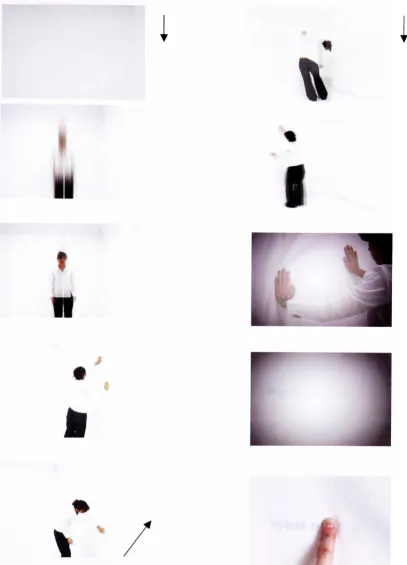
A human
subject(a female in
thisvideo)
suddenly is dropped into
acompletely
whiteroomwith whitewalls, ceilings,and
floors. She looks
aroundturning
her
head
asif
sheis
trying
to
figure
out wheresheis,
but
there
is nothing
aroundbut
the
white walls.She
starts
to touch
andsearchesthe
wallswithher
hands,
then,
sherealizesthewallsare coveredby
a whitefabric. As
she continuesto
searchthe
whitefabric
walls,
shefinds
writtenwordsbehind
thefabric. The
words appearthroughthe
whitefabric
when she pressesthe
translucentfabric
againstthe
walls.She
runsher fingers
overthe
fabric
along
the
wordsto
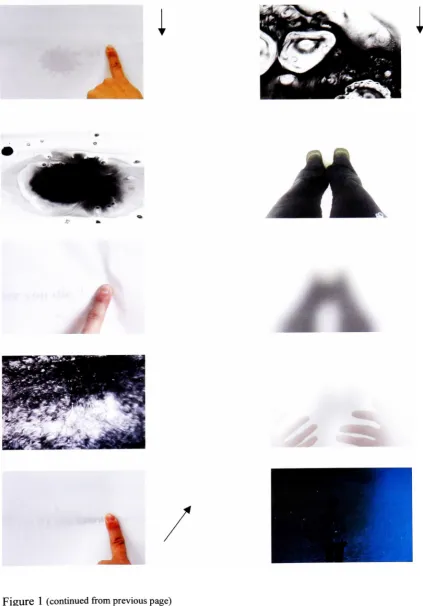
revealthem."Why
do
youexist?"Right
afterthesentence,
anabstractimage
appears;
black ink
is
gushing
outandcovering
a white screen
rapidly
whilechanging its
abstractform,
like
abad
omen or evil.She
continuously
searchesand more words appearbehind
the
fabric.
"Where
were youbefore
you wereborn?
"The
next sceneinvolves
another abstractimage
with moreblack
ink.
"What happens
after youdie?
""How
do
youknow
youreally
exist?""How
do
youknow
things
youseereally
exist? "She suddenly
feels
anxious and uneasy.As
shelooks
ather
hands
they
begin
to
disappear into
the
white spacealong
withher
legs.
Images
ofthe
universegradually
overlap
ontop
ofher.
She is slowly
andquietly
assimilated anddisappears into
thewhite space.There is
only
tranquilly
andserenity
ofthe
whiteroomleft behind.
(Conceptual Description
andGoals
ofthe
videowork)
Closed
Space
(The Room
the
video wasshot)
The
roomrepresentsthe
physicalexistence of ahuman
Emptiness
ofthe
spaceThe
emptiness ofthe
spacerepresentsthe
state when we areborn
into
this
world.We
start our
lives from
nothingness;
the
memoriesfrom
our ancestorshave been
storedin
ourgenes
but
ourbrains
seemto
carry
noinformation
-They
areempty.White Fabric
Just
asthe
skin ofhumans delineates
the
inner-self from
the
externalworld,
sodoes
the
white
fabric.
It
serves asthatskinto
act as a physicalboundary
between
theinside
andthe
outside.The
fabric
also acts as aveil.The
ontological questions areplacedbehind
the
fabric.
They
arefundamental
questionsto
human
existence,
but
peoplearetoo
busy
in
their
everyday
lives
to think
aboutthem.
The
questions are"veiled"
from
ourbusy
lives
and arejust
onethin
veilaway
from
ourconsciousness.The
Color White
The
color white represents nothingness-when
babies
areborn,
they
startfrom
nothing.White
also symbolizesthe
existenceofeverything;
when all colors ofthe
rainbowconverge,
it becomes
white.The
white also symbolizes"Fog."Our
lives
arefull
ofuncertainty;
wedon't know
ourfuture. As
we gothrough
life,
we are surroundedby
the
uncertainly
ofit,
just
asthe
personin
thevideo walksthrough the
fog.
Touching
andExploring
the
Fabric
by
Hand
Exploring
the
fabric
by
hands
represents anindividual's
searchfor
themeaning
oflife,
and
the
human
identity
both
in
natureandin
the
universe.Abstract
Ink Images
The
abstractink images
imply
the
feeling
ofuneasinessandanxiety
whichcomesfrom
theunknownandthe
uncertainty
ofhuman
existence.This
videois
about ourlives;
from
the
timewe arebom,
to the
timewedie,
searching for
the
answersto
who we are and whatthe
purpose of ourlives
are,
but
inevitably dying
without
them.
At
the
beginning
ofthe scene,
ahuman
subjectsuddenly
appearsin
theempty
space.This
denotes
the
birth
ofthe
personinto
this
world.The human life begins from
nothingness.
We know
nothing
when we areborn;
nordo
weknow
where weare,
whowe
are,
andwhy
we arehere. Our first
clueto the
world aroundusis
throughtouch.Newborn
babies
try
to
figure
outtheworld aroundthem
by
touching,
andthey try
todistinguish
the
boundaries
between
theirbodies
and othersby
touching (Platek,
Thomson,
&
Gallup
2004).
After
thepersonin
the
video appearsin
the
empty
space,
shestarts
exploring
the
white walls withher
hands.
This
actimplies
how
we understandthe
world around us.
The
personin
the
video continuesto
explorethewalls.This
gestureimplies
thatwe arestruggling
to
survive andsearching for
the
meaning
ofourlives. We
areoccupiedby
oureveryday
busy
lives
and struggletosurvivein
this
society.The
gesture ofexploring
thewhite walls also suggests
seeking
the
future. Our lives
arefull
ofuncertainty;
wedon't
know
the
future. It is just like
we arewalking
throughwhitefog,
as suggestedby
thewhite
fabric. We usually forget
and suppressthesefundamental
questionsin
ourbusy
lives.
However, they
sometimes cometosurfacein
ourconsciousness,
just
asthe
writtenwords appear
behind
thewhitefabric.
Once
werecallthe
fundamental
questions oflife,
they
in
turn
invite
otherquestions,
andan
uneasy
feeling
ofthe
unknowngradually
overtakeus,
just
astheblack ink in
thevideospreads and
eventually
overtakesthe
white surface.We
searchdesperately
for
theanswersbut
weleave
thisworld withoutthem.
Just
as weare
bom into
this world,
we returnback
to
nothingness(like
the
personin
the
video1
1
*
t
1
m
$
a
1*
[image:23.546.72.480.35.601.2]/
Figure 1
VideoWork
1
1
J\
Jp
j^
[image:24.546.62.486.37.644.2]Figure
1
(continued frompreviouspage)Video
Work [image:25.546.90.238.37.356.2]INSTALLATIONS
Installation
1
Figure
2,
Untitled
(Materials)
White
fabric
Words
printed on papers(Words
onthe
Wall)
"Please
feel free
to
walkin
to the
roomand explorethe
walls with yourhands.""This
room representsthe
worldofhuman
beings.
We
aresuddenly born into
the
worldwithout
knowing
the
meaning
of our existence.We
arestruggling
to
find
this meaning,
but leave
the
worldwithoutthe
answers."(Visual
Description)
Installation 1
is
a4
feet
x8 feet
roomwith allthe
surfaces(the
ceilings, the
floors,
andthe
four walls)
coveredby
whitefabric. The
light
sourcecomesfrom
the
ceiling
through
the
whitefabric. The light
reflects onallthe
white surfacesandcreatesabright
whiteroom.
On
the
wallsarewrittentexts
hidden behind
afabric. The
roomis
designed
to
be
The
writtentexts;
Where
were you priorto
yourbirth?
What
willhappen
after youdie?
What is
existence?Why
do
you exist?What
is
the
meaning
ofyourexistencein
this
world?How
do
youknow
youreally
exist?How
do
youknow
the things
you seereally
exist?What
is
this
worldthat
we areliving
in?
Was
there
abeginning
to this
world?If
so,
whatwasbefore
thebeginning?
Will
this
worldend?Then,
whatwillhappen
afterthe
end?Is
time
infinite?
If
time
is
infinite,
how does
infinity
existin
this
world?Is
there
abeginning
to time?
If
so,
whatdid
existbefore
time?
If
the
world wasborn
from
nothingness,whatis
nothingness?(Scenario
withthe
Audience)
A
vieweropens a white curtain and entersthe
installation
room.The
curtain closesby
itself
behind
theviewer,
andthey
are within anempty
space with white walls.The bright
white space surrounds
the
viewerin
silence.The
vieweris
now at aloss
-"what
is
this
place,
what amI
supposedto
see ordo
here?"A
whilelater,
the
viewer noticesthat the
walls are covered
by
a whitefabric,
and startsto touch
andexploreit.
Then,
they
seesomething
behind
thefabric.
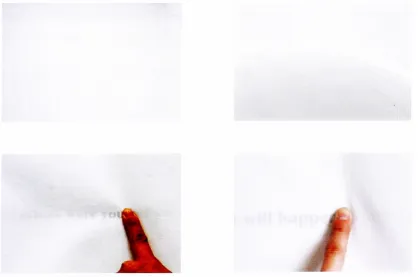
Suddenly,
wordsappear:"Why
do
youexist?"
The
texts
appearthrough the
whitefabric only
whenthe
fabric is
pushed againstthe
wall.The
texts
are arrangedsporadically
onthe
walls.In
orderto
readthe
texts,
onehas
to
press
the
fabric
againstthe
wall and runit along
the
entirelength
ofthe
sentence.The
audience searches
for
morehidden
wordsby
exploring
the
surfaceofthe
fabric.
[image:28.546.64.483.358.635.2](Linguistic
Expression)
Influence
ofConceptual Art
There
was atime
whenI
wasstrongly
influenced
by
60's
conceptual art.I
wasnotvisually
impressed but
rather moreinterested
by
the
way
they
expressedtheir
conceptsthrough the
medium of art.Furthermore,
theenergy
anddriving
force
that
they
usedto
try
andbreak
throughthe
conventional ways ofexpressionfascinated
me.The
use oflanguage
as an artform
was often what was usedby
the
artists.Their
conceptslargely
influenced
meto
uselanguage
onthis
installation.
For
instance,
Lawrence Weiner's
work,
AN ACCUMULATION OF SUFFICIENT
ABRASION TO REMOVE ENOUGH OF AN OPAQUE SURFACE TO LET LIGHT
THROUGH WITH MORE INTENSITY
(1981),
has
no visual object exceptthe
wordswritten on
the
wall.Because
visualinformation
is
not givento the viewers, the
audienceimagines
the
scenefreely
from
the
sentence.The images
areprivateand existsonly in
the
viewers mind.AN ACCUMULATION
OF
SUFFICIENT
ABRASION TO
REMOVE ENOUGH OfAN OPAQUESURFACE TOLET ItChT THHCaEHWINmi mmLawrence
Weiner,
AN ACCUMULATION OFSUFFICIENTABRASIONTO REMOVEENOUGHOF AN
OPAQUE
SURFACE TO LET LIGHTTHROUGHWITH MOREINTENSITY
(1981)
Weiner's
sentences are writtenhorizontally
andthe
worklimits
visualexpression.But
Robert
Smithson's
Heap
of
Language
(1966)
creates a visual expressionby
how
the
words arearranged.
Over
100
wordsrelatedto
language,
such as 'phraseology' and'hieroglyphic'
are written side
by
side and arrangedinto
atriangular
shape.The
word,
'language'
is
placed ontop
ofthe
triangle
(Rorimer
75). In
additionto the things
viewersimagine from
the
writtenwords,
this
triangular
shape also makesthem
associateit
to
something
such as amountainor a pyramid.The
shapesthat the
words create arestillabstract enough
to
givethe
viewersthe
freedom imagination.
Robert
Smithson,
Heap
ofLanguage(1966)
While Weiner
andSmithson
tried to
release onefrom
the
chains of afixed image
andencouraged viewers
to
create privateimages
oftheir
ownfrom
writtenwords,
Robert
Barry
intended
to
expressinvisible
concepts,
suchas emptinessandinfinity
through
language.
For
example,
his
Inert
Gas
Series: Helium (2
cubicfeet),
exhibited atSeth
Siegelaub
Gallery
in
March
1969,
showed novisual objectexcept a statement mentionedon
the
catalog:'Sometime
during
the
morning
ofMarch 5.
1969,
two
cubicfeet
ofHelium
willbe
releasedinto
the
atmosphere'(Rorimer 85). The
viewerstry
to
imagine
the
scenefrom
his
statement.He
described
the series,
theseworks are"made
of variouskinds
ofenergy
which exist outside of narrowarbitrary
limits
of our ownRobert
Barry,
Inert GasSeries:
Helium (2cubicfeet)
1969*Thephoto wastakenastherecord oftheproject and usedfor
his
posterforotherexhibitions.
The
goalsfor
these
conceptual artistsin
the
60's who employedlinguistic
expressionwasto
release onesimagination
from
the
physical existence ofconventional visualimages,
such as
paintings,
drawings
andsculptures,
andto
let
viewersimagine
freely
from just
the
language.
Ian
Wilson,
whois
also a conceptual artistusing
linguistic
expression,
described
his
work as'I've
freed
artfrom
a specific place.It
is
now possiblefor
everyone.
I'm
diametrically
opposedto the
precious object.My
artis
notvisual,
but
visualized'
(Rorimer
91).
I
usedlanguage
for
the
first
model ofthis
installation.
At
the critique,
it
was suggestedthat
I
usetwo
orthree-dimensional
images
instead
oflanguage,
however I
choseto
uselanguage because like
Weiner
andBarry,
I
tried
notto
give viewersfixed
images,
namely
my
images
abouthuman
existence.The
questions ofhuman
existencearefundamentals
that
allhuman beings
share,
but
ourideas
and perspectives aredifferent
depending
on ourdifferent
cultural and religiousbeliefs.
If I
expressthese
ontological questionswith visualimages,
the
reflection ofmy
culture,
religionand private views onthe
images
cannotbe
avoided.Visual
images
actas
distracters
andprevent onefrom
fully
andpurely
focusing
onthe
questions ofhuman
existence.
To
avoid such asituation,
the
expressionshouldbe
universalandhence
language is
a suitablemediafor
this
universalexpression.My
targeted
audiences are allpeopleregardless of
their race,
ethnicity,
nationality,
culture orbeliefs.
The
writtentextsonthewallsarethe
same questions thatthe
westernphilosophershave
been
pondering
for
centuries aswellasthe
questionsthat
I had
whenI
was achild.However,
thelanguage for
thisinstallation
wastoo
direct
and notattractive.The
styleofthe
sentencesneededto
be
exploredmore,
such asby
adopting riddles
orpoems.Ian
Wilson's
text
is
a good example.His
text
from
adiscussion
abouthis
artwork,held
atStedelijk Van
Abbe
museum,
Eindhoven
in
March
1983,
appearedonthe
invitation
cardsfor
theproject.that
whichis
both
known
andunknown
is
whatis
known
that
whichis both
known
andunknown
as
both
known
andunknown
whatever
is
known
is
just
He
appliedthe
Socratic
methodto
thistext
and encouragedthe
discussion
aboutthe
relationship between
the
known
andthe
unknown.While
words andtext
carry meanings, I
tried to
create avisual effectby
arranging
words,
like Smithson.
For
the
first
model ofthis
installation,
the
sentencesweredispersed
onfour
walls,
but they
were writtenhorizontally,
like
Weiner's
work,
and placed almost atthe
sameheights
as people's shoulders.At
acritique,
I
receivedcommentsthat
afterviewers
found
the
first
text,
they
wouldeasily
predictthe
places ofthe
rest ofthetexts
with
this
arrangement,
sothat there
wasnorolefor
the
whitefabric
hiding
them.
So for
thesecond model of
this
installation,
I
tried to
arrangethe texts
in
away
that
viewerscould not predict
their
locations.
The
second model was not a roominstallation,
but
ratherconstructedby
3 feet
x7
feet
flat
surface with whitefabric
covering
andhiding
the texts
onthe
walls.The
texts
wereno
longer
writtenhorizontally
norwereat comfortableheights, instead,
they
werewinding,
curling,
andup
sidedown
andranfrom
thefloor
to
the
heights
ofpeople'sheads.
Furthermore,
I
connectedthe texts
andcreating
a person'sprofile withthelines. I
also
tried to
representhuman beings
by
visualimages,
because
the
questionswereabouthuman
existence.I believe that, like
Smithson'
s
work,
thisimage
wasabstract enoughthat
it didn't
reflectmy
own cultural or religiousbiases.
Only
afew
peopleactually
noticedthe
shapeofthe profile,
but I
receivedgoodfeedback
from
the
viewersabouthow
they had
to
find
the texts
using
their
entirebodies. The
secondmodel was exhibited
for
theGesture Show
atGallery
rin
Rochester
in 2003. In
order
to read, the
viewershad
to
movenotonly
theirarms,
but
their
entirebodies
sometime
squatting
andgetting
ontheir tiptoes
ortilting
their
bodies.
I
carriedthis
idea
into my
final
modelofthis
installation,
which was exhibitedatmy
thesisshow.
The
ontological questions were placed onthe
walls with similararrangementsas
the
secondmodel.However,
I
noticedthat
thenumberofthe
ontologicalquestionsthat
I
prepared would notbe
enoughto
createahuman
image,
andit
endedup
with
just
arrangedtexts.
This
neededfurther
exploration.(Audience
Participation)
In
this
installation,
the
audience participatedby
touching
the
walls andfinding
hidden
words.
The
purpose ofthisaudience participation wasto
involve
and engagethem
actively.
However,
sometimes audience participation makesthe
artworkbecome
moreaform
ofentertainmentand
the
conceptbehind it
may
be
compromised.The
media-artinstallation,
The
Marionette,
andthe
installation/
performance,
Sodan
Cafe,
are such examples.The
media-artinstallation,
The
Marionette,
was createdby
anAmerican
artist,
Douglas
Stanly,
and exhibitedin
IC
museumin Japan
in
1997. It is
comprised ofananimatedpicture of a puppet
that
is
projectedonthree
walls.The
audienceis
encouragedto
participate and
interact
withthe artwork,
manipulating
thepuppetby
pulling
three
handles
on atable
placedin
the
center ofthe
room.When
the
pulleys arepulled,
aninternal
motor pullsback
withthe
sameforce
preventing
the
audiencefrom manipulating
the
puppet.This
in
turn
encouragesthe
audiencesto
question whetherthey
aremanipulating
the
puppetor whetherthepuppetis
manipulating
them.
With
this,
the
artisttries to
imply
the
cynicalrelationship between human
beings
andtechnology.
For
example, computers,
cell phones andpagers are supposedto
improve
the
quality
of ourlives, however,
weoftenfeel
that
we are"chained"to these
objectsandarecontrolledby
them.
Like The
Marionette,
the
installation /
performance,
Sodan
cafe,
requiresthe
audience'sparticipationaswell.
In
this artwork,
aJapanese
artistcreates aworking
cafein
Watarium
museumin
Japan for
3
monthsin 1997.
"Sodan"
means
to
advise orto
consultin
Japanese. With every cup
of coffeeserved, the
artistalsohands
outa questionnaireto
the
"customers"(audience)
asking
them to
givesuggestionson waysto
improve
the
cafe.Every
two weeks,
theartist changes thecafe,
suchasthe
furniture
orthe
interior
decoration
andthe
servicebased
onthe
suggestionsthat
he
receives.The
artist's messagethe
audience andinvolves
them
in
themaking
andshaping
ofhis
artwork(i.e.
thecafe).Initially,
the
audienceis
surprisedby
this
style of artwork.However,
they
are soonintrigued
by
their
involvement
in
the
making
ofthecafeto
such adegree
that
they
returnto
seehow
their
suggestionshave
changedthe
artwork.The Marionette
andSodan
Cafe,
both involve
audience participationbut
usedifferent
approaches
to
attainthisgoal.One
tries to
connect withthe
audienceby
getting
them
physically
involved
andthe
otherby
providing
the
audiencethe
opportunity
to
giveinput
into
the
running
ofthe
cafe.The Marionette
is
successfulbecause it
captures people'sinterest
and conveysthe
conceptthrough
theaudience's physical experience.As human
beings,
we are curiousindividuals
and are moredrawn
to
objectsthat
needto
be
exploredthan
thosethat
don't
pose a challenge.The
work,
by
itself,
is incomplete
unlessthe
audience
physically
pulls onthe
handles.
By
doing
so,
aninteraction
between
the
artwork and
the
audienceis
established andthe
artworkis
nowcomplete andthe
audienceis
better
ableto
sensethe
conceptbehind
the
artwork.There
are advantages anddisadvantages
to the
artworksthat
require audienceparticipation.
The
advantageis
that the
participationform
invites
people'sinterest
toward
the
art.People
are more curiousto
see a piecethat
has
ahidden
part ratherthan
apiecewhich
already
reveals everything.Audiences
alsotend to
spend moretime
withthe
artwork.
However,
the
disadvantage
is
that
theinstallation may be
too
entertaining
andit
may
distract
peoplefrom
understanding
the concept,
asis
the
casewiththe
So
dan
Cafe.
The
cluesdon't have
to
convey
the
artist's experiences orthoughtsaccurately,
but it
should
be broad
enoughto
allowthe
audienceto
have
a morediverse
way
ofthinking
andinterpreting
the
artwork.Installation 1 is
createdwiththis
intention.
I
tried
to
engagethe
audiences withthe
workby letting
themtouch the
fabric
andsearchfor
the
hidden
words.The
work would notbe
completedwithoutaudience
participation,
withoutthem
it
wouldbe just
anempty
whiteroom.
(Goals
ofthe
Installation
andReflections)
In
the
videowork,
the audience watchesthe
video of someone else's experience.This
is
an objectiveexperience.
However,
in Installation
1,
the
audienceactually
experiencesthe
installation
for
themselves.
This is
a subjective experience.Although Video
andinstallation 1
were showntogether
atthe
thesisshow, these two
worksstandindependently.
My
intention
wasto
makethe
audiencethink
ofthepurpose ofthe
roomwhenthey
entered
it
andby
finding
andreading
the
writtenwords,
I
tried to
encouragethe
audienceto
recallthefundamental
questions ofhuman
existencethat
they
mighthave
thoughtabout when
they
were children.My
purposein
encouraging
the
audienceto
explorethewhite room was notonly
metaphoric
(our
lives begin from
nothingness),
but
I
also wastrying
to
create an"engaging"
experience.
Today,
welive
in
a world ofinformation
overload.Media,
advertisements,
evenworks ofart
try
to
grab our attentionin
different
ways and we choosewhatinformation
we wantto
conveniently
absorb.We
are not"active"
in
understanding
the
information
that
bombards
us.It
is
conveniently
packagedin
waysthat
areeasily
received and appreciatedby
us.The
purpose ofthis
installation
wasto
attemptto
convertthe
audiencefrom
apassive viewerof
the
artworkto
an activeexplorerofthe
artworkTo
appreciatethis,
theviewers
had
to
walk around anddiscover
the
hidden
wordsbehind
the
fabric.
I
had hoped
that theaudiencewouldspontaneously
explorethe
installation
ontheir
ownbut it
wasdifficult
to
makethem
noticethe
writtenwordsbehind
the
fabric.
By
placing
anote
in
front
ofthe
installation
that read,
"Please
feel free
to
walkinto
the
room andA
commentI
receivedwasthat the
installation
providedaplaceto
meditate.This
wasoneof
my
objectives.I
wantedto
create anatmosphere of"emptiness"
where
the
audience could reflecton what
it
meantto
exist.Installation
2
Figure
3,
Untitled
(Materials)
White Vellum Paper
(to
cover walls andfloor)
Black Ink
Glue
Meshed Metal Wire (to
makethe
dome
shapedobject)
Plastic
wire(to
hang
the
dome
shaped objectfrom
the
ceiling)
[image:38.546.138.464.394.638.2](Words
onthe
Wall)
(These
texts
were placedin front
ofthe
installation
entrance.)
"Please feel free
to
walkin
theroom.""I
believe
that
human beings
arejust
apart ofthe
universe-Just
like
astonein
ariver.
All
existencesin
the
world are equal.There
is nothing
above andnothing
below
us.However,
because
wejust happen
to
possesspre-eminent powers ofthought,
the
human
race expands and continuesto
multiply
uncontrollably.As
aresult,
we consume natural resourcesaggressively
anddestroy
the
harmony
ofnature.
As
part ofnature,
we arestruggling
to
find
the
meaning
of our existenceand our
identity
withinit."y
j
:
*Figure
3-2
Installation2(detail)
[image:39.546.76.482.340.641.2](Visual
Description)
Installation
2
is
a12
feet
x8
feet
room.The
roomis
shutin from
the
outer worldby
four
walls,
aceiling
and afloor.
The
light
sourceis
only
the
domed-shaped
object(about
3
feet in
diameter)
that
is
floating
about4.5 feet
abovethe
centerofthefloor
hanging
from
theceiling.
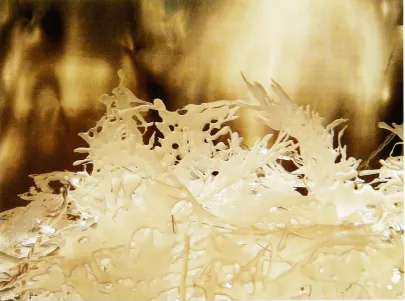
The dome
is
formed
by
meshed metalwireandcoveredby
countless whitetranslucent
substances(made
by
glue)
that
are shapedlike flat
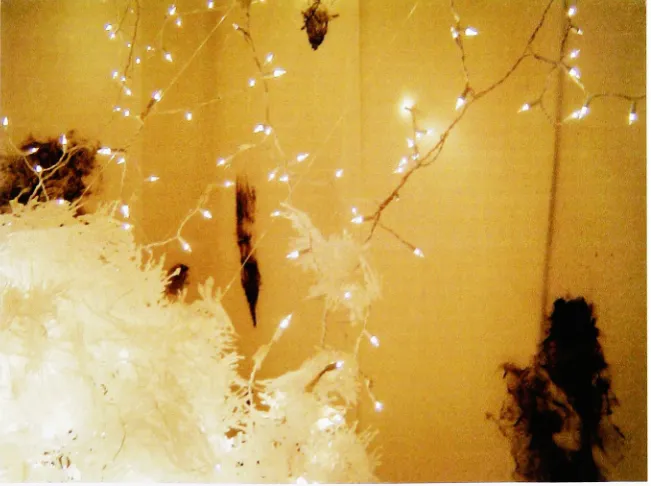
amoebas.Countless
smalllight bulbs
are placed underneaththe
amoebas.Although
each amoebais
flat,
they
areoverlapped
vertically
andhorizontally
on each other.The
whitelight from
underneathcauses
the
amoebasto glow,
casting
shadowsoneachotherasthough
they
arealive.As
awhole, the
dome's
dim
light
softly
illuminates
the
installation
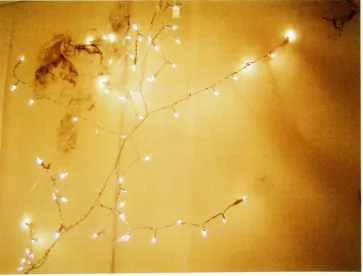
space.Several
whitecordswithsmall
light bulbs
areemerging from
the
dome like
tentacles,
forming
tree-likebranches,
andstretching
upwardstowards the
surrounding
walls.When
the
cordsreachthe
walls,
they
crawlonthe
wallslike ivy. The intersection
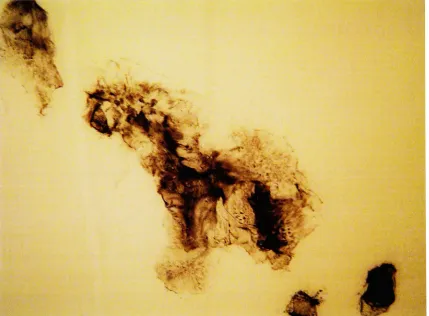
ofthe
cordsandthe
whitewalls are stained
black resembling
corrosion.There
is
also a swirl-shapedblack
stainonthe
floor
underneaththedome,
the
same size asthe
dome. A
curtainfalls behind
the
[image:40.546.113.439.417.660.2](Conceptual
Description)
Dome
The
dome
representsthe
human brain.
The
amoebalike
shapedobjects represent neuraldendrites,
andthecords representneuralaxons.The
smalllight
bulbs
representfiring
neurons
(see
the
diagram
3,
P8). The
dome
alsosymbolizesaliving
organism.The
amoeba
like
objects,
withtheir
irregular
wavy
shaped,
represent energetic movement ofthe
organism.The light
bulbs
symbolizelife. The heat
thatthe
light bulbs
createrepresent
the
organism'sbody
temperature;
the
light bulbs
that
areturned
onrepresentlife,
and onesthat
areturned
offrepresentdeath. The
cordsthat
stretchin
alldirection
like
tentacles
ortree
branches
representthepower ofthe
growing
living
creatures.The
[image:41.546.61.491.324.640.2]dome
representsthe
existence ofthe
human
being
in
nature.Figure 3-4
Installation2(detail)
Figure 3-5
Installation 2(detail)
Walls
The
dome is
surroundedby
walls and aceiling just
ashuman beings
are surroundedby
nature.
Cords
The
movement ofthe
outstretchedcordsfrom
the
brain
into
the
surrounding
environmentrepresents
the
development
ofthe
human
brain,
along
withhuman
greed andthe
desire
to
gain more
knowledge
whichhas
led
to
theuncontrolledconsumption of naturalBlack Stains
The
black
stainedintersection
wherethe
cordstouch
the
walls representhuman
contactwith
nature,
andthe
blackness
representshuman's
destruction
ofnature.The
swirl-shaped
black
stain onthefloor
representsthe
dilemma
that
human beings
face
between
the
moralinstinct
to
help
others andthe
animalinstinct
to
kill
andsurvive.We
can'thelp
destroying
naturebecause
wehave
to
consume otherlives
in
orderto
survive.However,
[image:43.546.95.459.307.583.2]our moral
instincts
makesusfeel guilty
ofthis
act.Figure 3-6
Installation2(detail)
r
J^
S.
*
i
[image:44.546.115.438.80.324.2](r-V .4*
(Goal