Int. J. Electrochem. Sci., 14 (2019) 3070 – 3080, doi: 10.20964/2019.03.43
International Journal of
ELECTROCHEMICAL
SCIENCE
www.electrochemsci.org
First Principle Study of New W
2N Monolayer: a Promising
Candidate for Li
+ion Batteries
Shafiq Ur Rehman1, Sayed Ali Khan 1, Waqar Uddin2 , Qudrat Ullah Khan1, Maryam Kiani1, Ikhtisham Mehmood1, Muhammad Sohail 3 , Muhammad Saeed3 , Sachin Kumar1, Ling Zhu1*
1 Shenzhen Key Laboratory of Flexible Memory Materials and Devices, College of Electronic Science and Technology, Shenzhen University, Nanhai Ave. 3688, Shenzhen, Guangdong 518060, P. R. China 2School of Chemistry and Chemical Engineering, Anhui University, Hefei 230601, China
3I nstitute for advanced study, Shenzhen University, Shenzhen, Guangdong 518060, P. R. China *E-mail: [email protected]
Received: 27 July 2017 / Accepted: 23 January 2019 / Published: 7 February 2019
We have predicted new anode material W2N monolayer for the application of Li+ ion batteries by using first principles calculation. The W2N monolayer is found to be stable energetically and dynamically as well. It is also found that W2N monolayer is metallic in both IT phase and in 2H phase. Furthermore, the calculated open circuit voltage for the Li+ adsorbed W2N monolayer is 0.88V which is suitable voltage for a commercial anode material. The calculated diffusion barrier for the Li+ ions on the surface of W
2N monolayer is 0.22eV. Due to low diffusion barrier the ions will easily flow over the surface of W2N monolayer. This will boost the electronic conductivity which is the requirement of an efficient Li+ ion battery.
Keywords: W2N monolayer, electronic structure, Li+ ion battery, adsorption and binding energy, storage capacity, open circuit voltage.
1. INTRODUCTION
[6,16-18]. The most widely used 2D material graphene have played an important role to improve the electrochemical performance of the LIBs. The excellent electrical and chemical properties and low cost of graphene make it a potential candidate for the applications in LIBs [4,1]. Many more 2D materials like, silicene, transition metal dichalcogenides and MX-enes have also shown better electrochemical performance and hence successfully used as anode materials in LIBs [7-10,13,6].These two dimensional semiconductor monolayer materials are best consider for the rechargeable batteries as an anode. For example the transition metal carbides (Mo2C and W2C) monolayers have metallic nature, high mechanical strength, thermal and dynamical stability and high charge capacity, such characteristics make transition metal carbides a promising candidate for application to the LIBs [19,5]. Similarly, the other 2D monolayers MoS2, MoSe2, TiS2 and SnS2 have been synthesized both experimentally and theoretically. The electrodes based on these 2D monolayers have been successfully employed in LIBs [20,11,21-24]. It is found experimentally, that MoS2 has a high storage capacity and is consider a promising anode material for the LIBs [25,26]. First principle calculations have shown that MoS2 monolayer have high adsorption energy and low diffusion energy barrier [27]. But MoS2 monolayer is a semiconductor material with direct energy gap 1.8eV, which cause a failure to good electrical conductivity in the MoS2 monolayer and hence, limits its electrochemical performance. Therefore, an alternate ideal candidate (anode material) is required to circumvent this barrier. Density functional theory (DFT) can be used to predict new efficient anode materials, for example VS2, MoS2, W2C and TiS2 monolayers has been investigated using DFT, which have high adsorption capability to the Li+ ion and also have high Li+ ion storage capacity [28-30]. Similarly, other low dimensional materials have been predicted theoretically and later successfully prepared in experiment and their electronic, electrical and optical properties have been studied [31-34]. Very recently, W2C monolayer has been predicted using first principle calculation and is expected to achieve in experiment [30]. Therefore, in this study we employed the same theoretical approach (DFT) and predict a new monolayer W2N with metallic character having open circuit voltage 0.8V. This value of open circuit voltage is very near to the calculated open circuit voltage of MoS2, VS2 and W2C monolayer predicted by density functional theory calculation [28-30]. Similar to the reported (Mo2 N,W2C) monolayers we also predict, that W2N monolayer exist in to two phases called 2H phase and 1T phase [34]. In 2H phase the N atom is sandwiched between two W atoms with AB stacking while in 1T phase the N atom is sandwiched between two W atoms with ABC stacking. The 1T (ABC stacking) and 2H (AB stacking) monolayer structures of W2N are shown on left side of Figure.1 respectively. Since, in this paper we actually present (W2N monolayer) an analogue to the previously predicted monolayers, with high electronic mobility, high specific capacity and high kinetic stability, which are the requirements of an efficient battery.
2. METHODOLOGY
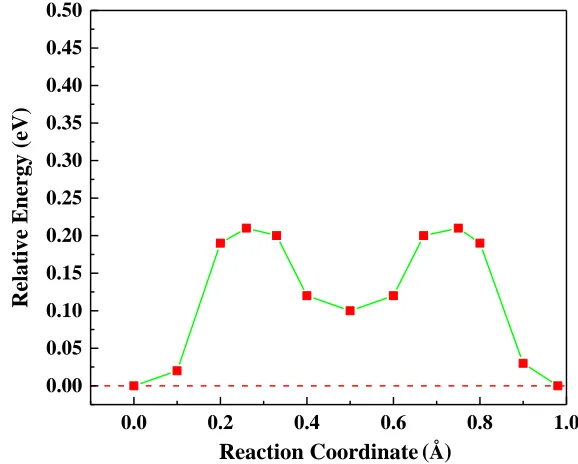
total energy is less than 10-4 eV and the error in the forces is smaller than 2×10⁻² eV/Å. Phonon calculation was performed with the phonopy code to find the dynamic stability of W2N monolayer. The nudge elastic Model (NEB) were used to study the minimum energy path for the flow of Li+ ion from one T2-site to another T2-site on the surface of W2N monolayer and to estimate the Li+ ion diffusion barrier [37].
3. RESULT AND DISCUSSION
We first built the bulk structures of W2N in two different phases i.e 2H-phase and 1T phase and then convert each structure in to pristine monolayers as shown on the left side of Figure.1.These monolayers were relaxed and their structure parameters were studied. The relaxed lattice parameters for 2H phase of W2N monolayer is (a=b= 2.84Å) and the bond length W-N is (2.16Å) and for 1T monolayer lattice parameters (a=b= 2.89Å), bond length (W-N=2.12Å) which were in agreement with the reported work [30].
0 2 4 6 8 10
(b)
Frequency (
THz)
(a)
L
K
[image:3.596.70.540.322.482.2] K L
Figure 1. Left side, 1T and 2H structures of W2N monolayer respectively. Right side, the calculated phonon band structures for the dynamical stability of W2N monolayer a) for 1T-phase b) for 2H-phase.
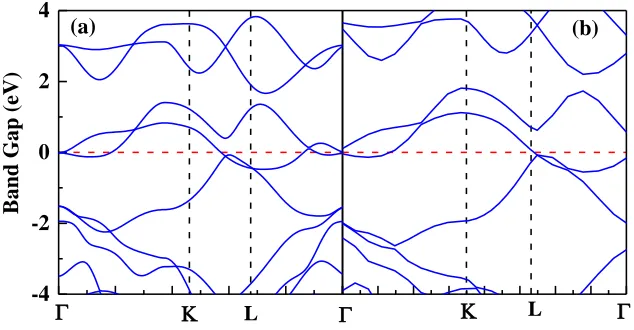
-4 -2 0 2 4
Band Gap
(eV)
(b)
L L
(a)
[image:3.596.145.462.547.712.2]
The energetic stability were found with the formation energy formulaEf (EW N2 2EW EN) / 3 . Where EW N2 is the energy of a single W2N layer per unit cell, EWand ENare the energies of W and N atoms respectively per unit cell. The calculated formation energy for W2N in 2H phase is -8.25 and in 1T phase is -8.47. The negative formation energy shows that both phases of W2N are stable. Further the dynamical stability of 2H and 1T phase of W2N were checked with the phonon calculation. The phonon calculation on the right side of Figure.1 shows that both phases are stable dynamically. Because all frequencies are greater than zero and no imaginary frequencies are found. Furthermore, the electronic structures of W2N monolayer were studied in the term of band structure shown in Figure.2. It is found that W2N monolayer is conductor in both phases 2H and 1T. Because no band gap were found in the band structure and there is an overlapping behavior at the Fermi level.
3.1 Adsorption and Diffusion
[image:4.596.148.447.404.641.2]Adsorption and diffusion are two important processes through which we can study the suitability of a material for the synthesis of electrodes. Because adsorption of ions on the surface of electrode material gives us the charge storage capacity of the electrode material and diffusion is related to the electronic mobility and charge/discharge rate of the electrode material, the selection of the proper electrode material for a battery based on these terminologies.
-0.75 -0.70 -0.65 -0.60 -0.55 -0.50 -0.45 -0.40
T2 H2
Bind
in
g St
re
ngt
h (
eV
)
Li@W2N
[image:5.596.218.414.74.253.2]H1 T1
Figure 4. Adsorption energy as a function of Li+ion adsorption on a single W2N layer where T2, H1, T1 and H2 are adsorption site.
Therefore it is necessary to study the adsorption and diffusion of the Li+ ion on the surface of the W2N monolayer to confirm eighter W2N monolayer is a desirable electrode material for Li+ ion batteries. But for the adsorption of Li+ on the surface of W2N monolayer favorable adsorption sites are required, which is the site of minimum adsorption energy of Li+ ion on the W2N monolayer. Therefore we defined the adsorption energy
2 2 bulk
Ad LiW N W N Li
E E E E , where
2 LiW N
E is the total energy of Li+ ion adsorbed W2N monolayer,
2 W N
E is the energy of isolated W2N monolayer and bulk
Li
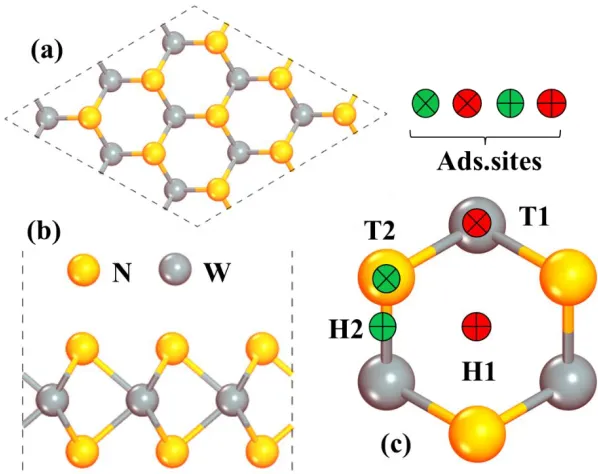
E is the total energy for the bulk Li+. Now we employ this formula to the W2N single layer to find the most favorable position for the Li+ ion adsorption on the W2N monolayer and then will consider the similar minimum energy position for the adsorption of all Li+ ions on the W2N nanosheet with 3×3×1 super cell. According to the geometry of the W2N monolayer we consider four possible positions for the adsorption of Li+ ion i.e the exact top positions on W and N are T1and T2 respectively as shown in Figure.3.
While H1 is the center of the hexagon and H2 is the center of the W-N bond length. The calculated adsorption energy for Li+ adsorption on each position is shown in Figure.4. Where the most favorable position for the Li+ adsorption is T2 i.e exact the top position of N. Because the ground state energy is at T2 position. The minimum adsorption energy of the Li+ ion at the T2 site is -0.77eV with a distance from T2 is 2.5 Å. Further, to see the effect of Li+ ion adsorption on the absolute binding energy in the 3×3×1 super cell we have calculate the absolute binding energies as a function of Li+ ion concentration x adsorbed on the surface of W2N monolayer with 3×3×1 super cell. Figure.5 shows the ball and stick model of Li+ adsorbed W2N monolayer (Li+@W2N monolayer). Figure.5 (a) shows the top view of Li+@W
Figure 5. The ball and stick models of Li+@W2N monolayer with 3×3×1 super cell after relaxation a) top side b) across view. Where the pink balls represents Li+.
The absolute binding energy of Li+ ions adsorption on the surface of W
2N sheet is given as
2 2
( ) /
bulk
b W N W N Li Li
E E E xE x. Where EW N2 is the total energy of the relax W2N single layer and
2 W N
E Li is the energy of Li+ adsorbed W2N monolayer system, bulk
Li
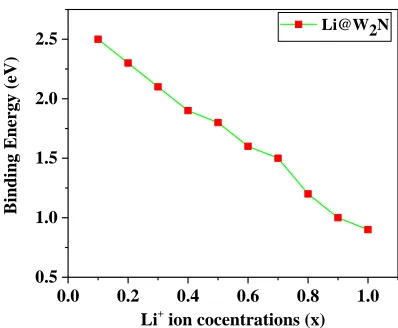
E is the energy of Li+ in its bulk crystal form and x is the number of Li+ ions. The calculated binding energy according to this formula is plotted in Figure.6. The higher binding energies of the Li+ adsorption on W2N monolayer means that Li+ ion transfer their charge to W
2N and make strong bonds with the surface of W2N monolayer and also shows high storage capacity of the W2N monolayer to Li+ ions. Furthermore, the dependencies of Li+ ions on the binding energies have been studied; the binding energy shows a linear decrease with Li+ ion concentrations. This is because every Li+ ion adsorbed on the surface of W2N monolayer give electrons to the W2N monolayer and gets positively charged so with the increasing Li+ ions the Li+-Li+ distance will be decrease and the coulomb electrostatic force between Li+ and N will be overcome by the strong repulsive force between Li+–Li+ ions. This will make apart the Li+ ions from the surface of the W
2N and result will be decrease in the binding energy. Hence the two factors the distance between the ions and the decrease in the net charge on the Li+ ions affects the binding energy. But still the binding energies are higher than zero so the adsorption of Li+ ions will not form a metal cluster. Second the higher binding energies for the Li+ ions means that the W
0.0 0.2 0.4 0.6 0.8 1.0 0.5
1.0 1.5 2.0 2.5
Bindi
ng
Energy (eV)
Li+ ion cocentrations (x)
Li@W2N
Figure 6. Binding energy graph for the Li+ adsorption on W2N sheet as a function of Li+ ion concentration; x=0.1–0.9
3.2 Open Circuit Voltage
The efficiency of a battery depends on the open circuit voltage (OCV); if the battery has low OCV it will be more reliable. Thus the electrode materials having low open circuit voltage are best consider for the application to the battery. Therefore we theoretically estimate the OCV by the reported equation
2 2
( ) /
bulk
OCV VLiW N VW N xVLi xe
. Where OCV is the open circuit voltage,
2 W N
[image:7.596.180.379.73.237.2]
0.2 0.4 0.6 0.8 1.0
0.0 0.2 0.4 0.6 0.8 1.0
0.33 0.40 0.44 0.50
OCV
(V)
Li+ ion concentration (x)
Li@W2N
0.88 0.82
0.75
0.67 0.60
0.56
Figure 7. Column graph representation of OCV Vs. Li+ ion concentration where the voltage rang is 0.88– 0.33V.
3.3 Specific Capacity
The amount of ions stored by a battery is term as specific capacity. The specific capacity of an electrode material can be defined as
2
1
/ W N( )
xF N mAh g
. Where is the specific capacity with SI
unit
1 (mAh g)
, xis the number of ions adsorbed on the surface of W2N monolayer sheet and F is faraday constant (26801mAh/mol) and
2 W N
[image:8.596.162.435.74.295.2]
0.5 1.0 1.5 2.0
-3 -2 -1 0 1 2 3
0.0 0.5 1.0 1.5 2.0
Li-9 Li
N W
Li-1
PDOS (ele
ctrons/eV)
[image:9.596.168.429.73.252.2]Energy (eV)
Figure 8. Projected Density of states (PDOS) for a) Li+ =1 and b) Li+ =9. The PDOS shows the metallic behavior of W2N during Li+ ions adsorption.
0.00 0.05 0.10 0.15 0.20 0.25 0.30 0.35 0.40 0.45 0.50
0.0 0.2 0.4 0.6 0.8 1.0
Reaction Coordinate
Relativ
e Ener
gy
(eV)
(Å)
Figure 9. Li+ ions minimum energy path from T2 site to near by T2-site through H-site on the surface of W2N nanosheet with calculated diffusion barrier is 0.22 eV.
[image:9.596.150.439.307.539.2]
4. CONCLUSION
In summery we have performed density functional theory calculations and predict W2N monolayer for the application to the Li+ ion batteries. The W2N monolayer is found to be stable energetically and dynamically as well. It is also found that W2N monolayer is metallic in both IT phase and in 2H phase. Furthermore, the calculated open circuit voltage range for the Li+ adsorbed W2N monolayer is 0.88-0.33V which is suitable voltage rang for a commercial anode material. The calculated diffusion barrier for the Li+ ions on the surface of W2N monolayer was found 0.22eV. Due to this low diffusion barrier the ions will easily flow over the surface of W2N monolayer. This will boost the electronic conductivity which is the requirement of an efficient Li+ ion battery.
ACKNOWLEDGEMENT
This work was financially supported by the grants from the Science and Technology Innovation Commission of Shenzhen (Grant No. ZDSYS201707271554071.
References
1. Y. Shi, L. Wen, G. Zhou, J. Chen, S. Pei, K. Huang, H.-M. Cheng, F. Li, 2D Materials, 2 (2015) 1-024004.
2. N.K. Jena, R.B. Araujo, V. Shukla, R. Ahuja, ACS Appl. Mater. Interfaces, 9 (2017) 16148- 16158.
3. L. Shi, A. Xu, T. Zhao, ACS Appl. Mater. Interfaces, 9 (2017) 1987-1994. 4. D. Er, E. Detsi, H. Kumar, V.B. Shenoy, ACS Energy Lett., 1 (2016) 638-645.
5. Q. Sun, Y. Dai, Y. Ma, T. Jing, W. Wei, B. Huang, J. Phys. Chem. Lett.,7 (2016) 937-943. 6. G.-C. Guo, D. Wang, X.-L. Wei, Q. Zhang, H. Liu, W.-M. Lau, L.-M. Liu, J. Phys. Chem.
Lett.,6 (2015) 5002-5008.
7. Y. Xie, Y. Dall’Agnese, M. Naguib, Y. Gogotsi, M.W. Barsoum, H.L. Zhuang, P.R. Kent, ACS Nano,8 (2014) 9606-9615.
8. X. Tan, C.R. Cabrera, Z. Chen, J. Phys. Chem. C, 118 (2014) 25836-25843. 9. C. Chowdhury, S. Karmakar, A. Datta, ACS Energy Lett., 1 (2016) 253-259.
10. D. Dubal, O. Ayyad, V. Ruiz, P. Gomez-Romero, Chem. Soc. Rev.,44 (2015) 1777-1790. 11. Y. Xiao, J.-Y. Hwang, Y.-K. Sun, J. Mater. Chem. A, 4 (2016) 10379-10393.
12. H. Zhang, M. Zhang, M. Zhang, L. Zhang, A. Zhang, Y. Zhou, P. Wu, Y. Tang, Journal of Colloid and Interface Science, 501 (2017) 267-272.
13. Q. Peng, X. Sun, H. Wang, Y. Yang, X. Wen, C. Huang, S. Liu, S. De, Appl. Mater. Today, 7 (2017) 169-178.
14. D. Er, E. Detsi, H. Kumar, V.B. Shenoy, ACS Energy Lett., 1 (2016) 638-645. 15. Y. Xiao, J.-Y. Hwang, Y.-K. Sun, J. Mater. Chem. A, 4 (2016) 10379-10393.
16. H. Zhang, M. Zhang, M. Zhang, L. Zhang, A. Zhang, Y. Zhou, P. Wu, Y. Tang, Journal of Colloid and Interface Science, 501 (2017) 267-272.
17. M. Moura, R. Barrada, J. Almeida, T. Moreira, M. Schettino, J. Freitas, S. Ferreira, M. Lelis, M. Freitas, Chemosphere, 182 (2017) 339-347.
23. F. Ersan, G.k. Gökoğlu, E. Aktürk, J. Phys. Chem. C, 119 (2015) 28648-28653. 24. L. Jiang, B. Lin, X. Li, X. Song, H. Xia, L. Li, H. Zeng, ACS Appl. Mater. Interfaces,
8 (2016) 2680-2687.
25. G. Du, Z. Guo, S. Wang, R. Zeng, Z. Chen, H. Liu, Chem. Commun., 46 (2010) 1106-1108. 26. H. Hwang, H. Kim, J. Cho, Nano lett., 11 (2011) 4826-4830.
27. Y. Li, D. Wu, Z. Zhou, C.R. Cabrera, Z. Chen, J. Phys. Chem. Lett., 3 (2012) 2221-2227. 28. D. B. Putungan, S-H. Lin, J-L. Kuo ACS Appl. Mater. Interfaces,8 (2016)18754-18762. 29. E. Yang, H. Ji, and Y. Jung, J. Phys. Chem. C, 119(2015), 26374.
30. J. Li, S. Xiong, Y. Liu, Z. Ju, Y. Qian, ACS Appl. Mater. Interfaces, 5 (2013) 981-988.
31. H. Zheng, X-B. Li, N-K. Chen, S-Y. Xie, WQ. Tian, Y. Chen, H. Xia, S. Zhang, H-B. Sun, Phys. Rev. B 92 (2015) 115307.
32. L. Guan, G. Chen, J. Tao, Phys.Chem. Chem. Phys., 18(2016) 15177-1518. 33. C. Bacaksiz, R. Senger, H. Sahin, Appl Surf. Sci., 409(2017)426-430.
34. M. Safari, Z. Izadi, J. Jalilian, I. Ahmad, S. Jalali-Asadabadi, Phys. Lett. A, 381(2017) 663-670 35. X. Zhang, Z. Yu, S-S. Wang, S. Guan, H.Y. Yang, Y. Yao, S.A. Yang, J. Mater. Chem. A, 4 (2016)
15224-15231.
36. G. Kresse and J. Furthmüller, Phys. Rev. B, 54 (1996) 11169.
37.P. Perdew, K. Burke and M. Ernzerhof, Phys. Rev. Lett., 77 (1996) 3865. 38. D. Sheppard, R. Terrell and G. Henkelman, J. Chem. Phys., 128 (2008) 134106.
39. M. Mortazavi, C. Wang, J. K. Deng, V. B. Shenoy, N.V. Medhekar, J. Power Sources, 268 (2014), 279−286.
40. L. David, R. Bhandavat, G. Singh, G. ACS Nano, 8 (2014) 1759−1770.
41. Z. Lan, M. Chen, X. Xu, Xiao, F. Wang, Y. Wang, Y. Lu, Y. Jiang, J. Jiang, J. Alloys and Compounds, 701 (2017) 875-881.
42. H. L. Pan, X. Lu, X. Q.Yu, Y. S. Hu, H. Li, X. Q.Yang, L. Q. Chen, Adv. Energy. Mater, 3(2013) 1186−1195.
43. H. J. Chen, J. Huang, X. L. Lei, M. S. Wu, G. Liu, C. Y. Ouyang, B. Xu, Int. J. Electrochem. Sci., 8 (2013) 2196 – 2203.