AND PERFORMANCE OF FIRMS
Neil Alexander Campbell May 1996
and my supervisor, Dr Neil Vousden. The remaining chapters are completely my own original work.
CHAPTER
PAGE
1
An Introduction
1
2
A Literature Review
6
3
Protection and Managerial Effort Revisited
31
4
Protection Reductions and Investment in New
Technology
48
5
Intermediate Goods Protection and Product Quality
79
6
Protection and Work Practices
98
7
Protection and Entry Deterrence
122
8
Concluding Comments
154
CHAPTER 1: AN INTRODUCTION
It is a well known result from international trade theory that protectionist policies have welfare costs associated with them. Protection is shown to be costly because it causes resources to be allocated so that the potential gains from trade are not fully exploited. This is a powerful argument against governments engaging in protectionist policies. At a popular level this argument has to share the limelight with the argument that protection is bad because industries receiving protection will perform less well than if they faced the competitive pressure associated with free trade. This argument characterizes the poorly performing protected firm as having; lazy managers, unions that insist on restrictive work practices, outdated technology, and a tendency to produce low quality products. The implication of this argument is that a benefit of trade liberalization is improved performance by the previously protected firms (an effect which can be labelled ‘a cold shower’). The problem with sustaining such a position is the need to provide an explanation for why the removal of protection should act as an incentive to improve certain aspects of a firm ’s performance.
(1974) serves as a useful illustration of how economists can contribute to understanding the cold shower issue. Corden simply borrows the standard theory o f the individual worker’s labour-leisure choice and applies it to a utility-maximising entrepreneur who has to choose how much cost-reducing effort to supply. If the income effect toward leisure is sufficiently strong, a reduction in protection will increase the supply of cost- reducing effort. Here we have a cold shower explanation which is methodologically sound since it involves the decision maker acting to maximise a quite uncontroversial objective function. Contrast this with the following approach: ‘If protection is reduced then the owner/manager may put more effort into reducing costs so as to continue making an acceptable level of profit’. This approach abandons the basic methodological tenet that an economic agent acts to maximise some objective. It can not be rescued by devising an objective which if maximised would give the desired cold shower story. For instance, it could be assumed that there is some target level of income below which utility falls to a very low level. Such an analysis would fall into the trap of being a tautology which assumes what it purports to ‘prove’.
Chapters 3 to 7 contain a variety of models of protected firms in different situations. In all cases the objective is to analyse the effects of the removal of protection. The decision makers; that is, the owners, the owner/managers and the managers, all act to maximise profit or utility. Where utility is maximised the arguments contained within the utility function are quite uncontroversial. In no cases is it claimed that the models have universal applicability. It is simply intended to look at a variety of situations, all o f which can be characterised as reasonably plausible.
who employs a manager to run the firm The manager is a utility-maximiser with a utility function consisting of income less the disutility of effort. The owner is unable to observe the m anager’s level of effort and productivity type. If certain restrictions are placed upon the firm’s technology then a decrease in protection will cause managerial effort to increase. Clearly this model is particularly applicable to large corporations since in general there is a substantial separation between ownership and control within such firms. It is worth noting that the firm would not be judged by the capital market as failing to make the most profitable use of its assets. Profits are being maximised given the existence of the asymmetry of information between the owner and the manager. The most striking result which emerges from Chapter 3 is that given certain conditions a protection-induced reduction in effort will represent an additional welfare cost of protection.
Chapter 5 examines how a change to the level o f protection on intermediate goods can affect the level of product quality. A Nash bargaining model is used to consider the removal of protection from a component supplier which gives the downstream firm greater bargaining power since the option o f turning to a foreign component supplier becomes more viable. This examination o f protection and product quality is a departure from the cold shower literature which has focused upon the cost of producing a given good. Similarly the literature on the economics of innovation has focused upon cost-reducing innovations rather than product improving innovations (see Tirole, 1988, Chapter 10). In the introduction to Chapter 5, some other studies which have touched on protection and product quality are discussed. Unlike the analysis in Chapter 5 these studies focus upon imperfect competition in the output market.
5
C H A P T E R 2: A L IT E R A T U R E R E V IE W
I:
Introduction
The idea that uncompetitive market structures result in technical inefficiency has received support from a number of eminent economists including such luminaries as Smith (1776, p.165) and Hicks (1935, p.8). The closely related proposition that a firm will respond to reduced protection by improving technical efficiency has received support from Lipsey (1960, p.512). However this support for the proposition has come primarily in the form o f casual comments. More formal theoretical approaches give support o f a far more circumspect nature. In almost all cases a model which can be used to show protection removal encourages technical efficiency can also be used to show the opposite case where technical efficiency is actually discouraged.
explanations for a protection - technical efficiency link which are based upon the protected firm’s actions being able to affect the level of protection it receives. Lastly Section VII considers empirical studies. While there are inherent difficulties associated with this research, significant support is found for the hypothesis that protection induces technical inefficiency.
II: Cold Show ers and the X-Efficiencv D ebate
I
how many units o f output are produced. Since a decrease in protection reduces the dom estic firm’s sales, the profit maximising investment in technological effort will be reduced.
Commenting on the possibility of a cold shower effect, Lipsey (1960, p.512) states that protected firms
“....m ay not be adopting methods known to be technically more efficient than those now in use due to inertia, a dislike o f risk-taking, a willingness to be content with moderate profits, or a whole host o f other reasons.”
The idea o f being content with moderate profits lies at the centre o f Leibenstein’s X- efficiency idea. Leibenstein (1966) considers the issue o f monopoly however, in general, protection also makes it possible for firms to deviate from profit maximisation without breaking the solvency constraint. Essentially what Leibenstein argues is that, without the pressure o f a competitive market structure, firms will operate so that the cost of producing a unit o f output is higher than the technically efficient cost level. Leibenstein concludes that the really significant cost of monopoly is the deviation from technical efficiency resulting in more resources being used to produce each unit of output. The label o f X-inefficiency is used to distinguish this from the conventional allocative inefficiency stemming from the monopoly under-producing output.
Following strong criticism by a number of authors, it now seems fairly clear that Leibenstein’s X-efficiency argument suffers from flawed logic1. The best known and probably the most lucid criticism of X-efficiency comes from Stigler (1976). The
Leibenstein entrepreneur can be thought of as acting to maximise outputs for given inputs (excluding managerial effort). The lower the manager’s ‘motivation’ the lower is the efficiency with which the manager acts to maximise output and hence for a given output the more inputs are used. Now contrast this story with the conventional approach to understanding the behaviour o f individual agents. The entrepreneur maximises utility2. In this utility function, profits represent a positive argument and managerial effort represents a negative argument. Suppose that a change in relative prices causes the entrepreneur to choose to put in less effort. A reduced effort level implies that for a given output more inputs are required as long as effort is not included as an input. However once it is recognised that effort represents another input, a decision to reduce effort can not be seen as a reduction in efficiency with an associated social cost. It is because of this point that the title of Stigler’s article is "The Xistence o f X-Efficiency". Essentially Stigler dismisses X-efficiency as being a useless concept. If some factor such as income tax causes the entrepreneur to make a distorted effort choice then this is an allocative inefficiency.
At the heart of the objections to Leibenstein is that the behaviour o f the entrepreneur is not satisfactorily explained. All that we are really given is the assertion that the entrepreneur will behave in a particular way when positive economic profits become possible. To be able to consider whether we can, at least loosely, talk about X- inefficiency providing us with a rationale for the occurrence of a cold shower, it is necessary to consider under what circumstances a utility-maximising entrepreneur will increase effort in response to a reduction in protection. This insight is due to Corden
(1970, 1974) and is treated in somewhat more formal terms by Martin (1978). Corden considers the case where increased managerial effort reduces the firm’s costs. The justification is that at a given point in time it requires effort to search for the best methods o f production which are available. The two arguments in the managerial utility function are leisure and profit. Increased leisure is regarded as being synonymous with reduced effort. Indeed, using an algebraic approach it is analytically convenient to directly include effort as a ‘bad’ in the utility function. A reduction in protection reduces the entrepreneur’s real income. The entrepreneur will only put in more effort if the supply o f managerial effort curve is negatively sloped over the relevant range. The important point is that there is no particular reason to believe that this is the typical case. If the substitution effect outweighs the income effect from a protection reduction then the supply curve for managerial effort will be positively sloped and so cutting protection will actually reduce managerial effort. An additional point is the general equilibrium consideration that, if a cut in protection does result in a cold shower in the importables sector, then the increase in real incomes in the exportable sector may result in a ‘warm sun effect’. That is the supply of managerial effort curve in the exportables sector may also be negatively sloped resulting in lower effort being supplied in this sector.
X-efficiency welfare effect is fully accounted for within the standard measure of welfare loss. This analysis supports Stigler’s intuition which rejects the idea that X-efficiency can be thought o f as something separate from allocative efficiency. The correct demand curve is an import demand curve estimated on the basis of, say, different tariff levels, rather than different observed world prices. The reason why a world price change and an equivalent tariff change can not be regarded as synonymous is that the model used takes into account that tariff revenue is recycled, affecting the size of the income effect.
A particularly important insight that comes from this analysis is that if protection does reduce managerial effort then this type of X-inefficiency effect will actually mitigate the overall welfare cost o f protection. This is because protecting an industry causes it to produce ‘too m uch’ output. With an X-inefficiency effect this increase in output is smaller than would be the case if managerial effort stayed constant. So to be able to say that an X-inefficiency effect adds to the cost of protection there m ust be some additional factor that is not included in a straightforward labour-leisure choice type model. An example o f where an X-inefficiency effect does yield an additional cost of protection is Vousden (1991) where a subsidy is determined by a policy maker operating without full information3.
Ill:
Competition and Managerial Slack: Asymmetric Information within the
Firm
A stream o f literature closely related to the X-efficiency debate deals with the
Separation of ownership and control. In this literature a fundamental question to ask is does a competitive market structure, as opposed to a monopolistic market structure, result in a higher level of managerial effort. The older managerial theory of the firm literature suggests that this would be the case. The more recent principal-agent literature indicates that it is actually very difficult to give a definite answer to this seemingly simple question.
The label ‘managerial theory of the firm’ is used to refer to the idea that, as long as a minimal level o f profit is achieved, managers are free to pursue their own goals. For example Baumöl (1958) examines the case where the manager maximises revenue subject to a minimum profit constraint. If this minimum profit is zero, the manager is only constrained to act in a profit-maximising manner if the market structure is perfectly competitive (with every firm having a homogenous cost structure). Thus the general conclusion which comes through from this literature is that, only if the market structure is non-competitive (so that positive profits can be made) is it possible for managers to engage in non-profit-maximising behaviour (see Williamson, 1974). It follows from this reasoning that if one o f the managerial objectives is to minimise effort, effort will only fall below somekind of maximal level if the product market is not perfectly competitive.
(the principal) cannot directly observe the manager’s (the agent’s) effort but does have sufficient other information to set a contract so that the manager will put in the profit- maximising effort, given the information asymmetry. A number of relatively recent papers use this framework to address the question of whether a competitive market structure encourages more managerial effort than a monopolistic one.
Hart (1983) analyzes a case in which the competitive price mechanism limits the opportunities for managerial slack to occur. Suppose that there are two types o f firms within an industry; entrepreneurial and managerial. The entrepreneurial firms are conventional profit-maximisers. The managerial firms have a profit-maximising owner who cannot observe the effort of a utility-maximising manager. The owner is also unable to observe the ‘state of the world’ that is certain (exogenous) costs faced by the firm In order to obtain H art’s results it is necessary to place some strong restrictions upon the manager’s utility function. The manager is very averse to the possibility of not achieving a certain level of income I . Any income above I will not increase utility. That is, rather than receive any income above I , the manager would prefer to put in less effort. Hart shows that the optimal contract is for the owner to commit to paying the manager I provided that a target profit is reached. This target profit is the profit consistent with the highest possible cost outcome and the maximum level of managerial effort. Hence, if the cost outcome is below the highest possible level, the manager will put in effort below the maximum level.
However the extent to which effort can be reduced is moderated by the reduction in the output price. If this managerial firm had been a monopoly then the cost reduction could be used entirely for increasing managerial utility by reducing effort.
This result of H art’s supports Hicks’ (1935) intuition that monopoly provides ‘a quiet life’. However Scharfstein (1988) shows that once the strong restrictions are removed from the manager’s utility function, the opposite result can emerge - ie competition can increase managerial slack. In Scharfstein’s model there are two states o f the world; high productivity and low productivity. Scharfstein shows that the optimal incentive scheme consists of paying the manager IH if a profit o f IIH is achieved (that being the higher productivity target profit) and paying the manager IL if a profit of IIL is achieved (that being the low productivity target profit). IL needs to be set sufficiently below IH to give the manager enough incentive, in the high productivity case, to put in the extra effort required to achieve IIH rather than IIL. It is shown that this incentive compatibility constraint results in a below-optimal level o f effort, output and profit when productivity is low.
As with Hart, competition comes from the entrepreneurial firms. These firms do not have an agency problem and so operate efficiently whether productivity is high or low. When productivity is low an entrepreneurial firm will produce more output than the comparable managerial firm. Hence, the more entrepreneurial firms in the industry, the greater industry output and consequently the lower the output price. A lower price is shown to imply a lower IIL. To maintain incentive compatibility it is necessary to extend the difference between IH and IL, further decreasing the low productivity effort level below what it would be in the full information case.
effect o f product market competition upon the total costs of production. Unlike the Hart-Scharfstein analysis the manager’s private information only consists of the productivity type. Also there is no assumption that type is correlated across firms. It is shown how the total cost of producing a given output can be divided between conventional production costs and the information rent which the manager receives. To obtain an index o f technical efficiency, production cost (the full information or lowest possible total cost) is divided by production cost plus information rent (the actual total cost). They consider an increase in the price elasticity o f demand for the firm ’s output as a device for reflecting an increase in competitiveness of the market structure. Whether such an increase in competition increases technical efficiency depends upon the form which the cost function takes. The general cost function used has two arguments; quantity, q, and type, t, with minimal and uncontroversial restrictions (C°t^0, C°qt<0, C°q>0, C°qq^0). An increase in competition is synonymous with an increase in q. An increase in q only increases efficiency if q .C ^ C 0, the elasticity o f cost with respect to output, exceeds q .C ^ C 0,, the elasticity of the rate o f change in cost with respect to type. McAfee and McMillan conclude from this that their analysis does not give general support to the proposition that competition results in increased technical efficiency.
trade liberalization is considered by comparing effort levels under free trade and autarky. It is demonstrated that effort levels will be higher under free trade. A number o f effects are identified that when taken together give this result. Firstly there is the ‘home market effect’. This refers to domestic firms’ decreasing output, and consequently effort, in response to the introduction of foreign competition. Secondly there is the ‘market enlargement effect’. Free trade gives the domestic firms access to the foreign market. The domestic firms respond by increasing output and consequently effort. Where the home and foreign countries are symmetric the market enlargement effect dominates the home market effect. Lastly the‘factor market effect’ refers to how effort will be affected by changes in wages induced by free trade.
IV:
Protection and the Strategic Choice of Technology
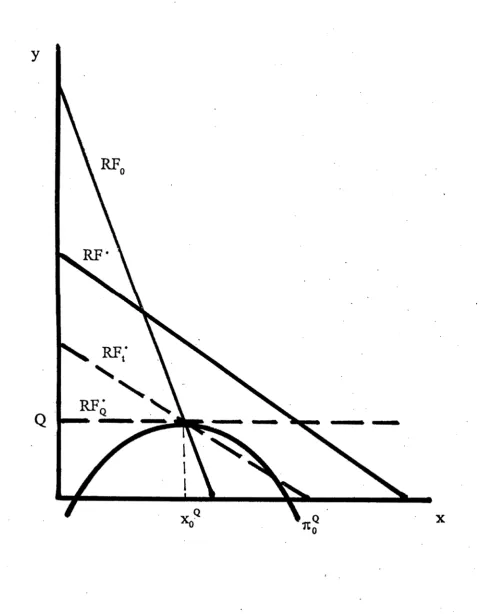
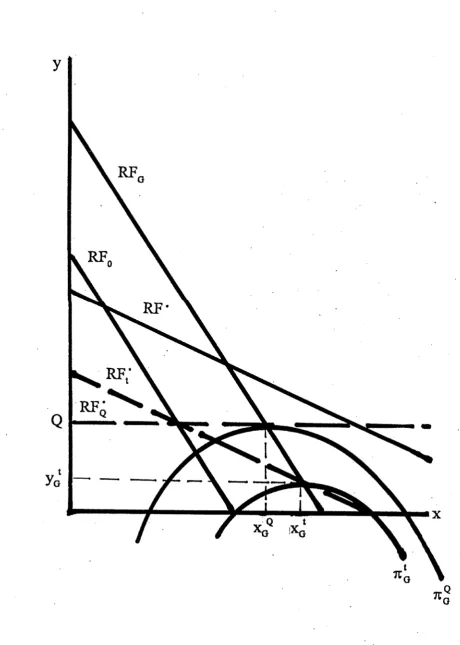
Rodrik (1990) presents a protection - technical efficiency analysis which requires its own separate classification. The focus is on a domestic oligopoly rather than a single domestic firm. The problem that these firms face is that competition erodes the potential profits. The impact of this competition may be reduced if the firms can commit themselves to lower sales. One device for achieving this commitment is for the firms to choose outdated or costly technology. The analytical framework used is an adaption of the investment in capacity - entry-deterrence models4. It is shown that under certain conditions the higher potential profit associated with protection acts as a stronger inducement for firms to make a low investment in technological effort. Rodrik makes
it clear that this result lacks generality since it is necessary to assume that the firms will engage in ‘excessive’ competition5. The most extreme version o f this excessive competition concept is the Bertrand paradox where competition (or aggressive behaviour) reduces potential profits to zero.
V:
Protection and Research and Development (R&D)
The R&D literature has traditionally been concerned with how market failure can result in a non-optimal level of innovative activity6. If a firm invests in R&D and discovers a new process or product then the rents from this invention may be appropriated by other firms engaging in imitation. The patent system allows the innovating firm to recoup its R&D costs, however in doing so, it confers monopoly pow er upon this firm. For a lucid discussion of the public good nature of R&D see Arrow (1962). In addition to the public good problem there is also the patent race issue. There is quite an extensive literature associated with this issue7. The essential idea is that competing firms ‘race’ to be the first to make an innovation so that there is an excess amount of innovative activity.
Clemenz (1990) examines how protection may influence the level of R&D using a two-country model. The industry consists of two firms. Firm A is the foreign firm. Firm B is the domestic firm. At least initially, the foreign firm has the lower marginal
5. For an overview o f the literature on strategic investment see Dixit (1986).
6. For an overview o f the literature on R&D see Tirole (1988 Chapter 10).
cost; cA<cB. The only way for either of these firms to reduce their costs is to engage in R&D. That is, imitation and buying the licence to new technology, are assumed not to occur. Clemenz models R&D as making an investment which allows the firm to make a random draw from a probability distribution of possible marginal costs. If the drawn marginal cost is lower than the existing marginal cost then the new technology is adopted. The firm will continue to invest in R&D until the ‘reservation unit cost level’ is reached. This is where the cost o f making the investment equals its expected return. Thus R&D is being treated as a ‘search process’. If there is a state o f autarchy obviously the two firms will both be monopolists. If free trade prevails, then the two firms engage in Bertrand competition.
profit of the domestic firm above zero. By way of contrast, in autarchy an identical reduction in cost would increase the domestic firm ’s profit (gross of R&D expenditure). Clemenz goes on to show that a direct R&D subsidy is a more efficient instrument, than the imposition of autarchy, for shifting the level of R&D closer to the social optimum.
VI:
Endogenous and Made-to-Measure Protection: The Implications for
Technical Efficiency
So far all the literature treats protection as something that the protected firm ’s actions cannot affect. Such a treatment can be justified on the basis of being a useful simplification. Recognising that protected firms behaviour may be partly explained in terms of influencing the level of protection provides us with further rationalizations for the belief that protection adversely affects technical efficiency.
Corden (1974, p.228-229) briefly considers how a made-to-measure tariff system may encourage managerial slack. Suppose government policy is to reduce the tariff whenever increased profits occur in the previous period. Given this policy an exogenous rise in the price o f imports may result in import-competing entrepreneurs reducing their effort level so as to keep profit constant. A view, based on a similar idea, is expressed by Bergsman (1974, p.413) in a discussion of his framework used to attempt to measure the ‘X-inefficiency costs’ of protection:
“Producers do not necessarily minimize costs or maximize profits, at least in the sense o f simpler economic analysis that assumes.... ,no political dangers from driving one’s competitors out of business,....”
“This.... may be especially important in LDCs, where the most efficient firms are often subsidiaries of foreign companies and some of the higher cost firms are purely local.”
Bergsman goes on to observe that it is common in Brazil for industries to be made up o f firms with greatly differing productivity. In general the firms with more advanced technology avoid taking market share from the other firms.
shows that the firm chooses to invest less than K 8. By reducing the investment below K the firm loses some benefit in terms of cost reduction and investment-contingent subsidy. However these losses are more than offset by the gain in the form of an increased rate o f protection at time q. Tomell goes on to show that for an investment-contingent subsidy to induce investment K it is necessary to set an ‘oversubsidization rate’ equal to the present value o f any future protection which may be induced.
Matsuyama (1990) is another example of an analysis which shows how a policy o f temporary protection can fail due to being time-inconsistent. The overall message from Matsuyama is the same as that from Tomell. That is, temporary protection can prove ineffectual due to government being unable to credibly commit to the future removal of protection. Matsuyama’s ‘liberalization game’ has an infinite horizon with the two players being the government and the firm. Prior to the game starting, the firm is a protected domestic monopolist. Then a new government is elected. The government wants to remove the protection and it wants the firm to make a cost- reducing investment. The government has the first move in the game (at the beginning o f period 1). The government has to choose between liberalizing (L) and not liberalizing (NL). If L is chosen then the foreign firm enters and that is the end of the liberalization game. If NL is chosen then the firm has to choose between investing (I) and not investing (NI). If I is chosen then at the beginning of period 2 the government chooses L and the foreign firm enters with the liberalization game ending here. If NI is chosen then the government at the beginning of period 2 has to once again choose between L
and NL. If the government continually chooses NL and the firm continually chooses NI the game can go on for an infinite number of periods. Matsuyama argues that subgame- prefect Nash equilibria, which involve the policy of temporary protection achieving the governm ent’s objective, should be rejected on the grounds that they fail the ‘renegotiation-proof criteria. The idea being that the firm can always choose NI and negotiate another period o f protection.
Miyagiwa and Ohno (1995) consider a case where initially, the foreign firm has adopted a new technology, while the domestic firm has not adopted this technology. Consequently the foreign firm has lower production costs. The cost of acquiring the new technology decreases over time. Miyagiwa and Ohno examine whether protection speeds up or delays the adoption o f the technology. They first consider the case of where the protection is permanent (that is, where protection is exogenous with respect to the domestic firm ’s choice as to when to adopt the new technology). They then go on to consider the case of conditional protection. In this case the protection is removed once the new technology has been adopted.
provided that the quota is binding both before and after the adoption. However, it is shown that, if the quota ceased to bind following the adoption, then the increase in non adoption momentary profit can result in the quota actually delaying the adoption. Turning to conditional protection, they note that if protection was sufficiently high, then adoption would never take place. As is to be expected, they concentrate upon the case where there is an internal solution. Conditional protection is shown, not surprisingly, to delay the adoption since once the adoption takes place the firm receives no more protection.
While Tomell, Matsuyama and Miyagiwa and Ohno abstract from the political process which determines the level of protection there is a substantial body of literature which treats this issue in an explicit fashion9. Here a common approach is to model the government as maximising a political support function. This involves setting protection so that the marginal benefit in terms of support from the protected industry equates with the marginal cost in terms of lost support from parties who are adversely affected. Vousden (1991) modifies this approach by dispensing with the assumption that the government can perfectly observe the protected firm ’s cost. To do this, the principal- agent paradigm is used with the government being the principal and the protected industry, assumed to be a single firm, being the agent. This paradigm has been used extensively in the literature on regulatory mechanisms10. The specific version of the principal-agent model used by Vousden was devised by Laffont and Tirole (1986) working within this regulatory literature. The government can not observe the firm’s level of effort and is unaware of the firm’s productivity type. To maximise political
9. For an overview o f the political economy o f protection literature see Hillman (1989).
support the government uses an incentive-compatible subsidy package. The package consists of both a conventional subsidy payed on each unit of output plus another component which depends upon the observed level of cost at the end of the production period. This latter component acts as a disincentive for the firm to pretend to be a higher-cost type than it is in reality. The political support - maximising subsidy package will imply a certain level o f effort. The paper shows that, under certain conditions, the level o f effort which such a subsidy induces is lower than the effort level which would be chosen in the free trade case. These (sufficient) conditions consist o f the following extra restrictions upon the firm ’s cost function:
where x is output, e is effort and 0 is productivity type. Vousden notes that these conditions bear some similarity to the McAfee and McMillan (1991) conditions for monopoly to reduce efficiency (discussed earlier). It is also noted that it is not difficult to devise cost functions which comply with these restrictions. As an example
VII:
Trade Liberalization as a Cause of Improved Technical Efficiency:
Empirical Evidence
Suppose it was observed that technical inefficiency was correlated with those industries which received higher levels o f protection. There is an obvious problem in ascribing causation. It might be that the protection has caused the technical inefficiency. H ow ever it might be that those industries which are technically inefficient lack comparative advantage and hence are granted protection so as to allow their survival11. It may aiso be the case that such industries receive higher marginal gains from lobbying for increases in protection. A methodology designed to overcome this problem would be to observe technical efficiency both before and after a change in protection. Tybout, de Melo and Corbo (1991) do this using Chile’s dramatic trade liberalization which occurred in the 1970s. This study uses industry census data, at the plant level, for 1967 and 1979. In 1967 protection levels were very high. In addition there were substantial differences in the protection levels between industries. By 1979 protection levels had become very low and very uniform. It seems that the size o f the protection reduction for any given industry was purely determined by the initial level of protection. Thus industries with particularly high levels of protection, prior to the trade liberalization, experienced the largest reduction in protection. Tybout et al examine whether there is a tendency for these industries to have had the greatest increase in technical efficiency. To do this, 1967 and 1979 production functions are estimated for each industry. This
allows changes in technical efficiency to be measured independently of scale effects. Using Spearman rank correlations, a strong association is found between improved technical efficiency and reductions in protection. An interesting point made by this study is that over the 1970s the measured productivity growth (total factor productivity growth) made by Chilean industries was actually quite poor. Taking the manufacturing sector as a whole, there actually would appear to have been a fall in total factor productivity between 1967 and 1979. Tybout et al consider one reason for this to have been the relatively slack demand for manufactured products in 1979. They consider that the major macroeconomic shocks which Chile experienced could mask the effects of commercial policy. There was hyperinflation during 1973, a major recession in the mid- 1970s, and during the latter half of the 1970s an exchange rate appreciation and an increase in the real interest rate. Other reasons cited why a fall in productivity may be observed include changing technology and measurement errors associated with capital stocks and the price deflators. Since the methodology of Tybout et al is comparative in nature, these problems associated with interpreting productivity growth should largely be abstracted from. That is, they judge that all Chilean industries have been roughly subject to the same macroeconomic shocks and measurement errors.
for each industry is decomposed into various components. These are scale effects, share effects and residual effects. The term ‘share effects’ refers to an industry’s productivity being increased as a result of the more technically efficient plants producing a greater share of total industry output. The term ‘residual effects’ refers to productivity growth which is not accounted for by either scale or share effects. Tybout and Westbrook describe it as a collection of hard-to-measure effects like capacity utilization, externalities, technical innovation, leaming-by-doing and managerial effort. A variety o f measures of international competition are utilised. These are; effective rates of protection, import licence coverage, official tariff rates, import penetration rates, and export shares. The results of the analysis suggest that increased exposure to international competition cause an increase in productivity and that this increase in productivity is mainly driven by the residual effects. It is found that improvements in scale efficiency are not associated with increased international competition. Thus both this and the Chilean study are consistent with the cold-shower argument.
domestic market power. As Carlsson notes, the concentration ratio is a very imperfect indicator. It fails to take into account the effect of close substitutes. More importantly, in the case of a small open economy, there is the problem of the concentration ratio ignoring the effect of foreign competition. Three measures of foreign competition are considered; the nominal tariff level, the export/output ratio and the import/consumption ratio. The results of the regression analysis indicate that the tariff is significant in explaining the variation in the efficiency index. Industries that are both heavily protected and inefficient include breweries, dairies and textiles and apparel. The export/output ratio and the import/consumption ratio are found not to be significant. This is judged to be probably due to the industries being defined too broadly. The concentration ratio is actually positively correlated with the efficiency index. Carlsson explains this by saying in the case of a small open economy it is likely that the concentration ratio reflects economies o f scale and specialisation rather than market power.
concentration ratio, an adjusted four-firm concentration ratio (adjusted to take into account various factors such as international competition), the number of indictments for anticompetitive agreements from 1958 to 1977, the imports/consumption ratio averaged from 1972 to 1976 and the export/output ratio averaged from 1972 to 1976. They do not consider protection because of data problems. They describe the econometric procedure which is followed as being “somewhat inductive”(p. 88). The problem which they, and any similar study, face is that there is no single neat theory of technical efficiency to dictate which model should be tested. Their approach involves, starting with the variables which have the strongest theoretic claim for being included and the fewest missing observations, and then following this, experimenting with the inclusion of some of the other variables. The results from this study are consistent with competitive pressure inducing technical efficiency. A positive correlation is found between import competition and technical efficiency in those industries with a highly concentrated domestic market structure. The obvious interpretation to put on this, is that, firms which would be fairly ‘safe’ from competition in autarchy, are subject to competitive pressure from imports.
CHAPTER 3: PROTECTION AND MANAGERIAL EFFORT
REVISITED
I:
Introduction
In this chapter a principal-agent model is used to provide another explanation for the cold shower effect1. As is to be expected the cold shower effect only occurs under certain conditions. It will be shown that if particular restrictions are placed upon the protected firm’s technology there will be a negative relationship between protection and managerial effort. The cold shower effect in this analysis has welfare implications which are not included within the standard deadweight loss associated with protection. Given certain conditions we can say that the occurrence of protection-induced managerial slack will contribute to the cost of protection. This result is quite striking when it is remembered that, with a model based upon a backward bending supply of effort curve, a decrease in managerial effort will mitigate the cost of protection since the gap between free trade output and protected output is lessened.
The principal-agent framework used is quite standard. In this case, the principal is the owner and the agent is the manager. While the owner can observe the cost of production, he is unable to observe the manager’s level of effort and productivity type. The arguments in the firm’s cost function are output, effort and productivity type. The restrictions placed upon this cost function are minimal and uncontroversial. This allows
1. The analysis contained in this chapter is presented in journal article form in Vousden and Campbell
identification of which restrictions are necessary for a cold shower to take place and have an X-inefficiency cost of protection associated with it.
In the case where a cold shower does occur this result is being driven by the asymmetry in information. The owner is a conventional risk-neutral profit maximiser. If the owner had full information then an increase in protection would, if anything, result in an increase in the use of managerial effort. Hence this chapter represents a distinct departure from the utility-maximising entrepreneur or the utility-maximising manager with essentially passive owners. Without full information the owner has to pay the manager an information rent to illicit a truthful revelation o f productivity type. Hence, when deciding upon the profit-maximising level of effort, the owner has to take into account what the associated information rent will be. If protection increases, the profit- maximising owner responds by increasing output. With some technologies the increase in output increases the marginal information costs of extra effort. If this is the case, then it is profit-maximising for the owner to require a lower level of effort as well as a higher level o f output. Examples of plausible technologies which will give this outcome are provided.
privately chosen effort has been made larger by the increase in protection. This is a cost o f protection which is in addition to the standard deadweight loss associated with protection.
This chapter is arranged as follows. Section II sets out the model which is used. It goes on to establish the conditions for the profit-maximising choice of effort and output given the asymmetry o f information. Section III considers the comparative statics associated with a change in protection. Examples are shown of some technologies which give a cold shower result. Section IV contains the welfare analysis. Finally some concluding comments are made in Section V.
II:
Optimal choice of Effort with Asymmetric Information
be thought of as hidden information rather than a hidden action. The owner does know the probability distribution o f all possible productivity types; F(0). 0! is the lower limit o f this distribution, that is the most productive type. 02 is the upper limit, that is the least productive type. The expected cost of production obviously needs to be written as a function o f productivity type and effort as well as output:
C(0,e,x), (Ce>0, Cee*0, Ce<0, C«>0, Cx>0, C „> 0f C^cO)
It can be noted from this that we are assuming effort is not an inferior input since increasing effort reduces both total and marginal cost. The cost, which is actually observed by the owner after production has taken place, is subject to the conditional probability distribution
H(z |C(0,e,x)), H!=h>0, H2<0,
where h is the density function derived from H and H2 represents the partial derivative o f H with respect to the mean cost C2.
This type of principal-agent problem was developed by Laffont and Tirole (1986) to examine government regulation of natural monopolies when the regulator can observe ex post cost even though effort and productivity type are unobservable. They show that the asymmetric effort level differs from the full information effort level. Hence this framework is particularly suitable for looking at the question of managerial effort within a profit-maximising firm. For reasons of tractability Laffont and Tirole treat both the principal and the agent as risk-neutral. Hence in this chapter the manager is treated as risk-neutral rather than risk-averse. This is desirable since here managerial risk aversion can be eliminated as a factor causing increased protection to result in lower managerial
effort.
This section proceeds to derive the conditions for the owner optimally choosing effort and output. The owner, of course, cannot simply order the manager to put in the required level o f effort. Rather, the owner chooses the payment function T which induces the profit-maximising choice o f e and x by the manager. This payment function is dependent upon the variables which the owner can observe. These are; 0* the productivity type the manager reports, x the level o f output, and z the realized production cost. Prior to solving the owner’s profit maximisation problem, it is necessary to devise the constraints which the owner faces. The incentive compatibility constraint can be thought of in terms of the requirement that the manager has no incentive to falsely report his productivity type. Hence we require that a relatively high- productivity manager cannot gain an advantage from pretending to be a low-productivity manager in order to be able to hide a low level o f effort. The reason why we require the incentive compatibility constraint to hold is that we are told by the Revelation Principal3 that an incentive scheme which elicits a truthful response yields at least as high a value o f the principal’s objective function as any other incentive scheme. To establish the incentive compatibility constraint we need to consider the manager’s expected utility maximisation problem:
u (0 ) = max
I
T ( 0 ’,x ,z ) h ( z | C ( 0 ,e ,x ) ) d z - C ( 0 , e , x ) - \{r(e) (1) 0\e,xJ
z
where 0* is the value of 0 reported by the manager.
H ere the manager receives a payment of T from which he must cover the production
costs. The actual value of the payment is stochastic since the observed cost z is a affected by a random disturbance. For a given payment function the manager’s choice of effort will satisfy
Cc[ | T h 2d z - 1 ] - i|/'(e) = 0.
(2)
z
It is convenient to rewrite this as
f T h d z - U - ^ . (2a)
{
C ‘Let us now consider the incentive compatibility constraint. For this to hold we must have 0*=0. If this is the case, then, using the envelope theorem:
u'(0) =
T (e \x ,z ) h ( z I C(0,e,x))dz - C (0 ,e ,x ) - f (e )]
C0[ j T h 2d z - 1] .
(3)
The interpretation which can be placed upon this condition is that any gain to the manager from misrepresenting his productivity type will be offset by the effect upon the incentive payment T. The more productive managers need to receive a higher payment so as to deter them from understating their productivity type in order to obtain a larger cost reimbursement. Using (2a) the incentive compatible condition can be written as
C 0
u'(0) =
where y = — < 0 .
(4)
Ce
The other constraint which the owner faces is the participation constraint. That is, the owner must offer the manager a contract which is at least as attractive as the manager’s next best alternative. The manager’s reservation utility is assumed to be zero. Hence the participation constraint is u(0)^O. W hat this is saying is that, whatever the m anager’s type, his expected utility must be non-negative. From the incentive compatibility constraint, it is clear that the least productive type of manager will have the lowest level o f utility. Consequently if the incentive scheme is such that the least productive manager would expect to obtain non-negative utility then the participation constraint would be satisfied since all other types o f managers would receive positive utility (an information rent). So the participation constraint may be written as
U(02) i 0 . (5)
We are now in a position to formulate the ow ner’s profit maximisation problem. It is convenient to write the owner’s expected cost (the payment to the manager) in terms o f covering the manager’s production costs, providing the manager with an information rent and compensating the manager for the disutility of effort:
j T ( 0 , x , z ) h ( z | C ( 0 , e , x ) ) d z - C ( 0 , e , x ) . u(0) ♦ >|r(e) •
Z
Hence we can write the owner’s expected profit as
Eft (0) = (p*+ s)x - C(0 ,e,x) - u(0) - i|/(e) ,
where p* is the given world price for output and s is a per unit production subsidy financed by lump sum taxes. It is analytically convenient to state the owner’s problem in terms of choosing x(0), e(0), u(0t) and u(02) to maximise
e2
e2
f
E * ( 0 ) f ( 0 ) d 0 = | [ (p *+ s)x - C(0 ,e,x) - u(0) - iH e ) ] f ( 0 )d 0 ,
0i
0,
subject to the incentive compatibility and participation constraints (4) and (5) where f(0) (=F'(0)) denotes the owner’s probability density function for 0. This is a ffee-end point, optimal-control problem with control variables e(0) and x(0) and state variable u(0). The necessary conditions for a maximum are given in Appendix 3.1. These yield the following conditions determining e and x for each 0:
where p(0) is the costate variable for the optimal control problem (6) and, as such, represents the owner’s shadow price of information rents. In Appendix 3.1 it is shown that p(0)=F(0). F(0) is the cumulative distribution function associated with the density
f(0).
To examine the implications o f the optimal output condition (7) it is useful to rewrite its right-hand side using the incentive compatibility condition (4):
The left-hand side represents the expected marginal profits with respect to output in the absence of hierarchic effects. The right-hand side represents the marginal information cost o f output since -du'(0)/dx is the change in the slope of the informational rent profile with respect to a change in output. Condition (7a) can be used to establish what we need to assume for the asymmetric information output level to be lower than the full information level o f output. In the full information case output must be chosen so that
[p ’ + s - Cx]f(0) = - p (0 )y xiK ,
(7)
[-ce-
i|/']f(0)= -n ( 0 ) [ Y er ♦ Y * ' L
(8)(7a)
assuming y x<0 insures that the asymmetric information level of output will be lower than the level of output which would prevail if the owner had full information.
Turning to consider the optimal effort condition (8) it is again useful to use (4) to rewrite the right-hand side:
[-ce-
« |r']f(0 )= (8a)de
The left-hand side represents the expected net marginal benefit of increased effort in the absence o f hierarchic effects. The right-hand side represents the marginal information cost of effort since -du'(0)/de is the change in the slope o f the informational rent profile with respect to a change in effort. Examining the right-hand side of (8) it is clear that y e^0 is sufficient for -du'(6)/de>0 and hence a positive right-hand side. Consequently if Ye^O the optimal level o f effort will be below the level o f effort which would have prevailed if the owner had full information.
It is commonly perceived that hierarchical relationships lead to both slack and low levels of output4. Therefore this chapter concentrates upon the case where effort and output are set below the full information levels. From the above discussion we can write a sufficient condition for this case as
y x^0 and y e^0. (9)
When considering this condition it is useful to remember how y is defined. That is, since y can be described as the marginal rate at which effort must be substituted for inherent productivity to maintain a given cost o f production. Assuming that y x<0 is saying that as output increases, the cost-reducing effect of a marginal increase in inherent productivity will proportionately exceed the cost-reducing effect of increased
effort. Assuming that y e<0 is saying that as effort increases, more effort needs to be substituted for a given fall in productivity so as to maintain a given cost.
Ill: When will Reducing Protection cause Increased Managerial Effort?
In this section we examine what assumptions are necessary for us to be able to obtain comparative static results which are consistent with the cold shower hypothesis. Let us consider a reduction in the subsidy5. To do this we differentiate (7) and (8) with respect to s, we obtain
dx_ f ( d ) d ^ ä 3e f( 8 ) a 2^ 0s JK d e 2 ds H d e d x
where Sf is the Hamiltonian for the optimisation problem (6) and • >0 is the Hessian determinant o f ££. Since $£ is assumed to be strictly concave in (x,e) it follows that dx/ds>0 and
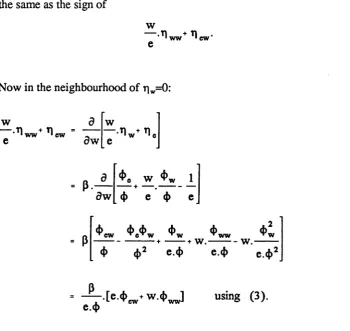
sgn — = sgn = s g n [ - f ( e ) C ex. F ( 0 ) [ Y ex>|'' * YXV " ] ] • (10)
0s dedx
Consider the expression on the right-hand side o f (10). The first term (-^ 0 )0 * ) represents how with increased output it is profit maximising to increase the level of effort given that effort is not an inferior good (C^cO). So according to this effect a decrease in protection would reduce effort since with lower output there would be less marginal return from expending effort. If a reduction in protection does increase effort it is purely due to the owner’s marginal informational cost of effort being increased as
output is reduced. This can be seen from looking at the following necessary condition for de/ds<0;
Clearly this condition will only hold for certain cost functions. If condition (9) holds y x will be non-positive. However y« is actually a third derivative and hence very little can be said about what its sign might be. What can be said is that it is easy to come up with examples of cost functions where (11) holds such as
C ( 0 ,e ,x ) = A - ex 2 + 0 x 3 .
A class o f cost function which is interesting to consider are those where effort only affects fixed costs. An example of such a cost function is
C ( 0 ,e ,x ) = A - e + 0x .
In this case condition (11) holds and since 0 ^ = 0 we can say from (10) that de/ds<0. Now let us consider the general form of this class of function;
It is simple to show that this will yield de/ds<0 if it is assumed that productivity type is not an inferior input. This assumption means that the more productive the manager is (the lower 0 is) the lower marginal cost (rx) will be; rx0>O. We can say that if this is the case then condition (11) will hold. That is
3 [ Yei)>'. y» * ] a [ a u '( 6 ) /d e ] ^
(
11
)dx
g
expect that greater quantities of other inputs would be used in setting up. That is fixed costs (or perhaps more exactly quasi-fixed costs6) would be higher.
IV: An ‘X-inefficiencv Cost’ of Protection
The comparative static results in the previous section are o f interest in their own right. However they prompt the question as to whether, from a social welfare view point, we should care about a reduction in effort caused by an increase in the subsidy. In this section it is shown that it is possible to identify a welfare cost associated with a such a reduction in effort. A change in the subsidy affects the owner, the manager and the taxpayers. Obviously an increase in the subsidy will make the taxpayers worse off. H ow ever we can not make any general comment as to whether the manager is made worse or better off. From Appendix 3.2 it is clear that the owner is made better off:
Total social surplus W consists of the owner’s expected profit plus the expected utility o f the manager minus the cost of the subsidy to the taxpayers (financed by lump-sum taxes). Hence for a given value of 0 it is defined as
Using (12) we can write out the following expression for the effect of an increase in the subsidy on the social surplus:
(12)
0, 0
W (0 ) = Eti (0 ) + u ( 0 ) - sx . (13)
f(0) de
—
[
w ( e ) f ( 0 ) d e = [ f x ( 0 ) * - ^ ^ - x ( e ) - s ^ ^
ds
J
J
ds ds
0 i 0 i
0 2
= -s
— f
x(0)f(0)d 0
ds
J
0 i
d _
ds
0 2
J u(0)f(0)d 0 .
0i
(1 4)
Here the overall welfare change is decomposed into two components. The first term on the right-hand-side represents the standard marginal deadweight loss associated with the subsidy. The second term is labelled the ‘organisational cost of protection’. This term is only present because the manager receives an information rent. Clearly it could be positive in which case we would be dealing with an organisational benefit. There will only be an organisational cost if an increase in the subsidy causes a reduction in information rents. This result may seem somewhat counter-intuitive. However it needs to be remembered that the payment o f information rent is simply a transfer between the owner and the manager. In principle the organisational cost of an increase in the subsidy could be measured by the change in incentive payments. In practice it would seem very difficult to isolate pure managerial incentive payments.
The X-inefficiency cost of protection is that component of the organisational costs which represents the welfare costs associated with the change in effort caused by the change in information rent paid. The organisational costs can be rewritten such that
_d^
ds
0 2 0 2
f
u(0)f(0)d0 = -
f
F(0)
yx ' K— * (
y* ♦ ' ) —
Hq Hq
J
° i
J Uj Ud
(15)
The case that we focus upon here is where output and effort are below their full information values (condition (9)) and there is a negative relationship between the size of the subsidy and the level of effort (a cold shower effect). Here y ^ ^ d x /d s ) will be negative (since dx/ds>0) and (Ye^'+ytlOCde/ds) will be positive. Thus if there is an organisational cost (rather than a benefit) this outcome will be driven by the X- inefficiency cost o f protection being sufficiently large to offset the organisational benefit effect associated with the change in output. This is a particularly appealing result since it links a welfare cost with a cold shower. However it should be noted that if output and effort are above their full information levels a cold shower would have an X-inefficiency benefit associated with it.
V: C oncluding C om m ents
sophisticated institutional investors. By contrast, the principal-agent framework used in this chapter reflects reasonably well the hierarchical nature of the corporate firm. That is the firm is treated as a profit-maximising entity which has the problem of the owner who makes the profit-maximising decisions not having full information. It should also be noted that if the information asymmetry was, say, between a supervisor and workers, the important results from the analysis still stand.
APPENDIX 3.1:
FIRST ORDER CONDITION FOR THE OWNER’S
PROBLEM
The Hamiltonian for the problem (6) is
= [(p% s)x - C (0 ,e,x ) - u(0) - i|r(e)]f(0) + P W Y ^ 'C e ),
where p(0) is the costate variable. The necessary conditions satisfied by a solution to
the problem are:
=
[p
+s - C J f ( 0 ) + PY
J f '= 0 ,
dx
(Al)
- - [ C , . <fr']f(0)
* 1 1 1 » ' 4Y'l'"] = 0 ,
d e
(A2)
u '(0 )=
Y+ 'M ,
(A3)
0c£
» » '(0 )---— - <10).
(A4)
du
n ( 0 , ) - o .
(A5)
H(02) a O , u(0j)
a0, n (0 2)u(0j)
=0 .
(A6)
Note that (Al) and (A2) yield equations (7) and (8) in the body of the chapter. Also,
from (A4) and (A5), we have
A PPEN D IX 3.2: D ISTR IB U TIO N A L AND W E L FA R E E F FE C T S O F A C H A N G E IN T H E SUBSIDY
Derivation o f Equation (12). Using the definition of the Lagrangian, integrating by parts and using (A4), (A5) and (A6), the ow ner’s expected profits are
02 e2
j
E
ti(0)f(0) d(0) = | [ c £ - n ( 0 ) u ' ( 0 ) ] d0
0i
o,
0 2
- 1
S£d0
0i
0 2
I
u(0)f(0)d0
0i
0 2
=
I{[(P’+ s ) x - C ( 0 , e , x ) - i |r ( e ) ] f ( 0 )
0 i
♦ p(0>Y^/ } d 0 .
Differentiating with respect to s and using the first order conditions (A 1) and (A2) yields equation (12) in the body of the chapter.
Derivation o f Equation (15). Use integration by parts to obtain
0 2 0 2
/ u (0 )f(0 )d 0 = [
u(02)F(02) -
- 1u'(0)F (Ö )d0
0 i 0 i
0 2
= - f
u'WFfOJd©, using (A5)-(A7).
Noting that
— u'(0) = — (Y'l'')*
— * (Ye’K*
ds
ds
ds
ds
C H A P T E R 4: PR O T E C T IO N R ED U C TIO N S AND IN V ESTM EN T IN N EW T E C H N O L O G Y
I: In tro d u ctio n
This chapter uses a simple decision-theoretic model to provide a possible rationalisation for the idea that a reduction in protection can facilitate investment in new technology. Consider the case where the removal of a firm ’s protection would result in it ceasing to survive with its cument cost structure. To many non-economists it would be almost axiomatic that removing the firm ’s protection increases its incentive to invest in cost-reducing new technology1. However if the question is given greater attention it becomes clear that the benefit from a cost-reducing investment would be greater prior to the removal o f protection2. The approach taken here hinges on regarding the outcome o f the investment as being stochastic3. For simplicity a two-point distribution is assumed. The good outcome is a reduction in cost sufficient for the firm to continue production with or without the protection. The bad outcome is a reduction in costs which is not sufficient for the resulting operating profits to cover the cost of the investment so that bankruptcy occurs. The decision as to whether or not to make the investment is made by an owner/manager whose utility is solely a function o f income. Thus there is a departure from the X-efficiency tradition which focuses on managerial
1. Knight (1967), writing in the business administration literature, describes this as ‘distress innovation’.
2. For a formal treatment o f this point see Rodrik (1990).
The US Congressional Budget Office (1986 p.9) consider that protected firms may be less inclined to make large and risky investments in cost-reducing technologies.
effort.
The ‘cold shower scenario’ which will be formalised runs in the following manner. The owner/manager first evaluates the investment while the firm is protected. The investment is rejected since the expected utility from proceeding with it is exceeded by the utility to be gained by continued use of the old technology. With the removal of the protection the investment is re-evaluated. The return from the good outcome is, of course, reduced. The return from the bad outcome remains the same because of limited liability. That is, with or without the protection, the owner/manager receives the income stream associated with bankruptcy. The return from not making the investment is reduced to the income stream associated with exiting from the industry. If the fall in utility associated with not investing exceeds the fall in utility associated with the good outcome, weighted by the probability that the good outcome occurs, then it is possible that the removal of the protection will result in the investment being made.
Essentially this analysis is an application of the fundamental insight from Golbe (1981) that imminent bankruptcy can affect equity holders’ risk preferences with respect to the firm’s returns. When bankruptcy is imminent the lower tail of the distribution of equity holders’ returns is truncated because of limited liability. Hence equity holders who are risk-neutral or risk-averse with respect to their own returns may prefer the firm to engage in behaviour which would imply risk-loving preferences if it were not for the effect of imminent bankruptcy.
to invest is synonymous with deciding to exit from the industry (losing the firm voluntarily). It seems reasonable to believe that the discounted income stream associated with losing the firm, either by voluntary exit or bankruptcy, is relatively low. With voluntary exit the owner/manager is taken to suffer a loss in industry-specific human capital. With bankruptcy, the penalty is taken to be even more severe since an association with a bankruptcy injures managerial reputation. Smith and Stulz (1985) consider bankruptcy aversion as one of a number of factors which may impact upon the extent o f hedging by value-maximising corporations. Hedging reduces the variability of the value o f the firm, hence reducing the probability of incurring the transaction costs associated with bankruptcy.
examined is where the creditor does know the probability of the bad outcome occurring and so is able to attach to a risk premium to the rate of interest. In both cases the firm is declared bankrupt if the required payment to the creditor can not be made. That is, the penalty for default is the owner/manager losing the status of being the residual claimant with control over the firm.
It is convenient to work using the assumption that a single, initially subsidized, domestic firm faces a price determined by a competitive world market. However the chapter also looks at the case where there are just two firms; the domestic firm and one foreign firm. This oligopolistic version of the model is useful for comparing the effect o f the rem oval o f a tariff with that of a quota. It is also useful for comparing the implications of Stackelberg behaviour with the implications of Cournot behaviour. An oligopolistic version of the model with n foreign firms is used to consider the relationship between the market power of the protected firm and the likelihood of a cold shower occurring.