Fongen, A. and Eliassen, F. and Ferguson, I. and Stobart, S. and
Tait, J. (2001) Distributed resource discovery using a context sensitive
infrastructure. In: Proceedings of the Third International Conference on
Information Integration and Web-based Applications and Services (IIWAS).
IOS Press. ISBN 3854031505
http://eprints.cdlr.strath.ac.uk/2
599
/
This is an author-produced version of a paper published in Proceedings of
the Third International Conference on Information Integration and
Web-based Applications and Services (IIWAS).
Strathprints is designed to allow users to access the research
output of the University of Strathclyde. Copyright © and Moral
Rights for the papers on this site are retained by the individual
authors and/or other copyright owners. Users may download
and/or print one copy of any article(s) in Strathprints to facilitate
their private study or for non-commercial research. You may not
engage in further distribution of the material or use it for any
profitmaking activities or any commercial gain. You may freely
distribute the url (
http://eprints.cdlr.strath.ac.uk
) of the Strathprints
website.
DISTRIBUTED RESOURCE DISCOVERY USING A
CONTENT-SENSITIVE INFRASTRUCTURE
Anders Fongen
1
Frank Eliassen, Ian Ferguson
Simon Stobart, John Tait
Distributed Resource Discovery in a World Wide Web environment using full-text indices will never scale. The distinct properties of WWW information (volume, rate of change, topical diversity) limits the scaleability of traditional approaches to distributed Resource Discovery. An approach combining metadata clustering and query routing can, on the other hand, be proven to scale much better. This paper presents the Content-Sensitive Infrastructure, which is a design building on these results. We also present an analytical framework for comparing scaleability of different distribution strategies.
Keywords: Distributed IR, Resource Discovery, Metadata Clustering, Query Routing
1. Introduction
Most papers describing approaches to Internet Information Retrieval (IR) agrees that traditional IR
design using full-text indices does not work well in this area. The problems experienced can be
divided into four categories [1]:
1.1. Scaleability
Automatic indexing is commonly done using indexing agents (often called web spiders) that read the
content of a web page and add indexing information about this page into an index database. In order
to keep the index database up-to-date, the indexing agent must employ a polling scheme to find
pages that have changed content or disappeared. This process places a communication cost on the
indexing agent believed to be proportional to the size of the text volume to be indexed and the rate of
change of the content.
The “search engine” (the server that processes queries and returns a result set) needs access to the
index database in order to process queries. Most search engines co-locate these two components, so
all queries and updates to the index database need to be concentrated in and around this site. A
centr-alised site is a candidate for becoming a bottleneck as the size, rate of change and query rate
increases [2, 3 p. 146].
With the large growth of both the number of users on the Internet and the amount of information
pub-lished there, it seems probable that a traditional IR design will not perform well in the future.
1.2. Currency
When following the references shown in a query result set, it often turns out that these information
resources are unavailable or have changed contents. Changes in a web page are never reported to the
indexing agent, and frequent reindexing of large collections is an expensive operation. Thus, the
indexing agent must “guess” which portion of the collection that need frequent re-indexing [4]. As
any user of a web search engine has experienced, this is only partly successful: A significant portion
of the references in a result set are “dead” links.
1.3. Relevance
Full-text search engines search for words without any context. The search for “bond” returns
refer-ences to chemistry, finance and film, although it is inconceivable that a user is interested in all the
three categories. Finding “hotels in Nice” is impossible with a full-text search engine [5, 6].
1.4. Coverage
The use of web spiders limits the coverage of the search engine to what can be seen through a URL
(Uniform Resource Locator), and what is linked to through HTML hypertext references. HTML
Framesets (requiring more than one URL to be represented) and database services (showing
informa-tion as a response to a HTTP POST operainforma-tion) will never be properly represented in a full-text index.
Sullivan [4] calls this “the hidden web”. It is estimated that the best spider tools are able to index no
more than 16 % of the entire Web content [7].
2. Our contribution
Our approach to these problem areas is a combination of distributed metadata clustering and query
routing inside a network of forwarding and processing entities, called members. We call this network
The focus of the work is on scaleability. We will present a model by which recent research projects
can be evaluated in terms of their ability to scale. Many of these systems claim to be scaleable, but
fail to analyse or even discuss this property. Our evaluation model suggests the necessary properties
for a resource discovery system scaleable to a World Wide Web environment.
Another important property of our project is the use of metadata. The use of metadata shows
promis-ing solutions to the problems of relevance, currency and coverage.
The rest of the paper is organised as follows: In section 3 we present the design of the
Content-Sensi-tive Infrastructure to some detail. In section 4 we present our framework for evaluation of distributed
resource discovery, and explain why most existing design is not scaleable to Internet proportions.
Section 5 gives a summary of our formal analysis of the CSI, and in section 6 we discuss some
posi-tive side effects of using metadata in resource discovery.
3. The Content-Sensitive Infrastructure
3.1. Members
At the heart of the design of our distributed search system is an infrastructure of network entities
(called members1). Each member has a particular area of interest (its topic).
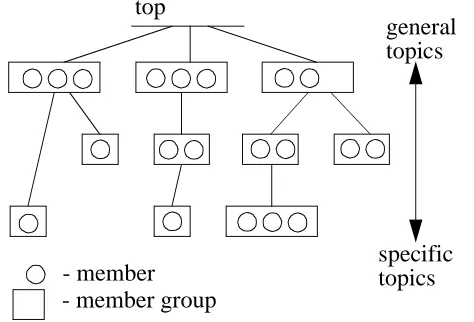
CSI employs a hierarchical means of describing topics whereby any topic can be arbitrarily
decom-posed into its sub-topics (e.g. computing->programming->java). Since the topics are hierarchical2,
one member can have its topic covered by another member with interest in a broader “parent” topic
(figure 1).
Members can accept, process and forward two types of information items: metadata items and query
items and are able to act upon the topic information in queries and metadata in such a way that these
items are forwarded towards those members with similar areas of interest.
3.2. Mapping to physical network
An instance of a member consists of the CSI servent (server/client - the software plays both roles)
and its associated database. One computer may be a host to many members.
1. Since a computer can accommodate several members, the words member and node has different meanings.
3.3. Member group, tuplets
More than one member can have an interest in a given topic. Together, these members form a
mem-ber group. We term memmem-bers of the same memmem-ber group tuplets1.
3.4. Self-configuration
Any large-scale distributed system must be able to accommodate new processing nodes that join the
system without any manual intervention or system configuration. Likewise, the system should allow
nodes to leave the system (or crash) without disruption or loss of control. Our CSI design is
com-pletely self-configuring, and separate “join”- and “leave”-protocols are responsible for maintaining
[image:5.595.185.422.326.487.2]the structure of the members currently active.
Figure 1: The components and organisation of a Content-Sensitive Infrastructure
It is not necessary that every topic in the hierarchy is explicitly covered by a member, but every topic
must be covered at least implicitly through a parent member with interest in a broader category of
topics.
The topic is represented internally in the system as a string variable called the Category of Interest
(COI). The characters of this string shows the path from the top of the topic hierarchy down to the
member’s position in the CSI hierarchy. A COI string can be t.ex. “15TGA”, and is only meaningful
when interpreted within the context of a “real” topical hierarchy, e.g. the Dewey Decimal
Classifica-tion system. Also note that any symbol (t.ex. the “G” above) has different interpretaClassifica-tions in different
positions in the CSI string.
1. We needed a general word for twins, triplets etc. since they are closer related than siblings. We chose tuplets.
- member - member group
general
specific topics
3.5. Metadata processing
Every item of metadata will have a topic and a unique serial number attributed to it. In addition the
item contains a description of “something” (most often a service or a document), and information on
where to find it and how to use it. The processing of metadata involves transporting the items to the
members having this topic inside its interest (includes members having interest in the corresponding
“super-topics”). The members having such interest form a path from one of the top-level member
groups1 to the member group having exactly the same topic of interest as the metadata.
3.6. Query processing
A query is a small, structured2 document resembling an item of metadata, and the processing of
que-ries involves a matching operation between a query and a set of stored metadata, as well as
transport-ing the query to the members expected to have interesttransport-ing metadata in storage.
3.6.1. Scope of query
To decide which items of metadata is interesting to a query, we employ these rules:
• Metadata associated with specific topics are interesting to queries associated with general topics,
given that the topics are in some parent-child relationship.
• Not the other way around
3.6.2. Candidates for processing
A query is initially sent to the member group having the same topical interest. If there is no such
member group, the query is sent to the closest parent member group. In this way the rules above are
automatically enforced, since this member group holds metadata information about this topic and
every sub-topic.
3.6.3. Return of result set
When a query arrives at a member possessing metadata within this topic of interest, the stored
meta-data will be inspected in order to find metameta-data similar (above some threshold) to the query. The
sim-ilarity check may take any information in the query/metadata into account: A list of descriptive
keywords, language used or accepted, storage format, client requirements, certifications, age, size,
price etc.
1. A top-level member group is one that does not have a parent
The metadata found to be a part of the query’s result set should be returned to the user agent or the
member acting on behalf of it.
3.7. The User Agent
The User Agent (UA) of our system is responsible for the generation of metadata and queries. It
assists the user filling out the information, and suggests the topic of the metadata/query based on
lex-ical analysis. It also holds a user profile and a history of previous queries in order to have more
infor-mation about the user’s intentions and preferences.
The UA presents the returned result set in a ranked form. It can inspect the indicated resources on
behalf of the user in order to improve the ranking process. It can also launch client software
neces-sary to use the indicated resource.
4. Scaleability issues
From an architectural view, search engines are not very complex. It seems possible to compare the
CSI design with alternative designs using an evaluation framework based on analysis of the
informa-tion flows between its components. The resource of greatest scarcity when applicainforma-tions are
distrib-uted over a WAN (Wide Area Network) is the networking capacity. Our chosen perspective is
therefore to study the message complexity of the different alternatives, i.e. the number of messages
sent or received by any node as a function of fulltext volume, index volume, metadata volume and
query volume. These four terms are discussed below.
4.1. The full-text volume
Any search engine using full-text indices will need an automatic indexing mechanism. An agent
gen-erating indices will need to fetch a given web page periodically in case it has changed content or
dis-appeared. The fraction of the total web content that needs to be fetched and reindexed over a time
period can be calculated as a function of grace period (the time allowed for an index to be
out-of-date with the page content) and the probability for an index to be out-of-out-of-date beyond the grace period
[9]. An example of Brewington and Cybenko’s analysis is that a page need to be fetched every 18th
day if the index should have a 0.95-probability that it is at most one week out-of-date. This period
With a total web page volume of 800 million pages, each having an average size of 12 kBytes
(num-bers indicated by Brewington and Cybenko), a reindexing period of 18 days requires the transport of
533 Gigabyte per day into the index-generating agent1!
The number of web pages is believed to grow exponentially over time [3].
4.2. The index volume
The structure most commonly used for storing full-text indices is the inverted list [10 p. 82]. The size
of the inverted list is dependent on the richness of the information contained in the list, as well as the
use of stop words in the indexing process. We estimate the size of the index to be less than, but at the
same order of magnitude as the full-text volume.
When distributing indices to several search engines, we will know exactly which portion of the index
has changed since the last time of distribution and transmit only this portion (possibly compressed).
Brewington and Cybenko’s observations indicate that 17 % of the web pages changes more often
than every week. It is reasonable to expect that 17 % of the index has to be transported over this
period in order to have an index with 1 week “currency” (related to the “original” index, not to the
web pages in question. If we allow the indexing process a 1-week grace period, then the transported
index is up to two weeks out-of-date).
If the size of the compressed index is 10 % of the total full-text volume, and 17 % of this needs to be
transported from the index-generating agent to the search engine every 7 days, an index volume of 23
Gigabyte needs to be transported every day.
The size of the index volume is also expected to grow exponentially over time.
4.3. The query volume
When a user issues a query to a search engine, it can have the form of a series of search words being
mapped into a set of relevant web pages, or as a metadata description of the desired documents being matched to a set of stored metadata descriptions [11]. In both cases the volume of the query is low
(100-200 characters) and the size of the response should be roughly the same when using either
full-text-based or metadata-based search engines. The network traffic generated by queries and responses
is therefore expected to grow linearly with the number of query operations2.
The number of web users is believed to grow exponentially over time [3]. The popularity of search
engines is not decreasing, so the number of query operations generated from each user is not
expected to decrease. We therefore expect the query volume to grow exponentially over time as well.
The most popular search engines report number of queries up to 40-50 million per day1. The volume
of information transferred is not known.
4.4. The metadata volume
When using metadata, the index information of a document is not distributed across large list
struc-tures, but are self-contained descriptions, made through a manual or automatic process. A metadata
description of a web page can be generated inside its web server and be sent to a search engine
“just-in-time”. A metadata description of a web page can be of any size, but the dominant standards (e.g.
Dublin Core) indicate a typical compressed size of 100-200 bytes (500-1000 characters
uncom-pressed).
A metadata-based search engine could receive metadata every time a web page is updated. For the
sake of comparable alternatives, we introduce a lower threshold of 7 days between updates, so that
our hypothetical metadata-based search engine has a one-week currency. Over a period of 7 days it
will receive metadata describing 17 % of the total population of 800 million pages, each the size of
150 bytes. This amounts to a volume of 2.9 Gigabytes per day.
The size of metadata volume is also expected to grow exponentially over time.
4.5. Distribution strategies
When dealing with distributed resource discovery, the processing model of the architecture has large
influence upon the way in which the information volumes need to be transported across the network.
We will here present some alternative models, most of them are in use in existing distributed IR
projects.
In order to process queries, a search engine needs access to an index2 representing the content of a
collection. In distributed resource discovery there are several collections distributed across several
information servers (what is just the case in the World Wide Web). The index can be kept centralised
(representing every collection) or distributed (representing a subset of collections).
2. Local- or LAN-caching of query results is not considered here. 1. http://www.searchenginewatch.com/
In the following analysis, the symbol F denotes the Full-Text Volume, I denotes the Index Volume, M
the Metadata Volume and Q the Query Volume. The symbols used are explained in figure 2.
Figure 2: The symbols used in this discussion: (a) shows an information flow distributed across several recipients, (b) shows a flow where two or more recipients receive the same information (multicast), (c) shows a flow where
everyone receives the same information (broadcast)
4.5.1. Centralised index (centralised search engine)
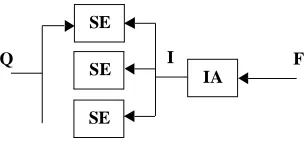
In this case the entire query volume is processed in a central search engine. Also, in order to keep the
index current, the entire index volume (from an indexing agent) or metadata volume must be
trans-ported into the same site (figure 3). The message complexity of the search engine in this case is
O(Q+M) or O(Q+I). Since both Q, I and M are expected to have exponential growth rate, this design
is not future-proof. “Traditional” search engines like Google (www.google.com) are using this
com-putational model1.
Figure 3: The information flow using centralised index. SE=Search Engine, IA=Indexing Agent
4.5.2. Replicated index (distributed search engines)
Several search engines can use the same index at different sites provided that the index is replicated
between them. In this case the query volume will be distributed between n search engines, but every
one need to receive the full index or metadata volume (figure 4). The message complexity becomes
O(Q/n+I) or O(Q/n+M). But an indexing agent need to send replica to several sites, making the
mes-sage complexity O(nI) for this component2. AltaVista (www.altavista.com) is using a variation of this
distribution strategy. There are search engines on different continents, but they do not give the same
result to a given query. Only parts of the index database seems to be replicated between the search
engines.
1. Any references to the design of commercial search engines are based on assumptions, since the internals of these systems are not open to the academic community.
2. The workload of replication can also be shared between the search engines, making the message complexity slightly dif-ferent.
a b c
SE IA
F I
Figure 4: The information flow using replicated index
4.5.3. Distributed index (distributed search engines)
When the index is distributed, query processing must consult possibly several indices, depending on
which collections are considered interesting. The IR literature refers to this problem as the collection
fusion problem. In the area of distributed resource discovery this is called Query Routing, since some
entity in the system (a Query Router) must decide which search engines a query should be forwarded
to. This decision is based on Forward Knowledge in the Query Router, a type of information
describ-ing the characteristics of the collection either as full-text indices (called Centroids in [12, 13], other
approaches are found in [5, 14]), or as a topical classification [15]. As these characteristics change
(which they constantly do when the collection is a web server), a new flow of information is
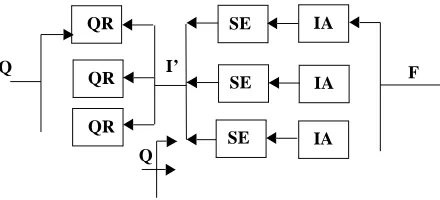
neces-sary, keeping the Query Routers up-to-date with current Forward Knowledge. The volume of this
flow (called I’) has not been analysed, but it is expected to grow in proportion with the Index volume
(exponential over time). Figure 5 shows the principles of this model.
Using this model, the “ideal” message complexity of a search engine becomes O(Q/n+I/m) or O(Q/
n+M/n), and that of the Query Router becomes O(Q/m+I’) (where m is the number of query routers).
This is only true under the situation where the query is forwarded to only one search engine. Under
conditions where queries are sent to several search engines, the complexity of the search engine
grows towards O(Q+I’).
In order to send queries to only one (or a few) search engines, the collections must be distinct and
different. When using an indexing agent under World Wide Web conditions, there is no obvious
method by which to find collections sufficiently different so that the Query Routers can discriminate
well between them1. An approach where the collections (web servers) themselves generate the index
(inverted lists or metadata) rather than letting an indexing agent rely on arbitrary hyperlinks seems to
be promising.
1. This problem is closely related to an information clustering problem. SE
IA
F I
Q
SE
Figure 5: The information flow using distributed index and Forward Knowledge. QR=Query Router
4.5.4. Using static forward knowledge
The only way to avoid sending the I’ volume to every Query Router is by relying on Static Forward
Knowledge i.e. a Forward Knowledge that never changes. Static collections can be characterised by
static forward knowledge, but static collections do not exist in the World Wide Web. Static forward
knowledge can be obtained if each collection contains information with a given class, e.g.
informa-tion related to a specific topic. By attributing a topic to the query, a query router can forward the
query to the correct collection. Such collections are hard to find on the World Wide Web, so this is
not a realistic solution.
4.5.5. Using metadata associated with a topic
The use of metadata, however, enables us to process queries on a metadata collection instead of a
full-text index. A metadata collection can represent information from several collections. It is thus
possible to make “topical” metadata collections that contain information about resources only within
a given topic. This approach requires that topics can be attributed to both metadata and queries.
One metadata item that describes a particular internet resource (e.g. a document) can be stored inside
a metadata collection together with metadata descriptions of similar resources. Since the collections
can be stored on different nodes in the network, we call this process distributed metadata clustering.
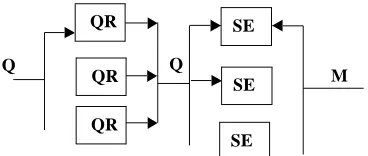
Queries can in the same manner be routed to a search engine based on the topic attributed to it. Both
the Q volume and the M volume can be distributed across several nodes using this approach, and the
I’ volume do not exist, since we only use static forward knowledge. See figure 6. SE
IA F
I’ Q
QR
QR
IA
IA SE
SE QR
Figure 6: The information flow using distributed metadata clustering and static Forward Knowledge.
The message complexity of the query router is under ideal conditions O(Q/n) and of the search
engines O(M/m). The CSI employs this model.
4.6. The design of forwarding protocols
All the research projects known to us inside Internet resource discovery fall into one of the categories
mentioned above. None of them are using distributed metadata and query routing with static forward
knowledge, except Hinds [16], which relies on static collections. On the basis of the given analysis
we therefore claim that none of these products will be able to scale to the future Internet proportions.
During the construction of the software algorithms and the networking protocols, it turned out to be
very difficult to avoid traffic bottlenecks that limits the theoretical scaleability shown above. A
thor-ough formal analysis of the design was necessary in order to prove that the design is scaleable in
practice. The need for fault-tolerance, self-configuration and flexible number of members also
needed to be addressed.
5. Analysis of the Content-Sensitive Infrastructure
The scaleability of the CSI was formally analysed using probability theory. By assuming that
mem-bers, metadata and queries have a COI according to some probability distribution, it is possible to
express as a function of member count:
• the probability for at least one member to have a given COI
• the average size of a member group with a given COI
• the probability that a member group has children interested in a given sub-COI (sub-topic)
• the fraction of the metadata volume arriving at a given member
• the fraction of the query volume arriving at a given member
The full analysis is omitted in this paper for the sake of brevity, but it can be summarised as follows:
• The size of the member groups contributes to the distribution of the metadata volume (M). The
SE
M Q
Q
QR
QR
message complexity of a member when processing metadata is , where n is the number of
members.
• The number of member groups contributes to the distribution of the query volume (Q). The
mes-sage complexity of a member when processing queries is , where the function h is a
monotonically decreasing function with a horizontal asymptote at a positive small number (that
number is inversely proportional with number of different topics).
• The fault-tolerance (robustness towards transport error) of the CSI increases with growing number
of members.
6. Advantages of metadata
This paper initially described a lot of problems inside the area of resource discovery, but have mostly
discussed the scaleability. We shortly comment on the other issues:
6.1. Currency
Metadata can be generated by a process local to the collection so that the volume of metadata indices
is optimised. Metadata can also include a “life-time”, after which it is considered irrelevant and is
deleted from the server.
6.2. Coverage
Metadata can also be generated from a manual process, so that it can represent resources invisible to
web spiders.
6.3. Relevance
Metadata can assign a topic to the resource. It can also describe the resource in terms of keywords,
date stamps, certificates, client requirements and other formal or informal characteristics of the
resource. A query conveying the precise requirements of the user can thus be more accurately
matched to a selection of resources.
7. Conclusion
Distributed metadata clustering combined with query routing is a promising approach for distributed
resource discovery under Internet conditions (size, diversity and rate of change). This paper has
described a prototype system based on this idea together with summary of analytical and experimen-O M n( ⁄ )
tal results. This paper has also presented an evaluation framework for comparing the scaleability of
different distribution strategies. The results from using this framework suggests that few existing
sys-tems inside this area is scaleable to Internet proportions.
8. Future work
The CSI is in its early experimental stage and only simulated testing has been done so far. The
simu-lation verifies the analytical results. The future work on this project will include the following
activi-ties:
• The development of necessary networking code to deploy CSI member nodes in the Internet
• The development of a User Agent
• The study of how a mixed (and evolving) set of metadata representations can exist in the CSI at
the same time
• The effect of letting a member change its Category of Interest in order to respond better to local
queries. This would resemble a “cooperative caching” system for metadata
• Evaluation of overall system efficiency and effectiveness when all these ideas are working
together
9. References
[1] GREY, D.J., P. DUNNE, and R.I. FERGUSON. AgentSeek: a means of efficiently locating
resources on the World Wide Web using mobile, collaborative agents. in Workshop2000 on agent-based simulation. 2000.
[2] KOSMYNIN, A., From Bookmark Managers to Distributed Indexing: An Evolutionary Way to
the Next Generation of Search Engines. IEEE Communications Magazine, 1997. 35(6): p. 146-151.
[3] KOBAYASHI, M. and T. KOICHI, Information Retrieval on the Web. ACM Computing Surveys,
June 2000, 2000. 32(2).
[4] SULLIVAN, D., Crawling Under the Hood, and Update on Search Engine Technology. Online,
[5] CHEKURI, C., et al. Web Search Using Automatic Classification. in Sixth International World
Wide Web Conference, Poster POS725. 1997. Santa Clara, California.
[6] SUGIURA, A. and O. ETZIONI, Query Routing for Web Search Experiments: Architecture and
Experiments. 2000, The ninth International World Wide Web Conference 2000.
[7] SHERMAN, C., What's new with Web Search. Online, 2000. 24(3): p. 27-34.
[8] W3C, Extensible Markup Language (XML). 1998, World Wide Web Consortium.
[9] BREWINGTON, B.E. and G. CYBENKO, Keeping up with the Changing Web. IEEE Computer,
2000(May 2000).
[10] KOWALSKI, G.J. and M.T. MAYBURY, Information Storage and Retrieval Systems, theory
and implementation. 2nd ed. 2 ed. 2000: Kluwer Academic Publisher.
[11] KORFHAGE, R., Information Storage and Retrieval. 1997, New York: John Wiley & Sons, Inc.
[12] WEIDER, C., J. FULLTON, and S. SPERO, Architecture of the Whois++ Index Service,
RFC1913. 1996, IETF.
[13] WANG, B., et al., Standards in the CHIC-Pilot distributed indexing architecture. 1998,
Com-puter Networks and ISDN Systems 30 (16), pp.1571-1578.
[14] YUWONO, B. and D. L.LEE. Server Rankning for Distributed Text Retrieval Systems on the
Internet. in Proceedings of the Fifth International Conference on Database Systems for Advanced Applications. 1997. Melbourne, Australia.
[15] KIRRIEMUIR, D., et al., Cross-Searching Subject Gateways. 1998, D-Lib Magazine January
1998.
[16] HINDS, N., RAVISHANKAR, CV. Managing Metadata for Distributed Information Servers. in
Proceedings of the Thirty-First Hawaii International Conference on System Sciences. 1998. Koala