Weiss, S. and Hadef, M. and Konrad, M. and Rupp, M. (2003) Blind
chip-rate equalisation for DS-CDMA downlink receiver. In: 37th Asilomar
Conference on Signals, Systems and Computers, 09 -
2003-11-12, Pacific Grove, California. ,
http://dx.doi.org/10.1109/ACSSC.2003.1292195
This version is available at
https://strathprints.strath.ac.uk/38346/
Strathprints is designed to allow users to access the research output of the University of Strathclyde. Unless otherwise explicitly stated on the manuscript, Copyright © and Moral Rights for the papers on this site are retained by the individual authors and/or other copyright owners. Please check the manuscript for details of any other licences that may have been applied. You may not engage in further distribution of the material for any profitmaking activities or any commercial gain. You may freely distribute both the url (https://strathprints.strath.ac.uk/) and the content of this paper for research or private study, educational, or not-for-profit purposes without prior permission or charge.
Any correspondence concerning this service should be sent to the Strathprints administrator:
The Strathprints institutional repository (https://strathprints.strath.ac.uk) is a digital archive of University of Strathclyde research outputs. It has been developed to disseminate open access research outputs, expose data about those outputs, and enable the
BLIND CHIP-RATE EQUALISATION
FOR
DS-CDMA DOWNLINK RECEIVER
S.
Weiss.
M.
HadeJ
M.
Konrad
School of Electronics
&
Computer Science
University of Southampton
Southampton,
UK
{s.weiss,m.hadef}@ecs.soton.ac.uk
ABSTRACT
A dispersive channel in the DS-CDMA downlink destroys the orthogonality of the synchronous users' spreading se- quences. In this paper, we aim to re-establish this orthogo- nality blindly by means of a common chip-level equaliser. The adaptation algorithm is based on a constant modulus criterion forcing the various user symbols onto a constant modulus, for which a stochastic gradient descent algorithm is derived. This algorithm is structurally similar to a multi- ple error filtered-X LMS type approach, whereby the equaliser input CM update is replaced by a spreading code filtered version. Various simulations demonstrating the algorithm's convergence and noise performance are presented.
1. INTRODUCTION
In a DS-CDMA downlink scenario, transmission over a dis- persive channel destroys the mutual orthogonality of the codes which are used to multiplex the various users in the system. As a result, the received and code-demultiplexed user signals are subject not only to inter-symbol interference (ISI) due to channel dispersion but also to multiple access interference (MAI) due to the loss of code orthogonality.
A popular approach to suppress MA1 and IS1 one a user is the minimum output power (MOE) algorithm blindly can- celling MA1 and IS1 terms but passing the desired user by code-constraints [ I , 21, which is essentially Frost's linearly constrained minimum variance beamformer [3]. Recover- ing several users at the same time exploits more knowledge of the system and has been performed blindly using a con- stant modulus (CM) criterion [4, 5, 61, whereby the derived algorithms either neglect spreading [ 5 ] or the dispersiveness of the channel [4, 61. Non-blind multiuser schemes in turn are based either on the knowledge of a pilot [7, 81 or training sequences [9].
In this paper, we derive, based on the definition of a simal model in Sec. 2. a suitable CM cost function for a
M.
Rupp
Institute for Comms
&RF Engineering
Technical University of Vienna
Vienna,
Austria
[email protected]
tiple error filtered-X LMS algorithm in [IO]. The addition mutual decorrelation between the various decoded user sig- nals as required in [5] and [I I] can be neglected due to the code-filtering. Simulations of the proposed algorithm are presented in Sec. 5 , and conclusions drawn in Sec. 6.
2. SIGNAL MODEL
We consider the DS-CDMA downlink system in Fig. 1 with multiple symbol-synchronous users, which for simplicity are assumed to have the same rate. The system is fully loaded with
N
user signals ui[n], 1 = O(1)N-
1, which are code multiplexed using Walsh sequences of length N extracted from a Hadamard matrix H. The resulting chip rate signal, running at hr times the symbol rate. is further scrambled by c[m] prior to transmission over a channel with dispersive impulse response g [ m ] and conuption by additive white Gaussian noise v[m], which is assumed to be indepen- dent of the transmitted signal.The dispersive channel g[m] destroys the orthogonality of the Walsh codes, such that direct decoding of the received signal r[m] with descrambling by c*[m] and code-matched filtering by
HT
will lead to MA1 and IS1 conuption of the decoded user signalsa,["],
1 = O(1)N - 1. In order to re-establish orthogonality ofthe codes, a chip rate equaliser w[m] can be utilised [9, 81. In the following, we are con- cerned with the blind updating of the equaliser coefficientsI
chip-level equaliser in Sec. 3. Sec. 4 presents a stochastic
[image:2.613.320.519.554.650.2]4 m l .
3. MULTIUSER EQUALISATION CRITERION
We first derive the detected user signals &[m] as a function of the chip-rate equaliser w[m]. Based on this, we state a suitable cost functions based on which the equaliser can be adapted.
3.1. Demultiplexed User Signals
For the decoding, Walsh sequences are used as matched fil- ters. ?e sequence for decoding the lth user, contained in a vector h f , can be taken from an N x N Hadamard matrix,
The Ith user is thus decoded as
rc*rnnrl
00 c*[nN-N+l]
whereby the descrambling code c*[m] has been absorbed into a modified and now time-varying code vector hf[nN], and w E ICL contains the equaliser's L chip-spaced com- plex conjugate weights. Rearranging w and hl[nN] yields
with H,[nNl E Z L x ( N y + L - l ) being a convolutio2al matrix comprising the lth user's modified code vector hT[n] and
rnN E P + L - ' . ..
3.2. CMA Cost Function
We assume that the user signals ur[m] consist of symbols with a coiistant modulus 7 , such as BPSK, QPSK, or 8-
PAM. Therefore, we.would like to blindly adapt the equaliser by forcing all decoded users 01 [m] onto a constant modulus. This can be formulated, similarly to [5, 121, by a suitable cost function (CM,
~
1284
mal(wJ
Fig. 2. Cost function ~ C M in dependency of a single complex valued coefficient wg.
wo
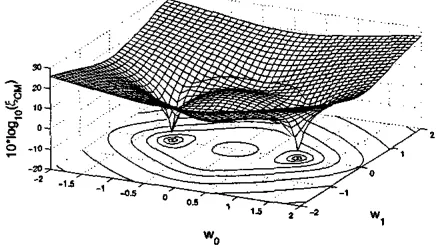
Fig. 3. Cost function ~ C M in dependency of a two coefficient equaliser w = [wo w1IT, which is constrained to be real.
which measures deviation of each of the N users' decoded symbols from the desired modulus. The optimum equaliser coefficient vector w is therefore given by
w O p t , c ~ = a r g m i n t ~ ~
.
(4)There is no unique solution to (4), since minimising (3) is ambiguous with a manifold of solutions due to an in- determinism in phase rotation. However, any member of this manifold is a suitable solution for the equaliser w, and can be used in combination with differential modulation schemes to recover u,[m].
Examples. Two examples for (CM with N = 4 users employing QPSK with y = 1 over a distortionless and de- layless noise-f?ee channel are given in Figs. 2 and 3. Fig. 2 shows f c ~ in dependency of an equaliser w with a single complex coefficient 100. The cost function shows that there is as manifold of solutions satisfying IwoJ = y.
Fig. 3 presents a case, where the equaliser contains two co- efficients which are constrained to be real, and therefore possesses two symmetric solutions wopt,CMA = [H 0IT only. Note that a solution w = [0
f
1IT would not syn- [image:3.613.334.547.102.225.2] [image:3.613.331.549.278.403.2]chronise the codes correctly and therefore has a large cost function value associated. It is also apparent from Figs. 2
and 3 that
CCM
has flat points, which we will discuss below.4. BLIND ADAPTATION
A simple stochastic gradient descent update rule for w[m] can be found by calculating the gradient of an instantaneous cost function, i.e. omitting the expectation operator in (3),
The resulting terms are then minimised w.r.t. w to obt?in in- stantaneous estimates ofthe cost function gradient V<(wN,), leading to the stochastic gradient update
wn+1 = wn
-
I v & M (wn)where I is the step size. The introduction of gradient noise through inaccurate estimates of the true underlying statistics into the update routine can assist in avoiding the adaptation to remain in flat poinp of the cost function.
To determine V ~ C M , we apply complex vector calcu- lus [ 131 to
(3,
yielding(6)
N--l
. r:, HF[nN] w]
N-1
= -2 (?Z-l~~[n]12) Hi[nN] r n N C y b 1 (7)
This algorithm differs from the standard CM algorithm [ 141 or its extension in IS] in the inclusion of a code filtered term H&N] r,,N rather than just the equaliser input ~ [ n ] . This is structurally similar to a multiple-errorfiltered-X LMS al- gorithm [IO], where the transfer functions appearing in the
i=o
Fig. 4. Moduli of complex valued channel impulse respnses
g~[m] (left) and gz[m] (right).
paths between the adaptive filter output and the error for- mations have to be accounted for by modifying the LMS' updating scheme. Hence, we refer to the proposed scheme in (7) as filtered-R multiple error CM algorithm (FIRMER- CMA).
5. SIMULATION
RESULTS
For the simulations below, we apply the FIRMER-CMA to two different channel impulse responses, a short g1 [m] and a more dispersive g2[m], as characterised in Fig. 4. We first demonstrate the convergencebehaviour in Sec. 5.1, and later the bit errorperformance in Sec. 5.2.
5.1. Convergence
In order to demonstrate the convergence behaviour of the proposed algorithm, we transmit N = 16 QPSK user sig- nals over g1 [m] in the absence of channel noise, and utilise the FIRMER-CMA to update an equaliser with
IO
coeffi- cients. The adaptation is initialised with the second co- efficient in the weight vector set to unity, while the opti- mal response will need to place the maximum coefficient in the first vector element. With /I = 0.05, the evolution of the filter coefficients' real part is shown in Fig. 5(top), whereby the instantaneous cost function of(5) is given in Fig. S(bottom). The system converges to a solution such that the convolution of gl[m] and the adapted equaliser is a complex rotation of a zero delay. This rotation is evident when considering the evolution of the constellation pattern of the demodulated 0th user 14n3 as presented in Fig. 6. Although adaptation is switched on at n = 0, the system exhibits a slow initial convergence which may be due to the flat points in Ccw, but is generally typical for CMA algo- rithms [14].We now assume a carrier offset 40, such that a modi- fied baseband channel is given by
~1 [m] = g1 [m] ejann (8)
whereby here 40 = 0.5 10V5r. Converging the FIRMER- CMA on this system yields symbols streams as exemplified for user 1 = 0 in Fig. 7. As the dynamic rotation applied to the basebandmodel does not affect the CM criterion, and the performance of FIRMER-CMA appears unaffected by a carrier offset.
The problem of rotating user signals is not further con- sider here, hut could he addressed, for example, by car- rier offset estimation in a second receiver stage analogously to [15].
5.2. Robustness
[image:4.616.80.298.589.659.2]. . . ... .. ..
. .
[image:5.619.84.309.92.449.2]axl UD Bm rn t m , r p a > u a > s m r a m 2 r m iteration n
Fig. 5. (top) weight trajectories and (bottom) learning curve
. . .
. . . . ... ,
. . . . . ~ f
: . . .
.. .
.:
..
: . . ... ,.~ . . . . . .. ... . .
, .. . . . .
. . . . .
- 3 3 -
-1
, . ’
. i . . . . . . . . . .’ . . . ,
1 m am- m - -‘rea~~-[n])
rn
.. iteration II
Fig. 6. Evolution of the received constellation pattern of user
1 = 0 over a rtationaly channel 91 [m].
sponses g,[rn] and gz[m] with L = 20 and L = 64 coef- ficients, respectively. With the middle tap set to unity and an appropriately adjusted p, the algorithm has always been given lo3 symbol periods to converge prior to correction of
the phase rotation and bit error rate (BER) measurement. The BER results are given in Fig. 8 in comparison to the optimal QPSK performance in AWGN and the analytical minimum MSE (MMSE) solution. Note that the FIRMER- CMA closely approaches the MMSE performance.
In order to explore the steady-state performance of the system, channel g*[m] in Fig. 4(right) has been used as an average magnitude profile. Each of the 4 multipath coeffi- cients is now drawn from a Rayleigh dism’bution. We use this system to explore the influence of the step size param- eter p on the convergence. Allowing the FIRMER-CMA
. . ....
:.. .. .. . . . , ... . .
. ,
. .
.
..iteration n
Fig. 7. Evolution of the received constellation pattern of user
I = 0 over a channel &[m] with carrier offset.
10
channel SNFUbit [dBj
Fig. 8. BER performance of proposed FIRMER-CMA over two
channels in dependency of the channel SNR compared to an ana- lytical MMSE channel equaliser and the BER in an AWGN chan- nel.
sufficient time to reach its steady state for each of 200 inde-
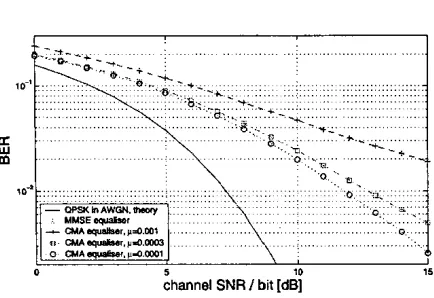
pendent, fixed channel realisations, the various BER curves for rotation-corrected systems are compared to their ana- lytic MMSE equaliser performances. The later are cho- sen to realise a delay of L/2 = 32 chips for every chan- nel, while the FIRMER-CMA is initialised with the cen- tre coefficient set to unity. The results for step sizes of p = 0,001, p = 0.0003, and p = 0.0001 are given in Fig. 9, and compared to the theoretical performance of QPSK over a non-dispersive AWGN channel, as well the the MMSE BER curve. It can be seen that for small values of p, the steady-state performance of FIRMER-CMA approaches the MMSE performance closely, while for larger p, the perfor- mance in noise is generally seriously degraded, particularly for lower BER performances in higher SNR regions.
[image:5.619.335.550.94.251.2] [image:5.619.94.309.95.269.2] [image:5.619.335.552.311.442.2]1
. . , . . . . . , . . . , . . .\,
. . . . . . . .. . . , . . .
m
k*i:z
I
..\
;... .. .. ...~.::.i
....10 IS
channel SNRl bn [dB]
Fig. 9. BER performance of proposed FIRMER-CMA over two
channels in dependency of the channel SNR compared to an ana- lytical MMSE channel equaliser and the BER in an AWGN chan- nel.
6. CONCLUSIONS
A blind equalisation approach for a DS-CDMA downlink scenario has been presented, which aims to enforce CM conditions on the various user signals. A stochastic gradi- ent algorithm has been derived, which differs from previous CM algorithms by a code-prefiltering of its input. Com- pared to other multiuser CM based solutions in the litera- ture [5, l l], the spreading codes enforce the olthogonality of the decoded user, which renders decorrelation of the var- ious output signals obsolete. The proposed algorithm has been extensively tested and proven very stable. Representa- tive simulations have been presented, highlighting the con- vergence behaviour as well as the algorithm’s noise perfor- mance, which is sensitive to the selection of the step size parameter but can reach very close to the performance of the MMSE equaliser.
7. REFERENCES
[ I ] M. Honig, U. Madhow, and S. Verdu, “Blind A d a p tive Multiuser Detection,” l€E€ Trans. 1nJ Theory,
41(4):944-960, 1995.
[2] R. Schober, W. H. Gerstacker, and L. H. J. Lampe,
/E€€
“Comparison of MOE and blind LMS,”
Comnis. Lett., 7(5):204-206,2003,
[3] 0. L. Frost, Ill, “An Algorithm for Linearly Con-
Proc. E E € , strained Adaptive Array Processing,”
60(8):92&935,1972.
[4] K. Fukawa and H. Suzuki, “Orthogonalizing Matched Filter (OMF) Detection for DS-CDMA Mobile Radio Systems,” in lE€€ Globecorn, 1994, 1: 385-389.
[SI C. Papadias and A. Paulraj, “A Constant Modulus Algorithm for Multiuser Signal Separation in Pres- ence of Delay Spread Using Antenna Arrays,” ]€€E
Sig. Proc. Lett., 4(6):178-181, 1997.
[6] Y. Huang and P. M. Djurit, “Multiuser Detection of Synchronous Code-Division Multiple-Access Sig- nals by Perfect Sampling,” /E€€ Fans. Sig. Pmc.,
50(7):1724-1734,2002.
[7] F. Petre, M. Moonen, M. Engels, B. Gyselinckx, and H.D. Man, “Pilot-Aided Adaptive Chip Rate Equalizer Receiver for Interference Suppression in DS-CDMA Forward Link,” in lE€€ VTC, Sept. 2000, 1:303-308.
“Adaptive Chip- Rate Equalization of Downlink Multirate Wideband CDMA,” IEEE Trans. Sig. Proc., to appear, 2004. [9] 1. Stirling, D. Garcia-Alis, S. Weiss, G. Rice, and R.W.
Stewart, “A Joint Adaptive MMSE Downlink Re- ceiver,” in Asilontar ConJ Sig. Sys. Conip., Nov. 2000.
2: 1436-1440.
[IO] S.J. Elliott, I.M. Stothers, and P.A. Nelson, “A Mul- tiple Error LMS Algorithm and its Application to the Active Control of Sound and Vibration,” /E€€
Trans. Acoustics, Speech Sig. Proc., 35( 10):1423- 1434,1987.
[8] A. R. Margetts and
P. Schniter,
[ I l l S. Lambotharan, J. A. Chambers, and A. G. Con- stantinides, “‘Adaptive Blind Retrieval Techniques for Multi-User DS-CDMA Signals,”
I€€
Electronics Let- ters, 35(9):693-695, 1999.[I21 Z. Xu and P. Liu, “Code-Constrained Blind Detec- tion of CDMA Signals in Multipath Channels,” / € € E
Sig, Proc. Left., 9(12):389-392,2002,
[I31 T. K. Moon and W. C. Stirling, MaflientaticalMethods and Algorithms, Prentice Hall, 1999.
[I41 C. R. Johnson, P. Schniter, T. J. Endres, J. D. Behm, D. R. Brown, and R. A. Casas, “Blind Equalization Using the Constant Modulus Criterion: A Review,”
Proc. /EE€, 86(10): 1927-1950,1998.
[IS] M. Rupp, “On the Separation of Channel and Frequency Offset Estimation,” in Asiloniar
[image:6.614.77.294.79.228.2]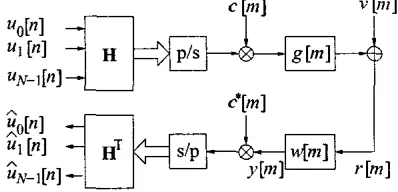
![Fig. 4. Moduli of complex valued channel impulse respnses g~[m] (left) and gz[m] (right)](https://thumb-us.123doks.com/thumbv2/123dok_us/1729578.126392/4.616.80.298.589.659/fig-moduli-complex-valued-channel-impulse-respnses-right.webp)
![Fig. 7. I Evolution of the received constellation pattern of user = 0 over a channel &[m] with carrier offset](https://thumb-us.123doks.com/thumbv2/123dok_us/1729578.126392/5.619.84.309.92.449/fig-evolution-received-constellation-pattern-channel-carrier-offset.webp)