MUTUAL KNOWLEDGE EVOLUTION IN TEAM DESIGN
ZHICHAO WU AND ALEX DUFFY
University of Strathclyde UK
1. Introduction
This paper presents an investigation into the phenomenon of mutual knowledge evolution in team working using protocol data. The focus is on whether mutual knowledge evolution in agents exists, and if so, what triggers this phenomenon.
Section 2 presents the nature of team design. Team design is a collective problem solving and knowledge co-constructed process (Bonner, 1959; Nguifo et al, 1999). When members in a design team work together, they can therefore produce a result that individuals may not readily produce, which is called team synergy (Prasad, 1995). Section 3 presents the hypothesis that designers can mutually evolve their design idea and learn from each other. An example of mutual knowledge evolution process is posited. In section 4, the analysis of mutual knowledge evolution using protocol data is carried out. Through the analysis, the phenomenon of mutual knowledge evolution has been observed and the reasons that trigger the phenomenon have been discussed. The conclusion is made in section 5 and future research has been identified.
Collective learning in team design has been presented by Wu and Duffy (Wu and Duffy, 2002). In this paper the focus is specifically on investigating mutual knowledge evolution, i.e., a design phenomenon in which the agents mutually evolve their design knowledge and co-construct the design solution.
2. The nature of team working
“… a coordinated, synchronous activity that is the result of a continued attempt to construct and maintain a shared conception of a problem.” (Roschelle and Teasleyt, 1995)
Similarly, Prasad argued (Prasad, 1995):
“Team working emphasizes interpersonal relationships, cooperation, negotiation, and collaborative decision-making.”
To create innovative artefacts and to integrate dynamic and diverse knowledge from multiple knowledge domains and disciplines, team design practice is widely adopted by modern industry in their product development (Sonnenwald, 1996). In this section, the nature of team designing in the context of product design is presented. This serves as a context of the investigation into mutual knowledge evolution.
Sonnenwald made a comprehensive study to analyse communication roles that support collaboration during design practice (Sonnenwald, 1996). Using four empirical or field studies in architecture, expert systems, telecommunications and engineering design, she identified 13 communication roles that emerge in the design process. Communications in a design team can occur within or between organisations, task and disciplines, or occur between different individual agents, or between the design environment and the agents. It is reasonable to conclude that interactions between agents in context of team design are an important activity that facilitates the team design process.
Team design is a collective problem solving process where there is a variety of research showing its advantages to problem solving by individuals (Bonner, 1959). Bonner argued that in an ideal design team where every individual contributes their own productive capacity, collective solutions should generally be better to individual efforts. When members of the team work together, the group is dynamic rather than static. The knowledge of the members can be updated through interactions, mutual discussions, and other effective communications. In a team design practice, solutions emerge by an interactive process in which each agent (learner) transforms the contributions of the other, in order to arrive at a mutually acceptable solution. This has been also described as knowledge co-constructed process (Nguifo et al, 1999).
Collective learning in such a design environment has been presented by Wu and Duffy (Wu and Duffy, 2002). In this paper the focus is specifically on investigating mutual knowledge evolution, i.e., a design phenomenon in which the agents mutually evolve their design knowledge and co-construct the design solution.
3. The hypothesis
Design and learning are two interlinked activities (Persidis and Duffy, 1991). “Designers learn when they encounter knowledge which is sufficiently different from their present state of knowledge” (Persidis and Duffy, 1991). The phenomenon is elaborated and justified by a Model of Learning in Design (Sim, 2000).
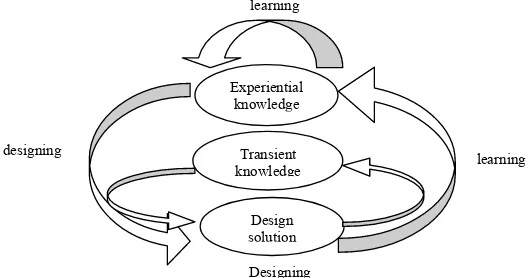
[image:3.612.172.438.450.589.2]Design and learning are coupled and can be described as a design and learning loop (Duffy and Duffy, 1996), see Figure 1. The lower loop suggests in-situ learning and application of knowledge when the design solution is evolved from an initial design stage, Stage: 1, to a design solution specification, Stage: N. Some of the learned knowledge will transform to long-term experiential knowledge and be re-used in later design scenarios. In addition to the lower loop, there is an upper loop that updates or modifies the experiential knowledge depicting the designers’ ability to explore and learn from their own experiential knowledge. Transient knowledge is created and used during problem solving on short-term memory, without being captured within the experiential knowledge base.
Figure 1 Design/Learning loop (Duffy and Duffy, 1996)
The design and learning loop does not reflect the phenomenon of learning in the context of team working. It is posited that designers mutually evolve their design knowledge and learn from each other. For example, mutual
Experiential knowledge
Transient knowledge
Design solution learning
learning designing
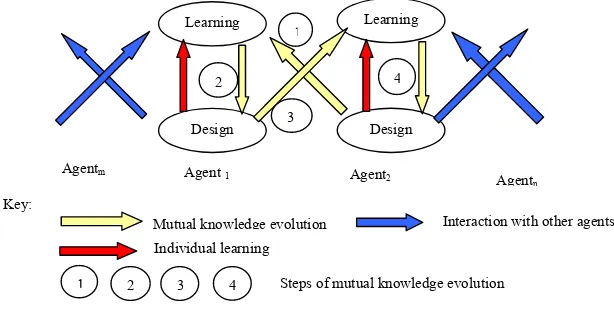
knowledge evolution process may occur through the following process (see Figure 2): Step 1, agent 1 learns a design idea from agent 2; Step 2, agent 1 can create a new design idea from the learnt idea; Step 3, agent 2 can learn agent 1’s new design idea; Step 4, agent 2 can create another new design idea, and so forth. The steps can be repeated and be considered as a mutual knowledge evolution loop. Agent 1 and agent 2 can interact with other agents and mutually evolve their design idea and knowledge. Thus, multiple agents can interact and mutually evolve their knowledge.
Figure 2 Mutual knowledge evolution
Based on the hypothesis, analysis of the protocol data of team design was carried out. The focus of the analysis is on two questions:
• Does the phenomenon of mutual creativity and learning exist in team working?
• What triggers the phenomenon?
4. Mutual knowledge evolution: an analysis using protocol data
4.1 THE EXPERIMENT
To facilitate the investigation, video recording was made of a meeting of a design team, consisting of three 5th-year students of a product design course and carrying out the conceptual design of a Golf Ball Dispenser. The team meeting was set for one hour and they were reminded of the time left during the meeting. The students used brainstorming in developing their design concept and the results were sketched. The team members are represented as
Agent 1 Agent2
Learning
Design
Learning
Design 1
2
3
4
Agentm
Agentn Key:
Mutual knowledge evolution
Individual learning
Interaction with other agents
M, B and S respectively. The protocol data (Wu and Duffy, 2002) is also used for the analysis presented in this paper.
The assumption made in the analysis is that “the verbalisable cognitions can be described as states that correspond to the information that is in the focus of attention”, and that “the information vocalized is the verbal encoding of the information in short-term memory” (Ericsson and Simon, 1984).
4.2 THE ANALYSIS AND RESULTS
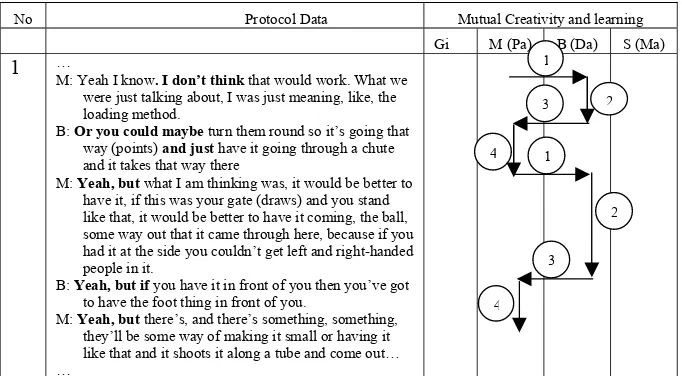
[image:5.612.141.482.371.559.2]Mutual knowledge evolution has been observed from the protocol data, see Table 1. The four steps for mutual knowledge evolution have been depicted in the table and the keywords used to identify the process have been highlighted using bold format. In the first example, M and B mutually evolve their knowledge in the design of loading method, and in the second example the knowledge of sealing the cartridge is mutually evolved.
Table 1 Mutual knowledge evolution
No Protocol Data Mutual Creativity and learning
Gi M (Pa) B (Da) S (Ma) 1 …
M: Yeah I know. I don’t think that would work. What we were just talking about, I was just meaning, like, the loading method.
B: Or you could maybe turn them round so it’s going that way (points) and just have it going through a chute and it takes that way there
M: Yeah, but what I am thinking was, it would be better to have it, if this was your gate (draws) and you stand like that, it would be better to have it coming, the ball, some way out that it came through here, because if you had it at the side you couldn’t get left and right-handed people in it.
B: Yeah, but if you have it in front of you then you’ve got to have the foot thing in front of you.
M: Yeah, but there’s, and there’s something, something, they’ll be some way of making it small or having it like that and it shoots it along a tube and come out… …
2 3
4 1
2
3
2 …
Gi: I think it should be sealed along those edges so that the whole thing is sealed.
Pa. What about a small gasket? Gi: What do you mean?
Pa: Just a small gasket that seal around, but I don’t know how you’d get that done and how you’d seal it. Gi: Even just silicon get round the top.
Da: But because it’s 3 compartments… Easier if it’s just a single compartment. But because it’s the three you’d
have to have rigid edges round here and a seal across.
Pa: Seal across here and here…you could possible have it coming in…
Gi: Could you not have the silicon binder stuff just going along all these surfaces and just stick the top on? Ma: Ifyou cut it well enough, you should get it pretty
close.
Ma: As long as it’s flat.
There can be different reasons that trigger the mutual knowledge evolution process. It is observed in the two examples that when the agents have complementary knowledge and working on the same design problem, the design knowledge can be mutually evolved and better design knowledge or ideas can be produced. It is postulated that more reasons triggering mutual knowledge evolution can be identified through analyzing other protocol data.
The final design concept resulted from the team meeting can also be regarded as the result of mutual knowledge evolution through discussion. The team members contributed their design ideas and mutually evolved the design concept.
5. Conclusion
In this paper, the phenomenon of mutual knowledge evolution has been observed in protocol data and the reasons that trigger this phenomenon has been analysed. As such, the hypothesis that mutual knowledge evolution in agents exists in team working has been evaluated and shown to exist.
There are other forms of collective learning that make it unique from individual learning, such as common learning and combined knowledge. The nature of such kinds of learning will be investigated in future research. Such an effort can be used as a basis for the development of computer supported means for collective learning in design.
Acknowledgements
The authors thank Mr Craig Finlay providing the protocol data for analysis. 1
2
3
4 1
2
3
Reference:
Bonner, H. (1959). Group dynamics: principles and applications. The Ronald Press Company. New York
Duffy, A., and Duffy, S. (1996). “Learning for Design Reuse.” Artificial Intelligence in Engineering Design, Analysis and Manufacturing 10, 139-142.
Ericsson, K and Simon, H: 1984, Protocol Analysis: Verbal Reports as Data, MIT Press, Cambridge, MA.
Nguifo, E., et al: 1999, Knowledge Transformation in Agents and Interactions: a Comparison of Machine Learning and Dialogue. In DillenBourg, P. (eds), Collaborative Learning:
Cognitive and Computational Approaches. Oxford, Elsevier Science Ltd.
Persidis, A., and Duffy, A. (1991). Learning in Engineering Design. Intelligent CAD, III. H. Yoshikawa, et al., Elsevier Science Publishers B. V. (North-Holland).
Prasad, B. (1995). “On Influencing Agents of CE.” Concurrent Engineering: Research & Applications 3(2), 78-80.
Roschelle, J., and Teasleyt, S.: 1995, The Construction of Shared Knowledge in Collaborative Problem Solving? In O’Malley, C.E. (eds), Computer-Supported
Collaborative Learning, Springer-Verlag, Berlin, pp.69-197.
Sim, S. (2000). Modeling Learning in Design. PhD. Thesis, CAD Centre, DMEM. Glasgow, University of Strathclyde.
Sonnenwald, D. H. (1996). “Communication roles that support collaboration during the design process.” Design Studies Vol. 17, No. 3, 277-301.