Knowledge transformers – a link between learning and creativity Siang Kok Sim∗ and Alex H B Duffy+
∗
School of Mechanical and Production Engineering, Nanyang Technological University,
Nanyang Avenue, Singapore 639798, Republic of Singapore
+
CAD Centre,
University of Strathclyde, 75 Montrose Street, Glasgow G1 1 XJ, United Kingdom
Abstract. The purpose of this paper is to investigate whether knowledge transformers which are featured in the learning process, are also present in the creative process. This is achieved by reviewing models and theories of creativity and identifying the existence of the knowledge transformers. The investigation shows that there is some evidence to show that the creative process can be explained through knowledge transformers. Hence, it is suggested that one of links between learning and creativity is through the knowledge transformers.
1. Introduction
Creativity is considered the ultimate of human qualities, one of the key measures of intelligence that separates us from the rest of the animal kingdom (Goldenburg and Mazursky, 2002). Our ability to create, to innovate, is believed to be Godlike – described by some religions as one of the divine qualities endowed to man, who was created in the image of God, the Creator. The question that has perplexed many researchers and scholars in the study of creativity is what is creativity? It has been suggested that there are more than 200 definitions in literature alone (DasGupta, 1994, Weisberg, 1992). Understanding what is creativity has been the focus of many research and academic studies across many disciplines – from psychology to art to medicine. Taylor (1988) in analysing more than fifty definitions categorised the various interpretation into one of several classes (Dasgupta, 1994):
1. Gestalt type: in which the major emphasis is on the recombination of ideas or the restructuring of a gestalt.
2. End-product-oriented: according to which creativity is a process that results in a novel output or work or inventions.
4. Psychoanalytic: in which creativity is defined in terms of the interaction between the id, ego, and the superego.
5. Process-oriented: in which the emphasis is on the thinking process itself. That is, a certain type of process is said to characterise creativity.
Here, the perspective adopted is that creativity is to do with the thinking process itself. Perkins [15, 16] and Weisberg [17] suggested that creativity is the outcome of ordinary thinking, only quantitatively different from everyday thinking, and does not necessarily require a qualitative leap or a creative spark. Weisberg [17] summarise the issue: “Creative thinking is not an extraordinary form of thinking. Creative thinking becomes extraordinary because of what the thinker produces, not because the way in which the thinker produces it.” Li (1996) in the development of the theory of conceptual intelligence showed that conceptual thought and conceptual learning are the essence of human intelligence. Conceptual thought can lead to creative thinking while conceptual learning as opposed to behavioural learning leads to knowledge acquisition. Hence, it can be argued that creative thinking and learning are related and linked to human intelligence and human cognition. Goldenburg and Mazursky (2002) posit the hypothesis that creative thinking is a process one may channel, diagnose and reconstruct by use of analytical tools. Boden (1991) has recently reviewed computational approaches to creativity and presents examples of programs that can create art, find novel geometric proofs, discover scientific laws and principles, and design new products. These programs can generate outputs that in many cases seem surprisingly creative. Boden argues that such efforts have important implications for the understanding of human creativity, pointing out that computers, like people, can apply various rules or heuristics that can result in creative performance. Such examples provide impetus for this workshop on Creativity and Learning in which one of aims is to understand the links between learning and creativity so that these can be computationally supported.
Complex systems are meaningfully characterised in terms of multiple description levels. The human cognitive system – the mind-brain entity is arguably the most complex natural entity we are aware of. DasGupta (1996) suggests that one of the ways in which we commonly attempt to grasp the complexity for the purpose of describing, explaining, or understanding mental processes is by recognising that it can be abstracted at multiple level of descriptions. Each of levels is appropriate for a particular kind of inquiry into the cognitive processes. The broad levels of description for cognition recognised by cognitive scientists are:
1. The knowledge level: Cognition is described or explained in terms of goal, actions, knowledge, and intentionally rational behaviour. 2. The symbol level: Cognition is described and explained in terms of
3. The biological level: Cognition is described or explained in terms of biological structures.
Understanding cognition at the biological level proves to be intractable at the moment. Understanding cognition at the knowledge and symbol levels have been the basis of study of creativity by DasGupta (1994), learning by Michalski (1993) and Kocabas (1991), and learning in design by Sim (2000). The term knowledge level was coined by Newell (1982) who presented a systematic and detailed characterisation of cognitive behaviour at this level. Sim (2000) shows that learning and designing as cognitive processes can be abstracted at the knowledge level. Sim and Duffy (1998) presented that the cognitive activity of learning can be explained in terms of knowledge transformers. It is the thesis of this paper that these similar knowledge transformers are “cognitive mechanisms” by which the creative process can be characterised and explained. Hence, section 2 presents the knowledge transformers as background knowledge and suggests that some of the discoveries and inventions may be explained in terms of these transformers. Section 3 reviews models and theories that attempt to explain creativity and the creative process. The review also identifies that the cognitive processes described therein are similar in their nature to the knowledge transformers. This identification provides the basis to suggest that learning and creativity are linked and section 4 explores this links.
2. Knowledge transformers
A knowledge transformer is an operator that derives a piece of new knowledge from a given input or an existing piece of knowledge. Sim and Duffy (1998b) identify seven pairs of main knowledge transformers that characterised the learning process in most MLinD systems (see Table 1). Some of these knowledge transformers are similar to Michalski’s set of 11 pairs of knowledge transmutations (Michalski, 1993). They were able to demonstrate that the types of learning in these systems map into these seven pairs of transformers. There is evidence that discoveries in science and inventions in technology can be explained by similar knowledge transformers.
through chemical bonds. The building blocks of protein are the amino acids, while those of DNA are the nucleotides: a sugar, a phosphate, and one of the four nitrogen-rich bases (adenine, cytosine, guanine and thymine). The double helix of DNA is constructed like a spiral staircase, with two sugar-phosphate chains connected by rungs made up of pair of bases.
The analogy in structure between protein and DNA leads to the possibility that Pauling’s methods might be applicable to the analysis of DNA, and in the fall of 1951, soon after Watson arrived in Cambridge, he and Crick decided that they would try to build a helical model of DNA. Two specific problems arose in constructing the model: how many helical strands it should contain, and where the bases should be located. The available information did not make clear the quantities or locations of the parts of the molecule, although it as known that the molecule was wider than a single-stranded helix. In Watson and Crick’s initial model, there were three strands rather than the correct two, and the bases projected outward from the backbones rather than being between them. Three strands were held together by bonds between magnesium ions. The initial insight that Watson and Crick had for the structure of the DNA can be explained by the cognitive process of analogical transfer. Analogical transfer depicts situations in which information from a previous situation is transferred to a new one that is analogous to the old; the new situation is similar in structure to the old one. The knowledge transformer that described the analogcal transfer is similarity comparison.
Another example of similarity comparison is provided by Design Continuum which used an old idea in a new way to develop an innovative medical product for cleansing wounds (Sutton, 2002). It would be used in emergency rooms to clean wounds with a pulsating flow of saline solution. The new product, called a pulsed lavage, had to meet strict guidelines for cleanliness and safety. It had to be low-cost and disposable. The Design Continuum engineers recognised similarities between the pulsed lavage and a battery-powered squirt gun. On the surface, an emergency-room tool and a children’s toy seem unrelated. But, once these engineers recognised the similarities between the two products, they were inspired to modify the inexpensive electric pump and battery of the squirt gun to meet the guidelines for the new medical product.
Table 1: Knowledge transformers and its description (adapted from Sim and Duffy, 1998)
Knowledge Transformers
Description of how knowledge is transformed
Abstraction/ Detailing
Abstraction generates a new version of the knowledge with less detail than the original through the use of representation of abstract concepts or operators. Detailing is the opposite, in which the new knowledge is generated with more details.
Association/ Disassociation
Association determines a dependency between given entities or descriptions based on some logical, causal or statistical relationships. The opposite is disassociation, which asserts a lack of dependency.
Derivations (Reformulation) /
Randomisation
Derivations are transformations that derive one knowledge from another piece of knowledge (based on some dependency between them). Randomisation transforms one knowledge segment into another by making random changes.
Explanation/ Discovery
Explanation derives additional knowledge based on domain knowledge. Discovery derives new knowledge without an underlying domain knowledge.
Group
Rationalisation (or Clustering)/ Decomposition
Group rationalisation involves the grouping of past designs according to their similarities when considering particular perspective(s) or criteria. Decomposition removes the groupings.
Generalisation/ Specialisation
Generalisation generates a description that characterises all of the concept based on a conjunction of all the specialisations of that concept. Typically, the underlying inference is inductive. Specialisation increases the specificity of the description.
Similarity comparison/ Dissimilarity comparison
Similarity comparison derives new knowledge about a design on the basis of similarity between the design and similar past design(s). The similarity comparison is based on analogical inference. The opposite is dissimilarity comparison, which derives the new knowledge on the basis of lack of similarity between the two or more past designs.
3. Models and theories of creativity
3.1. BISOCIATION
Bisociation is the name given by Arthur Koestler (1989) in his book The Act of Creation to the notion that the essential ingredient in ideation is the effective combination of possible disparate or unconnected ideas - "elements drawn from domains which are far apart," in Poincare's words. Koestler associated creativity with unconscious thought - more precisely, with the unconscious combining of ideas. But, bisociation is not merely the combination of ideas but of ideas from different "planes," from "frames of references" or the term Koestler meant "any ability, habit or skill, any pattern of ordered behaviour governed by code of fixed rules." Bisociation entails the linkage of (at least) two normally incompatible or unrelated matrices. For example, Maurice Wilkes's invention of microprogramming (Wilkes, 1986), signifies both a technique for designing the control unit of a computer as well as an architecture for control units. It entailed the combination of two entirely unrelated concepts - namely the concept of programming on the one hand and a particular kind of circuit structure called a diode matrix on the other (DasGupta, 1994).
The knowledge transformers that can be inferred here are that of functional association even though unrelated or incompatible concepts are linked together. Though the concepts may appeared unrelated, they are associated through the need of meeting functional requirements.
3.2. THE DARWINIAN MODEL
Donald Campbell proposed a Darwinian theory of the generation and growth of knowledge (Campbell, 1960). The application of Darwinian ideas to the resolution of particular problem has its foundation on the principle of natural selection. Keith Simonton (1988) proposed a Darwinian model of psychology of scientific discovery while Walter Vincenti (1991), the variation-selection theory. The evolutionary algorithms (e.g. genetic algorithms, genetic programming) based on the principle of natural selection have become a well-established approach in solving problems involving multi-objective optimisation.
without retention, a selected or successful variation can hardly make a permanent contribution to the acquisition and growth of knowledge.
The knowledge transformer inferred based on the first mechanism is that of randomisation which ensures generation of variations that are blind.
3.3. Geneplore Model
The Geneplore model consists of two distinct processing components: a generative phase, followed by an exploratory phase (Finke et al, 1995). In the initial, generative phase, one constructs mental representations called pre-inventive structures, having various properties that promote creative discovery. These properties are then exploited during an exploratory phase in which one seeks to interpret the pre-inventive structures in meaningful ways. These pre-inventive structures can be thought of as internal precursors to the final, externalised creative products and would be generated, regenerated, and modified throughput the course of creative exploration.
The Geneplore model of creative cognition follows the family resemblance principle: most creative endeavours result from most of these processes, but no one process is necessary and sufficient.
The most basic types of generative processes consist of the retrieval of existing structures from memory and the formation of associations among these structures. A richer variety of pre-inventive structures result from the mental synthesis of component parts and by the mental transformation of the resulting forms. Parts can be mentally rearranged and reassembled, and forms can be rotated or altered in shape to make interesting and potentially useful structures. Single concepts can be combined to form more complex concepts, with the meanings of one or both of the initial concepts being altered as a result. Another type of generative process is analogical transfer, in which a relationship or set of relationships in one context is transferred to another, resulting in pre-inventive structures that are analogous to those that are already familiar. Categorical reduction, another important generative process, means mentally reducing objects or elements to more primitive categorical descriptions.
The first example of exploratory processes is attribute finding, the systematic search for emergent features in the pre-inventive structures. Attribute finding could also be used to explore emergent features resulting from the creation of conceptual combinations and metaphors. Conceptual interpretation refers quite broadly to the process of taking a pre-inventive structure and finding an abstract, metaphorical, or theoretical interpretation of it. Functional inference refers to the process of exploring the potential uses or functions of a pre-inventive structure.
seeks to interpret the structures as representing possible solutions to a problem.
Yet, another exploratory process is searching for limitations. For example, when people generate exemplars for novel categories, they often discover that their initial creations are limited in important respects. They might then explore those limitations, leading to the creation of more appropriate exemplars.
In the generative phase, the knowledge transformers identified are association, analogical transfer and abstraction while in the exploratory phase they are abstraction, discovery through attribute finding, finding abstract, metaphorical, or theoretical interpretation of concepts, functional interpretation, hypothesis testing through contextual shifting.
3.4. Li’s theory of conceptual intelligence
Li (1996) developed a foundational theory of intelligence based on thinking and learning. He defines intelligence as follows:
“Intelligence is the mental capacity for higher-order conceptual activities of thinking and the acquisition of knowledge.”
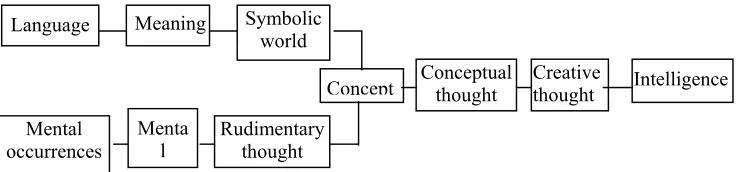
Based on the assumption that intelligence has a strong link with symbolic systems, his conjecture is that intelligence is the unintended consequence of using symbol systems that facilitate thinking and learning. Recognising that human beings use various symbolic vehicles (e.g. language, music, gesture, mathematics and pictures (Gardner, 1983)) in expressing and communicating meaning, Li suggests that it is language that has led to the creation of concepts that further enhance thinking and learning. The human language has led to the creation of a symbolic world while the mental occurrences have brought about a mental world. The interactions of both worlds have transformed rudimentary thought into concepts. Once concepts are formed, thinking, and higher-order conceptual activities come into being, and, hence, the emergence of intelligence (see Figure 1).
[image:8.595.123.496.523.609.2]
Figure 1: The links between language and intelligence (adapted from Li (1996)) Language Meaning Symbolic
world
Concept
Mental occurrences
Menta l
Rudimentary thought
Conceptual thought
Creative
thought Intelligence
physical objects and hence limited to operation on physical objects and actions. Conceptual thought is made possible by the creation of concepts which are the interaction between the symbolic world and the mental world. Through the medium of language, higher-order concepts such as relations between objects and qualities extracted from generalisation of objects are possible through conceptual thinking.
Li considers conceptual thinking and conceptual learning as the two major unique characteristics of human intelligence. While Li has developed a theory of conceptual intelligence, what is unique about the theory is the link between conceptual thought and conceptual learning to creativity. In fact, Li suggests that learning precedes creativity in that the discovery of new knowledge (i.e. the creative process) cannot possibly exist out of the blue; it can always be traced back with its root in existing knowledge. Li posit that in a problem-solving situation, a person is making use of a number of existing conventional frameworks of knowledge to bear on the problem. Li suggests that a transformation may take place leading to the creation of new knowledge.
In his example of a creative work by Jaynes in developing a theory to explain consciousness, he alluded to the fact that Jaynes combined all the sub-branches of knowledge (i.e. philosophy, psychology, language and history) configured and reorganised to the point of proposing a unifying theme in a meaningful way. He suggested that it is the important insight of the connection/similarity between the description of hallucinating schizophrenics and the mind of the ancient people as obedient to the voices of god that led him to gather evidence from different knowledge domain for the development of his theory. Although, Li, did not suggest the nature of the transformation, here in this study we infer that the knowledge transformer inferred is that of similarity comparison.
3.5. Summary
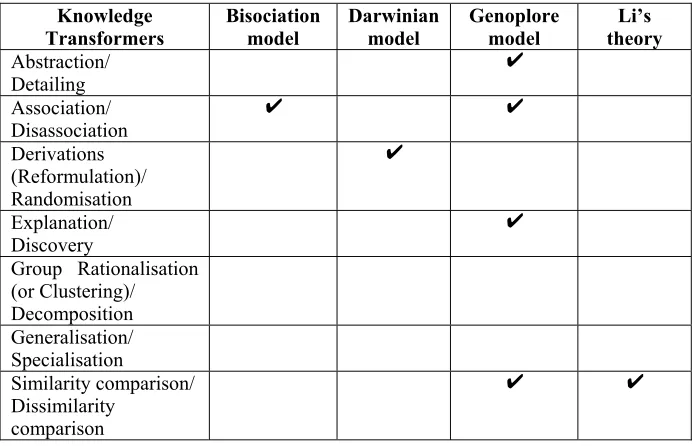
Table 2 shows a summary of the identification of the knowledge transformers in the various models and theories of creativity. There is at least one knowledge transformer identified in the models and the theory by Li.
Table 2: Identification of knowledge transformers in models/theories of creativity
Knowledge Transformers
Bisociation model
Darwinian model
Genoplore model
Li’s theory Abstraction/
Detailing
✔
Association/ Disassociation
✔ ✔
Derivations (Reformulation)/ Randomisation
✔
Explanation/ Discovery
✔
Group Rationalisation (or Clustering)/
Decomposition Generalisation/ Specialisation
Similarity comparison/ Dissimilarity
comparison
✔ ✔
4. Discussion
There is some evidence to suggest that the knowledge transformers featured in the cognitive activity of learning by Sim and Duffy (1998) can be found in the models and theory of creativity. If this is the case, one hypothesis is that creativity and learning is linked through the knowledge transformers. This link is apparent in Li’s theory of conceptual intelligence. As explained by Li, creativity can be seen as the human enterprise of extending from the known to the unknown, of venturing from existing knowledge and domains of human endeavour to new knowledge and endeavour. While learning is the acquisition of existing knowledge and skills, creativity is the transformation of existing knowledge into new knowledge. Although the same cognitive apparatus (human mind) is used to acquire knowledge as well as creating knowledge, the task demand is quite different. In acquiring existing knowledge, the subject matter is well structured and well organised. The same cannot be said when we venture beyond the existing realm of knowledge in which there is no clear definition of the problem let alone the solution. Creativity is about an intelligent search among a limited list of possibilities. But the thinking process through the knowledge transformers is the same regardless of whether one is engaged in the learning or creative process.
According to Anderson (1993), typical problem solving requires applying some method in a fixed problem space. Anderson also recognised an alternative, that problem solving sometimes involves a change in the problem space, and he commented that such instances of problem solving are considered to be more insightful. Kaplan and Simon (1990) made a similar distinction, noting that only some problems – insight problems – require a change in representation for their solution. Greeno, Magone and Chaikin (1979) distinguished between problems that require the construction of new problem spaces and those that do not.
5. Conclusion
The purpose of this paper is to investigate whether knowledge transformers that are featured in the learning process, are also present in the creative process. The investigation shows that there is some evidence to show that the creative process can be explained through knowledge transformers. Hence, it is suggested that one of the links between learning and creativity is through the knowledge transformers.
References
Anderson, JR: 1993, Problem solving and learning, American Psychologist, 48: 35-44. Boden, M: 1991, The Creative Mind:Myths and Mechanisms. New York: Basic Books. Campbell, DT: 1960, Blind Variation and selective Retention in Creative Thoughts as in
other Knowledge Processes, Psychological Review, 67, 380-400.
Carlson, WB and Gormon, ME: 1992, A Cognitive Framework to Understand Technological Creativity: Bell, Edison and the Telephone, in RJ Weber and DN Perkins (eds),
Inventive Minds, Oxford University Press (New York, 1992), pp. 48-79.
DasGupta, S: 1994, Creativity in Invention and Design – Computational and Cognitive Explorations of Technological Originality, Cambridge University Press.
DasGupta, S: 1996, Technology and Creativity, Oxford University Press.
Finke, RA, Ward, TB and Smith, SM: 1995, The Creative Cognition Approach. Cambridge, MA: MIT Press.
Gardner, H: 1983, Frame of Minds: The theory of multiple intelligence. New York: Basic Books.
Goldenburg, J. and Mazursky, D: 2002, Creativity in product innovation, Cambridge University Press.
Greeno, JG, Magone, ME and Chaiklin, S: 1979, Theory of construction and set in problem solving, Memory and Cognition, 7: 445-461.
Kaplan, CA, and Simon, HA: 1990, In search of insight, Cognitive Psychology, 22: 374-419. Kocabas, S: 1991, A review of learning, The Knowledge Engineering Review, 6 (3): 195-222. Koestler, A: 1964, The Act of Creation, Hutchinson & Co. London.
Kulkarni, D and Simon, HA: 1988, The Processes of scientific discovery - The Strategy of Experimentation, Cognitive Science, 12: 139-176.
Langley, P, HA Simon, GL Bradshaw, and JM Zytkow: 1987, Scientific Discovery, MIT Press (Cambrudge, Mass).
Li, R: 1996, A Theory of Conceptual Intelligence, Praeger.
Michalski, RS: 1993, Inferential theory of learning as a conceptual basis for multi-strategy learning, Machine Learning, 11: 3-43.
Strathern, P: 1997, Crick, Watson &DNA, London: Arrow.
Sutton, RI: 2002, Weird Ideas that Work, p. 26, The Free Press, New York.
Sim, SK: 2000, Modelling Learning in Design, Ph. D thesis, University of Strathclyde, Glasgow, UK.
Thagard, P: 1988, Computational Philosophy of science, MIT Press (Cambridge, Mass., 1988);
Thagard, P: 1992, Conceptual Revolutions, Princeton University Press Princeton, N. J. Vincenti, WG: 1991, What Engineers Know and How They Know It, John Hopkins
University Press, Baltimore.
Wallace, DB and Gruber, HE (eds.): 1992, Creative people at work: twelve cognitive case studies, New York; Oxford: Oxford University Press.
Weber, RJ., "Stone Age Knife to Swiss Army Knife: An Invention Prototype," in Weber and Perkins, op. cit., pp. 217-237.