Int. J. Electrochem. Sci., 13 (2018) 8150 – 8169, doi: 10.20964/2018.08.71
International Journal of
ELECTROCHEMICAL
SCIENCE
www.electrochemsci.org
Initial NaCl-induced atmospheric corrosion of a dual-phase
Cu60-40Zn alloy - Effect of UV illumination
Xiaoying Sun1,2, Zhuoyuan Chen1,2,*, Jiarun Li1, Jian Hou 2 and Likun Xu2 1
Key Laboratory of Marine Environmental Corrosion and Bio-fouling, Institute of Oceanology, Chinese Academy of Sciences, 7 Nanhai Road, Qingdao 266071, China
2
State Key Laboratory for Marine Corrosion and Protection, Luoyang Ship Material Research Institute, Wenhai Road, Qingdao 266237, China.
*
E-mail: [email protected]
Received: 25 March 2018 / Accepted: 22 May 2018 / Published: 5 July 2018
In this paper, the effect of ultraviolet (UV) illumination on the NaCl-induced atmospheric corrosion of a 40Zn alloy was investigated. UV illumination affects the atmospheric corrosion of the Cu60-40Zn alloy in terms of corrosion rate, corrosion morphology and corrosion products. The NaCl-induced atmospheric corrosion rate of the Cu60-40Zn alloy increases under UV illumination due to the increase of the corrosion initiation sites and the photovoltaic effect of the corrosion products. The increased photoinduced potential and the transfer of the photogenerated electrons from the substrate Cu-Zn alloy to the corrosion products provide evidence for the accelerated anodic reactions under light illumination, and thus promote the atmospheric corrosion of the Cu60-40Zn alloy under UV illumination.
Keywords: Cu-Zn alloy; atmospheric corrosion; UV illumination; NaCl particles; XPS
1. INTRODUCTION
The Cu-Zn alloy (brass) is extensively utilized in petroleum refineries, refrigeration, chemical plants and marine engineering due to its superior electrical and thermal conductivities, good corrosion resistance, and desirable hardness and strength compared to pure copper [1]. Nonetheless, the brass suffers from appreciable atmospheric corrosion when exposed to the dry and wet cycle environments containing chloride ions. To this end, extensive investigations have been conducted to clarify the mechanism of marine atmospheric corrosion of brass [2-7].
more than 15 wt% are predisposed to undergo a dealloying process by selective removal of zinc, named dezincification, which often occurs during the atmospheric exposure [8-11]. Therefore, Zn concentration can affect the corrosion type of the Cu-Zn alloys in atmospheric environment. Herman and Castillo studied a short-term atmospheric corrosion of various copper-based alloys in natural environment [12]. Plug type dezincification of Cu70-30Zn brass at all exposure locations and pitting corrosion coupled with plug type dezincification of Cu56-25Zn at the industrial and industrial marine sites were observed. Barr and Hackenberg investigated the corrosion products of α brass (20~35 wt% Zn) using XPS and the results reflected that a relatively thick zinc oxide (ZnO) layer initially formed on α brass at room temperature with the relative humidity (RH) of 35 %, above which a thin layer of cupric oxide (CuO) was detected and the outermost thin film was composed of CuO and Cu(OH)2 [13]. When it is exposed to chloride-containing solutions, brass forms a surface film consisting of a mixture of ZnO, Cu2O and CuO, wherein the molar ratios among the oxides depend on pH, chloride ion concentration and Zn content of the brass [14]. An overwhelming majority of the brass surface was covered with amorphous zinc hydroxyl carbonate (Zn5(CO3)2(OH)6) and ZnO after exposure in sites with low chloride deposition rates [8].
Solar illumination does have influence on metals exposed to atmospheric environments [15, 16], nonetheless, there are few reports focused on the effect of solar illumination on the atmospheric corrosion of brass. Lin and Frankel studied the atmospheric corrosion of NaCl particles deposited copper with UV illumination under CO2 atmosphere, and found that UV has a strong promotion effect on the formation of cuprite due to the interactions between UV photons and cuprite [17]. Chen et al. reported that UV illumination decomposes molecular oxygen to atomic oxygen, which directly participates in the oxidation of silver exposed in the atmospheric environment [18]. Recently, a work on chloride-containing atmospheric corrosion of Cu40Zn by Zhang et al. verified the presence of hydrozincite (Zn5(CO3)2(OH)6), simonkolleite (Zn5(OH)8Cl2·H2O), and small amounts of CuO, Cu2O, ZnO in the corrosion products formed at 70% RH humidified air containing 1000 ppm of CO2 [19]. It has been reported that Cu2O [20-24], CuO [21, 22], and ZnO [25, 26] have semiconductor properties and they will produce photogenerated electrons and holes under light illumination. These photogenerated charge carriers can influence the cathodic and anodic reactions, and thus affect the atmospheric corrosion of the metallic substrate. However, the investigation on the specific influence mechanism of light illumination on the atmospheric corrosion of brass is quite scarce to date. In this paper, a quantitative study of the role of UV illumination on the NaCl-induced atmospheric corrosion of a Cu60-40Zn alloy was performed. Microgravimetry, scanning electron microscopy (SEM), Fourier transform infrared (FT-IR) spectroscopy, X-ray photoelectric spectroscopy (XPS) and electrochemical tests were further applied to identify the corrosion processes and the corrosion products after 1, 2 and 4 weeks of laboratory exposure to humidified pure air.
2. EXPERIMENTAL
2.1 Sample preparation
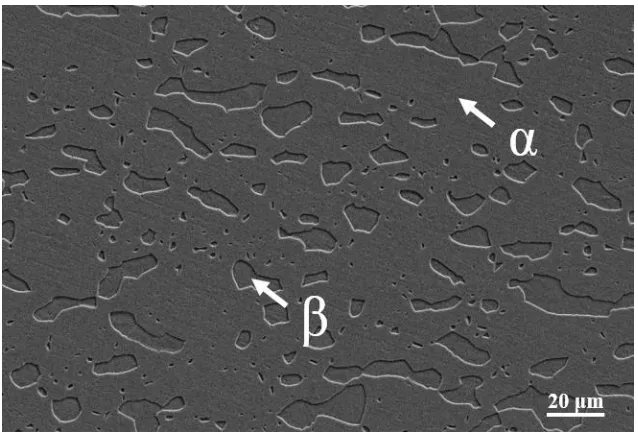
61.3700 Cu, 0.0025 P, 0.0062 Pb, 0.0060 Fe, and balance Zn. The microstructure of the Cu60-40Zn alloy is demonstrated in Figure 1. The dual-phase structure comprised of α phase and β phase can be clearly distinguished in a SEM image after slighted etching for 20 s in the solution containing NH3·H2O (100 mL), H2O2 (40 mL) and H2O (100 mL). The irregular shaped β phase with the typical size ranging from 10 to 20 μm contains more Zn compared with α phase, and it is embedded in the α phase after etching [27, 28].
Figure 1. Dual-phase microstructure of the as-received Cu60-40Zn alloy revealed by SEM after etching.
Prior to the laboratory exposure, each specimen (50×10×1 mm) was ground down to 3000-grit using SiC paper and then polished with diamond paste down to 0.5 m. Subsequently, the specimens were wiped with absorbent cotton, and ultrasonically cleaned in acetone of analytical grade for 5 minutes. After that, the prepared specimens of the Cu60-40Zn alloy were stored in a desiccator over silica gel for approximately 24 hours before exposure. In this study, 15 µg·cm2 of NaCl particles were evenly deposited on the surface of each specimen by uniformly transferring an appropriate amount of NaCl saturated ethanol of analytical grade, and the total amount of deposited NaCl can be determined by gravimetric method after ethanol volatilization [29].
2.2 Laboratory exposure
[image:3.596.145.464.184.400.2]
Additionally, two 9 W quartz UV lamps (T8, Shanghai Sitong Co. Ltd., Shanghai, China) with an optical intensity of 0.538 mW·cm−2 were installed on the top of the glass cover as the UV light source in the chamber. The wavelength of the light generated by the UV lamps is of 220 ~ 300 nm, and about 90% of the energy was contributed by the light in 253.7 nm wavelength. The external surfaces of the chamber were covered with black tapes to prevent the UV light from penetration.
An air pump was adopted to provide pure airflow to pass through the exposure chamber with a velocity of 30 mL·min-1, which was accurately controlled by a mass flow controller. Prior to passing through the exposure chamber, the flowing air was bubbled in a saturated K2SO4 solution and subsequently passed through two empty bottles. Except for the air pump, the whole exposure system was located in a thermostat (HWS, Dongnan Co. Ltd., Ningbo, China) in which the exposure temperature was controlled at 251 °C. More details of the apparatus for the atmospheric exposure were reported in our previous work [30]. All specimens were exposed in humidified air at 97% RH and 25 °C for 1, 2 and 4 weeks in the dark or under UV illumination. The RH was monitored by a temperature/humidity sensor (XMTA-2001, Yaoaote Instrument Co. Ltd., Dongguan, China). Nine parallel specimens were used for each exposure condition. Each test was repeated three times in order to ensure reproducibility of the measurements.
2.3 Mass gain and mass loss measurements
After laboratory exposure, the corrosion effect on the Cu60-40Zn alloy was quantitatively determined by measuring the increase and decrease in weights of the specimens. Mass gain equals to the mass of specimens after exposure minus that before the exposure with deposited NaCl particles; Mass loss equals to the original mass of specimen (without deposited NaCl particles) minus the mass after removal of the corrosion products. A microbalance (Sartorius CPA 26P, Germany) with a ±4 μg-specified precision (±0.4 μg·cm2 in this study) was adopted. Additionally, a stainless steel as a reference sample was weighed to eliminate the system error of the microbalance during the weight measurement. According to ISO standard [31], the corrosion products formed on the Cu60-40Zn alloy surface after laboratory exposure were removed by ultrasonically pickling the samples in a mixed solution by dissolving 50 g amidosulfonic acid (sulfamic acid) into distilled water to form a 1000 mL solution. Triplicate specimens were taken for the measurements of the mass gains and mass losses after laboratory exposure at different conditions.
2.4. Characterization of corrosion products
was based on C 1s 284.8 eV. Sputtering etching of the corroded Cu60-40Zn alloy after 1 week of exposure with Ar gas was employed to study the corrosion products beneath the surface layer with an etching speed of 0.2 nm/s.
2.5 Photoelectrochemical/electrochemical performance measurements
In order to clarify the photoelectrochemical/electrochemical performance, the corrosion products formed on the Cu60-40Zn alloy after laboratory exposure were peeled off and the corrosion product thin-film (CPTF) electrode was prepared by evenly depositing them onto the surface of fluorine-doped tin-oxide (FTO) conductive glasses. Because the corrosion products are insoluble, and the FTO conductive glass merely plays a role of a conductor, therefore, the CPTF electrode could be relatively stable in electrolyte solutions. Moreover, this method of manufacturing CPTF electrode has been applied in the field of photocatalysis [32, 33]. The FTO conductive glass was of 13×10×1 mm in size. Prior to the deposition, the FTO glass was ultrasonically cleaned in acetone for 5 min, subsequently rinsed by deionized water and dried with a clean dry airflow. A copper wire was connected to the conductive side of the FTO glass by silver paste, and then sealed with silicone rubber, leaving a 1-cm2 working area for depositing the corrosion products. The as-prepared corrosion products of the Cu60-40Zn alloy were mixed with deionized water in an agate mortar and then ground for 10 min to form a slurry, which was evenly distributed onto the working area of the FTO glass consequently.
Mott-Schottky plots were measured by Parstat 4000+ Electrochemical Workstation (AMETEK.Inc, Princeton, USA) in the dark, which employed a 10 mV AC perturbation signal at a constant frequency of 1 kHz with a variable potential from 0.2 to 0 V versus Ag/AgCl (saturated KCl) reference in a three-electrode cell system. A CPTF electrode acted as the working electrode, a platinum foil performed as the counter electrode and an Ag/AgCl (saturated KCl) electrode served as the reference electrode, respectively.
3. RESULTS AND DISCUSSION
3.1. Characterization of corrosion rates
Figure 2 shows the mass gains and mass losses of the Cu60-40Zn alloy pre-deposited with 15 μgcm2 NaCl particles after 1, 2, and 4 weeks of exposure in 97% RH humidified pure air at 25 °C in the absence and presence of UV illumination. As shown in Figure 2, the mass gains and mass losses increase with increasing the exposure time. In addition, the mass gains and mass losses obtained under UV illumination are larger than those obtained in the dark after identical exposure duration. However, an exception presents at 1 week of exposure as depicted in Figure 2b, in which the mass loss of UV illuminated specimens is slightly less than that of the specimen in the dark. The amount of the formed corrosion products after 1 week of exposure is comparatively less, leading to a weak effect of UV illumination on the atmospheric corrosion of the Cu60-40Zn alloy in comparison with those experiencing 2 and 4 weeks of exposure.
Figure 1. (a) Mass gains and (b) mass losses of the Cu60-40Zn alloy pre-deposited with 15 μgcm2 NaCl particles after 1, 2, and 4 weeks of exposure in 97% RH humidified pure air at 25 °C in the absence and presence of UV illumination.
3.2 Characterization of the corrosion morphologies after exposure
[image:6.596.78.520.313.471.2]
spread out associated with forming continuous NaCl-containing aqueous films. It has been reported that the initial NaCl concentrated areas are comparatively anodes with lower pH and higher chloride concentration to the peripheral spreading areas which are regarded as cathodes with higher local pH and lower chloride content [38]. In the condition of the NaCl-induced atmospheric corrosion of Zn, simonkolleite (Zn5(OH)8Cl2·H2O) is expected to be formed in the central anodic area, and hydrozincite (Zn5(CO3)2(OH)6), is expected to be formed preferentially in the more peripheral cathodic area [39, 40]. Furthermore, both the density and the thickness of granular and needle-like crystals are promoted with increasing the exposure time.
Figure 2. SEM images of the Cu60-40Zn alloy pre-deposited with 15 μgcm2 NaCl particles after 1 (a), 2 (b), 4 (c) weeks of exposure in the dark and after 1 (d), 2 (e), 4 (f) weeks of exposure under UV illumination.
[image:7.596.88.513.214.516.2]
except for their size. The other type of islands is covered with whiskers (zones H, J, and L), which distribute discretely after 1 week of UV illumination. Nonetheless, they perform consecutively after 2 weeks of exposure, and finally form fluffy balls over 4 weeks of exposure. After exposed under UV illumination for 4 weeks (Figure 3f), the entire surface of the specimen was covered with corrosion products validating that there were more corrosion initiation sites under UV illumination than those in the dark.
[image:8.596.86.515.217.382.2]3.3 Charaterization of corrosion products using FT-IR spectroscopy
Figure 3. FT-IR absorbance spectra of the Cu60-40Zn alloy pre-deposited with 15 μg·cm2 NaCl and exposed for 1, 2, and 4 weeks in humid pure air with 97% RH at 25 °C in (a) the the absence and (b) presence of UV illumination.
assigned to the Zn-O-H vibrations from Zn5(OH)8Cl2·H2O [42-44]. Apart from simonkolleite and hydrozincite, zinc oxide with the absorbance at 472 cm1 corresponds to the Zn-O vibration from ZnO [42, 43]. In addition, the bands at 620 cm1 [47-49] and 510 cm1 [47] are from the vibrations from the cuprous oxide and cupric oxide. And, the band at 424.2 cm1 can be assigned to Cu-O stretching mode from Cu(OH)2 [50, 51].
[image:9.596.81.527.225.401.2]3.4 Surface corrosion products analyses by XPS
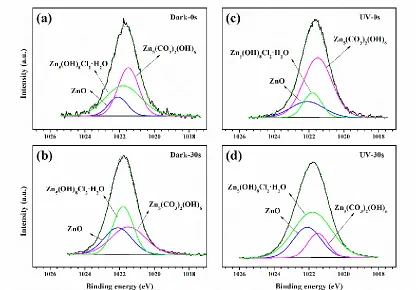
Figure 4. XPS spectra of the Cu60-40Zn alloy (a) after 1week of exposure in the absence and presence of UV illumination and (b) corresponding Zn 3d and Cu 3d spectra. (0 s: XPS spectra without sputtering; 30 s: XPS spectra after sputter etching for 30 s)
carried out on the shifts and width variations in the Zn 3d and Cu 3d lines to determine oxide species [13]. In the present study, the Zn 3d and Cu 3d spectra are introduced in purpose of clarifying whether the corrosion species of Zn and Cu change with depth. In Figure 5b, the peak at 9.9 eV can be attributed to Zn 3d. Furthermore, there is no shift of this peak, elucidating that the Zn-containing corrosion products are the same in spite of depth and UV illumination variations. Under UV illumination, it seems that there was no peak associated with Cu 3d in the context of spectra obtained after sputtering for 0 s and 30 s, which means that the Cu is corroded insignificantly after 1 week of exposure under UV illumination, and this is in agreement with the XPS survey spectra of Cu 2p1 and Cu 2p3 in Figure 5a. Besides, the Cu-containing corrosion products in the dark have changed as shown in Figure 5b, validating by a variation of Cu 3d peak from 5.0 eV in the surface to 2.9 eV in the shallow layer.
Figure 6. Zn 2p3 high-resolution spectra of the Cu60-40Zn alloy after 1 week of exposure in humid pure air with 97% RH at 25 °C. (a) in the dark without sputtering; (b) in the dark after sputtering for 30 s; (c) under UV illumination without sputtering; (d) under UV illumination after sputtering for 30 s.
[image:10.596.96.514.273.563.2]
that the Zn-containing corrosion products are identical despite of UV illumination, which is consistent with the preceding Zn 3d spectra in Figure 5b.
Figure 7. Cu 2p3 high-resolution spectra of the Cu60-40Zn alloy after 1 week of exposure in humid pure air with 97% RH at 25 °C. (a) in the dark without sputtering; (b) in the dark after sputtering for 30 s; (c) under UV illumination without sputtering; (d) under UV illumination after sputtering for 30 s.
[image:11.596.96.514.119.408.2]
3.5 Mott-Schottky analysis
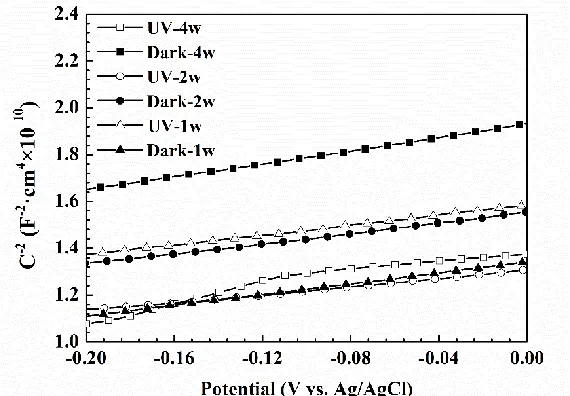
[image:12.596.162.447.369.567.2]The semiconductor properties of the corrosion products formed after 1, 2 and 4 weeks of laboratory exposure after 1, 2 and 4 weeks were analyzed using Mott-Schottky method, and the relevant results are presented in Figure 8. Positive slopes in Figure 8 indicate that the corrosion products have photoelectric rectifying characteristics similar to n-type semiconductor. According to the XPS results in this study, semiconductor products including ZnO, Cu2O and CuO were formed. ZnO is a wide bandgap semiconductor and typically has n-type conductivity [20, 58, 59]. Lin et al. reported that the acceleration effect of UV on atmospheric corrosion of Cu was due to the n-type cuprite which can give rise to anodic photocurrent and consequently increase the corrosion rate [60]. It is probable that these n-type corrosion products on Cu60-40Zn in this study cause the acceleration of atmospheric corrosion under UV illumination. Therefore, it is necessary to clarify the photovoltaic effect of the corrosion products formed on the Cu60-40Zn alloy specimens. Moreover, UV illumination doesn’t change the electric properties of corrosion products. Since the corrosion products are a complex mixture of semiconductors including Cu2O, CuO and ZnO, it’s difficult to quantitatively identify the amount of each species. For this reason, the Mott-Schottky curves were not applied to further analysis, such as the carrier density and the flatband potential.
Figure 8. Mott-Schottky plots of the CPTF electrodes in 5.2 wt% NaCl solution tested in the dark. The UV-1w, UV-2w and UV-4w represent the CPTF electrodes made from corrosion products after 1, 2 and 4 weeks of exposure under UV illumination, respectively; the Dark-1w, Dark-2w and Dark-4w stand for CPTF electrodes made from corrosion products after 1, 2 and 4 weeks of exposure in the dark, respectively.
3.6 Analysis of the photovoltaic effect of the corrosion products
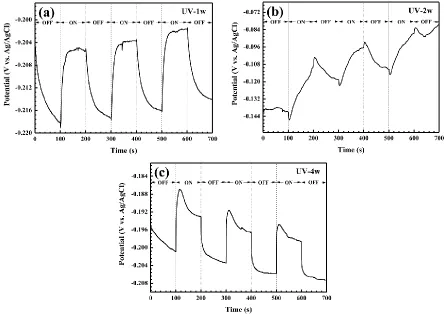
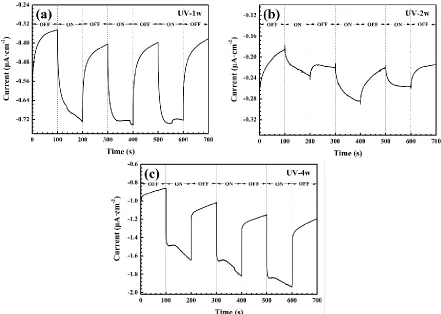
densities between CPTF electrodes and the Cu60-40Zn alloy under intermittent white light illumination. The results are shown in Figures 9 and 10.
Figure 9. The variations of the OCPs (vs. Ag/AgCl) of CPTF electrodes in 5.2 wt% NaCl solution under intermittent white light illumination. The CPTF electrodes were made from corrosion specimens after 1 (a), 2 (b) and 4 (c) weeks of exposure under UV illumination in humid pure air with 97% RH at 25 °C.
[image:13.596.75.519.126.440.2]
The corrosion products with semiconductor properties on the surface of metal will generate the photoinduced electrons and holes due to the photovoltaic effect under light illumination. The flowing direction of photoinduced electrons determines the promotion or inhibition of corrosion owing to the cathodic/anodic polarization effect aroused by them. Consequently, the flowing direction of electrons and the variations of the galvanic current between the corrosion products and the metal substrate are of significance to elucidate the mechanism of light illumination on the atmospheric corrosion of metals. In this study, the corrosion products derived from 1, 2 and 4 weeks of exposure under UV illumination were peeled off for preparing the CPTF electrodes since it is difficult to directly acquire the photoinduced current information between the metal substrate and corrosion products on a corroded Cu60-40Zn alloy.
Figure 10. The galvanic current densities between CPTF electrodes and the Cu60-40Zn alloy in 5.2 wt% NaCl solution under intermittent white light illumination. The CPTF electrodes were made from corrosion specimens after 1 (a), 2 (b) and 4 (c) weeks of exposure under UV illumination in humid pure air with 97% RH at 25 °C.
[image:14.596.81.522.271.585.2]
electrode), which suffers from the anodic dissolution and consequently leads to the acceleration in the cathodic reaction of oxygen reduction. A striking decrease of galvanic current takes place associated with the light illumination, and vice versa, the galvanic current increases remarkably as soon as the white light was switched off. The resulting photoinduced current densities are in the range of 0.05 to
0.79 μA·cm2
. As shown in Figure 10, the galvanic current increased steeply towards the negative direction as soon as the white light was switched on, delivering an instant acceleration in the rate of anodic dissolution of the Cu60-40Zn alloy. This is due to the electrons captured by the photoinduced holes from the Cu60-40Zn alloy electrode under white light illumination. Photoinduced current measurement clearly demonstrates that the photovoltaic effect of the corrosion products formed on the Cu60-40Zn alloy exposed under UV illumination can accelerate the corrosion rate of the Cu60-40Zn alloy substrate, as well as promoting the atmospheric corrosion under UV illumination. This phenomenon was also reported when Cu was exposed under UV illumination in atmospheric environment. The photons interact with the n-type Cu2O semiconductor and generate extra anodic photocurrent which doubled the corrosion rate of Cu [63]. In addition, Lin et al. found that UV illumination accelerates anodic reaction of Ag because extra anodic photocurrent can be generated and UV generates photoinduced holes in corrosion products which make mass transfer easier for localized corrosion [64].
3.7 Effect of UV illumination on the atmospheric corrosion of the Cu60-40Zn alloy
As the results shown in Figure 2, the atmospheric corrosion of the Cu60-40Zn alloy deposited with NaCl is enhanced by UV illumination. Zhang et al. reported that the β-phase with a higher susceptibility for initial corrosion generally exhibited a lower Volta potential compared with the surrounding α-phase [19]. As the corrosion morphologies of specimens exposed in the dark (Figures 3a-c), the center of the observed area might be the β-phase for corrosion initiation, whereas the surrounding area might be the α-phase that suffered from slight corrosion. The OCPs of the corrosion products formed under UV illumination swiftly shifted to the positive direction (Figure 9), and the photoinduced holes captured the electrons from the Cu60-40Zn alloy (Figure 10) under white light.
Based on the experimental results shown in Figures 10 and 2, the anodic photoinduced current and the increase of the atmospheric corrosion rates of the Cu60-40Zn alloy were observed, demonstrating that the corrosion products mainly embodied the characteristics of n-type semiconductor [63]. Among the atmospheric corrosion products formed on the Cu60-40Zn alloy, Cu2O, CuO, and ZnO possess semiconductor properties. Typically, ZnO is a wide-bandgap semiconductor and suffers from the doping asymmetry problem, in which the n-type conductivity can be obtained rather easily [20, 58, 59]. Normally, Cu2O formed in the presence of chloride ions exhibits n-type semiconductor property due to the chloride doping [65]. Therefore, the Cl--containing electrolyte in this work may have an effect on the conductivity of corrosion products because the n-type Cu2O films doped with Cl
−
ions exhibited poor protective properties against Cu corrosion [66].
of the oxidation of Cu and reduction of O2 [23], according to which the anodic reaction of the Cu60-40Zn alloy could be expressed as:
Figure 11. Schematic illustration of the NaCl-induced atmospheric corrosion of the Cu60-40Zn alloy: (a) in the dark; (b) under UV illumination.
Cu Cl- CuCl e- (1) and the cathodic reaction :
O2 2H2O 4e- 4OH- (2)
CuCl could be easily dissolved into NaCl solution, and then form the cuprous complex, i.e,
, which would subsequently react with OH to form Cu2O on the surface: CuCl Cl CuCl2 (3)
2CuCl2 2OH- Cu
2O H2O 4Cl (4) The Cu2O could further transform into Cu(OH)2 with the increase of exposure time: Cu2O 3H2O 2Cu(OH)2 2H 2e- (5)
CuO is believed to be the dehydration of Cu(OH)2 because the former is more stable than the latter [67, 68]:
Cu(OH)2 CuO H2O (6)
All these aforementioned reactions were conducted without illumination. Nonetheless, the UV illumination made the corrosion process more sophisticated, e.g., no Cu(OH)2 was detected in the corrosion products. It has been reported that the molecular oxygen would be disintegrated into two oxygen atoms as long as the wavelength of UV light is shorter than 242 nm [18, 69].
O2
h ( 242nm)
[image:16.596.133.474.118.408.2]
Atomic oxygen is extremely aggressive as previous researches had already proved that atomic oxygen has a stronger acceleration effect than ozone [18, 70, 71]. The aggressive oxygen could react with Cu2O to produce CuO under UV illumination, which can be expressed as:
Cu2O O 2CuO (8)
Apart from the acceleration effect of atomic oxygen, the scarcity of Cu2+ gives rise to the absence of Cu(OH)2 in the corrosion products under UV illumination [72]. It has been reported that the Cu(OH)2 (s) could be formed in near-neutral solution with Cu2+ concentration higher than 5×10⁸ M in 103 M NaCl solution [72]. The respective atomic percentages of Cu in corrosion products under UV illumination derived from XPS are 0.929% and 1.535% with and without sputtering, which are less than 1/10 of that in the dark. Consequently, the relatively low atom percentage of Cu implies the low Cu2+ concentration from the anodic reation of equation (1) under UV illumination, which might lead to the formation of CuO instead of Cu(OH)2.
In view of the FT-IR analyses and XPS results, the UV illumination has little effect on the constituents of Zn-containing corrosion products, e.g., Zn5(OH)8Cl2·H2O, Zn5(CO3)2(OH)6 and ZnO. Corresponding chemical reactions involved in the formation of these constituents were described for the corrosion process of zinc [41, 44, 73-76]. The major Zn-containing corrosion products in this work are hydrozincite mentioned in the previous FT-IR measurements (Figure 4). During the atmospheric corrosion of the Cu60-40Zn alloy, the anodic dissolution of zinc is balanced by oxygen reduction in the cathodic areas leading to the generation of Zn(OH)2. Zn(OH)2 can dehydrate to ZnO and subsequently react with carbonate ions supplied by atmospheric carbon dioxide.
Zn 1
2O2 H2O Zn(OH)2 ZnO H2O (9)
5ZnO(s) 2CO32(aq) 2H (aq) 3H2O(aq) Zn5(CO3)2(OH)6(s) 2OH(aq) (10) Therefore, the Zn-containing corrosion products would be ZnO, Zn(OH)2 and hydrozincite (Zn5(CO3)2(OH)6) in humid air. With the presence of NaCl in the solution, the cations, i.e., Na+, will migrate towards the cathodic areas, and meanwhile, the anions, i.e., Cl-, will move towards the zinc dissolution sites. Both chloride activities and pH values respectively lead to the formation of ZnO in the cathodic areas, while the simonkolleite (Zn5(OH)8Cl2·H2O) tends to precipitate close to the anodic sites.
4. CONCLUSIONS
The effect of UV illumination on the NaCl-induced atmospheric corrosion of a Cu60-40Zn alloy was studied in a laboratory exposure by microgravimetry, FT-IR spectroscopy, SEM, XPS and electrochemical methods in this paper. The atmospheric corrosion of the Cu60-40Zn alloy pre-deposited with NaCl is promoted by UV illumination. The Zn-containing products mainly comprise of Zn5(OH)8Cl2·H2O, Zn5(CO3)2(OH)6 and ZnO despite of the UV illumination. Cu(OH)2, CuO, and Cu2O are formed in the dark, whereas, only CuO and Cu2O are detected under UV illumination. It is extremely probable that aggressive atomic oxygen can be produced under UV illumination which directly reacts with Cu2O to produce CuO. In addition, the relatively low atom percentage of Cu in the corrosion film implies low Cu2+ concentration, which might lead to the formation of CuO instead of Cu(OH)2. Besides, UV illumination could promote the dezincification of Cu60-40Zn alloy to some extent. UV illumination affects the atmospheric corrosion morphologies of the Cu-Zn alloy. After exposure in the dark, a typical dezincification of meringue deposition on the Cu60-40Zn alloy was observed characterized by central granular crystals surrounded with needle-like crystals; comparatively, more corroded initiation sites presented as porous and whisker islands that distribute dispersively on the surface of the Cu60-40Zn alloy under UV illumination. Corrosion products of the Cu60-40Zn alloy have photoelectric rectifying characteristics similar to n-type semiconductors, which might be associated with ZnO and Cu2O doped with Cl-. A sharp noble shift of OCPs for the n-type corrosion products took place once the white light was on. This was attributed to the photoinduced holes generated from the corrosion products which then captured electrons from the Cu60-40Zn alloy and led to photogeneratated electrons flowing from the Cu60-40Zn alloy to the corrosion products. Compared to the typical dezincification in the dark, this photoinduced process directly accelerates the anodic process and furthermore induces more corrosion initiation sites where both the α phase and the β phase might be included under UV illumination, and consequently promotes the atmospheric corrosion of the Cu60-40Zn alloy.
ACKNOWLEDGEMENTS
This work was financially supported by the National Natural Science Foundation of China (No.41576114), Qingdao Innovative Leading Talent Foundation (NO.15-10-3-15-(39)-zch), and Qingdao Science and Technology Achievement Transformation Guidance Plan (NO.14-2-4-4-jch). And this work was also financially supported by State Key Laboratory for Marine Corrosion and Protection, Luoyang Ship Material Research Institute, China (No.614290101011703, KF160402 and KF160413).
References
1. J. Davis, ASM Specialty Handbook: Copper and Copper Alloys, United States of America:
ASM International, USA, 2001, 652.
2. W.I. Odnevall, X. Zhang, S. Goidanich, B.N. Le, G. Herting, C. Leygraf, Sci. Total Environ.,
472 (2014) 681.
3. G. Kammlott, J. Franey, T. Graedel, J. Electrochem. Soc., 131 (1984) 505.
9858.
5. A. Kawashima, A. Agrawal, R. Staehle, Effect of oxyanions and chloride ion on the stress
corrosion cracking susceptibility of admiralty brass in nonammoniacal aqueous solutions, ASTM International, 1979.
6. M.I. Abbas, Br. Corros. J., 26 (2013) 273.
7. A. Taylor, J. Electrochem. Soc., 118 (1971) 854.
8. S. Goidanich, J. Brunk, G. Herting, M.A. Arenas, I.O. Wallinder, Sci. Total Environ., s 412–413
(2011) 46.
9. E. Sarver, Y. Zhang, M. Edwards, Corros. Rev., 28 (2010) 155.
10. K.R. Trethewey, I. Pinwill, Surf. Coat. Technol., 30 (1987) 289.
11. A.A.E. Warraky, Br. Corros. J., 32 (2013) 57.
12. R. Herman, A. Castillo, Astm Special Technical Publication, (1974).
13. T.L. Barr, J.J. Hackenberg, Appl. Surf. Sci, 10 (1982) 523.
14. M. Forslund, C. Leygraf, C.J. Lin, J.S. Pan, Corrosion, 69 (2013) 468.
15. C. Leygraf, I.O. Wallinder, J. Tidblad, T. Graedel, Atmospheric corrosion, John Wiley & Sons,
(2016).
16. J. Ninlachart, K.S. Raja, Meeting Abstracts, MA2018-01 (2018) 1046.
17. L. Huang, G.S. Frankel, J. Electrochem. Soc., 160 (2013) C336.
18. Z. Chen, D. Liang, G. Ma, G. Frankel, H. Allen, R. Kelly, Corros. Eng.Sci.Techn, 45 (2010)
169.
19. X. Zhang, X. Liu, I.O. Wallinder, C. Leygraf, Corros. Sci., 103 (2016) 20.
20. S. Maroie, G. Haemers, J.J. Verbist, Appl. Surf. Sci, 17 (1984) 463.
21. O. Madelung, Semiconductors: Data Handbook, Springer Berlin Heidelberg, (2004).
22. S.M. Wilhelm, Y. Tanizawa, C.-Y. Liu, N. Hackerman, Corros. Sci., 22 (1982) 791.
23. Y. Zhang, Z. Xiao, Y. Zhao, Z. Li, Y. Xing, K. Zhou, Mater. Chem. Phys., (2017) 54.
24. J.N. Nian, C.C. Tsai, P.C. Lin, H. Teng, J. Electrochem. Soc., 156 (2009) S163.
25. A. Nazarov, E. Diler, P. Dan, D. Thierry, J. Electroanal. Chem., 737 (2015) 129.
26. A.T. Marin, D. Muñoz-Rojas, D.C. Iza, T. Gershon, K.P. Musselman, J.L. Macmanus-Driscoll,
Adv. Funct. Mater., 23 (2013) 3413.
27. G. Pantazopoulos, A. Vazdirvanidis, Micos. Micr, (2008) 13.
28. J. Dutkiewicz, F. Masdeu, P. Malczewski, A. Kukula, Archives of Materials Science &
Engineering, 39 (2009) 80.
29. Z.Y. Chen, S. Zakipour, D. Persson, C. Leygraf, Corrosion, 60 (2004) 479.
30. L. Song, Z. Chen, Corros. Sci., 86 (2014) 318.
31. ISO, International Organization for Standardization, 2009.
32. S. Chu, Y. Wang, Y. Guo, J. Feng, C. Wang, W. Luo, X. Fan, Z. Zou, Acs Catalysis, 3 (2013)
912.
33. J. Xu, L. Zhang, R. Shi, Y. Zhu, J. Mater. Chem. A, 1 (2013) 14766.
34. Z. Chen, F. Cui, R. Kelly, J. Electrochem. Soc., 155 (2008) C360.
35. L. Song, Z. Chen, J. Electrochem. Soc., 162 (2014) C79.
36. L. Song, X. Ma, Z. Chen, B. Hou, Corros. Sci., 87 (2014) 427.
37. L. Song, Z. Chen, B. Hou, Corros. Sci., 93 (2015) 191.
38. D. Landolt, Introduction to surface reactions: Electrochemical basis of corrosion, Marcel
Dekker.Inc, USA, 1995, 1.
39. I. Cole, T. Muster, S. Furman, N. Wright, A. Bradbury, J. Electrochem. Soc., 155 (2008) C244.
40. I.S. Cole, T.H. Muster, D. Lau, N. Wright, N.S. Azmat, J. Electrochem. Soc., 157 (2010) C213.
41. I. Odnevall, C. Leygraf, Corros. Sci., 34 (1993) 1213.
42. S. Song, Z. Chen, J. Electrochem. Soc., 161 (2014) C288.
43. T. Prosek, A. Nazarov, U. Bexell, D. Thierry, J. Serak, Corros. Sci., 50 (2008) 2216.
(2014) 111.
45. A.K. Neufeld, I.S. Cole, Corrosion, 53 (1997) 788.
46. O.K. Srivastava, E.A. Secco, Can. J. Chem., 45 (1967) 585.
47. G. Poling, J. Electrochem. Soc., 116 (1969) 958.
48. M. Apos, Keeffe, J. Chem. Phys., 39 (1963) 1789.
49. T. Minoru, Bull. Chem. Soc. Jpn., 37 (1964) 766.
50. R.A. Nyquist, R.O. Kagel, Infrared spectra of inorganic compounds, ACADEMIC, (1971).
51. L. Zhang, W. Lu, Y. Feng, J. Ni, L. Yong, X. Shang, Acta Physico Chimica Sinica, 24 (2008)
2257.
52. L.M. Peter, D. Vanmaekelbergh, Time and frequency resolved studies of photoelectrochemical
kinetics, Advances in Electrochemical Science and Engineering, (1999).
53. J. Duchoslav, M. Arndt, T. Keppert, G. Luckeneder, D. Stifter, Anal. Bioanal. Chem., 405
(2013) 7133.
54. L.S. Dake, D.R. Baer, J.M. Zachara, Surf. Interface Anal., 14 (1989) 71.
55. G. Deroubaix, P. Marcus, Surf. Interface Anal., 18 (1992) 39.
56. N.S. McIntyre, M.G. Cook, Anal. Chem., 47 (1975) 2208.
57. A.I. Stadnichenko, A.M. Sorokin, A.I. Boronin, J. Struct. Chem., 49 (2008) 341.
58. D.C. Look, B. Claflin, Physica Status Solidi, 241 (2004) 624.
59. V. Avrutin, D.J. Silversmith, H. Morkoc, Proceedings of the IEEE, 98 (2010) 1269.
60. H. Lin, G. Frankel, J. Electrochem. Soc., (2013) C336.
61. T.D. Burleigh, C.D. Ruhe, J.D. Forsyth, Corrosion Houston Tx, 59 (2003) 366.
62. P. Qiu, Int. J. Electrochem. Sci, 11 (2016) 10498.
63. H. Lin, G. Frankel, Corros. Eng.Sci.Techn, 48 (2013) 461.
64. H. Lin, G.S. Frankel, Corrosion, 69 (2013) 1060.
65. X. Han, K. Han, T. Meng, Electrochem. Solid-State Lett., 12 (2009) H89.
66. A.D. Modestov, G.D. Zhou, H.H. Ge, B.H. Loo, J. Electroanal. Chem., 380 (1995) 63.
67. V. Chalyi, Russ. J. Inorg. Chem., 8 (1963) 269.
68. M. Ugorets, E. Buketov, K. Akhmetov, Russian Jour. Inorganic Chem, 13 (1968) 1525.
69. B.J. Finlayson Pitts, J.N. Pitts Jr, Chemistry of the upper and lower atmosphere: theory,
experiments, and applications, Academic press, (1999).
70. D. Liang, H. Allen, G. Frankel, Z. Chen, R. Kelly, Y. Wu, B. Wyslouzil, J. Electrochem. Soc.,
157 (2010) C146.
71. Y. Wan, E.N. Macha, R.G. Kelly, Corrosion Houston Tx, 68 (2012) 036001.
72. J. Vuceta, J.J. Morgan, Limnol. Oceanogr., 22 (1977) 742.
73. T. Graedel, J. Electrochem. Soc., 136 (1989) 193C.
74. J. Svensson, L. Johansson, Corros. Sci., 34 (1993) 721.
75. I. Odnevall, C. Leygraf, Corros. Sci., 36 (1994) 1551.
76. Q. Qu, C. Yan, Y. Wan, C. Cao, Corros. Sci., 44 (2002) 2789.