AROMATIC IMIMLS
A thesis submitted in part fulfilment of conditions governing candidates
for the degree of MASTER OF SCIENCE
in the
AUSTRALIA# NATIONAL UNIVERSITY
by
bahry
vinclnt
o
*
grady
Dept, of Chemistry August, 1963
SUMMARY
The existence of an intramolecular hydrogen bond in ortho-substituted
phenols has been veil established» However« the corresponding
ortho-substituted anilines do not show the same marked variation in their physical end chemical properties and in 2~nitro-*niline there has been some doubt as to the presence of the expected chelate structure»
The NH stretching frequencies of the aminfi group in 109
ortho-substituted aromatic amines have been etudied as the fundamental and first
overtone bands both before and after deuter&tion» The separation of
v (0-2)NHg into two members has been suggested as being due to
intramolecular hydrogen bond formation» However« although the shape and
the separation of the absorption bonds eon be related to the strength of
the hydrogen bond« the cause of this splitting is still uncertain» The
appearonce of two NH stretching frequencies in the mono-deuterated amine is regarded as the most sensitive test for unilateral hydrogen bond formation» Repulsive interactions con also bring about a similar doubling but it is usually possible to decide on the nature of the interaction by a
consideration of the NH. stretching frequencies» Mono-deuteration of
2 *
2 «6-disubstituted anilines has shown that the amine group remains
symmetrically placed with respect to both substituents» Contrary to
assumptions which have been made by other worker?« the NH stretching frequencies in these symmetrically substituted anilines de not conform to
the relationship established for meta and para anilines» 4 reason for
iii .
i
C O
o n U )
(i M OT .)
The \utbor would like to record hie sincere appreciation of the guidance, help and inspiration given to hia by his
T
able
of
content
*
Summary
i.
Acknowledgments
1 i iTable of Contents
iv •List of Tables
vi .List of Figures
ix.1
INTRODUCTION
1.1
Definition of a Hydrogen Bond
11*2
Electronegativity and the Nature of the
Hydrogen Bond
21.3
Effect of the Hydrogen Bond
62
SFLCTRÜSÜi
lC Dl TECTION OF HYDROGEN BONDS
2«
1Fundament
%1NH Stretching Frequencies
02.2
Partial Deuteration
142. 3
Orertone Vibrations
IT
3
EXPERIMENTAL
3.1
Spectrometers
233.2
Calibration
233.3
Concentration Effects
263.4
Deuteration
304
ortfiP-UHYL ANILINES
4.1
Methyl Substituents
354.2
Other Alkyl Substituents
404.3
2—Phenyl-Ani1ine
435 o r t h o —ALhOXY ANILINES 40
6 XNTRiMOLLCÜLAR SYDRQGEN BUNDING TO IULOGLNS
6* 1 o~Ha1ogeno—Pheno1s 54
6 , 2 o^-Hal ogeno- \n i 1 ine » 56
7 AMINES WITH AN ortho-C .HBoNTL GROUP
7 .1 NTfc? S t r e t c h i n g F re q u e n c ie s 66
7 .2 Carbonyl F re q u e n c ie s 73
7 .3 Nil De fo n e a t io n V ib r a tio n s 76
8 N1TR0- JilLINL S AND NITRO-NAPHTHYAMINES 82
8 .1 I n tr o d u c tio n
8 .2 NH S tr e tc h in g F re q u e n c ie s
z
838 . 3 NHg D eform ation F re q u e n c ie s 92
9 AMINO SULH1GNES aNI) SULPHIDES 100
10 INTRAMOLECULAR HYDROGEN BONDING TO NITHOGiN
10.1 D i-am ines 109
1 0 .2
a
-A m in o -N ico tin e and a '-\m in o -N ic o tin e 1121 0 .3 2—\m in o -th ia * o le 115
1 0 .4 0-M ethoxy, 8 -A n in o -q u in o lin e 116
1 0 .5 2—\m in o ~ b e n z o n itrile 116
11 general observations
11.1 2f 6 - D is u b s titu te d A n ilin e s 119
11*2 O vertone F re q u e n c ie s 122
12 APPENDIX
12.1 P u r i f i c a t i o n o f Prim ary Arom atic Amines 130
U i T OF TABLES
3*1 Effect of Concentration on the N H 9 stretching
Frequencies 33
3.2 Effect of Concentration on the C*0 Stretching
Frequency 34a
4«1 Fundamental Stretching Frequencies of the HR
8
Groups in ortho-Alkyl-milinea 4Ö
4#2 First Overtones of Stretching Vibration of NH^
Group in ortho-ilkyl-Anilines
4*3 Fundamental Stretching Frequencies of NH and NO
Bonds in Beuterated and Partially Deuterated
4ni1ine s 48
3*1 Fundamental NR., Stretching Frequencies of the
NH Group in \lkoxy-\nilines 62
<A
5»2 Fundamental NH Stretching Frequencies of
Partially Deuterated Alkoxy-Anilines 53
5.3 First Overtone® of Stretching Vibrations of NH^
Groups in Alkoxy-inilines 53
6.1 Fundamental Stretching Frequencies of NH0 Groups
in Halogeno-Anilines 62
6.2 Fundamental Stretching Frequencies of N-H and
N-D Bonds in Deuterated and Partially
v i i .
6 . 3 F i r s t O v e rto n e s o f S t r e t c h i n g V ib r a tio n s o f
NRg Group« i n !!a lo g e n o ~ A n ilin e s 65
7 .1 F u n d am en tal Hll0 S t r e t c h i n g F r e q u e n c ie s o f A n ilin e s
w ith an o r t h o - C arbony 1 Group 77
7 . 2 F u n d am en tal S t r e t c h i n g F r e q u e n c ie s o f Nfl and ND
Bonds in D e u te r a te d and P a r t i a l l y D euter a t e d
\ n i l i n e s w ith an o r t h o - C arbony 1 Group 78
7 . 3 O v e rto n e NH^ S t r e t c h i n g F r e q u e n c ie s o f A n ilin e s
w ith an o r t h o - C arb o n y 1 Group 79
7 . 4 E f f e c t s o f D eu ter a t i o n on C a rb o n y l,
NTT T>e fo r m a t i o n . and A s s o c ia te d 2
V i b r a t i o n Band« 80
8 .1 NH0 S t r e t c h i n g F r e q u e n c ie s o f 2 - N i t r o - \ n i l i n e s 95
8 . 2 F u n d am en tal ND_9 NH.D and ND.II s t r e t c h i n g 2
F r e q u e n c ie s o f D e u te r a te d and P a r t i a l l y
D e u te r a t e d o r t h o - N i t r o - A n l l i n e s 96
8 . 3 F i r s t O v e rto n e s o f S t r e t c h i n g V i b r a t i o n s o f
NB;> G roups in o r t h o - N i t r o - A n i l i n e s 98
8 . 4 E f f e c t o f D e u t e r a t i o n on A b so rp tio n Bands o f
2 - N i t r o - .A n i l i n e s b etw een 1700 and I250cm~* 99
9 .1 F u n d am en tal NB^ S t r e t c h i n g F r e q u e n c ie s o f
Amino S u lp h id e s and S u lp h o n es 106
9 . 2 F i r s t O v e rto n e NH0 S t r e t c h i n g F r e q u e n c ie s o f
9.3 Fundamental OH Stretching Frequencies of
Nitro- and Sulphonyl-Fhenols 108
10.1 NHg Stretching Frequencies of Nitrogen Compounds 118
11.1 Calculated Stretching Force Constants and Bond
ingles for N H 0 Groups in 2-8-Disubstituted 15
Anilines 128
11.2 Solvent Effects on 1st Overtone NH^ Stretching
Frequencies 129
12*1 Purification and Identification of Primary
LIST OF FIGURES
2 .1
E f f e c t o f u n i l a t e r a l hydrogen bonding on Nil^
s tr e tc h in g fr©<:uenci©«
l l a
3 .1
\xmtmltk
c a l i b r a t i o n spectrum
25a
3 .2
I f f o o t o f c o n c e n tra tio n on
s t r e tc h in g
fre q u e n c ie s
27a
4 .1
R e la tio n s h ip between ^ N U g and ^
in
2~ Alkyl a n il i n e s
35a
4 .2
A bsorption bands due to
v(e»S)HHgo f SUAlkyl
a n il i n e s
35b
8.1
Nil s t r e tc h in g fre q u e n c ie s o f 2 f$~dehalogen0t
4 , n i t r o - a n ilin e a
61a
7*1
C o rre la tio n between '>AjML end (
^)NHg
67a
7.2
C o rre la tio n between s e p a ra tio n o f NH s t r e tc h in g
fre q u e n c ie s in l&onodeuterated a n il i n e s and
d e p a rtu re from p r e d ic tio n s o f e q u a tio n 2 .4
68a
7.3
F i r s t overtone a b so rp tio n bonds o f NHg s tr e tc h in g
v ib r a tio n s in amines w ith on o r th o - c arbonyl
s u b s titu e n t
71a
7.4
C o rre la tio n between s e p a ra tio n o f NH s tr e tc h in g
fre q u e n c ie s and s e p a ra tio n of two members of
^(O-SjHBg n b
7 .5
Tependeraee o f s tr e n g th o f hydrogen bond on
unbonded carb o n y l freq u en cy
73a
7*6 Spectra of carbonyl compounde ltOO-lßOOenT^
region before and after deute rati on 78a
8*1 Correlation between separation of Nil stretching
frequencies for oonodcu*erated nitro-anilines
and the departure from equation 2*4 86a
8*2
NH
stretching f r e u e n d e s of2-nitro-phenylenedla&tines 87a
8*3 First overtone absorption bands for
2-nitro-ani lines 91a
8*4
Spectra of 2-niiro-anilines in the 1706-18G0eo***region before and after deute rati <*» 68a
11*1 Correlation between NH stretching force constant
and ÄNH bond angle for para- gabst! tu ted anilines 120 a
11*8 Correlation between NH stretching force constant
and HNIi bond angle for 8|6-di*ubstitttted
anilines 181a
1 - ISTTC ACTION
1.1 Vefinition of a Hydro ran Bond»
Pimentel and McClellan (1060a) hare defined a hydrogen bond in the following terms»- rtA hydrogen bond exists be ween a functional group A-H and an atom or group of atoms B in the same or different molecule when
-(a) there is evidence of bond formation (association or chelation);
(b) there is evidence that this new bond linking A-H and B specifically involves the hydrogen already bonded to A*”
Although a definition of this nature is practicable when the hydrogen bond is strong* a© evidenced by its effect on the physical and chemical properties of the system involved, it becomes a matter of what criterion is to be used as being
sufficient evidence of bonding when the bond is weak and less specific interactions play a more important role*
f o r th e p r o p e r t ie s o f li q u i d m t e r , and i t has s in c e been found in numerous o th e r o r g a n ic and in o r g a n ic sy stem s in th e s o l i d , liq u i d and ga seo u s s t a t e s *
The o th e r c l a s s , in tr a m o le c u la r hydrogen bonds, a lth o u g h by i t s n a tu re more lim it e d in o c c u r r e n c e , has f a r r e a c h in g e f f e c t s on th e p r o p e r tie s o f compounds* Because the tiro p a r t i c i p a t i n g groups a re r e s t r i c t e d to th e one m o le c u le , th e y must have a s u i t a b l e s t e r i c r e l a t i o n s h i p to one another* I t i s n o t s u r p r is in g t h e r e fo r e to f in d in tr a m o le c u la r hydrogen bonds b e in g formed in m o le c u le s in w hich th e groups are a , o r t h o , ?>eri or c i s t o one another* In g e n e r a l a f i v e , s i x or
sev en menbered r in g i s formed on bond fo r m a tio n , w ith th e s i x oembered r in g b ein g t.»e m ost favoured b ecau se o f th e e a s i e r
r e t e n t io n o f approxim ate l i n e a r i t y o f th e jWH***B bond (H unter, 1 9 5 4 ), However in m a c r o -m o le cu le s, such a s p r o t e in s , th e r in g s i r e can be much g r e a te r *
•j»
b a s i c i t y o f t h e a c c e p t o r atom* Of c o u r s e i f t h e h y d ro g en at© »
i s to o a c i d i c and t h e a c c e p t o r atom to o b a s i c th e h y d ro g en w i l l
b e t r a n s f e r r e d a s a p r o t o n to fo rm a c o v a l e n t bond w ith th e
a c c e p t o r atom i n a s im p le a c i d - b a s e r e a c t i o n .
H ydrogen b o n d in g h a s b e e n d e p i c t e d a s an e l e c t r o s t a t i c
i n t e r a c t i o n , and C o u lso n (1 9 5 7 ) h a s re v ie w e d much o f th e
e v id e n c e f o r such a p r e s e n t a t i o n . H ow ever, a lth o u g h e l e c t r o
s t a t i c I n t e r a c t i o n s m u st c o n t r i b u t e to h y d ro g e n b o n d in g , a
r e p r e s e n t a t i o n s o l e l y on t h i s b a s i s m ig h t b e e x p e c te d to y i e l d
a c o r r e l a t i o n o f h y d ro g e n b o n d in g a b i l i t y w ith e l e c t r o n e g a t i v i t y
( P a u l i n g , I 9 6 0 ) . F o r e x a m p le , one w ould e x p e c t th e a l k y l
f l u o r i d e s to be b e t t e r h y d ro g e n bond a c c e p t o r s th a n a lc o h o l s
and e t h e r s , and th e s e to be b e t t e r th a n a m in e s . The a c t u a l
o r d e r , h o w e v er, a p p e a r s t o be th e r e v e r s e o f t h i s w ith th e more
b a s i c ato m s l e a d i n g t o t h e s t r o n g e r h y d ro g e n bond (Gordy and
S t a n f o r d , 1 9 4 C ,1 9 4 lf Ham m ett, 1 9 4 0 a ; C u r r a n , 1 9 4 5 ). The
u n u s u a l l y s t r o n g bond i n th e b i f l u o r i d e io n i s no e x c e p tio n t o
t h i s g e n e r a l i z a t i o n , s i n c e i n t h i s c a s e , i t i s n o t a bond
e x i s t i n g b etw een two h i g h l y e l e c t r o n e g a t i v e f l u o r i n e a to m s , b u t
b etw een a f l u o r i n e atom and th e much l e s s e l e c t r o n e g a t i v e
f l u o r i d e i o n . R e c e n tly A lle rh a n d and S c h le y e r (1 9 6 5 ) have
shown t h a t th e h a l i d e i o n fo rm a a s t r o n g e r h y d ro g e n bond th a n
H
H
C = C
/
\
o=c
c=o
\
/
O H-O
I
bond is e tiblished between the until a soo in ted carboxyl group and the singly bound, negatively charged oxygen of the ionised carboxyl group* This oxygen is certainly much less
electronegative than the carbonyl oxygen and yet it is the one involved in the hydrogen bond*
The electronegativity aspect of hydrogen bonding can be approached frost another point of view. While fluorine is the most electronegative of the nom a l atoms, units more
electronegative, i*e* having a greater attraction for electrons are easily obtained* These are the positive ions* The
least electronegative of the positive ions will correspond to that of the most eleetropoaitive metal, francium* Although the value of the electronegativity of the francium ion is not known, the electronegativity of the caesium ion is found to be 1*84 compared to fluorine 3*72$ yet no hydrogen bonding
involving positive ions has been reported.
5*
formation of hydrogen bonds* Hydrogen fluoride, owing to the
greater electronegativity of fluorine compared to hydrogen, has a di- ole moment with an electron distribution
6
+6
-H — F
If a fluoride ion approaches, it will experience the maximum of electrostatic attraction and the minimum of electrostatic repulsion if it comes along the F-H internuclear line towards
the hydrogen end* As it moves nearer, the bonding electrons
will be increasingly displaced towards the fluorine atom, and the less shielded proton will be attracted towards the
ap* reaching fluoride ion. The formation of the hydrogen bond
is thus associated with a weakening of the original covalency* At the sa e time the approaching fluoride ion, which initially has a spherically symmetrical electronic distribution, will become increasingly polarised as a pair of electrons with
opposite spins is displaced towards the proton* The
remaining electrons will adopt a most stable configuration on
the far side of the fluorine nucleus* The resultant of
these two processes is that the fluoride ion loses some of its ionic character and the fluorine of the hydrogen fluoride molecule begins to acquire the characteristics of a fluoride
ion* At equilibrium, in this particular case, the two
fluorines are symmetrically related to the hydrogen (bestrum
It ia evident therefore that if the hydrogen which forms the bridge is part of a covalent structure it must be attached to an electronegative atom so that the hydrogen can acquire a positive charge and the atom to which the bridge is established must be polarisable and capable of forming a covalent bond with a proton#
1 #3 Effect of the Hydrogen Bondi
Perhaps the most widely investigated compounds, containing intramolecular hydrogen bonds, would be the
1#2 riisubstituted aromatics# Although ortho substituted phenols and benzoic acids have been subjected to an extensive study by physical and chemical methods, the corresponding ortho substituted anilines have not been so exhaustively investigated until recent years#
There have been recent reviews (Badger, 1957 j
Pimentel and eCleilan, 1960b) on the general aspects of the detection of hydrogen bond by studying changes in the physical
iroperties of molecules# Hambly (1961) has reviewed the more specific topic of hydrogen bonding in ortho substituted
7
demonstrated*
When a strong tu moderate intramoleevilar hydrogen bond is formed, the simple physical properties (boiling point, melting point, steam volatility, solubility) are markedly different to those exhibited by the corresponding para isomer, and the presence of a hydrogen bond can be postulated with
some degree of certainty* With the weaker interactions, however, it becomes m;cessary to use alternative techniques* It was soon recognised by earlier workers that hydrogen
bonding had profound effects on the infrared spectrum and that in compounds, such as ortho nltro phenol, the absorption due to the 0— H stretching vibration disappeared altogether
(Hilbert et al*, 1936)* This was later realised to be a
manifestation of the general effect of a shift in the X-H stretching frequency to lower frequencies on the formation of a hydrogen
infra-red spectroscopy is the roost satisfactory method for detecting hydrogen bonds and with the advent of spectrometers of greater resolving power, a large volume of work has appeared on the
detection of hydrogen bonds and the correlation of the stretching frequencies with other properties of the molecule concerned.
Pimentel and PcClellan (1960c) have summarised the effects of hydrogen bonding upon the vibration frequencies of the &H bond participating in hydrogen bonding as follows
-1. stretching model- The stretching mode is shifted
to lower frequencies and there is an increase in half width and intensity which is often affected by a change in temperature, concentration or solvent.
£. Wi! bending modest- The bending mode is shifted to
higher frequencies but the relative shift is much less than that for the stretching mode, and changes in half width and intensity are slight.
Further, the changes produced by intramolecular hydrogen bonds are in general less than those produced by interrr.olecular hydrogen bonds.
The present work will describe the I.II. spectroscopic methods that have been used to detect intramolecular hydrogen
9
2 - STIEGT-IQSCOPIC DETECTION OF fflPrOfiEN MNVS
2*1 .Fundam ental NUp S t r e t c h i n g F r e q u e n c i e s *
The I n f r a - r e d a b s o r p t i o n sp e c tru m o f p rim a ry am in es i n
d i l u t e s o l u t i o n o l non p o l a r s o l v e n t s h a s two b a n d s a t ca* 3400
and ca# 3600 e » T * , c o r r e s p o n d i n g r e s p e c t i v e l y to th e in - p h a s e
(s y m m e tric ) and o u t - o f —p h a se ( a n t i s y n c t e t r i e ) v i b r a t i o n s I and I I #
H H H H
The f r e q u e n c y o f t h e s e a b s o r p t i o n s i s d e p e n d e n t upon th e
c o n f i g u r a t i o n o f t h e n i t r o g e n atom# In th e a l i p h a t i c a m in e s,
w hich p o s s e s s a p y r i i r i d a l a r r a n g e m e n t, th e a b s o r p t i o n s a r e a t
lo w e r f r e q u e n c i e s th a n i n a n i l i n e w h ic h i s somewhat more p la n a r #
The re s o n a n c e s t r u c t u r e s in v o lv e d i n a n i l i n e c a n be d e p i c t e d a s
I I I , IV , V, VI and VI I ( l i i n e , 1962)#
The contribution of structures V, VI and VII to the total structure gives the resonance hybrid a smaller density of unshared electrons on the nitrogen atom, which is therefore less basic titan in the aliphatic aeuincs or asanonia* It thus becomes a better donor but poorer acceptor of a hydrogen bond*
2 Furthermore the resultant C— N bond wi 11 have a degree of sp character,which will tend to pull the hydrogens into the plane
of the aromatic ring« If an electron withdrawing group is
substituted in the 2 or 4 position, the amount of sp
hybridisation will be increased, bringing the amino hydrogens still more into coplanarity, and at the same time shortening
the N— H bonds* The effect then on the infra-red spectrum of
the Nilg stretching frequencies will be to shift them to higher values*
Ifthen a hydrogen bond is formed by one of the amino protons, the N-H bond will increase in length and become
weaker* Simultaneously the electrons in this bond will move
towards the nitrogen atom, decreasing its electronegativity
and thus weakening the other bond* hen the amino group is
conjugated to a suitable ortho substituent, such as in VIII,
IX
the excess negative charge is transferred to the acceptor atom, enhancing the strength of the original bond but decreasing the bond order of the carbonyl group* The nett result will be
a
lowering of the NII^ stretching frequency as well as a lowering of the carbonyl stretching frequency*
The lowering of the frequencies produce«! will be different for the individual stretching modes* VoIff and
Staschewski (1962) have used the method of Kohlrausch (1938) to calculate the variation in the stretching frequencies of the NHg group when one bond remains at a fixed strength while the force constant of the other is varied by hydrogen bond formation or other causes (Figure 2*1)* The effect of unilateral bonding will b© to uncouple the two motions eo that the higher
frequency moves towards the mean of the coupled motions* The other vibration will show a much larger displacement to lover frequencies* For strong hydrogen bonds the two motions ©ay be almost completely uncoupled and be characteristic of the free and bonded N~H linkages* The lowering of frequencies by
hydrogen bonding may, however, be offset by an increase in frequency due to a change in hybridisation on the nitrogen atom brought about by an electron-attracting, acceptor group*
3400
3250
3200
FORCE CONSTANT
105
dyne cm
7F i g e 2.1 - Effect of unilateral h y d r o g e n b o n ding on
1 2
.
one a n o th e r . They r e v ie v e d th e h ig h r e s o lu t io n d a ta a v a ila b le a t th a t tim e and f o r a range o f s i x t y - f o u r prim ary oi .in e e in xriiich mass and c o u p lin g e f f e c t s xrere n e g l i g i b l e , th e y found th e e q u a tio n
V e « € .8 7 6 Vfts + 34 .33 ( 2 .1 )
i s obeyed in a l l c a s e s v i t h a standard d e v ia t io n o f 4 .8 cia” * , f a r t h e r th ey p o in te d o u t t h a t th e r e la t io n s h ip must be e x p e cted to f a i l in s i t u a t i o n s in w hich one NH lin k i s hydrogen bonded and th e o th e r i s n o t . They assume t h a t once the e q u a l i t y o f th e Nil l i n k s i s r e s to r e d th e r e l a t i o n i s a g a in obeyed and th e method th erefo r© o f f e r s a s e n s i t i v e t e s t f o r th e n o n -e q u iv a le n c e o f Nil lin k a g e s in prim ary a m in es. Krueger and Thompson (1 9 5 9 ), 't?it)i th e more r e s t r i c t e d c a se o f m et»- and para—s u b s t it u t e d
a n i l i n e s , found t h a t th e r e s u l t s ^ ere b e t t e r r e p r e se n te d by
V a - 0 .6 8 2 V ♦ 1 ,0 2 8 ( £ .2 )
S u b
▼ith a standard d e v ia t i o n o f l e s s than 1 ceT 1 . A s im ila r r e la t i o n s h i p h as been a l s o deduced f o r prim ary amide by Puranik and Kamiah (1 9 6 1 ) v h ic h i s
p c • 1 .1 2 1 4 V - 5 4 2 .5 (2 * 3 )
withdrawing or donating power of the substituent alters* Morit* (196S) regards the increased slope of the amide correlation as probably being related to a dipolar field effect on the N—11 bond which ie cis to the carbonyl group
(Moritz, 1960).
Harshly (1961), for a large number of me to- and para-substituted anilines examined at high resolution, obtained the relationship
V - U.T033 V + SH8.2 (2.4)
a as
-1
~*ith a standard deviation of 1.4 cm . The effect of
unilateral hydrogen bonding on the amino group will, as stated
earlier, lover V more than V • For a given value of V .
’
s
as
°
as’
the calculated value of from equation §«4 will be greater than
the observed value, i*e* unilaterally hydrogen bonded anilines
will show a negative departure from this relationship. The
assumption has been made (Richards and Walker, 1961) that the extent of this deviation could be correlated with the strength
of the hydrogen bond formed. This assumes that other ortho
interactions will e negligible with respect to the influence
of the hydrogen bond. While this may be true for strong
14
2 .2 P a r t i a l ^ e u t o r a t i o n »
When o n ly one o f t h e raid no h y d ro g e n s i n a n i l i n e i s
r e p l a c e d by d e u te r iu m th e two NHg a b s o r p t i o n s d i s a p p e a r t o be
r e p la c e d b y a s i n g l e a b s o r p t i o n a p p r o x im a te ly m id-w ay b e tw ee n
th e o r i g i n a l a b s o r p t i o n s » T h is a b s o r p t i o n c a n be a s s ig n e d
t o th e N-H s t r e t c h i n g mode o f th e NH(d) group» B y a ll and
Humbly (1 9 5 8 ) o b s e rv e d w it h o u t comment t h a t when 2 - n i t r o -
a n i l i n e was p a r t i a l l y d e u t e r a t e d , two a b s o r p t i o n s s e p a r a te d
by 31 ceT* w e re found»
The sp e c tru m o f a n i l i n e , when b o th o f t h e h y d ro g e n s
o f th e am ino g ro u p a r e r e p la c e d b y d e u te r iu m , e x h i b i t s s e v e r a l
m arked c h a n g e s» The two a b s o r p t i o n s due t o th e NHp s t r e t c h i n g
v i b r a t i o n s a r e r e p l a c e d by a com plex p a t t e r n i n th e 26ÖÜ cmT1 -
2400 cm"* r e g i o n (E v a n s , I960} C a l f a n i o and M o ccia, 1957)»
T hese a b s o r p t i o n s a r e due t o th e NVg s t r e t c h i n g v i b r a t i o n s »
V . £.; | i v;:,or-1 I ron ftfti no;NÜMf <;ono!(o' Ml V ^ is
u s u a l l y , b u t n o t a lw a y s , a com plex m u l t i p l e t . The a d d i t i o n a l
b a n d s have b e en a s c r i b e d t o Ferm i re s o n a n c e b etw een th e NDg
v i b r a t i o n s w ith weak c o m b in a tio n b a n d s o f t h e a ro m a tic r i n g
v i b r a t i o n s (llam b ly , 1961) C a l if a n o and M o cc ia , 1957)»
E vans ( i9 6 0 ) s u g g e s t s t h a t t h e unknown r e s o n a t i n g l e v e l t o b e a
c o m b in a tio n o f two modes w h ich b o th a p p a r e n t l y in v o lv e c o n s i d e r a b l e
C-N bond s t r e t c h i n g and Nftg b e n d in g » These modes o c c u r a t
The usual discussions of the structure of aniline
emphasise that delocalisation of the lone pair electrons of
the nitrogen atom will occur to an extent sufficient to give appreciable double-bond character to the C -N bond, and at least imply that there will be a tendency for the aniline
molecule to assume on all-planar structure* However, there
i® considerable indirect evidence which suggests strongly that, although the lone-pair electrons of the nitrogen are delocalised to a certain degree, this delocalisation is not as great as to produce a completely planar molecule and that the Nllg group has a configuration between that in methylnmine and that in
foraamide where the C-N bond order is estimated to be larger
than in aniline. Formamide has recently been shown to be
non-planar (Costain and Bowling, I960). An estimate by
molecular orbital methods (Baba and .Suzuki, 1961) of the C— N bond order in the ground state of the aniline molecule gives it
the value of 1.4. The estimated bond order of the C-N bond
would imply that there would be appreciable restriction to
rotation of the NHg group* Evans (i960) estimates it to be
of the order of 4*5 k*cal/mole* The results of Baba and
16
the amino group in aniline* If the amine nitrogen group is mono— deuterated there will be a sufficient barrier to rotation so that the NHP group will be able to adopt two configurations with respect to an ortho— substituent*
m
«eis« Nil ”transMIX
XThis is akin to the situation which was said by Pauling (19?6) to exist in ortho halo-phenols* Moritz (i960) has explained the presence of the two NH bands in Nd ^ 9£-nitro— ani1ine as arising from forms
IX
and X, and suggests that this is a sensitive method for the detection of a hydrogen bond between the ortho - substituent and the amino group* The separation of the two bands gave reasonable agreement with the strengths of the hydrogen bonds estimated by other methods* The conditions necessary for two NH frequencies corresponding to the cis andtrans conformation of the MHD group are
(b)
the
asymmetry of the environment raust produce a sufficient difference in vibration frequencies to permit resolution of the absorption bands which have a finite band width varying with type of substituent«This test however will not be specific for hydrogen bonds alone I and is only an indication that there is a
sufficient difference in the environment of the two hydrogens to give separate NIi stretching frequencies*
2
«3 Overtone Vibrationsi
In contrast to the extensive investigation which has been made of the Nhg fundamental stretching region in recent years, the first overtone has received little attention.
Bell (1925,1928,1927) was responsible for the first relatively intensive investigation of this region, and from the spectra of aniline, N-raethyl aniline and NN-dimethyl aniline, be concluded that absorptions at 1.04 and 1*47// were due to NH vibrations* Ellis (1927,1928) reached similar conclusions and showed that when the results in the near infra-red were combined with the fundamental NH vibration at 2*8/6/ there was a hyperbolic relationship between the frequencies, allowing that these absorptions were overtones of the fundamental vibration* These early studies were on the pure liquid anilines and the resultant spectra were poorly resolved*
well-IB
resolved, solution spectra of a large number of ring-substituted anilines in this region* In contrast to the two absorptions observed for the fundamental stretching vibration of the NHg group, there were three and sometimes four bands observed in the overtone* A shoulder on the low frequency side of the main absorption was common to all the aromatic compounds studied but was absent in primary aliphatic amines* They describe this as being due to coupling between the amine group and the adjacent CH groups* They support this argument by pointing out that it is more pronounced in aniline and its pieta and para derivatives than
in the ortho or 2,6-disubstituted anilines* Qrtho-nitro- aniline and methyl anthrontlate displayed a feature not common to the other ortho~substituted anilines* The intense low frequency band was split into two members and this was attributed to a coupling between the NHg and the adjacent carbonyl or nitro group*
Kaye (1954) has assigned the more pronounced bands in the m-toluidine spectrum as being due to Nil bands* An
absorption at 1*975/6/ is described as being a combination band involving the stretching and bending modes of the NH0 group* The bands at 1*496/6/ and 1.460/6/ are assigned to ^ ( 0 - 2 ) and y ^ C O - 2 ) for the NHg group respectively*
s p e c t r a o f 39 orth o -» taeta- and p a r a - e u b s t i 'u t e d a n i l i n e s i n th e
0 .8 t o r e g i o n . They observe*' t i n t i n a d d i t i o n to
o r t h o - n l t r o - a n i l i n e and m e th y l a n t h r a n i l a t e , o rth o -* a e th y 1 -
s u lp h o n y l - and o r t h o - j n e t h y l t h i o - a n i l i n e e x h i b i t e d a s p l i t t i n g
o f th e sy m m etric s t r e t c h i n g fr e q u e n c y i n b o th th© f i r s t and
sec o n d o v e r to n e b a n d s . As t h i s s p l i t t i n g o c c u r r e d i n c a s e s
vfaere m o d e ra te to s t r o n g h y d ro g en b o n d in g to t h e o r t h o -
s u b s t i t u e n t c o u ld r e a s o n a b ly be e x p e c te d » and n o t i n o t h e r
i n s t a n c e s , t h e y s u g g e s te d t h a t t h i s v a s due to bonded and
n o n -h o n d e d fo rm s o f th e N~H g ro u p , v i t h t h e h ig h f r e q u e n c y
member c o r r e s p o n d i n g t o th e n o n -h o n d ed fo rm .
C rueger ( i9 6 0 ) h a s c a l c u l a t e d th e a n h a n a o n i c i t y
f a c t o r s , wx % f o r b o th members o f th e s e y ^ O —2 ) b a n d s and
c o n c lu d e s on t h i s b a s i s t h a t th e r e v e r s e i s th e c a s e .
W h ereas th e l o v f r e q u e n c y member h a s a « m all p o s i t i v e
a n h a r m o n ic ity f a c t o r o f th e same o r d e r a s t h a t fo u n d f o r t h e
p e tty » and p a ra - s u b s t i t u t e d a n i l i n e s , t h e h ig h f r e q u e n c y
a b s o r p t i o n h a s in th e c a s e o f o r th o -curdno—a c e to p h e n o n e and
m e th y l a n t h r a n i l a t e a n e g a t i v e v a lu e and i n th e o t h e r i n s t a n c e
a v e r y s m a ll p o s i t i v e v a l u e . From t h e r e l a t i v e i n t e n s i t i e s
o f t h e s e two b a n d s he h a s c a l c u l a t e d th e p e r c e n ta g e o f th e
a m in e s e x i s t i n g i n th e bonded and non-bondetl f o r m s . I n th e
c a s e o f o ^ a m in o -a c e to p h e n o n e and e t h y l a n t h r a n i l a t e he c h o o se s
20
6 5 8 0 ©af*^ t o a c o m b i n a t i o n b a n d a n d c l a i m s t h a t t h e s e
c o m p o u n d s e x i s t e d c o m p l e t e l y i n t h e b o n d e d fo rm * He s u g g e s t s
t h a t a s t h e h i g h f r e q u e n c y c o m p o n e n t o f t h e « y u a n © trie d o u b l e t
h a s a n a b n o r m a l a n h a r a o n i o i t y c o n s t a n t , i t i s d u e t o a b o n d e d
NH, w h e r e a s t h e lo w f r e q u e n c y c o m p o n e n t a r i s e s f ro m t h e f r e e NH
g r o u p i n a n e q u i l i b r i u m o f t h e t y p e X I .
X I
H o o v e r h e r e p o r t s t h a t S - . t e r V b u t y l - a n i l i n e a n d 2 , 5 - d i - t e r t ^ . -
b u t y l - a n i l i n e sh o w a s p l i t t i n g w h ic h i s a l m o s t o s g r e a t a s f o r
o r t h o - n i t r o - a n i l i n e . a n d i t i s d i f f i c u l t t o c o n c e i v e how t h e s e
c o m p o u n d s w o u ld h a v e a n e q u i l i b r i u m a s s h o w n .
H a n b ly ( 1 9 0 1 ) h a s s u g g e s t e d t h a t t h e d o u b l i n g c o u l d
b e d u e t o a t u n n e l l i n g t h r o u g h a p o t e n t i a l b a r r i e r , s i m i l a r t o
t h a t w h i c h h a s b e e n s u g g e s t e d t o o c c u r w i t h som e l n t e r a o l e c u l a r
h y d r o g e n b o n d i n g ( B a r r o w an>! B e l l , 1 9 5 9 j B a r r o w , I 9 6 0 ) . I n
g e n e r a l t h e r e a r e tw o p o s i t i o n s w h ic h t h e p r o t o n c a n o c c u p y i n
t h e b o n d o n e c l o s e r t o t h e a to m A, t h e o t h e r c l o s e r
t o a to m B . T h e s e tw o p o s i t i o n s c a n b e r e p r e s e n t e d a s
One of these usually ha» a «ouch lower energy them the other so that there its no splitting of £©ra and first vibrational levels and the fundamental frequency is single. There will he some vibrational level at which the energy of the M l * « »ft system becomes similar to the energy for the ground state for A***iUB, and if the symmetries of the levels are appropriate they will interact and produce a double energy level. Barrow deduces that if the value for the acid A-H, as determined in aqueeu» solution, is 5 units greater than the acid I W , then there will be a doubling of the fundamental frequency as observed in non~;>olar solvents. If th© values differ by 15 units then splitting will occur in the second vibrational level and though the fundamental vibrational transition is single, th© first overtone will be doubled. If the suggestion of Harrow is applicable to this case, the doubling of v^(0— 2) would provide definite evidence for a hydrogen bond in the
ground state of the molecule.
22
Whotael et al* (1958) deduced a linear relationship
between V (0-2) and V (0-2) for met a and para anilines*
s as 1
The equation
V/ (0-2) - 0*876 V (C— 2) + 345*5 (2.5)
s as
3 - ExPEH imtüntal 3.1 Spec 1 r oise te r s >
The spectra vere recorded vith a Perkin Elmer ? ©del 112 single beeus, double pass spectrometer. For the 8000 era" to 4000 era""* region the instrument vae fitted vith a lithium fluoride prism, a tungsten filament source and a lead sulphide
-1
-1
photocon iuctive detector. In he 4000 cm «• 2C0C era range, the source vas changed to a HglobarH rod and the detector to a thermocouple* Belov 2000 cm * the llthitsn fluoride prisra vas replaced by one of calcium fluoride.
To reduce the interference produced by the absorption spectra of atmospheric vaier vapour and carbon dioxide, the monochromator vae continuously purged vith a stream of dry nitrogen.
The^spectra of the nitro-anilines in carbon
tetrachloride and methyl anthranilate and 6~iaethyl,a-nitro~ aniline in various solvents were recorded vith a BecToaan DK 2. A. spectrometer.
3.2 Calibration»
The positions of the absorption bands vere measured as a distance from an arbitrary reference point} these
24
converted to the frequency in wavenumbers by the appropriate calibration graph« The method and standard« used for
obtaining the required calibration curves are described below* The emission lines from a mercury arc provide several excellent calibration points between 900b cia * and 4000 cm~*. However they are too widely spaced to provide a sufficient number of points to give a satisfactory calibration« A thin film of suitable refractive index and thickness will give an interference pattern with ^ ^ the distance between
adjacent maxima (or minima) given by
v
St • (3.X)
where
n
is the refractive index of the film of thickness t« Mica, which can be cleaved into very thin layers, has been found (Kaye, 1954) to be adequate for producing aninterference pattern with a suitable trough to peak height« By interpolating this series of absorptions between the mercury emission lines, a suitable calibration curve can be obtained« For a material to be suitable for calibration by this means it is essential that its refractive index remain constant over the range under consideration« With mica this appeared to be the case as the frequency difference between successive absorptions regained unchanged«
ortho-nitro-aniline in carbon tetrachloride was recorded with each group of
samples* To keep distances measured along the chart to a
minimum the sharp combination and of chloroform at 8839 csT1 was used as the reference point from which all measurement® were made*
The r e m i t s were reproducible to +5 ckT 1 and were in reasonable agreement with the values obtained by rueger (1963) and T ho t sei et al« (1958) where the same compounds were
examined#
The calibration of the region from 3600 caT1 to
3400 enT1 is still in an unsatisfactory state for spectrometers of medium to low resolution because of the non-availability of
a suitable standard* Ammonia gas is generally used as a
calibrant but is not particularly satisfactory as the frequencies of the absorption are resolution sensitive
(Thompson, 1961)* A typical trace of tho ammonia spectrum at
the resolution of the spectrometer is shown in Figure 3*1* The
assigne i values for the frequencies are generally weighted means
of the frequencies obtained at higher resolution* Measurements
were made relative to a sharp peak in the 2 water band at
3854.0 c m*’1• Reproducibility of sharp peaks was +1 cm and the results were in agreement with other workers (rueger, 1069$ Moritz, I960).
c
m
25aI
3216-7 3237-03257 2
-- 1 - 1
aa th e c & l i b r a n t f o r th e r e g io n 2700 era t c 2409 cm • The
v a l u e s a s s i g n e d to th e i n d i v i d u a l b a n d s a r e th o s e £;iven b y
Thompson ( 1 9 6 1 ) . M easu rem en ts w ere made r e l a t i v e t o th e
c e n t r e o f th e c a rb o n d io x id e band a t ea* 2348 cm"*#
R e p r o d u c i b i l i t y f o r t h i s r e g io n was +\ c rT * .
B ecau se o f th e s i n g l e beam o p e r a t i o n o f th e
s p e c t r o m e t e r , s p e c t r a i n th e 2000 craT* - 1800 «a** r e g io n
a r e su p e rim p o se d upon th e a b s o r p t i o n s p e c t r a o f th e w a te r
band* O ver a n a rro w r a n g e , th e ch an g e i n f r e q u e n c y w ith
w a v e le n g th w as r e g a r d e d a s b e in g l i n e a r , and th e f r e q u e n c i e s
o f th e a b s o r p t i o n b a n d s u n d e r c o n s i d e r a t i o n w ere o b ta in e b y
d i r e c t i n t e r p o l a t i o n b etw een a d j a c e n t p e ak s o f t h e e n t e r band*
The f r e q u e n c y v a lu e s a s s ig n e d t o a b s o r p t i o n s i n th e w a te r band
w ere th o s e o f J o n e s (1 9 5 6 ,1 9 6 7 )* R e p r o d u c i b i l i t y was b e t t e r
th a n +1 cra~**
»3.3 mmrnmm+mmimmm—mmmmmmmnCon c e n t r a t i o n E f f e c t s !■ i> • • ■m m m i m i vMm m m m m i i
Chore h ave b een many a t t e m p t s to d e te rm in e w h e th e r
a n i l i n e i s a s s o c i a t e d i n th e p u re l i q u i d * N#M*K* e v id e n c e
p o i n t s t o t h e n o n - e x i s t e n c e o f i n t e r m o l e c u l a r h y d ro g e n b o n d in g
a s d i l u t i o n o f a n i l i n e w ith a n o n - p o l a r s o l v e n t h a s no e f f e c t
on t h e c h e m ic a l s h i f t o f th e amino p r e t o n (Rao e t a l * , 1962 $
Y am aguchi, 1961)* The e f f e c t o f c o n c e n t r a t i o n on th e N-H
PT
diluting aniline both the antisycaaetrie and symmetric et retching frequencies so e to higher values until at a
concentration be l o w 0*1?.! they res sain constant ' 'yall and H&mbly, 1958}* This variation of frequency has been ascribed to a general dielectric effect rather than to inteiriolccular hydrogen bonding. Pyall and Hasabiy have reported that, although the bunds in the spectra of liquid aniline are quite broad, there is no evidence of a doubling corresponding to "free" and "bonded” NIi groups* In the present work, at the higher resolution obtainable with a lithium fluoride prism, a noticeable shoulder on the high frequency side of both the stretching vibrations has been observed* On dilution this band increases in intensity until at a concentration of 3Hf the low frequency band becomes the shoulder and the high frequency band the ma i n absorption. At still lower concentrations
the shoulder disappears completely and the two bands retaining etay unchanged b y further dilution* This type of behaviour is typical of w h a t one would expect to observe if there was association between the aniline molecules*
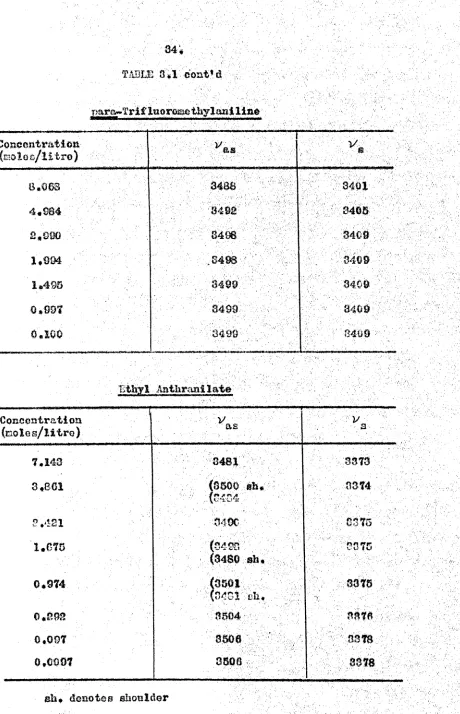
Two other anilines, ethyl anthranilate and para trifluoromethyl aniline, were also investigated and the effect of concentration on their NHL stretching frequencies is shown in Figure 3*2,
3500
3490
3480
3470
3460
3450
3440
3430
3430
3420
3410
3400
3390
3380
3370
3360
An i line
Et hyl An t h r a n i l a t e
p- Tr i f l uoromethyl Ani l i ne
J_____________ _L______________ 1_______________l
1 2 3 4
3 + log c
28
quite different from that of aniline. The change in frequency
on dilution is rauch less and the symmetric and anti syare trie
absorption bunds are single at all concentrations* It vould
be expected that the strong electron vithdraving trifluoronethy1 group in the para position vould make the amino nitrogen a better
donor for a hydrogen bond. Severer at the same t h e it vould
make it a correspondingly veaker acceptor, thus giving an overall lessening of the possibility of a hydrogen bend being
formed b© tureen the tvo amino groups. The possibility of a
hydrogen bond Letveen the amine group and the trif luo route thy 1 group cannot be overlooked, but in the corresponding ortho isomer it ha® been shovn (this thesis, p. 57) that the
trifluoromethyl group exerts a repulsive effect on the amine group and that there is no evidence for the formation of an intramolecular hydrogen bond#
In ethyl onthronil&te the symmetric stretching frequency of the Nlig group remains sensibly constant in
contrast tc the antieyirsnetrie frequency. The concentration
versus frequency plot shovs the behaviour of the main
absorption* iiovever the antisymmetric band is single for
the absorption. It still l o ’'or concentrations the absorption becomes sharp, single and has a constant frequency.
This bob
iviour
can be explained in terns of an interroolecular hydrogen bond being formed by the regaining ’’free” amino hydrogen tc one of the oxygen atoms.In the liquid film probably all the molecules are
associated by a vcak internee locular hydrogen bond into dimers
or higher polymers. On dilution these weak hydrogen bonds
arc broken very easily so that the NH absorption gives
evidence of -’free’’ and "bonded” NH groups* Further dilution gives equal intensity of these NH absorptions and the individual
bands cannot be resolved. On diluting further the ’’free” band
dominates with the ’’bonded” NH absorption becoming the shoulder
until at concentration belo' 0,B* the ruairie exists solely us the monomer.
If the intenaolecular hydrogen bond is formed to the carbonyl oxygen, the bond order of the C~0 linkage will be reduced, resulting in a shift of the carbonyl frequency to
a lover value. This would result in two carbonyl absorptions,
intro— ) oxygen ^1)
I
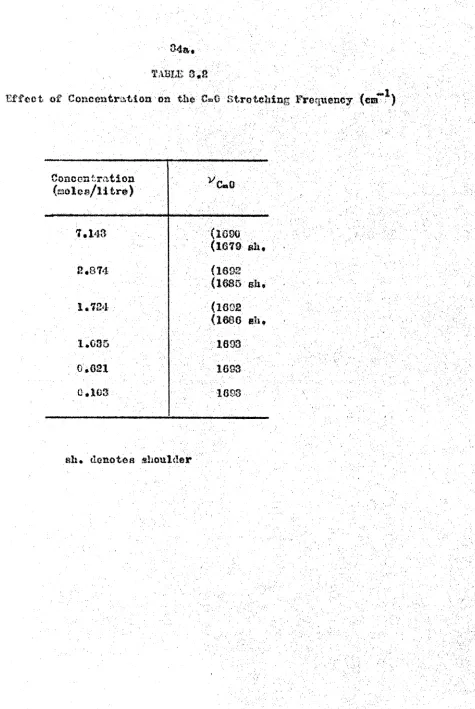
lie spectra» of ethyl anthranilate at various concentrations rai recorded and the results are given in Table 3 #2* The
absorption wag doubled at high concentrations but became single belov a concentration of lMf which was in agreement irith the behaviour exhibited by the NH stretching frequencies of the same compound# To ensure that the frequency values would be strictly comparable, the anilines were studied as dilute
(<l'#01M) solutions in carbon tetrachloride#
3.1 - euterationi
The replacement of the active hydrogens in amines, alcohols or carboxylic acids with deuterium his generally been achieved by repeated evaporation of the «ample free* a solution of deuterium oxide or in the case of water insoluble compounds free; deuterium oxide/clioxan mixtures or fro® deuterated
work in a drybox and to take special precautions with the drying of all laatcriuls likely to coae in contact with the don tor., tod sample.
X
further complication * itL compound & in ▼hick intramolecular hydrogen bonding con occur is theirvolatility in ateam during the evaporation process* The development of a rapid method by Tales and
Eobertson (1968) of deuterating natural products in structural investigations, by adding & drop of deuterium Quid* to the solution in the infra-red cell, has enabled this technique to
gain wider applicability* In the present work, deuturution
▼as accompli shod by shaking the dilute, carbon tetrachloride solution of the aniline with deuterium oxide, removing the excess and drying the solution vrith anhydrous sodium sulphate* The residual deuterium oxide present fra a insufficient to give
any
OT
absorption at approximately 2660 ccT*, and to shift anyof the absorption bonds under consideration. hen treating
water soluble compounds, which distribute preferentially into the "aqueous" layer, it was accessary to "salt" out the raine with dried sodium chloride before adding the sodium sulphate. By this technique it was possible to retain the concentration
of the sample at approximately its original level. In order
to obtain partial deuteration, in which only one of the amine protons is replaced by deuterium, a mixture of T5^ T>gC to
for partial Neuter tion wae to m i a r the original eolation of the
aniline vith t solution of the fully dentereted aniline at the
T4BLB 3 .1
E f f e c t o f C o n c e n tr a tio n on th e NUg S t r e t c h i n g F r e q u e n c ie s (cir~*)
A n ilin e
Cone e n t r o ti o n
^ m o l e s / l i t r o ) ^ a s
1 0 .9 7 (3456 a h . (3365 a h .
(3432 (3352
1 0 .0« (3458 e h . (2 3 7C e h .
(3432 (3354
5 .6 6 (3472 s li. (3381 a h .
(3448 (3382
3 .1 8 (84 62 (3377
(3443 a h . (3350 a h .
1 .7 9 (3470 (3386
(3448 e h . (3852 a h .
1.0C 8475 3389
0 .5 6 3477 3302
0 .3 2 3479 3394
0 ,1 0 3481 3395
0 .0 8 2 3482 3395
TABLE 3 .1 c o a t* d
p a r a - T r i f luorom e th y 1 a n i l i n e
C o n c e n tr a tio n ( m o l e o / l i t r e )
T
^ a s
8 .0 6 8 3488 3401
4 .8 8 4 8492 3406
2 .9 9 0 3498 3409
1 .9 9 4 ,8498 3409
1 .4 9 5 3499 3409
0 .9 9 7 8499 3409
0 .1 0 0 3499 3409
E th y l A n t h r a n i l a t e
C o n c e n tr a tio n V V
( t a o l e s / l i t r e ) & & 3
7 .1 4 3 3481 3373
3 .8 6 1 (3500 s h .
(3484
3374
2 .4 2 1 349C 8375
1 .6 7 5 (8498
(3480 s h .
3375
0 .9 7 4 (3501
(3481 e h .
3375
0 .P 9 2 3504 3*7*
0 .0 9 7 3506 3378
0 .0 0 0 7 3506 3378
[image:48.543.65.525.11.725.2]TABLE 3 .2
E f f e c t o f C o n c e n tr a tio n on th e C»G S t r e t c h in g F re q u e n c y ( c ia " * )
Concern ' r a t i o n
( m o l e e / l i t r e ) V C-Ü
7 .1 4 3 (1690
(1 6 7 9 a h .
2 .8 7 4 (1692
(1685 s h .
1 .7 2 4 (1692
(1686 s h .
1 .0 3 5 1693
€ .021 1693
0 .1 0 3 1693
[image:49.543.59.534.10.719.2]35
4 ~ ortho ALOI^-ANILIN!‘S
4.1 Methyl Substituents»
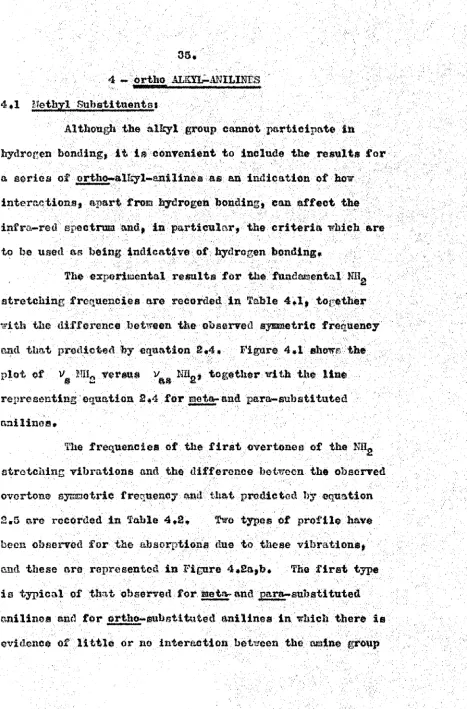
Although the alkyl group cannot participate in hydrogen bonding, it is convenient to include the results for a series of ortho-alkyl-anilines as an indication of how interactions, apart from hydrogen bonding, can affect the infra-red spectrum and, in particular, the criteria which are to be used as being indicative of hydrogen bonding.
The experimental results for the fundamental NHg stretching frequencies are recorded in Table 4.1, together with the difference between the observed symmetric frequency
and that predicted by equation 2.4. Figure 4.1 show* the plot of V NH0 versus v Nii_, together with the line representing equation 2.4 for nieta-and para-substituted anilines.
[image:50.543.63.530.13.722.2]c
m
O
2
- substi t ut edH
2.6
- d i - and2, 4, 6
-
t ri - subst i t uted3380
6600
FREQUENCY cm
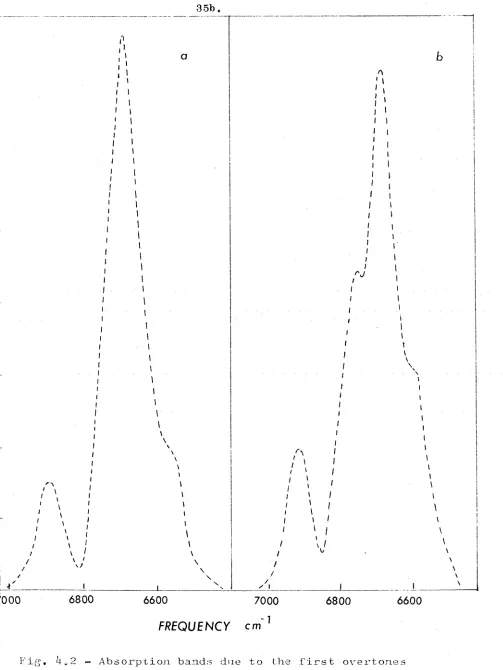
Fig. U *2 - A b sorption bands due to the first overtones
of the \ri19 stretching vibrations of 2 -alkyl anilines ,
[image:52.543.11.514.17.687.2]and the ortho substituent« Type 4.2b has been observed whe n
there is an indication of a repulsive interaction on the amine
group.
Several anilines were partially deuicratcd and the
[image:53.543.63.534.14.709.2]results for the stretching frequencies are recorded in
Table 4 «3, The appearance of multiple absorptions for the
NT>g symmetric stretching vibration has been attributed
(Califano and Moecia, 19^7} Hatnbly, 1961) to Fers i resonance
between a w e a k combination band of the aromatic system and
"V
The ten primary anilines with a single ortho-methyl
group all conform to equation 2.4 with a standard deviation
of l«0 dsT*. This agreement is not surprising as there is
no evidence of any interaction between the methyl and hydroxyl
groups in the corre «ponding ortho-substituted phenols (Put tin an,
I960) Krueger and Thompson, 1959), One case of particular
interest is that of 8 - methyl,4— amino-aniline for which, at the
resolution available, the presence of a methyl produces so
little interaction with the adjacent amine group, that only
tvo absorption bands ore found for the stretching vibrations
of the Nhg groups. The six compounds with an ortho-iaethyl
substituent that were studied in the overtone region produced
spectra of type 4 , 2 a and conformed to equation 2,5, the
ortho-37
toluidine gave only a »ingle NH and a «ingle NI> stretching frequency, the interaction between the substituent methyl group and the amino hydrogen being insufficient to enable differentiation between the cia and trau« forms*
Six anilines -with 2,6-diiaethyl substituents were examined and for five the value of the symmetric NH^ stretching frequency was higher than that predicted from equ tion 2*4* This result is in contradiction to the assumption by Richards and Walker (1961) that, in the absence of hydrogen bonding, ortho-»substituted anilines will conform to this relation* Bellamy and Williams (1957) also postulate that, when the two KH links are equivalent, there will be no deviation, and
support tills idea with the results from some co-ordination compounds*
epster (1958), in an investigation of the ultra violet spectra of a series of di-ortho-substituted alkyl- anilines, Including 2,6-<Ii- t ert*-butyl aniline and
2*4,ft-tri- t e r t ,-butyl aniline, found no evidence of
significant steric inhibition to mesomerism* Further he points out - "that these results leave no doubt that, in the less heavily substituted amines like 2,6-di-iisethyl aniline, there is no steric inhibition at all,"
between on« of the main© hydrogen* and the adjacent ortho-group# Further, it l.n» been »hown that in p i p « m i i M the lone pair on the nitrogen exerts a greater repulsion on the axial hydrogen* of the adjacent methylene groups than doe» the hydrogen on the nitrogen# The preferred conformation of the molecule is with thi® hydrogen in the axial position# Rotation of the amine group in dl-ortho-substitu ted anilines will introduce this additional hindrance to adopting a configuration euch a» in I
\
H-C
/H
I
39
can tim« give agreement with the V / y relationship« V>hen a «ä s
there are methyl groups in both tho two and six positions, the direct interaction between the hydrogen atoms predominates, giving rise to an effect which could be described as
Manti-hydrogen bonding*•
Because of the lowering of the bond order of the C— N Unit by the electron releasing para-amino group, the one
2,6-di-methyl aniline complying with equation 8.4,
8,8-di-iaethyl,4-€03dno-aniline, would have the l-aiaino group in a rore completely pyramidal conformation, which would lessen
the amine-methyl interaction« The decreased frequency shift
caused by this lowering of repulsion, would make the frequency of the interacting Nli0 group approach that of the para-NH^ group« At the resolution available <rith the spectrometer, the absorptions due to the stretching vibrations of the two groups would appear as two composite bands w ith frequency values intermediate to the true values for the individual groups and consequently any deviation from equ tion 2*4 would be small«
bi-amino-durene on the other hand showed evidence of increased interaction between the «mine groups and the adjacent methyl groups, exhibiting an increased departure fror» the
equation relating V a# and V # Scale models show that the
presence of the two extra methyl group® prevent the amine groups and the methyl groups fro*a taking up a position of
2,6-di-methyl anilines.
The two 2 ,0-di-methyl anilines examined in the overtone region agree with the predictions of equation 2*5 and gave spectra
of type 4,2a* The failure to differentiate these compound« from
those with a single methyl group would indicate that the
anh&rmonle i ty factors must be sufficiently different to annul the deviations found in the fundamental region,
? ono-deuteration of diaudno-durene in eosrnnm with other 2,8-di-methyl aniline resulted in only a single Nil absorption,
4,2 Other Alkyl Substituentsi
In the series ortho-ethyl ,-isopropyl,-tert,-butyl aniline there is no marked difference between the calculated and
observed values of the symmetric Ni»2 stretching frequency. This
result is surprising as, although it could be argued that the effect of the ethyl and isopropyl group» would be the same as
»ethyl because an CL hydrogen atom can still be directed towards
the amine group, the rapid increase in sire of the tort .-butyl group would be expected to give quite a marked departure,
Nd^,2-tort,-butyl-aniline gives definite evidence of an asymmetry in the environment of the amino hydrogens as two absorptions,separated by 45 cm ^ are observed for the cis and
trans Nil vibrations. This voul indicate that the period of