Introduction
The Issue
The reconceptualisation of educational assessment in recent years has not been in a vaccuum. During the 1990s it was becoming clear that, as the National Curriculum in England and Wales, and the 5-14 National Guidelines in Scotland became established, the systems for assessment which obtained were lacking in coherence and were limited in what they could contribute to:
• supporting learning, providing feedback to pupils, parents and other teachers, and
identifying next steps in learning;
• providing information on which to monitor and evaluate provision and attainment
at school, education authority and national levels.
While there has been improvement in the quality and use of assessment, there is still room for teachers to involve pupils in monitoring their own learning and to analyse assessment data with greater sophistication (HMIE, 2002; OFSTED, 2002). One powerful way in which teachers can begin to improve their assessment is for them to:
• be clear about the rationale which underpins their assessment practices • appraise the claims they make in their rationale
• evaluate the significance of the empirical evidence on which the claims rest
In other words, it is not sufficient that teachers be procedurally skilled in implementing assessment (necessary as such skills are) but they must also be able to reason about their assessment practice. This reasoning, otherwise known as pedagogical reasoning, is an integral part of teaching and is founded on an extensive knowledge base (Shulman, 1987). Just as there is a relationship between knowledge of the substantive structure of the subject/discipline and effective teaching (Bennett & Carré, 1993) so it seems reasonable to assume that knowledge of assessment will inform teachers' practice. One of the most robust findings in research on expertise is the strong relationship between knowledge and practice (Glaser, 1999). If a person's knowledg base influences that person's practice, it is worth considering what knowledge might be essential if beginning teachers are to assess children's work in ways that enhance learning. The focus of interest is therefore teachers' knowledge about assessment.
The Shift in what Educational Assessment Means
The shift from the historically dominant measurement model to the standards model (Berlak, 1992; Taylor, 1994) has seen earlier concerns with the relative, reliable
performance of individuals on decontextualised, standardised tasks, give way to concerns about the extent to which assessment evidences thinking and problem-solving skills rather than discrete knowledge (Newmann and Archbald, 1992). The realisation that learning is not linear and atomistic and that it is not decontextualised, implies that the implementation of assessment necessarily involves a diverse range of tasks and
profiles, exhibitions of artefacts and performances as well as tests of discrete competencies each have the potential to evidence authentic academic achievement.
While the measurement model viewed assessment as an indicator of extant achievement, the standards model sees assessment as directly informing instruction (Nichols, 1994) and of itself representing meaningful, significant and worthwhile forms of human endeavour and accomplishment (Wiggins, 1989). Assessment is thus interactive since it underscores the processes of thinking and learning. Both learner and teacher explore the extent to which performance can be enhanced by effort or intervention. Because assessment is embedded in instructional episodes, learners learn from assessment when it models what performance is to be emulated and also indicates how to move towards more competent performance. But, for assessment to serve learning and teaching well, assessment tasks must evidence coherent and usable knowledge, principled problem solving and self-regulatory skills (Glaser, 1990). That assessment is now seen as having instructional value is a distinguishing criterion in the reconceptualisation of assessment.
certainty that the relationship between the observed behaviour and the internal, unobservable process (or the construct) is valid. However, the stringencies of test construction within the psychometric paradigm mean that the technical matters of
validity, reliability and the appropriate use of norms can result in the construct being very narrowly, or idiosyncratically defined, and in making a case for the test's construct
validity the value judgements and subjective choices of the test constructors inevitably intervene (Messick, 1989). While the issue of the validity of the increasingly diverse range of educational assessments now used has not been resolved (Crooks, Kane & Cohen, 1996), there seems to be awareness if not agreement that not only is it impossible to achieve consensus on what constitutes any cognitive competence but that it is
undesirable in multicultural societies to deny plurality of perspective.
As the meaning and context of assessment becomes more elaborated, it seems important that teachers ground their practice in informed and rational decision-making. A
necessary pre-requisite of this is a rich base of conceptual and metacognitive knowledge, which can be brought to bear in solving a problem. Because the knowledge that one possesses affects the type of understanding that one can construct about a domain as well as the types of problems that can be recognised and solved, the purpose of the study was to delineate knowledge-about-assessment; specifically to address the question, What do novice teachers know about assessment?
Method
tightly related reasons. Firstly, it is well known that interviews are susceptible to participant acquiescence and since this study sought the considered responses of the participants it was decided that a task requiring a prepared written response would better enable this. A second, reason for using a written task to elicit data was an
acknowledgement of the evidence (Bereiter & Scardamalia, 1987; Langer & Applebee, 1987; Wells, 2002) that engagement in the writing process can enable the writer to transform extant and earlier understanding(s) into something more sophisticated. Hence the writing task was not merely a means of data collection but also a means through which participants could themselves learn (an opportunity, incidentally, that many participants explicitly acknowledged, in recognition of their own underveloped
understandings of assessment). Thirdly, because of the ethical consideration not to use participants' time exclusively for the satisfaction of research purposes, course credit was attached to completion of the written task, although participation in the task was
voluntary and alternative to other course requirements. The reasoning behind the written task was understood as contributing to its authenticity (Newmann & Archbald, 1992) and thereby increasing the credibility which could be placed on the findings.
Design Written text on educational assessment was analysed using a category system
derived by the author and informed by a range of writing on assessment (for example, Berlak, 1992; Black & Wiliam, 1998; Messick, 1989; Newmann & Archbald, 1992; Taylor, 1994) Further, Shulman's (1987) emphasis on the significance of the knowledge base provided the conceptual foundation for the category system. Knowledge of
• clear purpose (such as diagnosing or aiding learning, evaluating teaching,
motivating learners or ranking,selecting and grading learners);
• the basis for comparison (usually taken to mean normative or criterial but can also
include ipsative);
• modes (emphasis and timing) of assessment (which are represented as bipolar
dimensions such as informal/formal, process/product, formative/summative); • fairness (now perhaps better understood as 'just' or 'equitable' assessment but in
any event relying on the precepts of validity and reliability); • source of assessment (self, peer or teacher/other).
Assessment methods refer to the instruments through which information is gathered and would include:
• tests (objective measures designed to yield a 'correct answer' and which might be
constructed by the teacher or some external body, may/not be standardised, may be national or local);
• open-ended writing (which may be short, long or extended and in which the
respondent has some choice as to how the piece of writing is formulated); • the creation of some artefact or performance which can be observed by others; • oral work (which might be a formal presentation, particpation in discussion with
teacher and/or learners, proficiency in discussion or some consultation type task).
of which results in the award of a postgraduate certificate in primary education.
Possession of this certificate is one of the two principal ways through which teachers can gain provisional registration with The General Teaching Council in Scotland, enabling them to teach across the seven years of primary education and through all five areas of the curriculum (Mathematics, Language, Environmental Studies, Expressive Arts and Religious/Moral education). Most of the participants were completing the course to enable career changes and so brought to the course a very wide range of vocational experiences, although any teaching experience had been of an informal nature only. The average age of the 23 female and 7 male participants was 35 years. Twenty seven of the participants were United Kingdom nationals while the remaining 3 were Canadian. At the time of engaging in the study described here, the participants had completed 18 weeks of field experience and 12 weeks of in-Faculty study and so were almost at the point of applying for licensure.
Output for analysis Thirty essay scripts, of 3500-4000 words from teacher-education students in response to the question, 'What do you know about educational assessment that will help you in your teaching?' were content analysed.
reference to assessment methods or principles (as defined above) were coded.
Paragraphs which evidenced no knowledge of assessment principles or methods were discounted because:
they were 'signposting' the progress of the essay as in:
In order to consider the topic of assessment, it is necessary to consider the ways
in which children learn, what makes learning effective and how we determine the
effectiveness of our teaching.
they were discussing learning theory per se rather than knowledge of assessment as in:
Two key schools of thought exist regarding the process of learning. Behaviourism
focused on that which was observable and measurable. Drawing heavily on
Skinner, behaviourism claimed that there was no reason to suppose that the laws
which governed observable behaviour should not also govern activity in the mind.
In counterpoint to behaviourism, theories relating to cognitivism emerged much
later. Influenced initially by Piaget, cognitive explanations of learning
considered internal processing and the individual's construction of meaning more
important.
they were rehearsing some cant which did not illuminate assessment as in:
Assessment must not be allowed to dominate the teacher's time in the classroom.
which could lead the teacher to focus more time on maths and language at the
expense of other subjects.
Results
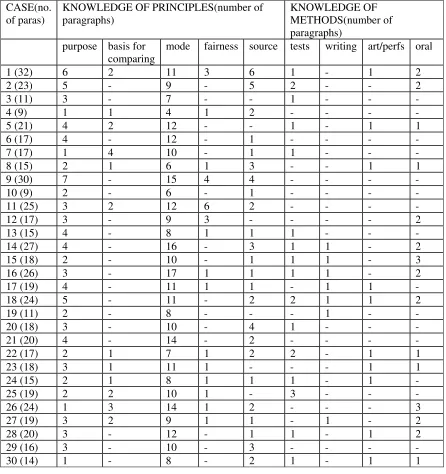
Insert Table I about here, please.
Knowledge of assessment was reflected variously. Table 1 summarises the number of paragraphs in each essay that were concerned with assessment knowledge. In terms of assessment principles, all participants made at least some reference to the purpose and modes of assessment, 24 made reference to the source of assessment whilst the basis on which to interpret assessment results and the fairness of assessment were mentioned by only 12 and 15 participants respectively. In terms of assessment methods, 16 participants referred to what would be categorised as tests, 10 to the production of artefacts or
performances and 15 to oral methods, but only 7 participants made any reference to written methods of assessment. The paragraphs themselves are not comparable because they are of variable number across scripts and of variable length within scripts;
Discussion
The study reported here was seeking to answer to the question, What do novice teachers know about assessment?
Knowledge of Assessment Principles
While Table I shows variability in the knowledge of assessment principles evidenced, there are some discernible consistencies. A first consistency was in the purpose of
assessment. All participants acknowledged that assessment information could be used for accountability and for supporting learning. This knowledge was offered as factual and, while possibly dichotomous, was relatively uncontentious as the following extract shows:
Assessment serves a variety of purposes in education today. It is used for
certification and selection of pupils for admission to higher education institutions.
It is also used to monitor standards in schools and to allow comparison to be
made between schools. Until fairly recently, the majority of assessment research
focussed on these summative purposes of assessment. However, assessment also
plays a vital role in teaching and learning. It enables teachers to diagnose pupil
difficulties, enhance pupil motivation, evaluate their teaching and plan the next
teaching and learning steps to be taken.
The purpose of norm-referenced assessment does not benefit the learner in any
significant way other than to create criteria for national standards.
Norm-referenced assessment should be discontinued.
Offerings of this type did not recognise that the purpose of assessment has implications for what type of assessment is conducted nor did it acknowledge that there might be some common but qualified ground between different purposes (Brown, 2002; Kimball & Cone, 2002; McLain, 2002; Sirotnik, 2002).
A second consistency was in the emphasis and timing of assessment. All participants acknowledged the formative-summative mode (and a few made brief reference to other modes):
Summative assessment is testing or examining in a formal situation, usuually
carried out at the end of a programme of work, and is a judgement of standard
achieved. Formative assessment is something that exists in day-to-day classroom
practice. Its main aim is to collect short term evidence that will promote further
learning for the pupils in a class. It is carried out by teachers themselves and
involves them in diagnosing problems, recognising achievements and giving
useful feedback to individuals as well as informing future planning for teaching.
exploration of the relationship between formative and summative functions (Wiliam & Black, 1996; Harlen & James, 1997), but while these explorations drew out the confusion in understanding each of the poles, they did not convincingly resolve how assessment data gathered in one mode might be properly interpreted in the other. Many of the participants used the formative-summative mode as a structuring device round which they made connections to other aspects of assessments and thereby produced scripts which gave some impression of global coherence. A few participants made connections between the formative mode and constructivist perspectives on learning to offer a persuasive case for the process of assessment having an impact on pupils but these were outnumbered by the many who uncritically suggested that formative feedback can and will enable the teacher to promote learning (Torrance and Pryor, 1998).
As a consequence of their awarenesss of formative assessment, many participants acknowledged that not only was the teacher a sourceof assessment but so too were the pupils themselves. In recognising the teacher's responsibility in assessment, extracts such as the following were common:
Working within a formative framework allows teachers to identify achievements.
As a result, teachers are in an improved position to identify individual differences
in learning and differentiate according to the needs of individual pupils. It is the
provision of freedback within this cycle of diagnosis and differentiation that can
lead to the promotion of learning. However the quality of this feedback plays a
It was clear from just about all of the scripts that the teacher's role in assessment was a 'top-down' one in which he/she made few, if any, assessment decisions in consultation with pupils. Such a conception of the teacher's role is now seen as outdated (Hackelton, 2002; Keefe & Jenkins, 2002; Miller & Byrnes, 2001; Wiener & Cohen,. 2002;). Of the scripts which recognised the role of le arners in their own assessment (and the majority did), the following excerpt was perhaps the most sophisticated representation of the importance of self-assessment:
Cognitive theories suggest that the child must be fuly engaged in what is being
taught before learning will take place. For this to happen, children must know
what is expected of them, how to achieve the expectation and why. It is therefore
important that children receive qualitative written and oral feedback in order that
they can appreciate how well they are doing and how they can improve.
while the excerpt immediately below would be more typical:
By communicating the aims of learning, teachers can include pupils in identifying
where they are now in relation to learning goals, to encourage them to take
responsibility for moving forward.
self-designed assessment tasks, or in pupils themselves driving formative assessment were not acknowledged in any of the scripts. At best, then self-assessment was viewed as a bonus of formative assessment without any appreciation of its centrality in the
metacognitive management of one's own learning.
The remaining consistency in novice teachers' knowledge of assessment principles was in their scant acknowledgement for either the basis of comparison on which judgements are made or for the issues of reliability and validity in assessment. True, there were
assertions along the lines of:
Assessment must be valid and reliable.
or
Assessment can be norm-referenced or criterion-referenced.
However, because there was little (and often no) exemplification or elaboration of the concepts in either type of assertion, such knowledge as the participants did have was not networked to any of their other knowledge about assessment and so was inert. For example, while there was no expectation that scripts would evidence technical exposition on all aspects of validity, knowledge of the principle of 'fair' assessment would have been more convincing had there been even some awareness of content validity and
consequential validity (Messick, 1989). Similarly, participants' knowledge of the
cognitive product) and of the role of learning in relation to both (Good & Brophy, 1986; Popham, 1974; Thorndike, 1997).
Knowledge of Assessment Methods
Inspection of Table I also shows variability in participants' knowledge although the overall finding is that the participants evidenced little explicit knowledge of assessment methods. References to tests acknowledged the country-wide policy of national testing and the commonly held view that tests are perhaps best fitted for assessing the acquisition of factual knowledge. There was also some confusion as to whether the national tests in Scotland were standardised. It was interpreted as somewhat strange that those who did refer to tests did not consider the type of objective measure used since they were at least familiar with, if not practised in, designing and using worksheets for pupils in which the tasks were multiple-choice items, short-answer completions, dichotomous-choice items or matching items. However, while the participants were not unfamiliar with
constructing such workshheets, they did not appear to explicitly recognise this as
assessment. Such references as there were to tests failed to suggest criteria by which the quality of a test might be judged, how to write test questions or develop a test, how to administer a test efficiently and fairly or to recognise the issues surrounding test score interpretation. This lack of essential knowledge (Ebel, 1961) pessimistically suggests that novice teachers are ill equipped to competently assess pupils in their charge (Hopkins, 1998).
thinking. Such acknowledgement as there was recognised that some observed pieces of written work were invalid either because their contents were not sampling, or because the requirements of the written medium were conflated with, the construct under assessment. A lack of regard for the value of written work as a possible means of assessing authentic academic achievement (Newmann & Archbald, 1992) could be inferred from all of the scripts which made reference to methods of assessment, but was particularly striking in scripts which characterised national tests as being pedagogically unhelpful because they allegedly assessed nothing more than factual information. In other words, while scripts made reference to the importance of learning-as-understanding, concern with how such learning might be evidenced did not include written work. Perhaps, however, belief in the importance of written work as evidence of tranformative learning (Bereiter & Scardamalia, 1987) is being compromised by confusions in understanding the extent to which authentic tasks are 'performances' that are valued in the adult world and tasks that focus on the production of knowledge (Newmann & Archbald, 1992; Ottobre, 1999).
A very small number of participants made reference to 'practical' assessment, to the observation of some artefact or performance (usually in the curriculum area of physical education and reflected in statements such as the ability to perform a handstand can only be assessed by observation or you can't assess a forward role by giving the children a
test). Apart from the participant's omission of any consideration of the validity of
of the assessment is the performance per se), their lack of consideration of the possibility that another type of performance might be construct-centred stongly suggests that they do not connect issues of replicability and generalisability (and therefore of the issues of reliability and validity) with assessment method.
The final assessment method to be discussed is oral work. Unfailingly, those participants who referred to this method conceptualised it only in terms of teachers asking questions of pupils. Although this focus was very narrow, and so ignored key issues in oral work such as communicating a body of information to an audience, handling and facilitating questions/discussion and self-presentation through voice and body language, the participants were nevertheless clear that constructing higher-order questions was more difficult than constructing questions of recall (Black, & Harrison, 2001; Wilen, 2001; Wimer, Ridenour, Thomas & Place, 2001), and that planning out questions in advance in order to stimulate higher-order thinking was probably important (Lenski, 2001, Wood, & Anderson, 2001).
Significance of the Findings
While knowledge-about-assessment is a large and complex field, it is evident from this study that particpants displayed limited knowledge of both assessment principles and methods. Further, such knowledge as participants displayed was largely
and fair assessment were not well developed. Similarly while a good number of participants saw some relationship between mode and source of assessment, their expositions on the relationship were far from complete. This lack of integrated
knowledge is evident in advanced students of other disciplines (for example, Boshuizen, Schmidt, Custers & Van de Wiel, 1995; Hofer & Pintrich, 1997) and suggests that while there has been some accretion of knowledge, there has been no restructuring (Rumelhart & Norman, 1978). This in turn indicates that the learning about assessment that has taken place is still at a very unsophisticated stage (Shuell, 1986; 1990) and raises the important question of how ready the participants – novice teachers about to become provisionally licensed – were to make autonomous professional judgements about pupils' learning.
Participants in this study frequently acknowledged that their knowledge about assessment had hitherto been circumscribed by their own experiences, usually of summative and terminal assessment for accountability purposes. And so what they had now learned represented considerable progress in developing their knowledge. However, laudable as such progress may be it is not enough. Since the fundamental rationale for a more
elaborated conception of educational assessment is that teachers can better facilitate pupil learning, they must simultaneously consider a range of assessment principles and
currently have for application. This phenomenon is what Bereiter (1985) refers to as the learning paradox.
What might be done?
Because there is considerable hard evidence which points to both the importance and cognitive advantages of a well-developed knowledge base (Haskell, 2001), teacher education is faced with the pedagogical problem of how to enable students to overcome their knowledge deficits. Courses of professional preparation must recognise that while additive learning is important, learning that involves an increase in structural complexity is also (and maybe more) important because it allows more profound reasoning. Insights derived from findings in cognitive science suggest that to promote complex learning, tutors might pay renewed attention to the the role of the learner and the role of reading.
The role of the learner In the literature there is no real resistance to the idea that humans are fundamentally knowledge constructors. What is much less explicit is what a pedagogy derived from constructivism might look like. One fundamental point is
evident in those who view learning as a goal to be achieved rather than an activity to be enacted (Bereiter & Scardamalia, 1989). The primacy of the learner thus suggests, counterintuitively, that learning tasks, rather than being overly strucured by tutors to minimise the possibility of learner error, might be more useful if they were complex or difficult since expertise does not develop through doing only what is within one's competence but through working on real problems that require the extension of knowledge and competence (Scardamalia & Bereiter, 1991). At a pragmatic level, it might also be helpful to focus on a few significant learning tasks for which the learners are accountable, and thereby communicate to the learners the kind of intellectual work which is valued (Crooks, 1988; Gibbs, 1999; Ramsden, 1997), rather than having a multitude of learning tasks which may have little or no alignment with the desired learning outcomes (Biggs, 1999). For example, it would seem important that tutors give primacy to the need for students to conceptualise new knowledge about assessment and so in an iterative fashion, tasks that require the comprehension, transformation and expansion of knowledge about assessment (Sarig, 1996) might better enable students to appreciate that the analyses of, and solutions to, problems of assessment are real and immediate issues with which they have to grapple in their professional practice. The essential point in all of this is that it is only when learners in the formal educational system are required to construct or generate their own new knowledge (Newmann & Archbald, 1992) that they will seriously grapple with significant learning.
purpose of enabling the person to solve problems or effect appropriate action (which in this case would mean addressing the many problems of classroom assessment that practising teachers eperience), it is assumed that the individual is behaving as though he/she is inside a particular situation rather than outside of it (Zwann, 1999). Therefore it would seem important that student teachers become aware of their own understanding of assessment through deliberating on, and sharing insights into, problems involving assessment. Having identified, for example, issues round the experiences of being assessed, the teacher's role and responsibility in assessment, the design of assessment, and the relationship between assessment and learning, student teachers could then pursue these issues through further reading. Not only would such expository text contribute to the reader's knowledge of the topic in question, but, more importantly, the semantic content of the reading, the reader's extant knowledge of assessment that is triggered by the text, the inferences that the reader derives from the text, the reader's recognition of the issue or problem that precipitated the reading in the first place, together with any other conceptual knowledge which the reader can retrieve from memory as being pertinent enables the construction of a more advanced situation model. While far from
preparation makes more, not less, reading demand of teachers. Novice teachers need to read to extend their domain knowledge about assessment so that they do not rely merely on common-sense knowledge. However, even high exposure to develop a rich domain of knowledge is, of itself, not enough. Such knowledge must be capable of being used in the practice of assessment. For the knowledge to be usable, novice teachers must build situation models of assessment practice through consciously invoking cognitive, strategic behaviour to remember, make sense of, or reconfigure new information. It is they who must make inferences from their reading, determine and overtake the gaps in their
knowledge base, and make connections among the various pieces of of knowledge-about-assessment which are conceptually isolated. To support learners in creating situation models, Kintsch (1998) has had some success using poorly written text which forces learners to compensate for text lacking in coherence. Such a suggestion is consistent with the case put forward earlier, for learners being required to grapple with complex, big or fuzzy ideas.
Conclusion
References
Bennett, N. & Carré, C. (1993). Learning to Teach. London: Routledge.
Berlak, H. (1992). The need for a new science of assessment. In H. Berlak, F. Newmann, E. Adams, D. Archbald, T.Burgess, J. Raven, & T. Romberg (Eds.), Towards a New Science of Educational Testing and Assessment. New York: State University of New York Press.
Bereiter, C. (1985). Toward a solution of the learning paradox. Review of Educational Research, 55(2), 201-6.
Bereiter, C. & Scardamalia, M. (1987). The Psychology of Written Composition. NJ: Lawrence Erlbaum Associates.
Bereiter, C. & Scardamalia, M. (1989). Intentional learning as a goal of instruction. In L. Resnick (Ed.), Knowledge, Learning and Instruction. Hillsdale, New Jersey: Lawrence Erlbaum Associates.
Biggs, J. (1999). Teaching for Quality Learning at University. Buckingham: The Society for Research into Higher Education &The Open University Press.
Black, P. & Harrison, C. (2001). Feedback in questioning and marking: the science teacher's role in formative assessment. School Science Review, 82(301), 55-61.
Boshuizen, H., Schmidt, H., Custers, E. & Van de Wiel, M. (1995). Knowledge development and restructuring in the domain of medicine: the role of theory and practice. Learning and Instruction 5, 269-89.
Brown, J. (2002). The portfolio: a tool for workplace learning and development. Paper presented at the National Meeting of the American Educational Research Association. New
Orleans: LA, April 1-5.
Buckendahl, C., Impara, J. & Plake, B. (2001). A Strategy for Evaluating District Developed Assessments for State Accountability. Paper presented at the Annual Meeting of the Mid-Western Educational Research Association. Chicago, IL, October 24-27.
Butler, R. (1987). Task-involving and ego-involving properties of evaluation. Journal of Educational Psychology, 79(4), 474-82.
Crooks, T. (1988). The impact of classroom evaluation practices on students. Review of Educational Research, 58 (4), 438-81.
Crooks, T., Kane, M. & Cohen, A (1996). Threats to the valid use of assessment. Assessment in Education, 3(3), 265-285.
Dweck, C. (2000). Self-Theories. Hove: East Sussex: Psychology Press.
Fenstermacher, G. (1986). Philosophy of research on teaching. In M. Wittrock (Ed.), Handbook of Research on Teaching. New York: Macmillan.
Gibbs, G. (1999). Using assessment strategically to change the way students learn. In S. Brown & A. Glasner (Eds.), Assessment Matters in Higher Education. Buckingham: The Society for Research into Higher Education & The Open University Press.
Glaser, R. (1990). Toward new models for assessment. International Journal of Educational Research, 14(5), 475-83.
Glaser, R. (1999). Expert knowledge and processes of thinking. In R. McCormick & C Paechter (Eds.), Learning and Knowledge. London: Paul Chapman Publishing in association with The Open University Press.
Goldstein, H. (1993). Assessing group differences. Oxford Review of Education, 19(2), 141-150.
Good, T. & Brophy, G. (1986). Educational Psychology. New York: Longman.
Hackelton, D. (2002). The Authority of the teacher in the student-centered classes. Paper presented at the Annual Meeting of the Conference on College Composition and Communication (53rd, Chicago, IL, March 20-23).
Harlen, W. & James, M. (1997). Assessment and learning:differences and relationships between formative and summative assessment. Assessment in Education, 4(3), 365-79.
Her Majesty's Inspectorate of Education (HMIE) (2002). Standards and Quality in Primary and Secondary Schools: 1998-2001 Edinburgh: Her Majesty's Stationery Office.
Hofer, B. & Pintrich, P. (1997). The development of epistemological theories: beliefs about knowledge and knowing and their relation to learning. Review of Educational Research, 67(1) 88-140.
Hopkins, K. (1998). Educational and Psychological Measurement and Evaluation. London: Allyn & Bacon.
Keefe, J. & Jenkins, J. (2002). Personalized instruction. Phi Delta Kappan; 83 (6), 440-48
Kimball, C. & Cone, T. (2002). Performance assessment in real time. School Administrator, 4(59), 14-16.
Kintsch, W. (1998). Comprehension. Cambridge: Cambridge University Press.
Kluger, A. & DeNisi, A. (1996). The effects of feedback intervention on performance. Psychological Bulletin, 119(2), 254-84.
Kyriakides, L. & Campbell, R. (1999). Primary teachers' perceptions of baseline assessment in mathematics. Studies in Educational Evaluation, 25(2), 109-30.
Langer, J. & Applebee, A.(1987). How Writing Shapes Thinking. Urbana, IL: National Council of Teachers of English.
McLain, B. (2002). Strategies to engage students in learning. Paper presented at the National Meeting of the American Educational Research Association (New Orleans, LA, April 1-5).
Messick, S. (1989). Validity. In R. Linn (Ed.), Educational Measurement (3rd edition). New York: American Council on Education and Macmillan.
Messick, S. (1994). The interplay of evidence and consequences in the validation of performance assessments. Educational Researcher, 23(2), 13-23.
Miller, D. & Byrnes, J. (2001). To achieve or not to achieve: a self-regulation perspective on adolescents' academic decision making. Journal of Educational Psychology; 93(4), 677-85.
Newmann, F. & Archbald, D. (1992). The nature of authentic academic achievement. In H. Berlak, F. Newmann, E. Adams, D. Archbald, T. Burgess, J. Raven, & T. Romberg (Eds.), Towards a New Science of Educational Testing and Assessment. New York: State University of New York Press.
Nichols, P. (1994). A framework for developing cognitively diagnostic assessments. Review of Educational Research, 64(4), 575-603.
Office for Standards in Education (OFSTED) (2002). Standards and Quality in Education 2000/01: The Annual Report of Her Majesty's Chief Inspector of Schools. London: The
Ottobre, F. (1999). The role of measurement and evaluation in education policy. Paris: UNESCO Publishing.
Popham, W. (1974). An approaching peril: cloud-referenced tests. Phi Delta Kappan, 55(9), 614-5.
Ramsden, P. (1997). The context of learning in academic departments. In F. Marton, D. Hounsell, &. N. Entwistle, (Eds.), The Experience of Learning. Edinburgh: Scottish Academic Press.
Rosch, E. (1973). Natural categories, Cognitive Psychology, 4, 328-50.
Rumelhart, D. & Norman, D. (1978). Accretion, tuning and restructuring: three modes of learning. In R. Klatzky & J. Cotton (Eds.), Semantic Factors in Cognition (pp. 37-52) Hillsdale, New Jersey: Lawrence Erlbaum Associates.
Rumelhart, D. (1980). Schemata: the building blocks of cognition. In R. Spiro, B. Bruce & W. Brewer (Eds.), Theoretical Issues in Reading Comprehension. Hillsdale, New Jersey: Lawrence Erlbaum Associates.
Sarig, G (1996) Assessment of academic literacy. In M. Birenbaum & F. Dochy (Eds.),
Alternatives in Assessment of Achievements, Learning Processes and Prior Knowledge.
Dordrecht, Kluwer Academic Press.
Sergiovanni T. & Starrat, R. (1995). Supervision. New York: McGraw-Hill.
Sirotnik, K. (2002). Promoting responsible accountability in schools and education, Phi Delta Kappan, 83(9), 662-73.
Shuell, T. (1986). Cognitive conceptions of learning, Review of Educational Research, 56(4) 411-36.
Shuell, T. (1990). Phases of meaningful learning. Review of Educational Research, 60(4), 531-47.
Shulman, L. (1987). Knowledge and teaching: foundations of the new reform. Harvard Educational Review, 57(1), 1-22.
Taylor, C. (1994). Assessment for measurement or standards: the peril and the promise of large scale assessment reform. American Educational Research Journal, 31(2), 231-62.
Thorndike, R. (1997). Measurement and Evaluation in Psychology and Education. New Jersey: Prentice-Hall Inc.
Torrance, H. & Pryor, J. (1998). Investigating Formative Assessment. Buckingham: Open University Press.
Wells, G. (2002). Learning and teaching for understanding: the key role of collaborative
Wiener, R. & Cohen, J. (2002). New paradigms for familiar concepts: portfolios and
conferencing as performance based assessment tools. Journal of Early Education and Family Review, 9(3), 8-16.
Wiggins, G. (1989). Teaching to the (authentic) test. Educational Leadership, 46(7), 41-47.
Wilen, W. (2001). Exploring myths about teacher questioning in the social studies classroom. Social Studies, 92(1), 26-32.
Wiliam, D. & Black, P. (1996). Meanings and consequences a basis for distinguishing formative and summative functions of assessment? British Educational Research Journal, 22(5), 537-48.
Wimer, J., Ridenour, C., Thomas, K. & Place, W. (2001). Higher order teacher questioning of boys and girls in elementary mathematics classrooms. Journal of Educational Research; 95(2), 84-92.
Wood, A. & Anderson, C. (2001).The case study method: critical thinking enhanced by effective teacher questioning skills. Paper presented at the Annual International Conference of the World Association for Case Method Research & Application (Sweden, June 17-20).
Yorke, M. (2001). Turn first-semester assessments into richer learning experiences. Innovations in Education and Teaching International; 38(3), 277-78.
RESULTS
Table I Knowledge of Principles and Methods
CASE(no. of paras)
KNOWLEDGE OF PRINCIPLES(number of paragraphs)
KNOWLEDGE OF METHODS(number of paragraphs)
purpose basis for
comparing
mode fairness source tests writing art/perfs oral
1 (32) 6 2 11 3 6 1 - 1 2
2 (23) 5 - 9 - 5 2 - - 2
3 (11) 3 - 7 - - 1 - - -
4 (9) 1 1 4 1 2 - - - -
5 (21) 4 2 12 - - 1 - 1 1
6 (17) 4 - 12 - 1 - - - -
7 (17) 1 4 10 - 1 1 - - -
8 (15) 2 1 6 1 3 - - 1 1
9 (30) 7 - 15 4 4 - - - -
10 (9) 2 - 6 - 1 - - - -
11 (25) 3 2 12 6 2 - - - -
12 (17) 3 - 9 3 - - - - 2
13 (15) 4 - 8 1 1 1 - - -
14 (27) 4 - 16 - 3 1 1 - 2
15 (18) 2 - 10 - 1 1 1 - 3
16 (26) 3 - 17 1 1 1 1 - 2
17 (19) 4 - 11 1 1 - 1 1 -
18 (24) 5 - 11 - 2 2 1 1 2
19 (11) 2 - 8 - - - 1 - -
20 (18) 3 - 10 - 4 1 - - -
21 (20) 4 - 14 - 2 - - - -
22 (17) 2 1 7 1 2 2 - 1 1
23 (18) 3 1 11 1 - - - 1 1
24 (15) 2 1 8 1 1 1 - 1 -
25 (19) 2 2 10 1 - 3 - - -
26 (24) 1 3 14 1 2 - - - 3
27 (19) 3 2 9 1 1 - 1 - 2
28 (20) 3 - 12 - 1 1 - 1 2
29 (16) 3 - 10 - 3 - - - -