among educators.
White Rose Research Online URL for this paper: http://eprints.whiterose.ac.uk/153185/
Version: Accepted Version
Article:
Ferrero, M, Hardwicke, T, Konstantinidis, E orcid.org/0000-0002-4782-0749 et al. (1 more author) (Accepted: 2019) The effectiveness of refutation texts to correct misconceptions among educators. Journal of Experimental Psychology: Applied. ISSN 1076-898X (In Press)
© American Psychological Association, 2019. This paper is not the copy of record and may not exactly replicate the authoritative document published in the APA journal. Please do not copy or cite without author's permission. The final article is available, upon publication, at: https://www.apa.org/pubs/journals/xap/index
[email protected] https://eprints.whiterose.ac.uk/
Reuse
Items deposited in White Rose Research Online are protected by copyright, with all rights reserved unless indicated otherwise. They may be downloaded and/or printed for private study, or other acts as permitted by national copyright laws. The publisher or other rights holders may allow further reproduction and re-use of the full text version. This is indicated by the licence information on the White Rose Research Online record for the item.
Takedown
If you consider content in White Rose Research Online to be in breach of UK law, please notify us by
IN PRESS
Journal of Experimental Psychology: Applied
21/10/2019
The effectiveness of refutation texts to correct misconceptions among educators
Marta Ferrero1, Tom E. Hardwicke2,3, Emmanouil Konstantinidis4,5, & Miguel A. Vadillo6,7
1Facultad de Educación, Universidad Complutense de Madrid, Spain
2Meta-Research Innovation Center Berlin (METRIC-B), Berlin Institute of Health, Charité –
Universitätsmedizin Berlin, Germany
3
Meta-Research Innovation Center at Stanford (METRICS), Stanford University, USA
4Centre for Decision Research, University of Leeds, UK
5Department of Psychology, University of Warwick, UK
6Primary Care and Public Health Sciences, King’s College London, UK
7Departamento de Psicología Básica, Universidad Autónoma de Madrid, Spain
Mailing address:
Marta Ferrero
Facultad de Educación, Centro de Formación del Profesorado
Universidad Complutense de Madrid
c/ Rector Royo Villanova s/n, Ciudad Universitaria, 28040, Madrid, Spain
Public Significance Statement
Existing evidence indicates that teachers endorse a considerable number of
misconceptions about education and neuroscience that hinder the adoption of evidence-based
practices in the classroom. The present study found that refutation texts can be an effective
means to correct educational misconceptions, although their effects were only temporary and
did not change teachers’ intention to adopt educational practices based on those erroneous
ideas.
Abstract
Teachers around the world hold a considerable number of misconceptions about
education. Consequently, schools can become epicenters for dubious practices that might
jeopardize the quality of teaching and negatively influence students’ wellbeing. The main
objective of this study was to assess the efficacy of refutation texts in the correction of
erroneous ideas among in-service teachers. The results of Experiment 1 indicate that
refutation texts can be an effective means to correct false ideas among educators, even for
strongly endorsed misconceptions. However, the results of Experiment 2 suggest that these
effects may be short-lived. Furthermore, attempts to correct misconceptions seemed to have
no beneficial effect on teachers’ intention to implement educational practices that are based
on those erroneous beliefs. The implications of these results for the training of pre-service
and in-service teachers are discussed.
Keywords: Teachers; Misconceptions; Refutation texts; Origin of information; Strength of
belief
The prevalence of misconceptions about education among school teachers and college
teachers is high. For instance, the belief that adapting teaching to the “learning styles” of
students improves learning is shared by more than 85% of teachers in different countries,
such as The Netherlands, United Kingdom, Greece, Argentina, Chile, Peru, Turkey, and
Spain. Similarly, more than 67% of educators worldwide believe that differences in
hemispheric dominance (left brain, right brain) can help explain individual differences
amongst learners (Dekker, Lee, Jones, & Jolles, 2012; Deligiannidi &
Howard-Jones, 2015; Ferrero, Garaizar, & Vadillo, 2016; Gleichgerrcht, Luttges, Salvarezza, &
Campos, 2015; Hunter & Lloyd, 2018; Karakus, Howard-Jones, & Jay, 2015; Morehead,
Rhodes, & DeLozier, 2015). However, both statements have been broadly discredited by
research (Coffield, Moseley, Hall, & Ecclestone, 2004; Corballis, 1999; Hines, 1987; Pashler,
McDaniel, Rohrer, & Bjork, 2008). The situation is not substantially different for in training
teachers (e.g. Fuentes & Risso, 2015).
The dissemination of these misconceptions among teachers through workshops,
conferences, and educational materials promotes the use of pseudoscientific practices in the
classroom (Busso & Pollack, 2014; Goswami, 2006) and might impede the adoption of
evidence-based practices, compromising the quality of education. For example, a sizeable
number of schools employ methods which have been shown to be ineffective by the scientific
community, such as Brain-Gym® (Hyatt, 2007) or “learning styles” (Pashler et al., 2008).
These interventions usually require modification of curricular programs, time in training
courses for educators, adaptation of teaching materials and learning spaces, and a
considerable amount of money, typically from limited public sources (Goldacre, 2006).
Consequently, they divert investment from well-grounded methodologies. Even worse, the
implementation of these dubious practices can translate into adverse consequences for the
exercises aimed at improving the neurological organization of impaired children, not only
wastes valuable time, it also seriously compromises children’s self-confidence, sibling
relationships, and parents’ financial resources (American Academy of Pediatrics, 1999;
Vergara, Martínez, Martínez-Sahuquillo, & Echevarría, 2011). Similarly, the widely used
"auditory integration training", which focuses on a broad range of disorders with special
emphasis on autism (American Academy of Pediatrics, 1998), involves a high monetary cost,
and may cause undesirable side effects in children (American Speech-Language-Hearing
Association, n.d.; New York State Department of Health, 1999).
The impact of misinformation in our society is not restricted to educational issues. For
example, many people believe that global warming is not due to CO2 emissions generated by
human activity (Lewandowsky, Oreskes, Risbey, Newell, & Smithson, 2015) or that vaccines
may cause severe adverse side effects for children (Freed, Clark, Butchart, Singer, & Davis,
2009). Faced with this reality, several studies have been undertaken to determine the best way
to correct misconceptions. Most of this research has been conducted in the domains of
politics (i.e., Nyhan & Reifler, 2010; Nyhan, Reifler, & Ubel, 2013), health (i.e., Nyhan &
Reifler, 2015; Nyhan, Reifler, Richey, & Freed, 2014), and school and college education (i.e.,
Guzzetti, Williams, Skeels, & Wu, 1997; Hynd, McWorther, Phares, & Suttles, 1994;
Kowalski & Taylor, 2009; Maria & MacGinitie, 1987; Tippett, 2010). Taken collectively,
these studies suggest that, once accepted, misconceptions tend to be quite resistant to change
and that not all correction methods are effective (Lewandowsky, Ecker, Seifert, Schwarz, &
Cook, 2012). Some evidence suggests that attempts to correct misinformation can actually
backfire; that is, instead of mitigating erroneous ideas, they can inadvertently strengthen them
(e.g., Nyhan & Reifler, 2010, 2015; Nyhan et al., 2013). However, several studies have been
unable to replicate this finding (Haglin, 2017; Swire, Ecker, & Lewandowsky, 2017; Wood &
One of the reasons why misconceptions are so difficult to correct is that it usually
requires modification of a complex network of self-reinforcing beliefs or 'worldview'
(Lewandowsky et al., 2012). Not surprisingly, individuals are often reluctant to abandon
previous conceptions in spite of their being inaccurate (Chi, 2005) and they persist in relying
on misinformation even when they can recall a correction, a phenomenon known as the
continued influence effect (Johnson & Seifert, 1994).
In this context, refutation texts are emerging as a promising means to correct
misinformation. Refutation (or refutational) texts are defined as those that describe a common
theory, belief, or idea, refute it, and offer an alternative that is shown to be more satisfactory
(Guzzetti, 2000). Presumably, highlighting the inconsistencies between false beliefs and
correct information might prepare the ground for a conceptual change (Hynd, 2001; Kendeou
& van den Broek, 2007). A second merit of refutation texts is that they provide an alternative
to replace the original misinformation. This element is critical to allow people to update their
knowledge and prevent them from relying on the same misconception in the future (Johnson
& Seifert, 1994; Ecker, Lewandowsky, & Tang, 2010; Wilkes & Leatherbarrow, 1988).
Ideally, the alternative explanation should be plausible, that is, it must help to resolve the
problem generated and also be consistent with other knowledge (Posner et al., 1982). In
addition, it should never be more complicated to understand than the original idea it attempts
to replace (Lombrozo, 2007). Finally, refutation texts seem to be more effective if they
include detailed information (Tippet, 2010) and if they make the reader suspicious about the
reliability of the original misconception or its source (Lewandowsky, Stritzke, Oberauer, &
Morales, 2005). Consistent with this, people seem to be more willing to revise their erroneous
beliefs when it is explained that these ideas do not originate from experts or trustworthy
sources (Guillory & Geraci, 2013). Based on this evidence, we can expect that a refutation
false but also highlights that the original statement of the misconception was not based on
solid evidence or sound reasoning to begin with.
According to some studies, the effectiveness of refutation texts and other debunking
methods varies according to the extent to which misinformation is endorsed. Some research
has suggested that firmly held beliefs are apparently the most resistant to change
(Lewandowsky et al., 2012; Nyhan & Reifler, 2015), to such an extent that some authors
have recommended to target only people with moderate rather that strong beliefs when it
comes to refuting incorrect information (Ecker, Swire, & Lewandowsky, 2014). This finding
is consistent with a long tradition of research on motivated reasoning showing that the
interpretation of new information is usually biased by the pre-existing beliefs and attitudes of
the recipient (Kunda, 1990). In contrast, other studies have shown that high-confidence errors
are easier to correct than low-confidence ones (Butterfield & Metcalfe, 2001; see also Ecker,
Lewandowsky, Fenton & Martin, 2014) and that refutation texts might be especially
beneficial for the correction of the former (van Loon, Dunlosky, van Gog, van Merriënboer,
& de Bruin, 2015). Many misconceptions are deeply integrated into the daily practice of
teachers but, to the best of our knowledge, the relevance of this point in the context of
educational misinformation among in-service educators has not been addressed by previous
research.
In sum, in-service teachers endorse a considerable number of educational
misconceptions, with potentially serious consequences. Despite the importance of this topic,
only a modest number of studies have been conducted to address teachers' educational
misconceptions and all of them have been exclusively focused on pre-training teachers (e.g.
Gill, Ashson, & Algina, 2004; Salisbury-Glennon & Stevens, 1999). Unlike them, in-service
teachers may have been exposed to a greater or lesser extent to different misconceptions and,
influence the effectiveness of correction efforts. The main objective of the present study was
to test the effectiveness of refutation texts in dispelling widespread myths about education
among in-service teachers. We also examined whether the effectiveness of these texts was
influenced by the inclusion of information discrediting the origin of the erroneous ideas.
Experiment 1
In this experiment, we measured the extent to which participants endorsed a number of
misconceptions before and after exposing them to different refutation texts. Specifically, we
examined the effectiveness of these texts depending on the inclusion or not of information
discrediting the origin of the misconception, as well as the pre-existing endorsement of the
misconceptions addressed in them. Our hypotheses were that (a) exposing teachers to
refutation texts would be more effective in reducing or eliminating misconceptions than
doing nothing, and that (b) refutation texts would be even more effective when they explicitly
discredited the origin of misinformation. Additionally, since the effectiveness of refutation
texts might depend on the degree of familiarity or endorsement of incorrect information, we
were also interested in testing the impact of these variables on the effectiveness of the
refutation texts. In this vein, we hypothesized that (c) teachers with more years of experience
in schools, and hence probably more exposed to misconceptions, would be more resistant to
corrections, and that (d) the most strongly endorsed misconceptions among educators would
be more resistant to change.
Method
Participants
Because this is a difficult sample to recruit, we aimed to test as many participants as
teachers (40 female) from 12 different schools of Spain. The mean age of participants was
39.08 (SD = 10.12). Participants were special education teachers (24.44%), kindergarten
teachers (42.22%), primary school teachers (13.33%), secondary school teachers (4.44%),
vocational education teachers (4.44%), and teachers who worked in more than one level of
education (11.11%). The sample was recruited from public (35.55%), private (11.11%) and
state schools (53.33%). The average teaching experience of the participants was 13.4 years
(SD = 10.12).
To participate in the experiment, teachers were contacted by email invitation to schools
randomly selected from the official list of schools of the Spanish Ministry of Education
(https://www.educacion.gob.es/centros/home.do). They were told that the aim of the study
was to determine the best way to transmit knowledge about neuroscience and education to
in-service teachers. After agreeing to participate in the study, schools received an email with the
instructions to complete the study. One day before the start date of each phase, headmasters
received a reminder they should forward to the teachers of their schools. In this reminder
(available at https://osf.io/umz5w/) an explanation about the nature and duration of the tasks
was provided. All participants in Experiments 1 and 2 provided informed consent and the
studies were approved by the KCL ethics committee (ref. LRS-15/16-2833).
Design and Procedure
To maximise power, we used a fully within-participants design. The experiment
consisted of two phases. During Phase 1, participants completed an on-line questionnaire
assessing the extent to which they endorsed a number of statements related to education and
neuroscience applied to education (for more details, see the Materials section). This level of
endorsement, measured by means of a Likert scale (see below), served as our main dependent
common misconceptions (e.g., “We only use 10% of our brain”) and the other 18 were
correct statements about education (e.g., “Boys have bigger brains than girls.”). Of particular
importance, nine of the 18 misconceptions tested at this stage (preselected on the basis of a
pilot study with an independent sample of 55 teachers, see Materials below) were to be the
subject of the manipulations conducted during Phase 2. Average completion time for Phase 1
was approximately 10 min.
Between Phase 1 and Phase 2 there was a fixed delay of 45 days. During Phase 2,
participants were exposed to three types of refutation texts: text along with discrediting
information about the origin of the misinformation (text-and-origin; TO), text alone (TA),
and no text (NT). Orthogonally, the refutation texts addressed misconceptions of three
different levels of endorsement strength, so that the type of text per topic and misconception
endorsement level could be counterbalanced. That is, for each level of endorsement (high,
medium, and low) one misconception was refuted with a text that contained information
about the origin of the misconception (TO), another misconception was refuted with a text
without such information (TA), and another misconception was left unchallenged (NT).
Therefore, each participant read six refutation texts in total. Texts were presented in a random
order for each participant. Immediately after reading the texts, participants completed the
same questionnaire used in Phase 1 for a second time. Finally, participants were asked to rate
how difficult they found to read the refutation texts on a scale from 1 to 10. Average
completion time for this task was approximately 20 min. All the materials were presented
on-line.
Materials
Phase 1. The questionnaire consisted of two parts. The first part contained a consent
qualification (e.g., degree, master degree, PhD), years of teaching, level at which they teach
(e.g., kindergarten, elementary school, secondary school), position within the school (e.g.,
teacher, coordinator, headmaster), type of school they attended (e.g., public school, private
school), and the region where their school was located. For exploratory reasons we also
collected additional information that we have considered in previous research on
misconceptions among teachers (interest in neuroscience applied to education, in-service
training in educational neuroscience, regular reading of magazines about general or
educational science and/or peer-review journal articles, and regular consultation of books,
blogs, or websites about neuroscience).
The second part of the questionnaire contained 36 statements about education and
neuroscience applied to education. Half of them are backed by robust evidence and the
remaining 18 statements have null or very weak evidence and can be considered
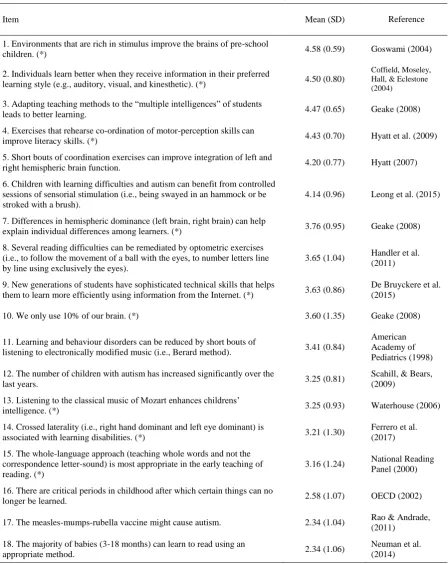
misconceptions (see Tables 1 and 2). These items were extracted from previous
questionnaires (Dekker et al., 2012), meta-analyses (Ferrero, West, & Vadillo, 2017; Hattie,
2009; Leong, Carter, & Stephenson, 2015), unsystematic reviews (American Academy of
Pediatrics, 2011; Bangerter & Heath, 2010; De Bruyckere, Kirschner, & Hulshof, 2015;
Geake, 2008; Hyatt, Stephenson, & Carter, 2009; Muijs & Reynolds, 2011; Waterhouse,
2006), experimental studies (Neuman, Kaefer, Pinkham, & Strouse, 2014), international
classification and diagnostic manuals (American Psychiatric Association, 2013; World Health
Organization, 2016), and national reports (National Reading Panel, 2000). For each question,
a 5-point Likert scale was employed, labelled as (1) Definitely false, (2) False, (3) Don't
know, (4) True, and (5) Definitely true, indicating the degree of endorsement.
Phase 2. For the purpose of the experiment, we addressed nine of the 18
misconceptions included in the 36-item questionnaire. As explained above, these nine
misconceptions were strongly endorsed by participants in the pilot study, three had an
intermediate level of endorsement, and three were weakly endorsed. The mean endorsement
strength and standard deviation of these items in the pilot study are shown in Table 2 (see
Appendix 1).
For each misconception, we created one refutation text with three different versions: (a)
refutation text which discredited the origin of the misinformation (text-and-origin); (b)
refutation text alone (TA); (c) no text (NT) (see the SM). All the texts were structured as
follows: At the beginning, the target misconception was introduced and, immediately
afterwards, it was refuted. Next, the origin of misinformation was discredited (only in the
text-and-origin condition). Then, the alternative (and correct) information was presented.
Finally, a rhetorical question was formulated. The mean length of texts which contained the
origin of information was 180.66 words (SD = 6.11) and the mean length of the remaining
texts was 149.55 (SD = 7.87). After the refutation texts, we included a question aimed at
measuring the level of difficulty of the refutation texts according to the perception of the
participants. The Likert scale employed for this question ranged from 1 (Extremely easy) to
10 (Extremely difficult). The materials used in both phases are publicly available at
https://osf.io/5d6nz/.
Results and Discussion
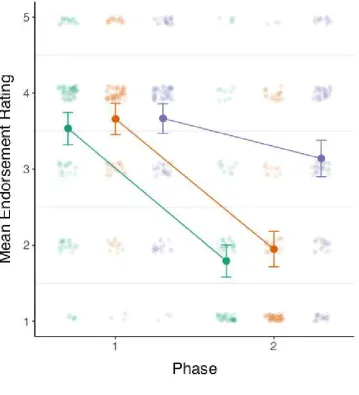
Figure 1 shows participants' endorsement ratings separated by condition and time. As
can be seen, overall participants’ endorsements for each misconception declined from Phase
1 to Phase 2. However, this change was steeper for misconceptions that had been addressed
with a refutation text. The figure suggests that this decline was roughly similar for the
We analysed the data using a linear mixed effects model1 with condition (3 levels: TO,
TA, NT) and time (2 levels: Phase 1 and 2) as fixed effects, and participant-specific random
intercepts. The analysis revealed that both main effects were statistically significant
(condition: 2(2) = 54.86, p < .001; time: 2(1) = 233.70, p < .001). The effectiveness of
refutation texts was assessed through the interaction between time and condition, which was
statistically significant, 2(2) =42.56, p < .001. Following up the interaction with post-hoc
pairwise comparisons (Tukey method), we found that while in Phase 1 there were no
differences between conditions (all ps > .05), in Phase 2 both intervention conditions (TO and
TA) were significantly different from the NT condition. These results suggest that, relative to
the NT condition, the presentation of a simple refutation text (TA) or a refutation text
addressing the origin (TO) gave rise to a stronger change in participants' endorsement for
misconceptions. Including discrediting information about the origin of the misinformation did
not make a significant different in the effect of refutation texts, as the contrast between TO
and TA was not significant, t(760) = 1.04, p = .55.2 Adding years of experience in the model
did not provide a better fit.
Another interesting aspect of the data that warrants further exploration is whether the
degree of endorsement in Phase 1 (i.e., the pre-existing strength of each misconception) had
an effect on the change in endorsement between Phases 1 and 2. To test this hypothesis, we
used a linear mixed effects model predicting change (difference in ratings between Phases 2
and 1, with negative scores indicating lower degree of misconception endorsement in Phase
2) by Phase 1 rating and condition (fixed effects), and random intercepts for each participant.3
The analysis showed that the higher ratings of endorsement in Phase 1 led to larger changes
in Phase 2, b = -0.63, t(376.10) = -13.57, p < .001. This result only holds for the refutation
text conditions and not the NT condition, as indicated by a significant interaction, 2(2) =
and TO was not significant, b = -0.08, t(365.10) = -1.39, p = .17, while the interaction
contrast that includes NT was significant, b = -0.19, t(366.50) = -5.72, p < .001. In other
words, after accounting for the strength of each misconception in Phase 1, we find that
refutation texts have an effect on behaviour compared to NT, but the effect of different types
(TO vs TA) of intervention is indistinguishable.
The results showed that refutation texts were effective at mitigating endorsement of
misconceptions. Specifically, when teachers were presented with misconceptions within
refutation texts, they significantly reduced their belief in these ideas in comparison with the
misconceptions that were not refuted. In contrast, the data showed that providing discrediting
information about misconception origin did not result in a significant additional reduction in
the endorsement of misconceptions: Refutation texts including this information
and-origin) were not significantly more effective than refutation texts that did not include it
(text-alone). Contrary to our initial hypothesis, the most strongly endorsed misconceptions among
educators were no more resistant to change than the weaker ones. If anything, we observed a
trend in the opposite direction: Participants’ change of attitudes in response to the refutation
text was largest for the strongest misconceptions. Note, however, that these analyses
necessarily conflate strength of belief and item: The items that were most strongly endorsed
by our participants at Phase 1 might have some particular feature that makes them more
susceptible to correction attempts. Similarly, this pattern might be entirely due to a floor
effect among the least popular items, for which the rating scales provide little space for
additional correction.
Experiment 2
The results of Experiment 1 suggest that refutation texts might be an effective means to
this limited evidence, we cannot know whether the brief exposure to a refutation text had
long-term effects on participants’ beliefs. Furthermore, the fact that participants were less
willing to endorse educational misconceptions after reading the refutation texts does not
necessarily mean that they will be less likely to rely on instructional methods that are based
on those misconceptions. In fact, previous research in the domain of attitudes towards
vaccination shows that attempts to correct misinformation might actually make parents less
willing to vaccinate their children, even if they also show less trust in the accuracy of the
misinformation (Nyhan & Reifler, 2015; Nyhan et al., 2014). To address these concerns,
Experiment 2 included new measures to assess whether the manipulation had any effect on
teachers’ intent to apply specific educational practices the classroom. In addition, to test the
persistence of these changes over time, we included an additional test phase 30 days after
completion of Phase 2. Finally, it is possible that the impact of discrediting misconception
origin in Experiment 1 was reduced due to participants ignoring this information. In an effort
to address this in Experiment 2, we highlighted this information with bold text.
Method
Participants
As in Experiment 1, our intention was to test the maximum number of participants that
we could reach using the same recruitment strategy as in Experiment 1. Before testing any
participant, we conducted a power analysis to decide what would be the minimal sample size
that would provide reasonable power to reproduce the main findings of Experiment 1. In the
previous experiment, the slope coefficient of the crucial target condition × time interaction
was b = 0.189. Using the ‘simr’ package, we were able to estimate that we would need to test
= 0.15, with 85% power. Therefore, we decided a priori that we would test at least 23
participants, although we would try to include more participants in our sample if possible. In
the end, we were able to test a total of 35 teachers (26 female) from three different schools in
Spain. The mean age of participants was 40.91 (SD = 9.88). Participants were kindergarten
teachers (22.85%), primary school teachers (37.14%), and secondary school teachers (40%).
The sample was recruited from public (8.57%) and state schools (91.42%). The average
teaching experience of participants was 16.25 years (SD = 8.89).
Design and Procedure
The design and procedure were identical to Experiment 1 with three exceptions. Firstly,
the piece of text discrediting the original claim behind the misconception was presented in
bold characters. Secondly, after reading the six refutation texts and completing the 36-items
on-line questionnaire in Phase 2, participants responded to a second on-line questionnaire of
18 items assessing whether they were planning to implement a number of practices in the
classroom. Nine of these practices were actually based on the nine crucial misconceptions
preselected for the experimental manipulation (see Materials). Thirdly, we included a new
test at Phase 3, 30 days after Phase 2. During Phase 3, participants completed the same
questionnaires used in Phase 2, but they did not read the six refutation texts nor respond the
question about their level of difficulty. For exploratory purposes, Phase 3 included two extra
questions per item to determine whether participants had searched any additional information
about the beliefs addressed in the refutation texts since Phase 2 and whether they had
received any formal training regarding about them.
Materials
Phase 2. The refutation texts were identical to those of Experiment 1, except that the
sentences explaining the origin of misconceptions in the text-and-origin condition were now
presented in bold characters. In addition to the materials employed in Experiment 1, we
created a new survey with 18 educational practices based on each of the 18 statements
extracted from the 36-items questionnaire. Half of them were elaborated from the items
addressed in the refutation texts, and hence had very weak evidence, and the other half were
based on robust empirical evidence. For each question, participants were asked to report how
likely they were to transfer each practice into the classroom, using a 6-point Likert scale,
labelled as (1) Definitely not, (2) Very unlikely, (3) Unlikely, (4) Likely, (5) Very likely, and
(6) Definitely yes.
Phase 3. Participants were asked to fill again the 36-item questionnaire of Phases 1 and
2 and the 18-educational practices survey of Phase 2. Additionally, we added two questions
for each of these 18 educational practices. One was aimed at determining if participants had
searched for any additional information about each of the beliefs targeted in the refutation
texts during the 30 days between Phase 2 and Phase 3. For each belief, there were four
response options: (1) I have not searched for information; (2) I do not remember having
searched for information; (3) I have searched for information and it runs in the same direction
of the refutation text; (4) I have searched for information and it runs in the opposite direction
of the refutation text. The second question was aimed at assessing whether participants had
received any information regarding each of these beliefs during their academic training. The
response options were identical, except that “search for” was replaced by “received”.
Results and Discussion
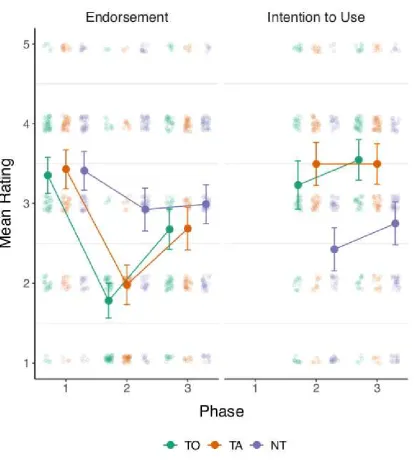
Analysis of the data in Experiment 2 was very similar to that of Experiment 1. Figure
While there is a clear decrease in the mean endorsement in Phase 2 for the refutation text
conditions (TO, TA), replicating the effect observed in Experiment 1, there seems to be an
increase in Phase 3, almost reaching the mean endorsement before refutation texts were
presented (i.e., Phase 1).
For this analysis, we used a linear mixed effects model with condition (3 levels: TO,
TA, NT) and time (3 levels: Phase 1, 2, and 3) as fixed effects, and participant-specific
random intercepts. All main effects were significant (condition: 2(2) = 32.74, p < .001; time:
2(2) = 155.41, p < .001). As in Experiment 1, the significant interaction ( 2(4) = 28.86, p <
.001) showed that there was no evidence of a difference between conditions in Phase 1,
however, in Phase 2 both experimental conditions were significantly different from the NT
condition (all ps < .01), but not between each other, t(926) = 1.22, p = .44. Interestingly, the
mean endorsement for misconceptions increased in Phase 3 where all pairwise differences
between the 3 conditions were non-significant (all ps > .13).
In this experiment, we also asked participants to rate the difficulty of the refutation
texts. The new model showed that perceived difficulty had a significant effect on the rate of
endorsement, b = 0.14, t(294.89) = 2.30, p = .02, indicating that as difficulty increased, so did
the mean rate of endorsement, regardless of condition and Phase (i.e., all 2-way and 3-way
interactions including difficulty were not reliable, all ps > .15). In contrast, adding years of
experience in the model did not provide a better fit (likelihood-ratio test, 2(18) = 14.84, p =
.67).
We conducted the same type of analysis for the intention-to-use statements. Figure 2B
shows a clear pattern that across Phases 2 and 3 the refutation text conditions received higher
ratings of intention-to-use. This is a rather surprising result considering the mean
endorsement rate from the previous analysis. The main effect of condition was significant
rates than the NT condition (both ps < .001). The effect of time was significant with
participants giving higher ratings in Phase 3 than Phase 2, 2(1) = 3.96, p =.046), but the
interaction between time and condition was not significant, 2(4) = 5.93, p =.051. Introducing
difficulty and years of experience in the main model did not result in better predictive power
(likelihood-ratio tests, both ps > .05.
Finally, we also conducted two extra analyses addressing the change in endorsements
between phases. Both linear mixed-models modelled the change in endorsements between
Phases (model 1: difference in ratings between Phase 2 and Phase 1; model 2: difference in
ratings between Phase 3 and Phase 2) as predicted by the endorsement rating in the preceding
Phase (i.e., rating in Phase 1 for model 1 and rating in Phase 2 for model 2). In both models,
we found that higher ratings in the previous Phase led to larger differences in the following
Phase (model 1: b = -0.28, t(303.82) = -3.44, p < .001; model 2: b = -0.32, t(308.54) = -4.41,
p < .001). This result is moderated by condition between Phases 2 and 1 (model 1: 2(2) =
16.86, p <.001) for the refutation text conditions, but not between Phases 3 and 2 (model 2:
2(2) = 2.64, p =.27).
The present results largely replicate the main findings of Experiment 1, but with
important caveats. As in Experiment 1, participants were more reluctant to endorse
misconceptions after reading the refutation texts and this effect was, if anything, larger for
strongly held beliefs. Again, addressing the origins of misconceptions, even using bold
characters for this piece of information, made no significant difference and the effects were
not moderated by years of experience, either. However, the additional tests included in
Experiment 2 reveal that the effects of refutation texts were short-lived and vanished after a
30-day period. Furthermore, the manipulation did not have a beneficial effect on
General Discussion
Teachers all over the world hold a significant number of misconceptions related to
education (i.e., Dekker et al., 2012; Ferrero et al., 2016). This fact might be damaging for the
school population because it facilitates the adoption of ill-funded interventions and,
consequently, jeopardises the quality and rigor of educational practice. In spite of this, no
systematic study to date has evaluated different strategies to correct these false beliefs among
in-service teachers. In the present study, we exposed a group of teachers to different types of
refutation texts in order to ameliorate the acceptance of misconceptions about education and
neuroscience applied to education. The key elements of refutation texts are the introduction
of a popular belief or idea, its immediate refutation, and the presentation of a more
satisfactory alternative to replace the previous one (Guzzetti, 2000).
In the present experiments, when teachers were presented with misconceptions
corrected within refutation texts, they significantly reduced their belief in these ideas in
comparison with the misconceptions that were not refuted. These results are consistent with
previous studies aimed at testing the success of refutation texts to correct misconceptions in
different fields, such as health or specific academic subjects (i.e., Guzzetti et al., 1997; Hynd
et al., 1994; Nyhan et al., 2014), although some studies also detected a continued influence
effect which impeded the full effectiveness of these texts (i.e., Nyhan & Reifler, 2015).
Interestingly, providing additional information that discredited the origin of misconceptions
did not enhance the effects of refutation texts significantly in either experiment, even when
this additional information was highlighted using a bold font. This result stands in contrast
with previous research showing that suspicion about the reliability of the original
misinformation or its source might foster belief change (Guillory & Geraci, 2013;
Perhaps the most striking feature of our results is that the effects of refutation texts
were short-lived. We failed to detect a significant effect of the manipulation after a relatively
short period of 30 days. These results are consistent with previous studies that find no
permanent effect of refutation texts (Gregg, Winer, Cottrell, Hedman, & Fournier, 2001).
Similarly, we found no significant evidence of changes in participants’ intention to
implement educational practices that are based on the misconceptions addressed in the
refutation. If anything, attempts to correct misconceptions had a paradoxical effect on
intention-to-use ratings: Participants were actually more willing to implement educational
practices based on the misinformation after reading the refutation texts. Although
unexpected, these results converge with previous research on the ‘backfire’ effect showing
that correcting misconceptions about a specific topic does not necessarily result in an increase
in the intention to implement correct practices. For instance, among parents hesitant about
vaccination, attempts to correct misinformation might work at the knowledge level, but be
counterproductive when it comes to changing intention to vaccinate (i.e., Nyhan & Reifler,
2015; Nyhan et al., 2014).
Contrary to our initial hypothesis, the most strongly endorsed misconceptions among
educators were no more resistant to change than the weaker ones. If anything, we observed a
trend in the opposite direction: Participants’ change of attitudes in response to the refutation
text was largest for the strongest misconceptions. As mentioned in the introduction, previous
studies have generally found that firm beliefs are more difficult to change (Lewandowsky et
al., 2012; Nyhan & Reifler, 2015), but the opposite result has been observed as well
(Butterfield & Metcalfe, 2001; see also Ecker, Lewandowsky et al., 2014; van Loon et al.,
2015). It is possible that, at least in some domains, attempts to correct firmly held beliefs are
more effective at drawing participants’ attention to the error or simply enhance error
& Wagner, 1972). In the same vein, the number of years as in-practice teacher did not
moderate the effectiveness of refutation texts.
Of course, the present study is not without limitations. As in any experiment, our results
might not generalize beyond these specific materials and samples. In the same vein, although
we tried to test as many participants as possible, this is a relatively difficult to reach
population, which limited our sample sizes to just 45 and 35 participants in Experiments 1
and 2, respectively. We cannot discard the possibility that our failure to find significant
effects for some manipulations was simply due to the lack of statistical power. As a first
attempt to evaluate the effectiveness of this intervention with in-service teachers, we wanted
to use experimental conditions that would maximize the chance of observing a change in
endorsement. Consequently, we decided to compare both experimental conditions
(text-and-origin and text-alone) with a no-text condition. However, once the effectiveness of refutation
texts is firmly established, future research should consider the introduction of a
non-refutation text control condition, addressing only the correct information without explicit
mention of the misconception. It would also be informative to directly measure behaviour,
instead of measuring intention to implement misguided practice. Finally, none of our
experiments were formally preregistered. We acknowledge that this might introduce biases in
our analytic pipeline that, ideally, should be controlled for in future studies.
As mentioned before, the high prevalence of misconceptions among teachers all over
the world is well documented. These false ideas are often introduced in schools through
workshops, conferences, and educational materials and pave the way for the use of
pseudoscientific practices in classroom (Busso & Pollack, 2014; Goswami, 2006). In the face
of this worrying reality, some experts have recommended efforts to improve the knowledge
of educators about specific topics and research methodologies (Ansari, Coch, & De Smedt,
collaboration between researchers and teachers (Ansari et al., 2011; Howard-Jones, 2014), or
to explicitly address the most popular misconceptions among educators (Ferrero et al., 2016).
In the present study we found that refutation texts only had a short-lived mitigating effect on
common misconceptions about education, and had the unintended side-effect of increasing
intention to implement instructional methods based on misconceptions. More research is
needed to find alternative methods that ameliorate misconceptions in the long-term and
facilitate transfer to teachers’ intention not to use questionable educational methods.
Open practices statement
None of the present studies were preregistered. In addition to the analyses presented
here, we also analyzed the data from Experiment 1 with ANOVA models, which yielded
virtually identical results and are omitted for the sake of simplicity. All data, materials, and
analysis scripts related to this study will be publicly available at https://osf.io/73a9y/. All data
exclusions, manipulations, and measurements conducted during this study are reported in the
References
Ansari, D., Coch, D., & De Smedt, B. (2011). Connecting education and cognitive
neuroscience: Where will the journey take us? Educational Philosophy and Theory, 43,
37-42.
American Academy of Pediatrics (1998). Auditory integration training and facilitated
communication for autism. Pediatrics, 102, 431-433.
American Academy of Pediatrics (1999). The treatment of neurologically impaired children
using Patterning. Pediatrics, 104, 1149-1151.
American Academy of Pediatrics (2011). Learning disabilities, dyslexia, and vision.
Pediatrics, 124, 837-844.
American Psychiatric Association (2013). Diagnostic and statistical manual of mental
disorders (5th ed.). Arlington, VA: American Psychiatric Association.
American Speech-Language-Hearing Association (n.d.). [Auditory integration training].
Retrieved from https://www.asha.org/policy/tr2004-00260.htm
Bangerter, A., & Heath, C. (2010). The Mozart effect: Tracking the evolution of a scientific
legend. British Journal of Social Psychology, 43, 605-623.
Busso, D. S., & Pollack, C. (2014). No brain left behind: Consequences of neuroscience
discourse for education. Learning, Media and Technology, DOI:
10.1080/17439884.2014.908908
Butterfield, B., & Metcalfe, J. (2001). Errors committed with high confidence are
hypercorrected. Journal of Experimental Psychology: Learning, Memory, and
Cognition, 27, 1491-1494.
Chi, M. T. H. (2005). Commonsense conceptions of emergent processes: Why some
Coffield, F., Moseley, D., Hall, E., & Eclestone, K. (2004). Learning styles and pedagogy in
post-16 learning. A systematic and critical review. London: LSRC & Dept. for
Education and Skills.
Corballis, M. C. (1999). Are we in our right minds? In S. Della Sala (Ed.), Mind myths:
Exploring popular assumptions about the mind and brain. Chichester, UK: Wiley.
De Bruyckere, P., Kirschner, P. A., & Hulshof, C. D. (2015). Urban myths about learning
and education. New York: Academic Press.
Dekker, S., Lee, N. C., Howard-Jones, P., & Jolles, J. (2012). Neuromyths in education:
Prevalence and predictors of misconceptions among teachers. Frontiers in Psychology,
3, 429.
Deligiannidi, K., & Howard-Jones, P. A. (2015). The neuroscience literacy of teachers in
Greece. Procedia - Social and Behavioral Sciences, 174, 3909-3915.
Ecker, U.K.H., Lewandowsky, S., Fenton, O., & Martin, K. (2014). Do people keep believing
because they want to? Preexisting attitudes and the continued influence of
misinformation. Memory & Cognition, 42, 292-304.
Ecker, U. K. H., Lewandowsky, S., & Tang, D. T. W. (2010). Explicit warnings reduce but
do not eliminate the continued influence of misinformation. Memory & Cognition, 38,
1087-1100.
Ecker, U. K. H., Swire, B., & Lewandowsky, S. (2014). Correcting misinformation—A
challenge for education and cognitive science. In D. N. Rapp & J. L. G. Braasch (Eds.).
Processing inaccurate information: Theoretical and applied perspectives from
cognitive science and the educational sciences (pp. 13-38). Cambridge, MA: MIT
Ferrero, M., Garaizar, P., & Vadillo, M. A. (2016). Neuromyths in education: Prevalence
among Spanish teachers and an exploration of cross-cultural variation. Frontiers in
Human Neuroscience, 10, 496.
Ferrero, M., West, W., & Vadillo, M. A. (2017). Is crossed laterality associated to academic
achievement and intelligence? A systematic review and meta-analysis. PLoS ONE,
12:e0183618.
Fuentes, A., & Riso, A. (2015). Evaluación de conocimientos y actitudes sobre neuromitos en
futuros/as maestros/as [Evaluation of neuromyth’s knowledge and attitudes in future
research]. Revista de Estudios de Investigación en Psicología y Educación, 6, 193-198.
Freed, G. L., Clark, S. J., Butchart, M. T., Singer, D. C., & Davis, M. M. (2009). Parental
vaccine safety concerns in 2009. Pediatrics, 125, 654-659.
Geake, J. (2008). Neuromythologies in education. Educational Research, 50, 123-133.
Gill, M. G., Ashton, P. T., & Algina, J. (2004). Changing pre-service teachers’
epistemological beliefs about teaching and learning in mathematics: An intervention
study. Contemporary Educational Psychology, 29, 164–185.
Gleichgerrcht, E., Luttges, B. L., Salvarezza, F., & Campos, A. L. (2015). Educational
neuromyths among teachers in Latin America. Mind, Brain, and Education, 9, 170-178.
Gregg, V. R., Winer, G. A., Cottrell, J. E., Hedman, K. E., & Fournier, J. S. (2001). The
persistence of a misconception about vision after educational interventions.
Psychonomic Bulletin & Review, 8, 622-626.
Goldacre, B. (2006). Brain Gym - Name & Shame [Blog post]. Retrieved from
http://www.badscience.net/2006/03/the-brain-drain/
Goswami, U. (2004). Neuroscience and education. British Journal of Educational
Goswami, U. (2006). Neuroscience and education: From research to practice? Nature
Reviews Neuroscience, 7, 406-413.
Guillory, J. J., & Geraci, L. (2013). Correcting erroneous inferences in memory: The role of
source credibility. Journal of Applied Research in Memory and Cognition, 2, 201-209.
Guzzetti. B. J. (2000). Learning counter-intuitive science concepts: What have we learned
from over a decade of research? Reading & Writing Quarterly, 16, 89-98.
Guzzetti, B. J., Williams, W. O., Skeels, S. A., & Wu, S. M. (1997). Influence of text
structure on learning counterintuitive physics concepts. Journal of Research in Science
Teaching, 34, 701-719.
Haglin, K. (2017). The limitations of the backfire effect. Research and Politics, 4, 1-5.
Handler, S. M., Fierson, W. M., Section on Ophthalmology, Council on Children with
Disabilities, American Academy of Ophthalmology, American Association for Pediatric
Ophthalmology and Strabismus, American Association of Certified Orthoptists (2011).
Joint technical report—Learning disabilities, dyslexia, and vision. Pediatrics, 127,
818-856.
Hattie, J. (2009). Visible learning: A synthesis of over 800 meta-analyses relating to
achievement. London & New York: Routledge.
Hines, T. (1987). Left brain/right brain mythology and implications for management and
training. Academy of Management Review, 12, 600-606.
Howard-Jones, P. A. (2014). Neuroscience and education: myths and messages. Nature
Reviews Neuroscience, 15, 817-824.
Hunter, A. S., & Lloyd, M. E. (2018). Faculty discuss strategies, but not the best ones: A
survey of suggested exam preparation techniques for difficult courses across disciplines.
Hyatt, K. J. (2007). Brain Gym®: Building stronger brains or wishful thinking? Remedial and
Special Education, 28, 117-124.
Hyatt, K. J., Stephenson, J., & Carter, M. (2009). A review of three controversial educational
practices: Perceptual motor programs, sensory integration, and tinted lenses. Education
and Treatment of Children, 32, 313-342.
Hynd, C. R. (2001). Refutational texts and the change process. International Journal of
Educational Research, 35, 699-714.
Hynd, C. R., McWhorter, J. Y., Phares, V. L., & Suttles, C. W. (1994). The role of
instructional variables in conceptual change in high school physics topics. Journal of
Research in Science Teaching, 31, 933-946.
Johnson, J. M., & Seifert, C. M. (1994). Sources of the continued influence effect: When
misinformation in memory affects later inferences. Journal of Experimental
Psychology: Learning, Memory, and Cognition, 20, 1420-1436.
Karakus, O., Howard-Jones, P. A., & Jay, T. (2015). Primary and secondary school teachers´
knowledge and misconceptions about the brain in Turkey. Procedia- Social and
Behavioral Science, 174, 1933-1940.
Kendeou, P., & van den Broek, P. (2007). The effects of prior knowledge and text structure
on comprehension processes during reading of scientific texts. Memory & Cognition,
35, 1567-1577.
Kowalski, P., & Taylor, A. K. (2009). The effect of refuting misconceptions in the
introductory psychology class. Teaching of Psychology, 36, 153-159.
Kunda, Z. (1990). The case for motivated reasoning. Psychological Bulletin, 108, 480-498.
Leong, H. M., Carter, M., & Stephenson, J. R. (2015). Meta-analysis of research on sensory
integration therapy for individuals with developmental and learning disabilities. Journal
Lewandowsky, S., Ecker, U. K. H., Seifert, C. M., Schwarz, N., & Cook, J. (2012).
Misinformation and its correction: Continued influence and successful debiasing.
Psychological Science in the Public Interest, 13, 106-131.
Lewandowsky, S., Oreskes, N., Risbey, J. S., Newell, B. R., & Smithson, M. (2015). Climate
change denial and its effect on the scientific community. Global Environmental
Change, 33, 1-13.
Lewandowsky, S., Stritzke, W. G. K., Oberauer, K., & Morales, M. (2005). Memory for fact,
fiction, and misinformation: The Iraq War 2003. Psychological Science, 16, 190-195.
Lilienfeld, S. O., Ammirati, R., & David, M. (2012). Distinguishing science from
pseudoscience in school psychology: Science and scientific thinking as safeguards
against human error. Journal of School Psychology, 50, 7-36.
Lombrozo, T. (2007). Simplicity and probability in causal explanation. Cognitive
Psychology, 55, 232-257.
Maria, K., & MacGinitie, W. (1987). Learning from texts that refute the reader's prior
knowledge. Reading, Research and Instruction, 26, 222-238.
Morehead, K., Rhodes, M. G., & DeLozier, S. (2015). Instructor and student knowledge of
study strategies. Memory, 24, 257-271.
Muijs, D., & Reynolds, D. (2011). Effective teaching. Evidence and practice. London: Paul
Chapman.
National Reading Panel (U.S.). (2000). Report of the National Reading Panel: Teaching
children to read: An evidence-based assessment of the scientific research literature on
reading and its implications for reading instruction. Washington, D.C.: National
Institute of Child Health and Human Development, National Institutes of Health.
Neuman, S. B., Kaefer, T., Pinkham, A., & Strouse, G. (2014). Can babies learn to read? A
New York State Department of Health (1999). New York State Department of Health early
intervention program. Clinical practice guideline. Report of the recommendations.
Retrieved from
https://www.health.ny.gov/community/infants_children/early_intervention/disorders/aut
ism/app_c.htm
Nyhan, B., & Reifler, J. (2010). When corrections fail: The persistence of political
misperceptions. Political Behaviour, 32, 303-330.
Nyhan, B., & Reifler, J. (2015). Does correcting myths about the flu vaccine work? An
experimental evaluation of the effects of corrective information. Vaccine, 33, 459-464.
Nyhan, B., Reifler, J., Richey, S., & Freed, G. L. (2014). Effective messages in vaccine
promotion: A randomized trial. Pediatrics, 133, e835-e842.
Nyhan, B., Reifler, J., & Ubel, P. A. (2013). The hazards of correcting myths about health
care reform. Medical Care, 51, 127-132.
OECD (2002). Understanding the brain. Towards a new learning science, OECD Publishing,
Paris. Retrieved from: http://www.oecd.org/edu/ceri/31706603.pdf
Pashler, H., McDanield, M., Rohrer, D., & Bjork, R. (2008). Learning styles: Concepts and
evidence. Psychological Science in the Public Eye, 9, 105-119.
Posner, G. J., Strike, K. A., Hewson, P. W., & Gertzog, W. A. (1982). Accommodation of a
scientific conception: Toward a theory of conceptual change. Science Education, 2,
211-227.
Rao, T. S. S., & Andrade, C. (2011). The MMR vaccine and autism: Sensation, refutation,
retraction, and fraud. Indian Journal of Psychiatry, 53, 95-96.
Rescorla, R. A., & Wagner, A. R. (1972). A theory of Pavlovian conditioning: Variations in
Prokasy (Eds.), Classical conditioning II: Current research and theory (pp. 64–99).
New York, NY: Appleton-Century Crofts.
Salisbury-Glennon, J. D., & Stevens, R. J. (1999). Addressing pre-service teachers'
conceptions of motivation. Teaching and Teacher Education, 15, 741-752.
Scahill, L., & Bears, K. (2009). The rise in autism and the mercury myth. Journal of Child
and Adolescent Psychiatric Nursing, 22, 51-53.
Swire, B., Ecker, U. K. H., & Lewandowsky, S. (2017). The role of familiarity in correcting
inaccurate information. Journal of Experimental Psychology: Learning, Memory, and
Cognition, 43, 1948-1961.
Tippet, C. D. (2010). Refutation text in science education: A review of two decades of
research. International Journal of Science and Mathematics Education, 8, 951-970.
Van Loon, M., Dunlosky, J., van Gog, T., van Merriënboer, J. J.G., & de Bruin, A. B. H.
(2015). Refutation in science texts lead to hypercorrection of misconceptions held with
high confidence. Contemporary Educational Psychology, 42, 39-45.
Vergara, G., Martínez, M., Martínez-Sahuquillo, M. E., & Echevarría, C. (2011). Eficacia del
método de los Institutos para el Logro del Potencial Humano (Doman-Delacato) en
pacientes con parálisis cerebral infantil [Eficcacy of the method of the Institutes for the
Achievement of Human Potential (Doman-Delacato) in patients with infant cerebral
palsy]. Rehabilitación, 45, 256-260.
Waterhouse, L. (2006). Multiple Intelligences, the Mozart effect, and emotional intelligence:
A critical review. Educational Psychologist, 41, 207-225.
Wilkes, A. L., & Leatherbarrow, M. (1988). Editing episodic memory following the
identification of error. Quarterly Journal of Experimental Psychology, 40, 361-387.
Wood, T., & Porter, E. (2019). The elusive backfire effect: Mass attitudes’ steadfast factual
World Health Organization (2016). International statistical classification of diseases and
Author Note
MF was supported by grant AYD-000-235 from bizkaia:talent, Diputación Foral de Bizkaia,
and by a postdoctoral grant from Programa Posdoctoral de Perfeccionamiento de Personal
Investigador Doctor, Gobierno Vasco. The Meta-Research Innovation Center at Stanford
(METRICS) is supported by a grant from the Laura and John Arnold Foundation. The
Meta-Research Innovation Center Berlin (METRIC-B) is supported by a grant from the Einstein
Foundation and Stiftung Charitè. MAV was supported by grants 2016-T1/SOC-1395
(Comunidad de Madrid) and PSI2017-85159-P (AEI/FEDER UE). TH was based at
METRICS when the study began and is now based at METRIC-B. The authors are grateful to
all the teachers who contributed to the completion of this research. Correspondence
concerning this article should be addressed to Marta Ferrero, Facultad de Educación,
Universidad Complutense de Madrid, Madrid, Spain, or to Miguel A. Vadillo, Facultad de
Psicología, Universidad Autónoma de Madrid, Madrid, Spain E-mail: [email protected] or
Footnotes
1 All analyses reported in the text were run in R using the packages lme4 for mixed effects
models and emmeans.
2 Due to the fact that the dependent variable is ordinal, we tried a cumulative link mixed
effect models (CLMM) analysis, which provided the same pattern of results as the linear
mixed effects model presented above.
3 This analysis is structurally equivalent to an ANCOVA, where the effect of condition on the
change between Phases 1 and 2 is tested after accounting for the degree of endorsement in
Table 1. Items with robust evidence.
1. Direct instruction leads to better outcomes than discovery learning.
2. Reversing letters is NOT a symptom of dyslexia.
3. The impact of new technologies on learning is questionable.
4. Boys have bigger brains than girls.
5. It is more effective to give feedback that includes information about the correct answer than information about the incorrect answer.
6. Accelerated learning is an appropriate approach for gifted students.
7. The proportion of boys diagnosed with autism is greater than the proportion of girls.
8. Normal development of the human brain involves the birth and death of brain cells.
9. Extended rehearsal of some mental processes can change the shape and structure of some parts of the brain.
10. Phonological knowledge, alphabetic principle, fluency, vocabulary, and comprehension are key elements in the teaching of reading.
11. The left and right hemispheres of the brain always work together.
12. Production of new connections in the brain can continue into old age.
13. Homework is more beneficial for secondary students than for elementary students.
14. We use our brains 24 h a day.
15. Spacing practice is more effective than concentrating the same amount of practice in a shorter period of time.
16. Differences between boys and girls are negligible when teaching one another.
17. Information is stored in the brain in a network of cells distributed throughout the brain.
Table 2. Items with null or very weak evidence and their degree of endorsement on the basis of the pilot study.
Item Mean (SD) Reference
1. Environments that are rich in stimulus improve the brains of pre-school
children. (*) 4.58 (0.59) Goswami (2004)
2. Individuals learn better when they receive information in their preferred
learning style (e.g., auditory, visual, and kinesthetic). (*) 4.50 (0.80)
Coffield, Moseley, Hall, & Eclestone (2004)
3. Adapting teaching methods to the “multiple intelligences” of students
leads to better learning. 4.47 (0.65) Geake (2008)
4. Exercises that rehearse co-ordination of motor-perception skillscan
improve literacy skills. (*) 4.43 (0.70) Hyatt et al. (2009)
5. Short bouts of coordination exercises can improve integration of left and
right hemispheric brain function. 4.20 (0.77) Hyatt (2007)
6. Children with learning difficulties and autism can benefit from controlled sessions of sensorial stimulation (i.e., being swayed in an hammock or be stroked with a brush).
4.14 (0.96) Leong et al. (2015)
7. Differences in hemispheric dominance (left brain, right brain) can help
explain individual differences among learners. (*) 3.76 (0.95) Geake (2008)
8. Several reading difficulties can be remediated by optometric exercises (i.e., to follow the movement of a ball with the eyes, to number letters line by line using exclusively the eyes).
3.65 (1.04) Handler et al. (2011)
9. New generations of students have sophisticated technical skills that helps
them to learn more efficiently using information from the Internet. (*) 3.63 (0.86)
De Bruyckere et al. (2015)
10. We only use 10% of our brain. (*) 3.60 (1.35) Geake (2008)
11. Learning and behaviour disorders can be reduced by short bouts of
listening to electronically modified music (i.e., Berard method). 3.41 (0.84)
American Academy of Pediatrics (1998)
12. The number of children with autism has increased significantly over the
last years. 3.25 (0.81)
Scahill, & Bears, (2009)
13. Listening to the classical music of Mozart enhances childrens’
intelligence. (*) 3.25 (0.93) Waterhouse (2006)
14. Crossed laterality (i.e., right hand dominant and left eye dominant) is
associated with learning disabilities. (*) 3.21 (1.30)
Ferrero et al. (2017)
15. The whole-language approach (teaching whole words and not the correspondence letter-sound) is most appropriate in the early teaching of reading. (*)
3.16 (1.24) National Reading Panel (2000)
16. There are critical periods in childhood after which certain things can no
longer be learned. 2.58 (1.07) OECD (2002)
17. The measles-mumps-rubella vaccine might cause autism. 2.34 (1.04) Rao & Andrade, (2011)
18. The majority of babies (3-18 months) can learn to read using an
appropriate method. 2.34 (1.06)
Neuman et al. (2014)
Figure Captions
Figure 1. Participants’ endorsement for the misconceptions before (Phase 1) and after reading
the refutation texts (Phase 2) in each condition in Experiment 1. TO, TA, and NT refer to
Text + Origin, Text Alone, and No Text, respectively. Error bars denote 95% CIs.
Figure 2. Participants’ endorsement (left panel) and intention-to-use ratings on Phases 1-3 of
Experiment 2. TO, TA, and NT refer to Text + Origin, Text Alone, and No Text,
Appendix 1
To determine the popularity of the 18 misconceptions contained in the on-line 36-items
survey used in Phase 1 and Phase 2, we conducted a pilot study with 55 (35 female)
in-service teachers of 10 Spanish schools, different from the sample who participated in the
main study. The items included in this pilot study and the rating scales (1-5) were identical to
those described in the main study of the present article (see Table 1 and 2). We recruited
educators by a direct invitation published on Twitter containing a link to a questionnaire with
the same 36 questions included in the main study. The mean age of participants was 40.10
years (SD = 10.70). Participants were special education teachers (12.72%), kindergarten
teachers (18.18%), primary school teachers (34.54%), secondary school teachers (24.44%),
vocational education teachers (14.54%), and teachers who worked in more than one level of
education (3.63%). The sample was recruited from public (45.45%), private (5.45%), and
state schools (49.09%). The average teaching experience of the educators was 14.34 years
(SD = 9.81). Once the task had been completed, we extracted three misconceptions with a
high level of endorsement, three with medium endorsement, and three with low endorsement.
These nine erroneous ideas were used in the nine refutation texts presented in Phase 2. The
Supplemental Material
Spanish versions of the nine refutation texts used during Phase 2 of the study and an
English approximate translation of them are shown below. Sentences in bold contain the
explanation added in the TO condition about the origin of information.
Text 1
There is a common belief that environments that are rich in stimuli improve the development of neuronal connections that enhance
intelligence in pre-school children. However, this belief is incorrect. It is based on the results of rats reared in extreme sensorial
deprivation, far removed from the conditions under which a child grows up. Neurologists show that, except for extreme cases, the
formation of connections occurs outside of environmental stimulation. On the one hand, experts show that the formation of neuronal
connections begins even before birth, this is, before children receive stimulation from the environment. On the other hand, many studies
have found that, in normal conditions, stimuli from the environment do not cause a large formation of neuronal connections even after
birth. Moreover, who says that having more neuronal connections (synapses) is better? Several disorders demonstrate that having
particularly a high number of synapses is not desirable. People with Fragile-X syndrome is a clear example.
Texto 1
Existe la creencia popular de que los entornos ricos en estímulos incrementan las conexiones cerebrales y por tanto la inteligencia de los
niños pre-escolares. Sin embargo, esta creencia es errónea. Se basa en los resultados con ratas criadas en condiciones de deprivación
sensorial extrema, muy alejadas de las condiciones en las que crece un niño humano. Los neurólogos demuestran que, salvo en
casos extremos, la formación de conexiones en el cerebro ocurre al margen de la estimulación ambiental. Por un lado, los expertos
muestran que la formación de conexiones neuronales comienza incluso antes del nacimiento, es decir, antes de que los bebés reciban
ninguna estimulación del ambiente. Por otro lado, muchos estudios encuentran que, en condiciones normales, después del nacimiento los
estímulos ambientales tampoco provocan una mayor formación de conexiones neuronales. Más aún, ¿quién ha dicho que tener más
conexiones neuronales (sinapsis) sea mejor? Muchos trastornos evidencian que tener niveles de sinapsis especialmente altos no es
deseable. Un claro ejemplo de esto son las personas con el síndrome de X-frágil.
Text 2
The belief that individuals learn better when they receive information in their preferred learning style (e.g., auditory, visual, and
kinesthetic) has become very popular. However, it must be noted that this is false and is considered a myth by OECD. It arose in 1975
when a psychologist popularized a classification of students according to four learning styles, simply on the basis of his personal