1. INTRODUCTION
Foraging behaviour is a large part of the daily rou-tines of many species and an essential link between prey availability and predator reproductive success. For central-place foraging species, including many birds, a key issue in this context is the extent of be -havioural flexibility in response to changing environ-mental conditions encountered during trips, espe-cially when parents need to travel long distances to obtain prey (Tarroux et al. 2016, Kokubun et al. 2018). Wind is a major component of the environmental con-ditions experienced by birds (Hernández-Pliego et al. 2017, La Sorte & Fink 2017), and in creases in mean wind speeds and storm frequencies are predicted to
occur as a result of anthropogenic climate change, particularly in mid-latitudes (McInnes et al. 2011, Young et al. 2011), along with increases in the fre-quency and intensity of extreme weather events (Coumou et al. 2015). Yet while research on the bio-logical impacts of global climate change has focused extensively on the effects of changes in temperature and rainfall (Terraube et al. 2017, Zuckerberg et al. 2018), impacts of changing wind conditions have re-ceived much less attention (Elliott et al. 2014).
Marine birds are particularly exposed to wind con-ditions while foraging at sea and during commutes between terrestrial breeding sites and marine forag-ing grounds. Wind also influences wave patterns and turbulence (Salisbury et al. 2013, Albert et al. 2016), © The authors 2019. Open Access under Creative Commons by Attribution Licence. Use, distribution and reproduction are un -restricted. Authors and original publication must be credited. Publisher: Inter-Research · www.int-res.com
*Corresponding author: [email protected]
Effects of windscape on three-dimensional foraging
behaviour in a wide-ranging marine predator,
the northern gannet
Jude V. Lane
1,*, Dominick V. Spracklen
2, Keith C. Hamer
1 1School of Biology, University of Leeds, Leeds LS2 9JT, UK2School of Earth and Environment, University of Leeds, Leeds LS2 9JT, UK
ABSTRACT: Marine birds are strongly exposed to weather conditions at sea but to date, few stud-ies have investigated the influences of wind or rainfall on their time−activity budgets or foraging routines. Here, we used data from GPS and pressure loggers to investigate the effects of wind speed and direction and rainfall on the 3-dimensional foraging behaviour of gannets Morus bas-sanusbreeding at Bass Rock, Scotland. We found that birds spent more time actively foraging dur-ing stronger winds, but there was no subsequent increase in overall trip duration because individ-uals compensated by decreasing the time they spent on the water during stronger winds. Birds returned more quickly from distant foraging grounds, and those encountering head winds spent less time on the water and so were able to compensate to some extent for an adverse effect of head winds on speed of travel over the return leg. These data strongly suggest that by reducing time spent on the water, birds were able to buffer trip durations against adverse effects of strong winds encountered during both commuting and active foraging. Birds also commuted at greater heights with increasing tail wind speed and at lower heights with increasing head wind speed, potentially providing an additional behavioural buffer against the adverse effects of strong head winds dur-ing foragdur-ing trips. There was no discernible effect of rain on foragdur-ing, but the behavioural flexibil-ity recorded here is likely to be critical to maintaining nest attendance patterns and food provi-sioning rates of chicks across variable environmental conditions encountered at sea.
KEY WORDS: Foraging behaviour · GPS tracking · Northern gannet · Morus bassanus · Wind speed · Rainfall · Flight height
O
PEN
PEN
which can alter the vertical distribution of forage fish in the water column and make them more difficult for surface-feeding and shallow-diving birds to locate and pursue (Konarzewski & Taylor 1989, Finney et al. 1999, Baptist & Leopold 2010, Parker-Stetter et al. 2016), while adverse winds may also reduce the speed with which parents can return to feed their off-spring and relieve their partner at the nest. Many seabirds forage over large areas of ocean, so how they are affected by wind conditions encountered at sea may thus have important consequences for trip durations, nest attendance patterns and chick provi-sioning rates. Yet while a number of recent studies have examined changes in flight behaviour and energy expenditure in relation to wind conditions (Kogure et al. 2016, Gibb et al. 2017, Goto et al. 2017, Shepard et al. 2019), impacts on time−activity budg-ets and overall foraging routines have rarely been examined (Lewis et al. 2015).
Wind conditions also influence flight heights of birds (Krüger & Garthe 2001, Villegas-Patraca & Her-rera-Alsina 2015, Tarroux et al. 2016). Over both land and open water, flying lower into head winds allows birds to take advantage of wind shear, where wind speed may be reduced by ~15−20% at heights below 4 m, while flying less than 1.5× wingspan above the surface also allows birds to utilise ground effect, where lift is increased and aerodynamic drag is de -creased as a result of the ground interrupting wingtip vortices and downwash behind the wing (Rayner 1991, Finn et al. 2012). Hence flying close to the sur-face reduces flight costs when flying into head winds while flying higher with tail winds enables faster and more efficient flight (Liechti et al. 2000, Krüger & Garthe 2001, Green 2004). Adjustments in flight height may thus be an important component of sea-birds’ responses to changing wind conditions at sea, but there are few previous data to address this ques-tion. For seabirds that exploit prey close to the water surface, foraging efficiency may also be influenced by rainfall, but the effects of rain on foraging behav-iour are poorly understood (Pistorius et al. 2015).
Northern gannets Morus bassanus(hereafter gan-nets) are plunge-diving predators that obtain most of their prey within 10 m of the water surface (Lewis et al. 2002, Cleasby et al. 2015a). During chick-rearing, adults make foraging trips lasting up to 1 d or longer and covering 10s to 100s of km (Hamer et al. 2000, Wakefield et al. 2013). Flight comprises ~50% of total trip time, and the dive rate of birds per daylight hour is apparently unrelated to trip duration (Lewis et al. 2004). Birds can reduce time away from the nest by returning to the colony at greater speeds from more
distant foraging locations, but speeds decrease for the furthest destinations, probably due to constraints on energy expenditure during sustained flight (Hamer et al. 2007). Energy expenditure in flight is also strongly affected by wind speed and direction (Amélineau et al. 2014), but it is not clear how wind conditions affect birds’ average speed of travel at sea or to what extent they can adjust their behaviour to reduce potential impacts of adverse wind conditions on time away from the nest. In addition, birds fly higher when ac-tively foraging than when commuting between the nest site and foraging sites (Cleasby et al. 2015b), but it is not known how wind conditions or rainfall affect flight heights during commuting or foraging. Here, we investigated variation in the 3-dimensional for -aging behaviour of gannets in response to weather conditions in the North Sea. We first examined how wind speed and direction and rainfall affect birds’ foraging trip durations and time−activity budgets at sea. We then assessed how wind conditions affect birds’ speed of travel and to what extent birds adjust their time−activity budgets to reduce the impact of adverse wind conditions on their rate of return to the nest from distant foraging sites. We next examined the influence of wind and rainfall on the flight heights of birds during commuting and active foraging.
2. MATERIALS AND METHODS
2.1. Study site and data collection
and recapture was no longer than 15 min, and on both occasions birds returned to their chick almost im mediately and resumed normal behaviour. The combined weight of loggers was < 2% of body mass, which was well within recommended guidelines (Phillips et al. 2003); previous studies at this colony recorded that such deployments had no discernible impact on trip duration or body mass (Hamer et al. 2007, 2009, Cleasby et al. 2015a).
2.2. Trip analysis
For each foraging trip we determined the duration (h), total distance travelled (km), maximum distance (km) on a direct bearing from the colony and depar-ture angle (degrees) from the colony (an average of the first 5 bearings >10 km from the colony; Patrick et al. 2014). We used the furthest location from the colony to distinguish between outbound and inbound stages of each trip; inbound distance was the total distance travelled from the furthest location back to the colony. We also calculated the direction of travel throughout each trip as the bearing between succes-sive locations. In addition, speeds and turning angles derived from GPS data were used to classify the be -haviour of birds at sea into 3 categories: commuting, characterised by long step lengths and small turning angles; active foraging, characterised by short step lengths and large turning angles; and time spent on the water, characterised by short step lengths and small turning angles (Wakefield et al. 2013, Amé -lineau et al. 2014, Grecian et al. 2018). Validation of these discrimination criteria against a separate sam-ple of birds equipped with GPS loggers and time− depth recorders (TDRs) showed that, within individu-als, 99% of GPS locations occurring within 10 min of dives detected using TDRs were classified as foraging (Wakefield et al. 2013).
2.3. Weather conditions
We obtained data on wind speed and direction and rainfall during foraging trips from the ERA-Interim reanalysis data set produced by the European Centre for Medium-Range Weather Forecasts (ECMWF) (6-hourly data at 0.125 × 0.125° or approximately 8 × 8 km resolution) (Dee et al. 2011). For every bird location at sea, we extracted the nearest data in time and space for rainfall (mm h−1) and 10 m zonal (west− east) and meridional (south−north) wind components at 10 m a.s.l. (max. distance: 4 km; max. time
differ-ence: 3 h). We then calculated wind speed (m s−1) and direction (°) using Eqs. 1 and 2, respectively:
(1) (2) where Ws = wind speed, Uw = zonal wind compo-nent, Vw = meridional wind component and Wv = meteorological wind direction.
Following Amélineau et al. (2014), we used bird− wind angle (BWA) to characterise the relationship between wind direction and the bird’s direction of travel. Absolute values of 0−45° (i.e. up to 45° to left or right of bird’s heading) were categorised as head winds, 45−135° as cross winds and 135−180° as tail winds.
2.4. Flight height estimation
Following Cleasby et al. (2015b), we used the baro-metric equation to estimate the height of the bird (h)
above sea level:
(3) where P0and Pare the atmospheric pressures (Pa) at sea level and at height h(m) respectively; K is the universal gas constant for air (8.31432 N m mol−1K−1);
mis the molar mass of air (0.0289644 kg mol−1); gis the acceleration due to gravity (9.80665 m s−2); and
Tis the temperature (K) of the atmosphere between
h0 and h (see Supplement 1 at www. int-res. com/ articles/ suppl/ m628 p183 _ supp. pdf). We obtained cal -i brat-ion pressures (P0) when birds spent time on the water (Cleasby et al. 2015b) and we accounted for spatial and temporal changes in atmospheric pres-sure during long periods of sustained flight by adjust-ing calibration pressures throughout the duration of each flight bout using the ERA-Interim reanalysis sea surface pressure data set (6-hourly data at 0.125 × 0.125° or approximately 8 × 8 km resolution) (Dee et al. 2011).
2.5. Statistical analysis
All analyses were conducted using R v.3.2.2 (R Core Team 2016). We used linear mixed-effects models (LMMs) fitted using the R package ‘nlme’ (Pinheiro et al. 2018) to examine how wind speed, direction and rainfall affected trip durations and the proportion of each trip spent actively foraging, commuting and on
Ws= Uw2+Vw2
Wv=180
(
atan(Vw Uw, ))
π
h KT
mg P P
ln 0
= ⎛
the water. Our rationale here was that birds show pro-nounced individual foraging site fidelity during chick-rearing (Hamer et al. 2001, Wakefield et al. 2015), so the distance travelled on each trip was modelled as a predictor variable that, together with different weather variables, could potentially affect both total trip dura-tion and the propordura-tion of time spent in different ac-tivities per trip. We included a mean value for wind speed, wind direction and rainfall per hour for each trip and we included year as a fixed effect to account for differences in trip parameters between years. We also included bird identity as a random effect to con-trol for repeated measures due to multiple trips per bird. Continuous predictor variables were normalised to increase the interpretability of parameter estimates (Schielzeth 2010), and we tested for collinearity be -tween predictor variables to ensure this would not cause difficulties for determining true relationships (Freckleton 2011).
In view of the large number of predictor variables and potential interactions, model simplification and selection were performed using a multi-model infer-ence approach based on the methods and recom-mendations of Grueber et al. (2011), using the ‘MuMIn’ package (Barto´n 2015). A set of candidate models was first identified for each response vari-able, with all possible subsets of predictor variables and interactions considered. Support for different candidate models was then assessed using Akaike’s information criterion adjusted for small sample size (AICc) and Akaike weights. Models with the greatest raw AICcweight and a ΔAICc> 2 from the next ranked model were considered to have the best model fit (Burnham & Anderson 2002), but where there was uncertainty over the top model, parameter estimates and the relative importance of each parameter were averaged across selected models, with test statistics and p-values extracted using MuMln.
To assess how wind conditions influenced flight speed and whether or not gannets adjusted their be haviour to compensate, we first used a LMM to exa -mine how mean wind speed and direction affected mean ground speed during periods of commuting flight. This analysis included foraging trip identity nested within bird identity as a random effect, to ac -count for repeated measures within each foraging trip and multiple trips per bird. A temporal auto -corre lation structure was also included to control for non-independence of successive data within each trip. We then used LMMs to examine how median wind speed and direction affected the average speed of travel during daylight hours and the proportion of day time spent on the water during the return leg of
each trip. Travel speeds were right-skewed and were therefore square-root transformed prior to analysis. Each model also included bird identity as a random effect to control for multiple trips per bird. We ran 3 models for both travel speed and proportion of time on the water, to include all combinations of distance and distance2to account for potential non-linear rela-tionships (Hamer et al. 2007), and we then selected the best model using AICcvalues.
To examine how wind and rainfall affected flight heights, we first used a LMM to compare the median heights of birds during each period of commuting and active foraging. Rainfall was the mean value dur-ing each period of flight. Wind direction was charac-terised from BWA and cross winds were excluded from the analysis. Foraging trip identity nested within bird identity was included as a random effect to account for repeated measures within each forag-ing trip and multiple trips per bird, and a temporal autocorrelation structure was included to control for non-independence of successive data within each trip. We then used a linear model (LM) to examine the influence of wind speed on flight heights. For this analysis, wind speeds were binned at 1 m s−1 inter-vals, with head winds having negative speeds and tail winds positive speeds, and a mean height was used for each wind speed interval. Heights were right-skewed and were therefore square-root trans-formed prior to calculating means. Some estimated flight heights were below 0 m and, following Cleasby et al. (2015b), these were retained in the analysis by adding the minimum estimated height (absolute value) to all cases to permit square root-transformation.
3. RESULTS
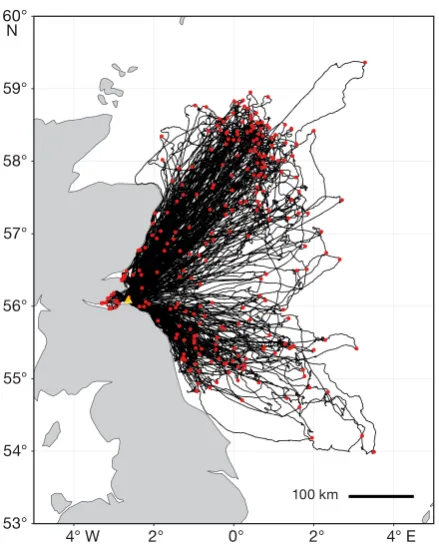
We acquired combined GPS and altitude data for 188 trips by 46 individuals (106 trips by 29 birds in 2015; 47 trips by 16 birds in 2016; 35 trips by 13 birds in 2017; data from 17 birds were incomplete). Most trips travelled northeast or southeast of the colony, with fewer travelling due east (Fig. 1). The prevailing wind direction was from the southwest (Fig. S1 in Supplement 2) and accordingly, birds spent most of their time in flight with cross winds and tail winds when commuting away from the colony, and with head winds and cross winds when returning to the colony (Fig. 2a,c). When actively foraging, however, birds spent significantly more time flying into the wind (mean ± SD: 33 ± 14%) and less with the wind behind them (18 ± 10%) than expected by chance (Fig. 2b; χ2
changed direction while actively foraging so would have been expected by chance to spend 25% of their time with head winds, 50% with cross winds and 25% with tail winds).
3.1. Trip durations and time−activity budgets at sea
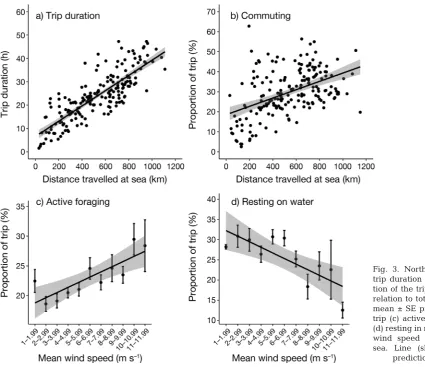
The mean duration of foraging trips was 24.3 ± 10.7 h (range: 1.5−70.3 h). Both trip duration and the proportion of each trip spent commuting were signif-icantly positively related to total distance travelled (Fig. 3; LMM; χ2
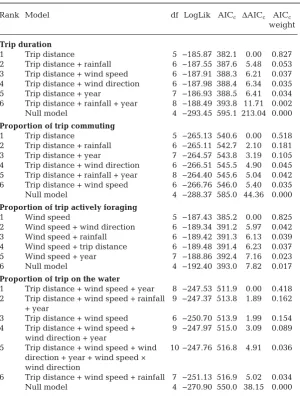
1= 378.5, p < 0.001 and χ21= 57.1, p < 0.001, respectively) but no weather variables im -proved either model (ΔAICc> 5 for trip duration, > 2 for proportion of trip commuting; AICcweight dropped from > 0.8 to < 0.1 and from > 0.5 to < 0.2, respectively; Table 1). The proportion of time spent actively forag-ing per trip increased significantly with increasforag-ing wind speed (Fig. 3c; χ2
1 = 14.6, p < 0.001) but the model was not im proved by including any other vari-able (ΔAICc> 5 in each case; Table 1). There was no clear top model for the proportion of daylight hours spent on the water, but model averaging of the top 3 models (i.e. those with ΔAICc< 2; Table 1) found dis-tance travelled per trip and wind speed to be the
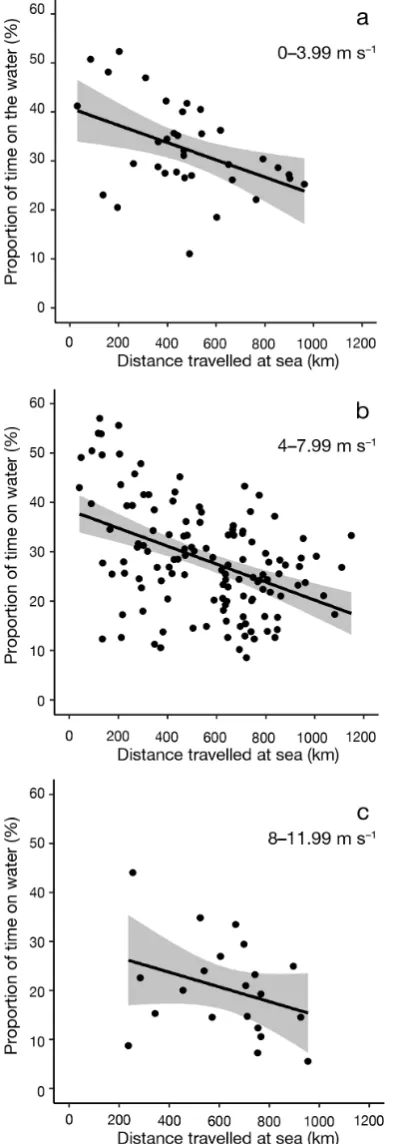
most significant factors (Table 2), indicating that the proportion of time on the water decreased as dis-tance travelled increased and with increasing wind speed (Figs. 3d & 4).
100 km 53°
54° 55° 56° 57° 58° 59° 60° N
[image:5.595.64.284.78.352.2]4° W 2° 0° 2° 4° E
Fig. 1. Tracks of foraging trips (n = 263) by adult northern gannets rearing chicks at Bass Rock between mid-June and mid-August of 2015−2017. Red dots: maximum distance from the colony on each trip; yellow triangle: colony location
Fig. 2. Frequency distribution of bird−wind angles for GPS locations of northern gannets during (a) outbound commut-ing (n = 19 238 locations), (b) active foragcommut-ing (n = 20 446) and
[image:5.595.326.504.82.616.2]3.2. Flight speeds and rates of return to the nest
During periods of commuting, whether outbound or inbound, ground speeds were faster with a tail wind component than with a head wind component (LMM; χ2
2= 301.5, p < 0.001; mean ± SD: 17.5 ± 3.4 and 12.6 ± 2.0 m s−1, respectively). As expected, ground speeds increased as the tail wind component in creased and the head wind component decreased (Fig. 5a; χ2
1= 278.67, p < 0.001). The average speed of travel over the return leg of a trip was significantly related to both distance from the colony and dis-tance2(LMM; χ2
1= 14.0, p < 0.001 and χ21= 5.9, p < 0.05, respectiv ely) indicating a non-linear relation-s hip with direlation-stance, while the berelation-st-performing model according to AICc also included wind speed and direction (Table 3): average travel speed increased with increasing distance from the colony up to 100− 200 km (fastest for birds returning with a tail wind, slowest for those returning into a head wind), beyond which the relationship levelled off (Fig. 5b). Time spent on the water during the return leg of a trip was
also significantly related to inbound distance trav-elled (χ2
1 = 5.9, p < 0.05) with the best-supported model also including distance2 and wind speed and direction (Table 3). For return legs up to 100− 200 km, time on the water decreased with increasing distance and was greatest for birds returning with a tail wind and least for those returning into a head wind (Fig. 5c).
3.3. Flight heights
Median flight height was significantly lower during periods of commuting than active foraging (LMM; χ2
1 = 4.75, p < 0.05; Table 4) but was unaffected by rainfall. Birds also flew lower into head winds than with tail winds when commuting (χ2
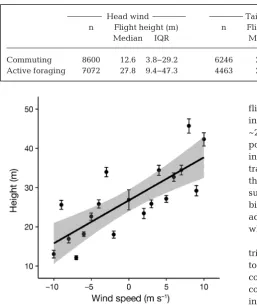
[image:6.595.50.476.73.440.2]1 = 37.6, p < 0.001) but not while actively foraging, when median height was ~28 m irrespective of wind direction (Table 4). In addition, commuting flight heights in -creased with increasing tail wind speed and de -creased as head wind speed in-creased (LM; F1,18=
Fig. 3. Northern gannet (a) trip duration and (b) propor-tion of the trip commuting in relation to total trip distance; mean ± SE proportion of the trip (c) actively foraging and (d) resting in relation to mean wind speed encountered at sea. Line (shading): model
17.9, p < 0.001; Fig. 6; slope [± SE] = 1.06 ± 0.25, R2= 0.47) whereas there was no discernible effect of wind speed on heights during active foraging (slope = −0.17 ± 0.25, R2= 0.02).
4. DISCUSSION
Wind conditions encountered at sea have complex effects on birds’ time− activity and energy budgets, with potentially contrasting effects on the time and energy spent com-muting be tween the colony and distant foraging sites and during periods of active foraging. For black-legged kittiwakes Rissa tridac tylaand little auks Alle alle, which are purely flapping species, energy expenditure in creased and food- provisioning rates of chicks decreased during strong winds (Gab riel sen et al. 1987, 1991, Ko -nar zew ski & Taylor 1989, Chris-tensen-Dalsgaard et al. 2018). In contrast, however, northern fulmars
Fulmarus gla ci alis, which are flap-gliders, had lower energy expendi-ture due to a lower wing beat fre-quency during stronger winds (Furness & Bryant 1996), while higher average wind speeds led to enhanced foraging efficiency and breeding success in wandering alba trosses Diomedea exulans
(Wei mers kirch et al. 2012). For northern gannets, we found that while wind speed and direction had strong effects on the speed of travel between the colony and dis-tant foraging sites, there was no ef-fect on the proportion of each trip spent commuting, probably be-cause with a constant wind direction, birds would en-counter both head and tail winds over the outward and return portions of a trip. Birds spent more time flying into head winds during active foraging than when commuting, probably to provide additional lift and reduce ground speed to aid detection of prey (Machovsky-Capuska et al. 2012, Amélineau et al. 2014). However, birds also spent more time actively foraging during stronger winds, probably because strong winds disrupted the water surface (Sunda ra ba -lan et al. 2016), reducing prey visibility and hence po-tentially leading to both more time spent locating prey and a greater number of dives to capture prey as a re-sult of lower success rates per dive (Finney et al. 1999, Elliott et al. 2014, Pistorius et al. 2015). Frequent dives and associated take-offs from the water surface are Rank Model df LogLik AICc ΔAICc AICc
weight
Trip duration
1 Trip distance 5 −185.87 382.1 0.00 0.827 2 Trip distance + rainfall 6 −187.55 387.6 5.48 0.053 3 Trip distance + wind speed 6 −187.91 388.3 6.21 0.037 4 Trip distance + wind direction 6 −187.98 388.4 6.34 0.035 5 Trip distance + year 7 −186.93 388.5 6.41 0.034 6 Trip distance + rainfall + year 8 −188.49 393.8 11.71 0.002 Null model 4 −293.45 595.1 213.04 0.000 Proportion of trip commuting
1 Trip distance 5 −265.13 540.6 0.00 0.518 2 Trip distance + rainfall 6 −265.11 542.7 2.10 0.181 3 Trip distance + year 7 −264.57 543.8 3.19 0.105 4 Trip distance + wind direction 6 −266.51 545.5 4.90 0.045 5 Trip distance + rainfall + year 8 −264.40 545.6 5.04 0.042 6 Trip distance + wind speed 6 −266.76 546.0 5.40 0.035 Null model 4 −288.37 585.0 44.36 0.000 Proportion of trip actively foraging
1 Wind speed 5 −187.43 385.2 0.00 0.825 2 Wind speed + wind direction 6 −189.34 391.2 5.97 0.042 3 Wind speed + rainfall 6 −189.42 391.3 6.13 0.039 4 Wind speed + trip distance 6 −189.48 391.4 6.23 0.037 5 Wind speed + year 7 −188.86 392.4 7.16 0.023 6 Null model 4 −192.40 393.0 7.82 0.017 Proportion of trip on the water
1 Trip distance + wind speed + year 8 −247.53 511.9 0.00 0.418 2 Trip distance + wind speed + rainfall 9 −247.37 513.8 1.89 0.162 + year
3 Trip distance + wind speed 6 −250.70 513.9 1.99 0.154 4 Trip distance + wind speed + 9 −247.97 515.0 3.09 0.089 wind direction + year
5 Trip distance + wind speed + wind 10 −247.76 516.8 4.91 0.036 direction + year + wind speed ×
wind direction
[image:7.595.65.366.120.518.2]6 Trip distance + wind speed + rainfall 7 −251.13 516.9 5.02 0.034 Null model 4 −270.90 550.0 38.15 0.000 Table 1. Top model sets for estimating effects of weather parameters on different components of northern gannet behaviour during foraging trips. LogLik: log-likeli
hood; AICc: Akaike’s information criterion corrected for small sample size
Parameter Estimate Confidence p Relative interval importance
Trip distance 5.13 −0.56 to −0.27 < 0.001 1.0 Wind speed −0.42 −0.42 to −0.43 < 0.001 1.0 Rainfall 0.13 −0.01 to 0.27 0.06 0.22 Year (2016) 0.06 −0.26 to 0.40 0.69 0.79 Year (2017) 0.56 0.19 to 0.92 0.002 0.79 Table 2. Model-averaged estimates for factors affecting the proportion of each trip spent resting on the water by northern
[image:7.595.60.287.571.658.2]Fig. 4. Proportion of daylight hours spent on the water by northern gannets in relation to distance travelled per trip and mean wind speed encountered during the trip. Lines (with 95% CI) plotted using model-averaged estimates for
each predictor variable (see Table 2)
Fig. 5. (a) Mean (± SE) ground speeds of commuting north-ern gannets in relation to the mean wind speed at 10 m a.s.l. over a trip for tail winds (speed > 0) and head winds (speed < 0). (b) Average speed of travel and (c) proportion of day-light hours on the water during the return leg of foraging trips in relation to distance (km) for different bird−wind an-gles. Lines: linear model predictions in (a) and predictions estimated with loess function in R (blue: tail winds; red: cross winds; green: head winds) in (b,c). Shaded areas: 95%CI.
[image:8.595.82.279.89.662.2]energetically expensive (Saka moto et al. 2013), so a greater time spent actively foraging in stronger winds may explain why, while energy spent in commuting flight decreased with in creasing wind speed in north-ern gannets (Amélineau et al. 2014), overall energy
ex penditure during trips increased with increasing wind speed in closely re lated Cape gannets M. capensis(Mullers et al. 2009).
We found that the increase in time spent foraging as wind speed increased did not result in any in crease in overall trip dura-tion, because birds compensated by decreasing the time they spent on the water during stronger winds, presumably reflecting a benefit in returning quickly to feed dependent offspring and relieve the partner at the nest. We also found that adults re -turned to Bass Rock at higher speeds from more distant forag-ing locations up to ~200 km from the colony, a similar pattern to that re corded by Hamer et al. (2007), who also found that speeds decreased for the fur-thest destinations, probably due to constraints on energy expen-diture during sustained flapping flight. In keeping with this notion, we found that the increase in average speed of travel for distances up to ~200 km was accompanied by a decrease in the pro-portion of time on the water, particularly for birds fly-ing into head winds, with an asymptote in speed of travel corresponding with a levelling off in time on the water beyond this distance. These data strongly suggest that by reducing time spent on the water, birds were able to buffer trip durations against adverse effects of strong winds en countered both while commuting and during active foraging.
In addition to altering time spent on the water during trips, birds also adjusted their flight heights in relation to wind speed and direction. The higher proportion of commuting flight at low elevations into head winds compared with tail winds was similar to that recorded in a wide range of species during migration (Krüger & Garthe 2001) and supports the notion that individuals can make use of both wind shear and ground effect to ameliorate the impacts of strong head winds on ground speed and energy expenditure (Finn et al. 2012, Tar-roux et al. 2016). During the breeding season, this flexibility in commuting flight height may provide an additional behavioural buffer against the adverse ef-fects of strong head winds during foraging trips.
Oceanic winds affect the prey fields of marine predators by altering their ability to access, detect Model df LogLik AICc ΔAICc
Speed
Distance + distance2+ wind speed 7 −182.16 379.0 0
+ wind direction
Distance + wind speed + wind direction 6 −184.28 381.0 2.0 Distance2+ wind speed + wind direction 6 −187.94 388.3 9.3
Resting
Distance + distance2+ wind speed 7 −376.47 767.6 0
+ wind direction
[image:9.595.65.381.126.263.2]Distance + wind speed + wind direction 6 −378.48 769.4 1.8 Distance2+ wind speed + wind direction 6 −379.72 771.9 4.3
Table 3. Top model sets for estimating effects of different variables on average speed of travel and proportion of time resting on the water during the return leg of each trip by northern gannets. LogLik: log-likelihood; AICc: Akaike’s information
criterion corrected for small sample size
Head wind Tail wind n Flight height (m) n Flight height (m) Median IQR Median IQR
[image:9.595.58.316.294.601.2]Commuting 8600 12.6 3.8−29.2 6246 25.6 9.6−46.1 Active foraging 7072 27.8 9.4−47.3 4463 28.3 7.7−48.7 Table 4. Flight heights of northern gannets during commuting and active foraging
with head and tail winds. IQR: interquartile range
Fig. 6. Mean (± SE) flight heights of commuting northern gan-nets in relation to the mean wind speed at 10 m a.s.l. over a trip for tail winds (speed > 0) and head winds (speed < 0). Line
and capture prey, acting as an additional dimension in their N-dimensional niche space (Raymond et al. 2010, Wilson et al. 2011, Weimerskirch et al. 2012). While gannets were able to buffer adverse effects of strong winds by reducing time spent drifting on water during trips and also by altering their flight heights in relation to wind conditions, other species may have different behavioural responses. For in -stance, Brünnich’s guillemots Uria lomviaand black-legged kittiwakes buffered the adverse effect of high winds on food-provisioning rates of chicks by switching to other food sources durswitching windy days or in -creasing food delivery rates when weather im proved (Elliott et al. 2014). Such behavioural flexibility is likely to be critical to maintaining fitness across vari-able environmental conditions encountered at sea, and parallels that recorded at an annual time-scale in a number of species in response to climate-related variation in prey abundance and availability (Grémil-let et al. 2012, Kokubun et al. 2018).
Acknowledgements. We thank Sir Hew Hamilton-Dalrymple and the Scottish Seabird Centre, North Berwick for access to Bass Rock; and Maggie Sheddan, Sam Lowe and the Dale family for logistic support. We thank Ewan Wakefield and Ian Cleasby for help with behavioural classification and cal-culation of flight heights, and we thank Francis Daunt and 2 anonymous referees for very helpful comments on a previous manuscript. This work was funded by the Natural Environ-ment Research Council (SPHERES DTP; reference NE/ L002574/1), and birds were ringed and loggers deployed with permits and approval from the British Trust for Orni -thology. Telemetry data are available free of charge through the BirdLife International Seabird Tracking Database: www. seabirdtracking.org.
LITERATURE CITED
Albert M, Anguelova MD, Manders AMM, Schaap M, de Leeuw G (2016) Parameterization of oceanic whitecap fraction based on satellite observations. Atmos Chem Phys 16: 13725−13751
Amélineau F, Péron C, Lescroël A, Authier M, Provost P, Grémillet D (2014) Windscape and tortuosity shape the flight costs of northern gannets. J Exp Biol 217: 876−885 Baptist MJ, Leopold MF (2010) Prey capture success of
Sandwich terns Sterna sandvicensisvaries non-linearly with water transparency. Ibis 152: 815−825
Barto´n K (2015) Mumin: multi-model inference. R package version 1.15.1. http: //cran.r-project.org/ src/ contrib/Archive /MuMIn/
Burnham KP, Anderson DR (2002) Model selection and multimodel inference: a practical informationtheoretic ap -proach, 2ndedn. Springer, Berlin
Christensen-Dalsgaard S, May RF, Barrett RT, Langset M, Sandercock BK, Lorentsen SH (2018) Prevailing weather conditions and diet composition affect chick growth and survival in the black-legged kittiwake. Mar Ecol Prog Ser 604: 237−249
Cleasby IR, Wakefield ED, Bodey TW, Davies RD and others (2015a) Sexual segregation in a wide-ranging marine predator is a consequence of habitat selection. Mar Ecol Prog Ser 518: 1−12
Cleasby IR, Wakefield ED, Bearhop S, Bodey TW, Votier SC, Hamer KC (2015b) Three-dimensional tracking of a wide-ranging marine predator: flight heights and vulner-ability to offshore wind farms. J Appl Ecol 52: 1474−1482 Coumou D, Lehmann J, Beckmann J (2015) The weakening
summer circulation in the northern hemisphere mid-lati-tudes. Science 348: 324−327
Dee DP, Uppala SM, Simmons AJ, Berrisford P and others (2011) The ERA-Interim Reanalysis: configuration and performance of the data assimilation system. Q J R Mete-orol Soc 137: 553−597
Elliott KH, Chivers LS, Bessey L, Gaston AJ and others (2014) Windscapes shape seabird instantaneous energy costs but adult behavior buffers impact on offspring. Mov Ecol 2: 17
Finn J, Carlsson J, Kelly T, Davenport J (2012) Avoidance of headwinds or exploitation of ground effect: Why do birds fly low? J Field Ornithol 83: 192−202
Finney SK, Wanless S, Harris MP (1999) The effect of weather conditions on the feeding behaviour of a diving bird, the common guillemot Uria aalge.J Avian Biol 30: 23−30 Freckleton RP (2011) Dealing with collinearity in behavioural
and ecological data: model averaging and the problems of measurement error. Behav Ecol Sociobiol 65: 91−101 Furness RW, Bryant DM (1996) Effect of wind on field
meta-bolic rates of breeding northern fulmars. Ecology 77: 1181−1188
Gabrielsen GW, Mehlum F, Nagy KA (1987) Daily energy expenditure and energy utilization of free-ranging black-legged kittiwakes. Condor 89: 126−132
Gabrielsen GW, Taylor JRE, Konarzewski M, Mehlum F (1991) Field and laboratory metabolism and thermoregu-lation in dovekies (Alle alle). Auk 108: 71−78
Gibb R, Shoji A, Fayet AL, Perrins CM, Guilford T, Freeman R (2017) Remotely sensed wind predicts soaring behav-iour in a wide-ranging pelagic seabird. J R Soc Interface 14: 20170262
Goto Y, Yoda K, Sato K (2017) Asymmetry hidden in birds’ tracks reveals wind, heading, and orientation ability over the ocean. Sci Adv 3: e1700097
Grecian WJ, Lane J, Michelot T, Wade HM, Hamer KC (2018) Understanding the ontogeny of foraging behaviour: in -sights from combining marine predator bio-logging with satellite-derived oceanography in hidden Markov mod-els. J R Soc Interface 15: 20180084
Green M (2004) Flying with the wind — spring migration of Arctic-breeding waders and geese over south Sweden. Ardea 92: 145−159
Grémillet D, Welcker J, Karnovsky NJ, Walkusz W and oth-ers (2012) Little auks buffer the impact of current Arctic climate change. Mar Ecol Prog Ser 454: 197−206 Grueber CE, Nakagawa S, Laws RJ, Jamieson IG (2011)
Multimodel inference in ecology and evolution: chal-lenges and solutions. J Evol Biol 24:699−711
Hamer KC, Phillips RA, Wanless S, Harris MP, Wood AG (2000) Foraging ranges, diets and feeding locations of gannets Morus bassanusin the North Sea: evidence from satellite telemetry. Mar Ecol Prog Ser 200: 257−264 Hamer KC, Phillips RA, Hill JK, Wanless S, Wood AG (2001)
Contrasting foraging strategies of gannets Morus bassanus
foraging area fidelity. Mar Ecol Prog Ser 224: 283−290 Hamer KC, Humphreys EM, Garthe S, Hennicke J and
others (2007) Annual variation in diets, feeding locations and foraging behaviour of gannets in the North Sea: flexibility, consistency and constraint. Mar Ecol Prog Ser 338: 295−305
Hamer KC, Humphreys EM, Magalhães MC, Garthe S and others (2009) Fine-scale foraging behaviour of a medium-ranging marine predator. J Anim Ecol 78: 880−889 Hernández-Pliego J, Rodriguez C, Dell’Omo G, Bustamente
J (2017) Combined use of tri-axial accelerometers and GPS reveals the flexible foraging strategy of a bird in relation to weather conditions. PLOS ONE 12: e0177892 Kogure Y, Sato K, Watanuki Y, Wanless S, Daunt F (2016)
European shags optimize their flight behavior according to wind conditions. J Exp Biol 219: 311−318
Kokubun N, Takahashi A, Paredes R, Young RC and others (2018) Inter-annual climate variability affects foraging behavior and nutritional state of thick-billed murres breeding in the southeastern Bering Sea. Mar Ecol Prog Ser 593: 195−208
Konarzewski M, Taylor JRE (1989) The influence of weather conditions on growth of little auk Alle allechicks. Ornis Scand 20: 112−116
Krüger T, Garthe S (2001) Flight altitudes of coastal birds in relation to wind direction and speed. Atl Seabirds 3: 203−216
La Sorte F, Fink D (2017) Projected changes in prevailing winds for transatlantic migratory birds under global warming. J Anim Ecol 86: 273−284
Lewis S, Benvenuti S, Dall’Antonia L, Griffiths R and others (2002) Sex-specific foraging behaviour in a monomor-phic seabird. Proc R Soc B 269: 1687−1693
Lewis S, Benvenuti S, Daunt F, Wanless S and others (2004) Partitioning of diving effort in foraging trip of northern gannets. Can J Zool 82: 1910−1916
Lewis S, Phillips RA, Burthe SJ, Wanless S, Daunt F (2015) Contrasting responses of male and female foraging effort to year-round wind conditions. J Anim Ecol 84: 1490−1496 Liechti F, Klaassen M, Bruderer B (2000) Predicting
migra-tory flight altitudes by physiological migration models. Auk 117: 205−214
Machovsky-Capuska GE, Howland HC, Raubenheimer D, Vaughn-Hirshorn R, Wursig B, Hauber ME, Katzir G (2012) Visual accommodation and active pursuit of prey underwater in a plunge-diving bird: the Australasian gannet. Proc R Soc B 279: 4118−4125
McInnes KL, Erwin TA, Bathols JM (2011) Global climate model projected changes in 10 m wind speed and direc-tion due to anthropogenic climate change. Atmos Sci Lett 12: 325−333
Mullers RHE, Navarro RA, Daan S, Tinbergen JM, Meijer HAJ (2009) Energetic costs of foraging in breeding Cape gannets Morus capensis.Mar Ecol Prog Ser 393: 161−171 Parker-Stetter S, Urmy S, Home J, Eisner L, Farley E (2016)
Factors affecting summer distributions of Bering Sea for-age fish species: assessing competing hypotheses. Deep Sea Res II 134: 255−269
Patrick SC, Bearhop S, Grémillet D, Lescroel A and others (2014) Individual differences in searching behaviour and spatial foraging consistency in a central place marine predator. Oikos 123: 33−40
Phillips RA, Xavier JC, Croxall JP (2003) Effects of satellite transmitters on albatrosses and petrels. Auk 120: 1082−1090
Pinheiro J, Bates D, DebRoy S, Sarkar D, R Core Team (2018) nlme: linear and nonlinear mixed effects models. R pack-age version 3.1-109. https: //cran. r-project. org/ packpack-age = nlme
Pistorius PA, Hindell MA, Tremblay Y, Rishworth GM (2015) Weathering a dynamic seascape: influences of wind and rain on a seabird’s year-round activity budgets. PLOS ONE 10: e0142623
R Core Team (2016) R: a language and environment for sta-tistical computing. R Foundation for Stasta-tistical Comput-ing, Vienna
Raymond B, Shaffer SA, Sokolov S, Woehler EJ and others (2010) Shearwater foraging in the Southern Ocean: the roles of prey availability and winds. PLOS ONE 5: e10960
Rayner JMV (1991) On the aerodynamics of animal flight in ground effect. Philos Trans R Soc B 334: 119−128 Sakamoto KQ, Takahashi A, Iwata T, Yamamoto T, Yama
-moto M, Trathan PN (2013) Heart rate and estimated energy expenditure of flapping and gliding in black-browed albatrosses. J Exp Biol 216: 3175−3182
Salisbury DJ, Anguelova MD, Brooks IM (2013) On the vari-ability of whitecap fraction using satellite-based obser-vations. J Geophys Res Oceans 118: 6201−6222
Schielzeth H (2010) Simple means to improve the inter-pretability of regression coefficients. Methods Ecol Evol 1: 103−113
Shepard E, Cole EL, Neate A, Lempidakis E, Ross A (2019) Wind prevents cliff-breeding birds from accessing nests through loss of flight control. eLife 8: e43842
Sundarabalan B, Shanmugam P, Ahn YH (2016) Modeling the underwater light field fluctuations in coastal oceanic waters: validation with experimental data. Ocean Sci J 51: 67−86
Tarroux A, Weimerskirch H, Wang SH, Bromwich DH and others (2016) Flexible flight response to challenging wind conditions in a commuting Antarctic seabird: Do you catch the drift? Anim Behav 113: 99−112
Terraube J, Villers A, Poudre L, Varjonen R, Korpimaki E (2017) Increased autumn rainfall disrupts predator-prey interactions in fragmented boreal forests. Glob Change Biol 23: 1361−1373
Villegas-Patraca R, Herrera-Alsina L (2015) Migration of Franklin’s gull (Leucophaeus pipixcan) and its variable annual risk from wind power facilities across the Tehu -an tepec Isthmus. J Nat Conserv 25: 72−76
Wakefield ED, Bodey TW, Bearhop S, Blackburn J and oth-ers (2013) Space partitioning without territoriality in gan-nets. Science 341: 68−70
Wakefield ED, Cleasby I, Bearhop S, Bodey TW and others (2015) Long-term individual foraging site fidelity — why some gannets don’t change their spots. Ecology 96: 3058−3074
Weimerskirch H, Louzao M, de Grissac S, Delord K (2012) Changes in wind pattern alter albatross distribution and life-history traits. Science 335: 211−214
Wilson RP, McMahon CR, Quintana F, Frere E, Scolaro A, Hays GC, Bradshaw CJA (2011) N-dimensional animal energetic niches clarify behavioural options in a variable marine environment. J Exp Biol 214: 646−656
Young IR, Zieger S, Babanin AV (2011) Global trends in wind speed and wave height. Science 332: 451−455 Zuckerberg B, Ribic CA, McCauley LA (2018) Effects of
tem-perature and precipitation on grassland bird nesting suc-cess as mediated by patch size. Conserv Biol 32: 872−882
Editorial responsibility: Kyle Elliott, Sainte-Anne-de-Bellevue, Québec, Canada