This is a repository copy of
Mathematical Model and Framework of Physical Layer
Encryption for Wireless Communications
.
White Rose Research Online URL for this paper:
http://eprints.whiterose.ac.uk/136504/
Version: Accepted Version
Proceedings Paper:
Li, W, McLernon, D orcid.org/0000-0002-5163-1975, Lei, J et al. (3 more authors) (2019)
Mathematical Model and Framework of Physical Layer Encryption for Wireless
Communications. In: Proceedings of 2018 IEEE Globecom Workshops (GC Wkshps).
2018 IEEE Globecom Workshops (GC Wkshps), 09-13 Dec 2018, Abu Dhabi, United Arab
Emirates. IEEE . ISBN 978-1-5386-4920-6
https://doi.org/10.1109/GLOCOMW.2018.8644193
© 2018 IEEE. This is an author produced version of a paper published in Proceedings of
2018 IEEE Globecom Workshops (GC Wkshps). Personal use of this material is permitted.
Permission from IEEE must be obtained for all other uses, in any current or future media,
including reprinting/republishing this material for advertising or promotional purposes,
creating new collective works, for resale or redistribution to servers or lists, or reuse of any
copyrighted component of this work in other works. Uploaded in accordance with the
publisher's self-archiving policy.
[email protected]
https://eprints.whiterose.ac.uk/
Reuse
Items deposited in White Rose Research Online are protected by copyright, with all rights reserved unless
indicated otherwise. They may be downloaded and/or printed for private study, or other acts as permitted by
national copyright laws. The publisher or other rights holders may allow further reproduction and re-use of
the full text version. This is indicated by the licence information on the White Rose Research Online record
for the item.
Takedown
If you consider content in White Rose Research Online to be in breach of UK law, please notify us by
Mathematical Model and Framework of Physical
Layer Encryption for Wireless Communications
Wei Li1
, Des McLernon2
, Jing Lei1
, Mounir Ghogho2,3, Syed Ali Raza Zaidi2
and Huaihai Hui2 1
College of Electronic Science and Engineering, National University of Defense Technology, China. Email: [email protected]
2
University of Leeds, Leeds LS2 9JT, U.K.
Email: [email protected], [email protected], [email protected] 3
International University of Rabat, Morocco. Email: [email protected]
Abstract—As a response to serious transmission security prob-lems in wireless communications, physical layer encryption (PLE) provides an effective security measure which is very different from upper layer cryptography technologies. PLE can take advantage of the effects of channel and noise and the processing objects are complex vector signals, which are essentially different from Boolean algebra based traditional cryptography. This paper estab-lishes mathematical models, design frameworks and cryptographic primitives for PLE. Two design frameworks are proposed: stream PLE and block PLE. For stream PLE, a new 3D security constellation mapping is derived. For block PLE, two types of sub-transforms are defined: isometry transformations and stochastic transformations. The proposed PLE framework has a large cipher signal space and key space; it provides more freedom in design and can resist known plaintext attacks and chosen-plaintext attacks.
Index Terms—Physical layer encryption, Block PLE, Stream PLE, Isometry transformation, Stochastic transformation, PLE-block chaining
I. INTRODUCTION
With the rapid development of wireless communication technology, transmission security has become a very important issue. Due to the broadcast characteristics of wireless channels, the leakage and decipherment of wireless signal has now become a major security issue. For the confidential commu-nication problem, Shannon’s early paper [1] made a seminal contribution, in which confidentiality and reliability are closely combined. However, sophisticated modern cryptography theo-ries recently developed are separated from the foundations of wireless communications. On one hand, modern cryptography considers the problem of encryption via transmission over error-free channels. On the other hand, in communication systems, we consider only the reliability and effectiveness of transmission. In a practical communication system, such as cellular communications or wireless LAN communication, the communication physical layer and the security layer are designed separately and do not have much overlap with each other.
The emergence of physical layer security (PLS) breaks this boundary. Wyner’s pioneering work took into account the physical layer security issues in error channels [2]. We call this information theory security. This is a completely different
This work was supported in part by the National Natural Science Foundation of China (Numbers 61502518 and 61702536), Natural Science Foundation of Hunan Province China (No.2018JJ3609) and the China Scholarship Council (CSC) government-sponsored visiting scholar research program.
This work was also partly supported by the UK British Council (Newton Fund) through the Project: “Wireless Sensor Networks for Real Time Monitoring of Water Quality” under Grant IL3264631003.
path from traditional cryptography. Following Wyner’s work, significant research about PLS has already been carried out, including multi-antenna beamforming [3], artificial noise tech-niques [4], [5], [6], cooperative interference techtech-niques [7], to name but a few.
Physical layer encryption (PLE) is another approach that is different from PLS. Compared with information theory secu-rity, PLE provides a more practical and effective method. The encryption process itself does not rely on channel conditions and it can provide security protection when the eavesdropper’s channel is better than the “Alice to Bob” channel. Compared with traditional cryptography (that only considers perfect chan-nels) it can take advantage of the effects of channel and noise and hopefully provide stronger security. The existing literature has adopted PLE methods in OFDM systems [8], [9], massive MIMO systems [10], [11], IEEE 802.15.4 protocols [12] and sparse code multiple access (SCMA) [13]. The work in [12] considers the hardware implementation of the PLE algorithm on ASIC and FPGA designs.
The main methods used in PLE are constellation rotation, sub-carrier disturbance, symbol scrambling, training symbol resequencing and so on. However, many existing PLE methods cannot resist known-plaintext attacks (KPAs) and chosen-plaintext attacks (CPAs). In this paper, we will consider the PLE method which can resist both KPA and CPA.
Furthermore, existing PLE papers lack precise cryptographic primitive definitions and rigorous proofs of security which are very important for building PLE-based practical cryptographic protocols. In this paper, we will concentrate on the general mathematical model and framework of PLE, and propose corresponding standards to measure the security of PLE. One of the main goals of this paper is to establish cryptographic primitives for PLE and summarize the basic design rules.
The main contributions of this paper are:
1) We will divide PLE intostream PLEandblock PLE. We will establish two general-purpose mathematical models and definecryptographic primitivesforstream PLEand
block PLE.
2) We will propose adesign frameworkand the basic rules of both stream and block PLE.
3) We will define the isometry transformation and the stochastic transformation in block PLE. We will prove that the proposed PLE frameworks can resist both KPA and CPA.
The design framework and rules of PLE are described in Section III. A security analysis of KPA and CPA is discussed in Section IV. Finally in section V we present some conclusions.
Notation: XT, X∗, XHand X−1denote respectively the transpose, conjugate, conjugate transpose and inverse of matrix
X.IN denotes theN-dimensional identity matrix.|x|denotes the absolute value of a complex scalar x. We will use k·k to denote the Euclidean norm of a vector.Cn represents the space of n×1 vectors with complex elements. Cm×n and Rm×nrepresent the space of allm×nmatrices with complex elements and real elements respectively. For sets A and B, A × B={(a, b)|a∈ A and b∈ B }, where×is Cartesian product between two sets.
II. PLE SYSTEMMODEL ANDCRYPTOGRAPHIC
PRIMITIVE
A. Comparison between PLE and a traditional cryptography system
A secrecy system is defined as a set of transformations of a message space into a cipher signal space. In traditional cryptography the cipher signal space and the message space are both discrete binary spaces. However, in PLE, the possible cipher signal space is a continuous vector space.
In the traditional security system, it is assumed that the en-cryption and deen-cryption blocks experience an error-free equiv-alent channel. We assume that error correction is guaranteed by the channel encoder/decoder module. So modern cryptology has been constructed on the premise of an effectively error free channel. The question is, can we use channel errors to increase the difficulty of deciphering and thus enhance security? PLE will consider this problem and thus combine the encryption and communication modules together.
Encrypt and Modulate
Channel
Demodulate and Decrypt
Channel Eve
Bob
Y ZB
K
ZE K
S Alice Channel
Encode
Channel
Decode
S%
[image:3.612.322.526.167.281.2]PLE
Fig. 1. PLE communication system model.
PLE is a computational, complex-based, security, and its system model is shown in Fig.1. The key still needs to be distributed in the PLE system, which differs from traditional cryptography in that it faces a practical non error-free channel. And its processing object also changes from a binary sequence into a complex sequence. PLE needs to convert the binary sequenceS into a complex sequenceY according to the key
K, and then it is processed and sent across the channel by the subsequent communication module. In fact, PLE requires the consideration of encryption, but it also needs to consider trans-mission efficiency and reliability issues. PLE can be thought of as a new extension of cryptography in complex fields and non error-free channels. Since the processing objects are completely different from cryptography, we need to propose new rules and we will also face new problems.
We will now provide a mathematical model and framework of PLE, and we will divide PLE into stream PLE and block PLE.
B. Stream PLE
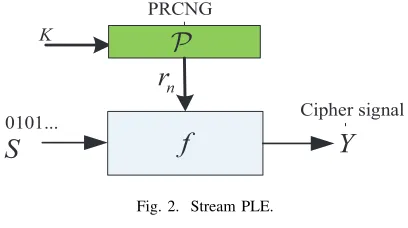
Stream PLE takes a transmission symbol as a basic pro-cessing unit and is a time-varying encryption transform. It has the advantages of fast conversion speed and low error propagation. The hardware implementation circuit is simpler; the disadvantages are: low diffusion and insensitivity to inserts and modifications. The basic model of stream PLE is shown in Fig 2.
f
Cipher signal
K
0101...
n
r
Y
PRCNGS
[image:3.612.77.295.421.500.2]P
Fig. 2. Stream PLE.
1) Transmitter and channel: First, a series of pseudo-random complex sequencesrn are generated from the initial keyK:
rn=P(K) =an+jbn=Aneθn. (1)
Here,Pis defined as a pseudo-random complex generation function. The distribution ofrn(wherenis the symbol index) needs to be designed by the user. It can be fixed in amplitude, uniform in phase distribution, or evenly distributed in real and imaginary parts. For simplification,nwill later be omitted.
Definition 1. Pseudorandom complex sequence generator (PRCSG)
Consider ξ a probability distribution on C (a complex domain). We call a functionP :K → Cn (where K is the set of positive integers) a pseudo-random complex sequence generator if∀K∈ K, P(K) ={r1, r2, r3...},where{rn} is a sequence of complex independent random variables which obeys theξdistribution.
A PRCSG is an algorithm for generating a sequence of num-bers whose properties approximate the properties of sequences of random numbers. The PRCSG is not truly random, because it is completely determined by the key K. We also can use chaos theory to design a PRCSG.
Then the encryption is done by the encryption functionf,
yn=f(sn, rn). (2)
The output encypted symbol sequence isY ={y1, y2, ...}
whose nth element is yn (a complex number), and yn is a function ofsnandrn. Here,S={s1, s2, ...}is a transmitted
binary sequence. ForM-ary modulation,sn (thenth element ofS) is alog2M length block of binary bits whose elements are “0” or “1”.
Now f in (2) is the PLE function that we need to design. The design offhas two goals. One is to prevent eavesdroppers (withoutK) recovering any information fromY, and the other is to enable the legal receiver (withK) to effortlessly recover
Returning to Fig.1, then after the cipher signalyn passes through the channel, the symbols received at the legal receiver and the eavesdropper are respectively:
ZBn=HB(yn) (3)
ZEn=HE(yn) (4)
where HB(.) and HE(.) are the channel functions of Bob and Eve, respectively. The effects of channel noise are also included inHB(.)and HE(.).
2) Demodulation and decryption: The legal receiver Bob needs to recover S, knowingZn
B and K.In traditional com-munication systems, detection and decryption are two separate processes. However in PLE, the detection and decryption processes are combined together. We define the decryption and demodulation algorithm as:
˜
S=D(ZB, K) (5)
where D needs to be designed to reduce errors as much as possible. We also need to consider the computational complexity ofD.
C. Block PLE
Unlike stream PLE, block PLE processes a large chunk of data. Block PLE transforms large blocks of bits into complex vector signals with fixed or probabilistic functions. Probabilistic transformation means the output of PLE is a random variable. This is different from traditional block cipher with only fixed operations.
We model block PLE as a function that maps anl-bit binary vector into an N-length complex vector according to the key
K:
S={s1s2. . . sl}−→K Y={Y1Y2. . . YN} (6) whereS is a l-bit binary message block (i.e., different from stream PLE),K is the key whose length isklbits which also can be consider as an integer, andY∈CN×1is the encrypted signal. Unlike stream PLE,lhere is large (for examplel=128, 256 or 512).
LetF2 denote the Galois field of two elements and letFl2
denote the vector space of ltuples with elements inF2. We can represent block PLE as the following mappingT:
T :Fl2×Fkl
2 →C
N
(7)
whereklis the key length.
Note thatTis also allowed to be a stochastic mapping which is different from traditional cryptography.
We also can consider (6) as a family of operations with one parameter, and rewrite it as
Y=TK(S).
The transformation TK is the block PLE function which we need to design. We can see that the PLE function transforms thel-bit stringS into a complex vectorYwhich is different from traditional cryptography in Shannon’s work [1]. We call
T pseudorandom if the function TK(for a randomly-chosen keyK)is indistinguishable from a function chosen uniformly at random from the set of all functions having the same domain and range.
Since the complex vector space is infinite, the theoretical key space of PLE is also infinite, while in conventional
cryptography the key space is limited by the length of the message. So, PLE can naturally resist a brute-force attack.
D. Definitions of cryptographic primitives of the PLE system
An important work is to build cryptographic primitives for PLE. Only after PLE cryptographic primitives are well-established can it then be used to build practical cryptographic protocols for security systems. So we now give the definition of PLECryptographic Primitives.
Definition 2. Physical layer encryption system
Message space M: the set of plaintext messages, a finite set. All input messagesS∈ M.
Cipher signal spaceC: the set of all possible ciphers. All cipher signalsY∈C.
Key spaceK,K′: possible encryption key setK, and possible
decryption key setK′
. For the symmetric PLE,K=K′
. The encryption keyKis chosen fromK, and the decryption keyK′
is chosen fromK′
, and soK∈ K, K′∈ K′
.
Key generation algorithmG:HB→ K × K′.
G is a probabilistic algorithm that outputs a key pair (K, K′)∈ K×K′
chosen according to the channelHbetween the transmitter and the receiver.
Encryption algorithmT :M× K → C.
Channel functionHB :C → Z.
His the equivalent channel function between cipher signal
Y and received symbol ZB, ZB =HB(Y). Z is the set of all possibleZB, andZB ∈ Z.
PRCNG:P:K →Cn.
Kis the key set andCnis a(n×1)complex vector space;
for stream PLE, complex sequence{rn}={r1, r2, ...} ∈Cn.
Decryption algorithmD:Z × K′→ M
.
There are some differences between PLE and conventional encryption.
1. The cipher signal space is different from conventional encryption. Here the cipher signal spaceCis a complex field. 2. The decryption algorithm requirements are different. Decoding errors are allowed in the PLE. In conventional encryption, it must be decoded correctly. In PLE, we only restrain the probability of the correct decryption as:
Pr(D(ZB) =S) = Pr(D(H(TK:(S)))=S)≥1−δe (8)
whereδe.is a given error threshold.
3. The encryption and decryption algorithms do not require deterministic functions. We can design them as random func-tions. In other words, the random function will give different outputs at different times even if the input is the same. This property can prevent many attacks such as Chosen-Plaintext Attacks (CPA).
4. The channel function is also a random factor in this system, due to random noise.
Finally, we can use the following formula to represent the cryptographic primitives of the PLE system:
Block PLE:Q
B=(G,T,D, HB), Stream PLE :Q
S=(G,T,D, HB,P).
III. THEDESIGNFRAMEWORK AND RULES OFPLE
1. Reliability.
We need to ensure that the legal receiver can recover the transmitted signal easily and correctly. PLE must be able to counteract noise and channel effects. This requires that the encryption function guarantees the constellation distances after the transformation and that the superimposed channel noise is not amplified after decryption recovery.
2. Security
We should prevent eavesdroppers from recovering infor-mation. The encrypted signal shows confusion and diffusion, and uses the effects of the channel and noise to increase this confusion feature.
Reversibility and security are two different goals. When the PLE function has the greatest reliability, its confusion tends to decrease, so a trade-off needs to be made in the design. We will now discuss the design methods of stream PLE and block PLE.
A. Stream PLE Design Framework
The key module of the Stream PLE has two parts. One part is to generate a particular distribution of a complex random sequence based on the keyK. Note that the random numbers here are not truly random, but rather a deterministic algorithm that can also be run at the legal receiver to obtain the same random complex sequence as the transmitter. The generation of pseudo-random complex numbers has been widely researched in many other works [14].
Another part is the design of the encryption functionf in Fig. 2. In stream PLE,f is the mapping of a small number of bits to a complex number. To measure and guide the design of thef-function, we propose two indicators to measure reliability and confusion. Fixing the number of transmission bits and energy of the output signaly, we can use the following index parameters to evaluate the encryption functionf.
a) Minimum constellation distance:
d= min
(i,j)i6=j|f(si−sj, rn)| (9) wheresi, sj∈ Mare possible input messages and dis the minimum distance of two different messages. Note thatdwill eventually affect the bit error rate of the legitimate recipient. This indicator is similar to the constellation design indicator in traditional communication systems. We should designf to maximized.
b) Distribution characteristics of the output signal:
Note that if r is truly random, then this forms a one-time system which provides perfect security. However, in a practical system, we cannot get a truly randomrfrom a limited length key. So,r is a pseudo-random complex sequence and is not truly random. Therefore, eavesdroppers have the possibility of obtaining information aboutsor rby accumulating observa-tions forY over a long time. In order to avoid this situation, we need more confusion in they-sequence, and there are more possible values fory=a+jb.
We use the continuous entropy to measure the confusion degree ofY as follows:
He(Y) =−
∞
Z Z
−∞
p(a, b) log2p(a, b)dadb, (10)
where p(a, b) is the joint probability density function for a
andb.
Since continuous entropy is infinite, it is not easy to cal-culate the continuous entropy values. In addition, the actual digital system will quantize the signal Y, so we will use discrete source entropy to measure the confusion degree of
Y. A continuous Y is discretized into bins of size ∆ (we can understand it as quantification accuracy). We thus have quantized entropy as:
H∆(Y) :=−
∞
X
i=−∞ ∞
X
j=−∞
Γ(i, j) log2Γ(i, j), (11)
whereΓ(i, j) =R(i+1)∆
i∆
R(j+1)△
j△ p(a, b)dadb.
We need to maximize H∆(Y), given the domain ofY is C. According to maximum entropy theory, Y needs to be a uniform distribution within its given domainC[15]. This rule means that for an arbitrary input symbolS, after thef-function transformation,Y can be any value in the entire given domain, and the probability of different values is equal.
We now present two approaches for the design of the encryption functionf.
(i) PLE based on traditional modulation
In transmitters, encryption transformation is performed after the traditional constellation mapping (such as BPSK, QPSK, 16QAM, etc.), and at the receiver decryption is performed before traditional constellation demodulation. The encryption and decryption transformation here needs to ensure that the constellation distance is not changed, in order to guarantee the error rate of the legal receiver.
In the phase modulation system (QPSK, BPSK, M-PSK, etc.), the generatedθnfollows the uniform distribution (θ ∼
U[0, 2π]). The input information bits are mapped by tradi-tional M-PSK to obtain a complex symbolXn, and then the following rotation processing is performed:
Yn=Xneθn. (12)
Clearly the rotation in (12) leasves the distances between the constellation points unaltered (in accordance with the aforemention a) and b)). This method is used in [16] and [11].
(ii) New constellation for stream PLE
Instead of relying on existing modulation systems, the func-tionf is totally redesigned so that the outputY is uniformly distributed in a given space.
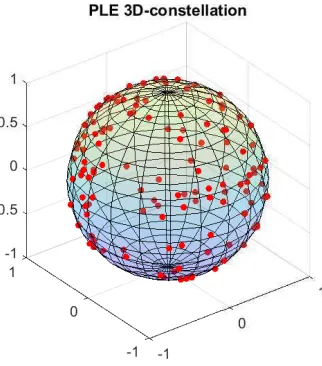
For example, in our previous work [17], a 3-dimensional rotated constellation modulation was designed in which 2 bits are mapped to a 3-dimensional constellation point and evenly distributed on a spherical surface. These 3 dimensions in practical systems can be obtained by (for example) using the two dimensions of one subcarrier and one dimension form another subcarrier. For example, in an OFDM system 1.5 subcarriers can be combined to get an modulation unit.
First, each block of 2-bit data is mapped to the four vertices of the regular tetrahedron Xn ∈ R3. The regular tetrahedron vertices have equal distances between them so the best performance can be obtained. Then the three-dimensional constellation is rotated to obtain an encrypted constellation
Yn∈R3:
Yn=Xn·R(α, β, γ) (13) whereR(α, β, γ)is the rotation matrix in (14), andα, β, γ∼
R(α, β, γ) =
cosγ sinγ 0
−sinγ cosγ 0
0 0 1
1 0 0
0 cosβ sinβ
0 −sinβ cosβ
cosα sinα 0
−sinα cosα 0
0 0 1
(14)
[image:6.612.271.537.57.200.2]Ynis shown in the Fig.3. These points are distributed on the surface of the sphere.
Fig. 3. PLE for a 3-D constellation where constellation points lie on the surface of the sphere with a uniform probability density function for each of the two parametric angles
B. Block PLE design framework
Block PLE operates on fixed-length groups of bits, called blocks, with a transformation that is specified by a symmetric key. Different from a traditional block cipher, block PLE converts bit blocks to complex vectors. Signals arriving at the receiver through the channel need to be correctly demodulated. So the rules of operation are very different from a traditional block cipher.
We need to design block PLE methods which should have the following properties.
(i) Confusion
Finding the relationship between the key and the cipher signal should be as complex and as involved possible. The key should be protected from exposure even when an attacker has large amounts of cipher signal to analyze.
(ii) Diffusion
The statistical structure of plaintext should be dissipated over the bulk of the cipher signal. There is no clear correspon-dence between plaintext and the cipher signal. This property ensures the PLE has the ability to resist differential attacks.
(iii) Noise tolerance
The cipher signal will pass through the wireless channel. When the signal-to-noise is large, the legal receiver should correctly recover the plaintext with a given key. In other words, decryption at the receiver should not increase the effect of the noise.
The framework of block PLE is shown in Fig. 4. A key schedule is an algorithm that expands a relatively short master keyKto relatively different expanded keys (K1, K2, K3) for
Bit Change
S
Modulation Block Change
e
(.)
Key Schedule
Plaintext
K1 K
2 K3
Cipher Signal K
[image:6.612.104.265.154.337.2]S’ X Y
Fig. 4. Block PLE.
later use in an encryption algorithm [18]. We divide the steps of block PLE design into 3 phases:Bit Change, Modulation
andBlock Change. Each stage uses different keys, which are derived from the master key.
The bit change stage can use Boolean functions such as interleaving, substitution, permutation, etc. [19], [20]. The binary vectorSis changed toS′ according toK
1.
The modulation stage can use common modulation methods such as BPSK, QPSK, and 16 QAM, as well as a new multi-dimensional modulation method previously mentioned in section A:
S′={s′1s ′ 2. . . s
′
l} →X={X1X2. . . XN} where{s′
1s′2. . . s′l}are binary numbers, andX∈CN is the output of the modulation. l is the bits length and N is the symbol number. ForM-ary constellation,l=Nlog2M.
Block change is the most important stage in PLE. Essen-tially, it is a mapping functionein a complex vector space:
X={X1X2. . . XN} →Y={Y1Y2. . . YN} (15)
Y=e(X) (16) whereY∈CNis the cipher signal vector. Here, we can design some sub-transforms e1, e2, e3...and then combine them to
form the final encryption transform.
e(X) =e1(e2(...(en(X)))). (17)
Then, we consider what kind of functions can be used as sub-transforms for PLE.
a) Isometry transformation: First of all, let us consider the transformations which can guarantee the constant constel-lation distance. We will use the definition of isometry.
Definition 3. Let X and Y be metric spaces with met-rics dX and dY. A map f : X → Y is called an isome-tryordistance preservingif for anya,b∈X one has
dY(f(a), f(b)) =dX(a, b). (18)
ThenX andY are Euclidean spaces of the same dimension
N, and all the isometries between X and Y can be denoted by premultiplyingX with a unitary matrixU∈CN where
UUH=UHU=IN. (19) Obviously |det(U)| = 1. The columns or rows of U
independent real phase parameters. Thus, we can generate an
N ×N unitary matrix U from a (N2 ×1) given rotation
direction vector Φ ∈ RN2. Φ can be generated from K3,
and both are known by both Alice and Bob. The method of generation of an N×N unitary matrix from Φ is given in [21].
TakingN = 2as an example then the general expression for an2×2unitary matrix is:
U=eiφ/2
eiφ1cosθ eiφ2sinθ
−e−iφ2sinθ e−iφ1cosθ
, (20)
which depends on 4 parametersΦ = {φ, φ1, φ2, θ}, where φ, φ1, φ2, θ∈[0,2π].
Thusei(X) =UX(see (17) forei(X)) can be used as a sub-transformation. We also can extend toN >2to acquire more confusion.
b) Stochastic transformation: If the eavesdropper can obtain a large number of plaintext and cipher signal pairs, then by only using an isometry transformation the system is likely to be cracked. In order to solve this problem and make the result of each encryption different, we need to introduce some stochastic transformations. These stochastic transformations make it impossible for an eavesdropper to perform a known-plaintext attack and so cannot calculate the encryption transforme from multiple accumulated Y and X data.
IV. SECURITYANALYSIS ANDPERFORMANCE COMPARISON
A. Security analysis for KPA and CPA
On the eavesdropper side, we need Eve to be unable to recoverS orKfromZE.
We assume that Eve has the following characteristics: 1) Eve knows the channel functionsHB(.)andHE(.). 2) Eve knows the PLE function f and the decryption functionD, but does not know the secret keyK.
Eve has the following attack aims:
1) Decode S from ZE without knowledge of the key (ciphertext-only attack).
2) RecoverKformZEwith the known messageS( known-plaintext attack).
3) Recover K form ZE without the known message S (cipher text-only attack).
4) The enemy Eve can obtain the cipher signal for any spec-ified plaintexts for the current key (chosen-plaintext attack).
The algorithm we design seeks to prevent these types of Eve attacks. From (4), we can see that even with the same transmission symbolS and the same keyK, due to noise and influence of the channel, at different transmission timings the
ZEobtained will be different.SandZEdo not show a one-to-one correspondence, which makes eavesdropper cryptanalysis methods such as linear attacks and differential analysis more difficult.
In block PLE systems, when designinge(X), we need to ensure that even if Eve accumulates some plaintext and cipher signal pairs over a period of time, the function e(.) cannot be inferred, and the key cannot be obtained. We consider the worst case where the noisenE received by Eve is very small and can be ignored. Thus in the KPA situation, we assume that Eve can accurately obtainY.
In the phase rotation method [12], [13], [11], each nth symbol is encrypted separately, Un, Xn, Yn ∈ C. Thus, we have
Yn=e(Xn) =UnXn.
If eavesdropper knowsXnandYn, then she can solveUn=
Yn/Xnand calculate the keyKfromUn. So just using phase rotation is not enough to resist KPA and CPA.
In our proposed block PLE frame, we encrypted the signal as a group. The unitary matrix U defined in the isometry transformation hasN×Nmatrix elements, so that Eve cannot solve the equation YN×1 = UN×NXN×1 to obtain U.
Moreover, U will change between different symbols. Thus, Eve cannot obtainUby accumulatingY andX.
Note that in the stream PLE system, becausernis changing all the time, its is obvious that KPA and CPA can be resisted by pseudorandom complex sequence generators.
B. Performance comparison of different PLE schemes
Due to page length constraints we can only directly summa-rize the performance of our two approaches (block PLE and stream PLE). A more thorough and detailed description will be presented later in a full journal paper.
In Table I we compare the performance of five different PLE schemes: phase rotation scheme [12], [13], [11], intrinsic interference scheme [9], sub-carrier obfuscate and dummy [8], our isometry based block PLE scheme, and our stream PLE framework. We consider five aspects: a) bit error ratio (BER) penalty, BER performance reduction due to PLE algorithm; b) throughput decrease; c) key space; d) CPA security, the ability to prevent CPA; e) encryption and decryption complexity.
As summarized in Table I, our scheme outperforms other PLE schemes. It is proven in the previous section that the phase rotation scheme cannot resist CPA, because this method encrypts symbol-by-symbol which does not obey the diffusion rule. The intrinsic interference scheme and the dummy based scheme use some transmission power to send imaginary sym-bols or dummy data, so their BER or throughput performances decrease. Note that in the subcarrier obfuscate and dummy scheme two stream ciphers are used, so the CPA security depends on the stream cipher it chooses. Actually, there are known attacks on stream ciphers. Also, the CPA security of the stream PLE framework is determined by PRCNG.
We also compared the encryption and decryption complexity of all the schemes. The main computational complexity in the isometry based block PLE scheme is a matrix multiplication. Here, n is the plaintext length. It is shown that all five PLE schemes have linear complexity that can be realized by software or hardware implementation.
V. CONCLUSIONS
TABLE I
PERFORMANCE COMPARISON OF DIFFERENTPLESCHEMES.
BER penalty Throughput decrease Key space CPA security Complexity
Phase rotation scheme [12], [13], [11] No No High No O(n)
Intrinsic interference scheme [9] 1dB-4dB No High No O(n)
Subcarrier obfuscate and dummy [8] No α=k/(Nds)∗ High Relies on stream cipher M O(n)
Our isometry based block PLE No No High Good O(n)
Our stream PLE framework No No High Relies on PRCNG O(n)
∗sis OFDM symbol number in one group,kis reserved subcarrier number for dummy data, andN
dis the subcarrier number [8].
REFERENCES
[1] C. E. Shannon, “Communication theory of secrecy systems,”
Bell System Technical Journal, vol. 28, no. 4, pp. 656–
715, 1949. [Online]. Available: http://dx.doi.org/10.1002/j.1538-7305.1949.tb00928.x
[2] A. D. Wyner, “The wire-tap channel,”The Bell System Technical
Journal, vol. 54, no. 8, pp. 1355–1387, 1975.
[3] A. Khisti and G. W. Wornell, “Secure transmission with multiple antennas i: The misome wiretap channel,”IEEE Transactions on
Information Theory, vol. 56, no. 7, pp. 3088–3104, 2010.
[4] W. C. Liao, T. H. Chang, W. K. Ma, and C. Y. Chi, “QoS-based transmit beamforming in the presence of eavesdroppers: An optimized artificial-noise-aided approach,”IEEE Transactions on
Signal Processing, vol. 59, no. 3, pp. 1202–1216, 2011.
[5] W. Li, M. Ghogho, B. Chen, and C. Xiong, “Secure communica-tion via sending artificial noise by the receiver: Outage secrecy capacity/region analysis,”IEEE Communications Letters, vol. 16, no. 10, pp. 1628–1631, 2012.
[6] W. Li, Y. Tang, M. Ghogho, J. Wei, and C. Xiong, “Secure communications via sending artificial noise by both transmitter and receiver: optimum power allocation to minimise the insecure region,”IET Communications, vol. 8, no. 16, pp. 2858–2862, 2014.
[7] J. Huang and A. L. Swindlehurst, “Cooperative jamming for secure communications in mimo relay networks,”IEEE
Trans-actions on Signal Processing, vol. 59, no. 10, pp. 4871–4884,
2011.
[8] J. Zhang, A. Marshall, R. Woods, and T. Q. Duong, “Design of an ofdm physical layer encryption scheme,”IEEE Transactions
on Vehicular Technology, vol. 66, no. 3, pp. 2114–2127, 2017.
[9] M. Sakai, H. Lin, and K. Yamashita, “Intrinsic interference based physical layer encryption for ofdm/oqam,” IEEE
Communica-tions Letters, vol. 21, no. 5, pp. 1059–1062, 2017.
[10] T. R. Dean and A. J. Goldsmith, “Physical-layer cryptography through massive mimo,”IEEE Transactions on Information The-ory, vol. 63, no. 8, pp. 5419–5436, 2017.
[11] B. Chen, C. Zhu, W. Li, J. Wei, V. C. M. Leung, and L. T. Yang, “Original symbol phase rotated secure transmission against powerful massive mimo eavesdropper,”IEEE Access, vol. 4, pp. 3016–3025, 2016.
[12] A. K. Nain, J. Bandaru, M. A. Zubair, and R. Pachamuthu, “A secure phase-encrypted ieee 802.15.4 transceiver design,”IEEE
Transactions on Computers, vol. 66, no. 8, pp. 1421–1427, 2017.
[13] K. Lai, J. Lei, L. Wen, G. Chen, W. Li, and P. Xiao, “Secure transmission with randomized constellation rotation for downlink sparse code multiple access system,”IEEE Access, vol. 6, pp. 5049–5063, 2018.
[14] J. E. Gentle, Random number generation and Monte Carlo
methods. Springer Science & Business Media, 2006.
[15] T. M. Cover and J. A. Thomas,Elements of InformationTheory. John Wiley & Sons, 1991.
[16] G. S. Kanter, D. Reilly, and N. Smith, “Practical physical-layer encryption: The marriage of optical noise with traditional cryptography,”IEEE Communications Magazine, vol. 47, no. 11, pp. 74–81, 2009.
[17] X. Li, W. Li, J. Lei, and L. Cheng, “A novel physical layer encryption algorithm based on three dimensional constellation rotation in ofdm system,”Acta Electronica Sinica, vol. 45, no. 12, p. 2873, 2017, in Chinese.
[18] J. Kelsey, B. Schneier, and D. Wagner, “Key-schedule crypt-analysis of IDEA, g-DES, GOST, SAFER, and triple-DES,”
inAdvances in Cryptology — CRYPTO ’96. Springer Berlin
Heidelberg, 1996, pp. 237–251.
[19] T. W. Cusick and P. Stanica,Chapter 7 - Block ciphers. Boston: Academic Press, 2009, pp. 157–191.
[20] M. A. Khan, M. Asim, V. Jeoti, and R. S. Manzoor, “On secure ofdm system: Chaos based constellation scrambling,” in2007
International Conference on Intelligent and Advanced Systems.
IEEE, Nov. 2007, Conference Proceedings, pp. 484–488. [21] D. Mortari, “On the rigid rotation concept in n-dimensional