random mutagenesis libraries
.
White Rose Research Online URL for this paper:
http://eprints.whiterose.ac.uk/150364/
Version: Published Version
Article:
Jajesniak, P., Tee, K.L. orcid.org/0000-0001-9458-733X and Wong, T.S. (2019)
PTO-QuickStep : a fast and efficient method for cloning random mutagenesis libraries.
International Journal of Molecular Sciences, 20 (16). ISSN 1661-6596
https://doi.org/10.3390/ijms20163908
[email protected] https://eprints.whiterose.ac.uk/
Reuse
This article is distributed under the terms of the Creative Commons Attribution (CC BY) licence. This licence allows you to distribute, remix, tweak, and build upon the work, even commercially, as long as you credit the authors for the original work. More information and the full terms of the licence here:
https://creativecommons.org/licenses/
Takedown
If you consider content in White Rose Research Online to be in breach of UK law, please notify us by
Article
PTO-QuickStep: A Fast and E
ffi
cient Method for
Cloning Random Mutagenesis Libraries
Pawel Jajesniak, Kang Lan Tee * and Tuck Seng Wong *
Department of Chemical & Biological Engineering and Advanced Biomanufacturing Centre, University of Sheffield, Sir Robert Hadfield Building, Mappin Street, Sheffield S1 3JD, UK
* Correspondence: [email protected] (K.L.T.); [email protected] (T.S.W.); Tel.:+44-(0)114-222-7591 (K.L.T.);+44-(0)114-222 7591 (T.S.W.);
Fax:+44-(0)114-222-7501 (K.L.T.);+44-(0)114-222-7501 (T.S.W.)
Received: 13 July 2019; Accepted: 9 August 2019; Published: 11 August 2019
Abstract:QuickStep is a cloning method that allows seamless point integration of a DNA sequence at any position within a target plasmid using only Q5 High-Fidelity DNA Polymerase and DpnI endonuclease. This efficient and cost-effective method consists of two steps: two parallel asymmetric PCRs, followed by a megaprimer-based whole-plasmid amplification. To further simplify the workflow, enhance the efficiency, and increase the uptake of QuickStep, we replaced the asymmetric PCRs with a conventional PCR that uses phosphorothioate (PTO) oligos to generate megaprimers with 3′
overhangs. The ease and speed of PTO-QuickStep were demonstrated through (1) right-first-time cloning of a 1.8 kb gene fragment into a pET vector and (2) creating a random mutagenesis library for directed evolution. Unlike most ligation-free random mutagenesis library creation methods (e.g., megaprimer PCR of whole plasmid [MEGAWHOP]), PTO-QuickStep does not require the gene of interest to be precloned into an expression vector to prepare a random mutagenesis library. Therefore, PTO-QuickStep is a simple, reliable, and robust technique, adding to the ever-expanding molecular toolbox of synthetic biology and expediting protein engineering via directed evolution.
Keywords: cloning; QuickStep; PTO-QuickStep; random mutagenesis; directed evolution; protein engineering; synthetic biology
1. Introduction
Molecular cloning has spurred progress throughout the life sciences [1,2]. In the late 1960s, several laboratories independently isolated host and bacteriophage-induced DNA ligases fromEscherichia coli[3]. The first type II restriction enzyme fromHaemophilus influenza(HindII) was isolated and characterized in 1970 [4]. These landmark experiments paved the way for gene cloning using restriction digestion and ligation, a popular method that is still widely and routinely used. As we move into the era of synthetic biology, the field is in need of low-cost, time-efficient, and more robust methods for high-quality DNA assembly [5]. QuickStep-Cloning was developed in response to this demand [6,7]. QuickStep is a cost-effective method for high-efficiency gene cloning that uses only Q5 High-Fidelity DNA Polymerase and DpnI endonuclease. These two enzymes are commonly found in most research laboratories. QuickStep is a two-stage protocol, starting with the generation of megaprimers with 3′
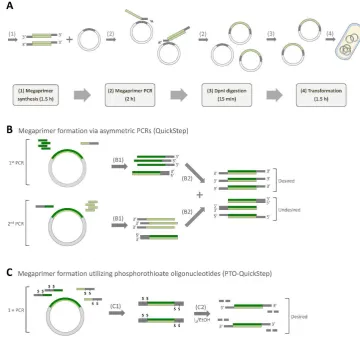
overhangs using two parallel asymmetric PCRs, followed by an exponential whole-plasmid amplification (Figure 1A). The key advantages offered by QuickStep include an exponential amplification (higher efficiency), point integration of DNA fragment at any desired position (higher flexibility), compatibility with low-efficiency bacterial transformation methods (e.g., CaCl2method), and time efficiency.
Figure 1.Overview of QuickStep and PTO-QuickStep. (A) Major steps of the method and estimated durations when cloning a 1 kb insert into a 7 kb recipient plasmid (adapted from [6,7]). (B) Molecular mechanism of megaprimer synthesis via two parallel asymmetric PCRs, featured in the original QuickStep method (B1: two asymmetric PCRs, B2: PCR purification and mixing of the products of the two asymmetric PCRs). (C) Molecular mechanism of megaprimer synthesis utilizing phosphorothioate (PTO) oligonucleotides, featured in PTO-QuickStep (C1: a standard PCR with PTO oligos, C2: iodine cleavage of PTO bonds via 5 min incubation in alkaline iodine solution. The short strands of DNA produced during the cleavage reaction are removed in a subsequent PCR purification).
The megaprimer synthesis stage in QuickStep involves two parallel asymmetric PCRs (Figure1B), which necessitate substantial preparation time. On top of that, megaprimers with 3′
overhangs are created by preparing an equimolar mixture of the two asymmetric PCR products. Ideally, each asymmetric PCR would produce only single-stranded DNA (ssDNA) as product, which forms a building block for the double-stranded megaprimer. In reality, the complementary strands with 5′
extension are also produced in each asymmetric PCR, albeit in a smaller amount. When the products of both asymmetric PCRs are mixed, these complementary strands with 5′
extension can either anneal (1) to 5′
extended strands, resulting in the formation of megaprimers with 5′
overhangs or (2) to 3′
extended strands, giving rise to blunt-ended megaprimers, as illustrated in Figure1B. These two types of undesired double-stranded megaprimers are “nonproductive” as they cannot be extended in the subsequent whole-plasmid amplification stage. To eliminate these two problems (the need for two asymmetric PCRs and the presence of the undesired megaprimers) and further simplify the method, we proposed phosphorothioate (PTO)-QuickStep. In this streamlined protocol, we replaced the two parallel asymmetric PCRs with a single conventional PCR using PTO oligonucleotides (Figure1C). 3′
nuclease degradation [8], which explains why this modification is commonly employed in therapeutic oligonucleotides [9]. PTO bond also exhibits chemical stability similar to a phosphodiester linkage [9]. Another interesting feature of PTO bond is that it is susceptible to iodine cleavage in alkaline solution. Selective strand cleavage is achieved through alkylation to form the hydrolytically labile PTO trimester [10]. This specific feature has been exploited in the development of several molecular biology tools, such as sequence saturation mutagenesis (random mutagenesis) [11–13], OmniChange (focused mutagenesis) [14], and PLICing (gene cloning) [15].
In this article, we present the optimized PTO-QuickStep. We demonstrated the applicability of PTO-QuickStep by applying it to cloning of the gene encoding the reductase domain of cytochrome P450 BM-3 (cpr, ~1.8 kb). We further extended the method to create a random mutagenesis library of a red fluorescent protein (mRFP1). This was the first attempt of coupling PTO-QuickStep and random mutagenesis.
2. Results and Discussion
2.1. PTO-QuickStep and its Optimization
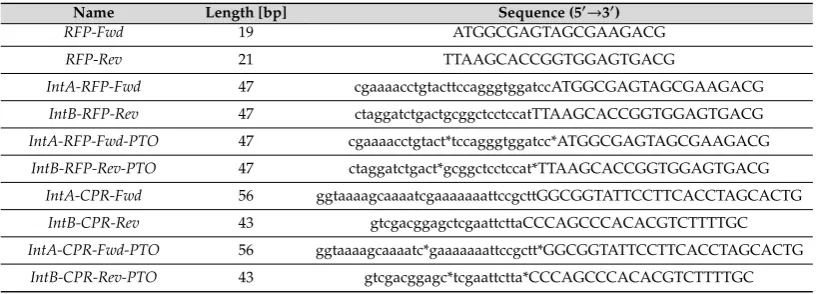
PTO-QuickStep was designed to streamline QuickStep-Cloning, which was reported previously by our group [6,7]. The objective was twofold: (1) to reduce the preparation time by replacing two parallel asymmetric PCRs with a single conventional PCR and (2) to remove unwanted by-products during megaprimer preparation (Figure1B). Compared to QuickStep, which requires four primers, PTO-QuickStep utilizes only two oligonucleotides, each containing two PTO modifications (Figure1C and Table1). PTO bonds were selectively cleaved by adding alkaline iodine solution to expose the 3′
[image:4.595.94.504.507.654.2]overhangs. We strategically incorporated two PTO modifications to build in a “fail-safe” mechanism in our design (Figure1C). Even if only one PTO bond was cleaved (i.e., incomplete iodine cleavage), the subsequent exponential megaprimer-based whole-plasmid amplification would still work. On top of that, shorter DNA fragments (half the length) were generated from iodine cleavage when two PTO modifications were used, which facilitated the subsequent removal of cleaved DNA fragments via a silica-based PCR purification.
Table 1.Primers used in this study (* represents the location of PTO modification, and DNA sequence in lowercase denotes the region complementary to the recipient plasmid).
Name Length [bp] Sequence (5′
→3′)
RFP-Fwd 19 ATGGCGAGTAGCGAAGACG
RFP-Rev 21 TTAAGCACCGGTGGAGTGACG
IntA-RFP-Fwd 47 cgaaaacctgtacttccagggtggatccATGGCGAGTAGCGAAGACG
IntB-RFP-Rev 47 ctaggatctgactgcggctcctccatTTAAGCACCGGTGGAGTGACG
IntA-RFP-Fwd-PTO 47 cgaaaacctgtact*tccagggtggatcc*ATGGCGAGTAGCGAAGACG
IntB-RFP-Rev-PTO 47 ctaggatctgact*gcggctcctccat*TTAAGCACCGGTGGAGTGACG
IntA-CPR-Fwd 56 ggtaaaagcaaaatcgaaaaaaattccgcttGGCGGTATTCCTTCACCTAGCACTG
IntB-CPR-Rev 43 gtcgacggagctcgaattcttaCCCAGCCCACACGTCTTTTGC
IntA-CPR-Fwd-PTO 56 ggtaaaagcaaaatc*gaaaaaaattccgctt*GGCGGTATTCCTTCACCTAGCACTG
IntB-CPR-Rev-PTO 43 gtcgacggagc*tcgaattctta*CCCAGCCCACACGTCTTTTGC
After the PCR with PTO oligonucleotides, 6.25µL of 0.5 M Tris-HCl buffer (pH 9) and 6.25µL of 100 mM iodine in absolute ethanol were added directly to the PCR product (50µL). After mixing, the mixture was incubated for 5 min at 70◦
C and then snap-cooled on ice to prevent the cleaved DNA fragments from reannealing to the exposed 3′
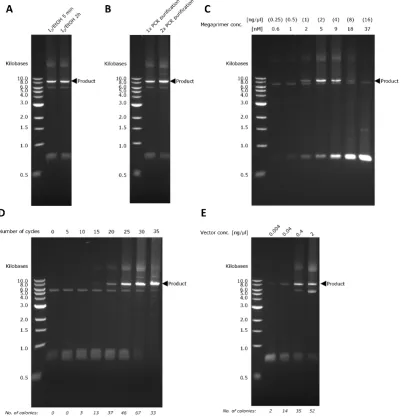
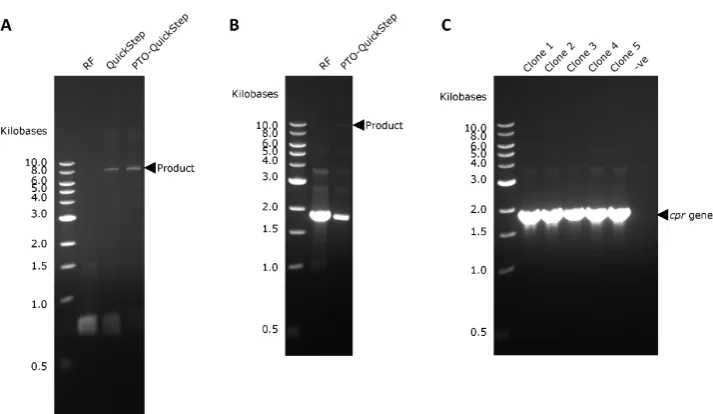
[image:5.595.99.502.279.699.2]overhangs. A quick silica column-based PCR purification was conducted before proceeding to the megaprimer PCR. This PCR purification step is necessary for two purposes: (1) to remove the cleaved DNA fragments, which are ssDNA molecules of 11–16 bases assuming a complete iodine cleavage of both PTO bonds (with a QIAquick PCR purification, only DNAs of 100 bp to 10 kb are purified) and (2) to remove ethanol that interferes with any downstream enzymatic reaction. As shown in Figure2A, there was no discernible difference when the incubation time in iodine solution was extended from 5 min to 2 h. We also investigated whether there was a need to add an additional PCR purification step just before the iodine cleavage. It is clear from Figure2B that an extra PCR purification step barely altered the final PCR yield. This indicated that the PCR mix did not interfere with the iodine cleavage, which was also observed in other studies [11–13].
Learning from our previous experience [6,7], the efficiency of exponential megaprimer-based whole-plasmid amplification is significantly influenced by megaprimer concentration, the number of PCR cycles, and recipient plasmid concentration. By varying megaprimer concentration between 0.25 ng/µL to 16 ng/µL, it was determined that the optimal PCR yield occurred at 2 ng/µL of megaprimer, which is equivalent to a concentration of 5 nM (Figure2C). Generally, we observed higher PCR product yield with increasing number of PCR cycles (Figure2D and Table2). However, as we increased the number of PCR cycles, we also noticed more side-products (indicated by the smears above and below the product band; Figure2D). For 35 cycles, the higher PCR product yield did not translate into higher cloning efficiency (Figure2D). This was most likely caused by a high amount of side-products that interfered with the subsequent chemical transformation. The same trend was observed when we varied the recipient plasmid concentration. Higher PCR product yield was obtained when we increased vector concentration, which was also accompanied with a higher side-product formation (Figure2E). Therefore, 2 ng/µL (5 nM) of megaprimer, 30 cycles, and 0.4 ng/µL of vector were chosen to be the most optimal conditions for a megaprimer PCR based on two considerations, namely, the amount of PCR side-products and the number of transformants obtained.
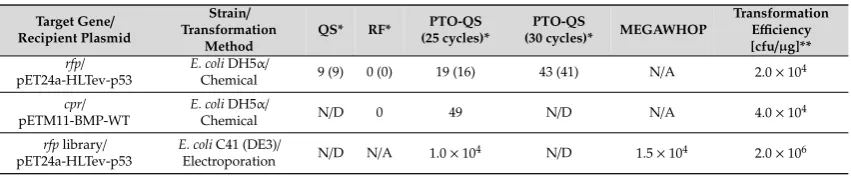
Table 2.Comparison of cloning efficiencies: QS: QuickStep; RF: restriction-free (RF) cloning; PTO-QS: PTO-QuickStep (*Numbers in bracket represent RFP-expressing clones; **intact recipient plasmids were used as reference plasmids; N/A=not applicable; N/D=not determined).
Target Gene/
Recipient Plasmid
Strain/
Transformation Method
QS* RF* PTO-QS
(25 cycles)*
PTO-QS
(30 cycles)* MEGAWHOP
Transformation Efficiency [cfu/µg]** rfp/
pET24a-HLTev-p53
E. coliDH5α/
Chemical 9 (9) 0 (0) 19 (16) 43 (41) N/A 2.0×10⁴
cpr/
pETM11-BMP-WT
E. coliDH5α/
Chemical N/D 0 49 N/D N/A 4.0×10⁴
rfplibrary/ pET24a-HLTev-p53
E. coliC41 (DE3)/
Electroporation N/D N/A 1.0×10⁴ N/D 1.5×10⁴ 2.0×10⁶
2.2. PTO-QuickStep is Superior to QuickStep-Cloning and RF Cloning
Figure 3.(A) Megaprimer PCR yield of RF cloning, QuickStep and PTO-QuickStep in therfpcloning experiment. (B) Yield of RF cloning and PTO-QuickStep in thecprcloning experiment. (C) Colony PCR confirming the presence ofcprgene in all five randomly selected clones from the cloning experiment using PTO-QuickStep.
It is important to note that all methods tested in this study (PTO-QuickStep, QuickStep, and RF) generated nicked circular plasmids. After transformation,E. colicells repaired the nicks in the plasmids. We also did a parallel transformation using intact circular plasmid (in this case, the recipient plasmid pET24a-HLTev-p53) as a reference. We achieved a transformation efficiency of 2×10⁴cfu/µg (Table2), which is equivalent to 20 colonies per 1 ng of intact plasmid. This benchmark was necessary for two reasons: (1) the number of transformants obtained in a gene cloning depends on the strain and the transformation method used, and (2) it is impossible to quantify the exact concentration of the desired product from a megaprimer PCR due to the presence of unavoidable side-products. The transformation efficiency of a nicked plasmid is widely known to be lower than that of an intact plasmid. This explains why the numbers of transformants from all cloning methods were lower than that of the reference plasmid.
2.3. Right-First-Time Cloning of P450 BM-3 Reductase Gene (cpr)
2.4. Applying PTO-QuickStep for Directed Protein Evolution
To maximize the potential of PTO-QuickStep, we applied the protocol to prepare a random
mutagenesis library for directed evolution. rfp gene was once again used as a model system.
However, this time, random mutations were introduced intorfpgene by amplifying the gene using PTO oligonucleotides and Taq DNA polymerase in the presence of imbalanced deoxynucleoside triphosphate (dNTP) concentrations and MnCl2. In other words, a standard error-prone PCR (epPCR) condition was used. After the epPCR and iodine cleavage, we proceeded to megaprimer PCR as per usual. Again, for a more objective comparison, 25 cycles of megaprimer PCR were used. Concurrently, we prepared another random mutagenesis library following the megaprimer PCR of whole plasmid (MEGAWHOP) protocol [18]. It should be noted that, in order to perform MEGAWHOP, the target gene (in this case,rfpgene) must first be precloned into the expression vector. This prerequisite would mean an extra step when applying MEGAWHOP compared to PTO-QuickStep. However, the advantage is a higher number of transformants due to better annealing of the megaprimers (the complementary region is essentially the entire target gene). When we transformed the products of
both PTO-QuickStep and MEGAWHOP intoE. coliC41 (DE3) using electroporation, we obtained
comparable library sizes (Table2), despite the fact that a suboptimal number of cycles (25 instead of 30) for megaprimer PCR was used for PTO-QuickStep to allow for an objective comparison between the two methods. Contrary to gene cloning experiments described above, electroporation was applied here to demonstrate that the number of transformants obtained (and consequently the library size in the case of a directed evolution experiment) can easily be upscaled through a more efficient transformation method. It is worth noting that a transformation efficiency of 2×10⁶cfu/µg DNA was obtained using electrocompetent cells prepared in-house. This efficiency is far lower than that of commercially available ultracompetent cells (>1× 10⁹ and >1× 10¹⁰ cfu/µg pUC19 DNA for chemically competent and electrocompetent cells, respectively). As such, the library size can be further increased by more than three orders of magnitude by combining the product of PTO-QuickStep with commercial ultracompetent cells. Nonetheless, our data showed that both chemical transformation and electroporation are compatible with PTO-QuickStep. The choice is dependent on the number of transformants required and the application.
2.5. mRFP1 Variants Isolated from PTO-QuickStep Library
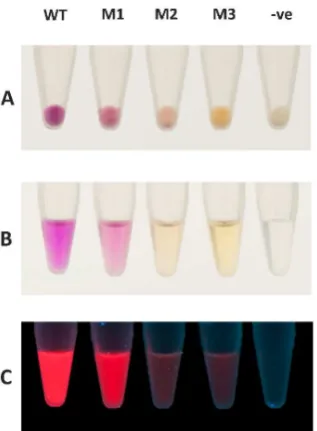
Three mRFP1 protein variants exhibiting a different color under visible light were isolated from the PTO-QuickSteprfplibrary for further characterization (Figure4). These variants displayed different absorption spectra (Figure5). The purified mRFP1 wild type showed an excitation maximum of 585 nm, consistent with previously reported values [16,19,20]. All variants (M1–M3) had blue-shifted excitation maxima. M1, the brightest variant of all, had two absorption peaks of almost equal height at 503 nm and 584 nm.
Figure 4.Comparison between mRFP1 wild type (WT) and the three variants (M1, M2, and M3) isolated from the PTO-QuickStep library. (A) Cell pellets ofE. coliC41 (DE3) expressing the red fluorescent proteins. (B) Proteins purified using Ni-NTA Spin Columns (Qiagen). (C) Purified proteins under UV light. (-ve) denotes negative control, i.e.,E. coliC41 (DE3) without a plasmid.
Figure 5. Normalized absorption spectra of mRFP1 wild type (WT; red) and the three variants [M1 (green), M2 (purple), and M3 (blue)].
Table 3. Nucleotide and amino acid substitutions found in the three isolated RFP variants (M1, M2, and M3).
RFP Variants Nucleotide Substitution Amino Acid Substitution
M1 ACC→TCC T195S
M2 TTC→CTC F91L
M3 CAG
→CTG Q66L
ACC→GCC T202A
2.6. PTO-QuickStep: Potential Limitations and Mitigation
[image:9.595.131.465.606.679.2]different transformation methods, depending on application and need. For example, electroporation generates a larger library for directed evolution experiment. Potential means to further increase the library size include the use of commercially available ultracompetent cells or treating the PTO-QuickStep product with nick-repairing enzymes prior to transformation (e.g., New England Biolabs’ PreCR Repair Mix).
As is the case with most PCRs or PCR-based methods, the success hinges on the correct primer design. PTO-QuickStep requires only a pair of PTO-modified primers compared to four primers needed for QuickStep. This change should minimize the chances of incorrect primer design. As PTO chemistry is one of the cheapest oligonucleotide modifications available, both primer configurations have the same price (£12 for either a pair of desalted PTO primers used for RFP-cloning experiments or four desalted unmodified oligos needed for the original QuickStep, as given by Eurofins Genomics).
It should be pointed out that both PTO-QuickStep and QuickStep are optimized for point insertion of DNA. They are not the methods of choice for gene replacement. Furthermore, the method has not been tested for simultaneous cloning of multiple fragments, although there is a possibility of incorporating an overlapping PCR into the method to create a megaprimer composed of several fragments.
A comparison between therfpandcprcloning experiments (Table2and Figure3) indicates that the cloning efficiency decreases with increasing length of either the target gene or the recipient plasmid, with the latter appearing to have a more profound effect. This is often observed with methods relying on whole-plasmid amplification, such as the QuikChange protocols for focused mutagenesis. As such, for more challenging cloning experiments (for example, when a target gene is longer than 2 kb), a standard CaCl2chemical transformation protocol might prove insufficient, and the use of a more efficient transformation method (e.g., electroporation or commercially available competent cells) is therefore advised.
3. Materials and Methods
3.1. Materials
All enzymes, deoxyribonucleotides, and DNA ladders were purchased from New England Biolabs Ltd. (Hitchin, UK).
3.2. Primers
All primers used in this study (Table1) were synthesized by Eurofins Genomics (Ebersberg, Germany). The melting temperatures of oligonucleotides were determined using the NEB Tm calculator (https://tmcalculator.neb.com/#!/main).
3.3. QuickStep-Cloning
To clonerfpgene from pBbA8k-RFP into pET24a-HLTev-p53, two asymmetric PCRs were carried out in parallel. Asymmetric PCR mixture I (50µL) contained 1× Q5 reaction buffer, 200µM of
each dNTP, 500 nMRFP-Fwdprimer, 10 nMIntB-RFP-Revprimer, 0.2 ng pBbA8k-RFP, and 1 U Q5
High-Fidelity DNA Polymerase. Asymmetric PCR mixture II (50µL) contained 1×Q5 reaction buffer,
200µM of each dNTP, 10 nMIntA-RFP-Fwdprimer, 500 nMRFP-Revprimer, 0.2 ng pBbA8k-RFP,
and 1 U Q5 High-Fidelity DNA Polymerase. Both mixtures were thermocycled using the following conditions: (i) 30 s initial denaturation at 98◦
C and (ii) 30 cycles of 7 s denaturation at 98◦
C, 20 s annealing at 68◦
C, and 30 s extension at 72◦
C. The two PCR products were purified using QIAquick PCR Purification Kit (Qiagen, Manchester, UK), and their DNA concentrations were determined using VersaWave Microvolume Spectrophotometer (Expedeon, Cambridge, UK). For megaprimer PCR, the mixture (50µL) contained 1×Q5 reaction buffer, 200µM of each dNTP, 200 ng of purified asymmetric PCR product I, 200 ng of purified asymmetric PCR product II, 20 ng pET24a-HLTev-p53, and 1 U Q5 High-Fidelity DNA Polymerase. The mixture was thermocycled using the following conditions: (i) 30 s initial denaturation at 98◦
C; (ii) 25 cycles of 10 s denaturation at 98◦
at 72◦
C; and (iii) 2 min final extension at 72◦
C. Forty units of DpnI were subsequently added to the PCR mixture and incubated at 37◦
C for 15 min to remove the parental plasmids.
3.4. Restriction-Free (RF) Cloning
PCR mixture (50µL) containing 1×Q5 reaction buffer, 200µM of each dNTP, 500 nMIntA-RFP-Fwd primer, 500 nMIntB-RFP-Revprimer, 0.2 ng pBbA8k-RFP, and 1 U Q5 High-Fidelity DNA Polymerase was thermocycled using the same program as the asymmetric PCR in QuickStep-Cloning: (i) 30 s initial denaturation at 98◦
C and (ii) 30 cycles of 7 s denaturation at 98◦
C, 20 s annealing at 68◦
C, and 30 s extension at 72◦
C. The PCR product was purified using QIAquick PCR Purification Kit (Qiagen), and its DNA concentration was determined using VersaWave Microvolume Spectrophotometer. Megaprimer PCR mixture (50µL) containing 1×Q5 reaction buffer, 200 nM of each dNTP, 400 ng of purified PCR product, 20 ng pET24a-HLTev-p53, and 1 U Q5 High-Fidelity DNA Polymerase was thermocycled using the following conditions: (i) 30 s initial denaturation at 98◦
C; (ii) 25 cycles of 10 s denaturation at 98◦
C, 4 min annealing and extension at 72◦
C; and (iii) 2 min final extension at 72◦
C. Forty units of DpnI were added to the PCR mixture and incubated at 37◦
C for 15 min to remove the parental plasmids.
To clone P450 BM-3 reductase gene (cpr) from pCWori-BM3 into pETM11-BMP-WT, the same
protocol was followed using a dedicated primer set (IntA-CPR-FwdandIntB-CPR-Rev). For the first PCR, the following thermocycling conditions were used: (i) 30 s initial denaturation at 98◦
C and (ii) 30 cycles of 7 s denaturation at 98◦
C, 80 s annealing and extension at 72◦
C. The PCR product was purified as described above. Subsequently, megaprimer PCR mixture (50µL) containing 1×Q5 reaction buffer, 200 nM of each dNTP, 500 ng of purified PCR product, 25 ng pETM11-BMP-WT, and 1 U Q5 High-Fidelity DNA Polymerase was thermocycled using the following conditions: (i) 30 s initial denaturation at 98◦
C; (ii) 25 cycles of 10 s denaturation at 98◦
C, 20 s annealing at 66◦
C, and 4 min extension at 72◦
C; and (iii) 2 min final extension at 72◦
C. Forty units of DpnI were added to the PCR mixture and incubated at 37◦
C for 15 min to remove the parental plasmids.
3.5. PTO-QuickStep
PCR mixture (50 µL) containing 1× Q5 reaction buffer, 200 µM of each dNTP, 500 nM
IntA-RFP-Fwd-PTO primer, 500 nM IntB-RFP-Rev-PTO primer, 0.2 ng pBbA8k-RFP, and 1 U Q5 High-Fidelity DNA Polymerase was thermocycled using the same program as the asymmetric PCR in QuickStep-Cloning: (i) 30 s initial denaturation at 98◦
C and (ii) 30 cycles of 7 s denaturation at 98◦
C, 20 s annealing at 68◦
C, and 30 s extension at 72◦
C.
After PCR, 6.25µL of 0.5 M Tris-HCl buffer (pH 9) and 6.25µL of 100 mM iodine in absolute ethanol were added directly to the PCR product. After brief mixing by pipetting, the mixture was incubated for 5 min at 70◦
C and then snap-cooled on ice.
Subsequently, the mixture was purified using QIAquick PCR Purification Kit (Qiagen), and its DNA concentration was determined using VersaWave Microvolume Spectrophotometer. Megaprimer PCR mixture (50µL) containing 1×Q5 reaction buffer, 200 nM of each dNTP, 100 ng of purified PCR product, 20 ng pET24a-HLTev-p53, and 1 U Q5 High-Fidelity DNA Polymerase was thermocycled using the same program as the QuickStep-Cloning megaprimer PCR: (i) 30 s initial denaturation at 98◦
C; (ii) 25 cycles of 10 s denaturation at 98◦
C, 4 min annealing and extension at 72◦
C; and (iii) 2 min final extension at 72◦
C. Forty units of DpnI were added to the PCR mixture and incubated at 37◦
C for 15 min to remove the parental plasmids.
To clone P450 BM-3 reductase gene (cpr) from pCWori-BM3 into pETM11-BMP-WT, the same
protocol was followed using a dedicated primer set (IntA-CPR-Fwd-PTOandIntB-CPR-Rev-PTO). For the first PCR, the following thermocycling conditions were used: (i) 30 s initial denaturation at 98◦
C and (ii) 30 cycles of 7 s denaturation at 98◦
C, 80 s annealing and extension at 72◦
denaturation at 98◦
C; (ii) 25 cycles of 10 s denaturation at 98◦
C, 20 s annealing at 66◦
C, and 4 min extension at 72◦
C; and (iii) 2 min final extension at 72◦
C. Forty units of DpnI were added to the PCR mixture and incubated at 37◦
C for 15 min to remove the parental plasmids.
3.6. DNA Gel Electrophoresis
PCR products were analyzed using 0.7% tris-borate-ethylenediaminetetraacetic acid (TBE) gel. For visualization purposes, ethidium bromide was added to the gel. Quick-Load 1 kb DNA Ladder was used as a DNA ladder.
3.7. Chemical Transformation and Clone Analysis
E. coli DH5α and C41 (DE3) were transformed with 5 µL of DpnI-digested products of QuickStep-Cloning, RF cloning, or PTO-QuickStep using a standard CaCl2chemical transformation protocol. Concurrently, the bacterial strains were transformed with 1 ng of intact pET24a-HLTev-p53 or pETM11-BMP-WT to estimate the transformation efficiency. Transformed bacteria were plated on TYE agar plates (10 g/L tryptone, 5 g/L yeast extract, 8 g/L sodium chloride, and 15 g/L agar) supplemented with 50µg/mL kanamycin and 1 mM isopropylβ-D-1-thiogalactopyranoside (IPTG) (only forrfp cloning experiment). The plates were incubated overnight at 37◦
C and for a further 12 h at 30◦
C. The number of mRFP1-expressing colonies was determined by visual inspection using UV transilluminator.
3.8. Error-Prone PCR
PCR mixture (50µL) containing 1×Standard Taq (Mg-free) reaction buffer, 7 mM MgCl2, 0.05 mM MnCl2, 200µM of deoxyadenosine triphosphate (dATP), 200µM of deoxyguanosine triphosphate (dGTP), 1 mM of deoxythymidine triphosphate (dTTP), 1 mM of deoxycytidine triphosphate (dCTP),
400 nM IntA-RFP-Fwd-PTO or IntA-RFP-Fwdprimer (depending on whether PTO-QuickStep or
MEGAWHOP was used, respectively), 400 nMIntB-RFP-Rev-PTOor IntB-RFP-Revprimer, 50 ng
pBbA8k-RFP, and 1.25 U Taq DNA Polymerase was thermocycled using the same program as the asymmetric PCR in QuickStep-Cloning: (i) 30 s initial denaturation at 95◦
C; (ii) 30 cycles of 20 s denaturation at 95◦
C, 30 s annealing at 55◦
C, and 45 s extension at 68◦
C; and (iii) final extension at 68◦
C for 5 min. The PCR product was purified using QIAquick PCR Purification Kit (Qiagen), and its DNA concentration was determined using VersaWave Microvolume Spectrophotometer.
3.9. MEGAWHOP
Megaprimer PCR mixture (50µL) containing 1× Q5 reaction buffer, 200 nM of each dNTP, 500 ng megaprimer, 50 ng pET24a-HLTev-RFP-p53, and 1 U Q5 High-Fidelity DNA Polymerase was thermocycled using the following conditions: (i) 30 s initial denaturation at 98◦
C; (ii) 25 cycles of 10 s denaturation at 98◦
C, 4 min annealing and extension at 72◦
C; and (iii) 2 min final extension at 72◦
C. Forty units of DpnI were added to the PCR mixture and incubated at 37◦
C for 15 min to remove the parental plasmids.
3.10. Transformation of mRFP1 Library
The products of PTO-QuickStep and MEGAWHOP were purified using QIAquick PCR Purification Kit (Qiagen). One microliter of the purified mixture was used to transformE. coliC41 (DE3) cells using a standard electroporation protocol. After the transformation, the cells were plated at different dilutions on Luria–Bertani (LB) agar plates (10 g/L tryptone, 5 g/L yeast extract, 10 g/L sodium chloride, and 15 g/L agar) supplemented with 50µg/mL kanamycin and 1 mM IPTG. The plates were incubated overnight at 37◦
C and for a further 12 h at 30◦
C. Three colonies exhibiting a different color under visible light compared to that of the mRFP1 wild type were identified by visual inspection and were grown overnight at 37◦
3.11. mRFP1 Expression and Purification
Overnight cultures (250µL) ofE. coliC41 (DE3) corresponding to mRFP1 wild type and the three isolated variants were used to inoculate 50 mL LB medium supplemented with 50µg/mL kanamycin and grown at 37◦
C with shaking. When OD600reached 0.6, the expression was induced with 1 mM IPTG. The cells were grown for a further 16 h. The proteins were purified using Ni-NTA Spin Columns (Qiagen) according to the manufacturer’s instructions. The absorbance measurements were conducted using UV-1600PC UV-VIS spectrophotometer (VWR International, Lutterworth, UK).
4. Conclusions
By applying two PTO modifications and strategically placing these PTO bonds within the PCR primers, we streamlined the workflow of QuickStep, enhanced its efficiency, and extended its application to directed evolution. PTO-QuickStep would be of great interest to the synthetic biology community as it facilitates fast, flexible, and efficient construction of recombinant plasmids. This study has also demonstrated that PTO-QuickStep is expected to make a significant contribution to the field of protein engineering.
Author Contributions: T.S.W. supervised the project. P.J., K.L.T., and T.S.W. designed the PTO-QuickStep method. P.J. and K.L.T. conducted all the experiments. P.J. and T.S.W. analyzed the data. K.L.T. and T.S.W. wrote the manuscript.
Funding:We thank the Department of Chemical & Biological Engineering, ChELSI, EPSRC (EP/E036252/1), BBSRC (BB/R020183/1), the RAEng/Leverhulme Trust Senior Research Fellowship (to T.S.W.), the University of Sheffield GCRF Fellowship (to K.L.T.), and the University of Sheffield PhD Scholarship (to P.J.) for financial support.
Conflicts of Interest:The authors declare no conflict of interest.
Abbreviations
bp base pair
cfu colony-forming unit DNA deoxyribonucleic acid dATP deoxyadenosine triphosphate dCTP deoxycytidine triphosphate dGTP deoxyguanosine triphosphate dNTP deoxynucleoside triphosphate dTTP deoxythymidine triphosphate epPCR error-prone polymerase chain reaction IPTG isopropylβ-D-1-thiogalactopyranoside
kb kilobase
LB Luria–Bertani
MEGAWHOP megaprimer PCR of whole plasmid PCR polymerase chain reaction
PTO phosphorothioate RF restriction-free RFP red fluorescent protein
ssDNA single-stranded deoxyribonucleic acid TBE tris-borate-ethylenediaminetetraacetic acid
References
1. Tee, K.L.; Wong, T.S. Polishing the craft of genetic diversity creation in directed evolution.Biotechnol Adv. 2013,31, 1707–1721. [CrossRef] [PubMed]
2. Tee, K.L.; Wong, T.S. Basic to basics: Creating genetic diversity. InDirected Enzyme Evolution: Advances and
Applications; Alcalde, M., Ed.; Springer, Cham: Basel, Switzerland, 2017; pp. 201–227.
4. Smith, H.O.; Wilcox, K.W. A restriction enzyme from hemophilus influenzae. I. Purification and general properties.J. Mol. Biol.1970,51, 379–391. [CrossRef]
5. Hughes, R.A.; Ellington, A.D. Synthetic DNA synthesis and assembly: Putting the synthetic in synthetic biology.Cold Spring Harb Perspect Biol.2017, 9. [CrossRef] [PubMed]
6. Jajesniak, P.; Wong, T.S. Quickstep-cloning: A sequence-independent, ligation-free method for rapid construction of recombinant plasmids.J. Biol. Eng.2015,9, 15. [CrossRef] [PubMed]
7. Jajesniak, P.; Wong, T.S. Rapid construction of recombinant plasmids by quickstep-cloning.Methods Mol.
Biol.2017,1472, 205–214. [PubMed]
8. Putney, S.D.; Benkovic, S.J.; Schimmel, P.R. A DNA fragment with an alpha-phosphorothioate nucleotide at one end is asymmetrically blocked from digestion by exonuclease iii and can be replicated in vivo.Proc Natl.
Acad. Sci. USA1981,78, 7350–7354. [CrossRef] [PubMed]
9. Wan, W.B.; Seth, P.P. The medicinal chemistry of therapeutic oligonucleotides. J. Med. Chem. 2016, 59, 9645–9667. [CrossRef]
10. Gish, G.; Eckstein, F. DNA and rna sequence determination based on phosphorothioate chemistry.Science 1988,240, 1520–1522. [CrossRef]
11. Wong, T.S.; Tee, K.L.; Hauer, B.; Schwaneberg, U. Sequence saturation mutagenesis (sesam): A novel method for directed evolution.Nucleic Acids Res.2004,32, e26. [CrossRef]
12. Wong, T.S.; Roccatano, D.; Loakes, D.; Tee, K.L.; Schenk, A.; Hauer, B.; Schwaneberg, U. Transversion-enriched sequence saturation mutagenesis (sesam-tv+): A random mutagenesis method with consecutive nucleotide exchanges that complements the bias of error-prone pcr.Biotechnol. J.2008,3, 74–82. [CrossRef] [PubMed] 13. Wong, T.S.; Tee, K.L.; Hauer, B.; Schwaneberg, U. Sequence saturation mutagenesis with tunable mutation
frequencies.Anal. Biochem.2005,341, 187–189. [CrossRef] [PubMed]
14. Dennig, A.; Marienhagen, J.; Ruff, A.J.; Schwaneberg, U. Omnichange: Simultaneous site saturation of up to five codons.Methods Mol. Biol.2014,1179, 139–149. [PubMed]
15. Blanusa, M.; Schenk, A.; Sadeghi, H.; Marienhagen, J.; Schwaneberg, U. Phosphorothioate-based ligase-independent gene cloning (plicing): An enzyme-free and sequence-independent cloning method.
Anal. Biochem.2010,406, 141–146. [CrossRef] [PubMed]
16. Shaner, N.C.; Campbell, R.E.; Steinbach, P.A.; Giepmans, B.N.; Palmer, A.E.; Tsien, R.Y. Improved monomeric red, orange and yellow fluorescent proteins derived from discosoma sp. Red fluorescent protein.Nat. Biotechnol.2004,22, 1567–1572. [CrossRef] [PubMed]
17. van den Ent, F.; Lowe, J. Rf cloning: A restriction-free method for inserting target genes into plasmids.
J. Biochem. Biophys Methods2006,67, 67–74. [CrossRef] [PubMed]
18. Miyazaki, K.; Takenouchi, M. Creating random mutagenesis libraries using megaprimer pcr of whole plasmid.
Biotechniques2002,33, 1033–1034, 1036–1038. [CrossRef] [PubMed]
19. Jach, G.; Pesch, M.; Richter, K.; Frings, S.; Uhrig, J.F. An improved mrfp1 adds red to bimolecular fluorescence complementation.Nat. Methods2006,3, 597–600. [CrossRef]
20. Campbell, R.E.; Tour, O.; Palmer, A.E.; Steinbach, P.A.; Baird, G.S.; Zacharias, D.A.; Tsien, R.Y. A monomeric red fluorescent protein.Proc. Natl. Acad. Sci. USA2002,99, 7877–7882. [CrossRef]
21. Wong, T.S.; Zhurina, D.; Schwaneberg, U. The diversity challenge in directed protein evolution.Comb. Chem.
High Throughput Screen2006,9, 271–288. [CrossRef]
22. Li, Y.; Tsien, R.W. Phtomato, a red, genetically encoded indicator that enables multiplex interrogation of synaptic activity.Nat. Neurosci.2012,15, 1047–1053. [CrossRef] [PubMed]