Int. J. Electrochem. Sci., 8 (2013) 973 - 982
International Journal of
ELECTROCHEMICAL
SCIENCE
www.electrochemsci.orgElectrochemical Corrosion Performance of AISI D2 Tool Steel
Surface Hardened by Pulsed Plasma Nitriding
Díaz-Guillén J.C.1,*, Díaz-Guillén J.A.2
, Granda-Gutiérrez E.E.1, Díaz-Guillén M.R., González-Albarrán M.A.1
1
Corporación Mexicana de Investigación en Materiales S.A. de C.V. Ciencia y Tecnología 790, Fracc. Saltillo 400. Saltillo, Coahuila. México C.P. 25290.
2
Instituto Tecnológico de Saltillo. Blvd. V. Carranza 2400, Colonia Tecnológico. Saltillo, Coahuila. México C.P. 25280.
*
E-mail: [email protected]
Received: 20 November 2012 / Accepted: 6 December 2012 / Published: 1 January 2013
In this work, the role played by temperature and discharge current density on surface properties of pulse-plasma nitrided AISI D2 tool steel is evaluated. Samples were nitrided at different temperatures (450, 500 and 550°C) using current densities (0.5, 1 and 2 mA/cm2
). The evolution of crystalline phases and thickness of modified layers were examined by X-ray diffraction and Scanning Electron Microscopy respectively. Surface micro-hardness measurements were performed by using a Vickers indenter (load of 0.3kgf and test time of 10s) and finally, electrochemical corrosion performance in chloride ion-rich solutions was evaluated by using the potentiodynamic polarization technique according to the ASTM G5 method. Results show that plasma nitriding process promotes the generation of a different thickness nitrided layer (from 40 m to 100 m) composed mainly by Fe3N,
Fe4N and CrN. This layer significantly improves the surface hardness of this alloy from 594 to
approximately 1800 HV0.3kgf for untreated and plasma nitrided samples (450 °C – 2 mA/cm2
) respectively. The evaluation of corrosion performance showed a decrease in corrosion rate values for samples nitrided at 450°C, in respect to untreated samples. Corrosion rates of 5.1X10⁻³
, 6.7X10⁻³ and 2.8X10⁻³ mm/year were obtained for samples nitrided at 450 °C using nitriding current densities of 0.5, 1 and 2 mA/cm2 respectively, all these values are below the corresponding value of untreated samples, 1X10⁻² mm/year, which represents an important increase in corrosion resistance as a consequence of nitriding process.
1. INTRODUCTION
Series D cold work tool steels, also known as die steels, are high alloy steels Fe-Cr-C-base. AISI D2 is one of the most popular high-carbon and high-chromium steels of this series and it is characterized by its high wear resistance and compressive strength, good through-hardening properties, high stability in hardening and good resistance to tempering-back. This alloy has the ability to retain its desirable mechanical properties intact upon cycling over a range of temperatures, which can be an advantage for applications including, piercing and blanking dies, punches, shear blades, spinning tools, slitting cutters, as well as variety of higher-end wood working tools [1,2,3].
Despite good mechanical properties of D2 steel, the lifetime of pieces and accessories fabricated with this alloy is negatively affected by the increase in the severity of operating conditions due to continuing evolution of industrial processes and corrosive operation environments [4]. Therefore, the need for corrosion protection and wear resistance has increased rapidly in recent years, opening up a considerable number of opportunities for new technologies aimed at reducing such problematic [5].
In fact, great efforts have been carried out in order to improve the corrosion and mechanical surface properties of AISI D2 by using a variety of hard coatings. Currently many different types of thin hard coatings (TiN, CrN, Cr2N) have been applied on tools and dies made of D2 steels by
chemical vapor deposition (CVD) [6], physical vapor deposition (PVD) [7] and its variants with plasma assisted methods. Unfortunately, several problems such as low adhesion, high temperature process, log time processing, as well as chemical and safety hazards caused by the use of toxic, corrosive, flammable and/or explosive precursor gases have not been completely solved [1].
Alternative to PVD and CVD processes, the plasma enhanced thermochemical treatments such as ion nitriding and nitrocarburizing, continue to be technologically attractive techniques to increase the lifetime of D2 components without the inherent problems of PVD and CVD techniques. It is known that plasma nitriding process, which is usually carried out at temperatures below 600 °C, imparts resistance to the wear [8] corrosion [9] and fatigue [10] of iron alloys, however, the search for optimal processing parameters to achieve the suitable properties of these iron alloys has not been completely established. Zukerman et. al. [11] report that there is still some uncertainty regarding the choice of the underlying nitride layer that imparts the best performance and some contradictory results have been reported in the literature [7]. In general, it has been reported that surface performance is related mainly to the control of the plasma nitriding processing conditions in relation to the quality of the nitrided layer, as well as nature and the relative amount of the iron nitrides formed [12,13].
2. EXPERIMENTAL SETUP
A commercial AISI D2 tool steel plate was cut into 20 mm square samples. The specimens were heat treated at 815°C for 20 minutes, austenitized at 1000°C during 28 minutes and subsequently quenched and double tempered at 200°C for 60 minutes. After heat treatment, all samples were progressively ground down to 1200 grit size using a series of SiC emery paper and polished using a 1
m diamond suspension to remove oxides or contaminants and to homogenize their surface. Finally, previously plasma nitriding process, samples were cleaned ultrasonically while immersed in acetone.
Pulsed plasma nitriding was carried out using a processing equipment [14] which consists of a vacuum chamber containing a central cathode biased by negative high voltage pulses. Plasma is generated and sustained by an IGBT (Insulated Gate Bipolar Transistor) based DC pulsed power supply unit which provides precise adjustments of discharge current, pulse frequency and duty cycle. An auxiliary heating system offers full control over the sample temperature, which is measured by a K-type thermocouple directly fastened on the processing samples. Mass flow controllers allow the precise control of pressure and gas mixture inside the vacuum chamber.
In order to evaluate the effect of both, processing temperature and nitriding current density on surface properties of AISI D2 tool steel, pulsed plasma nitriding process was conducted at temperatures of 450, 500 and 550 °C and discharge current densities of 0.5, 1 and 2 mA/cm2
. Discharge current density was computed through quotient: discharge current (measured in a sampling resistor) / cathode total area. The following parameters were kept constant: process duration 4 h, gas mixture 50% H2 50% N2, work pressure 2 torr, pulse frequency and duty cycle 1000 Hz and 50%,
respectively.
After surface treatment, samples were cross sectioned and metallographically prepared for observation by Scanning Electron Microscopy (SEM) and the modified layer thickness was measured by means of image analysis. Surface hardness measurements were performed for untreated and nitrided samples using a Vickers indenter, load of 0.3 kgf and test time of 10s. Corrosion performance in chloride ion-rich solutions of untreated and nitrided samples was evaluated by using the potentiodynamic polarization technique using the test sample as work electrode (1 cm2 evaluating area), according to the ASTM G5 method [15]. A calomel electrode was used as a reference and graphite as a counter electrode in 3% NaCl solution in double distilled water as electrolyte at 26°C. The electrode potential was raised in an interval from -1000 mV to -100 mV with the scanning rate of 60 mV/min. Electrochemical corrosion rate was computed through the Tafel extrapolation method.
In order to evaluate the evolution of crystalline phases as consequence of pulsed plasma nitriding process, the phases near the surface of nitrided samples were identified using X-ray diffraction analysis (radiation CuK=1.5418 Å) in a Philips X´Pert diffractometer at a scanning rate of 0.02°/s over the range 2 = 35-90°. Identification of crystalline phases was carried out by comparison of experimental data with the ICDD database.
3. RESULTS AND DISCUSSION
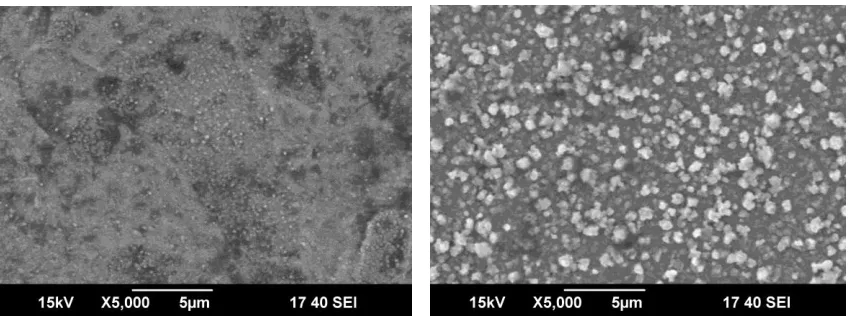
tool steel. Observations of the nitrided samples’ surfaces, which was as mirror polished previous to nitriding, showed an evident increase in the visual roughness as a consequence of nitriding process; such phenomenon (which could be also reported as increase in size of the semispherical particles formed on the nitrided surface) is increased together with the increase of both: processing temperature and nitriding current density. Accordingly, Figure 1a) shows the lowest observed roughness (sample 0.5 mA/cm2 at 450°C) while Figure 1b) shows the major roughness level, which occurred at the highest values of temperature and current density (2 mA/cm2 at 550°C). The obtaining of rougher surfaces by plasma assisted process has been related to an ionic erosion phenomena (sputtering), generated by the impinging of ions from the plasma on the surface of a processing piece [16,17]. It has been reported that both, temperature and discharge current density, increase the effect of sputtering phenomenon [18].
[image:4.596.87.511.283.441.2]
Figure 1. SEM Surface views of samples after nitriding process at a) 0.5 mA/cm2- 450°C (left) and b) 2 mA/cm2- 550°C (right) (no chemical etching).
Figure 2. Typical cross view (SEM) of plasma nitrided AISI D2.
[image:4.596.182.414.506.682.2]
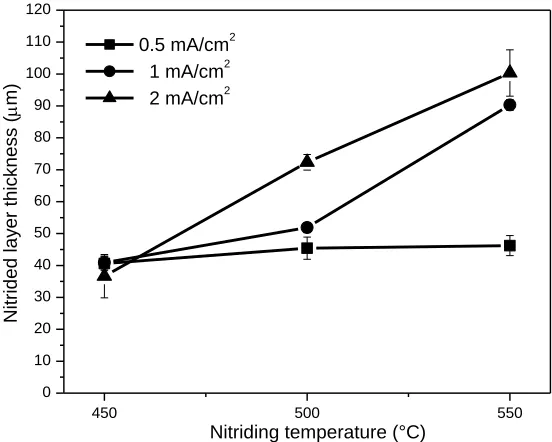
Typical cross section view of plasma nitriding modified region is appreciated and remarked at the top of Figure 2. Thickness of nitrided layer was measured by SEM and Figure 3 shows the influence of nitriding temperature and current density on this parameter. Plasma nitriding promotes the generation of a nitrided layer with a varying thickness of about 40 µm for samples processed at 450°C to approximately 100 µm for samples nitrided at 550°C and 2 mA/cm2
.
450 500 550
0 10 20 30 40 50 60 70 80 90 100 110 120
Ni
trid
ed
la
y
er
thickn
ess
(
m)
Nitriding temperature (°C) 0.5 mA/cm2
[image:5.596.159.435.177.398.2]1 mA/cm2 2 mA/cm2
Figure 3. Influence of temperature and discharge current density on nitrided layer thickness.
Results show that at the lowest nitriding temperature (450°C), nitriding current density has no significant effect on the thickness of nitrided layers; however this effect is significant when the temperature of the samples is raised. Hence, it is clear that thicker nitrided layers are produced when process is carried out at higher nitriding current densities and temperatures. The increase of nitrided layer thickness as a consequence of increasing of discharge current density can be related to plasma ion population. It is well established that the plasma density in a gaseous glow discharge increase when the current density rises [19]. Consequently, when nitriding current density increases, the availability of active nitrogen ions on a sample´s surface will be greater (increase in nitrogen chemical potential) and therefore more nitrogen atoms will be incorporated into the surface and subsurface of the sample. Likewise, diffusion process of nitrogen towards the steel is a thermal-dependent phenomenon which is favored by the rise of temperature, thus promoting major and deeper incorporation of nitrogen atoms.
450 500 550
1000 1200 1400 1600 1800 2000 2200
0.5 mA/cm2 1 mA/cm2 2 mA/cm2
Mi cro -H ar dn ess (HV 300g )
[image:6.596.156.438.76.298.2]Nitriding Temperature (°C)
Figure 4. Effect of nitriding temperature and discharge current density on nitrided AISI D2 surface micro-hardness.
40 45 50 55 60 65 70 75 80 85
´ ´ ´ ´ ´ ´ ´ ´
550 °C / 2 mA/cm2
450 °C / 2 mA/cm2
Untreated D2 ´ ´
Iron (Cr,Fe)7C3
Fe
3N ´ Fe4N
CrN Fe2C
Abso lu te Inten sity (a .u.)
Angle 2 Theta (Degrees)
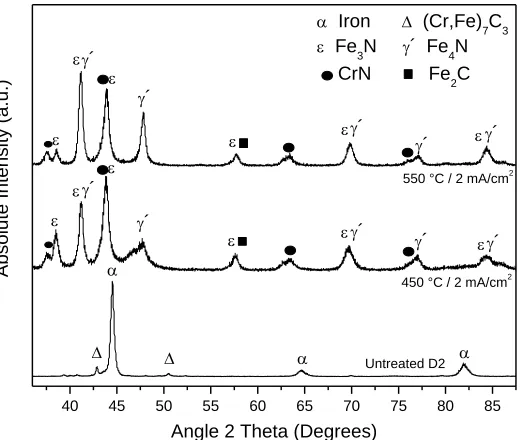
Figure 5. XRD patterns for untreated and plasma nitrided D2 samples at 450 and 550°C and 2 mA/cm2.
In order to identify the crystalline phases occurring on nitrided samples, XRD analysis was carried out in agreement with conditions previously stated. Figure 5 shows XRD patterns for untreated and nitrided samples using 2 mA/cm2 at 450 and 550°C. Untreated material is characterized by a presence of ferrite (Fe-) and iron-chromium carbide (Cr,Fe)7C3, while results show that pulsed plasma
nitriding promotes the occurrence of iron nitrides type ´-Fe4N and -Fe3N, chromium nitride kind
carlsbergite (CrN) and iron carbide (Fe2C) for both reported temperatures.
[image:6.596.169.429.346.566.2]
samples. As can be seen, increasing temperature from 450 to 550°C promotes the decrease of -Fe3N
phase content which is evident through decreasing of reflection intensity located at 38.2° 2 theta (which exclusively corresponds to -Fe3N phase) from 42.5% to 17.75%. In the same way, the increase
in proportion of the ´-Fe4N phase could be appreciate by the increase in intensity of the reflection
located at 48.33° 2 theta (which exclusively corresponds to ´-Fe4N phase) from 33 to 56.2%. For this
reason, the phenomenon of partial transformation of iron nitrides from -Fe3N to ´-Fe4N as a
consequence of the increase in temperature is evident. This phenomenon has been reported previously for low alloy steels and it has been related to increases in temperature [20] and to surface decarburization phenomenon resulting from sputtering. It is well established that higher carbon content in the nitrided steel has a stabilization effect of -Fe3N, however, as a result of diffusion of carbon out
of the steel during nitriding, a decarburizing phenomenon will occur as well as destabilization of the -Fe3N phase and the corresponding transformation to phase ´-Fe4N [21].
-1000 -900 -800 -700 -600 -500 -400 -300 -200 -100
1E-6 1E-5 1E-4 1E-3 0.01
0.5 mA/cm2 1 mA/cm2
2 mA/cm2
Untreated
Corrosion current (mA/cm2)
Pola
ri
zati
on
po
ten
tia
l (m
[image:7.596.156.440.307.531.2]V)
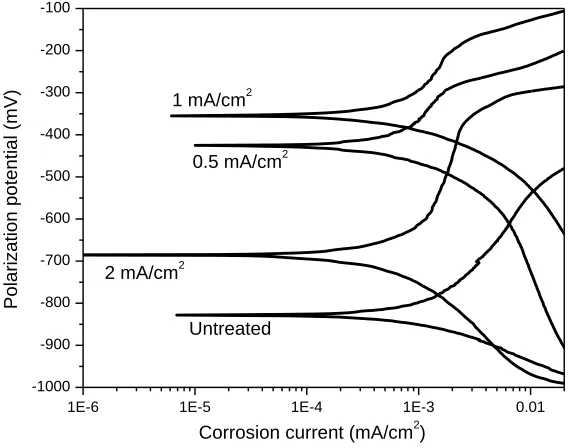
Figure 7. Polarization potentiodynamic curves for samples processed at 450°C.
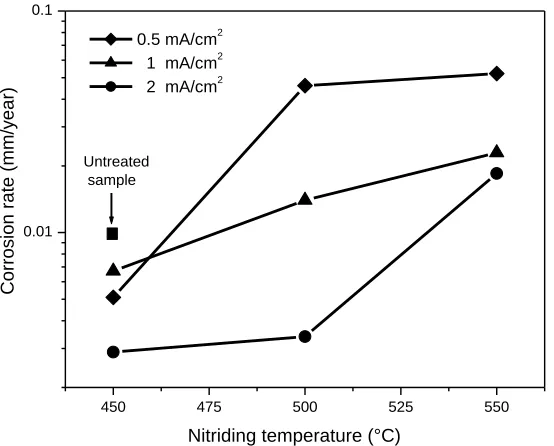
Figure 7 shows the polarization potentiodynamic curves for samples processed at 450°C, it is possible to appreciate the displacement of nitrided samples´ curves to lower values of corrosion current and higher values of polarization voltage, which is the main indicator of the increase in corrosion performance. Figure 8 shows corrosion rate values for AISI D2 nitrided samples computed using the Tafel extrapolation method. Regardless of the nitriding current density, the lowest corrosion rate values (major increase in corrosion resistance) occur when the tool steel is processed at 450°C. Corrosion rates of 5.1X10⁻³, 6.7X10⁻³ and 2.8X10⁻³ mm/year were obtained for samples nitrided at 450 °C using nitriding current densities of 0.5, 1 and 2 mA/cm2
The major increase in corrosion resistance occurs when samples are processed at 450 °C using a nitriding current density of 2 mA/cm2. Under this specific condition, the corrosion rate decreased to around one-third of the untreated sample corrosion rate, which could represent an important increase in the lifetime of pieces and accessories manufactured using this tool steel. However, despite the decrease in corrosion rate for samples nitrided at 450°C, the increase of both; nitriding temperature and current density, causes an increase in corrosion rate values. For samples processed at temperatures of 500 and 550°C, regardless of nitriding current density (except sample´s processed at 500°C, 2 mA/cm2
), the corrosion rate values are above those corresponding to untreated samples. This is indicative that for these specific conditions, even though the nitriding process increases the surface hardness, this process has a negative effect on corrosion resistance of this material. In agreement with XRD analysis, one can suggest that the production of modified layers with the best corrosion performance (450°C, 2 mA/cm2) is related to the preferred formation of -Fe3N crystalline phase; the preference of nitrided
layers with a higher -Fe3N content than ´-Fe4N is well known because of their good corrosion
performance [22].
450 475 500 525 550
0.01 0.1
Untreated sample
Co
rr
osi
on
ra
te (m
m/y
ea
r)
Nitriding temperature (°C)
0.5 mA/cm2 1 mA/cm2 2 mA/cm2
Figure 8. Influence of temperature and nitriding current density on corrosion rate values of nitrided samples.
4. CONCLUSIONS
In the present work, the effect of temperature and discharge current density on surface properties of pulsed plasma nitrided AISI D2 tool steel was analyzed. The results show that both, temperature and nitriding current density have a characteristic effect on hardness, surface morphology, crystalline phases and electrochemical corrosion performance of plasma nitrided AISI D2.
[image:8.596.161.438.340.563.2]
obtained when process was carried out at 450°C using a current density of 2 mA/cm2
; however, very similar hardness values (around 1750 HV0.3kgf) were obtained for all samples nitrided at 450°C. These findings indicate that when plasma nitriding process is carried out at 450°C, it is not necessary to increase the nitriding current density from 0.5 to 2 mA/cm2 to obtain the highest surface hardness values.
Evaluation of corrosion performance of plasma nitriding samples led to an evident decrease in corrosion rate values for samples nitrided at 450°C in respect to untreated samples. Corrosion rates of 5.1X10⁻³, 6.7X10⁻³ and 2.8X10⁻³ mm/year were obtained for samples nitrided at 450 °C using nitriding current densities of 0.5, 1 and 2 mA/cm2 respectively. All of these values are below the corresponding values of untreated samples (1X10⁻² mm/year) which represents an important increase in corrosion resistance as a consequence of nitriding process.
Both, an increase in surface hardness and corrosion resistance under specific processing conditions, can be related to the evolution of crystalline phases which is a consequence of processing parameters. XRD analysis of samples processed at 2 mA/cm2 and temperatures of 450 and 550°C showed a presence of iron nitrides Fe3N and Fe4N as well as Fe3C and CrN on the surface of nitrided
D2. An increase in processing temperature promoted an evident decrease in Fe3N content and an
increase in Fe4N. This transformation phenomenon can be related to surface decarburization which is
influenced by intensification of sputtering phenomenon at higher temperatures and current densities. ACKNOWLEDGEMENT
J.A. Díaz-Guillén would like to thank the financial support by CONACYT and DGEST (México).
References
1. V. Sista, O. Kahvecioglu, O.L. Erylmaz, A. Erdemir, S. Timur. Thin Solid Films. 520 (2011) 1582 2. Wuu-Ling Pan, Ge-Ping Yu, Jia-Hong Huang, Surf. Coat. Technol. 110 (1998) 111.
3. K.H. Prabhudev. Handbook of Heat Treatment of Steels, Mc-Graw-Hill Company, NY, 1992. 4. G. Ramírez, A. Mestra, B. Casas, I. Valls, R. Martínez, R. Bueno, A. Goez, A. Mateo, L. Llanes.
Surf. Coat. Technol. 206 (2012) 3069.
5. Chen-Yi Wei, Fan-Shiong Chen. Mat. Chem. Phys. 90 (2005) 178. 6. P.A. Steinmann, H.E. Hintermann. J. Vac. Sci. Technol. A3 (1985) 2394.
7. M.H. Staia, Y. Perez-Delgado, C. Sanchez, A. Castro, E. Le Bourhis, E.S. Puchi-Cabrera. Wear 267 (2009) 1452.
8. R.M. Muñoz Riofano, L.C. Castteleti, L.C.F. Canale, G.E. Totten. Wear 265 (2008) 57 9. Dong Cherng Wen, App. Surf. Sci. 256 (2009) 797.
10.M.A. Terres, S. Ben Mohamed, H. Sidhom. Int. J. Fatigue 32 (2010) 1795.
11.I. Zukerman, A. Raveh, Y.Landau, R. Weiss, R. Shneck, Y. Shneor, H. Kalman, J.E. Klemberg, L. Martinu. Surf. Coat. Technol. 201 (2007) 6171.
12.B. Podgornik, J. Vizintin, O. Wanstrand, M. Larsson, S. Hogmark. Surf. Coat. Technol. 120–121 (1999) 502.
14.J.C. Díaz Guillén, A. Campa Castilla, S.I. Pérez Aguilar, E.E. Granda Gutiérrez, A. Garza Gómez, J. Candelas Ramírez, R. Méndez Méndez. Superficies y Vacío.21 (2009) 1.
15.ASTM International Standards. Standard Reference Test Method for Making Potentiostatic and Potentiodynamic Anodic Polarization Measurements. ASTM International USA 2004.
16.C. Zhao, C. X. Li, H. Dong, T. Bell. Surf. Coat. Technol. 201 (2006) 2320. 17.Sh. Ahangarani, A.R. Sabour, F. Mahboubi. Surf. Sci. 254 (2007) 1427.
18.P. K. Barhani, Neelam Kumari, I. Banerjee, S.K. Pabi, S.K. Mahapatra. Vacuum 84 (2010) 896. 19.E.E. Granda-Gutiérrez, R. Lopez-Callejas, R. Peña-Eguiluz, A.R. Valencia, A. Mercado-Cabrera,
S.R. Barocio, A. de la Piedad-Beneitez, J. S. Benítez-Read, J. O. Pacheco-Sotelo. J. Phys. Conf. Ser. 100 (2008) 062019.
20.Sule Yildiz Sirin, Kahraman Sirin, Endric Kaluc. Materials Characterization 59 (2008) 351. 21.P. Corengia, G. Ybarra, C. Molina, A. Cabo, E. Broitman. Surf. Coat. Technol. 200 (2005) 2391. 22.J. Alphonsa, G. Sinha, A. Kumar, G. Jhala, S. K. Tiwari, S. Gupta, P. A. Rayjada, N. Chauhan, P.