Rochester Institute of Technology
RIT Scholar Works
Theses
Thesis/Dissertation Collections
1999
A Study of package handling drops in the United
States postal service
Thomas Kausch
Follow this and additional works at:
http://scholarworks.rit.edu/theses
This Thesis is brought to you for free and open access by the Thesis/Dissertation Collections at RIT Scholar Works. It has been accepted for inclusion in Theses by an authorized administrator of RIT Scholar Works. For more information, please [email protected].
Recommended Citation
A
STUDY
OFPACKAGEHANDLING DROPSINTHE UNITED STATESPOSTAL SERVICE
By
Thomas J. Kausch
A Thesis
Submittedto the
Departmentof
Packaging
ScienceCollegeofApplied Scienceand
Technology
inpartial fulfillmentoftherequirements
forthedegreeof
MASTER OF SCIENCE
Rochester Institute of
Technology
Department of Packaging Science
College of Applied Science and Technology
Rochester Institute of Technology
Rochester, New York
CERTIFICATE OF APPROVAL
M. S. DEGREE THESIS
The M. S. degree thesis of Thomas J. Kausch
Has been examined and approved
By the thesis committee as satisfactory
For the thesis reqwrement for the
Master of Science Degree
Stephen Pierce
John
C.
Kohler
David L.
Olsson
July 11, 1999
COPY RELEASE
ASTUDY OF PACKAGE HANDLING DROPS IN THE UNITED STATES POSTAL SERVICE
I,
Thomas J.Kausch,
hereby
grant permissionto theWallace MemorialLibrary
ofRITtoreproducethisthesisinwhole orinpart.
Any
reproductionwillnotbe forcommercial use or profit.
July
11,
1999ACKNOWLEDGEMENTS
IwouldliketothankMr. Stephen
Pierce,
MS. fromtheEastman KodakCompany
for hiscontinued support and guidancethroughoutthisproject.Iwould alsoliketo thankMr. John
Kohler,
MS.,
who withouthisencouragement and supportthisproject would nothave beenpossible.
Iwouldliketo acknowledgeMr. Dan Curtin fromtheUnitedStates Postal
Servicewho provided valuableinformation regardingtheoperation oftheUSPS
package
handling
system aswellas coordinatingvisitstothePittsburghBulk MailCenterandtheBuffalo
Auxiliary
Service Facility.IwouldliketothankMr.
Craig
L. Deanfrom Eastman KodakCompany
forcoordinatingtheshipments oftestpackagesthroughoutthisprogram.
IwouldliketoexpressmyappreciationtoMr. JamesE. Scottfrom Eastman
Kodak
Company
who provided managementsupporttothisstudyas well as myenrollmentintheMastersprogram.
IwouldliketoacknowledgeMs. Merrilee
Ritter,
MS. fromEastman KodakCompany
who was instrumentalinanalysis ofthedatacollectedthroughoutthisstudy.
IwouldliketoacknowledgeDr. Daniel L. GoodwinandDr. David L. Olsson
fromtheRochester Instituteof
Technology
fortheirsupport andguidanceduring
thisDEDICATION
Iwouldliketodedicatethis thesistomywife,Maureenwho supportedmy
desiretocontinuemyeducation. Without hersupport andencouragementthiswork
would nothavebeenpossible. It isoftendifficulttodescribethesupport and
sacrifices others make
during
anundertaking such asthis.The success ofthisprojectis as muchhersasit ismine.
Iwould also liketodedicatethisworktomy
father,
thelate Robert A. Kauschwho always supportedmycontinuededucation.
A STUDY OFPACKAGEHANDLING DROPS IN THE UNITEDSTATESPOSTAL SERVICE
By
Thomas J. Kausch
ABSTRACT
Theobjective ofthisstudywastomeasure
drop
heightsenvironmentwithin theUnited States Postal Service. Apopularbelief has beenthat theUnited States Postal
Serviceprovided a
handling
environmentthatwasmore severethanother smallparcel carriers.Previous studies of small package carriershave documentedthe
handling
environments ofthosecarriers. The datagatheredduring
thecourseofthis studywere comparedto thoseresults. The intentofthisstudywastoprovidedata thatwouldindicatethat theUnites States Postal Service didnotprovideahandling
environmentthatwasmoreseverethancompetingcarriers.
Anadditional objective ofthis studywastounderstandanddocumentthesmall
package
handling
systemused withintheUnited States Postal Service.CONTENTS
CERTIFICATE OF APPROVAL II
COPY RELEASE HI
ACKNOWLEDGEMENTS IV
DEDICATION VI
ABSTRACT VII
CONTENTS VIII
1.0 INTRODUCTION 1
BACKGROUND-UNITED STATESPOSTALSERVICE 1
SMALL PARCEL MARKET 2
STUDY ASSUMPTIONS 3
STUDYOBJECTIVES 3
SMALLPARCEL HANDLING ENVIRONMENT 3
BULK MAIL SYSTEM 4
BULK MAIL CENTEROPERATION 5
PARCEL SORTING 7
2.0 TESTMETHODSANDMATERIALS 8
DATA COLLECTION DEVICE 8
TEST PACKAGE 9
TEST PACKAGE DESTINATIONS 10
TEST PACKAGE IDENTIFICATION AND LABELING 11
TEST PLAN 11
TEST PACKAGE PREPARATION 12
3.0 TEST RESULTS AND DISCUSSION 13
ATLANTA DROP HEIGHT DATASUMMARY, HISTOGRAM,STATISTICS 14
ATLANTA DROP FREQUENCY DATASUMMARY,HISTOGRAM,STATISTICS 16
WINDSOR DROP HEIGHT DATASUMMARY, HISTOGRAM,STATISTICS 18
WINDSOR DROP FREQUENCY DATASUMMARY, HISTOGRAM,STATISTICS 20
USPS,SMALL PARCELCARRIERS,LTL DROP HEIGHT DATASUMMARY, HISTOGRAM,
STATISTICS 22
USPS,SMALL PARCELCARRIERS,LTL DROP FREQUENCY DATASUMMARY,
HISTOGRAM,STATISTICS 24
RESULTS 26
4.0 CONCLUSIONS 29
5.0 REFERENCES 31
1.0 INTRODUCTION
BACKGROUND-UNITED
STATESPOSTAL SERVICEThe UnitedStatesPostal Servicehas a
history
thatdates backto theearly daysof our country. Itwas on
July
26,
1776thattheContinental Congress appointedBenjaminFranklinthefirstPostmaster General. The Post Officecarried onfor nearly
100years througha number of
temporary
Actsuntil onJune8,
1872 Congressformally
declareditan executivedepartment. The Post Officeremainedas anexecutive departmentthrough
July
1,
1971 whentheUnited States PostalService,
was named as anindependent agencyoftheexecutivebranch1. Since it's early
beginning,
thePost Office provided a meanstomoveletters aswellas parcelsfromonelocationtoanother;
however,
itwasn't until 1913thatParcel Postwasbroughtinto being. Parcel Post is a subclass ofStandard Mailwith ratesbasedonweight,
zoneand
delivery
within abulkmail center.SMALL PARCEL MARKET
Following
theintroduction ofParcelPost,
thePostal Serviceenjoyed ahugeincrease in business. Mail orderhousessuch as SearsandRoebuckand
Montgomery
Wardprosperedas
they
soldtheirgoodsthrough theUS Mail. Aswithanybusiness,
competitionwasinevitable. The Postal Service eventually saw adecline inthe
volumeofparcelsmovingthroughits facilities. Newand more efficient competition
contributedto thereduction. Carriers suchasUnited Parcel Service
(UPS),
FederalExpress,
DHLandnumerous lessthan truckload(LTL)
carriershavereplacedtheUnited States Postal Serviceasthenumberone carrierforsmall parcels. As a
governmental agency, thePostal Servicetriedtobeallthingstoall people. The
Postal Service handlesa widevarietyof parcelsfromoccasional customers aswellas
regularshippers. The PostalServicemust maintain over40,000 facilitieswhereas
carriers such as United ParcelServicecould maintainapproximately 1,000. This has
preventedtheUSPS fromeffectively competinginthismarket. UPS and othersmall
parcel carriers ontheother
hand,
haveestablished relationships withlarge businessfirms. Thepackageshandled
by
thesecarriersforthemost part arewell packagedwhich allowsforswift and efficient
movement.2
Asthecompetition waspouring
millions ofdollarsinto upgradingtheiroperations,thePostal Service didnotreactin
the same manner. Constrained
by
limitedbudgets,
thePostalservicefell behind inthe abilitytohandlepackagesefficientlyand withoutdamage. Atonepoint, in
1974,
aninternal survey indicatedthat theUSPS damaged halfoftheparcels marked
fragile.3
In anefforttoimprovetheiroperation,in
1975,
theUSPS completedinstallationofaNational Bulk Mail Systemat a cost of over$1 billion. Theresult of
this workwas asystemthatwas designedtocompete withprivate carriersfor
efficiency, speed andabilitytohandlemail and packages withoutcausing
damage.4
Throughout
1998,
thePostal Service deliveredover82 billionpiecesofStandard(A)
andalmost 1 billionpiecesofStandard Mail (B).5Bulk Mail is definedas
Standard Mail
(A)
thatis lessthan 16oz.Mass mailings and periodicalsfall intothis2
Tierney,JohnT.,PostalReorganization:ManagingthePublicsBusiness, (Boston,MA. Auburn HousePublishingCompany) 1981,p.138.
3
Adie, Douglas,K.,Monopoly Mail:PrivatizingtheU.S. PostalService,(NewBrunswick, USA,
TransactionPublishers, 1989,p.54. 4
Tierney,JohnT.,PostalReorganization:ManagingthePublicsBusiness, (Boston,MA. Auburn HousePublishingCompany) 1981,p.59.
5
category. Standard Mail
(B)
is definedas parcel post and printed matter such asboundbooks.6
STUDY
ASSUMPTIONS:
1.
HYPOTHESIS:
Theassumptionforthis study isthatthefrequency
andheightofdrops occurringwithintheUSPS
handling
environmentiscomparableto thatofcompetingsmall package carriers.
2. Thedatacollected
during
thisstudywillberepresentative ofthatencounteredinthenormal
handling
environment oftheUnited StatesPostal Service.
STUDYOBJECTIVES:
1. Themain objective ofthestudywastomeasure
drop
heightsencounteredwithin the
handling
environment oftheUSPS and comparetheresultstoresults obtainedinprior studies ofother smallpackage carriers
2. Anadditional objective ofthisstudywastounderstandthesmall package
handling
environmentwithintheUnited States Postal Service.SMALL PARCEL HANDLING ENVIRONMENT
Throughoutthenormal
handling
environmentofpackage carriers, therewillbeavarietyofforcesthatwillaffect apackage.
Vibration, Shocks,
Impactsanddropsaretypical eventsthathaveaninfluenceonthe
integrity
ofa package anditscontents.This study focuses on
drop
eventswhich generallycausethemost visible and severedamage. Overthepast severalyears,therehave beena number of studies completed
on the
handling
environmentof small package andLTLcarriers.6
THE BULK MAIL SYSTEM
Tounderstandtheeffectiveness ofthe
delivery
system withintheUSPS,
itisimportanttounderstandthemethod
by
which packages aremoved. Packagestobeshipped originate at a number oflocations. Packages may be droppedoff at alocal
facility
such astheneighborhoodPost Office. Arrangementscan alsobemadewiththePostal Servicetopickuppackages at a specificlocationsuchas amailroom
within acompanyorbusinessmail facility. Theother method of
introducing
packagestothePostal
System,
whenlargequantities areinvolvedor wheneconomically
feasible,
istohavetheshipperdeliverthem toaBulk Mail Centeror anAuxiliary
Service Facility. The Bulk Mail System implementedby
theUSPS iscomprisedof21
highly
automatedregional facilities designedtohandlethelargeamounts ofbulkmailaswellas small parcels. The 21 Bulk Mail Centers
(BMC)
arelinkedto asystemof10
Auxiliary
Service Facilities (ASF). TheAuxiliary
ServiceFacilitiesarepartof ageneral mailfacility. The ASFserves as a subordinateto the
BulkMail Centerandis also capableof
handling
Standard AandB mail.Thetypicalvolume of parcels movedthroughaBulkMail Centersuch astheonein
Pittsburgh,
PAisover 1,700,000parcelsper
week.7
BULKMAIL CENTEROPERATION
Items
traveling
through theBMC generallyarrive atthefacility
by
truck;however,
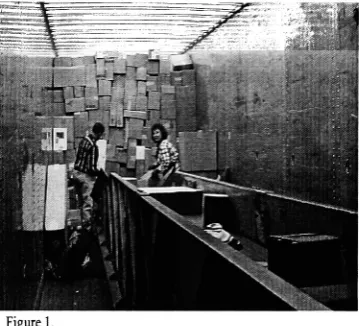
thefacilitiescan also accommodate raildelivery. Parcelscanbehand-stowed,
palletized orcontainerizedwhen arrivingatthefacility. Hand-stowedor
non-unitized parcels are off-loadedmanually
usingan ergonomically designed
mechanized conveyor(Figure 1). Parcels
unloadedinthismanner enterthe
automated system
directly
forprocessing.^^.e
lSmallparcels
heading
towarda commondestination mayalsobe "sacked" atalocal
facility
forease of movement. Palletizedunits areunloaded
by
aforktruckand removedfromthepallet
by
hand for entry intotheconveyance system. Packages transportedfrom localpost offices andASFto theBMC mayalsobeplacedin large reusable containers. Twotypesare mostcommonlyused, the 'BulkMail Center
(BMC)
Container' [image:14.571.297.477.198.361.2](Figure
2)
andtheCorrugated Bincontainer. The Bulk Mail Centercontainerisconstructed of Figure 2.aluminumandisonwheels allowing for easymovement. Thecorrugated style
trucktoliftand move. Removalofthecontents of
theBMCcontainerismanual whereasthe
corrugatedbincontaineris accomplished either
by
handor morecommonly
by
means of atipping
device. Thedeviceliftstheentire container and
emptiesthecontents onto a mechanized conveyor
.
r (Figure
3)
thatmovestheparcelstothenextstep in
the system, whichisthekeypad/barcodingstation.8
The
handling
and methods ofunloading previously describedaregenerallytrueforpackages andStandard Mail
(A)
weighing less than35 lbs. Packages weighingmorethan35 lbs. are
typically
handsorted and placed on pallets orhand-trucks formovement withinthesystem as opposedtoautomated conveyance.Decisiontoutilize
the automatedconveyance-sortingsystemis
generallyatthediscretion ofthePostal
Serviceoperatorattheinitialsort. Further
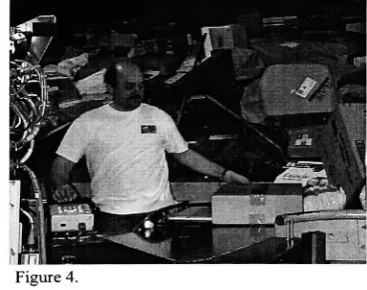
oninthe sequenceof automated package
sorting,isthekeypunchandscanning
[image:15.571.299.483.416.561.2]station(Figure 4).
Figure 4.
Hereanoperatorkeypunchesthedestination
ZIP Codeorscans thebarcodelabel previouslyapplied
by
themailer or atthelocalPost Office. The barcodeused
by
theUSPS isthePOSTNETcode andis comprisedof52characters. OncetheZIP Code is
keypunched,
abarcodelabel is thenprintedexam
following
training
and must read andcorrectly
key
32 parcels per minute with98% accuracy. Thepackagethen
moves onits waytowarda container
orbin in an areaknownas a"runout"
(Figure
5)
thataccumulatespackagesdesignated fora specifiedZIP Code.
Fullcontainers are relocatedto the Fi 5
truckortraindestinedfora particularZIP Code forshipmenttothefinal
delivery
point.
The scope ofthis studywastocapture and evaluate
drop
eventswithintheUSPS system whichincludes
handling
atthelocal Post Office level as well astheautomatedsortingfacilitiessuch astheBulk MailCenters. While it isnotedthat
considerable attention ispaidto thecharacterization ofthe
handling
attheBMC itshouldbenotedthatopportunitiesfor drops andimpactsareequallypresent atthe
local Post Office level.
PARCEL SORTING
Theparcel sortingsystemisa maze ofconveyorsmonitoredfroma central
controlcenterthatoversees systemstatus.
Monitoring
is accomplishedby
a closedcircuit TVsystem. Over200 TVcameras monitor atypical
system.9
Theconveyance
system usesaseriesofbeltconveyors,slides,
diverting
mechanisms and specializedtraystotransportthepackages andbulkmailthroughthefacility. Thecomputer
tracksthemovementoftheparcel viathebarcode. Constant monitoringkeepstrack
8
Daniel P.Curtin,USPS,personal conversation. 9
of whichtrays areemptyandwhichones are
headedtoa particular"runout" with aparcel.
Uponapproachingtheassigned runoutthe
tray
istippedandthepackageslidesdowna chuteintotheoutgoingparcel
Figure6. container.
Once
full,
containers are movedtotheoutgoingshipment area withinthePostalfacility. Herecontainers areloaded intotrailers. Thecontainers aresecured (Figure
6)
withinthe trailerby
a means oflocking
mechanismsinthefloororby
theuse ofstrapsthatare attachedto thewalls ofthe trailer.
Containersaretransportedwithinthebulkmail networkinthisfashion.
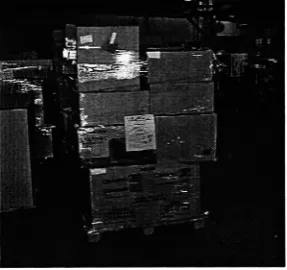
Manually
sorted packagesarepalletized andstretchwrapped
(Figure
7)
forshipmentto theASF.Uponarrivalatthenext
Auxiliary
ServiceFacility
orlocalPostal
facility,
packages arethenmanuallyhandledand sortedfor
delivery
totheirfinaldestinations. Fi8urc7
2.0 TEST METHODS ANDMATERIALS
DATACOLLECTION DEVICE
Thecollectiondeviceused
during
thisstudywastheSAVERmanufacturedby
[image:17.571.334.478.369.504.2]Figure 8.
vibration environment recorder. Thedeviceis capable ofrecordingacceleration,
drop
height,
temperatureandhumidity. The data isdigitizedand storedinto memory forlater uploadingand analysis. The SAVER
incorporatestriaxial accelerometers as well asanalog
todigitalconverters,
temperature/humidity
sensorsand a real-time clock are afew ofthecomplex
components ofthisdevice. Thecollecteddata is
uploadedtoaWindows-based hostPC usinga program called"SaverWare".10 All
datarecordingunits were calibrated priorto
testing
usingaccelerometers as specifiedby
theNational BureauofStandards.TEST PACKAGE
Packageswere assembledin a
laboratory
inthefollowing
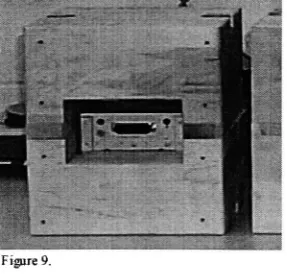
manner. Thetestpackage was comprisedofafabricatedwoodenfixture. The fixture hada
hollowed-outcenterso astoallowfor
fastening
ofthedatarecorderto thefixture (Figure 9).OncetheSAVERwas
fastened,
thefixturewas reassembled and securedusingthreadedbolts and nuts. Thefixturewas made
from
hardrockmaple. The fixturewas packedina
shippingcasealongwithtwo-inchthick,one
pound (1
lb.)
density
polyethylenefoam. TheFigure9.
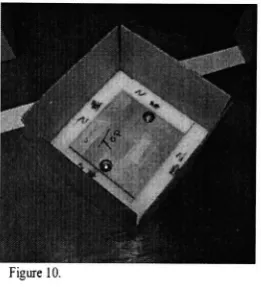
foam linedtheinsideofthecase on allsix sides
(Figure 10). The foamwasusedtoprotectthe
data-recording
device fromexcessive [image:18.571.333.477.478.615.2]Figure10.
from accurately recording
drop
heights. Previous fieldtestsas well aslaboratory
testshaveconfirmedthis. Thecorrugated
shipping
containersusedinthe testwere regularslottedcontainers madefrom 44ECTmaterial. Thecases werejoined
by
a glue-inglue
lap
and measured 13"x 13"x 13"inside. Thetestpackages weighed35 lb.which are representativeofmanysmall packages shippedtoday.
TESTPACKAGE
DESTINATIONS
The origin ofthe testshipments was
Rochester,
New York. Thepackageshippingdestinations inthisstudywheredesignedto
simulate routine or normal destinationsfor
productstransported
by
means ofa small parcel carrier. Inthisstudy,twolocationswere chosen oneto
Atlanta,
GeorgiaandtheothertoWindsor,
Colorado. AtlantaandWindsorwere selected asitcouldbeassuredthat the testpackages wouldtravel
through aBulk Mail Centerontheirjourney. Destinationscloserto theoriginmay
nothaveexperiencedthesametypeof
handling
thatmightbeencounteredintheBulkMail Centeras
they
may have beenrouteddirectly
to thefinal destinationvia anASF.The USPSpickedupoutboundpackages,senttoAtlantaand
Windsor,
atthemailroomof alarge firm in Rochester New York. Thepackages weredeliveredto the
local Postal
facility
in Rochesterandthendirectedto thePittsburgh Bulk Mail Center.Thepackages werethenrouted ontoAtlanta for
delivery
totheirfinal destination.The Windsor boundpackages followedthesamescenarioexcept
they
weredirectedtotheChicago BMC/ Denver BMContheirwaytodelivery. Returnofthepackages
10
Instruction Manual fortheSAVER,DallasInstruments,A LandsmontCompany,Version 1, 1995
[image:19.571.325.456.201.345.2]encounteredthesame USPSfacilities only inthereverseorder. Thepackages evaluatedinthisstudyweighed35
lb.,
which would providethemwiththeopportunitytobetransported throughout theBMC
by
means ofthesortingconveyor system orby
specialhandling
trucks.During
thestudy itwas notknownwhich method was used as packages movedthroughtheBMCandistypical ofUnited States Postal Serviceprocedures andguidelines.11
TEST PACKAGEIDENTIFICATIONAND LABELING
Thecorrugatedshippingcases usedin thisstudywere not printedand
contained no outside markings otherthat therequired corrugatedboxcertification stamp. Thecaseswereleftunmarked so asnottobiasthe testas well as anadditional securitymeasure of anonymity. Theaddress informationwassecuredinsideaclear sleevealongwithinstructionsto the addresseeforreturnprocedures. Contentsofthe
packages werenotapparenttoPostalworkers
during
the test.TESTPLAN
Thetestplan calledfor shipping fivepackagesto adestinationat onetime.
Upon arrivalatthedestinationan operator wouldreaddress thepackages and enter
them intothe outgoingmailforreturntoRochester. Theplan calledforthreeround
tripsperdestination foreachofthefivepackages. Thisproducedatotalof60 individual one-waytrips through theUSPS system. Datawas collected andanalyzed foreachofthe60trips.
11
Daniel P.Curtin,USPS,personalconversation.
Thetablebelow outlinesthenumber of packages andtrips.
Destination #packages per
round
trip
#roundtrips Equivalent #of
one-waytrips
Atlanta,
GA 5 3 30Windsor,
CO 5 3 30Total - - 60
TESTPACKAGE PREPARATION
The SAVERdatacollection devicesweresetup inthe
following
configuration.The SAVERwas settorecognize and save all
drop
eventsthatweregreaterthanorequalto 10G. This wasdonetobeconsistent withthedatacollectedfromprevious
studies.
Following
configuration,thedatacollectiondeviceswerefastenedto thewoodenfixtures and packedin the testcorrugatedshippingcases.
Foam,
asdescribedearlierlinedthe cases. Thecases were sealed withtwo-inchwide,pressure sensitive
plastic tape.To signifythestartofthetrip,eachtestcasewasdroppedonthebottom
surface(flat
drop)
fromaheightof24 inches. The dateandtimeofthedrop
arenoted.
Knowing
thedateandtimeofthecalibrationdrop
isuseful whenanalyzingthedataand
determining
drops thatmightnotbepart ofthestudy. The 24 inchdrop
isperformedatthe time the testpackages are received attheiroutbound andinbound
destinations. Uponreturn ofthe test packages, thedata isuploadedfromtheSAVER
unitto aPCandthenanalyzed.
3.0 TEST RESULTS AND DISCUSSION
ThroughoutthisstudyanAnalysisofVariance
(ANOVA)
andleastsquares'
meanstestswere usedto
identify
andisolatecharacteristicsaffectingdrop
heightandfrequency. The
following
pages are a compilation and statistical summaryofthedatacollected
during
thestudy.ATLANTADROPHEIGHT DATA
SUMMARY,
HISTOGRAM,
STATISTICSThe
following
is thesummaryoftheAtlantadrop
height data:Drop
HeightFrequency
Cumulative %(inches)
(drops)
2 2 1.79%
4 14 14.29%
6 16 28.57%
8 20 46.43%
10 15 59.82%
12 11 69.64%
14 9 77.68%
16 6 83.04%
18 7 89.29%
20 3 91.96%
22 1 92.86%
24 1 93.75%
26 4 97.32%
28 1 98.21%
30 0 98.21%
32 1 99.11%
34 1 100.00%
More 0 100.00%
The
following
is aHistogramoftheAtlantaDrop
Heights: 25 20 * 15 CD cr CD 10HistogramofAtlanta
Drop
Heights,
USPS11 9 !
Frequency
Cumulative %Do
1 f 0.9 0.8 t 0.7 0.6 0.5 0.4 0.3 0.2 0.1 0<V t <b <b N<_ NT, ^ Nfc Nfc ,>
fy ^
<$>tf
r> <g, $ ^>DropHeightin Inches
The
following
isthe statistical summaryoftheAtlantadrop
heights:Mean(inches)
Median
(inches)
Mode(inches)
ATLANTADROP FREQUENCY DATA
SUMMARY, HISTOGRAM,
STATISTICS
The
following
is summaryoftheAtlantadropspertrip
data:ops/Trip
0
Frequency
(trips)
3
Cumulative
%
10.00%
2 10 43.33%
4 8 70.00%
6 4 83.33%
8 1 86.67%
10 2 93.33%
12 2 100.00%
More 0 100.00%
The
following
is aHistogramoftheAtlanta dropspertrip:12
10
Histogramofthe Numberof Drops per
Trip
Atlanta USPS Data10
Frequency
Cumulative %
4 6 8 10
NumberofDrops per
Trip
12
1
0.9
0.8
0.7
0.6
0.5
0.4
0.3
0.2
0.1
0
More
The
following
isthestatistical summaryoftheAtlantadropspertrip:Mean
(drops)
3.73Median
(drops)
3Mode
(drops)
1Standard Deviation
(drops)
3.27 Range(drops)
12 Minimum(drops)
0 Maximum(drops)
12Count
(drops)
112WINDSOR DROPHEIGHT DATA
SUMMARY, HISTOGRAM,
STATISTICSThe
following
isthesummaryoftheWindsordrop
height data:Drop
HeightFrequency
Cumulative %(inches)
(drops)
0 3 10.00%
2 10 43.33%
4 8 70.00%
6 4 83.33%
8 1 86.67%
10 2 93.33%
12 2 100.00%
More 0 100.00%
The
following
isaHistogramoftheWindsordrop
height:Histogramofthe
Drop
HeightsforWindsor USPSData25 20 O 15 C 0 _3 O" __ 10
l l
Frequency
Cumulative%
2 2
11 1
D
n ia,0,i,l -1 --0.9 --0.8 0.7 1 0.6 0.5 0.4 0.3 0.2 0.1 0
<V <x <b N
*
sfc N* N*^ ^
<^ <{>?
#
*
<?Drop
Heights in InchesThe
following
isthestatistical summaryoftheWindsordrop
heights:Mean
(inches)
Median(inches)
Mode
(inches)
Standard Deviation
(inches)
The
following
isthe summaryoftheWindsordrop
frequency
data:Drops/Trip
0
1
2
3
4
5
6
7
8
9
10
11
More
equency
(trips)
3Cumulative%
10.00%
4 23.33%
0 23.33%
11 60.00%
4 73.33%
2 80.00%
3 90.00%
0 90.00%
0 90.00%
0 90.00%
1 93.33%
1 96.67%
1 100.00%
The
following
isaHistogramoftheWindsor dropspertrip:HistogramoftheNumberofDropsperTrip
Windsor USPS Data
12 -, 10 w - 1 - 0.9 - 0.8 S 8 >. o
1
6-cr 0) _. LL 4 -I 2 -0 7 - 0.7 0.6 - 0.5 - 0.4 -0.3 0.2 - 0.1 n 3 4 4 3I ~iFrequency
Cumulative %
_____
j$
/
/
0
1 1 1
o n n
aj
0 1 2 3 4 5 6 7 8 91011 More
NumberofDrops perTrip
The
following
isthe statisticalsummaryoftheWindsor dropspertrip:Mean
(drops)
Median(drops)
Mode
(drops)
Standard Deviation(drops)
Range
(drops)
Minimum(drops)
Maximum(drops)
Count(drops)
3.80 3 3 2.98 12 0 12 114Incomparisonto thedatagathered
during
thisstudy,thefollowing
is asummaryofdata fromprevious studiesasreportedatTransPack97
by
Mr. StephenPierce 12
Stephen R.Pierce,TransPack 97 InstituteofPackagingProfessionals,Herndon,VA.1997,p 130.
USPS,
SMALLPARCEL,
LTL DROP HEIGHT DATASUMMARY,
HISTOGRAM,
STATISTICSThe
following
isthesummaryofUSPS,
Small Parcel CarriersandLTLdrop
heightdata:
Drop
HeightFrequency
Cumulative %(inches)
(drops)
2 42 4.32%
4 93 13.87%
6 152 29.50%
8 150 44.91%
10 113 56.53%
12 94 66.19%
14 73 73.69%
16 63 80.16%
18 42 84.48%
20 28 87.36%
22 33 90.75%
24 24 93.22%
26 26 95.89%
28 9 96.81%
30 4 97.23%
32 8 98.05%
34 2 98.25%
36 2 98.46%
38 2 98.66%
40 6 99.28%
42 1 99.38%
44 0 99.38%
46 1 99.49%
48 5 100.00%
More 0 100.00%
The
following
istheHistogramofUSPS,
Small ParcelCarriers,
andLTLdrop
heightdata:
Histogramofthe
Drop
Heightsin Inches,Measured for SMALL PARCEL, USPS and LTL Carriers
H IFrequency
Cumulative %
I B. I
1 0.9 0.8 0.7 0.6 0.5 0.4 0.3 0.2 0.1 0
& & & & jf* ^
Drop Heightsin Inches
The
following
isthestatistical summaryoftheUSPS,
Small ParcelCarriers,
andLTL
drop
heightdata:Mean
(inches)
Median(inches)
Mode
(inches)
Standard Deviation(inches)
USPS,
SMALLPARCEL,
LTL DROPHEIGHT DATASUMMARY,
HISTOGRAM,
STATISTICSThe
following
isthesummaryofUSPS,
Small Parcel CarriersandLTLdrop
frequency
data:)ps/Trip
Frequency
Cumulative %(trips)
0 20 7.55%
1 55 28.30%
2 36 41.89%
3 49 60.38%
4 36 73.96%
5 19 81.13%
6 10 84.91%
7 5 86.79%
8 9 90.19%
9 2 90.94%
10 7 93.58%
11 4 95.09%
12 8 98.11%
13 2 98.87%
14 0 98.87%
15 0 98.87%
16 1 99.25%
17 1 99.62%
18 0 99.62%
19 0 99.62%
20 1 100.00%
More 0 100.00%
The
following
istheHistogramofUSPS,
Small ParcelCarriers,
andLTLdrop
frequency
data:HistogramofNumberofDrops per
Trip
SMALL
PARCEL,
USPSand LTLCarriers0 . U_Li_U_i_l
1
Frequency
Cumulative %nii
7 n 4 2JJ
1 0.9 0.8 0.7 0.6 0.5 0.4 0.3 0.2 0.1 aQ <V t <b <b N<_.
^
^y N<b N% ,>NumberofDrops per
Trip
The
following
isthestatistical summaryoftheUSPS,
Small ParcelCarriers,
andLTL
drop frequency
data:Mean
(drops)
Median(drops)
Mode
(drops)
RESULTS
Themean
drop
heightsand mean number ofdrops pertrip
fortheAtlantaandWindsordestinationsarelistedbelow.
DESTINATION MEAN DROP HEIGHT MEAN NUMBER OF
DROPS
Atlanta 10.25 inches 3.73
Windsor 10.98 inches 3.80
Thequantilesoftheentiredistribution isasfollows:
50% 75% 90% 95% 99%
Drop
Height 9.69 13.06 17.50 23.94 30.45NumberofDrops 3.0 5.0 9.5 11.0 12.0
Thequantilesofthe Atlanta distribution isasfollows:
50% 75% 90% 95% 99%
Drop
Height 8.60 13.31 18.09 24.49 31.38NumberofDrops 3.0 5.0 9.5 11.0 12.0
ThequantilesoftheWindsor distribution isasfollows:
50% 75% 90% 95% 99%
Drop
Height 10.58 12.86 16.36 21.94 30.4:NumberofDrops 3.0 5.0 9.5 11.0 12.0
Therewere significantdifferences inmean
drop
heightsandnumber ofdropsper
trip
with regardtothedirection ofthe trip. Thosetripsfrom Rochestertothedestinationweredesignated
"out"
andthose tripsfromthedestinationtoRochester
weredesignated "back".
Atlanta,
GAWindsor,
CODrop
HeightOut Back
11.0 9.91
11.48** 10.27
NumberofDrops
Out Back
2.33 5.20* 4.47*** 3.27
*=Atlanta
mean number ofdropsperback
trip
>Atlantanumberofdropspertrip
out.**=Windsormean
drop
heightperouttrip
>Atlantameandrop
heightperback trip, Windsormean
drop
heightperbacktrip
and"Atlantameandrop
heightper outtrip.
*** =Windsormean number ofdropsper
trip
outtrip
>Atlantamean numberofdropsperouttrip.
Themean
drop
heights andmean number ofdropspertrip
forthedatacompiledfromthecarriersare listed below.
DESTINATION MEAN DROP HEIGHT MEAN NUMBER OF
DROPS
LTL 13.77 inches 6.73
USPS 10.62 inches 3.77
SMALL PARCEL 10.18 inches 2.58
The quantilesofdistribution forall carriers are asfollows:
50% 75% 90% 95% 99%
Drop
Height 9.0 15.0 22.0 26.0 40.0NumberofDrops 3.0 5.0 8.0 11.0 16.0
The quantilesoftheLTLdistributionare as follows:
50% 75% 90% 95% 99%
Height 11.0 19.0 26.0 32.0 47.0
:>er ofDrops 6.0 10.0 12.0 13.0 17.0
Thequantiles oftheUSPS distributionare asfollows:
50% 75% 90% 95% 99%
Drop
Height 9.69 13.06 17.50 23.94 30.45NumberofDrops 3.0 5.0 9.5 11.0 12.0
Thequantiles oftheSmall Parcel Carrier distributionare as follows:
50% 75% 90% 95% 99%
Drop
Height 8.0 13.0 18.0 22.0 26.0NumberofDrops 2.0 3.0 5.0 6.0 16.0
4.0
CONCLUSIONS:
FortheAtlantaandWindsortrips,therewere no significantdifferences in
mean
drop
heightsor number ofdropspertrip.However,
whengoingtoWindsor,
therewas a greater chance of
dropping
a packagethanwhengoingtoAtlanta. Therewas also a greater chance of
dropping
a package whencoming from AtlantatoRochester,
thangoing from RochestertoAtlanta.Windsor hadsignificantlygreater mean
drop
heightsonthewayout,comparedtoboth destination backtrips, as well asAtlantaonthewayout. This may indicatea
differencein
handling
procedures whensendingpackagestoWindsor,
as opposedtoAtlanta.
Intheanalysis ofthedata comparingtheUnitedStates Postal
Service,
SmallParcel CarriersandLessthanTruck Load distribution methods,thedata hasshown
that Small Parcel Carriers droppedthe testpackagesfewertimeson averagethan
eitherLTLortheUSPS. The United States Postal Service droppedpackagesfewer
timesthanLTL. USPSandSmall Parcel
Carriers,
both droppedpackages ashorteraveragedistancethanLTL.
According
tothedata inthis study,Small Parcel Carriers havetheshippingsystemwiththefewestnumberofdropsand shortest
drop
height. The United StatesPostal Service has abetter shippingsystemwith regardtonumberofdropsper
trip
thanLTL. Both Small Parcel Carriers andtheUSPS haveabetter shipping system
with regardto
drop
height,
thanLTL.Inconclusion, theshippingenvironmentoftheUnited States Postal
Service,
with regardto
frequency
andheightofdrops iscomparableto thatfound inothersmall parcel carriers.
5.0REFERENCES
1. United StatesPostal Service Homepage:
http
://www.usps.gov/history2.
Tierney,
JohnT.,
Postal Reorganization:Managing
thePublicsBusiness, (Boston,
MA. AuburnHouse
Publishing
Company) 1981,
p. 138.3.
Adie, Douglas,
K., Monopoly
Mail:Privatizing
theU. S. PostalService,
(NewBrunswick, USA,
TransactionPublishers, 1989,
p.54.4.
Tierney,
JohnT.,
PostalReorganization:Managing
thePublicsBusiness, (Boston,
MA. Auburn House
Publishing Company)
1981,
p. 59.5. United States Postal Service Homepage: http://www.usps.gov/history/arirpt98/
6. United States Postal Service Homepage: http://www.usps.gov/cpim/ftp/pubs/pub32.pdf
7.
Anonymous,
Pittsburgh Bulk Mail Centerpublication, 1999.8. Daniel
Curtin,
USPS,
personal conversation9.
Anonymous,
Pittsburgh Bulk Mail Centerpublication, 1999.10. Instruction Manualforthe
SAVER,
DallasInstruments,
A LandsmontCompany,
Version
1,
199511. Daniel P.
Curtin,
USPS,
personalconversation.12. Stephen R.
Pierce,
TransPack 97 InstituteofPackaging
Professionals, Herndon,
VA.
1997,
p 130.